
Secretary-General Ban Ki-moon today strongly condemned a mortar attack on an Iranian exile camp near Iraq’s 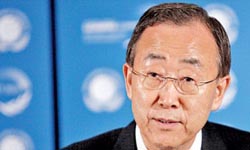 capital, Baghdad, which reportedly killed six people and injured several others.
According to media reports, the Hurriya camp, formerly known as Camp Liberty, was attacked this morning while most of the residents were sleeping. Iraqi police officers were among the wounded.
The camp serves as a transit facility for more than 3,000 exiles, most of them members of a group known as the People’s Mojahedeen of Iran, where a process to determine their refugee status is being carried out by the Office of the UN High Commissioner for Refugees (UNHCR).
Camp residents were previously situated at Camp Ashraf in eastern Iraq, but were relocated last year, in line with an agreement signed in December 2011 between the UN and the Iraqi Government.
“The Secretary-General calls on the Government of Iraq, which is responsible for the safety and security of residents of both Camp Liberty and Camp Ashraf, to promptly and fully investigate the incident and bring perpetrators to justice,” said Mr. Ban’s spokesperson in a statement. “He has repeatedly stated that violence and provocation are unacceptable.”
Mr. Ban also reiterated the UN’s strong commitment to continue its long-standing efforts to facilitate a peaceful and durable solution for residents of both camps.
The High Commissioner for Refugees, António Guterres, expressed his shock about the attack calling it “a despicable act of violence.”
“I call on the Iraqi Government to do everything it can to guarantee security to the residents,” he said. “The perpetrators must be found and brought to justice without delay.”
In a news release, the UN Assistance Mission for Iraq (UNAMI) said it is closely liaising with the Government on the response to the incident, including medical assistance to the wounded.
Mr. Ban’s Special Representative in the country, Martin Kobler, has also asked Iraqi authorities to promptly conduct an investigation into the mortar explosions.
Head of an Iraqi human rights group says Iraq seeks to try in absentia the members of the terrorist Mujahedin-e  Khalq organization (MKO, a.k.a. MEK and PMOI) in Iraq.
“The silence of the Iraqi government, international organizations, and the mass media regarding the martyrs and victims of Munafeqin (hypocrites, a term used in Iran and Iraq for the members of MKO) grouplet made us request the hearing in the absence of the Munafeqin,” head of the Association of Justice to Defend Iraqi Victims of MKO, Dr. Nafe al-Isa, told Habilian Association in an interview on Thursday.
He said the people of Tuz Khurmato, who are victims of the MKO and the trial is going to be held in their city, expressed happiness and satisfaction over the issue.
He added that the trial will be held as coordinated with the judicial system, and the witnesses will be heard in the first session.
Dr. Nafe al-Isa also called on Iranian media to cover the sessions, the first of which will be held on February 18, 2013.
We dont have security here!!!!!!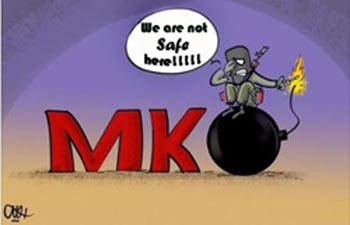
Five deaths reported after mortars and rockets hit new transit camp housing members of opposition MEK 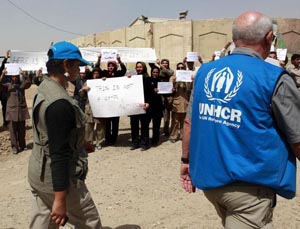 group.
Dozens of mortars and rockets fired on a camp housing Iranian dissidents near Baghdad have killed five members of the opposition group, Iraqi security officials say.
Five members of the Mujahedeen-e-Khalq (MEK) were killed in Saturday’s attack involving the mortars and rockets, two Iraqi security officials said on condition of anonymity.
Between 39 and 40 members of the group were wounded, along with three Iraqi policemen.
There was no immediate claim of responsibility for the attack on the transit camp, a former American military base known as Camp Liberty.
The United Nations called for an immediate investigation and said monitors were following up on the deaths, the first confirmed fatalities as a result of violence at the group’s new camp since they moved there last year.
The MEK, whose leadership is based in Paris, said in a statement that six people were killed and 50 wounded.
One Iraqi security official said around 40 rockets and mortars were fired into the camp, while the MEK said 35 were launched.
The UN said Martin Kobler, its special envoy, had asked Iraqi authorities to "promptly conduct an investigation into this," and added: "We have our monitors on the ground to follow up".
‘Hospitalised immediately’
Eliana Nabaa, spokeswoman for the UN mission in the country, said Iraqi officials had told the UN that "all those who were injured were hospitalised immediately".
Camp Liberty is home to about 3,000 residents from the MEK who were moved last year, on Iraq’s insistence, from their historic paramilitary camp of the 1980s – Camp Ashraf.
The MEK was founded in the 1960s to oppose the Shah of Iran, and after the 1979 Islamic revolution that overthrew him it took up arms against Iran’s rulers.
It says it has now laid down its arms and is working to overthrow the government in Tehran through peaceful means.
Britain struck the group off its terror list in June 2008, followed by the European Union in 2009 and the US in September 2012.
The US state department holds the group responsible, however, for the deaths of Iranians as well as US soldiers and civilians from the 1970s into 2001.
The MEK has no support in Iran, and no connection to domestic opposition groups.
Ban Ki-moon demands investigation by Iraqi authorities into deadly attack on dissident base that left at least six dead. 
Ban Ki-moon, the UN secretary-general, has condemned a deadly attack on an Iranian dissident camp in the Iraqi capital and demanded an investigation by authorities.
"(Ban) strongly condemns the mortar attack today on Camp Liberty, the temporary transit facility near Baghdad for former residents of Camp Ashraf," his press office said in a statement after the attack on Saturday.
The US state department labelled the assault a "vicious and senseless terrorist attack," and called on Iraq to probe the attack and enhance security at the camp.
According to the Associated Press, at least six people were killed and dozens of others were injured when missiles struck the area occupied by the Mujahadeen e-Khalq (MEK) group near Baghdad.
A spokesman for the European Union foreign policy chief Catherine Ashton, also joined in the condemnation of the attack.
"We express our condolences to the families of the victims. We are concerned that it could add tension to the present situation in the camp," the EU spokesman said.
A spokesman for the interior ministry, however, said only one person had been killed and that reports of more deaths were "exaggerated".
There was no immediate claim of responsibility for the attack on the transit camp, a former American military base known as Camp Liberty, adjacent to Baghdad’s international airport.
The camp was the base that now-executed dictator Saddam Hussein allowed the group MEK to establish in Diyala province in the 1980s, during Iraq’s eight-year war with Iran.
Martin Kobler, the top UN official in Iraq, told Al Jazeera that he was "shocked" by the attack.
"These people have to be protected," he said, calling on Iraqi authorities to "promptly conduct an investigation".
‘Terrorist group’
The camp is home to more than 1,000 residents from the MEK who were moved last year, on Iraq’s insistence, from their historic paramilitary camp of the 1980s – Camp Ashraf.
The MEK was founded in the 1960s to oppose the Shah of Iran, and after the 1979 Islamic revolution that overthrew him it took up arms against Iran’s rulers.
It says it has now laid down its arms and is working to overthrow the government in Tehran through peaceful means.
It is no longer welcome in Iraq under the Shia-led government that came to power after US-led forces invaded and toppled Saddam in 2003.
Al Jazeera’s Jane Arraf, reporting from Baghdad, said Iraq sees the MEK as a "terrorist group".
"They [MEK] say they’re in danger from the Iranians and the Iraqi government," she said.
The UN intends to process them for refugee status in other countries but no country has so far welcomed them.
Britain struck the group off its terror list in June 2008, followed by the European Union in 2009 and the US in September 2012.
The US state department holds the group responsible, however, for the deaths of Iranians as well as US soldiers and civilians from the 1970s into 2001.
The MEK has no support in Iran, and no connection to domestic opposition groups.
Following the campaign launched by the Mujahedin Khalq Organization (the MKO /MEK) on the alleged 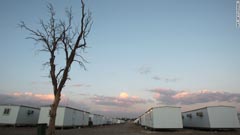 “inhumane condition” of Camp Liberty, the group leaders and supporters propagate “the necessity of returning residents to Ashraf”. Alejo Vida Quadras, the top MKO supporter in European Parliament suggested the new propaganda under the pretext of "lack of progress in relocation to third countries".
To our surprise, the group leaders do not call on their western supporters to aid facilitate their members’ relocation in European countries instead of returning to Camp Ashraf although a large number of Liberty residents have citizenship in various western countries. Earlier this month, speaking in their so-called international conference in Paris, Maryam Rajavi, the self-assigned president of the National Council of Resistance required the US government to relocate Liberty residents in Camp Ashraf. “Now the US must actively intervene as that the residents can return to Ashraf. Otherwise it would be responsible for what may henceforth happen in Liberty Prison” Rajavi addressed the conference. Fed by the large scale disinformation campaign of the MKO its supporters in Western states label Liberty as "Prison". They resort to the old pretext which has been flooding of storm and sewage at the camp. However, UN Mission in charge of the Camp believes that it complies with normal humanitarian standards as well as necessary infrastructure for residence of the group members. (View our previous post on Camp Liberty: Camp Liberty resembles a prison?)
On January21, 2013, in a debate in UK parliament House of Lords, a few number of Lords expressed their concerns over the situation of Liberty residents. Baroness Warsi, a conservative member of UK House of Lords convinced her coulleagues that heavy rainfall that flooded parts of Camp Liberty as well as many parts of Baghdad "did not affect residents’ accommodation blocks".
To respond her misinformed colleagues about the claims of ex-UNAMI chief Taher Boumedra and the alleged inefficiency of Martin Kobler over Camp Liberty issues, she noted:”Our own officials visited in July last year and the international community does not, at this stage, find any credible evidence to support the matters that have been raised by Mr. Tahar Boumedra.” Boumedra’s claims are still used as evidence by the MKO propaganda.
Lord Avebury who is one of the most loyal supporters of the MKO in UK parliament he pointed to allegations of “ill-treatment such as denial of access to urgently needed medical treatment”. In response Baroness Warsi mentioned that the situation of Liberty residents is “in many ways much better than that of residents in Baghdad.” She referred to the 24-hour electricity available in the Camp while Iraqi nationals enjoy power only three hours a day in some areas of Baghdad. She also noticed that enough water and medical facilities are available in the camp.
Baroness Warsi warned her peers in UK parliament that they “must be incredibly careful” about the MKO regarding its history and record.
The new tactic, the MKO has used to maintain the hegemony over its cult-like group seems to be an alternative to the previous agenda which was running petitions and lobbying efforts to make the UN grant the status of a refugee camp to camp Liberty. The failed tactic led the group to run the new one: return to Ashraf where they claim to own its properties.
In their most recent misinformation event in Paris, the “speakers condemned forcible eviction of Ashraf residents and their transfer to Liberty prison…”, according to NCRI website . They called for “the return of Ashraf residents to the modern town they built in 26 years.” Lord Dholakia’s asked about refugee status of Liberty while he confessed that he WAS misinformed by the MKO saying,”the information the Minister has is not the information that we receive from residents of those camps". Ordinary residents of liberty have no access to the outside world let alone contacting a UK Parliamentarian.
During the debate the conservative Baroness assured her colleagues that Liberty” is not a refugee camp as such: it is a place where individuals are being assessed as to the countries to which they could be relocated.”(View the debate here)
According to reports, almost all former members of the MKO who fled the group camps in Iraq could manage to resettle whether in Iran or in European countries. It sounds that leaving Iraq is not so difficult that the Rajavis could not relocate their members yet. Probably it’s not the matter of ability it’s the matter of will.
By Mazda Parsi
Iraq: Camp Liberty — Question
Lord Maginnis of Drumglass (Non-affiliated)
To ask Her Majesty’s Government what recent information they have concerning flooding by sewage and storm water at Camp Liberty, and whether they have made representations to the United Nations and the United  Nations Assistance Mission for Iraq about conditions at the camp.
Baroness Warsi (Conservative)
My Lords, we are aware that parts of Camp Liberty were flooded during a recent period of heavy rainfall, as were many parts of the Baghdad area. Fortunately, this did not affect residents’ accommodation blocks. We continue to monitor the situation at Camp Ashraf and Camp Liberty through the embassy in Baghdad and to raise issues with the Government of Iraq and the United Nations.
Lord Maginnis of Drumglass (Non-affiliated)
My Lords, is it not time that the Government made a judgment, based on first-hand evidence such as that produced by the ex-UNAMI chief Tahar Boumedra, and ignored the manipulation and dissembling by Martin Kobler on behalf of the Secretary-General of the United Nations? If the United Kingdom is to maintain its integrity and influence in the Middle East, we should be pressing for the dismissal of Herr Kobler and, indeed, be asking ourselves, with our allies, whether the present Secretary-General of the United Nations has not outlived his usefulness.
Baroness Warsi (Conservative)
Before I answer the noble Lord’s very important question, I am sure the rest of the House will want to join me in wishing him a very happy birthday.
The noble Lord raises an important point. The Secretary-General, whom I met with last week at the United Nations, is doing a very important job, with the support of the international community, in some very difficult circumstances. The specific situation in relation to Camp Liberty is that the Special Representative of the Secretary-General for Iraq, as part of the United Nations Assistance Mission, regularly reports about the situation in Camp Liberty and Camp Ashraf. Our own officials visited in July last year and the international community does not, at this stage, find any credible evidence to support the matters that have been raised by Mr Tahar Boumedra.
Lord Avebury (Liberal Democrat)
My Lords, considering that many of the complaints that are made by the residents of Camp Liberty and, indeed, Camp Ashraf, against the Iraqi authorities and UNAMI could be easily verified or refuted and that some have been confirmed not only by Mr Tahar Boumedra but by the UN Working Group on Arbitrary Detention, will the Government press for an inspector to be appointed by the UN Secretary-General to look into the serious allegations of ill treatment, such as denial of access to urgently needed medical treatment, which has lead to the deaths of two inmates of Camp Liberty? Since we have been aware for some time that 52 residents of Camp Liberty were formerly refugees in the United Kingdom, will my noble friend press for their immediate transfer to the UK?
Baroness Warsi (Conservative)
As my noble friend is aware, the situation in Camp Ashraf and Camp Liberty is in many ways much better than that of residents in Baghdad. For example, electricity is available for 24 hours a day, as opposed to the three hours for which it is available in some parts of Baghdad. About 200 litres of water are available to residents there, when about 90 litres are available in some parts of Baghdad. My noble friend raises the very important issue of the recent death of a resident there. We share those concerns about the death of Behrooz Rahimian and have made inquiries specifically in relation to the medical assistance that he received. We are aware that there is a doctor and medical facilities on site 24 hours a day; there is also the opportunity to receive medical assistance from doctors in Baghdad. We understand that Mr Rahimian was afforded medical assistance in relation to his illness.
Lord Foulkes of Cumnock (Labour)
My Lords, will the Minister confirm that the new Parliament in Baghdad will be built to a British design, that UK parliamentarians, including the noble Lord, Lord Kirkwood of Kirkhope, are out there helping to develop democracy and that the development of a democratic Government in Iraq to deal with the kind of issues raised by the noble Lord, Lord Maginnis, is the number one priority and will be supported fully by the British Government?
Baroness Warsi (Conservative)
I agree with much of what the noble Lord said. He will also be aware that this situation goes back many years. The group that lives in Camp Ashraf and Camp Liberty is an organisation that originally left Iran after the Iranian revolution. Mujaheddin e Khalq, the group that is predominantly part of Camp Ashraf and Camp Liberty, has its own history and record, and we must be incredibly careful about which members of that group we readmit to the United Kingdom.
Lord Dholakia (Liberal Democrat)
My Lords, does my noble friend agree that one of the problems we have is that the United Nations has not granted Camp Liberty the status of a refugee camp? It that were granted, would it not be possible to have adequate medical facilities and for water, sewerage et cetera to be resolved? At the same time, the status of Camp Ashraf could be looked at because the property of individuals is systematically being looted there, and the information the Minister has is not the information that we receive from residents of those camps.
Baroness Warsi (Conservative)
I can assure my noble friend that about 3,000 residents of Camp Ashraf have moved to Camp Liberty. It is not a refugee camp as such; it is a place where individuals are being assessed as to the countries to which they could be relocated. Four have already come to the United Kingdom, a fifth who was offered that has decided not to come and about 52 others are being considered for coming to the United Kingdom. In relation to property at Camp Ashraf, I can assure my noble friend that about 100 residents of this group remain in Camp Ashraf specifically to sell off their property.
Dear Mr. Per Westerberg, President of the Swedish Parliament
Members of the Swedish Parliament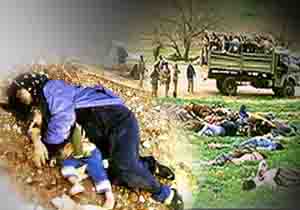
Ladies and gentlemen, we are a few long serving ex-members of the Mojahedin Khalq Organisation (aka; MKO, MEK, NCRI) who have been in Mojahedin Khalq prisons because of our disagreements with the ideology and the policies of the organisation. We have all been humiliated and undergone physical and psychological tortures while inside and even after being let out of the MEK prisons. We only managed to free ourselves from the claws of the Mojahedin Khalq after the fall of the infamous dictator regime of Saddam Hussein in Iraq.
Dear Ladies and Gentlemen,
In 1991 we witnessed the biggest co-operation between the leaders of the Mojahedin Khalq, Massoud and Maryam Rajavi, with the brutal regime of Saddam Hussein.
In a time that the Kurdish people had the chance of taking advantage of the weakness of the suppressive apparatus of Saddam. In that year when the military machine of Saddam Hussein had been severely weakened by the American forces in the first Persian Gulf war. The Kurdish forces had the best opportunity to move towards Baghdad and topple the regime of Saddam.
In March 1991 Massoud and Maryam Rajavi gave the order to massacre the Kurds with the heavy weapons given to them by Saddam and therefore stopped the Kurds from reaching Baghdad. This massacre of the Kurds is the most disgusting and shameful part of the history of this terrorist organisation during its entire existence.
The Swedish Parliament has accepted in the last few weeks to officially recognise the reality of the suffering of the Kurdish people of Iraq carried out by the Mojahedin Khalq Organisation in 1991. We believe that this just and humanitarian gesture should not be left unnoticed. We believe that other European countries should now pass similar resolutions and show their solidarity and respect for the people of Kurdistan.
Dear Ladies and Gentlemen,
We are a few long serving ex-members of Mojahedin Khalq Organisation who have managed to survive after the fall of Saddam Hussein and now live in European countries. We are living witnesses of the crimes the Mojahedin Khalq have committed in 1991. We urge you to allow us to present ourselves to your parliament and let you know what we have seen with our own eyes. In doing so we are sure that many other aspects of this horrifying crime would be revealed.
Faryade Azadi Association
Community of Independent Bloggers
CC:
The office of the Swedish P.M.
The Swedish Embassy in France
The Iraqi Embassy in France
The comments made by Iran’s Leader Ayatollah Seyyed Ali Khamenei are crystal-clear: No bilateral talks with the United States as long as Washington’s words do not match its deeds. Ayatollah Khamenei made the comments just days after US Vice President Joe Biden said Washington was prepared to hold direct talks with Iran.
Some Iranians also say there’s still a standing offer for talks under the right conditions. But for the talks to succeed, they say Washington has to ditch its anti-Iran policy and lift its unilateral sanctions against Iran.
Relations between Iran and the United States were severed in 1979 after the victory of Islamic Revolution and the overthrow of Iran’s pro-Western regime. Other factors behind the stalemate include Washington’s backing of the former Iraqi regime in its 8-year war against Iran in the 1980s, support for anti-Iran terrorist groups such as the Mojahedin Khalq Organization, assassination of Iranian officials and nuclear scientists, imposition of economic sanctions and financial restrictions, as well as funding anti-government political currents within the country.
Ghanbar Naderi,
An Iraqi official says the terrorist Mujahedin-e Khalq Organization (MKO) had turned its Camp Ashraf into a base for training al-Qaeda operatives who carried out terrorist attacks against the Iraqi nation.
Head of the Security Committee of Diyala Province Meysam al-Tamimi noted that the MKO had transformed Camp Ashraf, situated about 120 kilometers (74 miles) west of the border with Iran, into a training camp for al-Qaeda members when they were in charge.
He said a large amount of money and weapons was also funneled through Camp Ashraf to al-Qaeda and Salafist extremist groups to help them target Iraqis in acts of terror.
The MKO fled to Iraq in 1986, where it enjoyed the support of Iraq’s executed dictator Saddam Hussein, and set up its camp near the Iranian border.
The group is also known to have cooperated with Saddam Hussein in suppressing the 1991 uprisings in southern Iraq and carrying out the massacre of Iraqi Kurds.
The MKO has carried out numerous acts of violence against Iranian civilians and government officials.