Nejat Society
  • Home
  • Articles
  • Media
    • Cartoons
    • NewsPics
    • Photo Gallery
    • Videos
  • Publications
    • Books
    • Nejat NewsLetter
    • Pars Brief
  • About Us
  • Contact us
  • Editions
    • عربي
    • فارسی
    • Shqip
Nejat Society
Nejat Society
  • Home
  • Articles
  • Media
    • Cartoons
    • NewsPics
    • Photo Gallery
    • Videos
  • Publications
    • Books
    • Nejat NewsLetter
    • Pars Brief
  • About Us
  • Contact us
  • Editions
    • عربي
    • فارسی
    • Shqip
© 2003 - 2024 NEJAT Society. nejatngo.org
Iraq

Diala police commander: Iraqi forces control Camp Ashraf without any violence

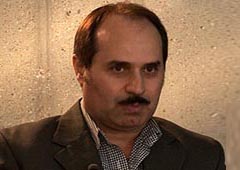
DIALA / Aswat al-Iraq: Iraqi police forces are entirely in control of camp Ashraf where the People’s Mojahedin Organization of Iran (PMOI) lives, the Diala province’s police commander said on Thursday. Iraqi police forces are entirely in control of camp Ashraf

The PMOI’s spokesperson did not confirm this announcement, and claimed that Iraqi army forces are preparing to attack the Camp, but an authorized source from the army denied this claim.

“Police forces, in coordination with Iraqi army forces, are in total control of Camp Ashraf without any violence,” General Abdilhussein al-Shemmary, the Diala police commander, told Aswat al-Iraq news agency.

But Mahdee Aqbaee, the PMOI’s spokesperson, told the agency that “Iraq army forces are preparing to carry out a new attack on Camp Ashraf.”

For his part, an authorized source from the Iraqi army denied this issue.
“Iraqi army and police forces are in control of Camp Ashraf, without any security troubles,” the source said.

Yesterday, Iraqi forces engaged with PMOI’s elements when the Organization’s operatives prevented the troops from entering Camp Ashraf territory.

The PMOI, also known by the abbreviations MKO and MEK, is a militant socialist organization that advocates the overthrow of Iran’s current government. Founded in 1965, the PMOI was originally devoted to armed struggle against the Shah of Iran, capitalism and Western imperialism.

The group is said  renounced violence in 2001 and today it is the main organization in the National Council of Resistance of Iran (NCRI), an “umbrella coalition” parliament-in-exile that claims to be dedicated to a democratic, secular and coalition government in Iran.

The PMOI has had thousands of its members for many years in bases in Iraq, but they were disarmed in the wake of the 2003 U.S.-led invasion and are said to have adhered to a ceasefire. Its armed wing is, or was, called the National Liberation Army of Iran (NLA).

The former Iraqi President Saddam Hussein dedicated Camp Ashraf in Diala province, northeast of Baghdad, to host the PMOI members since the 1980s.

Although being designated as a “terrorist” group, the organization has been under U.S. protection.

After the security agreement between Iraq and the United States government was signed, the Iraqi government took the responsibility of providing security to Camp Ashraf residents.

August 1, 2009 0 comments
FacebookTwitterPinterestWhatsappTelegramSkypeEmail
Iraq

LA Times : Iraq says raid on militant group’s camp wasn’t Iran’s idea

Seven members of the Iranian opposition faction Mujahedin Khalq were reportedly killed by Iraqi security in Iraq’s Diyala province, but government officials said outside pressure was not a factor.
Reporting from Baghdad — The Iraqi government refuted suggestions today that Iranian pressure had prompted a raid on a camp belonging to an Iranian opposition group, saying that Iraqi security forces are merely seeking to extend sovereignty over all Iraqi territory.

The Mujahedin Khalq (MEK), a militant group that has long opposed the Iranian government, claimed that seven of its members died in clashes with Iraqi security forces after Iraqi police attempted to enter its camp in Diyala province Tuesday to open a police station.

"The Iraqi government is determined to establish its sovereignty over all positions and facilities that were under the control of foreign forces," government spokesman Ali Dabbagh told reporters. "The government wants to open an Iraqi police station inside the camp to impose the rule of law and establish the rule of the state."

Dabbagh said Iranian citizens in the camp would not be forced to return to Iran, where they fear they would be punished..

Camp Ashraf, as the facility is known, illustrates the complex relationship that has emerged between Iraq and its two biggest allies, the U.S. and Iran. The camp dates back to the 1980s, when Saddam Hussein invited the MEK to establish a presence in Iraq during the Iran-Iraq war.

The U.S. military inherited control of Camp Ashraf after the 2003 American-led invasion in which Hussein was ousted, and U.S. forces disarmed the group. Though the U.S. brands MEK as a terrorist organization, it has also protected the perimeter of the camp and has argued against the forcible deportation of its 3,500 residents to Iran.
With the implementation of last December’s security agreement between the U.S. and Iraq, Iraqi forces assumed control of the camp’s perimeter and they have for months been threatening to take control of the camp itself. Iraq, meanwhile, has come under intense pressure from neighboring Iran to close the camp, from which residents are accused of carrying out acts of terrorism in Iran.

MEK says it has not carried out any acts of violence since 2002.

Iran’s parliament speaker Ali Larijani praised the raid. "This action by Iraq came late, but it is laudable that they decided to clear the country of terrorists," he was quoted as saying by the Fars news agency.

MEK quoted the group’s leader, Maryam Rajavi, who lives in Paris, as saying that "the attack was carried out at the behest of the Iranian regime." But Iraqi officials insisted Iranian pressure had played no role.
"This is an Iraqi operation on Iraqi land. . . . Our forces have the right to enter any place inside our country," said Defense Ministry spokesman Mohammed Askari.

The pledge to assert the right of Iraqi forces to extend their authority over all of Iraq has potentially profound implications for another simmering dispute, over territories claimed by the semiautonomous region of Kurdistan and currently controlled by Kurdish peshmerga forces.

The peshmerga have prevented Iraqi security forces from entering their territory on at least three occasions since May, and U.S. commanders have identified the dispute as the biggest single threat to Iraq’s stability.

On Wednesday, Defense Secretary Robert Gates visited Kurdistan to meet with Kurdish leader Massoud Barzani, who has just won reelection to the presidency of the northern region. Gates urged him to work with Baghdad to find a solution to the disputes before American troops finish withdrawing from Iraq, and said the U.S. was willing to help mediate a solution.

Gates told reporters that the exit of U.S. troops from Iraq’s cities has gone better than expected, and said it may be possible to speed up the withdrawal of some U.S. forces. Combat troops are due to go home by August 2010, and all U.S. forces are scheduled to be withdrawn by the end of 2011.
"I think there’s at least some chance of a modest acceleration," the Associated Press quoted him as saying aboard his plane on the journey back to Washington.Those brought home early could be a combat brigade of 5,000 troops, Gates said.
LA Times – July 29, 2009

July 30, 2009 0 comments
FacebookTwitterPinterestWhatsappTelegramSkypeEmail
Iraq

Who are the MKO and why did Iraqi forces storm their camp?

Iraq flexes its muscles at Camp Ashraf and shows military independence from America, as the Iranian exile group’s long strange trip draws to a close.

Iraqi security forces today violently wrested control of the sprawling compound of an exiled Iranian opposition movement, killing at least seven of its residents in the process.

The raid was the latest assertion of total military independence by Iraqi forces from US control. Video of the event, with Iraqi soldiers delivering severe beatings to unarmed residents, adds evidence of brutal tactics within the new Iraqi Army.

But it also may be the beginning of the end of the one the strangest sideshows of the entire Iraq war as the government of Prime Minister Nouri al-Maliki flexes its muscles and seeks closer ties with Tehran.

The raid came as Defense Secretary Robert Gates, who had long urged Iraq against a violent takeover of the camp, visited the country on Wednesday. Though the Iraqi government had repeatedly asked the Iranian exile group, the Mujahidin e Khalq (MKO, or People’s Mujahedin), to leave the country, US officials said the raid came as a surprise and the BBC quoted US Gen. Ray Odierno as saying the government had promised to deal with the MKO in a “humane fashion.” (The BBC article also has video of the beginning of the raid.)

Camp Ashraf, the object of the raid, has been the principal home of the MKO since the Iranian group allied itself with Saddam Hussein in the 1980s, receiving weapons and training from his regime. Hussein used them as shock-troops against Iraqi Kurds and Shiites who rose up against his regime in the 1990s.

The camp is currently home to about 3,500 Iranian exiles and a smattering of fellow travelers from the US and Europe who subscribe to the group’s secular blend of Islam, Marxism, and feminism and a “cult of personality” centered on the group’s leader, Maryam Rajavi, according to a 2007 State Department report.

On her website, Mrs. Rajavi called Wednesday’s clash at Camp Ashraf “a war crime, a crime against humanity, and a futile attempt by [Iran’s Supreme Leader Ali] Khamenei to compensate for his defeat in the face of the nationwide uprising.” She called for an international delegation to investigate.

They’ve abided in the camp for the past six years, largely under US protection. When the US invaded Iraq in 2003 it disarmed thousands of MKO fighters, but was left with a quandary. The group’s members are despised by mainstream Iraqi society as tools of Hussein’s repression and they were designated a terrorist organization by the US State Department for their murders of civilians. (American citizens have been among their victims.)

But they were also enemies of another American enemy, Iran, and some US politicians thought they could be a useful asset against the Iranian regime. When Iraq’s first post-Saddam government, appointed by the US, tried to kick the MKO out of the country, the US stepped in. The US even turned down Iranian overtures to trade Al Qaeda operatives in Iranian custody for MKO members in American hands.

The US administration eventually gave them protected status – something they enjoyed until the US handed the control of the camp over to Iraq in January.

Since then, Iraqi officials have redoubled their efforts to get rid of the group. MKO members inside Camp Ashraf have rejected Iraqi efforts to encourage them to return to Iran or find third countries to take them on. Iranian officials have promised amnesty to any members who voluntarily return and about 250 have taken them up on the offer so far. But the group has continued to behave semi-autonomously. On Tuesday, after Iraqi police sought to set up a post inside the camp, they were attacked by MKO members and two died, according to Agence France Press – setting up today’s confrontation.

Maliki’s Shiite-led government is seeking stronger relations with Iran, and many of its members remember how the MKO helped Hussein violently control their own community. When Maliki himself was an exile from Hussein’s regime and on the run from a death sentence at home, his Islamist political party received assistance from Iran.

Iraq’s national security advisor Muwaffaq al-Rubaie has been warning for months that Iraqi patience with the group was wearing thin. He described them as “brainwashed cult members from a high-trained terrorist organization” in an April interview and added that “if they resist and carry out this engineered crisis there will be some pain.”

The groups members are noted for their fervor and devotion, something which probably contributed to today’s clashes, which also left dozens of Iraqi forces injured. Shortly after Ms. Rajavi was arrested by French police in 2003 on suspicions she was using MKO offices to plan terrorist attacks on Iranian diplomatic missions in Europe, a number of her followers in Paris set themselves on fire and some died from their burns.

A 2005 report by Human Rights Watch reported the use of torture and detention of MKO members who expressed criticism or wished to the leave the group at Camp Ashraf. It also details the demands made of members over the years based on the demands of Rajavi, who views herself as Iran’s president in waiting, and her husband Massoud Rajavi.

For instance, in the late 1980s after a series of military failures, Mr. Rajavi declared that they were failing to overthrow the Iranian regime because of insufficient commitment to the cause, and said that people’s attachment to their spouses were a distraction. He ordered all members of the organization immediately divorced, and personally collected their wedding rings. The Rajavis themselves remained married, however. Massoud has not been seen since the US invasion of Iraq and its not clear if he’s dead or in hiding.

The reclusive Maryam Rajavi is based in Paris.
By Dan Murphy

July 30, 2009 0 comments
FacebookTwitterPinterestWhatsappTelegramSkypeEmail
USA

Iraqi Police Storm Ashraf – US ‘closely monitoring’ situation at Camp Ashraf

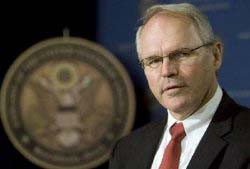
The US is “closely monitoring’ the aftermath of the Iraqi raid on a base of the anti-Iranian terrorist group the Mujahedin-e-Khalq Organization, an official says. US State Department spokesman Ian Kelly

"We’ve seen these media reports and we’re looking into them," AFP quoted US State Department spokesman Ian Kelly as saying.

"We continue to monitor the situation closely to ensure the residents of Camp Ashraf are treated in accordance with Iraq’s written assurances that it will treat the residents there humanely," Kelly told reporters at his daily press briefing in Washington on Tuesday.

"This is in accordance with the constitution, laws, and international obligations of Iraq," he said.

"The government has stated to us that no Camp Ashraf resident will be forcibly transferred to a country where they have reason to fear persecution on the basis of… their political beliefs or political opinions or religious beliefs, or where there are substantial grounds for believing they would be tortured," Kelly said.

Iraqi security forces stormed the camp located north of Baghdad on Tuesday.

July 30, 2009 0 comments
FacebookTwitterPinterestWhatsappTelegramSkypeEmail
Iraq

Iraqi Police Storm Ashraf – US ‘Not Happy’ as Iraq Announces Plans to Close MEK Camp

US officials are reportedly “not happy” with the situation unfolding in the MEK’s Camp Ashraf, following yesterday’s deadly raids by Iraqi forces. Today, the Iraqi government says that it plans to close the camp down entirely.

It remains unclear what the closure will mean to the thousands of Iranian exiles which reside in the camp, and which enjoy the status of “protected persons” under the Geneva Convention. The camp was turned over to the Iraqi government’s control in January, and yesterday’s raid killed at least eight and injured over 400 according to the governor of the Diyala Province.

The raid on the camp and the detention of several members of the anti-Iranian militant group has been welcomed by Iranian officials. Parliament Speaker Ali Larijani said the move “came late” but was still a welcome chance to clear Iraqi territory of terrorists.

Though the MEK is recognized as a terrorist organization by the US State Department, it has a complex relationship with the US. The Saddam-backed group has supplied the US with considerable information regarding Iran, though there is doubt over whether the information is accurate or simply an attempt to foment a US invasion and regime change.

Secretary of State Hillary Clinton has urged both sides to “exercise restraint” in the wake of the clashes, and House Foreign Affairs Committee members released a statement accusing the Iraqi government of not living up to its commitments. Other US officials concede that since they turned the camp over to Iraqi control there is very little they can do about the clashes.

by Jason Ditz

July 30, 2009 0 comments
FacebookTwitterPinterestWhatsappTelegramSkypeEmail
Iraq

Iraq: No MKO member killed in camp attack

The Iraqi government has denied that any members of an anti-Iranian terrorist group were killed during a Tuesday raid on its base in northern Baghdad.

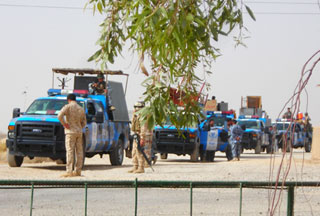
Iraqi police vehicles block one of the entrances leading to Camp Ashraf in northern Baghdad.

Earlier reports said between four to eight residents had been killed when Iraqi security forces stormed Camp Ashraf – the base of the Mujahedin-e-Khalq Organization (MKO).

“This morning’s report is that there was not a single death among the MKO,”government spokesman Ali al-Dabbagh said.”The police have an order not to use any live rounds.”

AFP quoted a police officer as saying that clashes resumed on Wednesday between Iraqi police and the residents of the camp, which lies in Diyala Province northeast of Baghdad.

An Iraqi police official said on Tuesday that about 50 of the camp’s residents had been detained.

Seyyed Mohsen Hakim, a member of the Islamic Supreme Council of Iraq, was quoted by ISNA as saying many of the camp’s 3,500 residents have called for their return to Iran, adding that Tehran and Baghdad are discussing the issue.

Militants had fiercely resisted Iraqi forces who called in security personnel to quell the violence that led to the deaths of two Iraqi soldiers and injured 110 members of the Iraqi security forces.

Some 400 militants were also wounded in the Tuesday operation, which came after months of tense standoff around the base.

Iranian Parliament Speaker Ali Larijani welcomed the ‘cleansing of the Iraqi territory from terrorists’ and described the move as ‘praiseworthy, albeit late’.

Iraq’s Defense Ministry said the offensive was justified under the long-term security agreement signed by Baghdad and Washington in November, under which Iraq assumed responsibility for the camp three months ago.

“It’s our territory and it’s our right to enter, to impose Iraqi law on everybody. They (camp residents) have to submit to the law, and to Iraqi sovereignty,”said Defense Ministry spokesman General Mohammed Askari.

The Mujahedeen-e Khalq Organization was founded in Iran in the 1960s, but its top leadership and members fled the country in the 1980s after assassinating a number of prominent political and religious figures and carrying out bombings that claimed scores of lives.

Along with Iran, the United States, Canada and Iraq have designated the MKO as a terrorist organization.

July 30, 2009 0 comments
FacebookTwitterPinterestWhatsappTelegramSkypeEmail
Iraq

Iraqi Police Storm Ashraf – Iraqi troops seize Iranian exiles’ camp

Iraqi soldiers and riot police stormed a camp housing Iran’s main exiled opposition yesterday, triggering violent clashes that left at least 260 people wounded.

Members of the Mujahedin-e Khalq clash with Iraqi police inside Camp Ashraf yesterday. The disturbance at the base north of Baghdad left at least 260 people wounded

The seizure of Camp Ashraf, which was disarmed by the United States in 2003 and surrounded by U. S. forces until recently, comes after months of a tense standoff at the base north of Baghdad.

"After the failure of negotiations with the Mujahedin to enter peacefully, the Iraqi army entered Camp Ashraf with force and it now controls all of the interior and all entrances to the camp," an Iraqi military source said.

The spokesman said two battalions of 400 soldiers each, plus 200 riot police, took part in the operation, which was ordered by Prime Minister Nouri al-Maliki’s office.

The offensive followed a declaration by the Mujahedin-e Khalq (MEK) — also known as the People’s Mujahedin of Iran — that it was ready to return to Iran if the authorities there would guarantee its members would not be abused.

The MEK said in a statement that Iraqi police had launched an attack on Ashraf by firing "pepper gas," with vehicles demolishing walls while police on foot forced their way into the camp.

It also coincided with a visit to Iraq by U. S. Defense Secretary Robert Gates, but the top U. S. commander in Iraq, General Ray Odierno, said the U. S. military had no advance warning.

Police captain Firaz al-Atbi, from the restive province of Diyala where Ashraf is located, said about 200 residents were injured when riot police called in by the army to quell unrest began beating them.

About 60 members of Iraq’s security forces were also wounded, 20 seriously, he said, adding that 50 camp residents were detained.

Shahriar Kia, a spokesman for the MEK, said four people had been shot dead and about 300 others were injured. Capt. Atbi, however, denied the four deaths.

"We are so worried that they might take the people arrested to the Iranian regime and hand them over," Mr. Kia said by telephone from Camp Ashraf.

A provincial police official said residents were throwing bricks at Iraqi security forces.

The official said Diyala provincial police chief General Abdul Hussein al-Shamari had entered the camp to try to negotiate with the MEK to end the violence. A company of U. S. soldiers had overseen the camp until handing over control three months ago to Iraqi security forces as part of the drawdown of U. S. troops, Gen. Odierno said.

The Iraqi authorities had pledged to the Americans previously that they "would deal with the MEK in a humane fashion," he said, adding that there were U. S. observers on the scene.

U. S. State Department spokesman Ian Kelly said Washington was "closely monitoring" the seizure, and added that the Iraqi government had "stated to us that no Camp Ashraf resident will be forcibly transferred to a country where they have reason to fear persecution."

Ashraf is home to about 3,500 MEK supporters and their families.Four shot dead, opposition spokesman says

Ali Al-Tuwaijri, Agence France-Presse

July 30, 2009 0 comments
FacebookTwitterPinterestWhatsappTelegramSkypeEmail
Iraq

Iraqi Police Storm Ashraf – Fighting Continues at Camp for Iran Exiles

BAGHDAD, July 29 — Violent clashes continued for a second day Wednesday between Iraqi troops and members of an Iranian opposition group whose camp the Iraqis stormed Tuesday, presenting the first major dilemma for the U.S. government since Iraq proclaimed its sovereignty a month ago. Iraqi Police Storm Ashraf_Fighting Continues at Camp for Iran Exiles

At least eight Iranians have been killed and 400 wounded since Tuesday, when hundreds of Iraqi police and soldiers in riot gear plowed into Camp Ashraf, northeast of Baghdad, using Humvees donated by the U.S. military, according to group leaders and Abdul Nasir al-Mahdawi, the governor of Diyala province…

The raid, ordered by Prime Minister Nouri al-Maliki, coincided with an unannounced visit by Defense Secretary Robert M. Gates, who left Iraq on Wednesday.

In Washington, Secretary of State Hillary Rodham Clinton described the raid as a legitimate act by a sovereign nation. "Although the U.S. government remains engaged and concerned about this issue, it is a matter for the government of Iraq to resolve in accordance with its laws," she said.

Clinton said Iraq had given assurances that camp residents would be treated humanely and would not be relocated anywhere they would have a well-founded fear of persecution. She urged the Iraqis to "show restraint."

U.S. officials are deeply concerned about the reports of violence and have been monitoring the situation using camera-equipped unmanned aircraft, said an official who spoke on the condition of anonymity. "We’re asking the Iraqis questions," the official said. "Sometimes they answer, sometimes they don’t."

A contingent of U.S. soldiers based outside Ashraf have been watching but have declined to intervene, residents said.

The raid and its aftermath represent a conundrum for U.S. officials. Some say they feel obligated to the MEK because its members have provided information about Iran’s nuclear program and because American officials vowed to protect them after the 2003 invasion of Iraq. But condemning this week’s events could be seen as an affront to Maliki’s government just as U.S. officials are talking up Iraq’s sovereignty, proclaimed June 30 when American troops withdrew from cities.
The stated goal of the Ashraf operation was to set up an Iraqi police station inside the camp, a move Iraq has described as the first step toward evicting the more than 3,000 residents.

Iraqi government spokesman Ali al-Dabbagh defended the raid Wednesday, telling the Associated Press that the government "intends to assert its sovereignty on all sites and facilities that were controlled by foreign troops, and Camp Ashraf is no exception."
"The Iraqi government doesn’t intend to clash with members of this camp," he said, "but it will defend the law decisively."

Tehran officials have long pressured the Baghdad government to expel the MEK, which seeks to overthrow Iran’s Islamic regime. But Iraq has held off from raiding the camp because of U.S. opposition to a violent takeover.
An Iraqi police commander who participated in the raid said the Iranians’ fierce resistance had startled the Iraqi security forces. When the Iraqis gathered outside the gate, throngs of MEK members, led by women, formed a human shield, said the official, who spoke on the condition of anonymity. "They put the women in front to prevent us from entering. They hit us with rocks and knives."

The official said 45 troops were injured. Residents at the camp said they did not provoke the forces.
After nearly four hours, the official said, the Iraqis set up a police station and checkpoints inside the camp and raised an Iraqi flag.

The State Department classifies the MEK as a terrorist organization, but Washington has interacted with the group since it agreed to disarm in 2003 in return for U.S. military protection. The Baghdad government assumed nominal control of the perimeter of the camp Jan. 1, when a U.S.-Iraqi security agreement took effect.
Special corresponden Aziz Alwan contributed to this report.
By Ernesto Londoño

July 30, 2009 0 comments
FacebookTwitterPinterestWhatsappTelegramSkypeEmail
Iraq

Iraqi Police Storm Ashraf – Iraqi forces have taken complete control of the camp Ashraf

Iraqi security forces have stormed the base of the terrorist Monafeqin grouplet named as the Mujahedin-e-Khalq Organization (MKO).

An Iraqi military official has said that Iraqi forces have taken complete control of the camp.

Four people were killed and 300 wounded when Iraqi soldiers and police stormed Camp Ashraf on Tuesday.

The base is located in Diyala province, north of Baghdad, and is home to around 3,500 MKO members and their families.

"After the failure of negotiations with the Mujahedeen (Khalq) to enter peacefully, the Iraqi army entered Camp Ashraf with force and it now controls the camp and all entrances to it," an Iraqi military source said.

An Iraqi police official has announced that about 50 camp residents have been detained.

The MKO was founded in Iran in the 1960s, but its top leadership and members fled the country in the 1980s after carrying out a series of assassinations and bombings inside the country.

The group is especially notorious in Iran because they allied with former Iraqi dictator Saddam Hussein during the 1980-1988 Iran-Iraq war.

America, Canada, Iraq, and Iran have all designated the MKO as a terrorist organization.

The European Union had also designated the MKO as a terrorist organization but inexplicably removed it from the EU terror list in January 2009.

US military officials in Iraq say they were not informed about the plan until after it was carried out.

July 30, 2009 0 comments
FacebookTwitterPinterestWhatsappTelegramSkypeEmail
Iraq

Iraqi Police Storm Ashraf – Iraqi forces storm MKO camp

TEHRAN/BAGHDAD – On Tuesday, Iraqi soldiers and riot police stormed Camp Ashraf, where Mojahedin Khalq Organization members had been based, triggering violent clashes that left atIraqi officials say clashes broke out as they were trying to establish a police post in the camp. least 260 people injured.

Iraqi officials say clashes broke out as they were trying to establish a police post in the camp.

“After the failure of negotiations with the Mojahedin (Khalq) to enter peacefully, the Iraqi army entered Camp Ashraf with force and it now controls the interior and all entrances to the camp,” an Iraqi military source said.

An Iraqi army spokesman in Diyala said two battalions of 400 soldiers each plus 200 riot police took part in Tuesday’s operation, which was ordered by Prime Minister Nuri al-Maliki’s office.

“It is our territory and our right to enter, to impose Iraqi law on everybody,” a defense ministry spokesman told al-Arabiya television.

Camp Ashraf, 40 miles north of Baghdad in Diyala province, houses 3,418 residents. It was set up in the 1980s, when Iraq was at war with Iran, as a base to operate against the Iranian government.

The camp was disarmed by U.S. soldiers following the U.S.-led invasion of Iraq in 2003. U.S. soldiers had overseen the camp until handing over control three months ago to Iraqi security forces.

The Iraqi government has vowed to close Camp Ashraf and expel the members to a third country. Iran has said those members whose hands are not tainted with the blood of Iranian nationals can return home.

Police captain Firaz al-Atbi from Diyala province said about 60 members of Iraq’s security forces were also wounded, 20 seriously.

50 camp residents were also detained, AFP quoted him as saying.

Shahriar Kia, a spokesman for the MKO, said four people had been shot dead and around 300 others were injured. However, Atbi denied the four deaths.

The MKO began a campaign of assassinations and bombings in Iran shortly after the victory of the Islamic Revolution in 1979.

The group moved to Iraq in the early 1980s and it fought Iran from there until the United States invaded in 2003.

The executed Iraqi dictator Saddam Hussein used the heavily armed group during his decade-long war with Iran in the ’80s, and it also played a role in Saddam’s bloody suppression of Shia and Kurdish uprisings after the Persian Gulf War in 1991.

The MKO was founded in Iran in the 1960s, but its top leadership and members fled the country in the 1980s after carrying out a series of assassinations and bombings inside the country.

The group is especially notorious in Iran because they allied with former Iraqi dictator Saddam Hussein during the 1980-1988 Iran-Iraq war.

The United States, Canada, Iraq, and Iran have all designated the MKO as a terrorist organization.

The European Union had also designated the MKO as a terrorist organization but inexplicably removed it from the EU terror list in January 2009.

It is still not clear if the US gave Baghdad the green light to storm Camp Ashraf or if Iraqi officials took the action on their own initiative.

However, US military officials in Iraq say they were not informed about the plan until after it was carried out.

Many political analysts had said the United States had intended to use the Camp Ashraf MKO members as pawns to pressure Iran, so this development will change the political calculus of the region.

July 30, 2009 0 comments
FacebookTwitterPinterestWhatsappTelegramSkypeEmail
Newer Posts
Older Posts

Recent Posts

  • The black box of the torture camps of the MEK

    December 24, 2025
  • Pregnancy was taboo in the MEK

    December 22, 2025
  • MEPs who lack awareness about the MEK’s nature

    December 20, 2025
  • Why did Massoud Rajavi enforce divorces in the MEK?

    December 15, 2025
  • Massoud Rajavi and widespread sexual abuse of female members

    December 10, 2025
  • Facebook
  • Twitter
  • Instagram
  • Youtube

© 2003 - 2025 NEJAT Society . All Rights Reserved. NejatNGO.org


Back To Top
Nejat Society
  • Home
  • Articles
  • Media
    • Cartoons
    • NewsPics
    • Photo Gallery
    • Videos
  • Publications
    • Books
    • Nejat NewsLetter
    • Pars Brief
  • About Us
  • Contact us
  • Editions
    • عربي
    • فارسی
    • Shqip