Nejat Society
  • Home
  • Articles
  • Media
    • Cartoons
    • NewsPics
    • Photo Gallery
    • Videos
  • Publications
    • Books
    • Nejat NewsLetter
    • Pars Brief
  • About Us
  • Contact us
  • Editions
    • عربي
    • فارسی
    • Shqip
Nejat Society
Nejat Society
  • Home
  • Articles
  • Media
    • Cartoons
    • NewsPics
    • Photo Gallery
    • Videos
  • Publications
    • Books
    • Nejat NewsLetter
    • Pars Brief
  • About Us
  • Contact us
  • Editions
    • عربي
    • فارسی
    • Shqip
© 2003 - 2024 NEJAT Society. nejatngo.org
European Union

The EU’s double standard approach to the issue of MKO

EU ‘will never follow US policies’

The European Union will never follow Washington’s militaristic approach to the world’s issues, a senior European legislator has said.  

MEP Angelika Beer, who is visiting Iran, also called for the promotion of cooperation between Iran’s and EU’s Parliaments.  

She made the remarks during a meeting with Iran’s Parliament Speaker Gholam-Ali Haddad-Adel on Sunday.  

Haddad Adel, for his part, termed the recent US intelligence report on Iran’s nuclear issue as ‘relatively positive’ adding that the report indicates Iran’s truthfulness.  

He said the National Intelligence Estimate (NIE) exposed the US lies about Iran.  

Haddad Adel also criticized the EU’s double standard approach to the issue of terrorism. The Iranian official said while the EU claims that it is fighting terrorism, the bloc is citing the misinformation provided by terrorist groups like the Mojahedin Khalq Organization (MKO).  

He said the Islamic Republic is honestly cooperating with the EU to tackle the problem of drug trafficking. The Iranian official added Tehran does it best to confront drug smuggling whose victims are the youth particularly the European.  

Beer, in response, reiterated that the European Union considers the MKO an illegal organization and denounces it.  

pressTV,Dec. 10, 2007  


December 12, 2007 0 comments
FacebookTwitterPinterestWhatsappTelegramSkypeEmail
Missions of Nejat Society

EP Delegation to Iran visits Nejat Society

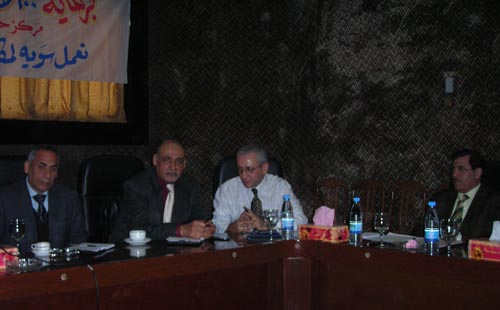
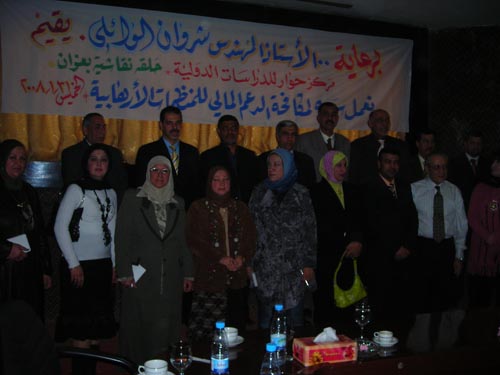
On Sunday 9th December 2007, the European Parliamentary Delegation to Iran met with the members and associates of Nejat (rescue) Society in their office in Tehran.


The Delegation which was headed by Ms Angelika Beer MEP from Germany (the Chairwoman of the EP Iran Delegation) consisted of 24 MEPs from various groups from different European countries.

Mr Arash Sametipur a former member of the military section of the Mojahedin-e Khalq Organisation (MKO) and one of the administrators of the Nejat society welcomed the delegation and introduced the goals and activities of the society. He discussed how he was recruited in the USA and sent to Iraq to receive military trainings as well as ideological teachings and then sent to Iran to carry out assassinations. He explained that since the Iranian authorities have a good understanding of the cultic nature of the MKO and they are well aware that the followers are brainwashed, they consider the members of the MKO as the prime victims of the organisation which must be helped rather than be punished.

Then Mr Sametipur invited Mr Ebrahim Khodabandeh and Mr Jamil Bassam former members of the MKO from the political section to talk about their experiences with the activities of the organisation in the western countries. Mr Khodabandeh referred to the absence of Mr Paula Casaca MEP from Portugal who dropped his name from the list of the delegation in the last minutes due to the pressure imposed by the MKO. He said that he was really willing to visit Mr Casaca today and tell him some mere facts about Iran and about the MKO. He mentioned that surely Mr Casaca missed an opportunity to face the truth.

Next was Ms Hura Chalchi another administrator of the Society and also a former member of the military section of the MKO who went into the details of the society’s activities. She brought up the case of the families of the members of the MKO in Ashraf Camp in Iraq who have no contact with their beloved ones and urged the European parliamentarians to make every possible effort to ensure a safe and private meeting between the families and their relatives inside the MKO.

Mr Qorban-Ali Pur-Ahmadi from Gilan province and Mr Reza Sadeqi Jebali from Esfahan, both former members of the MKO and present members of Nejat Society spoke next. Mr Jebali referred to his last meeting with Mr Casaca in Ashraf Camp in Iraq and said that he was really looking forward to seeing him here today since he had spoken with him in Ashraf Camp and today he wanted to tell Mr Casaca the other side of the story about the MKO which he has never heard before.

Then Ms Shahin Rabi’i a relative of a member of MKO in Ashraf camp addressed the delegation and expressed her demand of private contact with his brother Sa’id in Iraq. She said that she believes her brother has been mind manipulated and she seeks a way to help him out.

Then the members of the EP delegation raised their questions which were answered by the administrators and members of the society. Baroness Nicholson of Winterbourne MEP from the United Kingdoms referred to her visit with Mr Khodabaneh and Mr Bassam in Evin Prison four years ago on the demand of the family of Mr Khodabandeh in Britain and said that the MKO made a huge propaganda demonstrating that these two individuals were under severe torture and soon would be executed which later was proved to been wrong.

Members of the delegation also expressed their regret about the presence of Mrayam Rajavi in the European Parliament and emphasised the fact that these people like all cults do not expose their real identity and try to deceive people to reach their own goals. In the end Ms Beer thanked the Nejat Society for providing them with good information about the MKO.

Some materials and documentations on MKO were handed over to each member of the delegation.

Nejat Society,12 December

December 12, 2007 0 comments
FacebookTwitterPinterestWhatsappTelegramSkypeEmail
The cult of Rajavi

Brainwashing: Crime against Humanity

Gathering and Speeches in the city of Tabriz in Iran

On Tuesday 4th of December 2007, a meeting was held in the Law Department of Tabriz Islamic Free University. The topic was "Brainwashing: Crime against Humanity".

The meeting started at 1600 hours with the attendance of hundreds of students and scholars. Dr Samad Azizi the head of the Law Department opened the meeting and welcomed the students and participants. He introduces the presenters and discussed the importance of the topic in the world today.

Then Dr Hassan Movassaqi a senior lecturer in the Law Department started his speech. He gave a background of brainwashing in the history and discussed its consequences on human life in details. He went through many past examples of brainwashing and showed how it abuses human rights and why it must be considered as a crime against humanity. He scientifically showed the psychological aspects of brainwashing and explained how someone could hold control over other people’s minds and change their thoughts and persuade them to do deeds against their own will. He referred to the Davidian Cult lead by David Koresh in Waco in Texas and their final fate and called upon the International community to adopt serious measures to tackle this global difficulty urgently.

The next presenter was Mr Ebrahim Khodabandeh a former member of Mojahedin-e Khalq Organisation (MKO) lead by the cult leader Mas’ud Rajavi. He spoke about his experiences of 20 years membership in the MKO and gave many examples of how a person could practically be brainwashed.

He mentioned that he has been studying about cults and their common techniques of thought reforms since he left the organisation in 2003 and returned to Iran. He went into details of the process used by the MKO and many other cults to manipulate their members using psychological methods in order to recruit, preserve and control their followers.

He concluded that the leader of a cult is the only person responsible for the crimes committed by the cult and all followers are themselves the prime victims of the brainwashing practiced inside the cult. He explained how followers of a cult are mentally captivated and why they see no way out of their misery. He therefore concluded that the followers must be helped and the leaders of all destructive cults must legally and internationally be prosecuted and brought against justice.

Then Mr Arash Sametipur another former member of the MKO started his speech. He too explained his own experiences within the Rajavi’s Cult. He mentioned that many former members of MKO have organised themselves into an NGO called Nejat (Salvation) Society and their aim is to free the present members held captive in the Ashraf Camp in Iraq.

He emphasised that many families of members who are brainwashed by the MKO are extremely worried about the destiny of their beloved ones and they need urgent help.

In the end Mr Khodabandeh and Mr Sametipur answered the students’ numerous questions. Apparently the topic of the meeting and the speeches had extremely drawn the attention of the students. They demanded that more of such sessions be held in the future. This meeting finished at 1830 hours.

The students were ever so eager to learn more about the methods of brainwashing utilised inside the MKO and hours after the termination of the meeting they had circled around the two former members and asked them various questions. Some students showed interest to be in contact with the Nejat Society. Some reporters and photographers from the media were present in the meeting too.

Nejat Society

December 11, 2007 0 comments
FacebookTwitterPinterestWhatsappTelegramSkypeEmail
Mujahedin Khalq; A proxy force

Arming proscribe terrorist organisations like Mojahedin Khalq

Americans bizarre approach in arming proscribe terrorist organisations like Mojahedin Khalq Full report: Solana, Al-Baradi’i and China good for Iran’s active diplomacy  Ali Larijani said that Iran, Javier Solana and International Atomic Energy Agency are the three angles of a triangle that has brought fruitful results for the Islamic Republic’s diplomacy while stressing the importance of using China as a potentially important card to play for future diplomatic engagements. At 1913 gmt the Iranian television started broadcasting a live interview with Ali Larijani, the former head of the Supreme National Security Council of Iran. Reacting to the National Intelligence Estimate report on Iran’s nuclear policy Larijani said:”This is in effect a triangle one of the angles of which is Iran, another which is Solana and the third is Al-Baradi’i… The Chinese have significant economic ties with us, while at he same time we have common interests. In other words, if a certain problem arises and becomes complex then the principle country within the group of 5+1 to be affected by this will be the Chinese”

The presenter, Morteza Heydari, asked for the overall reaction of Ali Larijani who said that ”this is a great fiasco for the Americans. The Americans must be impeached for this”. He added that although there are many ifs and buts in the report the main contention of the report is that the basis of all allegations against Iran is false. He pointed to the fact that the report says that ”we can say with great confidence that Iran does not have a military programme in its nuclear project”.

Larijani added: they do leave the door open with certain ambiguities in their report to allow US adventurism.

He went on to add that three issues come out in the overall analysis: Firstly that Iran has no nuclear arms. Secondly, that between 2003 and 2007 it has not pursued a military programme in its nuclear project and finally that it will not be able to do that until 2015.

He stressed that the report makes some erroneous statements notably that Iran has been pressurised into its cooperation with International Atomic Energy Agency. He dismissed these saying that they have misunderstood Iran’s confidence building and good will measures.

Presenter asked him why is it that out of the 150 page report they have only published 9 pages of it. Is it because the Americans are saying that Iran has stopped its military programmes when pressures increased on Iran or is it that the Democrats have put pressure on the Bush Administration to publish these nine pages.

Larijani said that this is no accidental leak or due to Democratic pressure. He continued that the Americans are facing a ”crisis of honesty”.

The former Supreme National Security General-Secretary and present advisor to the leader added that Bush had, also, said that it is due to the reforms of the intelligence apparatus that these sorts of reports come out. He dismissed it as disingenuous and dishonest.

He conjectured another possibility on the so called ”Zionist lobby”. 1930

The National Security advisor to the leader added: The other possibility is that they may try to manipulate some members of the 5+1 saying that although we accept that there may be no military aspect to Iran’s nuclear programme it nevertheless shows that pressures on Iran have worked which is why no military pursuit of the nuclear programme has been detected.

Larijani, also, paid tribute to the Iranian nation’s resolute stance against ”bullying” by USA and this is what has caused the report to be leaked.

Presenter asked why is it that the ”Zionists” have firmly rejected the report despite the fact that many of the European countries have reserved judgment.

Larijani said that ”Zionist” leaders have been shocked by this report. He said that he doubts that the ”Zionists” will be able to make great capital out of this.

Larijani added that the Chinese are playing a more active role which is positive and must be welcome.

Larijani said that there is no guarantee that the Americans will come to their senses and stop their policies against Iran. They have to understand that through putting pressures on Iran they can not dissuade Iranian people from their nuclear policies.

He added that as Iran is a democratic country then Iran must be engaged diplomatically:”If there is a country with a sustainable democracy in the region it is Iran. The influential aspect of Iran is important in the region. It is obvious that they can have a proper engagement with this country. It is in the interests of the 5+1 countries. When I spoke to some leaders of Europe they used to tell me that they want to use Iran’s potential to create security in the region and for extending economic relations. You can use this potential. It will be in your own interests. And, naturally you will achieve more in the realm of regional interests and energy security and comprehensive economic relations with Iran. This is our suggestions.”

Asked about President Bush’s statement that ”Iran is a danger” Larijani said that ever since September 11, 2001, there is an air of savagery in American attitudes.

Presenter asked that one of the reasons cited for the subsiding of tensions in Iraq is due to Iran meddling less in Iraq affairs, how true is this?

Larijani said that talks were held three times with Iran. Iran has presented a coherent programme to help Iraq but the Americans are conducting certain bizarre approaches such as arming non-military groups some 70,000 in number. He drew parallels between this policy and arming the Mojahedin Khalq fighters and Pezhak in Kordestan. He called this serious. He said that this tactic will not change the realities of Iraq.

He went on to say that Iran has always helped the Iraqi government while knowing its own obligations and duties.

He dismissed the war-peace dichotomy of some of the discourses in the West adding that these are for internal consumption and they are false, no one wants to see war and things must not be seen in such black and white terms.

Presenter asked him what the realistic scenario for Iran’s dossier to be closed in the Security Council?

Larijani said that by rights Iran’s dossier must be closed. He added, however, that what is right is not necessarily what will happen in reality.

Larijani added:”We have to pursue an active and smart diplomacy in order to block their adventurism. It is obvious that the Americans are pursuing a policy of creating nuisance. This particular avenue [The nuclear dossier] has been blocked now but they will pursue another agenda. It is clear what this new agenda is going to be. It is not very complex. I believe that if Iran pursues a several-pronged approach – which at any rate it is doing already – it can be quite effective. One of these is cooperation with the Agency. We have said that we will follow this line up. Mr Al-Baradi’i’s report was a good one. Of course I have made criticisms of it saying that it had to be written in a more precise way. Some of its statements are not the sort which is at the level of the Agency’s function. It suffers the same problems as this present report [The Intelligence Estimate] saying, for example, that Iran’s cooperation has been reactive. This has no technical or legal characteristic but can turn into a pretext for trouble-making entities.”

He also emphasised the negotiations with Javier Solana, the EU foreign policy chief saying:”The talks with Mr Solana are quite helpful. Please pay attention to the fact that the Modality approach was the fruit of the debates that we had with Mr Solana. In reality we made an agreement in Lisbon on the basis of which the modality of cooperation with Mr Al-Baradi’i was formulated and an agreement was reached with him. This is in effect a triangle one of the angles of which is Iran, another which is Solana and the third is Al-Baradi’i. This will really help.”

He further pointed to cooperation with the Chinese saying:”I believe that the Chinese constitute a good potential in this too. And my understanding that there are countries who are interested in China playing a useful role. The Chinese have significant economic ties with us, while at he same time we have common interests. In other words, if a certain problem arises and becomes complex then the principle country within the group of 5+1 to be affected by this will be the Chinese… I see that the future is generally bright but we need to pursue a smart diplomacy.”  BBC Monitoring Middle East, December 07, 2007 Source: Vision of the Islamic Republic of Iran Network 2, Tehran, in Persian 1900 gmt 4 Dec 07

December 9, 2007 0 comments
FacebookTwitterPinterestWhatsappTelegramSkypeEmail
Lord Corbett

Open letter to Lord Corbett by Mohammad Sobhani

 Dear Lord Corbett

I have read all of your interviews and written statements that are to be seen on the website of the Mojahedin Khalq Organisation with interest and concern. I am committed to human rights and am studying intensely the politics in and around Iran. Therefore it would be a pleasure for me to add to your information.

In your interviews, you have mentioned that the history of the Mojahedin Khalq Organisation’s armed operations goes back to before 2001, and you have emphasised that they have preformed no terrorist or similar activities after this date. What I really want to know is whether the organisation has in fact ruled out armed struggle – once the core of its ideology, strategy and tactics. Or is it simply because the organisation is incapable of carrying out terror acts at this moment in time?

As I understand it, you are not supporting or sympathizing with the MKO or National Resistance Council (NRC). At least, you stated as such in your interview with the BBC:

“I do not support the MKO or the National Resistance Council. I do support the UK.” The reporter asks: “You are trying to impose the MKO on the Iranian People?” Your reply: “I am trying to pursue the benefits of the UK.”

In another interview, you have mentioned:

Israel has good relations within the U. S. and can arrange for the MKO being eliminated from the list of terrorist groups. Thus, the MKO will be enabled to initiate its struggle against Iran from Iraqi territory. We are sure that if the MKO should start its battle against Iran, it will be supported by the Iranian people. The Iranian government would quell the opponents and trigger an inner civil war. The National Liberation Army (NLA) would intervene in order to prevent bloodshed. The mullah’s regime would fall and the MKO would take over.“

In my opinion you are not a supporter of the MKO but a patriotic citizen of the UK. Therefore you want to use the MKO as a military tool in terms of the accomplishment of your objectives. But I want to advise you that your theory is wrong. I would like to draw your attention to my thirty years’ experience resulting from my former membership with the MKO.

If you are seriously interested in accomplishing the objectives of your home country, then why do you want to ride on a dead horse, the MKO? Do you really believe that the MKO has any support in Iran?

Please believe me, each and every political group or individual opposing the Islamic Republic, whether monarchist, republican or nationalist, all consider the MKO as remnants, the leftovers of the former Iraqi dictator Saddam Hussein and terrorism. Nothing else.

Do you know that this organisation is presenting itself with two different faces: one humanitarian, for the public and another one, military and sect-like to the inside.


The MKO is a terrorist organisation as well as a religious sect. The MKO has linked the ideology of Marx and Lenin with Islam and established a radical organisation.

Without the express approval of its religious leaders, Massoud and Maryam Rajavi, all marriage is prohibited. The future and destiny of their members depends on their decision only.

Those who wanted to decide for themselves about their private lives have been executed by the organisation. One of the victims was Alinaghi Hadady, whom I knew personally. At that time I was a member of the Central Committee and dared to protest against repression and violation within the organisation. Due to a direct order of the religious leaders Massoud and Maryam Rajavi I was given an extrajudicial sentence of imprisonment under solitary confinement, first at camp Ashraf and then in the prison of Abu Ghraib for a period of 9 years.

When Saddam Hussein was still in power in Iraq, the organisation was given the best opportunities, whether militarily, logistically or financially. They enjoyed full support from Saddam. And did it ever use one of the opportunities to make a step towards democracy in Iran?

Since 1981 the organisation tried to bring a so-called democracy to Iran by committing terrorist activities and assassination. But this led to a dead-end-street. Democracy will not be established by bringing violence to the people.

If what the MKO asserts is true, if there really is sympathy for them in Iran, then why do the leaders and their command live abroad and commit attacks inside Iran?

I wanted to write more to you about my experiences and with information about Iran and MKO, but I would prefer a personal meeting with you. Me and my colleagues would be pleased if you gave us the opportunity to speak to you personally.

Yours sincerely,

Mohammad Hossein Sobhani

08.12.2007

Postfach 90 06 63

51116 Köln“Deutschland

Phone: +49 (0)1639076911

Email:sobhani_m_h@hotmail.com


Mohammad Hussein Sobhani, December 08, 2007 –  http://www.iran-ghalam.de/2Haupt/2157.sobhani.8.12.07.HTM

December 9, 2007 0 comments
FacebookTwitterPinterestWhatsappTelegramSkypeEmail
Iran

Iran’s ambassador discusses MKO with UN envoy to Iraq

TEHRAN — UN Secretary-General’s Special Representative for Iraq, Staffan de Mistura, and Iranian Ambassador to Baghdad, Hassan Kazemi Qomi, met on Sunday to discuss the need for Iran’s ongoing and positive engagement with Iraq as well as with its other neighbors, UN news centre reported on Monday.

De Mistura and Kazemi also talked about possible increased support by Iran for Iraqi reconstruction under the International Reconstruction Fund Facility for Iraq.

The Iranian envoy raised the issue of the terrorist Mojahedin Khalq Organization (MKO) and asked whether the UN has a position on the legality of the presence of MKO members in Iraq.

De Mistura did not comment on the issue, but stated that he has no plans to meet with the organization.

However, Iranian state radio said the UN envoy said that MKO was a terrorist organization and any activity by this group was illegal in Iraq.

The MKO was set up in the mid-1960s to oppose the U.S.-backed dictatorship of the late Shah Mohammad Reza Pahlavi. It participated in the country’s revolution but soon launched a campaign of assassinations and bombings in Iran.

The group moved to Iraq in the early 1980s and it fought Iran from there until the United States invaded in 2003. The Americans have since disarmed thousands of the group’s members and confined them to a camp near Baghdad.

Tehran Times ,December 5, 2007


December 9, 2007 0 comments
FacebookTwitterPinterestWhatsappTelegramSkypeEmail
The Ideology of the MEK

The Role of Strategic Stalemates in MKO ideological Shift 2

Failure in overthrowing the regime

The short-term plan to overthrow the Iranian regime announced by Rajavi at the peak of MKO’s wave of internal terrorist actions, such as the explosions in the central office of the Islamic Republican Party and the Prime Ministry Building, constituted the most controversial issue that challenged the Mojahedin’s leadership. Believing that these bloody terrorist deeds would lead to destabilization of the regime, Rajavi declared that it ultimately took six months to finalize the collapse.

The prime aftermath of the declared phases of armed warfare following Khordad 30th (20 June 1981) was that Rajavi’s promise proved to be a chimera. Although insignificant at the beginning, after a while and following the military failures and stalemates, the challenge turned into serious crises within MKO.

Again and again Rajavi, overconfident of terrorist actions that he referred to as ‘great operations’, predicted a short time overthrow in his press interviews. He even classified the definite time of overthrow into three periods: short, mid, and long and finally fixed the exact date in a 5 year span. A review of Rajavi’s position taking reveals the fact that after 20 June, he began to evade determining an exact date for the overthrow. Finally he postponed his promise until the death of the leader of Islamic Republic.

From the phase of 20 June on, followed by the formation of NCR, Rajavi promoted himself atop of both MKO and NCRI as the egocentric decision-maker. Although everybody was aware that he was the one to say the last word, later on, and in the course of ideological revolution, Mehdi Abrishamchi referred to the decisive role of Rajavi in critical decisions such as that which initiated the armed phase. Even the Western media were interested in his hegemonic leadership atop of the organization in those years. Many of them asserted that he cleverly dodged the reporters’question and in one case, Jean Gueyras tells the story of Rajavi and his misuse of power for his personal ambitions:

Hidden away in his country bunker in Auvers-sur-Oise, Mr. Massoud Rajavi, the leader of the People’s Mojahedin Organization of Iran (PMOI) has mastered the art of allying the useful with the pleasurable. He sugar coats his decisions, even those about his private life, with politico-ideological statements of considerable grandiloquence. Thus, in October 1982, to justify his marriage to Firouzeh Bani Sadr, daughter of the former President of the Islamic Republic only eight months after the tragic death of his first wife, Ashraf Rab’i (killed on 8 February 1982 by the Pasdaran); he published a joint bulletin of the PMOI’s Politburo and Central Committee in which his marriage was presented as ‘one of the most important revolutionary decisions ever taken by the Mojahedin’ and as an initiative which would help consolidate the unity of the Iranian nation’. (1)

Antoine Gessler’s Autopsy of an Ideological Drift well explains that Rajavi and his organization are badly in need of being at the center of the world’s attention and are very afraid of being sunk into oblivion. Rajavi’s promises of victory to motivate his forces have never come true:

It involves an organization in permanent panic of being forgotten, a threat that grows day by day, and must, therefore, motivate its militants who have never witnessed the victory announced thousands of times in the past (2).

Such evidences prove the fact that even years before the ideological revolution and his promotion as the ideological leader, Rajavi had succeeded to maintain his unbeatable authority over the organization. After a while, the internal crises were well controlled but unsolved question of overthrow, in spite of the heavy responsibility of rampant terrorist operations, remained as an internal challenge that negatively affected Mojahedin’s relations. Then the circumstances lead to a condition in which Mojahedin were forced to deny the possibility of short- and mid-term overthrow. The critical situation of Mojahedin on the one hand and Iran’s prevailing over internal crises on the other hand corroborated fallacy of MKO’s promise of short-term overthrow. Although the leadership never acknowledged the fact openly, the analysis of the ideological development confirmed it. Niyabati’s outspoken fashion leaves no doubt that the leadership was convinced of the fact that the organization was structurally no match to cause regime’s downfall:

A summary of the political, military, organizational, and ideological aspects in fall 1984 made one point clear to Mojahedin, that was, the short-term overthrow of the regime was impossible due to the ideological-organizational structure on the one hand and outer-organizational political relations with various political trends active inside and outside of the country. (3)

According to Niyabati, such a particular phase was in fact the turning point of internal challenges Mojahedin had encountered. He refers to two years earlier when Mojahedin took the wrong path of the so-called phase of armed struggle that founded the background to such challenges. He further elaborates on two strategic solutions of Mojahedin in this regard and writes:

The year 1984 was a determining phase to reach a final settlement in political, military, strategic, and ideological scenes. The political and military impasse of armed resistance as well as the failure in short-term overthrow of the regime that came to light at the end of 1982 and became a proven fact at the beginning of 1983, led Mojahedin into a dilemma. (4)

Mehdi Khanbaba-Tehrani, an NCRI ex-member, in his review of the phase refers to failures and their aftermath within MKO and NCRI and concludes that the ideological revolution worked as the decisive solution to the desperate question of overthrow that was pressing hard on Rajavi and NCRI:

In my opinion, MKO has met serious crises due to the failure of the short-term plan of overthrow and its aftermath that has gravely questioned the organization’s leadership. Actually, the ideological revolution was the manifestation of such internal conflicts. To keep the integrity and life of the organization, Mojahedin’s leadership arrived at a compromise that resulted in pluralizing the leadership by means of adding a woman atop who had to change her name and get married to Rajavi. (5)

Hadi Shams-Haeri, another former member, considers the strategic stalemates and failures of MKO to be a result of Rajavi’s ineptitude, having no realistic appraisal of the situation inside Iran, and finally continuation of keeping the insiders in dark about the realities and insisting on the futile tactic of overthrow:

Of the Rajavi’s betrayals was advertising the overthrow of the Islamic republic as a possibly easy and quick task. In this regard, Rajavi never referred to the real problems and shortcomings that would be encountered on the route. (6)

Haeri also has the opinion that Rajavi is the sole responsible for the wrong decision of overthrow and the move on 20 June. He writes:

In fact, the armed warfare that initially aimed at overthrowing the regime in short-term and assuming the political power lasted not more than 1.5 years and ended in a complete strategic failure. The pioneer forces not only lost the ground but were strangled due to adverse circumstances. It happened as a result of inadequate and incorrect appraisal of forces’capacity on 20 June. (7)

As such, the issue of overthrow which acted as a motivator for winning the support of opposition groups, as well as some states standing in shadow, gradually turned into a factor arousing opposing reactions within MKO and NCRI.


References:

1. Gessler, Antoine; Autopsy of an Ideological Drift, Chapter 22.

2. ibid, chapter 19.

3. Niyabati, B. A different look at the ideological revolution within MKO. Khavaran publication, p.16.

4. ibid, p.16.

5. An inside look at left movements in Iran, some interviews with Mehdi Khanbaba-Tehrani, the interview 17.

6. Shams-Haeri, H. The swamp, Khavaran publication, p.35.

7. ibid.


Bahar Irani,Mojahedin.ws,December 6, 2007


December 9, 2007 0 comments
FacebookTwitterPinterestWhatsappTelegramSkypeEmail
UK

POAC Judgment and the alledged Renunciation of Terrorism by Mojahedin K

The political life of Mojahedin-e Khalq Organization (MKO), especially after Rajavi’s retreat to hideout to let his phoenix of democracy, Maryam Rajavi, to hold sway a democratic tactic after a long frantic phase of terrorism, heavily depends on propaganda ploys. Following a rather long propaganda doldrums, the UK court ruling, seemingly in favour of MKO, granted the organization  propaganda machine a recovering opportunity.

It started all with celebrating the court ruling along with Maryam Rajavi who in turn began extravagant performances of welcoming the decision and sending messages of congratulations. The scenario continued with repetitive, lengthy TV shows and analysis programs with a variety of analysts who suddenly turned to be experts in law and judiciary affairs. It is all to justify what has long remained controversial and even the court left it unsolved.

Mojahedin insist to prove that the organization has forsworn terrorism since 2001. They mean to say, the organization has stopped engaging in militarism and terrorism only for five years after maintaining a terrorist structure and aggressive nature in a span of at least twenty years according to the essential grounds set out in the court’s judgment:

23.1. Whatever the accurate characterisation of the organisation’s activities between 1980 and 2001, the position in 2006-2007 is radically different, and has been so since 2001.

23.2. That the PMOI has conducted no military activity of any kind since about August 2001, whether in Iran or elsewhere in the world.

Although nothing is said about countless terrorist operations of the group inside Iran, even based on what is stated above, the Secretary of State could in no way trust the temporary cessation of MKO’s terrorist activities without an officially announced denunciation of terrorism endorsed by the leaders. In a letter dated 1 September 2006 sent to the applicants of the appeal that is included in page 9 of the court’s judgment, the Secretary of State has concluded;

“Accordingly, even though there has been a temporary cessation of terrorist acts, I am not satisfied that the organisation and its members have permanently renounced terrorism (para 22)

and:

“Mere cessation of terrorist acts do not amount to renunciation of terrorism. Without a clear and publicly available renunciation of terrorism by the PMOI, I am entitled to fear that terrorist activity that has been suspended for pragmatic reasons will be resumed in the future” (para 23).

Even the accuracy of such remarks that “the PMOI has conducted no military activity of any kind since about August 2001 is dubious and questionable. Corroborated by Mojahedin’s own official communiqués published in the group’s official organ, Mojahed, MKO has certainly conducted terrorist operations inside Iran. Only one of these cases, the Ferdows operation, is referred to in the appeal as the “glorification” of terrorism. Existing evidences confirm that at least until 22 August 2002, MKO had been ceaselessly engaged in terrorist operations. Here is Evidences Dismissing MKO’s Disclaim of Terrorism to substantiate the claim.

No doubt, MKO has a military structure and its inherent aggressive characteristic endorsed by its declared strategy of armed struggle classifies it as a terrorist organization that has justly been proscribed. Actually, to de-proscribe a terrorist organization, there should be factual basis presented to a state and upon which a decision might be made. There is no need to justify renunciation of terrorism by inferring from reports and statements published here and there. The first evidence any court needs in the first stage to decide de-proscription of a terrorist organization that has been conducting terrorist deeds at least for forty years is an official declaration of renouncing violence and terrorism as did an Irish group in May.

The Irish paramilitary Ulster Volunteer Force (UVF) through an officially issued statement declared that “as of 12 midnight, Thursday 3 May 2007, the Ulster Volunteer Force and Red Hand Commando will assume a non-military, civilianized, role”. The UK Secretary of State has the right “to reject or cast doubt on the evidence presented to him that the MKO had renounced terrorism and rejected violence”.

To deracinate the malign roots of terrorism, especially a dangerous terrorist cult like MKO, special care should be taken to avoid harm that might come from the snakes in the grass. The problem is that the majority of the group’s advocates have been kept in dark about its overtly atrocious terrorist operations on which it has dodged to contribute facts.

As in the case of the judgment of the Court of First Instance of the European Communities released on 12 December 2006, nothing will come out of the judgment of POAC for Mojahedin. The only advantage out of it is its use as a vehicle of widespread, ceaseless propaganda, something MKO badly need instead of being removed from the list of proscribed organizations.


December 9, 2007 0 comments
FacebookTwitterPinterestWhatsappTelegramSkypeEmail
The Ideology of the MEK

Masud Rajavi’s timetable for destruction – January 2008 or 2009?


Immediately after the invasion of Iraq in March 2003 Massoud Rajavi, guru of the Mojahedin Khalq cult went into hiding. After three years incommunicado, a statement was issued in 2006 in his name. In it Rajavi announced his timescale for toppling the Iranian regime: "in the next two years". Little attention was given at the time. Rajavi has made this kind of claim frequently over the past 30 years without effect.  

Information from inside the cult, however, indicates that the specific deadline of January 2009 is part of a more sinister plan by the cult leaders. Following the announcement of this date, every member was required to sign a piece of paper giving their oath that they will not leave the cult until January 2009 – by which time, according to Rajavi, the regime must be toppled.

Rajavi’s message states that when the deadline of January 2009 arrives: ‘anyone who wants to can leave, and I will myself throw out all the useless ones. I will keep the rest who are pure, and I will tell them then what they have to do for me’. Experts on the MKO’s cult jargon interpret this as Rajavi’s intention to have his followers ‘wreak havoc’; the most predictable scenarios being mass suicide in Camp Ashraf and/or attacks on external interests with suicidal intensity in other parts of the world where the MKO cult has bases. That is, the ‘pure’ MKO operatives will kill all Rajavi’s opponents in Europe and then kill themselves.

The 2006 US State Department Country Reports on Terrorism, which describes the Mojahedin as a terrorist entity with cult-like characteristics, warned: "Many MEK leaders and operatives, however, remain at large, and the number of at-large MEK operatives who received weapons and bomb-making instruction from Saddam Hussein’s regime remains a source of significant concern."

A similar plan was previously exposed by Iran-Interlink [see links below]. On November 3rd 2001 in response to 9/11, Rajavi announced the Black Phase – if US forces attacked Iraq, the MKO would launch an all-out attack on Iran.

http://www.iran-interlink.org/files/child%20pages/pending_human_rights_disaster.htm

http://www.iran-interlink.org/files/info/brief_3.htm

Over thirty years, Rajavi has consistently sought conflict and chaos to keep his cult alive. Since the fall of Saddam Hussein in 2003 Rajavi has tied his fate to the US neo-conservative/far-right Israeli agenda of regime change. The MKO has repeatedly and emphatically offered itself to be used as an agent for regime change.

Banking on an aggravated standoff between Iran and the USA, Rajavi had hoped the US (or Israel) would attack Iran before the end of the Bush administration. But by 2006 the MKO leadership had grasped that after January 2009 the current Bush Administration would lose any possibility of starting a war with Iran, and any successor would be unlikely to start a war soon after. Ordering his followers to adhere to his deadline serves to ensure that the cult does not disintegrate from within before that date. The deadline is also a warning to western governments, the MKO will wreak havoc in the cities of Europe if I, and my cult, are not supported.

Now with the US National Intelligence Estimate report on December 3rd effectively removing any reason for war with Iran for the foreseeable future, there is nothing left for Rajavi to fill the void between now and January 2009. His deadline for destruction appears to have arrived sooner than he anticipated.

ENDS

Contact

Anne Singleton, Iran-Interlink

editor@iran-interlink.org

www.iran-interlink.org

Iran-Interlink

PO Box 148

Leeds LS16 5YJ

UK


Iran Interlink Brief, December 08, 2007

December 9, 2007 0 comments
FacebookTwitterPinterestWhatsappTelegramSkypeEmail
USA

Iran moves to pull a troublesome thorn

The November 15 report by the International Atomic Energy Agency (IAEA) on Iran’s nuclear program indicates that Tehran is still violating existing United Nations Security Council resolutions by continuing the construction of a heavy reactor and installing a total of 2,952 centrifuges needed for uranium enrichment.

International pressure on the Iranian government to cease such work is likely to increase in the following months. The present stalemate on the nuclear negotiations coincides with a tougher

US strategy toward Iran, which includes designating the Iranian Revolutionary Guards Corps (IRGC) as a terrorist organization and implementing a new round of unilateral sanctions.

While military action is still not seen as a viable option by the Department of Defense, there are certainly many within and without the White House who are growing increasingly restless about the seeming futility of sanctions. The most vocal advocate and perpetrator of violent regime change in Iran is the Mujahideen-e-Khalq organization (MEK), an Iranian opposition group designated as a foreign terrorist organization by the United States (Executive Order 13224, Department of State, 2003) and the European Union.

A 2007 German intelligence report from the Federal Office for the Protection of the Constitution called the MEK a”repressive, sect-like and Stalinist authoritarian organization which centers around the personality cult of Maryam and Mas’ud Rajavi”.

During the initial phase of the Iranian Revolution, the MEK was significantly influenced by Marxist theories and concepts of exploitation and class struggle, and particular emphasis was placed on Ho Chi Minh and Che Guevara and their ideas of guerrilla warfare. Besides these foreign Marxist influences, the MEK’s ideology was also heavily informed by Islamist/Marxist scholar Ali Shariati (1933-1977), who wrote many treatises on the idea of suffering and eternal struggle in Shi’ite doctrine, combining it with socialist ideas of class emancipation vis-a-vis secular tyranny.

When the Peoples’ Mujahideen were excluded from power sharing after 1979 and thousands of its members were executed under Ayatollah Ruhollah Khomeini’s orders, their struggle turned against what was to become the Islamic Republic. To date, the MEK’s structure is heavily dominated by a socialist outlook coupled with an Islamist veneer, highlighting the concepts of justice in reference to Shi’ite doctrines. The latter serves to legitimize the MEK in the eyes of Iranians at home and helps foster full commitment to the cause.

In October, the 4,000 residents of the MEK’s”Camp Ashraf”in Iraq staged a spectacular large-scale festival that included extensive military style parades, martial arts performances and a display of unarmed combat units. Video excerpts of the festivities were posted on YouTube. The festival was as much a display of military strength and the MEK’s ongoing commitment to fight the regime in Iran as it was a homage to the two leaders of the MEK.

One of the lingering questions surrounding the group’s continued existence is why it has not been disbanded.

Following the 2003 invasion of Iraq, the group was disarmed and many of its members were questioned by the Central Intelligence Agency and the Federal Bureau of Investigation. Soon after, US Major General John D Gardner confirmed the status of the residents of Camp Ashraf as”protected persons”under the 4th Geneva Convention, stating that”the coalition remains deeply committed to the security and rights of the protected people of Ashraf”.

Evidently, one of Iran’s key demands to the US government is the closure of Camp Ashraf and the subsequent expulsion of all MEK members. Despite demands by the International Committee of the Red Cross that residents of Camp Ashraf”must not be deported, expelled or repatriated”, Iraqi Foreign Minister Hoshyar Zebari said in April that the Iraqi government intended to resettle MEK members in European countries and set a deadline of six months for the move. The resettlement is unlikely to materialize given the EU’s tough stance toward the group and its umbrella organization, the National Resistance Council for Iran, but it still indicates that the MEK’s host country is becoming increasingly restless over its presence.

By and large it seems that the Iranian government is following a two-track strategy with regards to the MEK base in Iraq. Iranian diplomats in Iraq are putting increasing pressure on Baghdad to expel the group from Iraqi territory and to actively prosecute leading MEK operatives. At the same time, Iranian authorities continue to offer amnesties for members who cut their ties with the group and return to Iran. The MEK still creates serious security problems for Iran; according to a recent speech by Foreign Minister Manuchehr Mottaki, the group has killed over 16,000 people in and outside Iran, including one president, one prime minister, four ministers and dozens of members of parliament.

Most recently, Iranian authorities arrested a group of MEK operatives for the assassination of Sheikh Hashem Samiri, a Friday prayer leader in the city of Ahwaz. The crime was linked to the earlier September shooting of Sheikh Samir Durak, Friday prayer leader in the Koy-e Alavi district.

Following numerous consultations with Iraqi authorities, Tehran’s lobbying efforts seem to be paying off. Citing evidence of MEK involvement in the current insurgency as well as atrocities committed against Iraqi citizens, Ja’afar al-Musawi, chief prosecutor of the Supreme Iraqi Criminal Tribunal, issued arrest warrants for 150 MEK members, including the group’s leaders Maryam and Mas’ud Rajavi. Though insisting that all of them would be tried under the criminal jurisdiction of Iraq and not be handed over to Iran, Musawi indicated that extradition agreements with Iran will be concluded in the near future.

At the same time, authorities in Iran are wooing residents of Camp Ashraf to come back by offering amnesty and re-socialization programs. Since 2003, over 500 MEK members have returned to Iran, been officially pardoned by Supreme Leader Grand Ayatollah Ali Khamenei and extensively debriefed by Iranian intelligence. Iran’s judiciary officials continue to emphasize that defectors from Camp Ashraf will not be prosecuted on their return to Iran.

Though such amnesty initiatives prove to be useful incentives for disaffected members and their families, they fall short of genuinely addressing Iranian security concerns over the group’s ongoing activities in Iraq. The most urgent issue for Tehran is what Mohammad Jafari of the Iranian National Security Council described as intelligence cooperation between US forces in Iraq and MEK operatives sent across the border to spy in Iranian territory.

Though such accusations are difficult to verify, demands by the Iraqi government to dismantle Camp Ashraf and prosecute those charged with crimes have not yet been met. Abdul Aziz al-Hakim, head of the Supreme Islamic Iraqi Council, claims these efforts are actively prevented by the United States. The recent propaganda festival staged in Camp Ashraf has only fueled Iranian suspicions that the MEK is still considered by the United States as an effective ally against Iran.

 there is no evidence that the MEK enjoy any high-profile support in the State Department or Pentagon, there are certainly some on Capitol Hill who consider any enemies of Iran as friends of the United States. Most notably, congressmen Michael McCaul, Nick Lampson and Brad Sherman have repeatedly asked the US government to remove the MEK from the terrorist list.

Echoing such demands, the White Paper published by the US pressure group Iran Policy Committee in 2007 perceives the MEK in Iraq as”very useful for providing intelligence for border controls and operations”and, because of their”extensive network within Iran”and their”excellent record of revealing key intelligence about the IRGC proxies’ infiltration routes into Iraq”, the MEK is seen as a viable”interlocutor”between Washington and Sunni groups to quell Iraqi sectarian violence.

Given Camp Ashraf residents’ legal limbo under the 4th Geneva Convention, the United States is faced with the highly complex decision of whether to hand over MEK militants to Iraq or Iran, or arrange asylum in a third country. Each choice carries consequences for US-Iranian relations. Although denied by US authorities, keeping the MEK in Iraq may still be seen by some policymakers as providing an effective bargaining chip in the nuclear weapons negotiations.

Dr Bernd Kaussler holds a MA and PhD from the University of St. Andrews and is currently assistant professor in political science at James Madison University. As associate fellow at the Institute for Iranian Studies at St Andrews, he is involved in various research projects on contemporary Iranian politics and foreign policy.

By Bernd Kaussler,

December 9, 2007 0 comments
FacebookTwitterPinterestWhatsappTelegramSkypeEmail
Newer Posts
Older Posts

Recent Posts

  • Why did Massoud Rajavi enforce divorces in the MEK?

    December 15, 2025
  • Massoud Rajavi and widespread sexual abuse of female members

    December 10, 2025
  • Farman Shafabin, MEK member who committed suicide

    December 3, 2025
  • Nejat Newsletter No.131

    December 3, 2025
  • Israeli Hayom: The case for redesignating the MEK, Learning from history

    November 29, 2025
  • Facebook
  • Twitter
  • Instagram
  • Youtube

© 2003 - 2025 NEJAT Society . All Rights Reserved. NejatNGO.org


Back To Top
Nejat Society
  • Home
  • Articles
  • Media
    • Cartoons
    • NewsPics
    • Photo Gallery
    • Videos
  • Publications
    • Books
    • Nejat NewsLetter
    • Pars Brief
  • About Us
  • Contact us
  • Editions
    • عربي
    • فارسی
    • Shqip