Nejat Society
  • Home
  • Articles
  • Media
    • Cartoons
    • NewsPics
    • Photo Gallery
    • Videos
  • Publications
    • Books
    • Nejat NewsLetter
    • Pars Brief
  • About Us
  • Contact us
  • Editions
    • عربي
    • فارسی
    • Shqip
Nejat Society
Nejat Society
  • Home
  • Articles
  • Media
    • Cartoons
    • NewsPics
    • Photo Gallery
    • Videos
  • Publications
    • Books
    • Nejat NewsLetter
    • Pars Brief
  • About Us
  • Contact us
  • Editions
    • عربي
    • فارسی
    • Shqip
© 2003 - 2024 NEJAT Society. nejatngo.org
Mujahedin Khalq; A proxy force

Mojahedin Khalq terrorists the sources that America uses it in its allegations against Iran

Mojahedin Khalq terrorists the sources that America uses it in its allegations against Iran and the IAEA has repeatedly rebuked the allegations of the White House in its reports Iranian leader tempers anti-U.S. rhetoric; Ahmadinejad takes a softer tone in the wake of a U.S. report that says Tehran had halted its nuclear arms program.  Ramin Mostaghim and Borzou Daragahi  Special to The Times  12 December 2007  Los Angeles Times Home Edition  TEHRAN  In his first formal news conference since a U.S. intelligence report last week undercut claims that Iran was secretly developing nuclear weapons, President Mahmoud Ahmadinejad struck an unusually mild tone Tuesday, calling for dialogue with Washington and forgoing his usual anti-American and anti-Israeli rhetoric.  He also denied that Iran had resumed a secret nuclear weapons program, a claim made by an Iranian exile group, the Mujahedin Khalq, which has been listed as a terrorist organization by the U.S. State Department and the European Union. The group cited unidentified sources in Iran as saying the Islamic Republic had restarted its program in 2004.  A U.S. National Intelligence Estimate released last week concludes that Iran halted its weapons program in 2003. Tehran denies ever having such a program.  Ahmadinejad initially gloated over the report as vindication for Iran, though it says his country continued to enrich uranium and that Iran easily could restart its weapons program. But at the two-hour news conference, Ahmadinejad described the report as "a positive and forward step" by the U.S. to ease tensions in the Middle East.  "We do hope there will be one or two steps forward so as to make a different atmosphere for finding solutions," he told reporters. "If further steps are taken, then our problems will be less complicated."

Despite the softened tone, Ahmadinejad said Iran would continue its uranium enrichment program in defiance of international standards. He predicted Iran would have the ability to run 50,000 high-speed centrifuges within five years. Iran has about 3,000 centrifuges, which if run continuously for a year could in theory produce enough highly enriched uranium for one nuclear bomb, though inspectors have not detected high levels of enrichment at Iran’s facility in Natanz.

Many officials in Iran viewed the U.S. report as an olive branch, and some analysts have urged the Iranian leadership to take the opportunity to enhance ties or at least reopen channels of communication between Tehran and Washington. The two nations have had a hostile relationship since the 1979 revolution in Iran.

U.S. and Iranian officials are scheduled to meet in Baghdad on Dec. 18 for the fourth round of talks over securing Iraq. Such meetings have usually been preceded by chest-thumping and accusations on both sides. But at Tuesday’s news conference, his eighth since taking office in 2005, Ahmadinejad expressed confidence that the meetings would eventually produce positive results for bolstering security in Iraq.

Regardless of what the U.S. report concludes, Iran still faces the prospect of a third round of international sanctions over its enrichment of uranium. A team of International Atomic Energy Agency experts arrived in Tehran on Sunday in an attempt to clear up lingering questions over the country’s nuclear program. Iran insists its goal is to generate electricity, but the West suspects the effort is a cornerstone for an eventual weapons program.

Iran’s nuclear program and political and material support for armed groups fighting Israel have brought Tehran under heightened international scrutiny. Ahmadinejad and his circle also have come under enormous pressure from multiple quarters within Iran’s fractured political class.

On Monday, influential lawmaker Ahmad Tavakoli criticized Ahmadinejad for gloating over the U.S. report, which Tavakoli said contains many allegations that cast Iran in a negative light.

"By expressing happiness we may increase the credibility of these kinds of reports," said Tavakoli, a former ally of Ahmadinejad. "In the future, they may release some reports which will have more credibility and are against the Islamic Republic of Iran."

Former President Mohammad Khatami, who tried unsuccessfully to liberalize Iran’s Islamic system, told students at Chamran University on Tuesday that people should not be "Islamicized by force," a criticism of Ahmadinejad’s hard-line social policies.

Witnesses said students chanted, "Death to despotism!" Hundreds of students demonstrating at Tehran University on Sunday burst through the campus gates, chanting, "Ahmadi-Pinochet, Iran will not be Chile!" before they were dispersed by riot police.

Rival conservative, moderate and reformist Iranian political factions see Ahmadinejad and his loyalists as vulnerable in upcoming March parliamentary elections, primarily because of his administration’s failure to curb inflation, create jobs or draw foreign investment.

Although he confidently answered questions about Iran’s nuclear program, the security situation in Iraq and his country’s opposition to Israel, Ahmadinejad brushed aside a question about the reason for recent increases in the price of dairy products and other foods.

"In the near future," he said, "I will explain it in a press conference to the people."

daragahi@latimes.com

Mostaghim is a special correspondent and Daragahi a Times staff writer.

 Reports by LATimes (USA) and ISNA (Iran), December 12, 2007

————-

BBC Monitoring Middle East, December 11, 2007

Text of report by semi-official Iranian Students News Agency (ISNA) website


MKO claims Iran resumed nuclear weapon programme in 2004 – Agency


Tehran, 11 December: The terrorist group of hypocrites [a reference to Mojahedin-e Khalq Organization, MKO] claimed that America’s intelligence estimates in which it had been said that Tehran has stopped its nuclear weapons programme in 2003 is true, but Iran has resumed this programme since 2004.

According to Wall Street Journal, this claim of the terrorist group of hypocrites, that is going to be announced publicly today, is in tandem to the claims by American Conservatives’ war-mongers who say that the National Intelligence Estimate has brought about the misunderstanding that Iran’s nuclear programme is not considered a critical threat.

The terrorist group of hypocrites is among the sources that America uses it in its allegations against Iran and the IAEA has repeatedly rebuked the allegations of the White House in its reports.

The American Conservatives has called that the process which led to this estimate should be reviewed.

But Iran has repetitively emphasized the peacefulness of its nuclear plans and after the release of this estimate on last Monday [4 December], Iran has emphasized that it had no nuclear weapons programme.

The National Intelligence Estimate has raised new questions regarding the damaged credibility of the White House regarding war [with Iran].

The estimate, which is the result of a consensus among 16 American intelligence agencies, declares that it is not clear whether Iran pursues nuclear weapons or not. By stopping its programme, Iran has shown that it has been more responsive in the face of international pressures than what had been estimated.

At the same time, the National Intelligence Estimate’s report warns that the Islamic Republic still has kept the nuclear option open and rejects the international society’s demand for suspending uranium enrichment and it is possible that Tehran could produce nuclear weapons between 2010 to 2015.

By claiming that Iran has stopped its nuclear weapon programme in 2003, this intelligence report adds: The decision of Tehran for stopping the nuclear programme shows that Iran is not as determined in producing nuclear weapons as we had estimated in 2005.

Source: ISNA website, Tehran, in Persian 0930 gmt 11 Dec 07
December 16, 2007 0 comments
FacebookTwitterPinterestWhatsappTelegramSkypeEmail
Denmark

Danish government is determined to prevent activities of Mojahedin Khalq

 Danish Ambassador to Tehran Soren Haslund conferred on Wednesday with Head of Majlis National Security and Foreign Policy Commission, Alaeddin Boroujerdi on expansion of parliamentary cooperation between the two countries.

At the meeting, the Danish ambassador lauded the positive role of the Islamic Republic of Iran in fostering peace and stability in Afghanistan.

He said Denmark and Iran have common goals in restoring security and stability to Afghanistan and in anti drug fight in that country which could help broaden cooperation between the two countries.

Europe attaches importance to Iran’s decisive role in anti drug campaign in the region, he said.

Calling the MKO as a terrorist group, the Danish ambassador underlined that the Danish government is determined to prevent activities of the grouplet in the country.

Boroujerdi, for his part, referred to exchange of visits between the European and Iranian parliamentary delegations and said the two countries enjoyed ample potential which should be explored.

Role of parliaments in expanding and consolidating ties among countries are of prime importance, Boroujerdi said.

Referring to crises in the region mainly in Afghanistan, he described them as very complicated. He said increasing

terrorist acts and unprecedented production of narcotic drugs in Afghanistan is a cause of concern for all countries in the region.

Campaign against drug trafficking would have an effective impact on activities of terrorist groups in Afghanistan and the region, he pointed out.

Criticizing the weak role of Europe in anti-drug fight, he called for more active role on the part of Europe in dealing with the issue.

December 15, 2007 0 comments
FacebookTwitterPinterestWhatsappTelegramSkypeEmail
The Ideology of the MEK

Dwindling of MKO’s Social Prestige

Preceding articles investigated two major factors leading to the development of internal ideological revolution of Mojahedin and the role they played therein. The encountered crises following declaration of armed struggle as well as the failed strategy of overthrow were grave challenges threatening the organization. Rajavi’s hurried and unreasoning resort to armed phase followed by an illogically drawn timetable of short-term toppling of Iranian regime heavily affected the internal and external relations of Mojahedin. The third factor that forced the organization to cling to the alternate of the ideological revolution was the gradual dwindling of its social prestige and legitimacy. Besides, feelings of distrust began to arise among the cadres as a result of observing ever increasing anti-democratic relations within the organization.

Gradual dwindling of MKO’s social prestige

An optimistic analysis of MKO’s failure in the accomplishment of its short-term promise of overthrowing Iranian regime well indicate that Rajavi had an incorrect and subjective evaluation of the public element, namely, masses. His alliance with Bani-Sadr and confidence in the supposed potentiality of sympathizers and members gave him the illusion that Mojahedin was highly supported. He was under the false impression that the march of a number of members and sympathizers might lead to the elimination of any public fear that prevented masses from entering onto the scene in support of the group. The failed rally on 27 September 1991 made it clear to Mojahedin that masses walked in an opposite track which totally disappointed them of relying on social support as their last winning card from the very beginning months of the armed phase. However, the overall failure of this event was a severe put-down to the false illusion of Rajavi. Niyabati, in his review of this phase of armed struggle, points to the fact that it had no gain for Mojahedin but disappointment. He also believes that the September rally made Rajavi reconsider about having any faith in masses’ support. In fact, it was a test that convinced Mojahedin not only people accounted them no political-ideological legitimacy but also would engage in battle against them if needed:

After the wide-range military offences of Mojahedin in the summer 1981, the organization withdrew to take a defensive position; it was decided to test the social element once more. As such, Mojahedin started masterminding armed rallies in late summer 1981 in order to prompt people onto the scene. At the peak of these rallies, the test of the social element was ascertained to be negative. (1)

The confession well approves the strategic miscalculation on the part of Rajavi and Mojahedin. Although Niyabati tries to hide the lack of social support under the banner of the controlling strategies used by the regime, he acknowledges the fact that Mojahedin came to realize that they could in no way rely on the masses to bring about regime’s downfall:

The fact was that Mojahedin were still facing the problem of mobilizing masses for armed struggle that was known to be a locked strategic bolt and the three-year-long plan to overthrow the regime proved to a an absolute failure.(2)

The test being failed, Mojahedin turned to target the ‘social elements’, besides top official figures, to retaliate the defeats. His hopes totally frustrated, Rajavi this time termed the ‘social element’ as tip-fingers of the regime to intensify challenging ordinary people. He states that against his expectation, the masses had played a different role against Mojahedin. Elaborating on Mojahedin’s shift of attitudes in terrorist actions Niyabati has said:

The failure of Mojahedin in bringing the social element onto the scene, so as to unite them with the vanguard forces, through organizing rallies sheltered by Mojahedin’s military units results in the continuation of resistance by cutting the tip-fingers of the regime. (3)

Hadi Shams-Haeri, an MKO ex-member, analyses the 27 September rally as follows:

The organization’s analysis was that people supported the rally in heart but did not dare to participate since they were not armed. So we had to assure them that we would support them in case of firing from the side of [regime’s] guards to encourage them. Therefore, the 27 September rally was organized but again the masses refused to come and the strategy failed. The organization had predicted that 27 September was the regime’s last day and it would assume the power in the evening, but nothing happened. (4)

It is self-evident that the leadership’s miscalculations not only failed to work up support but also took away the little prestige it had already gained. Besides, the organization had to deal with the consequent challenges faced from within. Although it took some time to get internal tensions externalized, their invisible internal impacts cannot to be ignored. To curb internal reactions of any form, a number of decisive decisions had to be made.

The increase of distrust in the leadership

The first serious and critical consequences were the rapid grow of distrust in Rajavi’s leadership. Rajavi’s egocentric decision makings all resulting in strategic failures put the blame on him and made many doubtful about Rajavi’s ideological and political qualification. In spite of the fact that his inefficiency came to be even more palpable after the ideological revolution, according to Mehdi Abrishamchi, in any circumstance Rajavi was the one who said the last word:

Even prior to the internal ideological revolution, it was evident to all of us that Massoud was the key answer to all the ideological necessities of revolution in this historical phase. (5)

As such, it goes without saying that the leader was the one mostly met by crises and the consequent result would be escalation of distrust. As Niyabati openly points out:

The failure of Mojahedin in the short-term overthrowing of the regime as well as the failure of NCRI, considered as the sole democratic alternative, in recruiting all the anti-Shah and anti-sheikh political forces made Mojahedin subject to intolerable pressure both from inside and outside of NCRI. Evidently, the main target of all pressures in the first place was Massoud Rajavi. (6)

The rapid swelling of distrust within the organization put no other solution before the leadership but to resort to preventive measures to meet internal challenges.

The increase of anti-democratic relations in MKO

The only solution to the internally threatening critical conditions was to put an end to the question of leadership and his criticism forever. Cultivation of anti-democratic relations in MKO and NCRI was Rajavi’s short-term solution. However, a fundamental change in the organization’s internal and ideological structure deemed necessary. Still, before the initiation of the ideological revolution, the encountered serious backlashes were severely repressed in a variety of forms. Going into details about organizational reactions, Norooz-Ali Rezvani has said:

In 1984, MKO imprisoned more than 700 members out of whom 73 members, including me, had criticized the organization’s ideological, strategic flaws like accuracy of armed warfare and lack of any democratic internal relations and violation of the members’ democratic rights. I spent 10 days in gaol and 47 days in solitary confinement in the cities of Kahrizeh and Soleymanieh [in Iraq]. Finally, we cut our ideological connection with the organization and announced we were ideologically detached. (7)


The dispersion of organization’s forces

Rajavi called upon all members of the resistance cells and sympathizers inside Iran to leave the country. It led to the dispersion of members who now completely desolate, had to submit to Rajavi’s hegemony. Therefore, the reformation and revival of organizational relations and exercise of hegemony on members demanded a new mechanism to bring and control all the members under a single leadership:

It seemed something much unattainable at the end of 1984 if the past [organizational] framework had to be maintained. Therefore, to safeguard the new revolution and prevent another failure of Iranian people in struggle against repression and colonialism, the integrity and strategic stability of the leading organization had to be preserved. (8)

References:

1. Niyabati, Bijan; A Different Look at Mojahedin’s Ideological Revolution, Khavaran Publication, p.14.

2. ibid, p.16

3. ibid, p.54

4. Shams-Haeri, H. (1996). The Swamp, vol 2. Khavaran publication, p.90

5. The lecture delivered by Mehdi Abrishamchi on the ideological revolution.

6. Niyabati, Bijan; A Different Look at Mojahedin’s Ideological Revolution, Khavaran Publication, p.15.

7. Rezvani, n. (1996). Neo-Scholasticism in Rajavi’s cult, p.8.

8. Niyabati, Bijan; A Different Look at Mojahedin’s Ideological Revolution, Khavaran Publication, p.18.

Bahar Irani,Mojahedin.ws,December 14, 2007

December 14, 2007 0 comments
FacebookTwitterPinterestWhatsappTelegramSkypeEmail
USA

Missed Opportunities

“Iran: Fact & Fiction”

On December 8, 2007, CNN’s Special Investigations Unit started televising “Iran: Fact & Fiction” with Campbell Brown and Frank Sesno. Currently, the scheduled showings are 7 and 11 P.M. (Eastern Time) on December 8 and 9, 2007.

The major theme of the program is missed opportunities by political leaders in America and in Iran for peace. After years of television programs on the Fox News Channel and elsewhere promoting America’s worst enemies, the neo-conservatives (neo-Trotskyites) who want to bomb Iran, this CNN program provides some attempts to learn from past missed opportunities for peace.

Iran helped America fight the Taliban in Afghanistan, Fall 2001

Following September 11, 2001, the Islamic Republic of Iran helped America fight against the Taliban in Afghanistan. CNN provided only a few of the examples of Iran’s help, such as providing safe passage for humanitarian supplies going to Afghanistan and offering to work with the American military in providing military training for a new government in Afghanistan. How did President George W. Bush thank Iran for Iran’s sacrifices and help? In his January 2002 State of the Union address, President George W. Bush said that Iran is a member of the axis of evil. James Dobbins, a former State Department official, reported the extent of Iran’s help.

Iran’s Unsigned 2003 Memorandum

Switzerland passed to the American government an unsigned 2003 memorandum from the Iranian government suggesting in detail ways to resolve differences between Iran and America. This television program showed only a portion of the 2003 memorandum. That portion included a discussion of the Iranian Communist MEK (MKO, PMOI, NCRI, Rajavi Cult, or Pol Pot of Iran) terrorists. Brown and Sesno did not explain that President George W. Bush had used the MEK as a pretext for the Iraq War in 2002 and then protected America’s terrorist enemies at Camp Ashraf, Iraq in 2003.

Nicholas Burns, responsible for Iran at the State Department now (but not in 2003), appeared to lack knowledge of, and interest in, the 2003 memorandum.

Danielle Pletka, American Enterprise Institute (AEI), expressed her satisfaction that the Swiss official who passed the Iranian memorandum to American officials lost his job. She noted that America’s ambassadors to Iraq and to the United Nations meet with Iranian officials but nothing results from the meetings.

Brown and Sesno should have interviewed Michael Rubin at the American Enterprise Institute (AEI), author of “The Guldimann Memorandum: The Iranian ‘roadmap’ wasn’t a roadmap and wasn’t Iranian” (Weekly Standard, October 22, 2007).

Trita Parsi, National Iranian American Council (NIAC), regarded the Bush Administration’s failure to respond to the 2003 memorandum a missed opportunity.

Mohammad Khatami’s Election as President of Iran, 1997

This program included details of the efforts of former Secretary of State Madeleine Albright, who served in the Clinton administration, to respond to the opportunity provided by the election of Mohammad Khatami as President of Iran in 1997:

1. Albright gave speeches responding favorably to themes expressed in Khatami’s speeches.

2. America relaxed visa restrictions on Iranians.

3. Iranian scholars were permitted to visit America.

4. America wrestlers competed in Iran.

5. Albright gave a speech admitting American errors to a meeting of Professor Hooshang Amirahmadi’s American Iranian Council (AIC).

This program included an appearance by Kenneth Pollack, formerly with the National Security Council, who noted that Iran’s Supreme Leader responded unfavorably to America’s friendly overtures. Brown and Sesno failed to disclose relevant details about Pollack, such as:


1. Pollack is the author of The Threatening Storm: The Case for Invading Iraq. Pollack has admitted that he understands very little Arabic.


2. Pollack is the author of The Persian Puzzle: The Conflict Between Iran and America. At the end of this book, Pollack admitted that he has never been to Iran and does not know Persian (Farsi).

Trita Parsi explained correctly that it was a mistake for America’s political leaders to reach out to only one person or one faction in the Iranian government.

Frank Sesno explained correctly that many Iranians do not trust America’s political leaders because of American support for the Shah of Iran and of American support for Saddam Hussein against Iran in the Iran-Iraq War.


Unfortunately, Brown and Sesno did not mention that President Bill Clinton had given a speech to the World Jewish Congress (WJC) on April 30, 1995 pleasing Zionists with trade sanctions against Iran.

Nuclear Inspections

IAEA Director General Mohamed ElBaradei noted that Iran’s work with centrifuges is a political act. He reported that Iran does not allow surprise inspections or as complete access to its nuclear facilities as it did in the past. His advice for America was to “cool it”. While some American political leaders want a pressure cooker to explode, a cooler approach could result in being able to trust Iran in the future.

Former United Nations inspector David Kay regarded current Iranian leaders as dangerous but expressed the view that America has a 6 to 8 year opportunity to achieve a secure basis for peace.

Unfortunately, no one made comparisons with Israel, India, Pakistan, and with North Korea. America’s current political leaders have rewarded countries who did not even sign the Nuclear Non-Proliferation Treaty (NPT). North Korea is an evil communist, totalitarian regime guilty of torturing and of murdering Christians and persons who attempt to flee from North Korea. Many nuclear analysts that North Korea will never comply with agreements to end its nuclear weapons program.

2008 Presidential Candidates

Joe Klein, author of “Iran’s Nukes: Now They Tell Us” (Time magazine, December 6, 2007) noted that there is a real opportunity now for an opening with Iran, but President George W. Bush will fail to seize the opportunity. Klein predicted that the National Intelligence Estimate (NIE) will hurt the saber rattling Republican presidential candidates. Rudy Giuliani, with a staff of neoconservative advisers, might be hurt the most. Among the Democrats, Hillary Clinton could be hurt because of her vote on a Senate resolution. Iranian leaders are hurting the opportunity by enriching uranium and by supporting Hezbollah. However, Iran is not building nuclear weapons.

David Gergen agreed that Republican presidential candidates who have supported President George W. Bush’s excessive war rhetoric will be hurt.

Saturday December 8, 2007 – 09:13pm (PST) Permanent Link

—————————

 London Meetings with Members of Parliament, November 22, 2007

Paul Sheldon Foote,November 23, 2007

On Thursday, November 22, 2007 (Thanksgiving Day in America), some Members of Parliament experienced separate talks with questions and answers by Professor Raymond Tanter [President, Iran Policy Committee; promoting the Iranian Communist MEK (MKO, PMOI, NCRI, Rajavi Cult, or Pol Pot of Iran) terrorists] and Professor Paul Sheldon Foote [opposing the MEK terrorists and neoconservatives].

The Conservative Middle East Council (CMEC) arranged for my meeting with Members of Parliament.

http://www.cmec.org.uk

The following is my PowerPoint outline submitted to the Conservative Middle East Council (CMEC) following the meeting. My talk covered many, but not all, of the topics in this outline during the time period available for the meeting with some Members of Parliament.

US Division of Foreign Policy Towards Iran

Paul Sheldon Foote

Academic Credentials

• Professor of Accounting, California State University, Fullerton

• BBA, University of Michigan—Ann Arbor; MBA, Harvard Business School; Ph.D., Michigan State University


Marriage in Iran

• Married an Iranian khanam in Tehran, Iran, 1968

• Met my wife in London, 1967, when we worked at the Chief Foreign Branch of Barclays Bank (Fenchurch at Lombard streets)

Military Service

• Army lieutenant, Vietnam War

• Volunteered and served in Vietnam, 1968-1969, to fight communists

• Real veteran and conservative, not a neoconservative chickenhawk


Irandoost

• Lover of Iran

• Persian language studies, Harvard University, 1971-1972    

• Professor Richard Frye, Greater Iran

• Sir Roger Stevens, The Land of the Great Sophy

International Work Experience

• Government of Norway, Oslo, 1967

• Barclays Bank, London, 1967

• U.S. Army, Vietnam, 1968 – 1969

• American Embassy, Tehran, Iran, 1970


International Work Experience 2


• Citibank, Lebanon and India, 1972-1973

• Singer Sewing Machine Company, Greece, Iran, Turkey, Lebanon, Morocco, 1974 – 1975


International Work Experience 3

• Sultan Qaboos University, Oman, 1994 – 1996.

• English language teaching, Islamic Republic of Iran, 1995, 1996.

• Fraud consulting, Oman, 1998.

Republican Party Credentials

• Lifelong registered Republican, never a neoconservative admirer of Trotsky or of communism

• Elected: Los Angeles Republican County Central Committee, 1990


Republican Party Credentials 2


• Republican candidate for California State Assembly, 1992


Ron Paul


Republican Congressman: I support for President in 2008

• Libertarian Party presidential candidate, 1988

• “Neo-CONNED” speech to Congress, 2003


Patrick J. Buchanan

• Right From The Beginning, 1988 political autobiography


• Neoconservatives, claiming to be former communists, cannot dupe real conservatives.

Patrick J. Buchanan 2

• A Republic, Not an Empire (2002)

• Real American conservatives support setting an example of how to have a great republic at home, not how to invade other countries to steal resources.


Patrick J. Buchanan 3

• Where the Right Went Wrong (2005)

• Neoconservatives (Neo-Trotskyites) are not anti-communist because they opposed the Soviet Union after Stalin’s murder of Trotsky.

 Patrick J. Buchanan 4

• “Who are the neoconservatives? The first generation were ex-liberals, socialists, and Trotskyites, boat-people from the McGovern revolution who rafted over to the GOP at the end of conservatism’s long march to power with Ronald Reagan in 1980.”


Justin Raimondo

• Director, Antiwar.com

• Former public office candidate: Libertarian and Republican parties


• Articles critical of neoconservatives (Trotskycons) and of MEK


Justin Raimondo 2


• Book: Reclaiming The American Right


Claes Ryn


• Professor, Catholic University of America


• Book: America the Virtuous


• Parallels between neoconservatives (neo-Jacobins) and the Reign of Terror of French Revolution


Lew Rockwell

• Libertarian articles critical of neoconservatives and of MEK posted at LewRockwell.com

Renew Diplomatic Relations

• Bruce Laingen, Republican and highest ranking diplomatic hostage in Iran, has supported talks and diplomatic relations with Iran

• Example: March 6, 1998 PBS News Hour

End Western Support of Terrorists

• There are no good terrorists.

• Western countries need to stop all operations of Iranian Communist MEK (MKO, PMOI, NCRI, Rajavi Cult, or Pol Pot of Iran) terrorists.

Close Camp Ashraf, Iraq

• September 2002: President Bush used MEK as pretext for Iraq War.

• 2003: American and coalition forces attacked Camp Ashraf.

• 2007: America protects its communist enemies.


End Trade Sanctions

• President Clinton, a Democrat, at the World Jewish Congress Dinner (New York City, April 30, 1995) announced he would sign executive orders stopping investment in Iran.


End Trade Sanctions 2

• Clinton thanked Edgar Bronfman, a major shareholder in Conoco, for stopping Conoco from investing $1 billion in Iran’s petroleum industry.

• Clinton noted Bronfman’s Zionist ties.


End Trade Sanctions 3

• “I know he was the President of the World Jewish Congress, the World Zionist Organization, the Jewish Agency, Conference of Presidents of Major Jewish Organizations.” –Clinton, April 30, 1995


End Trade Sanctions 4

• The West has promoted trade and investment involving tens of thousands of factories in Communist China.

• China has millions of political prisoners and executes many for religious or political beliefs.


End Trade Sanctions 5

• Republican Presidential candidate Ron Paul has a policy of nonintervention

• Contrary to neoconservative lies, real conservatives are not isolationists. We support world trade, not endless wars.


Condemn Zionist Racism

• “A million Arabs are not worth one Jewish fingernail.” –Rabbi Yaacov Perrin at 1994 funeral for Baruch Goldstein, charter member of Jewish Defense League who murdered 29 Muslims.


Stop Strangling Iran

• Neoconservatives lie about exporting democracy.

• European powers crushed Persia’s 1906 Constitutional Revolution.

• Iranians struggled for democracy a century ago.

Reject Zionist Claims to Palestine

• For an honest history of the 7th Century conversion of King Bulan and of the Khazars to Judaism, read Chagall’s Target.

• Ashkenazics were descendents of Noah’s son Japhet, not Shem.

-Finns, not Semites and not “Chosen”.


Do not reward NPT non-signers

• Nuclear Non-Proliferation Treaty non-signers:

• India

• Israel

• North Korea

• Pakistan

Stop Stealing Resources

• The 1872 Reuter’s Concession (or Reuter Concession) described by Lord Curzon as ‘the most complete and extraordinary surrender of the entire industrial resources of a kingdom into foreign [i.e. British] hands’

• Newspapers published editorials and articles expressing shock at Baron de Reuter’s concession from Persia’s Shah.


Stop Stealing Resources 2

• The Shah of Iran squandered the wealth of the Iranian people for the benefit of American interests.

• The Shah of Iran abolished political parties and created a one-party totalitarian state.

• Interlock: The untold story of American banks, oil interests, the Shah’s money, debts, and the astounding connections between them

book by Mark Hulbert


Stop Stealing Resources 3

• Stop using the World Bank, the International Monetary Fund, and other international organizations to control and impoverish countries.

Stop Stealing Resources 4

• Neoconservatives lied about exporting democracy and fighting terrorism in Iraq.

• Be honest about petrodollar warfare: “It is the crude, dude.”


Contact Information

• Professor Paul Sheldon Foote

• Department of Accounting

• California State University, Fullerton

• PO Box 6848

• Fullerton, CA 92834-6848 USA

• (714) 278-2682

• Email: pfoote@fullerton.edu

• Skype Name: paulsheldonfoote

Blog and Political Forum

 •http://360.yahoo.com/paulsheldonfoote    

• http://groups.yahoo.com/group/traitorsusa/

Professor Paul shedon Foote, December 08, 2007

http://360.yahoo.com/paulsheldonfoote

December 12, 2007 0 comments
FacebookTwitterPinterestWhatsappTelegramSkypeEmail
Mujahedin Khalq Organization as a terrorist group

Angelika Beer: MKO illegal outfit in UK, US and EU.

Visiting member of European Parliament Angelika Beer met and conferred here Sunday evening with Speaker of Iran’s parliament Gholam-Ali Haddad-Adel.

Haddad in the meeting referred to the century old parliament presence in Iran and contribution of the Iranian people to the democratic process of electing their representatives in the legislature since the Islamic revolution. He said the forthcoming poll will be thirthieth elections in the Islamic Republic of Iran for electing members of the eighth parliament.

He said the US has created a gloomy atmosphere against Iran which has led to misunderstandings between Iran and the European countries since the Islamic revolution.

On the recent report of the US intellingence system about Iran, Haddad called it as relatively positive and said it showed the honesty of Iran about its peaceful nuclear efforts and disproved all US claims.

He added that now Iran can steadfastly go ahead with its cooperation with IAEA for further confidence building and continue its peaceful nuclear activities.

Haddad also said that Iran is doing its best to confront the drug smuggling from the neighboring country in which the drug production and smuggling has now quadrupled from two thousand tons four years ago.

The Iranian official also criticized the double standard of Europe towards the terrorism and terrorist groups notably the MKO. Haddad said the problem with the Europe and European Parliament is that they claim to fight terrorism while they obtain wrong information from a terrorist group whose history is drenched with the blood of the innocent people in Iran.

During the meeting Angelika Beer who is leading an 11-member delegation from the European Parliament for her visit to Iran expressed her satisfaction with talks with Iranian officials and said the visit is aimed at upgrading parliamentary relations.

She said the recent US intelligence report on Iran proved the non- military nature of Iran’s nuclear activities. She remarked that the European Parliament sees Iran’s peaceful nuclear projects as legal and legitimate and hopes any problems would be removed through dialogue.

She also asserted that the MKO grouplet is recognized as an illegal outfit by European Parliament, European Union and also US and British services, adding that the policy of European Parliament toward MKO is rejecting it and avoiding contacts with it.

She also said there is a collective mentality in the Europe which rejects US military approach. She called for more contacts between Iranian members of parliament with their colleagues in the European Parliament for cooperatrion in fields of common interest.

December 12, 2007 0 comments
FacebookTwitterPinterestWhatsappTelegramSkypeEmail
European Union

The EU’s double standard approach to the issue of MKO

EU ‘will never follow US policies’

The European Union will never follow Washington’s militaristic approach to the world’s issues, a senior European legislator has said.  

MEP Angelika Beer, who is visiting Iran, also called for the promotion of cooperation between Iran’s and EU’s Parliaments.  

She made the remarks during a meeting with Iran’s Parliament Speaker Gholam-Ali Haddad-Adel on Sunday.  

Haddad Adel, for his part, termed the recent US intelligence report on Iran’s nuclear issue as ‘relatively positive’ adding that the report indicates Iran’s truthfulness.  

He said the National Intelligence Estimate (NIE) exposed the US lies about Iran.  

Haddad Adel also criticized the EU’s double standard approach to the issue of terrorism. The Iranian official said while the EU claims that it is fighting terrorism, the bloc is citing the misinformation provided by terrorist groups like the Mojahedin Khalq Organization (MKO).  

He said the Islamic Republic is honestly cooperating with the EU to tackle the problem of drug trafficking. The Iranian official added Tehran does it best to confront drug smuggling whose victims are the youth particularly the European.  

Beer, in response, reiterated that the European Union considers the MKO an illegal organization and denounces it.  

pressTV,Dec. 10, 2007  


December 12, 2007 0 comments
FacebookTwitterPinterestWhatsappTelegramSkypeEmail
Missions of Nejat Society

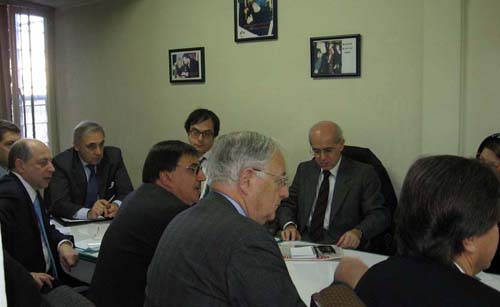
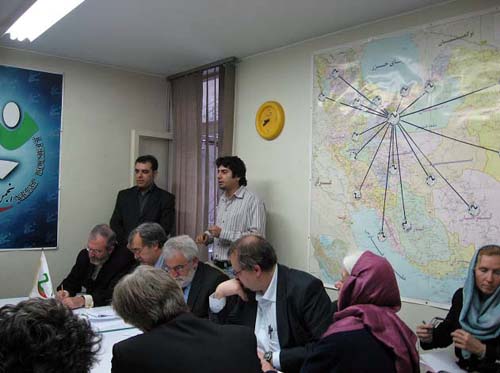
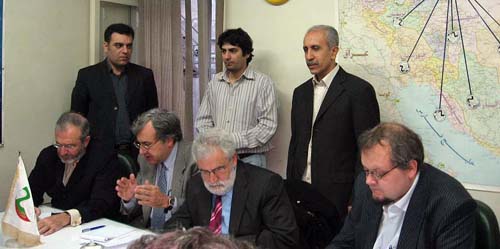
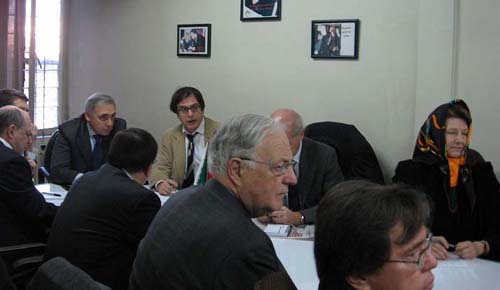
EP Delegation to Iran visits Nejat Society

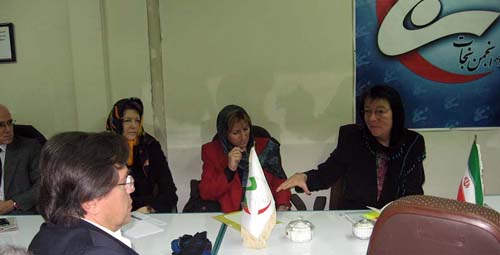
On Sunday 9th December 2007, the European Parliamentary Delegation to Iran met with the members and associates of Nejat (rescue) Society in their office in Tehran.


The Delegation which was headed by Ms Angelika Beer MEP from Germany (the Chairwoman of the EP Iran Delegation) consisted of 24 MEPs from various groups from different European countries.

Mr Arash Sametipur a former member of the military section of the Mojahedin-e Khalq Organisation (MKO) and one of the administrators of the Nejat society welcomed the delegation and introduced the goals and activities of the society. He discussed how he was recruited in the USA and sent to Iraq to receive military trainings as well as ideological teachings and then sent to Iran to carry out assassinations. He explained that since the Iranian authorities have a good understanding of the cultic nature of the MKO and they are well aware that the followers are brainwashed, they consider the members of the MKO as the prime victims of the organisation which must be helped rather than be punished.

Then Mr Sametipur invited Mr Ebrahim Khodabandeh and Mr Jamil Bassam former members of the MKO from the political section to talk about their experiences with the activities of the organisation in the western countries. Mr Khodabandeh referred to the absence of Mr Paula Casaca MEP from Portugal who dropped his name from the list of the delegation in the last minutes due to the pressure imposed by the MKO. He said that he was really willing to visit Mr Casaca today and tell him some mere facts about Iran and about the MKO. He mentioned that surely Mr Casaca missed an opportunity to face the truth.

Next was Ms Hura Chalchi another administrator of the Society and also a former member of the military section of the MKO who went into the details of the society’s activities. She brought up the case of the families of the members of the MKO in Ashraf Camp in Iraq who have no contact with their beloved ones and urged the European parliamentarians to make every possible effort to ensure a safe and private meeting between the families and their relatives inside the MKO.

Mr Qorban-Ali Pur-Ahmadi from Gilan province and Mr Reza Sadeqi Jebali from Esfahan, both former members of the MKO and present members of Nejat Society spoke next. Mr Jebali referred to his last meeting with Mr Casaca in Ashraf Camp in Iraq and said that he was really looking forward to seeing him here today since he had spoken with him in Ashraf Camp and today he wanted to tell Mr Casaca the other side of the story about the MKO which he has never heard before.

Then Ms Shahin Rabi’i a relative of a member of MKO in Ashraf camp addressed the delegation and expressed her demand of private contact with his brother Sa’id in Iraq. She said that she believes her brother has been mind manipulated and she seeks a way to help him out.

Then the members of the EP delegation raised their questions which were answered by the administrators and members of the society. Baroness Nicholson of Winterbourne MEP from the United Kingdoms referred to her visit with Mr Khodabaneh and Mr Bassam in Evin Prison four years ago on the demand of the family of Mr Khodabandeh in Britain and said that the MKO made a huge propaganda demonstrating that these two individuals were under severe torture and soon would be executed which later was proved to been wrong.

Members of the delegation also expressed their regret about the presence of Mrayam Rajavi in the European Parliament and emphasised the fact that these people like all cults do not expose their real identity and try to deceive people to reach their own goals. In the end Ms Beer thanked the Nejat Society for providing them with good information about the MKO.

Some materials and documentations on MKO were handed over to each member of the delegation.

Nejat Society,12 December

December 12, 2007 0 comments
FacebookTwitterPinterestWhatsappTelegramSkypeEmail
The cult of Rajavi

Brainwashing: Crime against Humanity

Gathering and Speeches in the city of Tabriz in Iran

On Tuesday 4th of December 2007, a meeting was held in the Law Department of Tabriz Islamic Free University. The topic was "Brainwashing: Crime against Humanity".

The meeting started at 1600 hours with the attendance of hundreds of students and scholars. Dr Samad Azizi the head of the Law Department opened the meeting and welcomed the students and participants. He introduces the presenters and discussed the importance of the topic in the world today.

Then Dr Hassan Movassaqi a senior lecturer in the Law Department started his speech. He gave a background of brainwashing in the history and discussed its consequences on human life in details. He went through many past examples of brainwashing and showed how it abuses human rights and why it must be considered as a crime against humanity. He scientifically showed the psychological aspects of brainwashing and explained how someone could hold control over other people’s minds and change their thoughts and persuade them to do deeds against their own will. He referred to the Davidian Cult lead by David Koresh in Waco in Texas and their final fate and called upon the International community to adopt serious measures to tackle this global difficulty urgently.

The next presenter was Mr Ebrahim Khodabandeh a former member of Mojahedin-e Khalq Organisation (MKO) lead by the cult leader Mas’ud Rajavi. He spoke about his experiences of 20 years membership in the MKO and gave many examples of how a person could practically be brainwashed.

He mentioned that he has been studying about cults and their common techniques of thought reforms since he left the organisation in 2003 and returned to Iran. He went into details of the process used by the MKO and many other cults to manipulate their members using psychological methods in order to recruit, preserve and control their followers.

He concluded that the leader of a cult is the only person responsible for the crimes committed by the cult and all followers are themselves the prime victims of the brainwashing practiced inside the cult. He explained how followers of a cult are mentally captivated and why they see no way out of their misery. He therefore concluded that the followers must be helped and the leaders of all destructive cults must legally and internationally be prosecuted and brought against justice.

Then Mr Arash Sametipur another former member of the MKO started his speech. He too explained his own experiences within the Rajavi’s Cult. He mentioned that many former members of MKO have organised themselves into an NGO called Nejat (Salvation) Society and their aim is to free the present members held captive in the Ashraf Camp in Iraq.

He emphasised that many families of members who are brainwashed by the MKO are extremely worried about the destiny of their beloved ones and they need urgent help.

In the end Mr Khodabandeh and Mr Sametipur answered the students’ numerous questions. Apparently the topic of the meeting and the speeches had extremely drawn the attention of the students. They demanded that more of such sessions be held in the future. This meeting finished at 1830 hours.

The students were ever so eager to learn more about the methods of brainwashing utilised inside the MKO and hours after the termination of the meeting they had circled around the two former members and asked them various questions. Some students showed interest to be in contact with the Nejat Society. Some reporters and photographers from the media were present in the meeting too.

Nejat Society

December 11, 2007 0 comments
FacebookTwitterPinterestWhatsappTelegramSkypeEmail
Mujahedin Khalq; A proxy force

Arming proscribe terrorist organisations like Mojahedin Khalq

Americans bizarre approach in arming proscribe terrorist organisations like Mojahedin Khalq Full report: Solana, Al-Baradi’i and China good for Iran’s active diplomacy  Ali Larijani said that Iran, Javier Solana and International Atomic Energy Agency are the three angles of a triangle that has brought fruitful results for the Islamic Republic’s diplomacy while stressing the importance of using China as a potentially important card to play for future diplomatic engagements. At 1913 gmt the Iranian television started broadcasting a live interview with Ali Larijani, the former head of the Supreme National Security Council of Iran. Reacting to the National Intelligence Estimate report on Iran’s nuclear policy Larijani said:”This is in effect a triangle one of the angles of which is Iran, another which is Solana and the third is Al-Baradi’i… The Chinese have significant economic ties with us, while at he same time we have common interests. In other words, if a certain problem arises and becomes complex then the principle country within the group of 5+1 to be affected by this will be the Chinese”

The presenter, Morteza Heydari, asked for the overall reaction of Ali Larijani who said that ”this is a great fiasco for the Americans. The Americans must be impeached for this”. He added that although there are many ifs and buts in the report the main contention of the report is that the basis of all allegations against Iran is false. He pointed to the fact that the report says that ”we can say with great confidence that Iran does not have a military programme in its nuclear project”.

Larijani added: they do leave the door open with certain ambiguities in their report to allow US adventurism.

He went on to add that three issues come out in the overall analysis: Firstly that Iran has no nuclear arms. Secondly, that between 2003 and 2007 it has not pursued a military programme in its nuclear project and finally that it will not be able to do that until 2015.

He stressed that the report makes some erroneous statements notably that Iran has been pressurised into its cooperation with International Atomic Energy Agency. He dismissed these saying that they have misunderstood Iran’s confidence building and good will measures.

Presenter asked him why is it that out of the 150 page report they have only published 9 pages of it. Is it because the Americans are saying that Iran has stopped its military programmes when pressures increased on Iran or is it that the Democrats have put pressure on the Bush Administration to publish these nine pages.

Larijani said that this is no accidental leak or due to Democratic pressure. He continued that the Americans are facing a ”crisis of honesty”.

The former Supreme National Security General-Secretary and present advisor to the leader added that Bush had, also, said that it is due to the reforms of the intelligence apparatus that these sorts of reports come out. He dismissed it as disingenuous and dishonest.

He conjectured another possibility on the so called ”Zionist lobby”. 1930

The National Security advisor to the leader added: The other possibility is that they may try to manipulate some members of the 5+1 saying that although we accept that there may be no military aspect to Iran’s nuclear programme it nevertheless shows that pressures on Iran have worked which is why no military pursuit of the nuclear programme has been detected.

Larijani, also, paid tribute to the Iranian nation’s resolute stance against ”bullying” by USA and this is what has caused the report to be leaked.

Presenter asked why is it that the ”Zionists” have firmly rejected the report despite the fact that many of the European countries have reserved judgment.

Larijani said that ”Zionist” leaders have been shocked by this report. He said that he doubts that the ”Zionists” will be able to make great capital out of this.

Larijani added that the Chinese are playing a more active role which is positive and must be welcome.

Larijani said that there is no guarantee that the Americans will come to their senses and stop their policies against Iran. They have to understand that through putting pressures on Iran they can not dissuade Iranian people from their nuclear policies.

He added that as Iran is a democratic country then Iran must be engaged diplomatically:”If there is a country with a sustainable democracy in the region it is Iran. The influential aspect of Iran is important in the region. It is obvious that they can have a proper engagement with this country. It is in the interests of the 5+1 countries. When I spoke to some leaders of Europe they used to tell me that they want to use Iran’s potential to create security in the region and for extending economic relations. You can use this potential. It will be in your own interests. And, naturally you will achieve more in the realm of regional interests and energy security and comprehensive economic relations with Iran. This is our suggestions.”

Asked about President Bush’s statement that ”Iran is a danger” Larijani said that ever since September 11, 2001, there is an air of savagery in American attitudes.

Presenter asked that one of the reasons cited for the subsiding of tensions in Iraq is due to Iran meddling less in Iraq affairs, how true is this?

Larijani said that talks were held three times with Iran. Iran has presented a coherent programme to help Iraq but the Americans are conducting certain bizarre approaches such as arming non-military groups some 70,000 in number. He drew parallels between this policy and arming the Mojahedin Khalq fighters and Pezhak in Kordestan. He called this serious. He said that this tactic will not change the realities of Iraq.

He went on to say that Iran has always helped the Iraqi government while knowing its own obligations and duties.

He dismissed the war-peace dichotomy of some of the discourses in the West adding that these are for internal consumption and they are false, no one wants to see war and things must not be seen in such black and white terms.

Presenter asked him what the realistic scenario for Iran’s dossier to be closed in the Security Council?

Larijani said that by rights Iran’s dossier must be closed. He added, however, that what is right is not necessarily what will happen in reality.

Larijani added:”We have to pursue an active and smart diplomacy in order to block their adventurism. It is obvious that the Americans are pursuing a policy of creating nuisance. This particular avenue [The nuclear dossier] has been blocked now but they will pursue another agenda. It is clear what this new agenda is going to be. It is not very complex. I believe that if Iran pursues a several-pronged approach – which at any rate it is doing already – it can be quite effective. One of these is cooperation with the Agency. We have said that we will follow this line up. Mr Al-Baradi’i’s report was a good one. Of course I have made criticisms of it saying that it had to be written in a more precise way. Some of its statements are not the sort which is at the level of the Agency’s function. It suffers the same problems as this present report [The Intelligence Estimate] saying, for example, that Iran’s cooperation has been reactive. This has no technical or legal characteristic but can turn into a pretext for trouble-making entities.”

He also emphasised the negotiations with Javier Solana, the EU foreign policy chief saying:”The talks with Mr Solana are quite helpful. Please pay attention to the fact that the Modality approach was the fruit of the debates that we had with Mr Solana. In reality we made an agreement in Lisbon on the basis of which the modality of cooperation with Mr Al-Baradi’i was formulated and an agreement was reached with him. This is in effect a triangle one of the angles of which is Iran, another which is Solana and the third is Al-Baradi’i. This will really help.”

He further pointed to cooperation with the Chinese saying:”I believe that the Chinese constitute a good potential in this too. And my understanding that there are countries who are interested in China playing a useful role. The Chinese have significant economic ties with us, while at he same time we have common interests. In other words, if a certain problem arises and becomes complex then the principle country within the group of 5+1 to be affected by this will be the Chinese… I see that the future is generally bright but we need to pursue a smart diplomacy.”  BBC Monitoring Middle East, December 07, 2007 Source: Vision of the Islamic Republic of Iran Network 2, Tehran, in Persian 1900 gmt 4 Dec 07

December 9, 2007 0 comments
FacebookTwitterPinterestWhatsappTelegramSkypeEmail
Lord Corbett

Open letter to Lord Corbett by Mohammad Sobhani

 Dear Lord Corbett

I have read all of your interviews and written statements that are to be seen on the website of the Mojahedin Khalq Organisation with interest and concern. I am committed to human rights and am studying intensely the politics in and around Iran. Therefore it would be a pleasure for me to add to your information.

In your interviews, you have mentioned that the history of the Mojahedin Khalq Organisation’s armed operations goes back to before 2001, and you have emphasised that they have preformed no terrorist or similar activities after this date. What I really want to know is whether the organisation has in fact ruled out armed struggle – once the core of its ideology, strategy and tactics. Or is it simply because the organisation is incapable of carrying out terror acts at this moment in time?

As I understand it, you are not supporting or sympathizing with the MKO or National Resistance Council (NRC). At least, you stated as such in your interview with the BBC:

“I do not support the MKO or the National Resistance Council. I do support the UK.” The reporter asks: “You are trying to impose the MKO on the Iranian People?” Your reply: “I am trying to pursue the benefits of the UK.”

In another interview, you have mentioned:

Israel has good relations within the U. S. and can arrange for the MKO being eliminated from the list of terrorist groups. Thus, the MKO will be enabled to initiate its struggle against Iran from Iraqi territory. We are sure that if the MKO should start its battle against Iran, it will be supported by the Iranian people. The Iranian government would quell the opponents and trigger an inner civil war. The National Liberation Army (NLA) would intervene in order to prevent bloodshed. The mullah’s regime would fall and the MKO would take over.“

In my opinion you are not a supporter of the MKO but a patriotic citizen of the UK. Therefore you want to use the MKO as a military tool in terms of the accomplishment of your objectives. But I want to advise you that your theory is wrong. I would like to draw your attention to my thirty years’ experience resulting from my former membership with the MKO.

If you are seriously interested in accomplishing the objectives of your home country, then why do you want to ride on a dead horse, the MKO? Do you really believe that the MKO has any support in Iran?

Please believe me, each and every political group or individual opposing the Islamic Republic, whether monarchist, republican or nationalist, all consider the MKO as remnants, the leftovers of the former Iraqi dictator Saddam Hussein and terrorism. Nothing else.

Do you know that this organisation is presenting itself with two different faces: one humanitarian, for the public and another one, military and sect-like to the inside.


The MKO is a terrorist organisation as well as a religious sect. The MKO has linked the ideology of Marx and Lenin with Islam and established a radical organisation.

Without the express approval of its religious leaders, Massoud and Maryam Rajavi, all marriage is prohibited. The future and destiny of their members depends on their decision only.

Those who wanted to decide for themselves about their private lives have been executed by the organisation. One of the victims was Alinaghi Hadady, whom I knew personally. At that time I was a member of the Central Committee and dared to protest against repression and violation within the organisation. Due to a direct order of the religious leaders Massoud and Maryam Rajavi I was given an extrajudicial sentence of imprisonment under solitary confinement, first at camp Ashraf and then in the prison of Abu Ghraib for a period of 9 years.

When Saddam Hussein was still in power in Iraq, the organisation was given the best opportunities, whether militarily, logistically or financially. They enjoyed full support from Saddam. And did it ever use one of the opportunities to make a step towards democracy in Iran?

Since 1981 the organisation tried to bring a so-called democracy to Iran by committing terrorist activities and assassination. But this led to a dead-end-street. Democracy will not be established by bringing violence to the people.

If what the MKO asserts is true, if there really is sympathy for them in Iran, then why do the leaders and their command live abroad and commit attacks inside Iran?

I wanted to write more to you about my experiences and with information about Iran and MKO, but I would prefer a personal meeting with you. Me and my colleagues would be pleased if you gave us the opportunity to speak to you personally.

Yours sincerely,

Mohammad Hossein Sobhani

08.12.2007

Postfach 90 06 63

51116 Köln“Deutschland

Phone: +49 (0)1639076911

Email:sobhani_m_h@hotmail.com


Mohammad Hussein Sobhani, December 08, 2007 –  http://www.iran-ghalam.de/2Haupt/2157.sobhani.8.12.07.HTM

December 9, 2007 0 comments
FacebookTwitterPinterestWhatsappTelegramSkypeEmail
Newer Posts
Older Posts

Recent Posts

  • The Psychological Impact of MEK Ideology on Members

    August 17, 2026
  • A study on the financial mechanism of the Mujahedin-e Khalq

    August 10, 2026
  • A Child behind the Ideological Bars of Massoud and Maryam Rajavi

    August 8, 2026
  • A Comparative Analysis of Psychological Control Mechanisms in Jeffrey Epstein’s Cult and the MEK

    August 3, 2026
  • Operation Mersad: How Iran foiled Saddam’s final gambit 37 years ago

    August 1, 2026
  • Facebook
  • Twitter
  • Instagram
  • Youtube

© 2003 - 2025 NEJAT Society . All Rights Reserved. NejatNGO.org


Back To Top
Nejat Society
  • Home
  • Articles
  • Media
    • Cartoons
    • NewsPics
    • Photo Gallery
    • Videos
  • Publications
    • Books
    • Nejat NewsLetter
    • Pars Brief
  • About Us
  • Contact us
  • Editions
    • عربي
    • فارسی
    • Shqip