Nejat Society
  • Home
  • Articles
  • Media
    • Cartoons
    • NewsPics
    • Photo Gallery
    • Videos
  • Publications
    • Books
    • Nejat NewsLetter
    • Pars Brief
  • About Us
  • Contact us
  • Editions
    • عربي
    • فارسی
    • Shqip
Nejat Society
Nejat Society
  • Home
  • Articles
  • Media
    • Cartoons
    • NewsPics
    • Photo Gallery
    • Videos
  • Publications
    • Books
    • Nejat NewsLetter
    • Pars Brief
  • About Us
  • Contact us
  • Editions
    • عربي
    • فارسی
    • Shqip
© 2003 - 2024 NEJAT Society. nejatngo.org
Iraqi Authorities' stance on the MEK

Presence of MKO terrorists contrary to the interests of regional states

Baghdad, Oct. 31, IRNA – Elsewhere in his remarks, Mottaki said no matter under what pretext terrorist groups such as Mujahideen Khalq Organization (MKO), Kurdistan Workers Party (PKK) or the Party for Free Life in Kurdistan (PJAK) act, what is important is their actions which disturb security in the region, he added.

Meanwhile, Zebari told the press conference that presence and activities of such terrorist groups as MKO, PJAK or PKK are contrary to the interests of regional states. 
November 4, 2007 0 comments
FacebookTwitterPinterestWhatsappTelegramSkypeEmail
The Ideology of the MEK

The Ideological Revolutionary and the Failed Strategy of Overthrow

Internal ideological revolution within Mojahedin-e Khalq Organization (MKO) was started as a result of a number of factors including the strategic failure of the organization in overthrowing the Iranian regime. In fact, the revolution was the outcome of the two fold necessity of first to overcome the encountered internal crises and second, to secure the political revival of the organization. In addition, the danger of split threatened Mojahedin more than before. The organization’s failed policy of overthrowing Iranian regime that was much a result of the leadership’s autocracy and defect of a sound political vision ended in absolute failure and the consequent withdrawal of the operational teams back to the Western borders and eventually onto the Europe. Massoud Rajavi in Paris declared that the Iranian regime enjoyed only 10-15 percent of public support and promised its overthrow in a one to three-year-long period.

As the first reaction to this failure, Rajavi determined two successive short-time and long-time plans for overthrow. However, recalling forces to abroad and their exit from Iran led even the most optimistic MKO members to be pessimistic about the made claims. As such, the first signs of challenge between the leadership of Rajavi and the rank and file appeared. After a while, the Iranian regime managed to control the crises completely which affected the status of Mojahedin and its alias, the National Council of Resistance. Deeply mired, it was impossible for Mojahedin to either change and reform the existing conditions or continue their adopted policies. Niyabati expounds on the conditions leading to the development of ideological revolution as follows:

It was impossible to do with the existing conditions due to the internal discrepancies within the sole democratic alternative whose present fragile political alliance hardly moved on the past line on the one hand, and the inevitable backwash of MKO’s failed strategy of overthrow in short-time within the organization and all around the world on the other hand. 20

It was the same case within the NCR. Those NCR members who were deceived to join on the pretext of short-time overthrowing of the Iranian regime and mainly aimed to achieve their own objectives were instigating a second crisis. Naturally, it was Rajavi who was the target of all accusations. In this regard, Niyabati says:

It was even worse in political stage. Mojahedin’s failure to overthrow the regime in short-term and to integrate, claiming to be the sole democratic alternative, anti-monarch and anti-cleric political parties put heavy pressure from the inside and outside on Mojahedin. It was self-evident that Rajavi was the one to be accused. 16

As the critics challenged the leadership increasingly, the first stages of the ideological revolution were planned in order to control the internal crises. Almost all the MKO ex-members refer to the challenge as the main factor leading to the ideological revolution. Failing to present convincing explanations, Mojahedin accuse dissatisfied members and critics in different ways and label them with a variety of names. Bijan Niyabati evaluates the mechanism and the necessity of the ideological revolution similarly. He reviews the interval between the declared armed struggle phase up to the meeting of Rajavi with Tareq Aziz and points to the fact that the ideological revolution was the sole solution to overcome from the strategic failure of the organization. Summarizing the course of events from 1981 to 1984, Mojahedin are convinced that a shock is assential to control the internal crises of the organization:

The year 1983 was the decisive year in all political, military, strategic, and ideological stages. The encountered cul-de-sac in political, military, and armed resistance as well as the proven inability to overthrow the regime in short-term, which was evident in late 1982 and was proved to be impossible through 1983, forced two options on Mojahedin. It had to either submit to the existing conditions or resort to politics or, by embracing all internal, external, and international consequences of resorting to armed warfare and violent overthrow of the regime, lean to the left and yield to radicalism. 17

The most probable reaction on the part of the members was predicted to be a split in the organization. The opposition of dissidents who played a key role in the organization, led the officials to give priority to confront and overcome the threat of another schism. As Niyabati writes:

It was a prepared condition only if one out of many members of the time’s political bureau or central committee, who were brilliant campaigners against the two regimes, moved on a different path and overtly questioned the failed guerrilla armed struggle. Among the other lower-rankings, problem-makers like Parviz Yaqubi and Saeed Shahsavandi and so were enough to sound the alarm.21

Finally, to become immunized against any risk of split and demise, the organization resorted to the ideological revolution. Since the rank and file’s challenge with the leader was highly probable due to the strategic failure of the organization, the ideological revolution mainly aimed at keeping the leadership out of the reach of any criticism and entrusting him an unquestionable ideological and political status. Niyabati believes:

To protect revolution against reactionary moves and practices of exploitation, the sole solution is to immune the organization and its leadership against splitting and disintegration. 21

Thus, the ideological revolution was devised as a firewall and immunity that protected the organization against any form of demise. However, the avalanche-like detachment of MKO and NCRI members well indicate that the organization was stepping onto a path of deviation both in principles and leadership.

The quotes are all from Bijan Niyabati’s A Different Look at Mojahedin’s Ideological Revolution, originally in Persian.


Bahar Irani – Mojahedin.ws – November 3, 2007

November 4, 2007 0 comments
FacebookTwitterPinterestWhatsappTelegramSkypeEmail
Mujahedin Khalq 's Function

Opaqueness of Mojahedin Khalq Financial Resources (2)

The revolutionary seizure of some members and sympathizers’ properties by the agents of MKO has long been justified in the organization as one of the approaches to raise funds for the group’s budget. Even before the Islamic revolution of 1978 in Iran, MKO and some active armed militia advocated bank robberies and similar ransacking acts as revolutionary deeds to support the struggle. As confessed by Ali Mihandust, a member of MKO tried in Pahlavi’s reign, such acts were justified as part of urban warfare:

A look over the course of struggle during the past year and the extension of blasts, confiscation of the banks, assassinations, kidnapping and similar acts are all evidences of ongoing urban warfare in our society. [1]

The reasoning for involving in these illegal and criminal fundraising activities is more a result of the ideological influences of Marxism and modelling on some other terrorist and militia groups. The majority of the groups that MKO modelled after justifiably followed Machiavellianism in their line of struggle. Of course, the deeds are rationale according to ideological infrastructures, and as Walter Reich explain:

The cause, as codified in the group’s ideology, according to its line of reasoning, becomes the rationale for acts the terrorists are driven to commit. [2]

Believing to be a forerunner in an anti-capitalism struggle, MKO rationalized their illegal accumulation of revenues. They believed that what they did was an inconspicuous and undeclared war against the domination of capitalism. Permitted by MKO’s leadership, a number of members employed by some private and state-owned European firms and factories purloined sums of money and properties both to meet their running expenses and to accomplish the struggle. Ali-akbar Rastgou, an ex-member, quotes Massoud Rajavi justifying theft and purloin:

Through these deeds [theft] we recover our violated rights from the dominant capitalism in the West. It is also lawful according to Islamic laws since the Prophet himself before the reign of Islam 1400 years ago looted the mercantile caravans, being at war with them, and seized their properties to solve his military financial problems. They called it revolutionary seizure. [3]

An important point to mention is that Mojahedin’s leadership had banned the top cadres to be engaged in such activities because of their key role in diplomatic relations. As Rastgou explains:

The outcome of some meetings was Rajavi’s order, except for the members of diplomatic bodies, to all allied associations and sympathizers to take advantage of revolutionary seizure for financial autarky. Consequently, the associations initiated special departments to organize for these crooking deeds. [4]

These are the most common activities among some cults and particularly in MKO as fundraising operations. Another technique manipulated by MKO to raise fund is involving in sophistically organized financial activities.

The organized financial activities

It is the most common technique manipulated by MKO to accumulate big revenues. To involve in illegal financial activities, MKO needs to indirectly register and initiate commercial institutions as well as taking part in private shareholding and investment business under different alias because of the imposed bans following its acknowledgment as a terrorist group. Stealthy and underground financial activities have so far remained as undiscovered. Nobody can believe that accumulation of big sums of money in the organization, as discovered by the French police in its raid into MKO’s headquarters in Paris, come from donations of sympathizers. In this respect, Antoine Gessler believes:

Money remains one of the big unknowns in PMOI’s financing. Must we believe Maryam Rajavi when she flatly claims that the money all comes from fundraising among the Mojahedin and their supporters? This was notably the case in explaining the millions of dollars uncovered during”Operation Theo”. This is just the tip of the iceberg. The PMOI has a lot more at its disposal. [5]

Maryam Rajavi’s claim is in total contradiction with the police investigation that is dubious about the source of the found money:

This statement is in serious contradiction with the police investigators who all note that large amounts of PMOI money circulate around the world through”dirty”networks. [6]

Implicitly stated, it is proven that the organization is involved in a variety of widespread illegal and clandestine activities. According to released information by DST, French Counter-intelligence, certain members on behalf of the organization are involved in dubious, financial activities:

The study of the accounts of certain members of the organisation shows this complexity. The large sums involved and managed by these individuals far exceed their own professional income. They are, in fact, usually without any real profession, or business activity, at least as far as the tax authorities and social institutions are concerned. [7]

Antoine Gessler further points out to the complexity of the organization’s financial networks:

The identification of the financial networks of the People’s Mojahedin Organisation of Iran is anything but easy. The organisation has set up international financial circuits that are very complex. Their opaqueness is such that they are very difficult to ‘read’. The source and destination of the funds are often unknown. [8]

The extension of the fund network makes it a hard task to discover the gathering and channelling of revenues. No credited person can be traced for deposits and redeposits that easily flow in different countries unnoticed:

Information from many sources about the flow of these funds between networks of bank accounts shows a closed circle, difficult to penetrate and evaluate. For example, an account receives deposits from Jordan, Belgium, Germany, etc. and is then debited for new redeposits in France, Germany, Denmark, Norway, Italy, Great Britain, Switzerland, Luxemburg, the United States and so on. [9]

Unproved presence of members and sympathizers in the circle of financial activities in the Western countries complicates identification of fund collection. But, there is no doubt that none of these activities are legal since the organization well justifies the means to achieve the end.


Sources:

[1]. The Last Defense of Martyred Mojahed Ali Mihandust; Published by MKO.

[2]. Walter Reich and Walter Laqueur; Origins of Terrorism: Psychologies, Ideologies, Theologies, States of Mind, 35.

[3]. Ali-akbar Rastgou; Mojahedin mirrored in the history.

[4]. Ibid.

[5]. Antoine Gessler; Autopsy of an Ideological Drift, translated byThomas R. Forstenzer, chapter 15.

[6]. Ibid.

[7]. Ibid, chapter 14.

[8]. Ibid.

[9]. Ibid.


The excerpt from chapter 14 of Antoine Gessler’s “Autopsy of an Ideological Drift” exclusively discussing MKO’s illegal fundraising and financial activities.


Finance

The PMOI needs a big budget to support its activities. These include managing its real estate, its communications system, the travel of its militants and the maintenance of its Anny in Iraq. According to our information, the organisation does not use illegally obtained funds. On the other hand, the PMOI and some of its members are under indictment or civil action for misallocation of funds. This is notably the case in Germany, where significant sums of German private donations and State subsidies were used, in fact, for the purchase of arms for PMOI terrorists and militants in Iraq.

Part of their finances comes from fund raising among individuals and groups of Iranian expatriates. This is done by the PMOI representatives in Europe, North America and the Middle East. Another part comes from its own members dues. They are required to pay regular”tithes”to the organisation. Finally, there was Saddam Hussein. He was the main funder, providing sums estimated at several hundred million dollars.

The identification of the financial networks of the People’s Mojahedin Organisation of Iran is anything but easy. The organisation has set up international financial circuits that are very complex. Their opaqueness is such that they are very difficult to ‘read’. The source and destination of the funds are often unknown. There is a clear policy of hiding the organisation’s financial operations, a source of pride to a membership tempered in clandestine operations.

The financial assets of the People’s Mojahedin of Iran travel through a complicated web of bank accounts in France, throughout Europe, in North America and in the Middle East. The legal holders of these accounts are either real people or private groups, many domiciled in France.

As to the private groups, the Iran Aid Association has as its official humanitarian and social aim the collection of funds in French territory from private donors. They place the vast majority of these monies in foreign personal ban~ accounts, largely in Turkey and the Arab Emirates. These are countries in which all trace of the funds is lost, especially their final destination. Strongly suspected of financing the PMOI’s terrorist war against Iran, as well as its terrorist operations inside the country, the Association succeeds in violating its private, non-governmental status in France, by flouting its statutes and humanitarian basis in law…

Information from many sources about the flow of these funds between a network of bank accounts shows a closed circle, difficult to penetrate and evaluate. For example, an account receives deposits from Jordan, Belgium, Germany, etc. and is then debited for new redeposits in France, Germany, Denmark, Norway, Italy, Great Britain, Switzerland, Luxemburg, the United States and so on.

The study of the accounts of certain members of the organisation shows this complexity. The large sums involved and managed by these individuals far exceed their own professional income. They are, in fact, usually without any real profession, or business activity, at least as far as the tax authorities and social institutions are concerned. The account holders are, thus, very difficult, almost impossible to find. They are all housed at ‘convenience’ addresses of”convenience”, where they most certainly do not reside.

November 4, 2007 0 comments
FacebookTwitterPinterestWhatsappTelegramSkypeEmail
Missions of Nejat Society

Bringing Freedom

Salvation

November 4, 2007 0 comments
FacebookTwitterPinterestWhatsappTelegramSkypeEmail
Nejat Publications

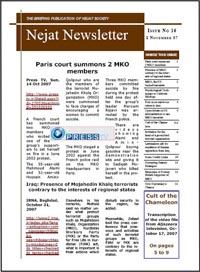
Nejat NewsLetter NO.16

Nejat News LetterINSIDE THIS ISSUE:

1.    Paris court summons 2MKO members

2.    Presence of MKO contrary to the interest of regional states

3.    MKO, the US backed terrorists

4.    Psychological Techniques to Cultivate Ideology

5.    Four more survivors return to Iran

6.    Open debate in US administration to use MKO terrorists

7.    Cult of the Chameleon

8.    Invitation for the head of a proscribed terrorist organization

9.    Lawmakers call for expulsion of Iranian opposition from Iraq

10. Some Useful Links  

11. Disrupting Satanic Strategies

12. Memories of Former British Supporter of MKO

13. Give Diplomacy a Chance  

Download Nejat NewsLetter-ISSUE NO.16

November 1, 2007 0 comments
FacebookTwitterPinterestWhatsappTelegramSkypeEmail
The cult of Rajavi

Fundraising Cult techniques within MKO

Failing in its military phase, although never denouncing its armed strategy, Mojahedin-e Khalq Organization (MKO) has adopted a diplomatic phase mainly stressing on a prodemocracy campaign in the Western countries as an appropriate means to survive. The new phase, in contrast to its previous aggressive phase, relies less on the human forces and more on abundant financial sources that play a crucial role in the life and demise of the organization. The ever-increasing propaganda and political expenses in the West, modern lifestyle privileges, as seen in the leaders and the members of the National Council of resistance, as well as the running daily expenses of the forces residing in Camp Ashraf and those scattered in other countries require tremendous financial resources. A simple calculation reveals that the organization does have to avail unlimited financial resources to meet its surging financial expenses. Even the organization itself implicitly denies its total rely on sympathizers’ financial aids especially when nobody knows how long they have to sit waiting for the regime’s overthrow. The curious paradox is so disturbing that it makes leaders give some justifying explanations from time to time. In his message delivered on July 3, Massoud Rajavi stated:

Only the Iranian people and history are qualified to make any judgment on the veracity and independency of this resistance. We have reiterated that we are ready to give a detailed record of what we have done through a forty-two year long struggle and any spent penny to Iranian people living in any region from the north to the south. [1]

That is nothing more than a tactic to evade giving justifiable explanations. To escape imposed allegations the organization had to react by periodically calling for donations and financial aides, as advertised in its media and press, in the past two years.

The released documents after the fall of Saddam and also admissions made by the ex-members all indicate that Mojahedin had received abundant sums of dollars from the Iraqi agents as a bounty for espionage collaboration. Only in one of these sessions, due to reported information by Abbas Davari, the Iraqi agents granted the organization a remarkable sum of 50 million in dollars.

No doubt, from the day Mojahedin settled in Iraq till Saddam’s fall, the organization fully benefitted Saddam’s bountiful financial aids. But Saddam’s fall and the regional and political fluctuations led Mojahedin into a financial vacuum and they had to look for new resources to cover their huge expenses. But Mojahedin suffered no financial shortages since they have been commonly indulged in a variety of cult-like techniques to raise funds. Besides, they have promoted much developed and sophisticated techniques. The techniques can be classified and separately discussed as follows:

– Internal techniques of financial abuse

– Organized techniques of fundraising

– Political and social techniques of abuse


Internal techniques of financial abuse

The techniques mainly rely on members, sympathizers and their families’ financial potentialities. Being under political and psychological impact of the organization, they are more open to persuasion of the group and suggestible to offer what they are demanded. Politically, socially and ideologically convinced that the group draws the boundary between two worlds of absolute white and black, they are ready to offer whatever they own in addition to persuade friends and relatives to make remarkable donations. Here are the processes.


Persuading individuals to turn over their properties

It is not too hard to prove that under influential cult mechanisms the individuals willingly surrender whatever property they have gathered all through their career. When they easily consent to do whatever they are demanded to prove their loyalty and devotion to the cult and leader, it is much easier a task to relinquish property and savings unquestionably. To achieve the cause is deemed above anything and the worldly things have to be sacrificed for the greater achievement. That is the point where the individual is persuaded to close his eyes over whatever he owns as worthless unless spent for the accomplishment of the cause. The majority of the recruits in MKO who owned properties or savings rendered them up to the organization retaining not a penny.


Persuading individuals to earn incomes

It seems common in many cults to persuade individuals to travail in fitted professions to earn money for the cult. As the active members of a cult and organization, it is a part of their struggle for the cause to raise funds for the group’s expenses. Far above a duty, it is an organizational command to load the group’s treasure. At the present, many of Mojahedin’s cadres and members, based on their education and professional abilities, are engaged in a variety of profitable businesses and jobs to channel the incomes into the organization’s accounts. Explained by Anne Singleton, fundraising activities marked the degree of loyalty to Rajavi:

As regards membership, Rajavi has at his disposal, a totally loyal and self-sacrificing force of up to three thousand people who are willing to perform any task or deed he requires without question. One of the most important of these tasks has been a concerted and prolonged fund-raising campaign. For nearly two decades, the Mojahedin have been collecting money under the disguise of charity work for victims of Iranian repression, earthquakes and floods. Everyone who becomes involved with the Mojahedin is required to take part in fund-raising activities. This means standing in the street in all weathers, all day and asking the public for money. In the evening, a door to door collection is also employed. Collectors are urged to make up any deficit in their daytime amount in these evenings by working even harder. So important has this fund-raising become that classes are held to teach newcomers how best to manipulate the ‘subject’. Fund-raising very early on became a litmus test for support. Only those prepared to undergo the hardship and difficulty of this activity, were regarded as ready to move on to the next stage of involvement. [2]


Persuading individuals to engage in extortion and charity activities

As part of the organization activities’ duty in Western countries, they resort to a variety of alms gathering and charity activities in the streets. Through deceitful ways, they try to win the sympathy from European citizens under different pretexts of raising funds for homeless Iranian children, political refugees, the families of political prisoners, jobless and needy people and the like. Referring to bullying tactics of fundraising in Western streets, Anne Singleton writes:

When Maryam came to Europe in 1993, she brought with her a totally dedicated force who undertook any task required. They set about taking over from the supporters’ role of fundraising. With their bullying tactics, their productivity far exceeded anything seen before. Some were able to return up to 1500 pounds sterling, per day. But even before this, in one year alone, Iran Aid charity in the UK had a declared income of 5 million pounds. Its undeclared income has been estimated at over twice this, making a total of over 15 million pounds in one year. If this amount is multiplied for just ten countries: UK, USA, Canada, France, Germany, Italy, the Netherlands, Sweden, Norway and Denmark, then an annual amount of 150 million pounds can be estimated to have made its way to the Mojahedin organisation. If this is multiplied over ten years, then the figure of 1.5 billion pounds gives a rough estimate of the resources which Massoud Rajavi has amassed through the efforts of his devoted followers only in the streets of the West. [3]

Anne Singleton also states that the organization even exploited elderly members and sent them into the streets to collect money:

The Mojahedin have also brought to Europe some of their more elderly members who can no longer cope with the harsh conditions in Iraq. These people are also used in fund-raising. That is, standing in the streets from morning until night collecting money under the guise of Iran Aid. These elderly people have little other choice considering the pressures on them. [4]


Persuading individuals to extort money from the families

The individuals are persuaded to conceptualize a black and evil picture of whoever stays out of the context of the cult or organization. Thus the members are convinced that any action to deceive people in general and their parents and relatives in particular are acknowledged as right and ethical. As explained by Margaret Singer:

Psychotherapy and self, improvement cults are particularly known for getting members to produce revised personal histories and, especially, to view their parents as evil and no longer trustworthy. Similarly, as I have mentioned, the religious cults train members to regard outsiders, even blood relatives, as of Satan and to be avoided at all costs. [5]


The individuals, who have left their parents when they needed to have them along, as it is the case with members of Mojahedin, can readily plot to extort money from them. Many MKO’s ex-members confess that under the group’s instructions, they pried big sums of money out of their parents.

Cults also turn members against their families, using a plethora of rationales made to fit the group’s ideology. One political cult, for example, "tests" young recruits by having them deliberately lie to their parents while someone in leadership stands next to them when they make the call. This is a first step in both separating recruits from their families and teaching them to follow irrational orders. [6]


Revolutionary seizure

 Admitted by a number of the ex-members, the properties of some members and sympathizers in European cities were confiscated by the agents of the organization under the direct command of the Rajavies. The process will be discussed in detail.

Sources:

[1]. Massoud Rajavi’s delivered message on July.

[2]. Anne Singleton’s Saddam’s Private Army.

[3]. Ibid.

[4]. Ibid.

[5]. Thaler Singer, Margaret; Cults in Our Midst, p. 89.

[6]. Ibid.


Bahar Irani – Mojahedin.ws – October 27, 2007


October 30, 2007 0 comments
FacebookTwitterPinterestWhatsappTelegramSkypeEmail
The cult of Rajavi

Maryam Rajavi and Camp Ashraf: Cult Hallmarks of MKO

As mentioned in the previous article, exaltation of self-immolation in the messages of MKO’s leaders is in fact an applied ploy to encourage members to commit suicidal operations for cult causes. The causes displayed as holy, their accomplishment requires ceaseless sacrifices on the part of members. Eric Hoffer, explaining on the glorification of terror acts by the cults states: “The holy terror only knows no limit and never flags”.

Terror-exaltation is not the chief approach manipulated by certain cults and Mojahedin in particular. In his few messages delivered from his hideout in the past recent years, Rajavi has particularly provoked continuation of suicidal operations as an emergency exit from the raised crisis. The self elected leader of Mojahedin has mainly focused on the preservation of two cult dynamics as the strategic guidelines in his messages, namely, Maryam Rajavi and Camp Ashraf. Calling on all the sympathizers of Mojahedin to fight in a united front against the EU for the removal of the terrorist tag, Rajavi in his message of March 25 stated:

At the present, it is a national duty on any Iranian and especially on our victorious opposition forces throughout the world to preserve two things which have turned to be two sides of the same coin. On one side rests a portrait of Maryam and on the other side, a perspective of Ashraf. I urge you one by one to struggle like Maryam and along with her day and night to mint the coin and achieve the end. [1]

There seems to be no need to explain what crucial and strategic roles Maryam and Camp Ashraf play in Mojahedin’s explicit cult relations. Regardless of their political potentialities to motivate and push the insiders forward, they represent the unequivocal manifestations of a much transcendental entity, Massoud Rajavi, who can never be fathomed unless through a deep comprehension of Mojahedin’s internal ideological revolution. It does require a high price which the members have to pay. He patterns Ashraf as a model for all European sympathizers to follow:

Adhere to Ashraf’s resistance forces and rise up ahead in line with phoenix of liberty (Maryam Rajavi) in any region in the country. [2]

It might seem too exaggerating an idea that a geographically isolate military camp might maintain so dynamic prerogative to instigate a national uprising. Beyond a geographical location, Ashraf has to be regarded as Mojahedin’s ideological receptacle or a synagogue of organizational teachings whereto all the sympathizers have to inevitably turn their attention to be ideologically inspired. In fact, Maryam and Ashraf have impressions far beyond two names; they are instruments with two internal and external functions. Internally, they are concepts to convey the cult commands concealed from the eyes and notice of the west. Externally, they are manipulated to keep the cult’s ideology dark to buy political legitimacy. Theorizing the external aspect, Mehdi Abrishamch explained:

Internationally, we intend to convince countries that we are the ones who represent Iranian people. Of course, in none of the international scenes the issue of ideology and political stances is ever discussed. Of the importance is to impose ourselves, on account of a sea of blood, as representing Iranian people. In the accomplishment of this strategic line, we must incubate how to benefit the existing conflicts between the imperialists. [3]

The organized gatherings and extravaganzas in Camp Ashraf with Rajavi’s coincidently delivered messages entirely rotate around cult and ideological instructions. In his latest message, Rajavi called on all sympathizers to adapt themselves to Ashraf’s capacities. It is a command for any sympathizer to be detached from his/her personality and to develop a personality of absolute devotion to the organization and leadership. Rajavi’s messages work as a powerful magnet to associated scattered particles of the cult, a common procedure in most cults of personalities. Expounding on the effacement of individual separateness, Eric Hoffer writes:

The effacement of individual separateness must be thorough. In every act, however trivial, the individual must by some ritual associate himself with the congregation, the tribe, the party, etcetera. His joys and sorrows, his pride and confidence must spring from the fortunes and capacities of the group rather than from his individual prospects and abilities. Above all, he must never feel alone. Though stranded on a desert island, he must still feel that he is under the eyes of the group. [4]

Then, the insiders’ submission to the leader and whatever he demands them in his presence and absence is the result of his full authority over them. The sympathizers’ ideological dependence on the organization has convinced them that there are eyes watching them all the time and they must be in constant association with other particles to form a whole. Now in the absence of the leader, Maryam and Ashraf are considered the pivotal axle around which the whole body of Mojahedin rotates; they are the strategic red lines that nobody is permitted to transgress.

Sources:

[1]. Massoud Rajavi’s Message delivered on March 25.

[2]. Ibid.

[3]. Revolutionary Diplomacy vs. Liberal Diplomacy and open, anti-revolutionary policies, p. 12.

[4]. HOffER, ERIC; The True Believer, Harper &. Row Publishers, New York, 1966, p. 61.

Bahar Irani, Mojahedin.ws, October 19, 2007

October 28, 2007 0 comments
FacebookTwitterPinterestWhatsappTelegramSkypeEmail
The cult of Rajavi

Cult of the Chameleon

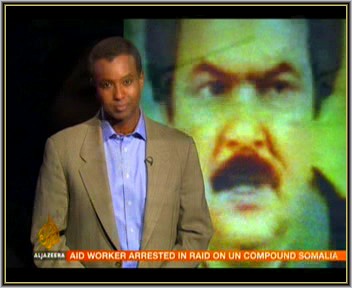
A documentary by Aljazeera television about Rajavi cult (Mojahedin Khalq Organisation) transcription and video file Aljazeera television, October 17, 2007  Aljazeera television on october 17, 2007 broadcasted a documentary about Rajavi cult. Cult of the Chameleon

Aljazeera

Aljazeera

Hello and welcome to WITNESS. I am Rageh Omar. During the ongoing and often contentious negotiations between Iran and the United States, there is one subject they both agree on: the MEK or the People’s Mojahedin of Iran is a terrorist organisation. Massoud Rajavi is the leader of this bizarre Iranian Cult Cult of the Chameleonwho over the years helped Ayatollah Khomeini overthow the Shah, then declared war on the Islamic Republic ruthlessly killing their fellow countrymen. They allied themselves with Saddam Hussein but now that he is gone are ardent supporters of the coalition. The MEK has switched allegiances so often that any underlying ideology is long gone. But one fundamental tenet remains; personal power.
Massoud Rajavi claims to be a bridge between his followers and God and the faithful believe him. Rajavi is a master of human psychology. He manipulated his followers’ weaknesses until they are prepared to do anything for him. One woman carried cyanide capsules in her mouth for two years ready to die for her leader.

Iranian film maker Maziar Bahari met her and other followers as he tried to untangle the CULT of the Chameleon.

Narrator: For more than three decades, it has been one of the most secretive cults in the world – The People’s Mojahedin of Iran – or the MEK. Its leader is Massoud Rajavi.

Anne Singleton: Massoud Rajavi has likened himself as the bridge between people and God. Now from that position, he can more or less order his followers to do anything.

Marjan Malek: The MEK tell their members that Massoud Rajavi is not only your leader, but also your husband, father and brother. He is the only one who should matter in your life and you shouldn’t think about anyone else.  Narrator: In a suburban house in the northern English city of Leeds, Anne Singleton looks like any other suburban mother having a bit of after school playtime with her son. But for Anne and her husband Massoud Khodabandeh, it has been a long strange journey to this normality.

In the 1970s like many university students, Anne was looking for a challenge and a cause. She found it in an Iranian revolutionary group active in Leeds University.

Anne Singleton (former MEK supporter): When I became a full time cult member I gave up everything that I had. I gave up my home, and all the possessions in it. I gave up my car. I converted to Islam. I became Moslem. I had even burned my diaries. Since I was a kid I kept diaries, and in order to show them that I was so dedicated to them I just burned them all. Just, I gave myself to them. 

Narrator: When Anne joined the MEK in Leeds in 1979, the organisation was helping the leader of the Iranian revolution – Ayatollah Khomeini – to depose Iran’s Monarch – the Shah.

The MEK shared Khomeini’s hatred of America and called him their Imam or Islamic leader. But the Ayatollah never thought Rajavi was a true Moslem. After the revolution, the MEK was outlawed, and Rajavi was banned from running for president.

Narrator: The MEK’s terror teams killed many officials as well as more than ten thousand innocent Iranians. In turn the Islamic government executed and tortured thousands of MEK members, and even those who only sympathised with Rajavi’s ideas. Majid Farahani was one of them. He was working as a trades union activist when he was arrested and sent to prison for four years.

Majid Farahani: When I was in prison they tortured me in different ways. For example they played football with me. The torturers literary kicked me around between them. They also made me lie down at the door of the torture chamber, so I could hear the screams of others being tortured inside. But the most effective form of torture was beating my feet with an electric cable. When they hit you they start with a thick cable, after a while your feet go numb and you can’t feel anything anymore. So they change the cable and hit you with a smaller one. That hurts much more.

Narrator: Like thousands of imprisoned political and labour activists, soon after his release Majid joined the MEK’s guerrilla fight against the Islamic government.

Majid Farahani: While I was being tortured, the main thing I was thinking about was when my feet were going to heal. But while my feet were healing there was not a moment in which I was not thinking about taking revenge for what they did to me.

Narrator: While the tortures and assassinations continued in Iran, in London Anne Singleton joined a group of Rajavi supporters on a hunger strike against Khomeini’s regime.

Anne Singleton: After about three or four days of hunger strike, I began to feel if as I was really on a different level to the rest of the world around me. It was almost as if when I walked down the street, I was walking at twice the speed of everyone else. I was having a really kind of spaced out experience. And I interpreted this – and I was encouraged to interpret this – as if I had kind of seen a hidden truth.And the truth was that by understanding the Mojahedin and understanding their leadership – the Rajavis – I had somehow transcended normal existence and that therefore I had made the grade.

Narrator: In 1981 Rajavi escaped to France. Soon after, the MEK began evolving into a cult. Rajavi declared that the organisation should be run equally by a man -himself – and a woman. The problem was Rajavi’s wife had died fighting the Islamic government. He needed a new partner to join him at the top of the organisation. Rajavi’s deputy Mehdi Abrishamchi voluntarily divorced his wife Maryam, so Rajavi could marry her.

Massoud Rajavi’s marriage was the beginning of a series of ideological and sexual revolutions which he used to take over his followers’ lives.  Anne

Singleton: They went beyond arranged marriages and actually ordered their members to divorce. This didn’t just mean that if you are married – actually married to somebody – you must divorce them. It meant that if you weren’t married you had to somehow mentally, emotionally divorce, to understand that you are divorced from your sexuality. And the demand was made – on the surface – it was justified by saying that you had to give all your energy and your time to the cause and not be distracted by your sexual feelings and your love for your wife or your husband.

Narrator: Anne’s husband Massoud Khodabandeh was Rajavi’s bodyguard for six years. He is one of the very few people who observed up-close the characteristics which make Rajavi a charismatic leader. 

Massoud Khodabandeh (former MEK member): As someone who lived closely with Mr Rajavi for years, I can tell you that he is very intelligent and he is quite a charming man, but most importantly he is a hard worker. He spends a lot of time and energy on whatever he wants to do. He is really interested in psychology. There is no book on psychology that he has not read a few times. But he is a very lonely person. That might be because he is a ruthless leader who has killed or alienated many of his close friends and colleagues. 

Narrator: In 1986 at the height of the Iran-Iraq war, the MEK moved to Iraq at the invitation of Saddam Hussein. Saddam was already responsible for the death of hundreds of thousands of Iranian young men. To many Iranians who already hated the MEK for its campaign of terror, Rajavi’s collaboration with Iraq was nothing short of treason. 

Massoud Khodabandeh: Shortly after we went to Iraq, we became part of Saddam’s Army. We collaborated very closely with the Iraqis. You may ask me now: “how you help the enemy of your country?” But it goes back to the nature of cults. Being part of a cult kills all kinds of emotions in you. A member becomes a tool in the hands of a cult. You don’t care about your country, or even your mother and father anymore. We saw ourselves as saviours of humanity, so nationalism or other feelings were not important for us anymore.

Narrator: The group settled at camp Ashraf, a military base one hundred kilometres north of Baghdad. In this isolated setting, Rajavi could exert more control on his followers and delude them about his power. In 1988 he convinced them all to make an all out attack on the regime in Iran, an act of collective suicide. Rajavi told his followers that they could take over Tehran within a few days. The operation was called the Eternal Light. And the order to attack was give by Rajavi’s wife Maryam.

Massoud Khodabandeh: At the time of operation Eternal Light, we were isolated in camp Ashraf in Iraq and didn’t know anything about what was going on in Iran. We were under the illusion that if we attacked Iran, the people of Iran would help us and then we could topple Khomeini’s government. That was wrong and most Iranians we came across fought against us. 

Narrator: After the attack Ayatollah Khomeini ordered the massacre of MEK members inside Iranian prisons. Within a few weeks thousands of MEK prisoners were summarily executed. Rajavi in turn, used the legacy of the Eternal Light martyrs to reinvigorate the organisation.

Massoud Khodabandeh: Rajavi had his own reasons to fight the Iranian regime. He believed that more victims on either side of the conflict would help him consolidate his control over the MEK. After the operation he even exaggerated the number of the dead on both sides. Ironically Mr Rajavi was helped in his mission by the Iranian government. They killed about three to four thousand MEK prisoners after the operation and ensured that Rajavi could rule the MEK for years. 

Rageh Omar: For individuals caught up in the strange world of a cult, the price is high. But on the world’s political stage the MEK, led by Massoud Rajavi still had a few more surprises. Join me after the break. Welcome back. Life inside a cult is filled with disinformation and psychological manipulation. Massoud Rajavi is a master of mass hypnosis, harnessing the faith of his followers and convincing them to fight his battles. He switches allegiances at will to suit the current political climate. But some started to question their leader when he asked them to kill children. Narrator: In 1991, at the height of the first Gulf War, Saddam found a new use for Rajavi. He ordered the MEK to help put down the uprising of the Iraqi Kurds with maximum force. 

Majid Farahani: When we entered the town of Kifri in Iraqi Kurdistan, the MEK used heavy artillery against anyone who was in their way. It didn’t matter if the person was an innocent civilian, a man, a woman or even a child. The MEK shot anyone who came in their way through the town. 

Narrator: Majid’s platoon killed most of the captives, but one was handed to the Iraqis to be executed.

Majid Farahani: They brought this little boy who was hit in the stomach and was suffering a lot. The MEK didn’t give him any medical help or even a glass of water. The next morning they handed the boy to the Iraqi authorities and the Iraqis killed him right there and then. I can never forget the screams of the boy who called Baba, Baba, asking for his father. Those words still echo in my head.  Narrator: Majid and many others left the organisation in protest after the genocide against the Kurds. Once again Rajavi needed new members for the MEK. He found them among vulnerable Iranian asylum seekers in Europe. In 1996, Marjan Malek was living as a refugee in Holland.

Marjan Malek (former MEK member): The MEK are masters of human psychology. When they meet someone they spot that person’s weak points. They talked to me and they realised that I had many problems with my ex-husband who used to beat me. So they started talking about women’s rights and the equality between men and women, in order to attract me for the organisation.

Narrator: Marjan was born into a working class family in Tehran. She was not politically active and simply left Iran with her family to find a better life in Europe. When the MEK operatives first approached Marjan in Holland, her asylum application had just been rejected. The MEK helped her successfully appeal the Dutch government’s decision and in so doing, gained a new recruit for the organisation. By the time Marjan joined the MEK, Rajavi was using even more personal measures to control his followers.

Marjan Malek: Sometimes Massoud Rajavi had general meetings with women and never allowed men to enter the session. I remember in one of those meetings he gave us brushes, combs and hairclips as a gift. But before giving them to us he used them on his own hair first. Or in another session, he gave women Terrycloth robes as a gift. Again he put them on first and walked around the stage a little bit before giving robes to the women.

Narrator: In 1998, Marjan was chosen to be a member of an all women sabotage team sent into Iran.

Marjan Malek: Before leaving for operations in Iran, I had training in camp Ashraf on how to hold cyanide capsules under my tongue. We had to use the capsules in case we got arrested by the Iranian regime. We had to break the glass, scratch our tongues with it, and within a few seconds commit suicide, so we couldn’t reveal any organisational secrets to our captors. In order to practice, we put two small date pits under our tongues. I hope I can remember how to do it – good – I still remember. We had to hold the pits for days under our tongues to practice, and the pits are really hard. I am sorry, can I throw these out?

Narrator: After a failed attack on an army base in Tehran, Marjan was captured in a restaurant just as she was taking out the cyanide capsules so she could eat. The MEK thought that she succeeded in committing suicide. Rajavi called her a martyr . . . a shining emerald in the sea of love who reached the highest levels of dignity and glory.

Marjan Malek: When they arrested me I thought of nothing else but Massoud and Maryam Rajavi. I didn’t think of getting killed, tortured or whatever else might be about to happen to me. My only thought was that I disappointed Massoud and Maryam Rajavi.

Narrator: Soon after her arrest, Marjan publicly denounced the MEK. At a press conference, she told reporters that while in prison she had time to question Rajavi’s policies and his cult of personality. Marjan came to realise that terrorism and collaboration with Saddam had made Rajavi a hatred figure in Iran. She also experienced the new attitude that the Iranian government took towards the MEK prisoners.

Marjan Malek: When I was in prison, I often asked my captors when they tortured and killed the MEK members in the past, why they weren’t doing that now? They answered that in the past they didn’t know better so they resorted to violence. But now they realise that if they killed me, my whole family would want to revenge my blood. So the Iranian regime has realised that if they treat the MEK as cult members and not criminals, there will not be bad blood between them and the victims family, so there would not be any reason for revenge.

Narrator: Soon after leaving the MEK, Marjan opted for normal life. She married another MEK dissident and they now live in the Netherlands with Marjan’s two daughters from her former husband.

After the fall of Saddam Hussein, Rajavi ordered the MEK to greet the coalition forces wholeheartedly. Rajavi himself went into hiding and he has not been seen since. The MEK surrendered their arms and offered to help the Americans to fight against the Ayatollahs in Iran.

Rajavi’s words sounded like music to the ears of those Americans who thought after the fall of Baghdad they could attack Tehran. While many in the Pentagon wanted the United States to support the MEK, the State Department insisted that Rajavi cannot be trusted. But Saddam’s overthrow meant that the MEK had to find other ways of financing their survival in Iraq. There are many stories of members embezzling their parents to send money to them.

Rezvan and Mohammand Saffari’s son joined the cult sixteen years ago.

Mohammad and Rezvan Saffari (parents of an MEK member): He never called us or tried to get in touch with us for fifteen years. We thought that – god forbid – he might have died in a war. He said I want to leave the MEK and I need money to hire a lawyer. I withdrew whatever savings I had to send to him. I was really happy that I could send him that money. I thanked God that he could finally come back to us – come home.

I worked so hard to raise my son. I worked until midnight to provide for him and his brothers and sisters. I sent him to London to become a dentist, to become a useful member of society. I really don’t know what to say.

Narrator: Their son gave the money to the MEK and is now one of spokesmen of the organisation.

Massoud Rajavi is still in hiding and still in charge. His organisation is listed as a terrorist group by the United States and the European Union. For three decades he has changed ideologies and swapped allegiances, while keeping his followers enthralled with sexual manipulation. After the American debacle in Iraq, Rajavi’s followers are trapped at a camp in the Iraqi desert, awaiting his next alliance.

And in northern England, at least one former cult member thinks about those in the desert all the time.

Anne Singleton: I look now at the people in camp Ashraf and I remember how I was in that organisation. And I feel nothing but the mostenormous compassion for them. I really wish I could help them to escape from that organisation because I do feel very deeply how inhuman their life is in many ways. They really have no rights at all. And now that I have regained my freedom – my freedom of thought – of belief – my freedom of speech – and just basic enjoyment of life, I understand how deeply their humanity has been crushed, and I really wish they could be helped.

Rageh Omar: Massoud Rajavi’s followers are still sitting in the Iraqi desert waiting for their leader’s next move. They are being ‘looked after’ by American and Bulgarian forces.

Thank you for watching.  Cult Of The Chameleon 

Download Cult of the Chameleon

October 28, 2007 0 comments
FacebookTwitterPinterestWhatsappTelegramSkypeEmail
Mujahedin Khalq 's Function

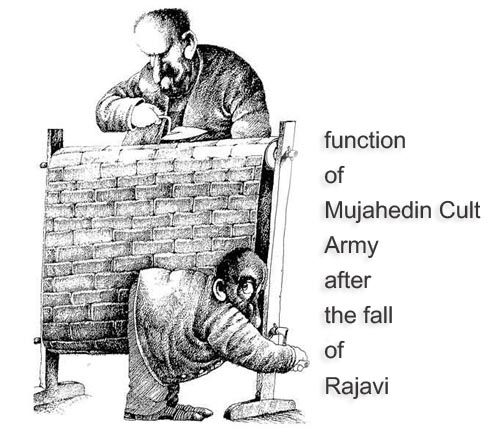
Function of the Cult’s Army after the fall of Rajavi

Function of the Cult’s Army after the fall of Rajavi

Function of the Cult's Army after the fall of Rajavi

October 24, 2007 0 comments
FacebookTwitterPinterestWhatsappTelegramSkypeEmail
Mujahedin Khalq Organization as a terrorist group

Terrorism Awareness Indeed

I’m very excited and pleased to introduce today’s guest poster, Danny Postel, who comes to us with some absolutely chilling revelations about the bad faith of the neoconservatives’ supposed dedication to”freedom”(I know, I know: you’re shocked). Danny is the author of Reading “Legitimation Crisis” in Tehran: Iran and the Future of Liberalism and is co-coordinator of the Committee for Academic and Intellectual Freedom of the International Society for Iranian Studies.

By Danny Postel

During the week of October 22-26, an official announcement effuses, “The nation will be rocked by the biggest conservative campus protest ever – Islamo-Fascism Awareness Week, a wake-up call for Americans on 200 university and college campuses.” Ringmastered by David Horowitz, this circus will be performing under the tent of something called the”Terrorism Awareness Project.”

The purpose of this ballyhoolooza, we are told, is to confront the “Big Lies” of the Left regarding terrorism and militant Islam. Worthy subjects, to be sure. Indeed I would like to help the sponsors of the “wake-up call” promote awareness of them. Toward this end, let’s consider the American Right’s “special relationship” with one group of terrorists.

The U.S. State Department officially considers the Mujahedeen-e Khalq (MEK) a Foreign Terrorist Organization. While those honors date back to 1994, they’ve been renewed during the Bush years. Indeed in 2003 Foggy Bottom went further, including the National Council of Resistance of Iran — an MEK alias — under the terrorist designation. (The MEK is also known as the People’s Mujahedeen.)

To make a long and bizarre story short, the MEK got its start in early 1960s Iran, helped overthrow the Shah in 1979, but quickly turned on the revolutionary government it helped bring to power. Employing an ideological blend of Stalinism and Islamism, the tactics of a paramilitary guerilla faction, and the organizational structure of a cult, the group went into exile, eventually making their home in Iraq in the mid-1980s. Not only did Saddam give the organization cover: he armed, funded, and utilized them for a variety of ends over two decades.

The group’s wicked political brew was on spectacular display on the old MEK flag (see below; since abandoned), with its sickle and Kalashnikov positioned atop of a Koranic verse. (Not — to state the obvious — that the mere presence of a Koranic verse in and of itself implies Islamist political commitments, but in this case the shoe very much fits.)

Here you have virtually everything the Right claims to oppose all rolled into one: Islamism, Marxism, terrorism, and Saddam. Naturally, then, neoconservatives would utterly deplore the MEK and everything it stands for, right? The MEK would in fact make an ideal target for Islamo-Fascism Awareness Week and Terrorism Awareness efforts, no?

Well, no. At least one of the carnival’s acts, it turns out, is rather fond of the Islamo-Stalinist-terrorist cult group, and has repeatedly argued for the removal of the MEK from the State Department’s list of terrorist groups and indeed urged the U.S. government to embrace it. Daniel Pipes, who will be speaking at Tufts on October 24th as part of the Horowitz high jinks, has made the MEK a recurring theme in his writings going back several years.

Pipes has also gone to bat for the MEK right in the pages of Horowitz’s house organ.

But Pipes is far from alone on the Right in championing the MEK. He co-authored the first piece linked to above with Patrick Clawson of the right-wing Washington Institute for Near East Policy. Right-wing commentator Max Boot has argued not merely for the removal of the MEK from the terrorist list but for funding and unleashing it to do battle with Iranian forces — this while casually acknowledging that it is a “political cult.”

In some cases the MEK plays a stealth role in the media machinery of the American Right. What the FOX News Channel tells viewers about Alireza Jafarzadeh when he appears on its airwaves is that he is an “FNC Foreign Affairs Analyst.” What you have to go to the FOX News website to discover, however, is that Jafarzadeh served “for a dozen years as the chief congressional liaison and media spokesman for the U.S. representative office of Iran’s parliament in exile, the National Council of Resistance of Iran.” But it is scarcely known that the sonorous-sounding National Council of Resistance of Iran is in fact a front name for the MEK.

Now, it’s true that Jafarzadeh discontinued his post with the National Council of Resistance of Iran—but only when (and only because) its Washington office was forced to close in 2003 as a result of the State Department decision about it being a front for the MEK. It’s not like he had a change of heart.

If you attend an “Islamo-Fascism Awareness Week” event, you might want to ask the speakers about this terrorist cult and whether they condemn it. Some of them might — not all neoconservatives agree on the MEK.

But the fact that several prominent American conservatives have cozied up to an Islamist-Stalinist cult that was on Saddam’s payroll and the State Department considers a terrorist organization — this raises serious questions (to put it mildly) about the Right’s bedfellows and the calculus that determines them.

It suggests the need for a little more terrorism awareness.

Commonsense – By Rick Perlstein

October 21, 2007 0 comments
FacebookTwitterPinterestWhatsappTelegramSkypeEmail
Newer Posts
Older Posts

Recent Posts

  • The Psychological Impact of MEK Ideology on Members

    August 17, 2026
  • A study on the financial mechanism of the Mujahedin-e Khalq

    August 10, 2026
  • A Child behind the Ideological Bars of Massoud and Maryam Rajavi

    August 8, 2026
  • A Comparative Analysis of Psychological Control Mechanisms in Jeffrey Epstein’s Cult and the MEK

    August 3, 2026
  • Operation Mersad: How Iran foiled Saddam’s final gambit 37 years ago

    August 1, 2026
  • Facebook
  • Twitter
  • Instagram
  • Youtube

© 2003 - 2025 NEJAT Society . All Rights Reserved. NejatNGO.org


Back To Top
Nejat Society
  • Home
  • Articles
  • Media
    • Cartoons
    • NewsPics
    • Photo Gallery
    • Videos
  • Publications
    • Books
    • Nejat NewsLetter
    • Pars Brief
  • About Us
  • Contact us
  • Editions
    • عربي
    • فارسی
    • Shqip