
Terrorism 
In 1992, Anne Singleton was in the Iraqi desert being trained to fire a Kalashnikov rifle by the People’s Mujahedin of Iran. It was a year after the first Gulf War and Singleton was a member of an organisation intent on overthrowing the Iranian government by force.
“I was in the desert wearing a military uniform and I had no passport and no money,” she says. 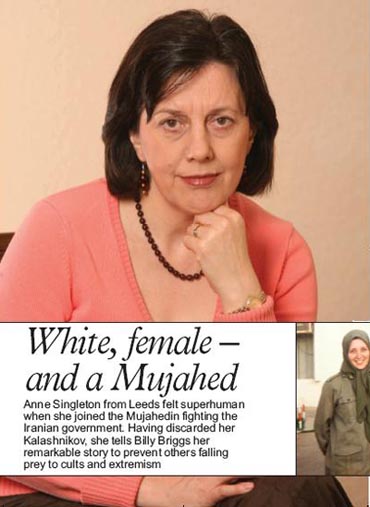
“I had never felt so free in my life. But the irony was that I was in a state of modern slavery. I was mentally chained to the Mujahedin.” Sitting in her Leeds home 15 years later, the 48-year-old wants to make her past public in the hope it acts as a warning that recruitment to an organisation proscribed as a terrorist movement by the European Union, America and Canada is something that could happen to anyone. In the present climate, with radical terrorist cells and cults active in the UK, Singleton is campaigning to raise awareness of how extremist groups and cults manipulate people. Her life now, living in a three bedroom semi as a computer programmer and being a mother to a six-year-old-son, could not be further removed from a previous existence where she prepared for war and accepted the deaths of innocent people as a justifiable means to an end. “I thought I was a savior of the world and would have done anything for the Mujahedin.
I worshipped those people,” says Singleton, whose involvement with fanatical extremists began when she moved from Yorkshire to study English at Manchester University. Her boyfriend at that time, an Iranian called Ali, was interested in the Mujahedin, and Singleton became intrigued by the movement’s opposition to the regime of the Ayatollah Khomeini after the 1979 revolution. “Manchester Uni was very political and I went along to Mujahedin meetings,” she says. “In truth, I could not even understand what the leader was saying in the videos but I was utterly transfixed.”
The Mujahedin was formed in 1965 to free Iran from “capitalism, imperialism, reactionary Islamic forces and despotism” and by the early 1970s; it had embarked on an armed struggle and later sought refuge in Iraq, fighting with Saddam Hussein against the Iranian government. Singleton’s indoctrination, conversion and submission to the organization was something that happened gradually over a period of about 10 years, the subtle influence of her Mujahedin peers eventually leading her away from her job, friends and family.
She views the Mujahedin now as a cult and says their methods of psychological manipulation are tried and tested and used by many other groups around the world, even similar to some tactics employed by salesmen to sell timeshares. “It takes a long time and they are very clever and use peer pressure. They implement subliminal messages. They use mind control techniques.
“They got me to submit to a higher order, their leader. They got me to make financial commitments. I used to ask friends and family to donate money to causes that were blatant lies. They replace your family, your relationships and get you to reject all your old values.” In 1985, Massoud Rajavi became the Mujahedin leader, transforming the movement, Singleton says, from being a political group into a cult. He married a woman called Maryam, whose role was to encourage women to break away from male control, and Singleton began spending all of her spare time looking after members’ children, cooking, listening to their poetry and revolutionary music. “I thought they were people of a higher order,” says Singleton, who was utterly convinced she was part of a noble, armed struggle. She even had posters of martyrs, suicide bombers and women with guns adorning her walls.
In 1989, Singleton split with Ali, who wanted nothing more to do with the movement, and she moved to London to become more involved in Mujahedin activities. During this period, she got involved with activists at a safe house in Finchley and, when the Unite Nations human rights rapporteur visited Iran in l990, they all went on hunger strike to apply pressure on him to question the Iranian government about the nation’s Mujahedin prisoners.
“I was as high as a kite on hunger strike and I felt superhuman, as if I had transcended normal humanity. Shortly afterwards I walked out on my job and went full-time with the movement. “I didn’t question anything. I was shown a film of a female suicide bomber blowing up an ayatollah in Iran. It was horrific and very shocking at first but I was shown the film many times, and each time I was less distressed. Eventually, I didn’t bat an eyelid.” By this time Singleton barely saw her parents and she had ditched all her friends. She had even publicly burned the diaries she had kept since childhood, as a symbolic rejection of her past. “If the leader had said ‘kill yourself’, I would have killed myself.” In l992, Singleton was asked to go to Iraq for military training. As a member of an armed struggle, she knew this might be required and did not resist, even relinquishing her passport to the Mujahedin when she arrived in the desert.
“You have no human rights, no nationality, you are simply a Mujahed. I loved the camp and it felt liberating to obey orders, because you lose all responsibility for yourself. I felt like a child and thought if I put all my trust in their hands, I would be OK.”
But in 1993 Singleton started to have doubts about the movement after all members were told that marriage was banned and all couples must get divorced. At this time she met her current husband, Massoud, another disillusioned member, and in 1996 they made the decision to leave. With the Mujahedin in constant contact, initially it was extremely difficult for them to adapt back into society and it took three years to make a complete break and fully recover from their ordeal. “We are both Muslims, and we were like little kids doing things like going to the supermarket and choosing our own food.” In 1999, Singleton and Massoud discovered literature from the Cult Information Centre and discovered that the psychological coercion techniques used by the Mujahedin were methods all recognised and listed, and together they now campaign to warn others that anyone is vulnerable to these groups.
“Look at the young men in West Yorkshire who are being targeted by the terrorist organisations. People across the UK must be asking what is wrong with the people in West Yorkshire. There is nothing wrong with the people here, it is just that the extremists are out there recruiting in the locality, using the same tried and tested methods used by the Mujahedin and the many other disparate cults and movements active around the world. “Psychological manipulation can happen to anyone, any time. If you’re lucky, you end up with a timeshare. If you’re unlucky you end up blowing yourself and innocent people up on the Tube.” An interview by Billy Briggs – Big Issue Magazine (UK), May 2007
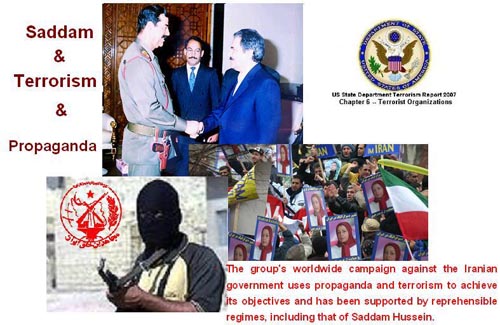
The State Department Office of the Coordinator for Counterterrorism on April 30 released the list of designated terrorist organizations. Once again Mujahedin-e Khalq Organization (MEK) continues to occupy the status it has been designated since 1997. in a part we read: "The group’s worldwide campaign against the Iranian government uses propaganda and terrorism to achieve its objectives and has been supported by reprehensible regimes, including that of Saddam Hussein. "
A radical Iranian opposition group will be one of the key discussion issues during talks between Iranian and U.S. officials in Iraq on May 28, an Iraqi newspaper reported Saturday.
Al-Sabah newspaper, a publication financed by the Shiite-led Iraqi government said the agenda of the talks would include four key issues – "the supplies of Iranian weapons to Iraqi militant groups, the Mujahadeen-e-Khalq organization, the U.S. military presence in the Persian Gulf region and the withdrawal of American troops from Iraq."
Mujahadeen-e-Khalq (MEK) is the largest and most extremist group opposed to the Islamic Republic of Iran. It was founded in the 1960s by a group of college-educated Iranian leftists opposed to the country’s pro-Western ruler, Shah Mohammad Reza Pahlavi. The group, which reportedly maintains bases in Iraq, was put on the U.S. State Department’s list of foreign terrorist groups in 1997 and on the European Union’s terrorist list in 2002 because its violent attacks often killed civilians. However, certain reports indicate that the group’s strong stand against Iran has won its support by some U.S. lawmakers and U.S. military command in Iraq.
Tehran demands that MEK members be expelled from Iraq or extradited to Iran.
The Baghdad talks, which come at the request of Iraqi leaders, had initially been scheduled for March of this year but were continuously postponed due to a U.S. propaganda campaign against Iran, in which the White House has accused of providing Shiite militia with weaponry and explosives.
Tehran, in turn, denies the accusations and blames Washington for the bloodshed and violence in Iraq that followed the U.S.-led military campaign in the country
Al-Sabah, Iraq, May 20, 2007
According to Italian investigators, Total in 2002 unwittingly helped Baghdad finance an Iranian group, the Mujahidin Khalq, or People’s Mujahidin, which is on the U.S. government’s list of terrorist organizations. Less than a year later, in 2003, France’s counterintelligence agency stormed the group’s headquarters in Paris on terrorism charges. Besides collecting illegal funds through the surcharges, Baghdad also helped friends and allies around the world by awarding them oil contracts. A multinational committee led by the former U.S. Federal Reserve chairman, Paul Volcker, found that with this arrangement, Saddam was able to finance journalists, politicians and diplomats who he apparently believed would support his effort to lift the UN sanctions.
Seven oil contracts were also awarded to an Iranian exile organization, the Mujahidin Khalq, fiercely opposed to the government in Tehran, which was hostile to Saddam.
In 1992 the Mujahidin was blamed by the U.S. State Department for the almost simultaneous attacks on Iranian facilities in 13 European countries.
Investigators in the United States have a copy of a 1999 Iraqi memo summarizing an exchange between Iraqi intelligence and Iraq’s Oil Ministry regarding a request for oil received from the Mujahidin. The Iranian group had asked for the oil as a gift but, because of UN sanctions, the ministry could not comply.
The ministry was, however, willing to give the group a contract for two million barrels. The intelligence director had then provided the ministry the name of a company that the Mujahidin wanted to use as a front – Century Marketing Associates.
Contract M/11/44, which awarded more than five million barrels of oil to Century Marketing on Dec. 23, 2001, was signed by Haftavaradan Reza as a director of that company. Better known with his pseudonym of Saeed Mali, or Saeed Finance, Reza was at the time the No. 2 person in the finance department of the Mujahidin Khalq, according to Massoud Khodabandeh, a former executive committee member of the group.
At least some of that oil was bought by Betoil, a company controlled by an Italian trader, Fabrizio Loioli. An internal Betoil accounting document found by the Italian Guardia di Finanza indicates that 1,041,970 barrels of that contract was loaded onto the tanker Yannis P and sold to Total.
According to Loioli’s records, he received $156,295 in premium payments from Total for that shipment. "It was out of that money that Loioli would have paid the fee to the contract holder, that is Century Marketing," an Italian investigator said.
Almost a year later, in June 2003, the French riot police stormed the suburban Paris headquarters of the People’s Mujahidin. The investigation is still open.
Total declined to comment on the case.
Claudio Gatti
International Herald Tribune
The New York Times Media Group
17 May 2007
Released in IraqSlogger Daily Column, Zeyad Kasim quoted the Shaheed Al-Mihrab Foundation’s website revealing MEK terrorist operation in Iraqi soil.
The Shaheed Al-Mihrab Foundation, a SIIC-sponsored Shi’ite organization led by Ammar Al-Hakim, son of SIIC leader Abdul Aziz Al-Hakim, accused Mujahideen e-Khalq, an Iranian militant opposition group in Iraq, of attacking a Shi’ite village in the Diyala governorate, northeast of Baghdad.
MEK elements attacked the Anbakiya area, near Muqdadiya, and clashed with residents, who killed 15 MEK elements, according to the Shaheed Al-Mihrab Foundation’s website. Strongly opposed to the presence of Iranian opposition groups in Iraq, SIIC had repeatedly accused MEK of cooperating with local insurgents and Al-Qaeda in Iraq in the Diyala governorate to attack and forcefully deport Shi’ite residents. MEK operated three military bases in the Diyala governorate under the rule of Saddam Hussein and reportedly assisted the former regime in suppressing the 1991 uprising. Following the invasion of Iraq, U.S. troops disarmed the group but designated its members as “protected persons” under the Geneva Convention and posted guards at their bases.
IraqSlogger – 19/05/2007
The State Department Office of the Coordinator for Counterterrorism on April 30 released the List of designated terrorist organisations. Once again Mojahedin Khalq organisation (MKO, MEK, aka the National Council of Resistance, NCR, NCRI) continues to occupy the status it has been designated since 1997.
While we support the recent report of the State Department, we would like to point out some important issues related to this report.
As ex-members of Mojahedin Khalq Organisation we, over the past few years, have repeatedly emphasised the capabilities of Mojahedin Khalq (aka Rajavi cult) and its potential to carry out terrorist operations in European and North American countries. And we have repeatedly made the point that the Mojahedin Khalq Organisation is a destructive cult which uses typical cult methods (i.e.: brain washing and ideological cleansing) to prepare its members to carry out violent acts.
We have also insisted during our meetings with various officials in Europe that a series of sophisticated devices and technologies have been bought by the members of the cult from Europe and smuggled into Iraq. These consists of (but is not limited to) night vision goggles, special anti mine shoes, and many other apparatus for carrying out terrorist activities. Maryam Rajavi (co cult leader), between 1993 and 1999, started these smuggling operation from her HQ in Auvers sur Oise in France and used her network to its full extent during 1999 and 2000 when it was the height of its terror campaign.
Now after years the State Department has finally been referring to a small part of these illegal activities, and reports:
“… Also in 2001, the FBI arrested seven Iranians in the United States who funnelled $400.000 to an MEK- affiliated organisation in the UAE which used the funds to purchase weapons…”
http://www.state.gov/s/ct/rls/crt/2006/82738.htm
Although the new report mentions specific and significant points which could not be found in the original report of 1994 but we can say that has still fallen short of pointing out some specific, important, clear and proven points.
Considering this shortfall, we the ex members of the Mojahedin Khalq Organisation (Rajavi Cult), who have survived imprisonment and torture in this cult and have had clear insight into the inner world of Mojahedin Khalq terrorist camp Ashraf, would like to point out the following:
– The retaining of the Mojahedin Khalq Orgaisation in the list of Terrorist entities is a just act but is not enough.
– As has been stated in the report, the Mojahedin terrorist group clearly displays cult like charactristics and is now a threat to western countries including the United States of America. It is clear that before the group engages in a new wave of violent activities (similar to the self-immolations carried out in 2003), western govenments should take approprate action to prevent such disasters.
– We have emphasized over and over to the Prime Minister of Iraq Mr. Al Maleki and to Mr. Talebani the President of Iraq in numerious letters that the remaining 3400 members of the Rajavi cult in Ashraf camp near Khales are part of the body of this organisation, many of whom have themselves been experiencing mental and physical torture at the hands of the leaders of the Mojahedin. They have been denied any contact with society or even members of their family for years and their account should be seperated from the account of the leaders of the cult. You are aware that more than 200 of them who have seperated themselves from the Mojahedin are still in the adjecent camp called TIPF and need help to get back to the normal society and integrate.
– As has been mentioned again in the report, the Mojahedin have been instrumental in the suppresion of the uprising of the Shiites and the Kurds by the Republican Guards of Saddam Hussein. The report reads:
“… in 1991, the group rportedly assisted in the Iraq Republican Guard’s bloody crackdown on Iraqi Shia and Kurds who rose up against Saddam Hussein’s regime; press reports cite MEK leader Marym Rajavi encouraging MEK members to”take the Kurds under your tanks.”…”
http://www.state.gov/s/ct/rls/crt/2006/82738.htm.
Our association asks for your intervention to prepare a court to bring the leaders of this cult to justice. A petition has been signed by about 400 ex members of the Mojahedin Khalq Organisation asking for the indictment of Massoud and Maryam Rajavi, life-time, self-appointed heads of the horifying Mojahedin Khalq Organisation. The signitures are continuing.
Yours sincerely,
Iran Sabz,
May 17, 2007
Irracontable Association e.V.
Postfach 680271
50705 köln
phone:+49(0)1777581050
www.iran-sabz.de
info@iran-sabz.de
Taking a clear political stand in support of Ségolène Royal, MKO looked with dismay a resounding win by Right Wing UMP candidate Nicolas Sarkozy. It does not necessarily mean that Ms. Royal intended to sacrifice the people’s interests and political concerns to meet the demands of a proscribed group long leeching onto France.
Of the diplomatic controversies that have clouded French-Iranian relations, which Nicolas Sarkozy has on his political agenda to improve, was the issue of MKO. Darius Kadivar, a freelance journalist, in an article released in persianmirror makes a short reference to the issue and is of the opinion that the days of MKO in France may well be counted with Sarkozy who is anti-communist.
Another issue of controversy between Iran and France has been the Armed Opposition Organization of the Peoples Mujahedin Khalge known as the MKO which is labeled as a terrorist organization by the EU and the US. The Para Military organization founded by Massoud Rajavi and led by its self elected wife Maryam Rajavi combines Marxist and Islamist ideologies and has made headlines for the spectacular fanatical actions of its members such as self immolation to protest against the arrests of its leaders. It claims to have given up military actions against the Islamic Regime and seeks respectability amongst European deputies and personalities such as Bernard Lavillier, and controversial excommunicated Bishop Jacques Gaillot. It has however found amongst its staunchest ally the former First Lady Danielle Mitterand, who has often been at odds with her own husband the late French President François Mitterand who favored political ties with Iran whilst selling Arms to both Iran and Iraq during their 8 year war. The days of this organization in France may well be counted with Sarkozy who is anti-communist, with pro-American sympathies and claims to combat terrorism and support Human Rights.
19/05/2007 – Mojahedin.ws
Vienna – Iran sharply criticized the Western powers’ approach to fighting terrorism Saturday as superficial and biased.
Iran’s Ambassador Ali Asghar Soltanieh told delegates participating in a UN-sponsored counter-terrorism symposium in Vienna that the West’s actions only led to an increase in violence.
‘The unsuccessful experience of major powers in their superficial, improper and biased approach to combating terrorism has been ineffective in decreasing terrorist threats,’ he was quoted as saying by the Iranian IRNA news agency.
At the two-day meeting which concluded on Friday, Soltanieh, who represents his country at the Vienna-based International Atomic Energy Agency, denounced the attempt to establish a connection between terrorism and religion.
‘Worst of all are the attempts made to associate terrorism with a certain religion and culture,’ he said.
The reasons behind terrorism were foreign occupation, discrimination, the West’s double standards in politics and economy, and so-called ‘state terrorism,’ Soltanieh argued.
The ambassador also belaboured Western support for the exiled anti-Iranian People’s Mujaheddin (MEK), whom Iran regards as a terrorist organization, formerly under the protection of Iraqi dictator Saddam Hussein.
The Vienna counter-terrorism symposium was aimed at propelling forward the UN-strategy for fighting terrorism.
The participants from approximately 100 UN member states were asked to present their issues and discuss strategies.
dpa – Deutsche Presse-Agentur – May 19, 2007
The terrorist organization of Mojahedin-e Khalq, with long history of denying its own acts and plots, responded to the comments and revelations of Mr. Hadi Farhan Abdullah al-Aameri, the head of Iraqi Parliament’s Security Commission, by projection and denying the facts; Mr. Aameri had revealed MKO’s ties with Al-Qaeda.
He had stressed that the MKO was involved in violent acts in Dyalah province.
However, the gang of Rajavi, failed to benefit from such acts, claimed that American Generals can testify that MKO has nothing to do with this.
Meanwhile, additional intelligence have been reported, including those broadcast by Kurdistan TV, which quoted Al-Sharq alawsat:
“Mountains of Hamrin have turned to safe haven and training base for armed terrorists of Al-Qaeda. Following the security plan in Baghdad and mobilization of tribes in Anbar province to push out Al-Qaeda militants, members of this terrorist organization left the place to Hamrin Mountains. Armed members of Al-Qaeda have established 7 bases in Hamrin to train new terrorists.”
What can be clearly seen of MKO’s involvement in this issue is that Hamrin was for long time a place for MKO’s terrorist training and practices; now they coordinate with Al-Qaeda by establishing terrorist bases.
Such relations with Al-Qaeda justify in part the philosophy of abducting and killing of two MKO members by the Gestapo of this group; they abducted and killed two of their own members in order to take position against those who may accuse the group of terrorism!
The Gestapo of Ashraf has already accused tens of Iraqi officials and figures of being involved in abducting the two members and Mr. Aameri is the last one to be accused after he revealed MKO’s ties with Al-Qaeda.