
Striking down the boundaries

Striking down the boundaries
Facing its most crucial days in Iraq, MKO gets advantage of any chances to muster sympathizers and supporters to reaffirm its status as political refugees in Iraq. As the organization is banned, under the adopted anti-terrorism laws, to hole open rallies and meetings, the duty is laid on the shoulder of other groups and committees campaigning under a variety of aliases.
Reported by NCRI, “The International Committee in Defense of Ashraf was launched in a meeting at the European Parliament on Tuesday, September 12. Participants in the meeting were founding members of the committee among whom were European lawmakers and political and human rights figures. The meeting was initiated by the Friends of a Free Iran, a parliamentary committee at the European Parliament co-chaired by Euro MPs, Paulo Casaca and Struan Stevenson”.
For those who are familiar with the history of MKO and are aware of its being proscribed by the EU as a terrorist organization it might be too shocking to hear that some claimed “European lawmakers and political and human rights figures” so blatantly violate a unanimously adopted law aimed to safeguard the Western citizen’s national security and peace.
But it should be pointed out that sub-parliamentary “Friends of a Free Iran” is a coverage name for MKO activists advertising the policies masterminded by the heads of MKO. The few speeches made by the participants stress on nothing more than what the group’s propaganda machine has been focusing on during the past few months. The speakers, each on his/her turn, reiterated that “the PMOI members have been living in Iraq since 1986 as political refugees and stressed that the new Iraqi government should reaffirm their status”; “members of the PMOI have been staying in Iraq for over 20 years and enjoy widespread support among Iraqis”; “that the PMOI enjoys a widespread support among Iranians in exile all over the world and is the main obstacle to Iran’s regime”; “that all efforts should be concentrated on removing the PMOI from the terror list.”
The only issue “The International Committee in Defense of Ashraf” preferred not to deal with was the plight of the members held forcefully within the walls of Ashraf. It seems that even the claimed “human rights figures” present at the meeting had completely forgotten that there were many human beings residing at Ashraf with a few rights to be defended.
mojahedin.ws – 19/09/2006
In an article titled "Nuclear Energy Crisis" published on "Sout al-Iraq" website, Canada-based Iraqi author "Qasem Mohammed al-Kafayee" points to the issue of the MKO’s presence in Iraq under the protection of US forces and says:
"What’s the justification of Americans for keeping these terrorists in Iraq, while Saudi Arabia, Jordan and Qatar have rejected US’s request to accept these terrorists in their soil?"
"If the US really wants to find a proper solution for these terrorists, it should prove its goodwill by returning the elements of this group to their homeland and coordinate the issue with Iranian officials to guarantee the safety of these people. We ask our new government not to allow others to dictate their orders on Iraq; orders that include hosting criminal forces such as the MKO and …," he adds.
Qasem Mohammed also declares: "There’s no political modesty in US policies. They created al-Qaeda and have common interests with the group. How is that they put the MKO in terror list on one hand and support it in a third country on the other?
Hereby, we ask the US to understand the concept of political modesty, observe and use it. Iran, as a neighbor, benefits from security and stability in Iraq but the US observes no moral human standards."
Sout al-Iraq, September 19, 2006
Report by the Islamic Human Rights Commission
Introduction
As the stranglehold of increasingly draconian anti-terrorism laws takes hold in the UK, this briefing focuses on British policy regarding the Mujahedin-e-Khalq Oragnsiation also known as the MKO or MEK and under various other pseudonyms and acronyms [1] . Whilst most groups on the list of proscribed organisations under the Terrorism Act 2000 have some sort of perceived Muslim or Islamic affiliation, the MEK – whilst claiming to have some Islamic affiliation –openly target a form of political Islam i.e. the Iranian government. The organisation boost prominent supporters from amongst the British establishment including a number of MPs and Lords, and calls for its unproscription have been made. This briefing discusses the treatment of the MEK and its supporters and their actions, in light of the terrorism laws enacted in the UK and highlights not only the abuse of these laws with the complicity of government but also the duplicity of the government’s stance on terrorism. HISTORY OF MEK [2] The Mujahedin-e-Khalq Organisation [3] is a cult like organisation [4] which has been proscribed in the UK. They were formed in the 1960s with the primary intention of overthrowing the then regime of Reza Shah Pahlavi. They fought alongside supporters of Ayatullah Khomenei to overthrow the Shah of Iran, but after the revolution it broke away from Khomenei and opposed the revolutionary government. They were expelled from Iran after the revolution.
The National Council of Resistance (NCRI), forms a ‘government in exile’, opposed to the Shah’s successors and has offices around the world. The leaders fight under a banner of human rights and democracy, accusing the Iranian government of denying freedom of expression, while they breach the prohibition of torture. They justify their actions based on the belief that the Iranian government must be destroyed through any necessary means. Maryam Rajavi is the head of this organisation. She is now living in exile in France, where she is carrying out propaganda to further their cause. PMOI is aware that only through the support of the West will they have any possibility of overthrowing the Iranian government.
However, the chances of succeeding in their aim have been greatly slimmed by their proscription in Europe. The history of MEK illustrates their innate terrorist nature. They have been involved in anti-Western attacks as well as terrorist attacks against the government in Iran and abroad. During the 1970’s, the MEK killed US military personnel and US civilians working on defence projects in Tehran. Furthermore, they supported the takeover in 1979 of the US Embassy in Tehran. The 1980’s show the MEK targeting Iranian officials by detonating bombs in the head office of the Islamic Republic Party and the Premier’s office. They killed over 70 Iranian officials. There were 4 suicide bombing attacks during the Friday prayers in four different cities in Iran [5]. According to some estimates 12,000 people have been killed in Iran by the activities of the MEK [6].
The nature of these attacks has been brutal and callous – the organisation was the first to use human bombings against civilians in the region, including at mosques, shrines and prayer gatherings. Other attacks include the firebombing of buses and assassinations of former members of the organisation.[7]
In addition to this, during the Iran/Iraq war, they fought alongside the Iraqi forces. In the 1990’s the MEK assisted the Saddam Hussein in suppressing the Shia and Kurdish uprisings in Iraq. They also conducted simultaneous attacks on Iranian Embassies. In April 1999, they targeted key military officers and assassinated the deputy chief ofArmed Forces General Staff. In 2000, the MEK attempted to assassinate the commander of the Nasr Headquarters (Tehran’s interagency board responsible for coordinating policies on Iraq). Further to this, a number of mortar attacks and hit-and-run raids on Iranian military, law-enforcement units and government buildings occurred.
In the late 1990s and early 2000s, the MEK tried to court support from the Taliban and spent much energy on this process. [8] In 2001 they were reported to have negotiated use of Afghan territory bordering Iran with the Taliban. [9]
Since 2001, the MEK have not actively taken part in outwardly terrorist activities, however they are still very much in existence and continue to promote their ideology to the West. Issues regarding the personality cult that surrounds its leadership have evolved, with many defectors exposing the internal workings of the organisation as abusive and corrupt [10]. A recent report by Human Rights Watch further elaborates on continuing reprisals against members wishing to leave. This includes solitary confinement, mental and physical torture and interrogation. [11]
Furthermore, the MEK continue to call for the removal of the Iranian government. They have convinced a number of politicians and leaders in the West to support them despite still being on the U.S and U.K list of terrorist organisations. 2. TERRORISM ACT 2000
Under the Terrorism Act, the definition of terrorism is extremely broad and vague and potentially outlaws any type of political activism:
“For the purpose of advancing a political, religious or ideological cause”, the use or threat of action “designed to influence a government or to intimidate the public or a section of the public” which involves any violence against any person or serious risk to the health or safety of the public or a section of the public, or is designed seriously to interfere with or seriously to disrupt an electronic system.”[12]
Terrorist organisations proscribed under this legislation cannot operate in the UK. It is quite simply illegal. The offences related to proscription include the following:
• Membership of a proscribed organisation.
• Inviting support and fundraising for the proscribed association.
• Managing or assisting in the arranging of meeting to support or further the activities, or to be addressed by a member of a proscribed organisation.
• Addressing a meeting where the address encourages support for the proscribed organisation.
Those found guilty are liable, on conviction; to imprisonment for no longer than 10 years, a fine, or both. On the ‘summary conviction’, one would be imprisoned for no more than 6 months, a fine, or both.
3. ACTIVITIES SINCE PROSCRIPTION
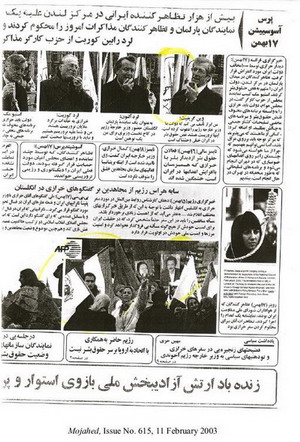
Regardless of the terrorist organisation’s proscription there have been a number of events which have occurred in the UK which are in breach of the legislation. However, no action has been taken in stopping these events occurring. Firstly, the organisation’s newspaper Mojahid is in circulation in the UK. Furthermore, this newspaper published an article on Tuesday 11th February 2003, No 615 (Appendix 1) showing Iranian protestors in London, who were demonstrating against the Iranian Foreign Minister’s visit on February 6 2003. Over a 1000 Iranian demonstrators alongside a number of MP’s condemned Dr Kharrazi’s visit. The Secretary of the Iranian Women’s Association (an affiliate of MEK) Laila Jazayeri threw eggs at Dr Kharrazi’s car. She was a held in Charing Cross police station for 2 hours before being released. [13]
Secondly, a series of demonstrations outside the French embassy in London, took place to protest the arrest of Maryam Rajavi in France under anti-terror laws, in the summer of 2003. Supporters of the MEK were clearly seen to be protesting, holding MEK banners and flags. A number of protestors also set themselves alight, resulting in one fatality. [14]
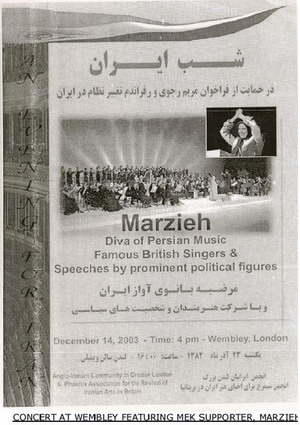
Thirdly, a concert was organised in Wembley on December 14 2003 by the Anglo-Iranian Community in Greater London and Phoenix Association for the Revival of Iranian Arts in Britain (Appendix 2). This was attended by Maryam Rajavi, the leader of MEK. Also, Marzieh, an Iranian performer and supporter of the MEK was the main guest at this event. Marzieh declared her support for MEK in 1994. She funded MEK and helped them buy tanks and guns for guerrilla operations against the Iranian government. She was also seen in a group of 100 fugitive fighters camping in the Iraq-Jordanian border during the Iraq/Iran war.
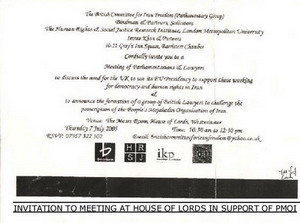
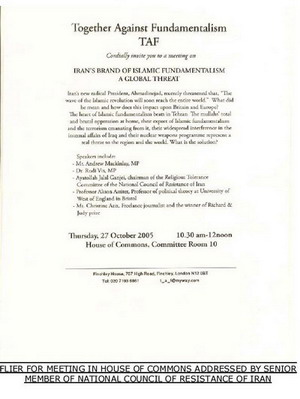
In March 2005, The Symposium of Jurist and Parliamentarians for Support of Iranian Resistance organised by Lord Corbett on the removal of the terror tag on PMOI. Further to this, a seminar was organised in the House of Lords by Lord Corbett and others on the 7th July (Appendix 3). The seminar intended to discuss human rights and democracy in Iran, and the proscription of PMOI. Another seminar was organised in the House of Commons on the 27th October 2005. At this seminar, a number of supporters of NCRI were schedules to speak and attend, but most importantly an NCRI representative was listed as a speaker (Appendix 4).
Furthermore, MEK have a number of supporting groups in the UK. (See Appendix 5). Finally, numerous British parliamentarians and lawyers have met with the MEK leader Maryam Rajavi (see Appendix 6).
4. THE UK RESPONSE TO MEK
Despite the foregoing evidence supporters of the MEK have strenuously argued that the MEK has no presence in the UK [15], and has never threatened any British interests and thus to proscribe the organisation appears unjustified and implies support of the Iranian government.
The supporters of MEK argue that this group fights against terrorism because they fight against Iran. Lord Corbett of Castle Vale, the leading figure against the proscription, has stood firm in his fight; criticising the British Government’s policy towards the Iranian government.
However, the actions of this organisation illustrate an image quite different to that portrayed by its supporters. The noted activities are clearly contrary to the Terrorism Act 2000. The organisation by its very existence comes within the official catch-all definition of ‘terrorism’ as it seeks to overthrow a government through illegitimate means.
However, while it is recognised that many other legitimate resistance groups come within this broad definition, a clear distinction must be made between the MEK and other such groups; that is MEK has a track record of targeting civilians. This failure to distinguish between legitimate and illegitimate targets bears a greater similitude to groups such as al-Qaeda. Therefore, if there was to be any campaign to unproscribe a group, it is difficult to make such a case for groups which deliberately target civilians such as MEK or al-Qaeda.[16]
Furthermore, whilst its supporters continue to portray MEK as freedom fighters, it should be noted that MEK hold very little support amongst Iranians in Iran or diaspora Iranians opposing the Iranian government, due to their participation in the Iran – Iraq war in support of Iraq. Despite protestations of being a government on exile, it seems clear that the MEK have little or no democratic credentials, regardless of the issue of terrorist violence.
Therefore, it is important for the UK to take a stringent approach when dealing with this and any other proscribed terrorist organisation but this has not been the case. Rather there has been little response from the British authorities towards the activities which have occurred in the UK. This brings into question a number of issues, firstly the true nature of this legislation and the manner against whom it is enforced, and secondly the basis of proscribing an organisation.
5. THE DOUBLE STANDARD
The government has recently proscribed a further 15 organisations [17] – all Muslim based – and mooted proscribing Hizb-ut-Tahrir (HT), an organisation which seeks to establish an Islamic state through intellectual dialogue. In August 2005, the British Government stated that they intended to proscribe this organisation.[18] This has caused confusion among many, because HT has not been involved in terrorist acts in the UK or internationally. One may question the criteria an organisation must meet to be proscribed. How does a non-violent organisation committed to intellectual change, fit this definition, yet an organisation which like the MEK meets the definition of terrorism, yet there is debate that such an organisation should no longer be proscribed or even tolerated as has been the case thus far despite proscription..
This reveals a double standard from the government. It is clear that British laws should be indiscriminate in nature and cannot proscribe an organisation because it disagrees with its objective, but rather through the means employed to achieve this objective. Such double standards undermine further the already shredded
credibility of a government that claims to want to attack terrorism, but seems to rather attack Muslims and Islam.

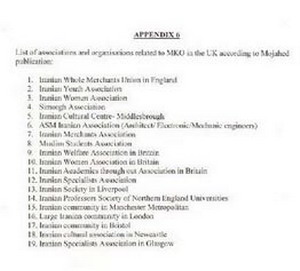
APPENDIX 2
APPENDIX 3
APPENDIX 4
APPENDIX 5
APPENDIX 6
British Parliamentarians and Lawyers who have met with Maryam Rajavi include:
A delegation of British parliamentarians from all three main parties led by Lord Corbett of Castle Vale, March 2006
Mr. Brian Binley, Conservative MP for Northampton South-UK, February 2006
Lord Russell-Johnston, the former Chairman of the Parliamentary Assembly of the Council of Europe and a former foreign affairs spokesman of the Liberal Democratic Party, April 2005
Andrew MacKinlay MP, member of Foreign Affairs Select Committee of
the British Parliament, June 2005
David Amess, MP for Southend West and Parliamentary Private Secretary to the Secretary of Defence in the last Conservative government, March 2005
Sources:
1. Including the National Council of Resistance (NCRI), and People’s Mujahedin of Iran (PMOI), the National Liberation Army of Iran, The People’s Mujahedin of Iran (PMOI), National Council of Resistance (NCR), National Council of Resistance of Iran (NCRI), Muslim Iranian Student’s Society source: Country Reports on Terrorism, 2004. United States Department of State, April 2005.
2. Unless specified as otherwise, information sourced from http://www.globalsecurity.org/military/world/para/mek.htm
3. The fact that this organisation operates under a number of different names was recognised by the US Department, who in 15 August 2003, amended the designation of MKO to add its aliases.
4. See http://www.iran-interlink.org/ for details of the organisation’s philosophy and structure.
5. See http://www.irandidban.com/enlist/terrorism_in_iran.asp for lists of victims of MEK terrorist attacks.
6. Hlaibilian cited at http://www.irandidban.com/master- e.asp?ID=11372
7. Charbonnier, V. (translator Forestenzer, T. R.) The People’s Mojahedin of Iran: A Struggle for what? 2003, France.
8. Shirzai, Faegheh, The Veil Unveiled: The HIjab in Modern Culture University Press Florida, 2001, Gainsville.
9. European Country of Origin Information Seminar Berlin, 11 – 12 June 2001: Seminarbericht – Iran (#7661)
10. see e.g. Banisadr, M Masoud: Memoirs of an Iranian Rebel 2004 Saqi Books, London
11. Human Rights Watch ‘No Exit Human Rights Abuses Inside the Mojahedin Khalq Camps’ May 2005 http://hrw.org/backgrounder/mena/iran0505/index.htm
12. Terrorism Act 2000, Section 1(1)
13. ‘Khatami’s FM Visit to UK protested’, Agence France Press, 10 January 2003
14. ‘Iranian fire protests at Paris arrests’ BBC News Online, 18 June 2003; ‘Fourth person sets themselves on fire outside French embassy’ Guardian, 21 June 2003. 15. The Symposium of Jurists and Parliamentarians for Support of Iranian Resistance, March 2005.
16. For further information, see Fahad Ansari, British Anti-Terrorism: A Modern Day Witch-hunt, (Islamic Human Rights Commission, 2005) pp 48-49.
17. 14 October 2005; of the 40 groups currently proscribed under the legislation, 33 are ‘Islamic’/’Muslim’ groups. Full list of proscribed organisaitons is available to view at the Home Office website on http://www.homeoffice.gov.uk/security/terrorism-and-the-law/terrorism-act/proscribed-groups?version=1
18. Prime Minister Blair’s Press Conference, 5 August 2005
May 2006 IHRC PO Box 598 Wembley UK HA9 7XH T (+44) 20 8904 4222 F (+44) 20 8904 5183 E info@ihrc.org www.ihrc.org.uk W
According to Nejat Society Correspondent, "Mr. Gholam Reza Sadeqi Jabali " – the old member of MKO could release himself from the hell made by Rajavi’s cult and join his family.
Mr. Jabali holds the message of many other dissatisfied members who are still captive behind the bars of Rajavi’s Cult in Iraq.
Referring to the dangerous situation of those members in Iraq, He’s requested the families to do their utmost for the salvation of their beloveds.
He described the inner MKO’s condition as being "chaotic ".
He added that the discontented members do any thing to free themselves from the intolerable situation of the cult and unfortunately some of them, commit suicide as currently some have set themselves on fire.
Salvation

Iran: Iraq’s PM visit to Iran a turning point Visiting Iraqi Prime Minister Nuri al-Maliki conferred yesterday with Chairman of Expediency Council Ayatollah Akbar Hashemi Rafsanjani. In the meeting, Rafsanjani emphasized the importance of Iraq’s national unity and territorial integration. He said, "National reconciliation plan in Iraq is a positive step and its achievements would benefit the whole region." Expressing concern over existing insecurity in Iraq, EC chairman blamed occupiers for instability and said the Iraqis can solve their own problems with relying on their domestic potentials. He added Iraq’s neighboring countries can benefit from security and stability in Iraq and must do their utmost to help Iraqi people and government. Emphasizing the Iraqi government and nation’s intention to expand and consolidate ties with Iran, Nuri al-Maliki said, "Iraq wants a relation upon mutual understanding free from tension and interference with Iran." Referring to Iraq problems, al-Maliki said, "Iraqi government is trying to take full control on security matters by its own armed forces to decrease its reliance on multi national forces." Al-Maliki called economic relations with Iran very important and added, strengthening cooperation in the fields of oil, agriculture, water and electricity have been under special attention in this visit. During the trip, he also said "our policy is non-interference in domestic affairs of neighboring countries, respecting mutual interests and trying to solve remaining problems of the deposed regime ( of Saddam Hussein)." He stressed that establishment of security in Iraq is not only in benefit of Iraqi people, but in benefit of all regional countries. Regarding the members of Mujahedeen Khalq Organization (MKO), who are still in Iraq, al-Maliki said they have six months time to leave Iraq. Iran welcomed Iraqi National Reconciliation Plan at the final joint press communique here at the end of official visit of Iraqi Prime Minister Nuri Kamal al-Maliki. In the joint communique, which was released on Wednesday evening, Tehran welcomed Iraqi government’s efforts, especially announcing national reconciliation plan by Nuri al-Maliki to invite all Iraqi groups to participate actively in the political process of the country. Tehran also welcomed the recent Iraqi government decision on expelling terrorist group of Mujahedeen Khalq Organization (MKO) from Iraq and called it a positive step in deepening ties between the two neighboring countries. Three Memorandums of Understanding (MoU) were signed here on Wednesday evening. Cooperation between Iran’s Interior Ministry and Iraqi Immigration Ministry to facilitate affairs of both countries citizens was the first MoU signed between Iran’s Interior Minister Mostafa Pour Mohammadi and the Iraqi minister. The second MoU was about security cooperation and exchanging information which was signed by Iran’s Intelligence Minister Gholam-Hossein Mohseni Eje’ie and Iraqi National Security Advisor Mwaffaq al-Rabiei. The third agreement was about development and expansion of cooperation between the two countries which was signed by Iran’s First Vice-President Parviz Davoudi and Iraqi Prime Minister Nuri Kamal al-Maliki.
First Vice-President Parviz Davoudi called Iraqi PM visit to Tehran as a turning point in bilateral relations adding the positive and important outcome of the visit will be seen soon.
After signing ceremony of the three MoUs, Davoudi said ties between the two countries have deep roots in commonalities and both countries intend to expand ties in different political, economic, social and cultural fields.
He said Iran supports fully al-Maliki government adding, "We had good discussions concerning the latest situation in Iraq, about establishment of stability and security and solving problems in that country."
ArabicNews.com – September 14, 2006
With the trial of Saddam Hussein, Iraqi newspaper Al-Adalah presented some documents and evidences and asked for the execution of Saddam Hussein. In part of its article, Al-Adalah pointed to the staggering costs of Saddam’s propaganda and wrote:
"Saddam’s regime allocated 50% of its budget to propaganda and had ties with many Arab and non-Arab terrorist groups; for instance, it had established close ties with the MKO (Mojahedin-e Khalq organization) and in return, took advantage of this group. There’s no doubt that Saddam’s propaganda had a huge impact on many countries including Arab nations, particularly those countries with higher rates of illiteracy and poverty (such as Mauritania, Yemen, and Somalia)."
Irandidban – 2006/09/14
More nuclear ‘secrets’ to eat up IAEA resources
Alireza Jafarzadeh is now acknowledged by neoconservatives in the Bush Administration to be more effective than Maryam Rajavi in bringing about regime change in Iran.
Just as western concerns over the issue of Iran’s nuclear programme appeared to be veering toward the dialogue/negotiation route – a seemingly highly unpopular approach in the US which appears to favour military intervention as its primary foreign policy tool – Jafarzadeh was wheeled out one more time to expose – through the Associated Press – a fresh secret designed to undermine mutual efforts to move the issues forward.
Without waiting for the IAEA to "take the time to check it against all our information in order to decide whether it is worth following up", Jafarzadeh has already cast doubt on his claim by stating that it came from "members of the resistance inside the country".
Jafarzadeh needs first to bring evidence that the Mojahedin (aka National Council of Resistance of Iran or the resistance) does indeed have members and/or supporters inside the country and that such people are in position to gain greater access to information on Iran’s nuclear activities than the IAEA inspectors, before his claims can be taken seriously by Iran experts.
As it is we should look to the consistent timing of these revelations which only come at times when progress is being made to avoid imposing the sanctions or military intervention which would cause untold hardship and suffering for the Iranian people.
http://www.thestate.com/mld/thestate/news/nation/15520747.htm
Opposition: Iran using laser enrichment
EDITH M. LEDERER
Associated Press
NEW YORK – Iran has secretly revived a program to enrich uranium using laser technology, reportedly with favorable results, an Iranian opposition figure said Thursday citing information from members of the resistance inside the country.
Alireza Jafarzadeh said information about the laser enrichment program at Lashkar Ab’ad, about 15 miles northwest of Tehran, came from the same sources that led to his revelation in May 2003 that Iran had a clandestine nuclear program.
There was no independent confirmation of the latest information and Iran’s U.N. Mission called the allegation "baseless and unfounded."
Jafarzadeh, who heads the Washington-based Strategic Policy Consulting think tank, is credited with having aired Iranian military secrets in the past. But U.S. officials considered some of his past assertions inaccurate.
Jafarzadeh urged the International Atomic Energy Agency to immediately send U.N. nuclear inspectors to Lashkar Ab’ad and demand access to all areas, including a new 5,000-square foot hall in a large garden where he said secret laser enrichment activities are being conducted.
"We’ve only now been sent a copy of this report," said IAEA spokeswoman Melissa Fleming, "and like all information that we receive, we must take the time to check it against all our information in order to decide whether it is worth following up."
The U.N. has demanded Iran halt uranium enrichment.
Jafarzadeh said there are two ways to separate uranium isotopes and isolate U235 which can be enriched. The most common way is using centrifuges while laser technology is an experimental method, he said.
Jafarzadeh said Iran’s decision to revive its laser enrichment program, which is still at experimental levels, shows Iran wants "to use every possibility that is available to them to rush to the bomb."
The laser enrichment is being conducted under the guise of a front company called Paya Partov whose board is chaired by Reza Aqazadeh, head of the Atomic Energy Organization of Iran, Jafarzadeh said. Its advisers include Iran’s leading experts on laser enrichment, he said.
Contrary to Iran’s claim that it is complying with its obligations under the Nuclear Nonproliferation Treaty, Jafarzadeh said, "once again the information indicates that this is absolutely not the case."
"The information I’ve gotten from my sources today suggests that Iran is heavily involved in laser enrichment program, something Iran has told the IAEA that they have abandoned," he told a news conference.
Jafarzadeh has worked for the political wing of the Mujahedin Khalq, an Iranian opposition group that Washington and the European Union list as a terrorist organization.
Iran’s U.N. Mission countered in a statement, saying: "It is also a well-known fact that at any stage that the international community is witnessing a step forward in the Iranian peaceful nuclear program, this terrorist group and collaborator of Saddam Hussein tries its best to hamper the progress."
The reference to the deposed Iraqi leader stems from Saddam allowing the Mujahedin Khalq to operate bases in Iraq.
Jafarzadeh said laser technology is an experimental method of separating uranium that can be enriched from that which cannot, a process that normally is done using centrifuges.
Jafarzadeh said Iran’s decision to revive its laser enrichment program, which is still "at experimental levels shows that Iran want "to use every possibility that is available to them to rush to the bomb."
Iran-Interlink, September 15, 2006
Remnants of Rajavi’s gang, frightened by the trip of Iraqi PM Mr. Nuri al-Maliki to Iran, released a statement and quoted what the US commanders had said, in order to boost the morale of their desperate members in Camp Ashraf who commit suicide to get rid of the current situation.
Remnants of Rajavi’s group, citing Resalaet newspaper, claimed that Mr. Maliki’s visit to Iran was limited only to the issue of MKO; by this, the MKO wants to buy credibility for itself.
The article of Resalat newspaper titled "The Obstacle of MKO", on Sept. 14, 2006, said:
"There are two obstacles in the way of development and expansion of relations: remnants of Baath party and secular pro-Baath groups with inclination towards the US, the presence of MKO in Iraq. Of these two obstacles, presence of MKO in Iraq is the main one because the MKO, with its terrorist nature and its policy of overthrowing the Islamic Republic of Iran, is more dangerous than the first one."
MKO’s misuse of these words in order for claiming of being credible (to get a place with the masters) shows how poor and desperate this group is.
It’s amazing that the author of the article (in Resalat newspaper) has continued as follows:
"Besides conducting international propaganda against Iran, these people are considered as the only oppositions who resort to terrorist and blind acts in Iran to prove their identities."
Irandidban – 2006/09/17