Nejat Society
  • Home
  • Articles
  • Media
    • Cartoons
    • NewsPics
    • Photo Gallery
    • Videos
  • Publications
    • Books
    • Nejat NewsLetter
    • Pars Brief
  • About Us
  • Contact us
  • Editions
    • عربي
    • فارسی
    • Shqip
Nejat Society
Nejat Society
  • Home
  • Articles
  • Media
    • Cartoons
    • NewsPics
    • Photo Gallery
    • Videos
  • Publications
    • Books
    • Nejat NewsLetter
    • Pars Brief
  • About Us
  • Contact us
  • Editions
    • عربي
    • فارسی
    • Shqip
© 2003 - 2024 NEJAT Society. nejatngo.org
Iran

Economist: MKO Hated Among Iranians

Economist has published an article about US’s 75 million dollar budget for intensifying media propaganda against Islamic Republic.

Besides discussing and reviewing Iranian opposition groups that are supposed to receive this money, Economist’s analyst has examined State Department’s refusal to allocate the money to the MKO.

Economist refers to the situation of MKO and designation of the group on terror lists and stresses the fact that they have no popular base in Iran:

"Many Iranian families lost their loved ones in Saddam Hussein’s imposed war on Iran. MKO joined Saddam in his war against Iran and that’s why the Iranians hate this group."

Mojahedin.ws (quoted from BBC)

February 27, 2006 0 comments
FacebookTwitterPinterestWhatsappTelegramSkypeEmail
Hojat Zamani

Hojat Zamani Was A Terrorist

After the reports came up on execution of Hojat Zamani, the old breathless system of MKO started to work and the leaders of this group who now felt a new blood in their bodies didn’t know how to express their happiness; in this regard, MKO and those tied to it are competing in raising the position of Hojat Zamani.

MKO has proved that it considers no value for the lives of people, even the lives of its members. During the past two decades, MKO has hidden its strategic, political and ideological problems by taking advantage of the blood of its members.

Considering the following conditions, Hojat Zamani’s blood is a gift for MKO leaders:

• MKO remained on the US list of terrorist organizations,

• The EU and Britain thumbed down MKO’s requests for being removed from terror lists,

• Human Rights Watch organization emphasized on the accuracy of it previous report "NO EXIT", which revealed human rights violations in Iraq.

• After the Iraqi elections and the victory of Shiites and Kurds (who both ask for the expulsion of MKO from Iraq) the conditions became tougher for the organization.

• Reports were released that Bulgarian forces will take control of Camp Ashraf, which is another step toward the dismantling of MKO in Iraq.

• Iranian took to the streets in large number on the anniversary of Iranian Revolution and supported Iranians’ right of having nuclear technology for peaceful purposes; this showed that it was a national request. People’s turnout was so great that even Iran’s enemies were surprised. MKO which recently has been working as a mercenary of Zionist took nothing from the event.

• The news on Massoud Rajavi and some of his partners’ detention in Camp Mercury leaked out.

• Maryam Rajavi’s judicial case is passing final steps in France.

• And finally, MKO former members and critics showed up strongly in all scenes and proved that their resistance and struggle, despite all plots by MKO, will continue until the final fate of Massoud Rajavi, Maryam and other leaders of MKO is determined.

MKO leaders stupidly believe that the number of their victims gives legitimacy to the group.

MKO has claimed for more than two decades that it has 120000 martyrs, while it has no evidence to proof it.

Massoud Rajavi was not upset when 1400 members and cadres of Mojahedin were killed in the murderous operation of "Forugh-e Javidan", was he?

In early and mid 1985, all MKO operational teams experienced consecutive blows from Islamic Republic because the regime tapped the phones. At that it was Massoud who was still insisting on deploying more operational teams to Iran, wasn’t he?

There are numerous similar examples after January of 1979.

Today, Mojahedin is singing songs for Hojat Zamani and describes him as symbol of sacrifice, as a beautiful swan and …!

But I, as a person who opposes inhumane act of execution wherever in the world, as a person who opposes terrorist and violent activities, as a person who doesn’t like even his enemy to be treated violently, announce that:

• Hojat Zamani was not the symbol of sacrifice; he was not beautiful like a swan; he was not a hero.

• Hojat was a poor man, caught into the trap of a terrorist cult.

• Hojat was a miserable man who killed his own compatriots due to the brainwashing of leaders of this terrorist cult; in his first terrorist operation in 1998, he killed four innocent civilians including an Armenian Iranian William Wigen.

• Hojat was so deaf and blind that he killed 4 people, and after a number of terrorist operations in 2001 and firing mortars on innocent citizens, he was arrested. He was not even the champion of resistance in prison. Despite all of his crimes, he used prison vacations. In one of such vacations, he fled to Turkey. But he was arrested and deported to Iran.

• Hojat was a terrorist, although I’m against execution of terrorists. Such people need time, education and treatment. Escaping from the trap and manipulation of religious-terrorist cult of MKO needs time.

Karim Haghi

February 27, 2006 0 comments
FacebookTwitterPinterestWhatsappTelegramSkypeEmail
Human Rights Abuse in the MEK

Violation of Human Rights in MKO

Mojahedin is recently pushing forward Mr. Paulo Casaca, MEP from Portugal, to decorate its terrorist mafia face and to denounce the realities of torture and imprisonment in the MKO.

Mojahedin has claimed that "EU’s delegation reviewed all forged accusation against MKO under the name of "Violation of Human Rights" and after studying the history of Mullah’s longstanding efforts in this regard concluded that their investigation revealed that allegations against MKO in Human Rights Watch report are nothing new."

However, they ignore the fact that a few days ago, the Human Rights Watch stressed the accuracy of its "No Exit" report and announced that:

"Because Human Rights Watch places a high premium on the accuracy of our reporting and public statements, the organization took these allegations seriously. We went back to our sources to review and reevaluate the credibility of their allegations.In October 2005 Human Rights Watch researchers met in person with all twelve witnesses quoted in the No Exit report. The researchers conducted interviews lasting several hours with each witness, individually and privately. All interviews were conducted in Germany and the Netherlands, where the witnesses now live.

All of the witnesses recounted in extensive detail their experiences inside the MKO camps from the 1991-2003 period, and how MKO officials subjected them to various forms of physical and psychological abuses once they made known their wishes to leave the organization. Human Rights Watch researchers questioned the witnesses at great length about the circumstances under which these abuses allegedly took place. The researchers also asked the witnesses to respond to the specific issues raised in the FOFI document with regard to their testimonies. The witnesses provided detailed and credible responses to these challenges that were consistent with their earlier testimony as recounted in No Exit and are detailed in the appendix to this statement."

As far as it concerns the imprisonment and torture in MKO, former members have credible evidences to prove their claims and they have presented these evidences and documents to the representatives of Human Rights Watch, otherwise Human Rights Watch that is an independent international body wouldn’t accept such claims. HRW investigators’ citation to tortured former members and their information indicates an unrevealed truth, which has reflected only a small part of crimes inside the MKO.

Therefore, MKO tries to link these people to Islamic Republic only in order to deceive public opinion in Europe and elsewhere. With advancing MKO’s aims, this group’s lobbies from Belgium to, express nothing else in political scenes. In fact, they are going to fight with the truth with artificial weapons!

Indeed, this proves former members’ ability and their rightness in disclosing the crimes of MKO. This is what annoys MKO the most and makes them more untrustworthy in the eyes of people.

Javad Firouzmand

February 27, 2006 0 comments
FacebookTwitterPinterestWhatsappTelegramSkypeEmail
Iran

IRAN: US relies on terrorists for nuke ‘intelligence’

In a widely reprinted story, the February 8 Washington Post reported that Iran has completed drawings of an underground shaft that could be used for testing a nuclear weapon. Citing unnamed US officials who claimed to have examined classified documents held by US intelligence for 20 months, the drawings included sensors for measuring heat in the envisioned 400-metre tunnel.

The Post’s report stated: ”Drawings of the unbuilt test site, not disclosed publicly before, appear to US officials to signal at least the ambition to test a nuclear explosive. But US and UN experts who have studied them said the undated drawings do not clearly fit into a larger picture. Nowhere, for example, does the word ‘nuclear’ appear on them. The authorship is unknown, and there is no evidence of an associated program to acquire, assemble and construct the components of such a site.”

A week earlier, Agence France-Presse had provided a clue to the source of the drawings when it reported: “Iran is building a secret tunnel north of Tehran as part of efforts to conceal a clandestine nuclear weapons program, an exiled opposition leader charged … The tunnel complex was being built in mountainous slopes in an area identified as Mini City, northeast of Tehran, supervised by Iranian Revolutionary Guards, opposition figure Alireza Jafarzadeh told reporters” at the National Press Club in Washington.

According to his website biography, Jafarzadeh is the founder and president of Strategic Policy Consulting, which describes itself as “an independent firm, whose purpose is to provide expert advice and analysis on geopolitical developments in the Middle East”. Jafarzadeh’s biography also described him as “a FOX News Channel foreign affairs analyst” and “a well-known authority in issues relating to terrorism”.

Not disclosed in his web bio is the fact that Jafarzadeh was the public spokesperson for the National Council of Resistance of Iran until its office in Washington was closed by the US State Department in 2002 on the grounds that the NCRI is a front group for the Mujahedin-e Khalq (MEK).

Also known as the People’s Mujahedin of Iran, the MEK was described as follows in the US State Department’s Pattern of Global Terrorism 2002: “Formed in the 1960s, the organization was expelled from Iran after the Islamic Revolution in 1979, and its primary support came from the former Iraqi regime of Saddam Hussein starting in the late 1980s. The MEK conducted anti-Western attacks prior to the Islamic Revolution. Since then, it has conducted terrorist attacks against the interests of the clerical regime in Iran and abroad …

“In 1981, the MEK detonated bombs in the head office of the Islamic Republic Party and the premier’s office, killing some 70 high-ranking Iranian officials, including Chief Justice Ayatollah Mohammad Beheshti, President Mohammad-Ali Rajaei, and Premier Mohammad-Javad Bahonar.

“Near the end of the 1980-88 war with Iran, Baghdad armed the MEK with military equipment and sent it into action against Iranian forces.

“In 1991, the MEK assisted the government of Iraq in suppressing the Shia and Kurdish uprisings in southern Iraq and the Kurdish uprisings in the north.

“In April 1992, the MEK conducted near-simultaneous attacks on Iranian embassies and installations in 13 countries, demonstrating the group’s ability to mount large-scale operations overseas.”

Since 1997, the State Department has classified the MEK as a terrorist organisation. However in January this year, US Secretary of State Condoleezza Rice described the MEK to reporters as a “dissident” group that had been “helpful” to Washington’s campaign alleging that Iran has a secret nuclear weapons program.

The February 9 San Francisco Chronicle reported that the “MEK has been a major source of US intelligence on Iran’s alleged nuclear weapons program, producing evidence of clandestine centrifuge production that has proved accurate when checked by UN inspectors. Other allegations by the MEK have been proved wrong, however, and experts warn that the Bush administration is making the same mistakes on Iran as it did before leading the 2003 invasion of Iraq.”

“There is an eerie similarity to the events preceding the Iraq war”, David Kay, who directed the CIA’s search for weapons of mass destruction in Iraq after the 2003 US-led invasion, wrote in an op-ed in the February 6 Washington Post. “Now is the time to pause and recall what went wrong with the assessment of Iraq’s WMD program and try to avoid repeating those mistakes in Iran.”

Kay warned that information from the MEK and other Iranian exile sources was as untrustworthy as that provided by Iraqi exiles like Ahmad Chalabi about Iraq’s alleged WMD. “Having gone to the Security Council on the basis of flawed evidence to ‘prove’ Iraq’s WMD activities, [the US] only invites derision to cite unsubstantiated exile reports to ‘prove’ that Iran is developing nuclear weapons”, Kay wrote.

Kay’s warning, however, did not deter the Washington Post from reporting as reliable information coming from US intelligence the MEK’s unverified claims about Iran building a tunnel to test a nuclear weapon.

Doug Lorimer

Green Left Weekly,February 22, 2006.

February 26, 2006 0 comments
FacebookTwitterPinterestWhatsappTelegramSkypeEmail
Former members of the MEK

The names of the returnees

Following the return news of two other defectors of Rajavi’s cult who were staying in US Camp and returned to Iran by IRC cooperation;

Here we state the names:

1-     Mohammad Reza Chovari

2-     Fath Allah Aghaiee

When the two defectors arrived Iran, through an interview declared that a large number of members in the cult are seeking a way to escape from the camp and separate from Rajavi’s cult since the depression atmosphere and suffering treatment rule the camp.

February 25, 2006 0 comments
FacebookTwitterPinterestWhatsappTelegramSkypeEmail
USA

SECRETARY RICE: MKO, Awful Terrorists

In a roundtable with Arab Print Journalists:

QUESTION: (Inaudible). Madame Secretary, you — a few days ago, you asked for $75 million from Congress to be spent on Iran for democratic changes. What aspect of it — you know, I saw in the papers — you know, it was saying part of this money goes to creation of opposition, as well, in Iran. Could you elaborate on that?

And also, if I may add to these questions, the Iranians are saying, you know, if the U.S. is seriously trying to bring the regime change, for instance, in Iran, how can — be seriously talk — you know, with the rest — these two questions?

SECRETARY RICE:…So, when we say that we will support democracy in Iran, it’s no different than our view of supporting democracy any place else in the world. But it also says that — you said, are we trying to create opposition. I think there is opposition in Iran and the question is, are they going to have a voice. Opposition ought to have a voice. And it’s not opposition that the United States creates; it’s opposition that the Iranian people themselves expressed and we just want to see them have a means to express it.

QUESTION: In the same context, you know, do you consider the Mojahedin Organization as an opposition, for instance, or as a terrorist group or —

SECRETARY RICE: MEK?

QUESTION: Mojahedin, yes.

SECRETARY RICE: MEK? No, MEK is listed as a terrorist group. They were involved in some pretty awful and bloody incidents, including — involving American citizens.

QUESTION: It’s Americans?

SECRETARY RICE: Yes. So, MEK, we do not have dealings with, but there are many voices of opposition in Iran. You know, the sad thing is that people say, "Well, Iran is further along than fill in the blank states." But Iran is going in the reverse direction. It’s going in the wrong direction, because a few years ago, there was a Majlis where voices of opposition were actually heard, where people felt that they could speak up. But that has now been all but silenced and so, there is opposition in Iran that is not associated with terrorism. And I think we have an obligation to try to give voice to that opposition.

QUESTION: Thank you.

US State Department

http://www.state.gov/secretary/rm/2006/61545.htm

February 23, 2006 0 comments
FacebookTwitterPinterestWhatsappTelegramSkypeEmail
Former members of the MEK

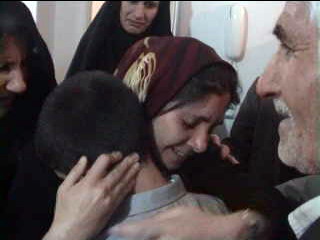
Two defectors of Rajavi’s cult repatriated

Nejat Society Reporter “ Mehr Abad Airport Tehran

Two defectors of Rajavi’s Cult returned, being under pressure since long ago could join American camp and by cooperation of IRC they returned to their homeland and welcomed .

February 23, 2006 0 comments
FacebookTwitterPinterestWhatsappTelegramSkypeEmail
Hojat Zamani

Terrorist or Victim?!

With a little consideration, one can clearly see how happy is the terrorist MKO of possible execution of Hojjat Zamani, one of its members. At the current situation, MKO needed to introduce this as a sign for the importance of its espionage activities in the referral of Iran’s case to UN Security Council. However, the reality is that this event, which has been only reported by the MKO and its accuracy is doubted, has nothing to do with nuclear issues.

Hojjat Zamani and two of his brothers were among the people who were deployed to Iran- because of stupid plans of Rajavi to disrupt social order in Iran after the presidential elections in 1997, which led to the presidency of Seyed Mohammed Khatami- to conduct terrorist operations, attract the so-called global attention toward the MKO and overthrow the reformists, as Rajavi said.

After joining the MKO, Hojjat passed terrorist courses and in his first terrorist operation in the June of 1998, he detonated a strong bomb in Tehran’s Revolutionary Prosecution Office that killed 4 people including an Armenian Iranian (William Wigen); many others were injured in the event.

Terrorist MKO claimed responsibility for this terrorist act in a statement released on June 2, 1998:

"At around 2:00 pm Tehran time, Revolutionary Prosecution Office in downtown Tehran was destroyed by military teams of Mojahedin… ambulances could be heard in the region until hours after the explosion… before that, operational teams of the MKO left the place unhurt."

He was later in 2001 deployed to Tehran again to conduct mortaring operation, and he was arrested after his operations.

After he was arrested, there were wide range efforts to help him (by trying to get the consent of complainants) and the MKO has even pointed to this fact in its statement, released yesterday:

"In the summer of 2004, Hojjat had been sentenced to 4 times execution by the 6th chamber of unjustice reactionary court of so-called Islamic Revolution. Then, in early 2005, a chamber of Supreme Court, comprised of Mohseni Ezhei and Nabi Raji, sentenced him to two times execution and paying a full fine."

From legal point of view, this can happen only if the two complainants of the case agree to withdraw their complaints.

Anyway, the Mojahedin could make a criminal terrorist out of a rural teacher; a terrorist who didn’t care about the blood of people and the one the MKO took advantage of his blood. This is the brief fate for those trapped by the terrorist MKO; what should they be called, Terrorist or Victim?

Irandidban


February 21, 2006 0 comments
FacebookTwitterPinterestWhatsappTelegramSkypeEmail
Iraq

MKO, A Threat Against Iraq

What is of primary importance for us, as Iraqis, is the interest of our nation and we should not lose our way. Past and present experiences prove that the Mojahedin-e Khalq organization is like a blade at the hands of occupiers against innocent Iraqis. We witnessed the brutality of this treacherous organization during Iraqis’ Intifadah (uprising) in 1991. Members of this organization were pioneers in suppressing our nation. Former senior Iraqi officials counted on this group. MKO had a strategic place in security and intelligence issues.

After the fall of Saddam and his partners, most of the leaders of this group fled to Europe but currently, the members of this group plan terrorist operations inside Iraq and support such operations logistically and financially.

Mojahedin-e Khalq organization is a burden for Iraqis. The organization of hypocrites (MKO), under full protection of US tanks in military Camp of Ashraf in Iraq, receives the orders directly from the US army. The leaders and officials of this organization are in practical coordination with those Sunni tribes leaders who disagree with the current political process. The camp of this organization has become a workshop for preparing bombed cars; this camp is used for targeting mosques, kindergartens, hospitals, schools and crowded markets.

Therefore, we ask the Iraqi government, National Assembly and political parties and movements to take an immediate tough stance on expelling the terrorist treacherous group of Mojahedin-e Khalq from Iraq. Our country has suffered enough from this organization and we can’t see more destruction and terrorist operations anymore. We are free in our country. No more deals on the pure blood of Iraqis and their wealth.

You Iraqis, raise your voice to denounce all plots against our country. No one should be allowed to undermine our honor and we should be able to determine the future of our own country. The wealth of Iraq is today an opportunity for parties and organizations and some groups victimize Iraqis to get to their own goals; they do it to serve their own political ambitions.

Hassan Alzameli/Sotaliraq

http://www.sotaliraq.com/articles-iraq/nieuws.php?id=26163

February 21, 2006 0 comments
FacebookTwitterPinterestWhatsappTelegramSkypeEmail
Mujahedin Khalq Organization as a terrorist group

United States Court of Appeals verdict on NCRI

Notice: This opinion is subject to formal revision before publication in the Federal Reporter or U.S.App.D.C. Reports. Users are requested to notifythe Clerk of any formal errors in order that corrections may be made before the bound volumes go to press.


United States Court of Appeals

FOR THE DISTRICT OF COLUMBIA CIRCUIT


Argued April 2, 2004                                                      Decided July 9, 2004


No. 01-1480


NATIONAL COUNCIL OF RESISTANCE OF IRAN,

PETITIONER


v.


DEPARTMENT OF STATE AND

COLIN L. POWELL, SECRETARY OF STATE,

RESPONDENTS


On Petition for Review of Orders of the

Department of State


Paul F. Enzinna argued the cause and filed the briefs forpetitioner. Martin D. Minsker entered an appearance.

Douglas Letter, Litigation Counsel, U.S. Department ofJustice, argued the cause for respondents. With him on thebrief was Peter D. Keisler, Assistant Attorney General.

Bills of costs must be filed within 14 days after entry of judgment.The court looks with disfavor upon motions to file bills of costs outof time.  

——————————————————————————– Page 2  

Before: HENDERSON, GARLAND, and ROBERTS, CircuitJudges.Opinion for the Court filed by Circuit Judge ROBERTS.ROBERTS, Circuit Judge: This is the fourth in a series ofrelated cases concerning the biennial designations by theSecretary of State of the Mojahedin-e Khalq Organization(MEK)1and its aliases as a foreign terrorist organization(FTO). See People’s Mojahedin Org. of Iran v. Dep’t ofState, 182 F.3d 17 (D.C. Cir. 1999) (PMOI I); NationalCouncil of Resistance of Iran v. Dep’t of State, 251 F.3d 192(D.C. Cir. 2001) (NCRI); People’s Mojahedin Org. of Iran v.Dep’t of State, 327 F.3d 1238 (D.C. Cir. 2003) (PMOI II); seegenerally 8 U.S.C. § 1189. In 1999, and again in 2001, theNational Council of Resistance of Iran (NCRI) was deter-mined by the Secretary of State to be an alias of MEK andwas accordingly also designated an FTO. See 1999 Designa-tion, 64 Fed. Reg. at 55,112; 2001 Redesignation, 66 Fed.Reg. at 51,089. In May 2003, after a remand to cure certaindue process deficiencies, see NCRI, 251 F.3d at 208–09, theSecretary decided to leave in place the 1999 and 2001 desig-1The Mojahedin-e Khalq translates into English as People’sMojahedin. [AR268] The Mojahedin-e Khalq Organization (MEK)is known in English as the People’s Mojahedin Organization of Iran(PMOI). Our prior decisions have variously referred to the Moja-hedin-e Khalq as MEK, People’s Mojahedin of Iran, and PMOI.Compare PMOI I, 182 F.3d at 20 (‘‘the People’s Mojahedin Organi-zation of Iran — the MEK, for short’’), with NCRI, 251 F.3d at 197(‘‘petitioner People’s Mojahedin Organization of Iran (‘PMOI’)’’).To limit confusion, wherever possible we will use the terms Mojahe-din-e Khalq and MEK, and, except in case names, not the termsPeople’s Mojahedin or PMOI. We adopt this convention because itis the Mojahedin-e Khalq Organization that the Secretary hasdesignated as a foreign terrorist organization. See Designation ofForeign Terrorist Organizations, 62 Fed. Reg. 52,650 (Oct. 8, 1997)(1997 Designation); Designation of Foreign Terrorist Organiza-tions, 64 Fed. Reg. 55,112 (Oct. 8, 1999) (1999 Designation); Redes-ignation of Foreign Terrorist Organizations, 66 Fed. Reg. 51,088,51,089 (Oct. 5, 2001) (2001 Redesignation); Redesignation of For-eign Terrorist Organizations, 68 Fed. Reg. 56,860, 56,861 (Oct. 2,2003) (2003 Redesignation). ——————————————————————————– Page 3

nations of NCRI as an FTO. NCRI now again petitions forreview. After reviewing NCRI’s arguments, the entirety ofthe administrative record, and certain classified materialsappended to that record, we conclude that the Secretary’slatest designation complied with the governing statute and allconstitutional requirements. We therefore deny the petitionfor review.I.The Anti-Terrorism and Effective Death Penalty Act of1996 (AEDPA) empowers the Secretary of State to designatean entity as an FTO whenever the Secretary determines that(1) the entity is foreign; (2) it engages in terrorist activity;and (3) the terrorist activity threatens the security of theUnited States or its nationals. 8 U.S.C. § 1189(a)(1). Adesignation as an FTO persists for two years, after which theSecretary may redesignate the entity as an FTO for a suc-ceeding two-year period upon finding that the statutory cir-cumstances still exist. Id. § 1189(a)(4)(B).An FTO designation visits serious consequences on theaffected organization: The Secretary of the Treasury mayrequire financial institutions to freeze any assets of the FTO,id. § 1189(a)(2)(C); the members and representatives of theFTO become ineligible to enter the United States, id.§ 1182(a)(3)(B)(i)(IV), (V); and anyone who knowingly pro-vides ‘‘material support or resources’’ to the FTO — includingany donation of money — may be prosecuted and imprisonedfor up to fifteen years, 18 U.S.C. § 2339B(a)(1). The mani-fest purpose of these provisions is to deny terrorist organiza-tions support — financial or otherwise — in and from theUnited States. See H.R. REP. NO. 104-383, at 43–45 (1995)(House Report on AEDPA’s primary predecessor bill).Despite these serious consequences of designation, thegoverning statute affords suspect entities only ‘‘truncated’’participation in the administrative process leading to thedesignation and ‘‘quite limited’’ judicial review after the fact.NCRI, 251 F.3d at 196. As we noted in PMOI I, ‘‘unlike therun-of-the-mill administrative proceeding,’’ ‘‘there is [under ——————————————————————————– Page 4  

AEDPA] no adversary hearing, no presentation of whatcourts and agencies think of as evidence, [and] no advancenotice to the entity affected by the Secretary’s internaldeliberations.’’ 182 F.3d at 19. Once the Secretary hasdesignated an entity an FTO, the statute directs us to ‘‘holdunlawful and set aside a designation’’ only if we find it to be:(A) arbitrary, capricious, an abuse of discretion, or oth-erwise not in accordance with law;(B) contrary to constitutional right, power, privilege, orimmunity;(C) in excess of statutory jurisdiction, authority, or limi-tation, or short of statutory right;(D) lacking substantial support in the administrative rec-ord taken as a whole or in classified information submit-ted to the court [ex parte and in camera], or(E) not in accord with the procedures required by law.8 U.S.C. § 1189(b)(3). Although the statute permits thiscourt to base its review either ‘‘solely upon the administrativerecord’’ ‘‘taken as a whole,’’ or as supplemented by anyclassified information submitted by the Secretary, the Actmakes no provision for the disclosure of that classified materi-al to the designated entity. See id. § 1189(b)(2), (3)(D); seegenerally 28 C.F.R. pt. 17 (governing access to classifiednational security information).In 1997, and every two years since, the Secretary hasdesignated MEK an FTO. See 1997 Designation, 62 Fed.Reg. at 52,650; 1999 Designation, 64 Fed. Reg. at 55,112;2001 Redesignation, 66 Fed. Reg. at 51,089; 2003 Redesig-nation, 68 Fed. Reg. at 56,861. Starting in 1999, the Secre-tary added NCRI to the list of designated FTOs, havingconcluded that NCRI was an alias of MEK. See 1999 Desig-nation, 64 Fed. Reg. at 55,112 (‘‘I hereby designate TTT thefollowing organization as a foreign terrorist organization: TTTMujahedin-e Khalq Organization TTT also known as NationalCouncil of Resistance, also known as NCR.’’). NCRI now, forthe second time, seeks review of that designation. In NCRI’sprevious challenge — brought jointly with MEK — we con- ——————————————————————————– Page 5

cluded that both the 1999 designation of MEK as an FTO andthe designation of NCRI as an alias of MEK satisfied therequirements of the statute. Specifically concerning NCRI,we held — based on the record then presented to us by theSecretary — that the Secretary’s conclusion that NCRI wasan alias of MEK ‘‘does not lack substantial support and TTT isneither arbitrary, capricious, nor otherwise not in accordancewith law.’’ NCRI, 251 F.3d at 199.As a constitutional matter, however, we determined thatthe procedures afforded by the statute and employed by theSecretary in arriving at those designations violated bothorganizations’ due process rights. See id. at 208–09. We didnot vacate the Secretary’s designation as to either MEK orNCRI, but remanded to the Secretary with instructions thateach entity be afforded the opportunity to: (1) respond to anypart of the Secretary’s administrative record that is notclassified material; (2) file evidence on its own behalf; and (3)be meaningfully heard by the Secretary. Id. at 210.Both MEK and NCRI availed themselves of these opportu-nities. NCRI submitted voluminous materials that purportedto demonstrate that it was sufficiently independent of MEKthat it could not be considered an alias of that organization.On September 24, 2001, the State Department informed MEKand NCRI that the Secretary had decided to leave the 1999designation of MEK in place but that ‘‘no such determinationregarding the NCRI as an alias of the MEK is possible atthis time.’’ Letter of Ambassador Francis X. Taylor, Coordi-nator for Counterterrorism, U.S. Dep’t of State, at 2 (Sept.24, 2001). This was shortly followed, on October 5, 2001, bythe Secretary’s redesignation of both MEK as an FTO andNCRI as an alias of MEK. See 2001 Redesignation, 66 Fed.Reg. at 51,089. At that time, the State Department assuredNCRI that although ‘‘the present situation TTT requires con-tinued designation of [NCRI] as an alias of MEK for now,’’upon the completion of review of NCRI’s submissions, ‘‘theSecretary will make a de novo determination in light of theentire record, including the material you have submitted.’’ ——————————————————————————– Page 6

Letter of Ambassador Francis X. Taylor, Coordinator forCounterterrorism, U.S. Dep’t of State, at 1 (Oct. 5, 2001).Nearly a year later, the State Department provided forNCRI’s review additional materials obtained by the FBI inthe course of ‘‘its long-running investigation of the MEK andNCRI.’’ Letter of Ambassador Francis X. Taylor, Coordina-tor for Counterterrorism, U.S. Dep’t of State, at 1 (Sept. 4,2002). Within two months, NCRI submitted its response.See Letter of Paul F. Enzinna, Esq. (Nov. 1, 2002). In May2003, the State Department completed its review process and,on May 24, the Secretary decided to leave in place the 1999and 2001 ‘‘designations of the National Council of Resistance(NCR) and the National Council of Resistance of Iran(NCRI) as foreign terrorist organization aliases of the Muja-hedin-e Khalq (MEK).’’ Action Mem. from William Pope &William H. Taft, IV to the Secretary of State, at 3 (May 22,2003) (Action Mem.). NCRI now petitions for review of thislatest decision.II.NCRI’s primary argument is that the Secretary’s conclu-sion that NCRI is an alias of MEK lacks substantial supportin the administrative record. NCRI insists that it is anumbrella organization of Iranian dissident persons and groupsof which MEK is only a single member, no more powerfulthan any other. In addressing this contention, we begin withour earlier holding in this action. In NCRI, we concluded —based on the record then presented to us — that the Secre-tary’s designation of NCRI as an alias of MEK ‘‘does not lacksubstantial support and TTT is neither arbitrary, capricious,nor otherwise not in accordance with law.’’ 251 F.3d at 199.Although that decision is obviously not determinative of thequestion before us today — we are now reviewing a recordthat has since been supplemented both by the Governmentand NCRI — its holding must nevertheless inform our deci-sion here. Logically, NCRI’s challenge can succeed only ifthe new record materials establish its independence fromMEK so that we can no longer affirm that ‘‘the Secretary, on ——————————————————————————– Page 7

the face of things, had enough information before [him] tocome to the conclusion’’ that NCRI is an alias of MEK. Id.Having reviewed the supplemented administrative record as awhole and the classified information appended to it, we con-clude that NCRI has not met this burden.To explain our decision, we must first review what itmeans — in the very particular context of AEDPA — for oneorganization to be an alias of another. On its previousappeal, NCRI argued that the Secretary lacked authorityunder AEDPA to designate an entity an FTO based on afinding that it was an alias of another designated FTO. Seeid. at 200. We rejected that contention, finding that thegrant of authority to designate FTOs ‘‘implies the authorityto so designate an entity that commits the necessary terroristacts under some other name.’’ Id. In so doing, we used amathematics metaphor — specifically, the transitive proper-ty — to describe the alias concept: ‘‘Logically, indeed mathe-matically, if A equals B and B equals C, it follows that Aequals C. If the NCRI is the [MEK], and if the [MEK] is aforeign terrorist organization, then the NCRI is a foreignterrorist organization also.’’ Id.; see also id. (‘‘If the Secre-tary has the power to work those dire consequences on anentity calling itself ‘Organization A,’ the Secretary must beable to work the same consequences on the same entity whileit calls itself ‘Organization B.’ ’’). Seizing upon our earlierinvocation of the transitive property, NCRI now argues thatthe administrative record does not demonstrate that ‘‘Aequals B’’ — that is, that NCRI equals MEK — and there-fore NCRI cannot be an alias of MEK. Indeed, NCRIrightly points out that even the State Department acknowl-edges that NCRI and MEK are not ‘‘one and the same.’’ SeePet. Reply Br. 4–6.Implicit in NCRI’s argument, however, is a mistaken as-sumption that the alias concept, under AEDPA, is boundedby the transitive property. This reads too much into ourmathematical metaphor in NCRI. See Berkey v. Third Ave.Ry. Co., 244 N.Y. 84, 94 (1926) (Cardozo, J.) (‘‘Metaphors inlaw are to be narrowly watched, for starting as devices toliberate thought, they end often by enslaving it.’’). While it is ——————————————————————————– Page 8

certainly correct to use the term alias to describe scenarioswhere a single entity is known by more than one name — forinstance, Mojahedin-e Khalq is an alias for People’s Mojahe-din, two names for the same organization, one Farsi, theother English — nothing in AEDPA or any more general ruleof logic or language requires that the application of the aliasconcept be strictly limited to such circumstances.To the contrary, our citation in NCRI to First NationalCity Bank v. Banco Para El Comercio Exterior de Cuba, 462U.S. 611 (1983), indicates that we intended the alias conceptto have a sweep beyond the transitive. In that case, whichconcerned a suit brought by Banco Para El Comercio Exteri-or (BPECE) against First National City Bank for perform-ance under a letter of credit, the Supreme Court held thatFirst National could counterclaim for setoff of the value of itsassets that had been seized and nationalized by the Cubangovernment, notwithstanding the fact that BPECE had beenestablished by the Cuban government as a juridical entityseparate from the government. See id. at 623–34. Acknowl-edging a presumption that ‘‘government instrumentalities es-tablished as juridical entities distinct and independent fromtheir sovereign should normally be treated as such,’’ id. at626–27, the Court nevertheless concluded that the normallyseparate juridical status had to be set aside where the Cubangovernment was the real party in interest behind BPECE’sletter of credit claim, id. at 632. The Court, in reaching itsconclusion, looked to ordinary principles of agency law, notingthat ‘‘where a corporate entity is so extensively controlled byits owner that a relationship of principal and agent is created,we have held that one may be held liable for the actions of theother.’’ Id. at 629 (citing NLRB v. Deena Artware, Inc., 361U.S. 398, 402–04 (1960)). We think those same ordinaryprinciples of agency law are fairly encompassed by the aliasconcept under AEDPA. When one entity so dominates andcontrols another that they must be considered principal andagent, it is appropriate, under AEDPA, to look past theirseparate juridical identities and to treat them as aliases.The inclusion of these fundamental precepts of agency lawwithin AEDPA’s alias concept is entirely consistent with — ——————————————————————————– Page 9

indeed, necessary to — the effective pursuit of the statute’sobjective of denying support in and from the United States toterrorist organizations. Just as it is silly to suppose ‘‘thatCongress empowered the Secretary to designate a terroristorganization TTT only for such periods of time as it took suchorganization to give itself a new name, and then let it happilyresume the same status it would have enjoyed had it neverbeen designated,’’ NCRI, 251 F.3d at 200, so too it is implau-sible to think that Congress permitted the Secretary todesignate an FTO to cut off its support in and from theUnited States, but did not authorize the Secretary to preventthat FTO from marshaling all the same support via juridicallyseparate agents subject to its control. For instance, underNCRI’s conception, the Government could designate XYZorganization as an FTO in an effort to block United Statessupport to that organization, but could not, without a separateFTO designation, ban the transfer of material support toXYZ’s fundraising affiliate, FTO Fundraiser, Inc. Thecrabbed view of alias status advanced by NCRI is at war notonly with the antiterrorism objective of AEDPA, but commonsense as well.We need not plumb all the complexities of agency law todetermine when an agent, under AEDPA, is the alias of itsprincipal. It is sufficient for our purposes to note that therequisite relationship for alias status is established at leastwhen one organization so dominates and controls another thatthe latter can no longer be considered meaningfully indepen-dent from the former. See, e.g., NLRB v. Deena Artware,Inc., 361 U.S. 398, 403 (1960) (‘‘ ‘Dominion may be so com-plete, interference so obtrusive, that by the general rules ofagency the parent will be a principal and the subsidiary anagent.’ ’’) (quoting Berkey, 244 N.Y. at 95); Casino ReadyMix, Inc. v. NLRB, 321 F.3d 1190, 1196 (D.C. Cir. 2003)(‘‘ ‘agent’ is one who agrees to act ‘subject to [a principal’s]control’ ’’) (quoting RESTATEMENT (SECOND) OF AGENCY § 1, cmt.a (1958)); cf. Transamerica Leasing, Inc. v. La Republica deVenezuela, 200 F.3d 843, 848 (D.C. Cir. 2000) (‘‘A sovereign isamenable to suit based upon the actions of an instrumentalityit dominates because the sovereign and the instrumentality ——————————————————————————– Page 10

are in those circumstances not meaningfully distinct entities;they act as one.’’).We thus frame our inquiry here as whether ‘‘the Secretary,on the face of things, had enough information before [him] tocome to the conclusion’’ that NCRI was dominated andcontrolled by MEK. PMOI I, 182 F.3d at 25. Based on ourreview of the entire administrative record and the classifiedmaterials appended thereto, we find that the Secretary didhave an adequate basis for his conclusion. While our deter-mination is buttressed by classified information provided tous on an ex parte and in camera basis — the contents ofwhich we cannot discuss — the voluminous unclassified mate-rials contained in the administrative record by themselvesand by a comfortable margin provide sufficient support forthe Secretary’s conclusion, given the standard of review. Itwould serve little purpose to catalogue all the material in theadministrative record supporting the conclusion that NCRI isdominated and controlled by MEK, but we will set out belowa few of the pieces of information we found to be mostcompelling. As we do so, it bears repeating that AEDPAdoes not permit us, in exercising our limited judicial review,to make any ‘‘judgment whatsoever regarding whether thematerial before the Secretary is or is not true,’’ but allows usto inquire only whether the Secretary ‘‘had enough informa-tion before [him] to come to the conclusion’’ that NCRI isdominated and controlled by MEK. Id.After an extensive investigation of MEK and NCRI, theFBI reported to the State Department that ‘‘[i]t is theunanimous view of the FBI personnel who are involved in andfamiliar with the FBI’s investigation of the [MEK] that theNCRI is not a separate organization, but is instead, and hasbeen, an integral part of the MEK at all relevant times.’’Letter of Charles Frahm, Section Chief, International Terror-ism Operations Section II, at 1 (Aug. 28, 2002). Contrary toNCRI’s portrayal of itself as an umbrella organization, ofwhich the MEK was just one member, the FBI concludedthat it is NCRI that is ‘‘the political branch’’ of the MEK. Id.Attach. at 1. ——————————————————————————– Page 11


This conclusion was based in large part on evidence gath-ered from the search — executed in December 2001 pursuantto a valid warrant — of a house in Falls Church, Virginiaapparently used as office space by both NCRI and MEK.There, the FBI discovered NCRI and MEK materials ‘‘com-mingled together, and not separated,’’ including bank records,signed blank checks, MEK propaganda, NCRI publications,travel documents, and letterhead which listed the sameFrench address for each organization. Id. Attach. at 2–4.Crucially, among the recovered documents was a schematicbreakdown of the ‘‘Iranian Resistance,’’ which describedNCRI as ‘‘The Political Branch’’ of the movement. Id. at Tab6.Additionally, earlier investigations of MEK and NCRI hadrevealed that the two organizations shared an essentiallyunitary leadership structure. The overall head of MEK,Massoud Rajavi, also leads NCRI. And Rajavi’s wife, Mar-yam Rajavi, was selected by NCRI to be Iran’s President-in-Exile. Id. Attach. at 2; see also id. Attach. at 4 (‘‘Theleadership of [MEK] and NCRI is intermixed, and the enti-ties operate in a day-to-day way as a single unit.’’). Thesefacts corroborated the FBI’s earlier conclusion prior to the2001 designation of NCRI as an FTO that ‘‘the NCR/NCRI isin fact controlled by and inseparable from the MEK.’’ Decl.of Agent Michael Rolince (quoted in Action Mem., Tab 2 at11).The State Department acknowledged that ‘‘NCRI has sub-mitted numerous affidavits purporting to show that it is notcontrolled by the MEK and is not an MEK front,’’ and evencredited some of NCRI’s ‘‘subsidiary points.’’ Action Mem.,Tab 2 at 12, 9. The agency, however, concluded that ‘‘theevidence developed by the FBI is convincingly to the con-trary.’’ Id. Tab 2 at 12. It may be true that the StateDepartment relied very heavily on the conclusions of thecounterterrorism experts of the FBI. As noted above,though, under the narrow powers of judicial review Congresshas accorded to us under AEDPA, it is emphatically not ourprovince to second-guess the Secretary’s judgment as towhich affidavits to credit and upon whose conclusions to rely. ——————————————————————————– Page 12  

We are to judge only whether the ‘‘support’’ marshaled forthe Secretary’s designation was ‘‘substantial.’’ 8 U.S.C.§ 1189(b)(3)(D). We conclude that the support for the Secre-tary’s conclusion that NCRI was dominated and controlledby, and thus was an alias of, MEK was indeed substantial,and we therefore reject NCRI’s statutory challenge to itsdesignation as an FTO.III.This leaves only NCRI’s constitutional challenges to certainprocedures employed in making that designation. Specifical-ly, NCRI argues that due process requires that (1) it beprovided access to any classified materials that the Secretaryrelied upon in making the designation, and (2) it have anadversary hearing before the agency at which it could con-front witnesses against it. Both these arguments are fore-closed by our earlier decisions in NCRI and PMOI II. See251 F.3d at 208–09; 327 F.3d at 1242–43. ConcerningNCRI’s claim that it is entitled to review classified materials,in NCRI we wrote that the government ‘‘need not disclose theclassified information to be presented in camera and ex parteto the court under the statute.’’ 251 F.3d at 208. In PMOIII, addressing the same claim, this time brought by MEK, wewere even more emphatic: ‘‘We reject this contentionTTTTWe already decided in [NCRI] that due process required thedisclosure of only the unclassified portions of the administra-tive record.’’ 327 F.3d at 1242. PMOI II also disposes ofNCRI’s claim for an adversary hearing. There, we held thatNCRI established the constitutional baseline for fair processand, the Government having complied with those commandson remand, that ‘‘nothing further is due.’’ Id. at 1243. Wereach the same conclusion with regard to NCRI.The petition for review is denied.

FAS

Download United States Court of Appeals verdict on NCRI

February 21, 2006 0 comments
FacebookTwitterPinterestWhatsappTelegramSkypeEmail
Newer Posts
Older Posts

Recent Posts

  • A Criterion for Proving the Violent Nature of the MEK

    December 31, 2025
  • Rebranding, too Difficult for the MEK

    December 27, 2025
  • The black box of the torture camps of the MEK

    December 24, 2025
  • Pregnancy was taboo in the MEK

    December 22, 2025
  • MEPs who lack awareness about the MEK’s nature

    December 20, 2025
  • Facebook
  • Twitter
  • Instagram
  • Youtube

© 2003 - 2025 NEJAT Society . All Rights Reserved. NejatNGO.org


Back To Top
Nejat Society
  • Home
  • Articles
  • Media
    • Cartoons
    • NewsPics
    • Photo Gallery
    • Videos
  • Publications
    • Books
    • Nejat NewsLetter
    • Pars Brief
  • About Us
  • Contact us
  • Editions
    • عربي
    • فارسی
    • Shqip