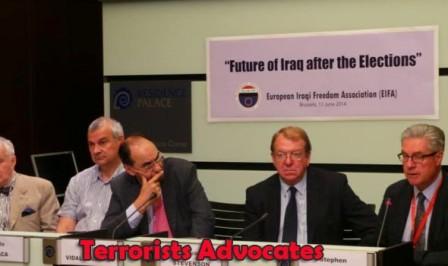
I only have a few words to add to Jim’s post about United Against a Nuclear Iran naming Joe Lieberman as its new president. Those words are: Mojahedin-e Khalq. That’s the ex-terrorist Iranian opposition group, often known as the MEK, that has campaigned tirelessly for decades for regime change in Iran, and Joe Lieberman is one of their favorite advocates in Washington.
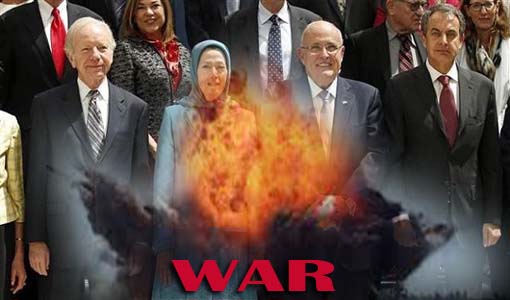
Here’s a bit of something I wrote in June about Lieberman’s positions on Iran and the MEK:
As far back as 2008, Lieberman was joking—yes, joking, as if this were a laughing matter—about the “appeal” of bombing Iran. In a 2010 speech to the Council on Foreign Relations that re-purposed many of the talking points Lieberman had used to push for the invasion of Iraq, he spoke of a six-month deadline—six months! in 2010!—for Iran to roll back its nuclear program before the U.S. had to seriously consider a military strike.
Lieberman’s been at it since then, too. In 2012, he said that a military strike could cause Iran’s nuclear program to “be delayed for enough years that we may hope and pray that there will be a regime change.” And that is the central point of Lieberman’s advocacy: he wants a U.S. policy of regime change. Just this month, he participated by video in a confab of the Mojahedin-e Khalq (MEK), the ex-terrorist Iranian opposition group that relentlessly pushes for regime change.
“Inevitably,” Lieberman addressed the MEK members directly, “as individuals you may ask yourself: Is it possible that we can bring about a change of regime in Iran? And I want to say to you that it is. I’m confident that it is and it will happen.” The US, he said, “should be working closely with your resistance group.” The event was even the subject of a “sponsored report“—whatever that means—from The Washington Times that helpfully categorized Lieberman’s statements as “American support for regime change and the Iranian opposition.”
I mention this because of the raft of deal opponents who just won’t stop insisting that actually they don’t want war with Iran, they just want a “better deal.” If that’s the case, they ought to stop naming Joe Lieberman to prominent positions in their organizations. As it stands now, the hawkish former Democrat holds positions in several major anti-deal groups in Washington. Jim noted his roles at theAIPAC anti-deal spin-off (which has also promoted MEK materials in its advertisements), the American Enterprise Institute, and the Foundation for Defense of Democracies, adding to that now his elevation from advisory board member at UANI to being its leader.
Fellow board members who actually support the Iran nuclear deal, such as Graham Allison and its Lieberman’s immediate predecessor, Gary Samore, might take note.
But hawkishness on Iran is a matter apart from support for the MEK. The group is reviled in Iran; it has launched terrorist attacks there; many impartial analysts have described it as a cult. Eli and I have already written about UANI’s targeting of legal humanitarian trade with Iran, and how it belies its professed solidarity with the Iranian people. Now, we can add UANI’s promotion of a pro-MEK hawk to that score. What’s worse, though, is the group’s elevation of a man who has such a cavalier attitude toward war with Iran and who wants official US policy toward the Islamic Republic to be regime change.
We’ve seen this move before with the Iraq war, and UANI seems determined to have Joe Lieberman, who, as Jim noted, was Honorary Co-Chair of the Committee for the Liberation of Iraq, return to star in the sequel.
Ali Gharib,
About the Author
Ali Gharib is a New York-based journalist on U.S. foreign policy with a focus on the Middle East and Central Asia. His work has appeared at Inter Press Service, where he was the Deputy Washington Bureau Chief; the Buffalo Beast; Huffington Post; Mondoweiss; Right Web; and Alternet. He holds a Master’s degree in Philosophy and Public Policy from the London School of Economics and Political Science. A proud Iranian-American and fluent Farsi speaker, Ali was born in California and raised in D.C.
 dly plans on spending $20 million over the next two months urging Congress to vote against the deal. But its efforts at a full frontal attack on the accord, inked by the P5+1 (the US, China, France, Russia, the UK, and Germany) and Iran is leading to some politically awkward alliances.
 For the past week, a letter from a varied group of policy experts has been making the rounds, mostly as a case against doing a deal with Iran. More particularly, many of these experts have been opposed to doing this deal currently being hashed out in Vienna. The exact contours of the deal are unknown, but the broad strokes have been apparent since an April “framework” laid out the parameters for many of the larger issues. The letter, which was organized and released by the pro-Israel think tank Washington Institute for Near East Policy (WINEP), got a big write-up in The New York Times:
 The contrast with a visit of a delegation from the Iranian Majles to Brussels on May 6-7 could not be greater. Sure enough, the MEK tried to derail the visit by lobbying the MPs to adopt a resolution on capital punishment in Iran, which would have almost certainly led to the cancellation of the visit. When that plan failed, they called on Euro MPs to boycott the delegation.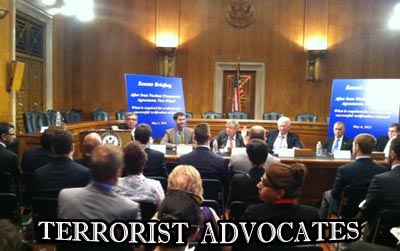
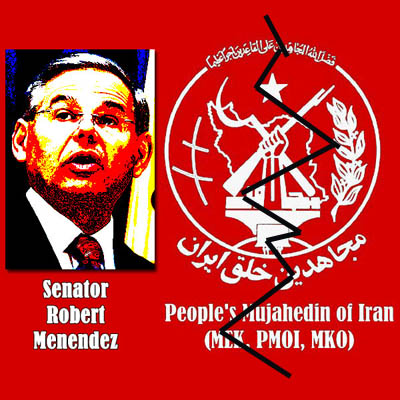 Democrats of new sanctions against Iran. He has repeatedly co-sponsored sanctions legislation-with Mark Kirk (R-IL), the top recipient of pro-Israel campaign funding for the past decade-with the ostensible purpose of increasing pressure on Tehran to make far-reaching concessions at the negotiating table.
 by July 20 or shortly thereafter. While prospects for an agreement within that time frame remain uncertain — the most important sticking point by far appears to be the gap between US demands that Iran retain only a few thousand centrifuges and Iran’s insistence that it needs many more to meet its energy needs — the hawks (by which I mean the Israel lobby and its many allies in Congress) are taking no chances.