
Come October 1, a federal appeals court decision will force the State Department to decide whether the exile-Iranian group Mujahadin-e Khalq, or M.E.K., belongs on the list of designated  foreign terrorist organizations.
As recently as 2007, a State Department report warned that the M.E.K., retains "the capacity and will" to attack "Europe, the Middle East, the United States, Canada, and beyond."
The M.E.K., which calls for an overthrow of the Iranian government and is considered by many Iranians to be a cult, once fought for Saddam Hussein and in the 1970s was responsible for bombings, attempted plane hijackings, and political assassinations. It was listed as a foreign terrorist organization in 1997.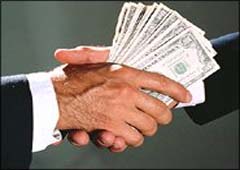
If the State Department does decide to delist M.E.K., whose name means "People’s Holy Warriors of Iran," it will be with the blessing of dozens of congressmen.
A congressional resolution that urges Secretary of State Hillary Clinton to remove M.E.K. from the State Department list of foreign terrorist groups was signed by 99 politicians, including Rep. Darrell Issa, a California Republican, Rep. Eleanor Holmes Norton, a Democrat from Washington, D.C., and Alabama Republican Sen. Spencer Bachus.
Those signatures may have been obtained with real money to grease the wheels. A U.S. News investigation found that three major lobbying firms were together paid hundreds of thousands of dollars by U.S.-based Iranian-American community groups with ties to the M.E.K. to drum up support for the resolution.
Victoria Toensing of DiGenova & Toensing, a lobbying shop famous for its involvement in the Bill Clinton-Monica Lewinsky scandal, was paid $110,000 in 2011 to lobby for the resolution. The firm Akin, Gump, Strauss, Hauer & Feld dedicated five lobbyists to getting signatures for the resolution, and was paid $100,000 in 2012 and $290,000 in 2011 to do so. Paul Marcone and Association similarly lobbied for the resolution, and received $5,000 in 2010 and $5,000 in 2011 for its efforts.
"It’s a worthy cause," said Toensing, who believes the M.E.K. has reformed from its violent past. "Have you ever seen a more bipartisan disciplined group as the one that supported this issue?"
(Akin, Gump, et al. declined to comment to U.S. News. Paul Marcone said despite its history, the M.E.K. "has every right to petition the government on resolutions.")
While dozens of congressmen have signed on to the delist resolution, those no longer holding office appear to be even more supportive of the group.
Last week, at a Paris rally for the M.E.K., Newt Gingrich was captured on camera bowing to the Iranian exile-group’s leader, Maryam Rajavi. (The M.E.K.’s political arm, the National Council of Resistance of Iran, has its headquarters in Paris).
Also in attendance were former Pennsylvania Gov. Ed Rendell, former New York City Mayor Rudy Giuliani, former State Department spokesman P.J. Crowley, and former Bush U.N. Ambassador John R. Bolton.
Video of the rally in Paris shows what appear to be tens of thousands of M.E.K. supporters waving flags and holding up pictures of Rajavi, who has called democracy "the spirit that guides our Resistance." Some assert the M.E.K. would prefer Iran to become a Marxist state, as it was founded by Marxist-Islamist Iranian students in the 1960s.
"The MEK are trying to portray themselves as a popular and democratic opposition to the current Iranian regime," said Karim Sadjadpour, an Iran analyst at the Carnegie Endowment for International Peace. "The reality is that they’re neither popular nor democratic."
A prominent Iranian journalist, who did not want to be named for fear of repercussions from the M.E.K., said that despite the group’s attempts to present itself as the main Iranian dissident group, the majority of the Iranian diaspora "does not want to get close" to it. A 2011 New York Times story said most Iranians and Iraqis see the M.E.K. as a "repressive cult."
The "cult" descriptor isn’t just popular opinion. A 2009 Rand study of the M.E.K. described the group as having "cultic practices" and "deceptive recruitment and public relations strategies."
Patrick Clawson, director of research at the Washington Institute for Near East Policy, which has been described as a pro-Israel group, describes the M.E.K. this way: "It’s a cult. There’s no other way to put it."
Clawson, who has spent time with M.E.K. members abroad and their supporters in the U.S., says politicians have been "misled" by "these charming individuals."
"They tell what seems at first glance to be a believable story," he said. "People in cults are charming sometimes. I mean, Scientologists convince movie stars."
There’s no doubt the M.E.K. knows how to charm. When reached by U.S. News & World Report, the spokesman for the National Council of Iran (the M.E.K.’s Paris-based political arm), Shahin Gobadi, spent an extraordinary amount of time answering questions, both over the phone and by E-mail.
"I have sent you a lot," he said, after an E-mail arrived containing 17 attachments. "But I am happy to send much more."
Gobadi repeatedly said that the M.E.K. was working for a democratic future for Iran, emphasizing freedom of speech, abolition of the death penalty, equality for women, and peaceful coexistence with the rest of the world.
"The designation of the M.E.K. as a foreign terrorist organization was … a goodwill gesture to the murderous regime in Iran as part of a policy of appeasing the mullahs," Gobadi said, skimming over the group’s violent past. "Various senior U.S. officials have acknowledged this reality."
Among these officials is former Democratic National Committee chairman Howard Dean, who once called for Rajavi to be recognized as Iran’s president.
As happened at the Paris rally last week, a number of politicians also deliver energetic speeches on behalf of the M.E.K.
Rendell, who has given at least eight supportive speeches, has made $150,000 for his efforts.
The Treasury Department is currently investigating Rendell along with several former senior government officials for giving M.E.K. speeches for money, as transactions with a terrorist group are against the law. Treasury spokesman John Sullivan said that the department "takes sanctions enforcements seriously," but would not give a timeline for when the investigation would be complete.
Rendell says his support for M.E.K. is humanitarian-based, as thousands of the group’s members currently live in exile in a refugee camp in Iraq.
The humanitarian situation is undoubtedly real—Camp Ashraf has been attacked several times since the U.S. transferred control back to the Iraqi government in 2009. In April of last year, Iraqi security forces reportedly stormed the camp and killed 31, wounding 320 more, though news reports vary widely. The M.E.K.’s various websites are heavily Camp Ashraf-focused.
"Ithink our reneging on protecting Camp Ashraf is nothing short of disgraceful," Rendell said, calling it.
Ask any politician who has supported the M.E.K., though, and they are unlikely to be able to tell you very much about the group or its history.
Both Rendell and Giuliani, who has spoken at M.E.K. events in Paris, Geneva, and New York, and who was in Paris twice last week to advise the group, said they knew little about the group before their paid speaking gigs began.
Giuliani said he first learned about the group from former FBI head Louis Freeh, who told him the M.E.K. were a group of revolutionaries, not terrorists. Then, Giuliani said, he "did research." "And every time I go to one of these meetings, I am more convinced," he said.
Former State Department spokesman Crowley, who has been paid to speak at at least four M.E.K. events, acknowledged that the exile group has in the past "on more than occasion been on the wrong side of history." But Crowley said he became increasingly "intrigued" with the group during his time at the State Department, whose location on C Street the M.E.K. regularly visits. He said he believes "their pursuit now is peaceful."
Sadjadpour, the Carnegie analyst, finds it remarkable that so many politicians have supported a group with so much baggage. "In some cases it’s greed, in some cases it’s cluelessness, in some cases it’s remarkably poor judgment, and often it’s all of the above," he said of the political support.
While Gobadi repeatedly told U.S. News that the group is peaceful, a number of news reports allege that the M.E.K. may have been involved in a string of nuclear scientist assassinations over the last several years, with monetary and other aid from the U.S. and Israeli governments.
"On the premise that the enemy of my enemy is my friend, funding, arming or training M.E.K. is an important strategic tool for Israel and the U.S.," Dilshood Achilov, assistant professor of Middle East politics at East Tennessee State University, told the International Business Times of the nuclear scientist assassinations.
Gobadi called the allegations "absolutely absurd" and "directly from the textbook of the mullahs’ Intelligence services."
But the New Yorker’s Seymour Hersh this April gave credence to possible ties between the M.E.K. and the U.S. government, publishing a short piece that said the U.S.’s Joint Special Operations Command had trained members of the M.E.K starting in 2005. According to Hersh’s sources, the training stopped sometime before President Obama took office. But "some American-supported covert operations continue in Iran," Hersch wrote, under the headline, the M.E.K. "Our men in Iran?"
Gobadi insists they aren’t anyone’s men. He says the M.E.K has "not received any funding or weapons from any foreign country and does not seek" it. "The Iranian crisis has an Iranian solution," he said.
Much of M.E.K.’s support, Gobadi says, comes from the Iranian diaspora. While he doesn’t name the group’s U.S. supporters, the Senate disclosure database reveals the Iranian American Community of North Texas and Iranian American Community of Northern California have been most active. Dozens of similar community groups came into existence after the U.S. government shut down a partner office of the M.E.K. in D.C. in 2003, but many have since disappeared. Requests for comments from both community groups were not returned, but it’s clear that they have had enormous fundraising and sway.
IACNT and IANCC paid the lobbying firms in Washington thousands of dollars to get signatures for the congressional resolution. They paid the speakers lobby thousands of dollars to get Rendell, Giuliani and Crowley, participants said.
And they funded a series of sleek ads that have aired on channels like Fox calling for a delisting of the M.E.K.
While it initially looked as though the M.E.K. would be delisted in October, new comments from the White House suggest the group won’t be.
In June, a senior administration official told reporters in a conference call that the M.E.K. may have "over-interpreted" recent events to its favor. "It appears that MEK leaders believe that the Secretary has no choice now but to delist them," the official said. "That is, quite plainly, wrong."
Gobadi said he can’t predict the outcome, but can only be hopeful the "unlawful designation" can come to an end.
Despite hundreds of thousands of dollars in effort, that may be impossible while doubts over the group remain.
US News reporter Seth Cline contributed to this report.
By Elizabeth Flock ,USNews.com
 thousand bucks to lobby for them. I wrote about the problem before, but count me even more gobsmacked by Joby Warrick’s fine WaPo piece. It’s one thing to take money for speeches from the MEK, something a bipartisan group of luminaries has done on repeated occasions; it’s completely another to join a series of calls and meetings with the State Department on the MEK — representing their interests — and pretend it’s anything other than what it is: Acting for a foreign agent.
 the Mujahadin-e Khalq (MEK), an Iranian group that has been lobbying Washington to be removed from the U.S. government’s list of designated foreign terrorist organizations.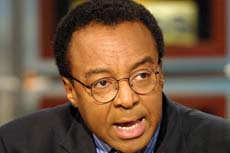

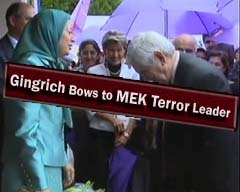 face Rajavi, smiled, and at approximately 1:02 minutes into the above video, folded at the waist and bowed solemnly. Rajavi, clothed head-to-toe in green, handed him a bouquet of flowers as the crowd cheered.
 against terrorism. Now, according to TalkingPointsMemo, the Atlantic, and other outlets, it appears that the former Speaker has himself been lauding an organization that the State Department continues to view as a terrorist one, namely, the Iranian MEK. He’s calling it a "massive, world-wide movement for liberation in Iran."
 list that also happens to hate the current Iranian regime. This seems pretty illegal.. Now let’s meet an additional two faces who’ve been providing support to this official terrorist group recently: Newt Gingrich and columnist Clarence Page!
  and “legitimacy” because it now can be used to carry out attacks inside Iran.
 organizations. However, the controversial decision is being hindered by reports that the embattled group has failed to evacuate the remaining 1,400 group members from Camp Ashraf in Iraq. The MEK has long fought Iranian governments, in what they claim is a struggle to establish a democratic Iranian state.
 group, have spread like wildfire through the mainstream U.S. press. The firestorm began in early February 2012 after anonymous White House officials accused the group of assassinating several Iranian nuclear scientists with the help of the Israeli government. Media coverage gained further traction after reports surfaced about alleged payments made by the MEK to former, high-ranking U.S. officials in exchange for their work in lobbying to remove the group from the
 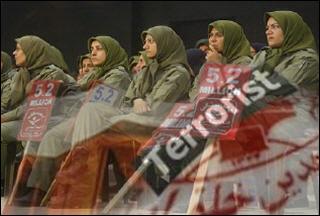 State Department’s list of terrorist organizations.