
The misleading, deceptive and false propaganda of the Mujahedin Khalq Organization (the MKO/the MEK/the  Cult of Rajavi) is plainly clear to a large number of people regardless of their political viewpoint. Ben Davies is an analyst and writer, formerly filming in Syria in 2013 with the primary focus on the Middle East, with an emphasis on Syria, Iraq and Iran. He is an anti-Bashar Assad and so an anti-Iran journalist –although he introduces himself as independent in his website. His emphatic focus on Syria, Iraq and Iran has led him to the case of the MKO. In August 2014 he wrote a probed article on the group and its support for the Syrian opposition titled “Revolt Without Rajavi: Syria’s Opposition Must Not Embrace the MEK”.
Ben Davies describes the efforts of the MKO propaganda to voice its support for “Syrian people”. “The support given to the MEK (or rather, the approval that some anti-Assad activists show in its general direction) is down to the fact that since the start of Syrian revolution against the Assad regime in 2011, the group has spiced up its usual monotonous, anti-Iranian regime rhetoric with anti-Assad rhetoric too,” he writes. It was just a few months later, in December 2014 that Davies posted a perfectly investigated article on how the MKO propaganda system works.
This former writer of Radio Free Syria warns about Maryam Rajavi’s hypocritical rhetoric for the Syrian opposition giving a brief of the MKO’s violent past, its alliance with Saddam Hussein and combat against its own people. “The problem is not with the words”, he writes about Maryam’s “well-worded performance” for Syrian people. “The problem is with who is speaking them. Rajavi is able to so fluently describe the horrors that a sadistic dictatorship puts people through because she runs one herself in the MEK’s base.”
Davies explains the cult-like system ruling the MKO fairly:
“The ways in which the mujahideen work are almost identical to the very regimes they ostensibly despise. Yes, they claim to be strongly opposed to Khamenei’s regime in Iran. Yes, they have a history of fighting against it (to the point of self sacrifice all too often), and yes, they claim to strongly support the Syrian revolution. Maryam Rajavi, the leader of the MEK, even met with former SNC leader Ahmed Jarba, and regularly condemns the Assad regime.
“Maryam and Massoud literally and metaphorically watch over the lives of their followers.
“While it is true that the MEK did indeed start out as an idealistic (and it still is, at the ground level, where many genuinely believe in fighting for Iran) organisation which helped to unseat the repressive regime of the Shah, it degenerated into a dystopic cult, ruled by the two-headed tyranny of the Rajavi couple. Members have been forced into self-criticism sessions in which they are forced to humiliate themselves if they get any thoughts about the opposite sex, men and women have been forced to divorce if they are married (although this didn’t stop Maryam and Massoud from getting together of course), members are taught that they must give themselves over utterly to Maryam and Masoud, dissenting members are imprisoned and killed.”
The journalist also refers to parts of an article written by the prominent journalist of the New York Times, Elizabeth Rubin who was first to label the MKO as “the Cult of Rajavi” in 2003. Rubin’s first-hand account on the life of MKO members in Camp Ashraf was at the time a huge revelation on the oppressive cult-like system the Rajavis run.
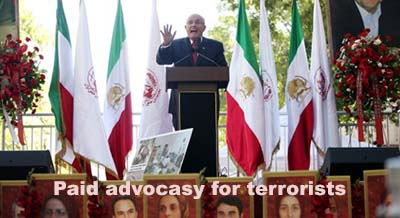
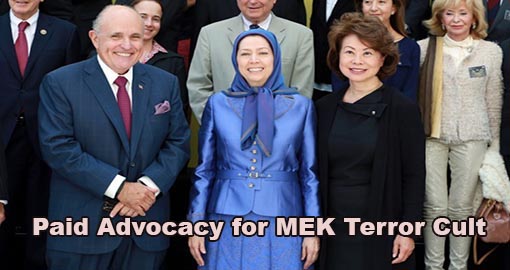
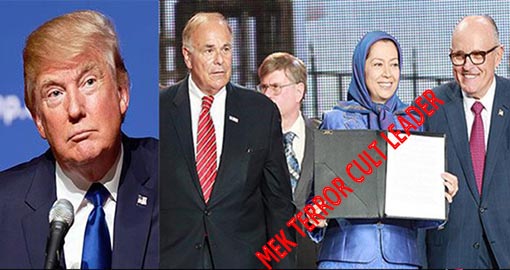
Besides, Ben Davies quotes Rubin’s second article on the MKO in 2011 after she got to know about paid speakers such Rudy Guilliani, Howard Dean and Michael B. Mukasey who spoke on behalf of the MKO in the group’s rallies. “I thought I was watching The Onion News Network. Did Mr. Giuliani know whom he was talking about?”, Writes Rubin who is stunned with the exaggerated compliments of Giuliani for Maryam Rajavi.
Davies blames the then US Secretary of State Hillary Clinton for ignoring the warnings of journalists and scholars, delisting the MKO from the list of Foreign Terrorist Organizations of the US State Department. Thus, he warns the leaders of Syrian opposition on the futile and even destructive fallouts of approaching the Cult of Rajavi:
“I would personally very much like to know what Ahmed Jarba, then head of the Syrian National Coalition, was thinking when he met with Rajavi in May 2014. What was he hoping to achieve? Did he think that such a meeting would give his unpopular, disorganised, and so far ineffective coalition some sort of clout? Did he imagine that he would gain access to their bottomless pits of pecuniary resources? Was he naively trying to establish some perverse form of solidarity with the Iranian people through this organisation? In short, was he as heartless or thoughtless as the group’s western backers seemingly are?
“If he was seeking any of these things, he will be disappointed. Far from bringing him any clout, meeting with the MEK can only earn derision and disdain from the majority of well-informed, sane, non-fraudulent pro-democracy activists, Iranian and otherwise. As one US state department official frankly admitted about the group: “They are the best financed and organized, but they are so despised inside Iran that they have no traction.” Such a meeting only lends ammunition to pro-Khamenei propagandists, which they can use to smear the Syrian opposition by mere association with the Rajavi death cult.
“It isn’t like he could gain any form of useful resources or funding from such a meeting either. All the MEK’s money, when it isn’t being used to enable Maryam to live in luxury far from her suffering followers in the baked Iraqi desert, is used for endless lobbying in the west. Running a PR machine for a Middle Eastern 21st century Marxist cell cum Heaven’s Gate Sect takes up a lot of money, after all. He isn’t going to see a penny of it.
“If he was seeking to establish solidarity with the Iranian people, then he’d come to the wrong place altogether. Iranians despise the MEK; not only did it fight against their young men in the Iran-Iraq war and kill so many of its fellow Iranians, but it deliberately fed Saddam Hussein’s regime intelligence on Iranian targets to bomb, costing the lives of thousands more. The MEK has also teamed up with Israel to assassinate Iranian nuclear scientists.”
Although Davies announces his disdain for the Islamic Republic and Bashar Assad constantly, he is reasonable to denounce the MKO as a treasonous force. “Syrian revolution activists, freedom advocates and opposition members should think carefully when it comes to the MEK,” he write. “Yes it claims to support you in its finely crafted words and rhetoric, yes it does fill its websites with news of the resistance fighters’ military successes, and yet it has a history of fighting the regime in Tehran… By killing and fighting against its own people.”

 things do not look good. With the new Trump administration it is very likely that, in addition to the existing war zones – Syria, Iraq, Yemen, Bahrain … – we will see new areas of conflict and new attempts at regime change from above.