An Iranian exile group attacked in Iraq this month has moved from terrorism lists to international good graces, but Baghdad wants it out over its opposition to Iran’s rulers and ties to Saddam Hussein.
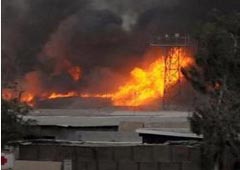
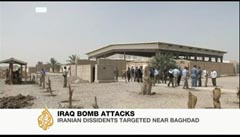
On February 9, mortar rounds and rockets slammed into Camp Liberty, a former US military base near Baghdad that now houses some 3,000 members of the People’s Mujahedeen Organisation of Iran (PMOI), killing five people, according to Iraqi security officials.
The attack triggered condemnation from the United States and United Nations, but in Iraq officials are eager to see the group depart.
The PMOI’s "presence in Iraq is illegal and illegitimate," Ali Mussawi, Prime Minister Nuri al-Maliki’s spokesman, told AFP. "Their presence is rejected."
Iraqi political analyst Ihsan al-Shammari said the "nature of the relationship between the (Iraqi) Shiite political powers and Iran," Baghdad’s Shiite neighbour to the east with which it has close ties, is a key factor in Iraq’s insistence on the PMOI’s ouster.
Shammari also noted other factors including the PMOI’s links to executed dictator Saddam, under whose rule Iraq’s now-empowered Shiite majority was oppressed.
Saddam allowed the PMOI to establish a base called Camp Ashraf northeast of Baghdad after he launched the 1980-88 war with Iran, in which the group fought alongside his forces.
According to the US State Department, Saddam armed the group with "heavy military equipment and deployed thousands of (PMOI) fighters in suicidal, mass wave attacks against Iranian forces" near the end of the war.
Following the 2003 US-led invasion of Iraq, the PMOI turned over "2,000 tanks, armoured personnel carriers, and heavy artillery," the State Department said.
The group was also allegedly involved in Saddam’s violent suppression of 1991 Shiite and Kurdish uprisings in Iraq.
"The former regime used (the PMOI) to carry out repression" in Iraq, said Dr Adnan al-Saraj, who has written books about the group.
Saddam gave the PMOI four bases in Iraq, buildings in central Baghdad and other perks including Iraqi passports and free petrol, Saraj said.
Almost all PMOI members in Iraq have moved to Camp Liberty from Camp Ashraf, the last of their bases, as part of a UN-backed process that aims to see them resettled outside the country.
But after this month’s attack, the PMOI complained about the slow pace of the process, which has dragged on as few countries have come forward with concrete offers of resettlement.
The PMOI has not taken the move from Camp Ashraf, where some members have lived for decades, quietly, alleging Baghdad is acting at Tehran’s behest.
It has also criticised the UN’s assertion that the camp meets minimum humanitarian standards and complained about a variety of alleged shortcomings including restrictions on using forklift trucks, which it said amounted to "torture".
While not accepted in Iraq, the PMOI has made strides internationally.
The group, which was founded in the 1960s to oppose the shah of Iran but took up arms against the country’s new clerical rulers after the 1979 Islamic revolution, successfully campaigned for its removal from US and EU terrorism lists.
The PMOI said it renounced violence in 2001 after carrying out attacks in Iran and elsewhere for decades. It now issues deluges of statements to the media and has enlisted well-known western politicians and officials as advocates.
The language of the official US condemnation of the attack on Camp Liberty also indicates the progress made by the PMOI, which was listed as a "terrorist organisation" by Washington until last year and by the EU until 2009.
The US State Department condemned it as a "terrorist attack," and also referred to the attack as a "tragedy".
Although the PMOI has gained international acceptance, Karim Sadjadpour, an Iran expert and senior associate with the Carnegie Endowment for International Peace, said the same is not true within Iran.
"They’re widely viewed as a backward and intolerant cult by their opposition peers in Iran," Sadjadpour said.
By W.G. Dunlop – Dailystar.com
Articles
The undeniable fact about the UN is that it is a recognized unique international character along with its affiliated
councils, bodies and committees. It has a global responsibility to fulfill and works on a broad range of fundamental issues and if it ever engages itself in solving regional differences, disputes and conflicts, that is because to achieve greater general causes and to coordinate efforts for a safer world. In the same way, when the UN Secretary-General officially appointed Mr. Martin Kobler as his Special Representative for Iraq and Head of UNAMI on 11 August 2011, he tasked Mr. Kobler with sensitive duties to take up. As Mr. Kobler said upon his arrival in Baghdad, “I am privileged to be here to contribute to serving and assisting Iraq and its people at a time when the country is going through an important phase in its transition towards a peaceful and prosperous state”.
As a matter of fact, Mr. Kobler is not in Iraq to deal with the never-ending problems, better to say non-stop excuse makings, of an outcast terrorist group that has no respects for internal or international agreements. As a coordinator to help solve one among many problems in Iraq, Mr. Kobler did his best to mediate a settlement between the Iraqi government and Mojahedin Khalq Organization (MKO, MEK, PMOI, MCR, NLA). The issue of Camp Ashraf, MKO’s bastion located in eastern Iraq, has been one of the main issues dealt with by UNAMI for more than two years. In line with a memorandum of understanding signed in December 2011 by the UN and the Iraqi Government to resolve the situation, the Ashraf residents were re-located to a transit location near Baghdad known as Camp Liberty to carry out a process to determine refugee status again by another office of the UN, UNHCR.
But Mr. Kobler, unfamiliar with MKO’s unconventional thanksgiving, never anticipated that his humanitarian efforts would leave him the most hated and despised man in the eyes of MKO along with Iranian and Iraqi officials. Strong condemnation of Mr. Kobler’s efforts and announcing his boycott as well as seeing him biased and siding with Iran and Iraq regimes is not an unprecedented campaign since MKO’s safe settlement in Camp Liberty. Even after the recent mortar attacks against Camp Liberty, Mr. Kobler did not hesitate to request the Iraqi authorities to ensure medical care for the wounded and confirmed that all those injured have been hospitalized. However, the most unethical, shameful attack against him that raised outcry from sensible politicians was made after the bloody incident when Rudy Guiliani, the former New York mayor, lambasted Mr. Kobler saying:
“You allowed it to become a concentration camp and you permitted it to become a killing field. You shouldn’t resign. Ban Ki-moon should fire you today.”
While the UN monitors are still on the ground and Mr. Kobler has asked the Iraqi authorities to promptly conduct an investigation into the mortar explosions, why is MKO pressing the UN’s head to dismiss his Special Representative for Iraq? That is mainly because Mr. Kobler has a general and humanitarian cause to fulfill rather than bowing down to irrational, impractical demands of a terrorist cult; that is because he cannot be bought and exploited as many other paid advocates of the group like Rudy Guiliani himself; that is because his efforts to redeem the enslaved insiders goes against the group’s barbaric plots to victimize them; that is because he played a decisive role in closing the cult’s bastion and returning the occupied lands to their real owners and … .
Mr. Kobler is not easily corruptible and cannot be manipulated as a stooge of MKO’s propaganda campaign; he is experienced enough not to be trapped in group’s provoked propaganda brawls and keeps away from rebutting unproven allegations leveled against him. In contrast to MKO’s press to be recognized an entity with exclusive privileges and rights, Mr. kobler insists to devote efforts to recognize the rights of the insiders as human beings with the rights of deciding for a free life in a third country. MKO fails to understand that it is making a futile attempt to question the legitimacy of the UN and its representatives. An effective cooperation is a more sensible approach, a right path which MKO is unfamiliar with.
A missile attack on Camp Liberty on 9th February resulted in the tragic deaths of seven residents. Seven more
families have been plunged into grief and dismay over losing their loved ones. Their grief compounded by the fact that, whatever their wishes, they will have had no contact with this loved one for several years. And compounded by the fact there appears to be no acceptable explanation why they had to die at all but especially in such a tragically avoidable way.
The problem with the MEK in Iraq is not so much where they are, but that they are still there at all. Even the MEK’s own supporters understand this logic. Speaking to an MEK rally in the US, long time MEK advocate Rudi Giuliani said, "These people can all be removed within hours… Planes can be sent immediately. They can be here within a day. We have done far more difficult things than that. It’s only about 3,000 people".
Moves to relocate the MEK and send them to third countries started two years ago. Officials from the United Nations and the government of Iraq collaborated to undertake the calm and unhurried negotiation needed to achieve their peaceful relocation first out of Camp Ashraf to a temporary transit camp – Camp Liberty – and then on to third countries where they can rebuild their lives in safety and security. Their every effort has been met by obstruction and obfuscation by the MEK leadership. Two years on and the residents are still no closer to gaining their actual freedom. Even worse, many have died and will continue to die as long as they are unable to walk freely out of the camp and get the help that is available to them. (The Iraqi authorities have kept alternative accommodation available for two years for the individual residents.)
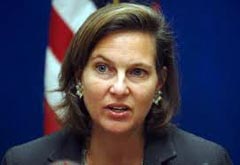
Describing the attack as “vicious and senseless”, US State Department spokesperson Victoria Nuland said, “We call on [the Government of Iraq] to earnestly and fully carry out that investigation and to take all appropriate measures to enhance the security of the camp consistent with its commitment and obligation to the safety and security of the camp’s residents. The terrorists responsible for this attack must be brought to justice.”
It is essential that a thorough investigation be made into this latest attack and the perpetrators brought to justice. More than anything this is necessary for the families of the victims. They need the facts and they need justice. But above all else they need answers. Any family suffering the sudden and violent loss of a loved one will ask ‘Why?’ Why did they die in this way?
The only person preventing the residents in Camp Liberty from leaving and taking refuge in a safe place is the leader of the MEK, Massoud Rajavi. He is therefore the only person who can answer this question. Only he can explain to all the suffering families why their loved ones are still in the path of danger. Why, after ten years, they are still unable to walk freely from the camp and continue their lives in freedom and safety. Why is he still holding them hostage and what did these seven individuals die for?
While we wait for a reasoned, satisfactory answer – which will never be forthcoming – the focus must return to the living. While the Government of Iraq pursues its thorough, painstaking investigation into the deaths of these seven victims, international human rights investigators must likewise undertake a rigorous investigation into the never ending allegations of unbearable daily systematic abuses against all the residents of the camp, including the leadership cadre.
While the MEK persists in denying access to the relevant external agencies to freely enter Camp Liberty and talk to the residents without hindrance, this investigation can start with the recently escaped members. Many of them are now resident in Europe as well as in Iraq and Iran and are willing to give testimony to their experience of human rights abuse inside the MEK camps.
Human Rights Watch conducted a scrupulous and methodological investigation into allegations of human rights abuse resulting in the report ‘No Exit’ in 2005. Testimony from former members in Europe formed the basis of the report. HRW rigorously checked them, their background and their information. A similarly professional approach toward the more recent escapees will yield further evidence of abuse. One of the more controversial but easily verifiable allegations is that the MEK leader instigated a programme of spurious hysterectomy operations to ‘neutralise the gender’ of women members. Already the names of a hundred women victims have been compiled (out of around 800). Medical records and examination will verify the conditions surrounding these operations. Around thirty women who now live in Europe have declared themselves willing to participate in such an investigation. They want justice, for themselves and for the other women still trapped in Camp Liberty.
These women, the families and the former members challenge international human rights organisations to be fearless and determined. Every aspect of this sad debacle must be examined from every angle; the MEK itself and its critics. Such an investigation is long overdue and can only help to end the existing stalemate at Camp Liberty.
Anne Khodabandeh (Singleton), Middle East Strategy Consultants
The February 9th mortar attack on the Temporary Transit Location (TTL) for the members of the Mujahedin
Khalq Organization known as Camp Liberty, which left 7 dead and dozens injured, opened a new opportunity to the group leaders to run their new plot:”Return to Ashraf”.
The group said that more than 100 had been injured in the shelling and its demands to return to its previous location in Iraq, Camp Ashraf, had been ignored, New York Times reported.[1]
A few hours after the Liberty attack, the MKO websites launched largescale propaganda over the issue. They held an event where a number of their supporters including Howard Dean, Patrick Kennedy, and Strauan Stevenson, spoke on behalf of the group’s recently taken agenda; they all called for residents’ return to Camp Ashraf. Among the event speakers was Rudy Giuliani, former mayor of New York who condemned Martin Kobler and even former US Secretary of State, Hillary Clinton for not protecting Liberty residents. He went further and suggested the relocation of Liberty residents to the United States territory. Surprisingly, this part of his speech is no more available on YouTube or the MKO websites. It seems that Mr. Giuliani’s passionate speech was not completely in line with the group’s tactic.
The attack on Liberty that only victimized the suffering hostages held in the MKO’s cult-like structure provided more fuel for the group’s propaganda machine to condemn Iraqi government for its so-called violent act.
New York Times quoted Ali Al Mousavi, saying the accusation from the MEK "is not the first time when they blame us for everything.”[2]
Since the collapse of Iraqi Baath regime, in 2003 and the takeover of camp Ashraf by American military, the MKO was ordered by the new Iraqi government to leave Iraqi territory. Ultimately, in late December 2011, a Memorandum of Understanding was signed by the UN, Iraqi Government and the MKO in order to evacuate Camp Ashraf and the relocation of its resident in the former American Camp near Baghdad airport, Camp Liberty. But, the MOU didn’t work until the US government promised to remove the group from its list of Foreign Terrorist Organization. the NY Times clarifies:” The MEK had long resisted leaving Camp Ashraf, on land that had been set aside by Saddam Hussein, the toppled Iraqi dictator, and did so only because the United States made it a condition of dropping the group’s terrorist designation”. The report also notifies, “An American official said in August that the MEK had been using Camp Ashraf for paramilitary training.”[3]
The group was delisted in September 2011, only a few weeks after it almost completely evacuated Camp Ashraf. Getting removed from the US black list was a great victory for the MKO that had for years launched a well-funded active lobbying campaign in the US government including the Congress and the Pentagon.
Now that they are no more in the terrorist list they have shifted to the new agenda; return to Ashraf. The attack on TTL (Camp Liberty) provided them with the opportunity to insist on their rude demand but actually it was opposed by the US State Department.
State Department spokeswoman Victoria Nuland said on Tuesday, ”The answer for the individuals at (Camp Liberty) is not to relocate back to Ashraf, in our view”, reported the AFP.[4]
“The only peaceful and durable solution for these individuals is resetteltment outside Iraq, and that should continue to be the focus of everything involved in this effort.”[5]
French Foreign Ministry Spokesman Phillipe Lalliot also expressed support over transferring the residents of Liberty underlined its readiness to take part in coordination with the UN High Commissioner for Refugees (UNHCR).[6]
MKO is losing the last chances for maintaining its cult in Iraqi territory and this is good news for most Iraqi people. Head of Iraqi human rights group said that Iraq seeks to try absentia the members of the MKO. He said the people of Tuz Khurmato, (a Kurdish area in Iraq) who are victims of the MKO and the trial is going to be held in their city, expressed happiness and satisfaction over the issue. [7]
By Mazda Parsi
References:
[1] Ghaze, Yasir, Six killed in shelling of Iranian Refugee Camp in Iraq, the NewYork Times,February9,2013
[2]ibid
[3]ibid
[4] AFP, US rejects moving Iranian exiles back to old Camp, Febriary12, 2013
[5]ibid
[6]Aswat al-Iraq, France supports transferring MKO members outside Iraq,February13,2013
[7]ibid
Hardly may you encounter an organization struggling for a political, social, or any other cause to be highly
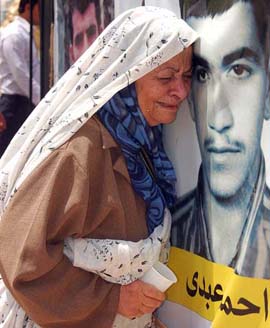
dependent on the blood of its devoted members, calling them martyrs. The terrorist cult of Mojahedin Khalq (aka. MKO, MEK, PMOI, NCR, NLA) is just one among a handful. And what is the necessity of such ever-growing dependence? The reason is simple; MKO needs flow of fresh blood to sustain its structure; it needs more and more martyrs to keep the whole enterprise going; it is a necessary means for the accomplishment of its causes, survival, and keeping its impressive propaganda machine going. As a vindication of its rightness in its struggle path, the group has always boasted about the counts of its members killed, injured and disabled as well as imprisoned members who are believed to substantiate its hegemonic legitimacy over all other opposition groups antagonizing the Iranian regime.
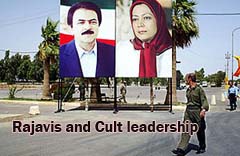
Blood, shed from its own members or those in opposite front, builds the cornerstone of MKO. The Rajavis, the husband-wife leaders of the group, are of the opinion that the rightness of any ideology is maintained by the number of its casualties and martyrs; included in their political and ideological framework, the life and death of man is so simple an issue like drinking water. Ask any defected member and they would promptly enumerate plain examples of the glorification of violence and death-seeking attitude within the organization, an experience that can better than any other theoretical sources of ideology lead you to fathom why the organization delights in victimization of its own members. And open a MKO-run webpage and you will see highlighted reports of Maryam Rajavi’s attending some ceremony to pay homage to the victims of some incident or glorification of the casualties of a certain attack or clash.
Due to the internal demand for constant indoctrination, the MKO cannot hold back from advertising its martyrs, better to say people who die for Rajavi. In fact, MKO longs and prays for a frequent bloody raid and aggression by any outsider against its insiders and in many cases, plots instigation of violent reaction. For instance, once in Camp Ashraf, before residents’ relocation to Temporary Transit Location TTL, the residents had the strict order to provoke a bloody clash since the group needed fresh blood and a few martyrs and wounded people to feed its new round of propaganda against the Iraqi government to maintain its gripe on the camp. As a result, at least twice in 2011 insiders provoked harsh clashes that led to many casualties from the both sides. MKO uncompromisingly refused to cooperate in transferring the insiders to TTL and the Special Representative of the Secretary-General for Iraq, Martin Kobler, had repeatedly expressed his concern about the possible eruption of violent clashes between the sides.
MKO’s settlement in TTL has totally gone against its expectation as the group never expected such indefinite prolongation of being kept in limbo. As the group was sinking into a political oblivion and there was an increasing number of members demanding to defect and there were instances of escapes, new blood was an urgent necessity. Just on February 9, rockets hit TTL leading 7 to their death and leaving many more injured. The media coverage presume MKO has received an awful shock and busy mourning for the killed, condemning the attacks and accusing this and that for committing what they call an appalling human tragedy. But in the heart the leaders are jubilant and behind the closed doors they are celebrating the bloody incident; they wish and hope the injuries hasten the injured to their death to make more martyrs.
The attacks carried out by any party have provided excellent excuses for MKO to display an exhibition of martyrs long victimized within the cult themselves. They could be free people like those escaped or defected and MKO is not uninterested to make all residents martyrs to demonize the Iraqi and Iranian governments as well as securing a much more extended period of stay in Iraq with all needed sympathy directed in its own favor. The world should be concerned about any plotted violence from the side of terrorist MKO that threatens the life of the insiders. The only words instilled into them are those that connote death and violence. They need to hear murmurs of love and life.
Six people were killed and more than 50 were wounded on Saturday when several dozen mortar shells fell on a refugee camp for members of an Iranian opposition group, according to an Iraqi police official.
The camp, on the site of a former American military base near the Baghdad airport known as Camp Liberty, is home to about 3,400 Iranian exiles who are members of Mujahedeen Khalq, or M.E.K., a militant organization. It was removed from the State Department’s terrorist list in September after years of intensive lobbying from prominent American politicians and former military officers, who viewed the group as a legitimate democratic alternative to the Iranian government.
In an e-mail sent to news media outlets in Iraq, the military wing of Hezbollah in Iraq, a militant organization believed to have connections to the main Lebanese group and to Iran, claimed responsibility for the attack and warned that others would follow.
Although Hezbollah in Iraq was active during the American military presence there, attacks by the group died down after the Americans left, and its leaders said they would lay down arms and join the political process. But in an ominous sign that a recent spate of deadly sectarian conflicts in Iraq might escalate, the group announced at a recent news conference that it was establishing a militia to fight Sunni groups that had been attacking Shiites. Camp Liberty is meant to be a temporary residence for the Iranian refugees while the United Nations works to find host countries for them. In a statement issued from Geneva, the United Nations high commissioner for refugees, António Guterres, called the attack “a despicable act of violence” and said the residents of the camp were asylum seekers entitled to international protection.
In a statement, the M.E.K. accused the Iranian government and Iraqi forces of being behind the attack, and said the Iraqi government had recently removed the blast walls surrounding the camp, leaving the refugees unsafe. The group said that more than 100 had been injured in the shelling and that its demands to return to its previous location in Iraq, Camp Ashraf, had been ignored.
“The residents and their representatives have warned about a massacre by the Iranian regime and the Iraqi forces,” the statement said, “and demanded several times from the secretary general of the United Nations and U.S. officials to return to Camp Ashraf, where concrete buildings and shelters are available.”
Ali al-Moussawi, an Iraqi government spokesman, denied that Baghdad was involved, saying the accusation from the M.E.K. “is not the first time when they blame us for everything.”
The United Nations demanded that the Iraqi government open an investigation, saying in a statement that Martin Kobler, the United Nations special representative for Iraq, “called on the Iraqi authorities to immediately ensure medical care for the wounded.”
The M.E.K. had long resisted leaving Camp Ashraf, on land that had been set aside by Saddam Hussein, the toppled Iraqi dictator, and did so only because the United States made it a condition of dropping the group’s terrorist designation. An American official said in August that the M.E.K. had been using Camp Ashraf for paramilitary training.
The group carried out bombings in Iran in the 1970s against the shah’s government and later against the Islamic government, causing the death of several Americans, but by most accounts it has not engaged in terrorism in recent years. But Iraq’s current government, a close ally of Iran, views the M.E.K. as a terrorist group and wants it out of the country.
By YASIR GHAZI
Reportedly, the military wing of Hezbollah in Iraq, a militant organization active during the American military
presence, has claimed responsibility for the mortar attacks on Camp Liberty that left a count casualty of nearly 60 on both sides, the Iraqi guards and the residing MKO members. In a statement, as it was expected, MKO accused the Iranian and Iraqi regimes to be not only the responsible but behind the attacks. But the chief responsible for the attacks and the inflicted casualties is MKO itself with Massoud Rajavi at the head.
Regardless of all these accusations and who the real directors of the attacks might be, MKO is the side that best benefits from the bloodshed. In fact, the leaders are not at all looking for the responsible to accuse; whoever they are, they have served MKO in the best way to deserve its thanks. It makes no difference for Rajavi who is sacrificed from which side; the emphasis is on the applied brutality to claim victims. And for MKO, the more victims the better.
The suffering, enslaved insiders of MKO have always been the front-line victims and their families, pressing effortlessly to rescue them, have repeatedly declared that Iraq is not a safe place for their children and relatives to stay. From the within the insiders are, physically and psychologically, under relentless pressure of a totalitarian cult, and from without, there are an ever-increasing likelihood of violent reaction from Iraqi people looking for any opportunity to strike at MKO in revenge for its flagrant collaboration with Saddam against the Iraqi people.
The Committee for the Defense of Iraqi victims of the terrorist MKO has reportedly filed more than 280 complaints against the group in German, Spanish and Turkish courts of law. The chairman of the committee Nafee Issa has asserted that lawyers have filed complaints on behalf of Iraqi victims particularly by farmers living in Diyala province whose crop lands have been occupied by the group to be walled and to establish the cult bastion called Ashraf. In fact, it was a legal demand by the Iraqi government and the local people, to whom the lands belong, to close the camp and return the lands to their real owners. Naturally, MKO as the occupier was reluctant to return what it had seized mostly because its erected utopia was known to be both its ideological and military bastion.
The group, however, was forced to leave Camp Ashraf and the residents were transferred to Camp Liberty near Baghdad. The group is well aware of the fact that relocation from Ashraf is equal to permanent expulsion from Iraq sooner or later. From the very day the first group of members arrived at Liberty, the leaders began a widespread campaign to stop the process of relocation. Now they are nagging, urging and plotting to be returned to Ashraf. And the recent mortar attack has provided the golden opportunity the leaders were looking for. In a statement after the incident, MKO accused the Iranian government and Iraqi forces of being behind the attack, and blasted the Iraqi government for its recent decision of removing the blast walls surrounding the Camp Liberty and, of course, repeated the necessity of being returned to Ashraf:
“The residents and their representatives have warned about a massacre by the Iranian regime and the Iraqi forces, and demanded several times from the secretary general of the United Nations and U.S. officials to return to Camp Ashraf, where concrete buildings and shelters are available.”
What is done cannot be undone but any similar operation for any claimed legal and just reason is either in the behest of MKO or an act on behalf of MKO. The safety of the residents, despite being known as the members of a despised terrorist cult, has to be guaranteed until they are resettled to third countries.
Following the campaign launched by the Mujahedin Khalq Organization (the MKO /MEK) on the alleged
“inhumane condition” of Camp Liberty, the group leaders and supporters propagate “the necessity of returning residents to Ashraf”. Alejo Vida Quadras, the top MKO supporter in European Parliament suggested the new propaganda under the pretext of "lack of progress in relocation to third countries".
To our surprise, the group leaders do not call on their western supporters to aid facilitate their members’ relocation in European countries instead of returning to Camp Ashraf although a large number of Liberty residents have citizenship in various western countries. Earlier this month, speaking in their so-called international conference in Paris, Maryam Rajavi, the self-assigned president of the National Council of Resistance required the US government to relocate Liberty residents in Camp Ashraf. “Now the US must actively intervene as that the residents can return to Ashraf. Otherwise it would be responsible for what may henceforth happen in Liberty Prison” Rajavi addressed the conference. Fed by the large scale disinformation campaign of the MKO its supporters in Western states label Liberty as "Prison". They resort to the old pretext which has been flooding of storm and sewage at the camp. However, UN Mission in charge of the Camp believes that it complies with normal humanitarian standards as well as necessary infrastructure for residence of the group members. (View our previous post on Camp Liberty: Camp Liberty resembles a prison?)
On January21, 2013, in a debate in UK parliament House of Lords, a few number of Lords expressed their concerns over the situation of Liberty residents. Baroness Warsi, a conservative member of UK House of Lords convinced her coulleagues that heavy rainfall that flooded parts of Camp Liberty as well as many parts of Baghdad "did not affect residents’ accommodation blocks".
To respond her misinformed colleagues about the claims of ex-UNAMI chief Taher Boumedra and the alleged inefficiency of Martin Kobler over Camp Liberty issues, she noted:”Our own officials visited in July last year and the international community does not, at this stage, find any credible evidence to support the matters that have been raised by Mr. Tahar Boumedra.” Boumedra’s claims are still used as evidence by the MKO propaganda.
Lord Avebury who is one of the most loyal supporters of the MKO in UK parliament he pointed to allegations of “ill-treatment such as denial of access to urgently needed medical treatment”. In response Baroness Warsi mentioned that the situation of Liberty residents is “in many ways much better than that of residents in Baghdad.” She referred to the 24-hour electricity available in the Camp while Iraqi nationals enjoy power only three hours a day in some areas of Baghdad. She also noticed that enough water and medical facilities are available in the camp.
Baroness Warsi warned her peers in UK parliament that they “must be incredibly careful” about the MKO regarding its history and record.
The new tactic, the MKO has used to maintain the hegemony over its cult-like group seems to be an alternative to the previous agenda which was running petitions and lobbying efforts to make the UN grant the status of a refugee camp to camp Liberty. The failed tactic led the group to run the new one: return to Ashraf where they claim to own its properties.
In their most recent misinformation event in Paris, the “speakers condemned forcible eviction of Ashraf residents and their transfer to Liberty prison…”, according to NCRI website . They called for “the return of Ashraf residents to the modern town they built in 26 years.” Lord Dholakia’s asked about refugee status of Liberty while he confessed that he WAS misinformed by the MKO saying,”the information the Minister has is not the information that we receive from residents of those camps". Ordinary residents of liberty have no access to the outside world let alone contacting a UK Parliamentarian.
During the debate the conservative Baroness assured her colleagues that Liberty” is not a refugee camp as such: it is a place where individuals are being assessed as to the countries to which they could be relocated.”(View the debate here)
According to reports, almost all former members of the MKO who fled the group camps in Iraq could manage to resettle whether in Iran or in European countries. It sounds that leaving Iraq is not so difficult that the Rajavis could not relocate their members yet. Probably it’s not the matter of ability it’s the matter of will.
By Mazda Parsi
The comments made by Iran’s Leader Ayatollah Seyyed Ali Khamenei are crystal-clear: No bilateral talks with the United States as long as Washington’s words do not match its deeds. Ayatollah Khamenei made the comments just days after US Vice President Joe Biden said Washington was prepared to hold direct talks with Iran.
Some Iranians also say there’s still a standing offer for talks under the right conditions. But for the talks to succeed, they say Washington has to ditch its anti-Iran policy and lift its unilateral sanctions against Iran.
Relations between Iran and the United States were severed in 1979 after the victory of Islamic Revolution and the overthrow of Iran’s pro-Western regime. Other factors behind the stalemate include Washington’s backing of the former Iraqi regime in its 8-year war against Iran in the 1980s, support for anti-Iran terrorist groups such as the Mojahedin Khalq Organization, assassination of Iranian officials and nuclear scientists, imposition of economic sanctions and financial restrictions, as well as funding anti-government political currents within the country.
Ghanbar Naderi,
The incontrovertible facts about MKO’s genocidal campaign against the Iraqi Kurds are so hard that even the organization itself prefers to keep silent over it and even abstains from getting into efforts to attribute it to Iranian regime as an anti-MKO campaign. The Swedish Parliament is just a few steps from making a decision to recognize MKO’s Operation Morvarid (Pearl), a post-Persian Gulf military campaign in collaboration with Saddam to suppress Iraqi Kurds uprising, as genocide and crimes against humanity as it has already recognized Saddam’s Anfal campaign. The following from David Gethin’s New Al-Qaeda in Europe: Iranian Terrorists-Good or Evil provides adequate evidence to dispel any doubt.
The Wall Street Journal reported that in March 1991, after the Persian Gulf War and the operation by American Forces called Desert Storm in Iraq, Saddam Hussein, the then President of Iraq ordered Masoud Rajavi, the President of NCRI, who was at the same time the Leader and the Commander in Chief of MKO and NLA, to help Iraq in suppressing the Kurds uprising in the northern part of the country. Those who were involved in this operation have testified to this fact.
The US Department of State in a comprehensive report to Congress at the end of 1994 also certified that NCRI/MKO forces were involved in the suppression of Iraqi Kurds by saying the followings:
“Following the Operation dubbed “Desert Storm”, Iraqi Kurds claimed that MOW helped the Iraqi army in the suppression of Kurds. Those who fled the operation zone and took refuge near Iranian borders corroborated this allegation.
In this connection, Jalal Talebeni the Leader of the “Patriotic Movement of Iraqi Kurdistan”, (and the present Iraqi President) told reporters:
“In Karkouk Battle, five thousands MKO members joined Saddam’s forces.”
In a book entitled “For the Judgment of History”, the text of the negotiation between Masoud Rajavi, the President of NCRI, with Iraq’s intelligence officials at the time of Saddam Hussein’s rule in Iraq is published. Part of the book is about negotiations between Masoud Rajavi and General Saber Eldori, the then Head of Iraq’s Intelligence Service, right after the 1991 uprising in Iraq. From these negotiations the role of the Leader and members of NCRI in the suppression of the Iraqi people and the extent of their loyalty to Saddam Hussein’s Regime becomes clear.
“General Saber: The President (Saddam Hussein) thanked and appreciated Brother Masoud Rajavi and NLA for the valuable contribution of this army in the suppression of the recent agitations. I explained to him, in detail, the role played by the organisation in this suppressive opera-tion. In the course of operation, I was reporting minute after minute your activities and told him that organisation. Despite little facilities at your disposal and we are sorry that we cannot satisfy all your needs, you have done a great job, beyond our expectations. …I have asked the President to send a thank you letter to Masoud, but the President told me that sending a letter is not enough and he should meet Masoud in person and thank him himself.”
The documentary film of the meeting between Masoud Rajavi, President of NCRI and the Head of the Intelligence Service of Iraq is attached.
Other members of NCRI who accompanied Masoud Rajavi, the President of NCRI, in this meeting and were involved directly in the genocide of 1991 were:
1Mehdi Abrishamchi, Head of NCRI’s Peace Committee 2Abass Davari, Head of NCRI’s Labour Committee 3Ebrahim Zakeri, Head of NCRI’s Security and Counter Terrorism Committee 4Mahdi Boraei, Member of NCRI
It is noteworthy to mention Masoud Rajavi, the President of NCRI was in charge of commanding this genocide operation dubbed “Pearl Operation” against the Kurds. Furthermore, according to the testimonies of the members of NCRI, Mrs. Fereshteh Yeganeh, Chair of Educations and Training Committee of NCRI was responsible for providing logistics and sup-port for the operation.
The crime of genocide against Iraqi Kurds was committed in March 1991 in two regions in the northern parts of Iraqi Kurdistan namely “Kafri” and “Kalar”. The Governor of Iraq’s Kurdistan province in a statement issued the names of persons killed, injured or captured by MKO forces.
The names of those who lost their lives as a result of this operation are as follows:
1. Samad Rahim Hassan Mohammad
2. Ali Mahmoud Khalil
3. Aboubakr Saddigh Hussein
4. Mostafa Mohammad Saddigh
5. Hussein Rahim Hassan
6. Sami Nasser Ismaeil
7. Servat Ahmad Rahim
8. Omar Ashraf Majid
9. Borham Ali Rostam
10. Ali Mahmoud Khalifeh Hamid
11. Aziz Ahmad Mohammad Ali
12. Mohammad Ahmad Mohammad Ali
13. Salah O Edin Mohammad Ahmad Rahim
14. Najib Hussein Hassan
15. Farhad Rahman Rahim
16. Ali Abdollah Sadigh
17. Samad Rahim Hassan
18. Jamileh Hassan Hamid
19. Salar Mohammad Amin
20. Adalat Jabbar Hussein
21. Ahamad Mohammad Ghader Mahmoud
22. Mohammad Hussein Hamid
23. Jalal Hussein Abodllah
24. Mohammad Ebrahim Abdollah Farah
25. Aziz Mohammad Hadar
26. Rafigh Farigh Rahim
27. Sareif Faeigh Maha El Din
28. Hakim Aziz Ahmad
29. Abdolkarim Abdolrahman Fattah
30. Omar Mohammad Amin
31. Hamid Fattah Mohmmad
32. Yadegar Halah
33. Glaviz Abdolgahder Abdolkarim
34. Akram Ali Rostam
35. Ali Hassan Abdolrahman
36. Adalat Jabar Hussein
37. Kaveh Dara Ahmad
38. Aref Baban
39. Adnan Mahmoud
40. Adnan Hassan Ahmad
41. Haji Mahmoud Mohammad Rashid
42. Omar Mahmoud Mohammad
43. Osman Mohammad Gharib
44. Shokr Rashid Najmeh
45. Shalan Rashid Najmeh
46. Salar Hamid Raouf
47. Omar Ahmad Hassan
48. Nomid Omar Saleh
49. Dara Rashid Abdolgader
50. Mohammad Rashid Ghanbar
51. Ali Hassan Lafteh
52. Jalil Khalil Ebrahim
53. Mohammad Shokr
54. Loghman Abdolrahim Fars
55. Tahssin Saeid Abdollah
56. Ehssan Vahab
57. Talaat Shokat Majid
58. Mohammad Namegh Tabib
59. RibovarAhmad Mohammad
60. Majid Aziz Abdollah
61. Omar Ahmad Solyman
62. Zojiya Fazel Marhoud Owdah
63. Lyla Fazel Marhoud Owdah
64. Bakir Ali Saleh
65. Borham Jabar Majal
66. Maheh Mohammad Rahim Karim
67. Youssef Hussein Ali Ghader
68. Mohmmad Sharief Mohammad Saeid
69. Nor Edin Ali Ahmad
70. Noshirvan Ahmad Rostam
71. Ali Ahmad Abdollah
72. Osman Ghader Sadoun
73. Abdorahman Ahmad Karim Khadr
74. Omran Krim Mohammad Saleh
75. Fatah Ahmad Ali
76. Hussein Abdolrahman Ahmad
77. Adel Mahmoud Saeid Sharief
78. Loghman Mohammad Saleh Madouf
79. Omar Mohah Saeid Ahmad
The death certificates of some of those killed in this massacre are attached.
List of those who were injured as a result of this operation:
1. Hadim Hussein Ali (injured in the feet and abdomen)
2. Hassan Ahmad Rahim (injured in the toes and abdomen)
3. Khalil Ebrahim Abdolghader (injured in the neck)
4. Nori Sofi Mahmoud Khossrow (injured in eyes and hands)
5. Jamal Vahid Amin (injured in throat)
6. Hoywa Mohammad Ahmad
7. Mojhdeh Hussein Darvish
8. Khandeh Hussein Darvish (injured in the right hand)
9. Hussein Darvish Ahmad
10. Hatam Mahmoud Vahab Mohammad
11. Dara Ahmad Ali (injured in the abdomen, head and feet)
12. Nabard Assi Mohammad
13. Hmzeh Mohammad Darvish
14. Shilan Mohammad Darvish
15. Salmeh Mohammad Abdoljabar
The medical certificates and some photos of those injured in this operation are attached.
List of those who were captured and jailed in the prisons belonging to NCRI Group for almost five months are as follows:
1. Abdollah Mohammad Rashid
2. Ebrahim Mohammad Rashid
3. Adel Saleh Mohammad
4. Salar Mohammad Khan
5. Mohammad Javad Solyman
6. Shalan Hassan Fathollah
7. Mohammad Hassan Ali
8. Mohammad Ali Fars
9. Edris Ghader Shaker
10. Jalal Hassan Kaki
11. Omar Hassan Mohammad
12. Shir Ali Sharief
13. Mostafa Hassan Mohammad