
These are not democrats or freedom fighters. The more you get to know them the more they seem closer to some kind of odd, almost Manson-like cult. Maryam Rajavi is their leader and she 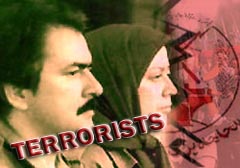 (her husband yielded to her years ago since a woman leader impresses Westerners) will be President of Iran when they somehow sweep away the clerical regime.
Trita Parsi (an MEI adjunct scholar by the way) has a good post up at The Huffington Post about the People’s Mojahedin of Iran/Mohahedin-e-Khalq (PMOI or MEK) efforts to get themselves off the US terrorism supporters list. His lead says it all succinctly:
In the 10 years that I have lived in Washington, I have never seen lobbyists for al-Qaeda parade through the halls of Congress. I have not seen any events on Capitol Hill organized by Hamas. And I have not seen any American politicians take campaign contributions from the Islamic Jihad.
But the Mujahedin-e Khalq (MEK), an organization with the blood of Americans and Iranians alike on its hands, freely does all of these things, despite being a designated foreign terrorist organization by the U.S. government.
I’ve been here a lot longer than ten years, but I share his view. The MEK have been lobbying hard in Washington since the 80s at least, despite being on the terrorist list for killing American diplomats and military personnel in the days of the Shah. They’re slick, they’re well funded (how?) and they seem able to persuade Congressmen who would never respond to an Arab group in the same way. Yet besides their track record of killing US personnel in the Shah’s day, they are based in Iraq, fought on the side of Saddam Hussein during the Iran-Iraq war, maintain to this day a cult like "Camp Ashraf" in Iraq that the Iraqi government is pressuring to leave and threatening to deport to Iran, have a true cult of personality about their leadership, and are uniformly hated by every Iranian I know who isn’t one of them, from Pahlavi restorationists to leftists to liberal democrats to people who support the current system. After all, they fought for Saddam against Iranians, and are traitors in the eyes even of those who hate the clerical regime.
Their PR skills are good. In my journalism days they used to drop by regularly to try to cultivate me, and while I listened politely, I had too many US military friends who’d served in pre-revolutionary Iran and knew them as their primary nemesis. (The MEK claim that was because their current leadership was in jail under the Shah, and all the bad stuff was done by somebody else.)
True story: I’ve only been in Iraq once, for about five days in 1989 in between the Iran-Iraq war and the Kuwait war. I was getting in an elevator in the Sheraton Hotel when a smallish man in an impeccable suit stepped in and asked if I was an American. My first thought was, gosh, he looks and carries himself just like the MEK guys in DC. Guess what? That’s exactly who he was. With exactly the same missionary spiel.
These are not democrats or freedom fighters. The more you get to know them the more they seem closer to some kind of odd, almost Manson-like cult. Maryam Rajavi is their leader and she (her husband yielded to her years ago since a woman leader impresses Westerners) will be President of Iran when they somehow sweep away the clerical regime. Not through election, through acclamation. She’s the Evita Peron of Iran, or at least a wannabe.
I have no brief for the Iranian regime, but these guys worry me, especially for their strange, Svengali-like power over members of Congress from both sides of the aisle. I applaud Trita’s warning here. Let the Buyer Beware.
by Michael Collins Dunn – mideasti.blogspot
 leading terrorist organizations—al-Qaeda and the Mujahideen e-Khalq (MEK)—in his zeal to overthrow the present governments in Syria and Iran. The Obama-al-Qaeda marriage of convenience is particularly deep and it centers
 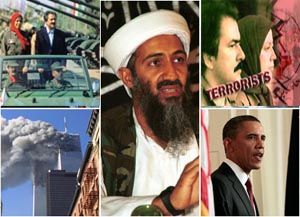 on the drive to overthrow the government of Bashar Assad in Damascus, through an armed opposition.

 terrorist organisations.
 past could stain this moment of opportunity with tragedy.
  a series of assassinations of Iranian nuclear scientists.
 ideology). Huge majorities support indefinitely detaining accused terrorists without charges, or killing them without due process. So you’d think that a Muslim terrorist group with Marxist roots would be anathema, especially if it was on the official American and Canadian lists of terror sponsoring organizations. But the People’s Mujahedin of Iran, commonly referred to as MEK, has its American defenders.