
The congressional team led by Dana Rohrabacher, a California Republican, met the MKO terrorists in Paris on Sunday and expressed strong support for the group.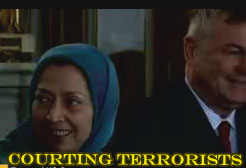
The US congress members called for the immediate transfer of the MKO terrorists to Camp Ashraf in Iraq’s Diyala Province. The American legislators even threatened to declare Iraq’s Prime Minister Nouri al-Maleki a sponsor of terrorism after an attack on the terrorist members inside another camp in Iraq.
The mortar attack, which happened earlier this month on Camp Liberty near Baghdad, left at least seven members of the terrorist group dead and more than 50 others wounded.
Members of the MKO terrorist group are being transferred from Camp New Iraq, formerly known as Camp Ashraf, which is situated about 120 kilometers (74 miles) west of the border with Iran, to Camp Liberty near Baghdad Airport.
The MKO is listed as a terrorist organization by much of the international community.
On September 28, the terrorist group was taken off the US State Department’s terrorism blacklist a week after US Secretary of State Hillary Clinton sent the US Congress a classified memo about the move.
The MKO fled to Iraq in 1986, where it received the support of Iraq’s executed dictator Saddam Hussein, and set up its camp near the Iranian border.
The MKO has carried out numerous acts of violence against Iranian civilians and government officials.
Urgent call
Inhabitants of Camp Liberty do not enjoy the minimum of security under Rajavi
Inhabitants of Camp Liberty do not enjoy the minimum of security under Rajavi
It is 10 years now since the Baghdad dictator, the only state sponsor of MKO terrorist cult up to now, has been toppled, but the members are still both mentally and physically captive in the hands of Rajavi. As far as the  suffering families whose loved ones remain confined by the MKO are concerned, the fall of Saddam Hussein did not improve their situation and did not lead to their safety. On the contrary it ended in greater threat and suffering. The families are shocked by the passivism of international organizations, in particular the UN in the face of this situation.
The process of the past 10 years, particularly the past 3 years during which the families have remained in Iraq with the hope of learning about their loved ones’ wellbeing, shows that the only party who doesn’t want to lift the burden of the MKO from the shoulders of the oppressed Iraqi nation is Massoud Rajavi. It is obvious that the burden of the MKO – the legacy of Saddam Hussein and a threat to national security – under pressure from the 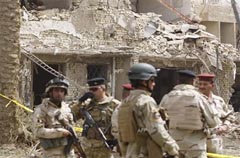 occupying forces, is still a problem for the Iraqis.
Previously we revealed reports from inside Camp Liberty that the top officials of the MKO were instructed to demonstrate that living conditions in Liberty are very difficult in order to feed the organization’s propaganda machine which in turn tries to put pressure on the UN and the government of Iraq, and follows the line of “getting back to Ashraf”.
News which has emerged following the hand-made missile attack on the camp which resulted several casualties, reveals that the officials of the MKO tried to impose every kind of obstacle to prevent the wounded being taken to hospitals in Baghdad in order to add to the loses. This attack, considering the atmosphere of revenge within some Iraqi forces that know the MKO as collaborators with Saddam Hussein in suppressing the Iraqi people, could easily have been predicted and the same threat still remains.
It is routine in the Rajavi cult to create martyrs and Rajavi calls it “opening a nut with blood”. In his previous speeches about the incident of April 8, 2011 which led to the deaths of 36 individuals, Rajavi had said that ‘with this amount of martyrs we managed to inspire the world and managed to delay evacuating Ashraf garrison’.
It is worth mentioning that in that incident some individuals died because the MKO prevented them from being taken to hospital immediately. Rajavi’s policy is to make the number of martyrs as high as possible for propaganda purposes. Now that Rajavi is following the path of “returning to Ashraf”, he strives to increase the number of dead in Liberty.
We know that the Iraqis did all in their capacity to help the wounded and gave every sort of aid to transfer them to hospitals in Baghdad and even managed to take some and have them treated. But the MKO officials of the camp deliberately tried to prevent this in order to increase the number of dead for propaganda use.
Rajavi tries to control both internal and external opposition and protest by claiming that he is struggling against the Islamic Republic of Iran and is giving so much blood for this struggle. He always pushes such claims at his critics instead of answering their sincere queries. He tries to legitimize his actions by claiming to have more martyrs than others.
Why does Rajavi insist on going back to Ashraf?
Considering the ongoing security status of Iraq, which is one of the worst in the world, it is obvious that the deceived followers of Rajavi residing in Camp Liberty do not enjoy any security. But the question is: if these people do not feel safe just outside Baghdad in an American base, how would they be safer nearer to the Iranian border and far away from Baghdad? If Rajavi is honest and his real concern is his followers’ security he should have asked for them to be transferred out of Iraq to a third country or at least to the west of Iraq further from the Iranian border.
The truth is that Liberty is much smaller than Ashraf and Rajavi’s cultic apartheid cannot be enforced in it so easily; gossip spreads quicker amongst the people and therefore cultic control is much harder. What has no place in Rajavi’s scheming is the life of the members of his cult and he even prefers to have more casualties for using in his propaganda campaign.
It must be mentioned that returning to Ashraf would be the clearest indication that the organization is to be restored for terrorist activities. This would make the present situation even more complicated and in consequence both the national security of Iraq and the security of the residents of the camp would be at greater risk.
Sahar Family Foundation which represents the families of the trapped members of the MKO in Iraq wishes to draw the attention of all international and humanitarian organizations worldwide, in particular the UN and UNAMI and the SGSR Mr Martin Kobler to the fact that while the residents of Camp Liberty are under the cultic rule of Rajavi they will not enjoy the least bit of security.
We urge all western countries and humanitarian organizations, despite all the obstacles created by Massoud Rajavi, to do all in their capacity to transfer the MKO members in Iraq to a third country and let their families be gratified.
THE US has rejected calls for Iranian exiles housed in a camp near Baghdad that came under mortar and rocket attack to be sent back to their former base near the Iranian border.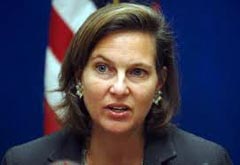
The death toll from Saturday’s assault on Camp Liberty, which houses about 3000 members of the opposition People’s Mujahedeen of Iran (MEK), has risen to seven, the group said.
Iraqi authorities are now investigating who was behind the attack, but the MEK and its supporters have called for the group to be allowed to return to their old base dating back to the 1980s – Camp Ashraf near the Iranian border.
"The answer for the individuals at (Camp Liberty) is not to relocate back to Ashraf, in our view," State Department spokeswoman Victoria Nuland said.
"The only peaceful and durable solution for these individuals is resettlement outside Iraq, and that should continue to be the focus of everybody involved in this effort."
The camp residents were reluctantly and finally moved from Camp Ashraf last year, on Iraq’s insistence, as part of deal negotiated via the United Nations.
They are now in the process of being resettled, and it is understood the United States and several European countries have agreed to take them in.
Nuland said the United States has still not made any decisions on whether to accept any of the residents.
"We are now in the process of evaluating some of the referrals that UNHCR has sent our way, and we’re strongly, as I said, encouraging others to do the same," Nuland said.
The MEK was founded in the 1960s to oppose the shah of Iran and took up arms against Iran’s clerical rulers after the 1979 Islamic revolution that ousted the shah.
The group says it has now laid down its arms and is working to overthrow the Islamic regime in Tehran by peaceful means.
Britain struck the group off its terror list in June 2008, followed by the European Union in 2009 and the United States in September.
Attack on Camp Liberty Unveils Deep Differences between MKO, Western Lobbyists
The recent rocket attack on Camp Liberty – the transient settlement facility of the terrorist Mojahedin-e Khalq 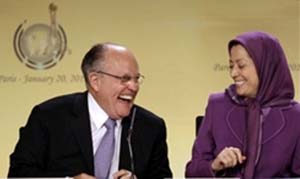 Organization in Iraq – unveiled the deep differences between the terrorist group and its American and European lobbyists.
According to a report by Didehban center, pro-MKO lobbyists, who are mostly retired European and American politicians, have recently concluded that the criminal activities of the MKO (also known as the MEK, PMOI and NCR) will definitely prove costly for them.
They have recently increased their criticism about the "irresponsible" remarks of MKO’s ringleader, Maryam Rajavi, and the negative impacts of her remarks.
These lobbyists have realized that MKO ringleaders want to massacre the group’s members as they see such bloodshed as the only way to guarantee their longer stay in Iraq, while their lobbyists such as former New York mayor Rudy Giuliani have asked for the transfer of the MKO members to the US, said the Didehban report.
In Washington on Saturday, at a convention of Iranian-Americans, Giuliani called on the United States to take in the camp residents.
"These people can all be removed within hours," Giuliani said. "Planes can be sent immediately. They can be here within a day. We have done far more difficult things than that. It’s only about 3,000 people."
The report came after some media reports alleged that Katyusha rockets fired on the Camp Liberty have killed five members of the MKO. About 40 members of the terrorist group were reportedly wounded in Saturday’s attack, along with three Iraqi policemen, said the reports.
Meantime, a senior Iraqi lawmaker said that the recent rocket attack on Camp Liberty was a move to convince Iraq to allow the MKO to return to Camp Ashraf, but such actions are futile the grouplet’s return to its main training camp is impossible.
"Attack on the MKO aimed to rally the support of the international community’s public opinion for the MKO’s return to the Diyala province and Camp Ashraf," Abdullah al-Naeli said on Wednesday.
"But returning the MKO’s members to their previous position is not possible, specially given the fact that Diyala residents spent much efforts to expel them from their province," Naeli was quoted by Ashraf News as saying.
The Iraqi lawmaker added that the Baghdad government is seriously investigating the attack to find out the realities.
France expressed support over transferring members of the Mojahedin-e Khalq Organization outside Iraq, underlining its readiness to take part in coordination with the UN High Commissioner for Refugees (UNHCR).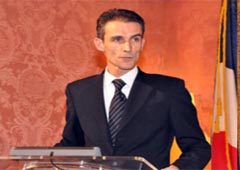
Iranian Fars news agency quoted French Foreign Ministry Spokesman Philippe Lalliot as saying that his country supports the UN plan to move the MKO to a third country.
Head of an Iraqi human rights group had said that Iraq seeks to try in absentia the members of the Mojahedin-e Khalq Organization (MKO, also known as the MEK, NCR and PMOI) in Iraq.
He said the people of Tuz Khurmato, who are victims of the MKO and the trial is going to be held in their city, expressed happiness and satisfaction over the issue.
A senior Iraqi lawmaker said that the recent rocket attack on the terrorist Mojahedin-e Khalq Organization  transient settlement in Camp Liberty was a move to convince Iraq to allow the MKO to return to Camp Ashraf, but such actions are futile the group’s return to its main training camp is impossible.
"Attack on the MKO aimed to rally the support of the international community’s public opinion for the MKO’s return to the Diyala province and Camp Ashraf," Abdullah al-Naeli said on Wednesday.
"But returning the MKO’s members to their previous position is not possible, specially given the fact that Diyala residents spent much efforts to expel them from their province," Naeli was quoted by Ashraf News as saying.
The Iraqi lawmaker added that the Baghdad government is seriously investigating the attack to find out the realities.
Some media reports alleged that Katyusha rockets fired on the Camp Liberty, the transient settlement facility of the MKO (also known as the MEK, PMOI and NCR) in Iraq, have killed five members of the MKO. About 40 members of the terrorist group were reportedly wounded in Saturday’s attack, along with three Iraqi policemen.
Speaking to reporters here in Tehran on Tuesday, Iran’s Foreign Ministry Spokesman Ramin Mehman-Parast said that the move is part of the MKO’s efforts to portray itself as an oppressed community in a bid to postpone its expulsion from Iraq’s soil.
Mehman-Parast also called on the UN and Iraqi officials to rapidly implement the agreements on the expulsion of the MKO from Iraq.
Also on Tuesday, Iran’s Ambassador to Baghdad Hassan Danayeefar said that the attack is part of the MKO’s efforts to return to Camp Ashraf.
Iran has nothing to do with the recent rocket attack on Camp Liberty, the transient settlement facility of the anti-Iran terrorist Mojahedin-e Khalq Organization (MKO also known as the MEK, PMOI and NCR) in Iraq, an Iranian spokesman said.
Media reports alleged that Katyusha rockets fired on the Camp Liberty near Baghdad have killed five members of the MKO. About 40 members of the terrorist group were reportedly wounded in Saturday’s attack, along with three Iraqi policemen.
Speaking to reporters here in Tehran today, Foreign Ministry Spokesman Ramin Mehman-Parast said that the attack was carried out inside Iraqi soil and "Iran has nothing to do with it".
He said that the move is part of the MKO’s efforts to portray itself as an oppressed community in a bid to postpone its expulsion from Iraq’s soil.
Mehman-Parast also called on the UN and Iraqi officials to rapidly implement the agreements on the expulsion of the MKO from Iraq.
The group, founded in the 1960s, blended elements of Islamism and Stalinism and participated in the overthrow of the US-backed Shah of Iran in 1979. Ahead of the revolution, the MKO conducted attacks and assassinations against both Iranian and Western targets.
The group started assassination of the citizens and officials after the revolution in a bid to take control of the newly-established Islamic Republic. It killed several of Iran’s new leaders in the early years after the revolution, including the then President, Mohammad Ali Rajayee, Prime Minister, Mohammad Javad Bahonar and the Judiciary Chief, Mohammad Hossein Beheshti who were killed in bomb attacks by MKO members in 1981.
The group fled to Iraq in 1986, where it was protected by Saddam Hussein and where it helped the Iraqi dictator suppress Shiite and Kurd uprisings in the country.
The terrorist group joined Saddam’s army during the Iraqi imposed war on Iran (1980-1988) and helped Saddam and killed thousands of Iranian civilians and soldiers during the US-backed Iraqi imposed war on Iran.
Since the 2003 US invasion of Iraq, the group, which now adheres to a pro-free-market philosophy, has been strongly backed by neo-conservatives in the United States, who argued for the MKO to be taken off the US terror list.
The US formally removed the MKO from its list of terror organizations in early September, one week after Secretary of State Hillary Clinton sent the US Congress a classified communication about the move. The decision made by Clinton enabled the group to have its assets under US jurisdiction unfrozen and do business with American entities, the State Department said in a statement at the time.
In September 2012, the last groups of the MKO terrorists left Camp Ashraf, their main training center in Iraq’s Diyala province. They have been transferred to Camp Liberty which lies Northeast of the Baghdad International Airport.
Expressing disapprobation of the terrorist Mujahedin-e Khalq group’s presence in Iraq, head of the Iraqi 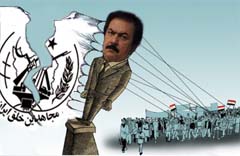 parliamentary committee on martyrs and political prisoners said that, if compelled, they would extradite MKO members to Iran.
“The United Nations should expedite the process of their expulsion from Iraq,” Muhammad al-Hindawi said, as quoted by FNA, Habilian Association reported.
“One day we may be forced to hand the MKO elements over to the government of Iran,” he said, adding that nobody in Iraq thinks about aggression against MKO members held in the country, but they have to leave Iraqi soil.
The Iraqi MP finally concluded that the government of Iraq is not responsible for the lives of these people, as it has not granted them political asylum.
Earlier this week, the temporary home of some 3000 MKO members came under mortar attack, leaving 6 dead and dozens injured.
In an e-mail sent to news media outlets in Iraq, the military wing of Hezbollah in Iraq, claimed responsibility for the attack and warned that others would follow, NY times reported.
The High Commissioner for Refugees, António Guterres expresses his shock about this  morning’s mortar attack on Camp Liberty in Iraq that reportedly killed six and wounded dozens.
"I strongly condemn this attack," Mr. Guterres said, noting that the residents of Camp Liberty are asylum seekers undergoing the refugee status determination process and thus entitled to international protection. "This is a despicable act of violence."
"I call on the Iraqi Government to do everything it can to guarantee security to the residents," he said. "The perpetrators must be found and brought to justice without delay," he said.
The High Commissioner also calls on all countries to help find urgent solutions for the Camp Liberty residents.
Mr. Guterres expresses his deep condolences to the families of the victims.
Secretary-General Ban Ki-moon today strongly condemned a mortar attack on an Iranian exile camp near Iraq’s 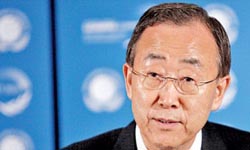 capital, Baghdad, which reportedly killed six people and injured several others.
According to media reports, the Hurriya camp, formerly known as Camp Liberty, was attacked this morning while most of the residents were sleeping. Iraqi police officers were among the wounded.
The camp serves as a transit facility for more than 3,000 exiles, most of them members of a group known as the People’s Mojahedeen of Iran, where a process to determine their refugee status is being carried out by the Office of the UN High Commissioner for Refugees (UNHCR).
Camp residents were previously situated at Camp Ashraf in eastern Iraq, but were relocated last year, in line with an agreement signed in December 2011 between the UN and the Iraqi Government.
“The Secretary-General calls on the Government of Iraq, which is responsible for the safety and security of residents of both Camp Liberty and Camp Ashraf, to promptly and fully investigate the incident and bring perpetrators to justice,” said Mr. Ban’s spokesperson in a statement. “He has repeatedly stated that violence and provocation are unacceptable.”
Mr. Ban also reiterated the UN’s strong commitment to continue its long-standing efforts to facilitate a peaceful and durable solution for residents of both camps.
The High Commissioner for Refugees, António Guterres, expressed his shock about the attack calling it “a despicable act of violence.”
“I call on the Iraqi Government to do everything it can to guarantee security to the residents,” he said. “The perpetrators must be found and brought to justice without delay.”
In a news release, the UN Assistance Mission for Iraq (UNAMI) said it is closely liaising with the Government on the response to the incident, including medical assistance to the wounded.
Mr. Ban’s Special Representative in the country, Martin Kobler, has also asked Iraqi authorities to promptly conduct an investigation into the mortar explosions.