Nejat Society
  • Home
  • Articles
  • Media
    • Cartoons
    • NewsPics
    • Photo Gallery
    • Videos
  • Publications
    • Books
    • Nejat NewsLetter
    • Pars Brief
  • About Us
  • Contact us
  • Editions
    • عربي
    • فارسی
    • Shqip
Nejat Society
Nejat Society
  • Home
  • Articles
  • Media
    • Cartoons
    • NewsPics
    • Photo Gallery
    • Videos
  • Publications
    • Books
    • Nejat NewsLetter
    • Pars Brief
  • About Us
  • Contact us
  • Editions
    • عربي
    • فارسی
    • Shqip
© 2003 - 2024 NEJAT Society. nejatngo.org
blank
Mujahedin Khalq Organization as a terrorist group

Mujahedin-e Khalq assassinated US officers

Identifying the Experts of Secret Mission
In the midst of the attacks that SAVAK brought to Marxist armed groups in the spring and summer of 1976, including the active elements of the MKO, they got killed or arrested, the MKO’s leadership decided to take a dramatic and effective military action.
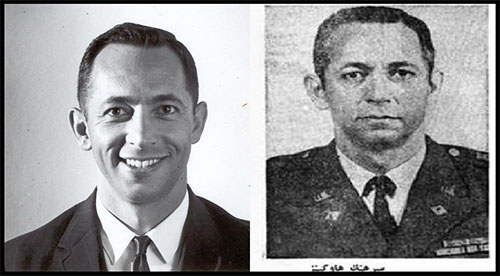
Assassination of Three American Advisers  

The analysis of the leaders of the organization was based on the fact that after the deadly attacks to the MKO, and the Fadaian1, they had to – in the first place – express their effective existence, and, secondly, – put the Pahlavi regime in a complex array of armed movements .

Along with this matter, at last, the assassination of three American advisers in Iran was designed and carried out by Mojahedin. These advisers were experts in the field of electronic equipment that led the installation and operation of complex eavesdropping systems in the form of a series of designs in ((Kabkan)), that is located on the border between Iran and the Soviet Union. According to the available information, the basic information about these three spies was most likely transmitted to the Mojahedin by the Soviet government2.
The Process of Assassinations

During the identification operations to carry out assassinations, the exact route of the car movement got identified. According to information obtained from the operational units of the organization, they traversed Tehranpars (the intersection of Damavand Avenue, known as the Tehran-Pars three ways) every morning between 7:00 and 7:20 minutes, and near the intersection of Narmak thirty meters, passing from Khayyam avenue (one of the neighboring streets of Vosuq Square). Therefore, it was decided that the MKO’s operational layout be arranged in this area and at a specific point on Khayyam Street.

According to the plan, a Volkswagen truck was used for traffic jams and one more car to escape. Additionally, the weapons gathered in compare with the individuals presented on the operation. This terrorist operation is described by Abedini as follows:

“Operation Day”, [1976/08/28] all work was done in accordance with the schedule. The driver of the motorcycle and the person who was with him were marked with a positive signal. The team got ready. Attack layout was done. The car was turned by the driver who should make the traffic, a few moments later the car carrying the advisors appeared on the street, and the driver stopped the car. The driver of the advisers felt that something is going on and turned the steering wheel to his right, but because of the narrow street he couldn’t do anything and the way got closed.

Commander surrendered the driver and made him to put his head under the dashboard then the machine gunner shot the bullets toward Americans. The front man (Robert Krongard) committed to run away after being hit, he came out of the car and went toward the side walk but machine gunner followed him and while he fell into the gutter, finished him. Meanwhile the driver who should make traffic, should get out and support the machine gunners and should stand beside them while machine gunner can dead shot the two Americans behind, and again give the machinegun to the traffic driver and ran toward the scape car. This part of the operation, that was the main part, was done completely (except two parts) and car moved in the identified way. After a distance one of the members got out and removed the fake car number and again continued to move. After a while two members got out and the driver went to Khorasan square with scape car, while the bags of the advisors were also in the car. He put the scape car in one of the alleys of Khorasan square and transferred the equipment to another car, which had already been put there, and move the new car to the base, where the equipment had to be taken there. And in this way the operation ended.3”
Members of the operation team of assassination of three advisors are:

Hosein SiyahKolah (Kazem) the commander of the operation;
Mehdi Fathi (Vahid) deputy commander and in fact executive commander of the scene of operation; (the first machine gunner)
Mohsen Tarighat (Mahmoud) the second machine gunner
Ghasem Abedini (Asgar)traffic driver and driver of scape car
Shahram Mohammadian Bajgiran (Javad) motor driver and marker
Gholamhosein Sahebekhtiari (shamsollah-Asghar) the motor cyclist and marker4

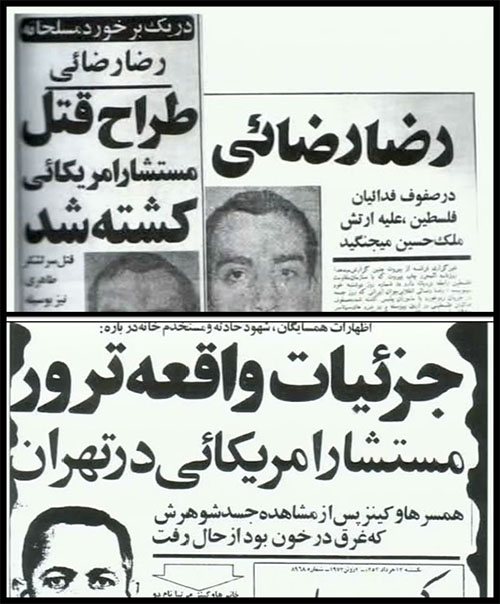
From the very next day, the details and descriptions of this assassination, with more details of the victims (with an emphasis on their military identity), were published in newspapers and it was announced that the American bodies were transferred to California.5
Quality of operation

One of the differences between this assassination and other terror operations of the Mujahedin organization was that it was used handy machineguns for killing the targets this time. Other assassinations – generally – were carried with pistols, and the reason was clear: having large machineguns was in contradiction with the security and destroys the security of the team. But in this particular case, the use of Kalashnikov’s machinegun was on the agenda. Typically, machineguns were used to defend team houses, but Fadaian guerrillas used it in operations, but smaller and lighter ones, such as the ((Shi)) machine gun, which made by France.

SAVAK review results

One of SAVAK’s first reports about the assassination of three advisors of IBEX was as follows:

“As mentioned before, on the 7 o’clock of 1976/08/28, 6 members of the Mojahedin-e-Khalq group (Islamic Marxist) blocked the way with a Volkswagen of the three American citizens residing in Tehran with the name of ((Robert Krongard, William Cotrell and Donald Smith)) that cooperating with Iran Imperial Air Force while transferring to their work place and killed three of them with machinegun and pistol and left their car and ran from the crime scene. Investigation done regarding the terror of three mentioned advisors shows that the executive members of this terror had enough intelligence of their status and jobs. With the regard that the parts that military and nonmilitary American advisors were doing their services were always on special interest of members of intelligence services of Soviet Union and mentioned three advisors were working in a sector that has high sensitivity, this is concluded that the mentioned information and identification have done by members of the Soviet Union intelligence service.6”

Source: MKO organization: Founding till the end (1965-2005), Second volume, In an effort by a team of researchers, the Institute of Political Studies and Research publication
September 8, 2019 0 comments
FacebookTwitterPinterestWhatsappTelegramSkypeEmail
USA double standards on terrorists
Mujahedin Khalq; A proxy force

US government supports Iranian terrorist group

The MEK was founded in 1965 and it has the unusual distinction of taking action to overthrow both the former government of the shah of Iran and the Islamic Republic of Iran by relying on terrorist actions. In the early 1970s, the MEK embarked on a program of assassinating Iranian officials and U.S. personnel in Iran.

The Iranian Revolution of 1979 saw the MEK’s program of bombings and shootings increase in intensity. The MEK is led by the husband-wife team of Massoud and Maryam Rajavi, who opponents and ex-members of the MEK describe as leaders of what has become known as the “Rajavi Cult.” The Rajavis abhor criticism and have been known to silence former MEK members-turned-critics by having them constantly harassed or worse, assassinated. There were nine assassinations between 1970-79).

After the United States ousted Saddam Hussein in the 2003 invasion and occupation of Iraq, the MEK forces were confined to U.S.-protected compounds in Iraq, the most prominent being Camp Ashraf, the former U.S. military’s Camp Liberty. The new Iraqi government demanded the MEK forces leave Iraq. Acceding to Iraqi demands, the United States relocated 3,000 MEK members to the Manez base in Albania, which the MEK calls “Ashraf 3.”

The MEK, which reportedly receives support from Israel’s Mossad, is said to be involved in money laundering and sex trafficking through the intensive use of cryptocurrencies like Bitcoin.

Not surprisingly, MEK forces joined with ISIL forces in battling against Syrian and Iraqi government forces. The MEK saw ISIL as a natural ally in fighting pro-Iranian governments in Baghdad and Damascus. It was well-known to Western intelligence agencies that the MEK and ISIL had established an alliance, but, nevertheless, the Barack Obama administration removed the MEK from the U.S. State Department’s terrorist list in 2012. From 1997 to 2012, the United States officially designated the MEK as a foreign terrorist organization.

After ISIL forces were routed in Syria and Iraq, the United States pressured Albania to allow the Islamist terrorists to join their MEK allies in Albania. ISIL terrorists and their families have reportedly been housed in buildings in Tirana that were formerly occupied by MEK members prior to their transfer to the Manez base. From their Albanian base, MEK operatives have easily entered Kosovo, the location of another major NATO military base at Camp Bondsteel, near Ferizaj in eastern Kosovo.

MEK terrorists, allied with sympathizers in Albania and Kosovo, have targeted Shi’a and Sufi Islamic institutions. It is also believed by some Albanian journalists, who have been intimidated by the Albanian government and MEK, that Ashraf 3 and Camp Bondsteel are being used to train MEK and other Middle Eastern mercenaries for a war against Iran to effect a NATO-led regime change operation.

The MEK enjoys widespread support in the Trump White House, as well as in the U.S. Congress. One of the MEK’s biggest boosters is Trump’s National Security Adviser John Bolton. On April 1, 2017, Bolton addressed an MEK Nowruz (Persian New Year) conference in Albania and declared that the MEK would be celebrating taking power in Tehran before 2019.

The MEK is represented in Washington by the law firm of Joseph diGenova and his wife, Victoria Toensing. DiGenova almost became Trump’s personal attorney. However, diGenova took his name out of consideration due to conflicts of interest and Giuliani accepted the job.

The Trump administration’s neocons, notably Bolton and Giuliani, are hell-bent on regime change in Iran. They are ramping up their terrorist army in the Balkans for such a future war. Politics makes for strange bedfellows.

By Cyrus Shamloo,wilsontimes.com

September 7, 2019 0 comments
FacebookTwitterPinterestWhatsappTelegramSkypeEmail
some one is absent here
The cult of Rajavi

Someone is absent here

In this documentary Mr.Bashiri narrates the story of his life and how he lost his wife…
My name is Alireza Bashiri. I was born in Ahwaz. I am 52. I live in Sweden with my daughter and her son.

After marriage, I told my wife that I’d like to go abroad and live in another country
My wife was just 17 and myself around 22 or 23. I didn’t have that much experience. We decided to go to Europe from Turkey. We went from Turkey to Germany. We sought asylum.
We spent around 2 years in a refugee camp.
The MKO members were very active there …

September 5, 2019 0 comments
FacebookTwitterPinterestWhatsappTelegramSkypeEmail
weekly digest
Iran Interlink Weekly Digest

Iran Interlink Weekly Digest – 260

++ In Albania, a source inside MEK has informed Iran-Interlink that alongside the click farm work Rajavi has ordered some members to discover who leaked the incriminating photographs which we wrote about in Lobelog last week to the Iranian media. The way this is being done is through telephone calls. They change the way they speak so they can pass as officials in Iran who are ringing to congratulate reporters for their work and then ask who sent the photos. Technically, MEK uses double phone calls which divert between themselves, so they appear to be coming from inside Iran. Sometimes they use Iranian mobiles so although the call goes to Albania, it shows up as Iran. This work is not new for MEK. After they arrived in Paris in 1981 over 200 landlines were set up to make calls into Iran to conduct their terrorist campaigns from France. MEK have sold their expertise in this kind of undercover work to Saddam Hussein, the CIA, MOSSAD, etc.

++ Last week the MEK launched an all-out online attack against Zarif’s visit to Europe. During a demonstration in Sweden they attacked the police, and some of them were arrested. In Paris, the MEK were forced to gate-crash another Iranian group’s demonstration since they are banned from holding their own. The police were not happy about this misuse of the protest. Interestingly, in spite of this effort to be seen, the success of Zarif’s visit and his subsequent return to the fringes of the G7 had a bad backlash inside MEK as the members became demoralised and deflated again. They are questioning ‘what are we doing, it’s not about helping Iran, we have just become an anti-Iran force’. To counter this mood, Rajavi has ordered the leading members to talk about the MEK’s martyrs, to remind the rank and file that they died for ‘the cause’, particularly glorifying those who burned themselves in 2003. Unfortunately for Rajavi, this caused even more of a backlash and made matters worse because members don’t buy these narratives anymore. External to the MEK, critics write in Farsi about what happened. They point out that instead of the MEK affecting Zarif and his work. Iran’s top diplomat performed his job well and the result was that the MEK became wobbly and ended up fighting each other. Some say that the way Rajavi thinks diplomacy works is the diplomacy of slavery; that the MEK are slaves to the Saudis and to the U.S. etc. Inside the MEK they are waking up to this. Others say that contrary to what Rajavi says, that these martyrs burned themselves for love, no, they were slaves who died because you ordered it. You killed them. And now, gone are the days of keeping people in MEK with false narratives.

In English:

++ Costantino Ceoldo, Pravda, interviewed Richard Black of the Virginia State senate – the only Western politician to have spoken openly in defense of Syria and its people. Asked about the role of the MEK, Black said that because Iran is a patriotic, cohesive and unified nation, there was little chance of the MEK growing like ISIS. But Western support for MEK-led regime change would be problematic. Using terrorists against Western enemies has not produced good results. Indeed, the damage to the German and Scandinavian countries due to these disasters may cause permanent damage. The MEK’s role could be to continue its covert intelligence activities at the behest of the U.S. such as the tanker attacks earlier this summer.

++ Ebrahim Khodabandeh’s blog piece ‘How has the MEK resisted disintegration’ explains that the MEK has only survived this long because of the support of the Republicans in America over the past two decades. In particular, the Trump administration, which intervened directly to enable the MEK to build what is a de facto extra-territorial enclave in Albania.

++ A lengthy analysis by Jonathan Broder in Newsweek magazine examines the state of Iran’s opposition groups as political pundits variously predict the chances of war or regime change in Iran as the Trump administration sends out mixed messages on an almost daily basis. Iran, he acknowledges, is weakened by American sanctions, but by no means bowed. Broder’s take on the MEK’s ability to take advantage of such turmoil is not flattering. Realistically, the MEK is a bad group with a bad history. To paraphrase, it is paid to exist and yet only exists by paying for support from a roll call of shills drawn from the dregs of American politics. They have no support inside Iran and cannot work with any other opposition groups.

++ A Washington Post piece by Adam Taylor highlights the dilemma of the MEK. It is dependent on American political will. So, the Trump administration’s prevarication – is regime change a thing or is it not – is particularly problematic for the group. President Trump wants to meet with Iran (anyone). That would spell disaster. The MEK can only exist in war and chaos. Diplomacy is an anathema to Rajavi.

++ Iranian media reported President Rouhani declaring the unity of the country. Parliament Speaker Ali Larijani talked about the intelligence cooperation between Iran and Iraq. Both mentioned the MEK as the enemy of Iran and a potential danger imposed by the West.

++ A socialist perspective on Iran and the U.S. approach by Mazda Majidi in Liberation News, takes the view that Iran is not collapsing and that Trump’s desire to meet with the Iranians is a bitter disappointment for Maryam Rajavi who feeds off war and destruction and bloodshed.
August 30, 2019

September 3, 2019 0 comments
FacebookTwitterPinterestWhatsappTelegramSkypeEmail
Massoud Rajavi
Massoud Rajavi

MEK leaders want Rajavi’s soul to dominate their troll factory

The rise of rulers with absolute power in Europe and Asia led to World War II. The totalitarian systems of Stalin, Hitler, Mao, Pol Pot and other relied largely on mass terror and indoctrination. Although today we live in a more democratic world with less ideological systems to rule people, there are still cult-like groups that are ruled by dictators. Cults of personalities such as the Mujahedin Khalq Organization (the MKO/ MEK/ PMOI) use considerable violence to intimidate dissidents inside the cult.

In a totalitarian system like the one in the MEK, individuals have no rights, and the leaders suppress all opposition. However, the MEK tries to stimulate democracy using it as a tool to legitimize authority, consolidate power, and repress its members. The self-assigned president of the group Maryam Rajavi is called”president elect”to suggest that she was elected by the group’s parliament in exile, the so-called National Council of Resistance (NCRI). Actually, NCRI is 98 percent consisted of MEK members, no other fractions of Iranian political spectrum is included. She was indeed elected by Massoud Rajavi and other members had no way but agreeing with his decision.

Maryam Rajavi in her turn makes efforts to take the gesture of a democratic leader. Her”ten point plan”for the future of Iran is a representation of her alleged pro-democratic aspirations but none of the ten points of that secular democratic plan are practiced inside the group’s headquarters Ashraf 3 in Albania as a token community of Iranians.

Members in camp Ashraf 3 are not allowed to ask for their most basic rights. They are not allowed to have any contact with the outside world. They are victims of forced celibacy, forced labor, sleep deprivation in a coercive system that requires them self-criticism and peer pressure. They can never ask about the controversies they are faced with in the cult.

Indeed, the most controversial question in members’ minds might be about the whereabouts of Massoud Rajavi who disappeared in 2003 after the US invasion to Iraq and the eventual collapse of Saddam Hussein, Rajavi’s long-time financial and military sponsor in his struggle against Iran. But, no one dares to ask such a question. Even after the Saudi prince Turki Faisal announced Massoud’s death in the group’s gathering in 2016, the MEK leaders did not approve or deny the announcement.

“However, this absence has been so prolonged that it has led members to criticize and even flee the group.”Suggests Ali Alghurabi of the MNA.”Fear of the group’s collapse has forced Maryam Rajavi to repeatedly move from her Paris headquarters to Tirana to lecture to members in order to show that the situation is under control.”

Alghurabi who is an Arab journalist based in Iran, assumes that the MEK’s stance about the death of Massoud Rajavi is like a game to keep members in limbo.”It seems that measures such as former Saudi intelligence chief Turki al-Faisal’s statements among members of the cult a few years ago in which he had called Masoud Rajavi dead or putting Masoud’s image among Iran’s deceased historical leaders, and, at the same time, denying his death by the cult’s ringleaders by occasionally broadcasting Masoud’s voice messages are the cult’s game to confuse members and even Iranian officials about the status of the group’s leader,”he argues.”The goals of this game are preventing the members’ exit as well as blinding Iranians’ desire to prosecute or exterminate Rajavi.”

ALghurabi correctly asserts that the MEK’s declining system will no more succeed to maintain Massoud Rajavi’s authoritarian soul over members.”It seems that under the current circumstances, whether Massoud is alive or not will have little effect on the group’s situation,”he states.”The MEK continues to be viewed as a notorious group with a bad record among Iranian people and the Iranian opposition groups; A group which had been on the list of terrorist organizations in the US and the EU, with no credible social base in Iran, dozens of its members fled its camps since 2014 when the group was relocated to Albania, the average age of its members on the rise, and many of them already too old. It is even feared that because of its relocation to Albania, the MEK could be considered a serious obstacle to Albania’s EU accession negotiations and the group’s presence in Albania could turn into a challenge for the Balkan country.”

“So whether or not the elderly leader of this cult is alive, when the MEK is facing a lot of challenges, may not matter much,”Alghurabi determines. The collapse of the world’s most powerful dictators like Hitler, Stalin, Saddam and Ghaddafi is the proof. Maryam Rajavi’s hard work to trigger her troll farm in Albania makes no sense when members hardly believe in the group’s cause seeking an opportunity to escape the cult.

Mazda Parsi

September 3, 2019 0 comments
FacebookTwitterPinterestWhatsappTelegramSkypeEmail
The End of the Path
The cult of Rajavi

The End of the Path documentary- Part1

The documentary “The End of the Path” is a first-hand account of suffering families whose loved ones have been misled by a destructive cult called the Mujahedin-e Khalq Organization (the MKO/ MEK/ PMOI/ the Cult of Rajavi). The victims are still taken as hostages by the cult leaders consequently living under a modern slavery.

Download the Video
The three-part documentary was produced while the MEK’s relocation from Iraq to Albania was being accomplished. After the relocation a number of families together with certain former members of the group visited the ruins of Camp Ashraf.
The documentary include these parts: The Ruins of Ashraf, Survivors, and Camp Liberty.
The documentary serves to inform and awaken public opinion on the sufferings of those who are imprisoned inside the destructive mind control cult, the MEK as a group with no popular base in Iran. Today, the group’s treatment against its members is primarily a human rights issue.
In this regard, the mission of Nejat Society is to expose the true nature of the leaders of the cult. We urge all international humanitarian bodies to help us in our efforts to release the victims of the Cult of Rajavi.
By the Media Group of Nejat Society

September 2, 2019 0 comments
FacebookTwitterPinterestWhatsappTelegramSkypeEmail
Rajavi and ISIS
Mujahedin Khalq; A proxy force

MEK/ISIS terrorists as tools against Iranian people

Intelligence Ties with Neighbors A Priority for Iran: Parliament Speaker
Iranian Parliament Speaker Ali Larijani described intelligence cooperation with friendly and neighboring countries as one of the Islamic Republic’s priorities.

Addressing a conference in Tehran on Wednesday, Larijani praised the Intelligence Ministry for the professional handling of issues, stressing the need for constant efforts to foil the enemy’s plots.

He also called for the expansion of intelligence cooperation with friendly states.

“Friendship and creating connections with the neighbors is one of the priorities for the (Islamic Republic’s) establishment,” he added.

Larijani also warned against the enemy’s plot to employ the terrorist Mojahedin-e Khalq Organization (MKO or MEK) and the Daesh (ISIL) forces against Iran, urging the intelligence forces to keep a close watch on their activities.

In December 2017, in an address to a six-party conference on the threat of terrorism, held in Islamabad, Larijani called on his counterparts from Pakistan, Russia, China, Turkey and Afghanistan to attach more significance to interaction among their intelligence organizations and data sharing.

He had also proposed the idea of formation of a special committee to coordinate counterterrorism efforts and share intelligence data to ensure regional security.

August 31, 2019 0 comments
FacebookTwitterPinterestWhatsappTelegramSkypeEmail
Richard Black
Mujahedin Khalq; A proxy force

West to employ MEK-led terrorists 

Richard Black speaks about Syria (and not only)

Syria is still torn by the conflict that has endangered its very existence since the distant 2011. It is a war that has never been simply internal to the Syrian society but that has involved, on the contrary, numerous players each moved by own interests and own purposes. The official West has always stood firm against the legitimate government of Damascus, endorsing every possible lie against it. But some voices of dissent have also been heard: Richard Black of the Virginia State senate is the only Western politician to have spoken openly in defense of Syria and its people, immediately highlighting the Western absurdity of trusting that international holding of terror headed by Al-Qaeda.

USA terrorist allies

For some months now, international diplomacies have been in flux over the possibility of an open war between United States and Iran. It would be a war that would drag the entire Middle East and the Western hemisphere into a conflict with devastating and unpredictable results. There is something tremendously irreconcilable between Washington and Tehran, an antagonism that also sees Israel as co-protagonist: the Jewish State in fact lives the Iranian presence in Syria and Iraq as a clear existential danger and craves to eliminate that danger once and for all.
I asked Senator Black to express once again an opinion on the current Middle Eastern situation, which develops its tragedy having as a background, also and unfortunately above all, the moral decadence of the West. There is indeed a subtle and hidden thread who connect Jeffrey Epstein’s perverse behavior with the stolen children scandal of Bibbiano, Italy, to which I have dedicated a previous column [1].

John Bolton

1) Do you feel that Syria is making progress in the war?
A) Yes. In particular, Syria is making excellent progress in recapturing Idlib Province. This month, the SAA, led by the Tiger Forces, skillfully outmaneuvered al Qaeda in Syria near Khan Shaykhun. They attacked from the east and west, creating an untenable salient, which was then choked off, besieging the Khan Shaykhun pocket. Syrian forces are rapidly clearing the pocket, and they are poised to advance more deeply into enemy-held territory.

2) The war in Syria has entered its eighth year and yet there is no end to it despite the successes of government forces and their allies. In your opinion, who still hinders the end of this terrible conflict?
A) The war would end if the United States left Syria. Throughout the war, the U.S. has sent arms and equipment across Turkey’s borders into Syria. We needlessly keep the war alive in order to squeeze Iran, which has lost many men fighting against ISIS and al Qaeda in Syria. General Westley Clark, former Supreme Allied Commander, Europe, described a 2001 meeting with a high-ranking general in the Pentagon War Room. The General said,”I just got this down from upstairs today.”He was referring to the Secretary of Defense’s office.”This is a memo that describes how we’re going to take out seven countries in five years, starting with Iraq, and then Syria, Lebanon, Libya, Somalia, Sudan and, finishing off, Iran.”So U.S. planners sought to overthrow Syria as early as 2001.The U.S. war plans developed quickly afterwards. In 2006 William Roebuck, chargé d’affaires at the US embassy in Damascus, issued a cable outlining strategies for destabilizing and exploiting perceived weaknesses in the Syrian government. His objective was to instigate and uprising and overthrow Syria. Under the bloodthirsty regime of President Obama, the United States relentlessly pursued their war plans. After toppling Libya, we quickly started the Syrian War. We did this by shipping stolen Libyan arms through Turkey and Lebanon immediately after the U.S., U.K. and France destroyed Libya in 2011. The war against Syria began within months of Libya’s fall in 2011, when the CIA established a”Rat Line”to infiltrate stolen Libyan weapons into Syria. This was a top-secret plan code-named Project Timber Sycamore. Tunisian terrorists became the first foreign fighters sent by Turkey and the West to fight the ill-prepared Syrian soldiers. However, the United States is not the only obstacle to peace in Syria. Turkey is a major stumbling block. Turkey provided most of the military hardware to ISIS, and supplies heavy military equipment to al Qaeda in Syria, which now controls most of Syria’s Idlib Province.

3) The Iranian front is being added to the Syrian front, with provocations that seem a prelude to war. Do we see a war between United States and Iran in our future?
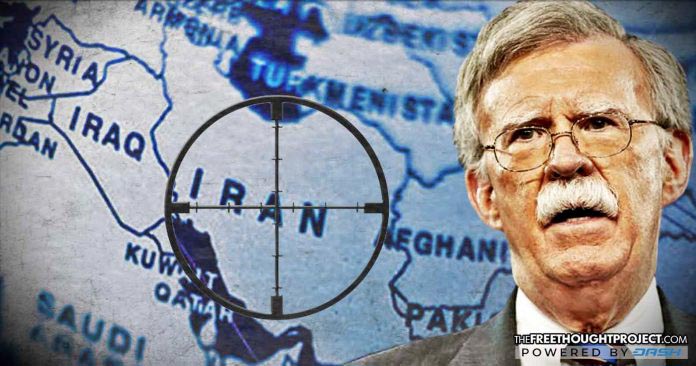
A) John Bolton, the National Security Advisor to the President, and Secretary of State Mike Pompeo would like to trigger a war with Iran. However, President Trump knows the American people are tired of fighting wars in the Middle East. I don’t expect anything dramatic to happen with Iran before the 2020 elections. Predicting what will happen after that is difficult, but I do not think President Trump is anxious for war. However, a number of provocations have already been staged and others are likely. Bolton and Pompeo would like nothing better than to see the President forced into a war with Iran. Of course, going to war with Iran would be disastrous for America.

4) Is there a risk that MEK, the Mojahedin-e khalq, will openly take in Iran the place that ISIS has had in Syria, giving way to a bloodbath in the Islamic Republic as well?
A) That is a distinct possibility. However, Iran is a cohesive, unified nation. Despite their internal political disagreements, Iranians are patriotic and even its dissidents are generally unwilling to undermine the unity of the nation. For that reason, I do not believe the MEK will find fertile ground to grow like ISIS did in the deserts of Iraq and Syria. Nevertheless, the West has decided to employ MEK-led terrorists to overthrow the duly-elected government of Iran. The Ashraf-3 base has just opened in Albania. Its purpose is to coordinate terrorist training, logistics and military action against Iran. The Ashraf-3 facility will be used to plan the infiltration and destabilization of Iran. It may use both MEK terrorists and battle-hardened ISIS and al Qaeda troops who are moved there from Iraq and Syria. The massive Ashraf-3 base is a complete city. It has parks, shopping centers, conference centers, and a luxury hotel. The heavily-guarded facility will be home to 3,000 MEK terrorists and families. If MEK succeeds in toppling Iran, Maryam Rajavi has already been designated as its first interim president. The United States designated the MEK as a terrorist organization in 1997. However, the push to overthrow seven Middle Eastern countries (including Iran) began to move forward rapidly in 2011 with the invasion of Libya. MEK was removed for the list of terrorist organizations in 2012 in order to bring about a violent regime change in Iran.

5) Has the west had much success working with organizations like MEK or al Qaeda in the past?

A) Employing the terror weapon has not produced good results for Western countries. The CIA fielded a quarter-million-man army of terrorists against the Soviet Union in Afghanistan. Saudi Arabia built a vast system of madrassas to indoctrinate youth in Wahabism, a remarkably murderous version of Islam. Although CIA’s jihadists did defeat the Soviets, they also gave birth to al Qaeda, which attacked the U.S. on 9-11 and went on to spread terror across the globe. Every time the West and its Gulf State allies use terrorists to overthrow governments, the results are disastrous. By recruiting and supplying affiliates of al Qaeda in Libya and Syria, we flooded Europe with a tidal wave of culturally-incompatible refugees. This gravely damaged countries like Germany, whose people were startled when foreign immigrants assaulted and raped German women with wild abandon soon after their arrival. The resulting crime and social disorder shocked Germans and Scandinavians, who may be permanently afflicted by these unpleasant social conditions.

6) Some investigations made by Iranians point to a MEK responsibility in the recent oil tankers attacks. Is Washington still trusting this organization?
A) The MEK is not independent of Washington. The Ashraf-3 base opening was attended by many senior-level U.S. officials. National Security Advisor John Bolton told the MEK at its 2017 conference in Albania,”Before 2019, we here will celebrate in Tehran”. He was wrong. But John Bolton still intends to overthrow Iran. I am not convinced that Iran was behind the tanker attacks. The attacks seemed staged and implausible. In one case, the State Department insisted the Kokuka Courageous was damaged by Iranian magnetic mines. But tanker crew said that flying ordnance pierced the ship’s hull. The holes pierced the ship above the waterline. That means the magnetic mines had to jump up from the water and cling to the ship’s side. It seems that a covert intelligence action was the more likely source of the damage.

7) Recently, you wrote a letter to President Trump [2]. Why did you feel the need for such a step? Have you got any answer from the White House? Or from the media of your country?

A) I was concerned that covert actions were being undertaken to trigger a war against Iran. I sent the letter to President Trump through certain channels. I also sent copies to every member of congress. I hoped to educate the Members about the actual situation in Iran. My goal was to block Bolton and Pompeo from drawing the nation into a war that would kill thousands of American servicemen and perhaps a million Iranians. It would also destabilize the entire world, and that could lead to a world war involving Russia, China, Europe and the Gulf State dictatorships.

8)”But the CINC does not ‘hope’, he commands”as you wrote about Trump’s hope to avoid a war with Iran. Do you think there is a lack of firmness by the current American President?
A) President Trump has only a tenuous hold on the government’s foreign policy establishment. The House of Representatives is firmly under Democrat control. Large portions of the federal court system are under Democrat control as well. The Senate is narrowly divided 53-49 in favor of Republicans. However, many senators in both parties are quite hawkish and anxious for new wars. Moreover, the State Department and CIA are heavily invested in war. Furthermore, unlike Presidents Nixon and Reagan (who were masters of foreign affairs) this is not Trump’s area of expertise. And since he surrounded himself with hawkish advisors like Bolton and Pompeo, he has little support for peaceful initiatives. Because of this, Trump has very limited maneuvering room in matters of foreign policy. For example, Trump announced a total, immediate withdrawal of U.S. forces from Syria on Dec 19, 2018, saying,”Our boys, our young women, our men – they’re all coming back, and they’re coming back now.”Within a week, John Bolton had flown to Tel Aviv and rescinded the President’s order. Today, there is no evidence that any troops ever left Syria. They even remain at the isolated outpost of al-Tanf, which plays no role in fighting ISIS and probably never did. Bolton sometimes exercises powers that are the traditional domain of the Commander-in-Chief. That’s especially ironic, since Bolton was a Vietnam draft-dodger who shirked has duties and avoided the dangers of combat.

9) The case of Bibbiano is similar but not the same as that of Epstein who ran an environment of pedophiles for political blackmail. Don’t you think our Western decline has passed a terrible level of watch?
A) President Obama ordered the rainbow-sodomy flag flown directly beneath the American flag at U.S. embassies across the globe. He even bathed the White House in rainbow colored lights to celebrate sodomy in America. Under then-Secretary of State Hillary Clinton, the U.S. State Department was ordered to promote gay sodomy as a human right. Naturally, this offended nations with strong moral values. Fortunately, the situation has improved a bit under President Trump, and the rainbow-sodomy flag is not flown over U.S. embassies today. Nonetheless, Western morality has suffered enormously by elevating immoral sexual behavior and permitting homosexuals to parade in various states of nudity, while committing lascivious acts in the presence of families with children.
Homosexuals seek out youth and children. We now permit homosexuals to serve openly in the military. The practice allows homosexuals to dominate young men and women. Incorporating homosexuals into the military has undermined good order and discipline.
I know a young Marine woman who was mocked for her Christian faith and for refusing to participate in lesbian sex during boot camp. That is a far cry from the high standards maintained when I attended the Marine Corps boot camp as a young man. Integrating homosexuals into the military ranks was designed to force waves of recruits to accept homosexuality in order to spread this acceptance throughout society. Today, homosexuality has been forced into every facet of life. Homosexuals are even allowed to adopt children, despite their well-known inclination toward sexual activities with minors. Public schools in my own county provide children with books that describe a six-year-old transvestite child performing illicit sex acts with older youth. So, the cultural decay is evident everywhere. The U.S. suffered a grave moral collapse in 2015, when the U.S. Supreme Court created homosexual marriages. Although such marriages are an illusion, that illusion is a toxic one that has far-reaching, destructive ramifications. There is little evidence that open homosexuality and Christianity can co-exist. And since Christianity is the moral bedrock of Western Civilization, it is unclear whether civilization will survive this reckless social experiment at all.

[1]http://www.pravdareport.com/opinion/142543-italy/
[2]https://drive.google.com/file/d/1n9lTd4FBsXJl2nRtCNsPNS6bWrYcRr67/view?usp=sharing

By Costantino Ceoldo – Pravda freelance

August 29, 2019 0 comments
FacebookTwitterPinterestWhatsappTelegramSkypeEmail
blank
Mujahedin Khalq Organization as a terrorist group

MEK deny the true ver. Of its history

Iran’s Opposition Groups are Preparing for the Regime’s Collapse. Is Anyone Ready?

In July 13, President Donald Trump’s personal lawyer, Rudi Giuliani, addressed an Iranian opposition group called the Mujahedin e-Khalq (MEK) at the group’s tightly guarded encampment in rural Albania, where some 3,400 members have been preparing for the overthrow of the clerical regime in Tehran.
Calling the MEK Iran’s”government-in-exile,”Giuliani assured MEK members that the Trump administration regards the group as an acceptable replacement for the current regime.”It gives us confidence that if we make those efforts to overthrow that horrible regime, sooner rather than later, we will not only save lives but we will be able to entrust the transition of Iran to a very responsible group of people,”the former New York City mayor told his cheering audience.

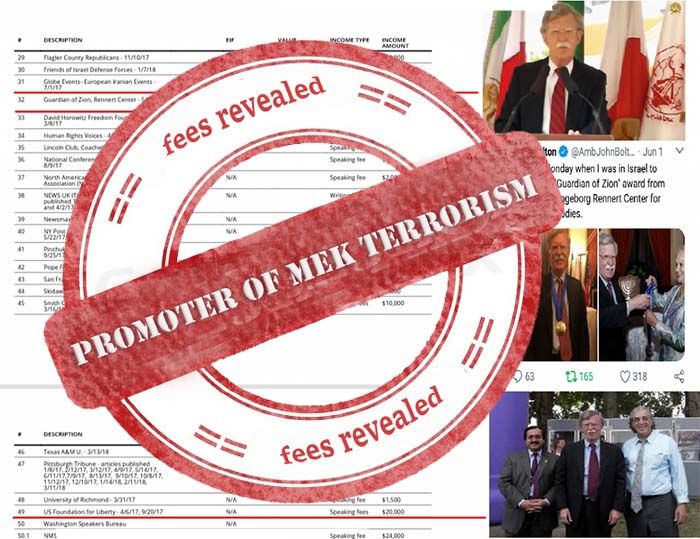
Like other former U.S. officials, Giuliani has been a frequent—and highly paid speaker—at MEK events over the past several years. So has John Bolton, Trump’s hawkish national security adviser, who has earned $180,000 from his MEK speeches according to Joanne Stocker, an editor at The Defense Post and an expert on the MEK. Bolton stopped addressing the group last year when he took up his White House post, which precludes such appearances.

But in his last speech to the MEK at a Paris rally in 2017, Bolton enthusiastically endorsed the group’s claim to be the most attractive alternative to the Iranian regime.”There is a viable opposition to the rule of the ayatollahs and that opposition is centered in this room today,”Bolton said. His financial disclosure showed he earned $40,000 for that speech.
The MEK, whose name means the”People’s Holy Warriors,”is the oldest, best organized and best known of several Iranian opposition movements waiting in the wings. But there are others. One group are the monarchists, led by the son of the deposed shah, Crown Prince Reza Pahlavi, who hopes to coordinate the different opposition groups and create a provisional government until democratic elections can be held. There are also several armed groups representing Iran’s oppressed ethnic and religious minorities, who favor a federal-style government that will give their regions greater autonomy.
Earlier this year, the Trump administration said it would not rule out the MEK as a viable replacement for the current regime. But at the same time, senior officials also stress that Trump is not seeking regime change. Instead, these officials say, the administration is focusing on Trump’s campaign of economic sanctions against Iran aimed at forcing the regime to negotiate what U.S. officials call”behavioral changes.”They include a verifiable end to Iran’s nuclear weapons program, a halt to its ballistic missile development and a stop to its support for proxy militias in Lebanon, Syria, Iraq and Yemen that have expanded Iran’s influence throughout the Middle East. Iran has rejected the administration’s demands, describing them as tantamount to regime change.
Regime change or no regime change, the opposition groups remain deeply divided, which undermines their chances of ever taking power, Iran experts say. Over the years, several opposition groups have tried repeatedly to form a united front against Tehran, but their attempts have failed because of clashing histories, agendas and personalities.
Opposition to Iran’s clerical regime, in the form of street protests and armed attacks on government officials and installations, has been around since the country’s 1979 Islamic revolution. But something is different now. What distinguishes the most recent protests from those that erupted in 2009, 2017 and 2018 are both the severity of Iran’s economic woes and the regime’s reluctance to crack down hard on the demonstrators for fear of sparking another revolution.”These days, they’re cautious,”Abdullah Mohtadi, the leader of the Iranian Kurdish Komala Party, one of the country’s principal ethnic opposition groups, told Newsweek.”They know how fragile the system is.”
Administration officials say that Iran’s leaders can either negotiate the behavioral changes Trump is demanding or watch their country’s economy crumble. Eventually, they insist, the Iranian regime will bend to the president’s will. So far, Iran continues to defy Trump with a campaign of threats and harassment against shipping in the Persian Gulf that has drawn U.S. and British naval and air reinforcements to the region. Meanwhile, a recent Swiss intelligence assessment reportedly says Iranian leaders will wait out the U.S. elections in November 2020 in the hope Trump is defeated—and a Democratic administration lifts the sanctions under a return to the 2015 nuclear deal.
Still, many analysts say the current tensions could easily escalate into an armed conflict and the collapse of the Tehran regime. That prospect has raised the question of what kind of Iranian government might come next. And that conversation inevitably turns to Iran’s opposition groups.

The Mystery of the MEK
The MEK has been the leading opposition voice against the Islamic Republic for years. For the past decade, MEK leaders and their supporters have presented the group as a secular, democratic and nonviolent organization with widespread popular support inside Iran.
It is also the most controversial group. Many former U.S. officials and Iran experts question the MEK’s democratic credentials, as well as the depth of its support base inside Iran. Indeed, virtually every claim made by the MEK draws denials and counter-narratives.
Founded in 1965 by Iranian students who opposed the U.S.-installed monarchy of Shah Mohammad Reza Pahlavi, the MEK espoused an odd hybrid of Marxism and Islam. It was the first opposition group to take up arms against the shah and his supporters in the west. In the 1970s, according to U.S. intelligence, the MEK assassinated three U.S. Army colonels, murdered another three American contractors and bombed the facilities of numerous U.S. companies, earning it a place on Washington’s list of foreign terrorist organizations.
The MEK also backed Ayatollah Ruhollah Khomeini, who led the Islamic revolution that deposed the shah in 1979. The group supported the takeover of the U.S. embassy, but it broke with Khomeini over his decision to release the American hostages. In 1981, after launching an abortive uprising against the Khomeini regime, the MEK was forced underground while its top leaders, the husband and wife team of Massoud and Maryam Rajavi, fled to Paris to avoid arrest.
But the Iraq-Iran war, which had begun in 1980, provided the MEK with another opportunity to fight the regime. The group aligned with Saddam Hussein and sent some 7,000 MEK members to Iraq for military training. Equipped by Saddam, the MEK fought numerous battles against Iranian forces during the war. In 1988, the group launched an armored invasion to topple the regime but suffered a major defeat, losing more than 3,000 soldiers. The invasion also prompted Iran to execute thousands of MEK political prisoners. Once the war ended later that year, Saddam prevented the group from conducting further cross-border attacks.
Many independent scholars say the MEK’s alliance with Saddam in that long and bloody war turned the group into traitors in the eyes of most Iranians. In the 1990s, the Rajavis instituted a number of cult-like measures to prevent defections. According to a 2005 Human Rights Watch report based on interviews with several defectors, members were required, among other things, to divorce their spouses and send their children abroad for adoption, lest family obligations divert their attention from the struggle against the Islamic Republic.
After U.S. forces toppled Saddam and occupied Iraq in 2003, they disarmed the MEK and placed its remaining 3,400 MEK members under U.S. protection. That same year, Massoud Rajavi mysteriously disappeared, and Maryam assumed sole leadership of the group.
In 2009, she launched a multi-million-dollar campaign from her Paris headquarters to get the MEK removed from Washington’s terrorist list. Despite its official status as a foreign terrorist organization, the MEK operated openly in Washington from offices in the National Press Club, warmly embraced by Iran hawks. The group hosted lavish receptions on Capitol Hill and began paying as much as $50,000 to prominent U.S. political and military figures to deliver speeches that stressed what the group said was its commitment to a secular, democratic Iran.
In addition to Bolton and Giuliani, the list of the MEK’s paid speakers included former White House Chief of Staff Andrew Card, former national security adviser Gen,. James Jones, former White House terrorism adviser Fran Townsend, former Attorney General Michael Mukasey, former Homeland Security Secretary Tom Ridge, former FBI director Louis Freeh, former CIA Director Porter Goss, former deputy CIA Director John Sano, former Joint Chiefs Chairman Gen. Richard Myers, Gen. Wesley Clark, Gen. Anthony Zinni, former Vermont Gov. Howard Dean, former Pennsylvania Gov. Ed Rendell, former senators Robert Torricelli and Evan Bayh, and Reps. John Lewis and Patrick Kennedy, among others.
“Some people do it just for the money; others do it because they hate the Islamic Republic of Iran,”said Barbara Slavin, who heads the Future of Iran project at the Atlantic Council, a foregn policy think tank in Washington.”They embrace the old adage that the enemy of my enemy is my friend, and they know this is a group that gives Iran heartburn. To top it off, they pay well.”
The question of how the MEK could afford such generous speaking fees was partially answered when Newsweek first reported that the post-war search for Iraq’s alleged weapons of mass destruction uncovered documents showing Saddam Hussein had given the group vouchers for the sale of more than 38 million barrels of oil to overseas middlemen for the four years preceding the U.S. invasion. A report by Charles Duelfer, the chief U.S. weapons inspector, estimated the MEK earned as much as $16 million from the sales of the vouchers. (After Saddam’s fall, many experts have speculated that Saudi Arabia, Iran’s arch rival, took over funding for the group.)
Meanwhile, the MEK became known as a valuable intelligence asset. In 2002, the MEK was credited with exposing Iran’s then-secret uranium enrichment plant at Natanz, which led to United Nations inspections. Over a five-year period starting in 2007, MEK assassins—financed, trained and armed by Israel’s Mossad intelligence service—killed a half dozen Iranian nuclear scientists, U.S. officials told NBC News.
In 2011, pro-Iranian militias in Iraq killed some 140 MEK members and deeply embarrassed the U.S. military, which was responsible for their protection. To prevent further slaughter, then-Secretary of State Hillary Clinton took the group off the terrorist list in 2012, a move that paved the way for the evacuation of Camp Ashraf’s MEK members to Albania.

But had anything really changed?
Daniel Benjamin, the State Department coordinator for counterterrorism at the time, told Newsweek the delisting was done”at the discretion of the secretary out of humanitarian concern because no country would take them otherwise, and not because of any changed thinking within the MEK. We simply didn’t want any more blood on our hands.”
“The MEK has done a great job in gussing themselves up as democrats,”said Benjamin, now director of The Dickey Center for International Understanding at Dartmouth College.”They talk the talk, but there’s no evidence whatsoever that they’ve changed in any way. And there is zero question about their support inside Iran itself —they have no statistically significant group of supporters in Iran.”
Officials of the MEK and its political arm, the National Council of Resistance of Iran (NCRI), vehemently deny this version of the group’s history, including any responsibility for the assassination of Americans.
“The Iranian regime has been engaged in this misinformation campaign for four decades,”Ali Safavi, director of the group’s Washington office told Newsweek.”They have invested huge sums of money in it and developed a sophisticated network of talking heads and lobbies in the U.S. and Europe to demonize the Iranian opposition as having no support inside Iran and being undemocratic.”

In the Magazine
Today, he said, the NCRI”brings together several different groups and about 500 well-known opposition personalities who are committed to the establishment of democratic, secular and non-nuclear republic.”Its funding, he says, comes solely from wealthy members of the Iranian diaspora community.
But other opposition groups say the MEK has rebuffed their overtures for coordination.”They’re deaf to any proposals other than their own beliefs,”said the leader of one opposition group, who spoke on condition of anonymity to discuss sensitive opposition politics.

A Royal Figurehead Emerges
As the Trump administration tightens the economic screws on the Islamic Republic, Crown Prince Reza Pahlavi has been speaking out against the regime in Tehran and calling for opponents to band together under his leadership and vision for a democratic Iran.
Pahlavi, 58, was only 17 when the Iranian revolution drove his family into exile. But over the past four decades, he has kept a close watch on developments in Iran, where he says discontent with government corruption and economic mismanagement has brought the regime to the brink of collapse.”The atmosphere [in Iran] seems to be close to a flash point,”he told Radio Farda, the U.S. government’s Persian-language broadcast service, in February.
But though Pahlavi lives just outside Washington, he’s been an unfamiliar figure in foreign policy circles. Critics have said he lacks charisma and resolve. In 1980, he issued a proclamation declaring himself shah but later retracted it. In the 1980s, U.S. intelligence reportedly approached Pahlavi with a proposal to land a monarchist force on Iran’s Kish island in the Persian Gulf with U.S. naval and air support. Pahlavi’s first question allegedly focused on the exit strategy.

But since late last year, Pahlavi has set out to raise his profile by meeting with think tanks to explain the role he could play as the regime’s disparate opposition groups prepare for its downfall. Pahlavi says he sees himself as a figurehead who can guide those groups in producing a common plan for a political transition. He already has taken a step in that direction with his Phoenix Project, an effort to bring together exiled Iranian scientists, scholars and experts to address the problems any democratic successor government in Iran will face. He has said he had no personal ambition to rule Iran.
Pahlavi’s supporters include several monarchist groups made up of Iranian exiles in the United States and Europe, as well as an unknown number in Iran, some of whom called for a return of the monarchy during anti-government demonstrations in 2017.
Over the past few years, several Europe-based TV stations have been broadcasting pro-monarchy programs into Iran in an effort to create a mood of pre-revolution nostalgia. But Pahlavi remains unpopular among Iran’s ethnic minorities, who haven’t forgotten the monarchy’s Persian chauvinism. And some Iranian Americans have urged the crown prince to distance himself from his late father’s authoritarian rule as a prerequisite for any leadership role.
Patrick Clawson, the Washington Institute’s director of research, suggested Pahlavi would prefer a role as a ceremonial monarch with no responsibility for governing along the lines of Britain’s constitutional monarchary.”He wants to be Queen Elizabeth,”Clawson told the Atlantic Council’s Slavin.
Among all the Iranian opposition groups, the ones that are doing the most actual fighting against the regime are those representing the country’s ethnic and religious minorities—Kurds and Azeris in the northwest, Arabs in the southwest, and Balochis in the southeast, all of whom demand autonomy for their regions.
According to Naysan Rafat, an Iran expert at the International Crisis Group, these groups have been conducting frequent but small-scale attacks on government targets since the revolution. The government portrays them as terrorists, supported by regional rivals.
For the past few years, Iranian Kurdistan’s Komala Party has taken the lead in trying to unify these different groups behind the idea of replacing Iran’s clerical regime with a decentralized federal government whose constitution will safeguard the rights of the country’s ethnic minorities.
“What is certain is that this regime will collapse sooner or later,”the Komala Party’s Mohtadi said.”We want to avoid the possibility that a collapse will lead to the break-up of the country into different ethnic regions.”
Mohtadi is urging the Trump administration to establish contact with the opposition groups to plan for what comes next. Without such preparations, he warned, the regime’s collapse could be followed by a seizure of power by Iran’s Revolutionary Guards—or the country’s disintegration into chaos.”The Trump administration has pressured the Iranian regime economically and politically,”Mohtadi allowed,”but in terms of reaching out to the Iranian opposition, I haven’t seen anything serious.”

Waiting For A Spark

In fact, the Trump administration has not met with any Iranian opposition figures, deliberately distancing itself from the groups for now.”The future of Iran will be decided by the Iranian people,”Brian Hook, the administration’s special representative for Iran, told Newsweek in an interview.”We do not pick winners and losers on that issue.”
Of course, that could change overnight. White House aides say Bolton is still trying to convince the president to adopt an explicit policy of regime change in Iran, which would increase the value of opposition groups. Analysts say that is particularly the case for the MEK, given the group’s organization, funding and high visibility in Washington.
Some supporters believe the MEK already has moved to the head of the line with the administration’s decision not to rule out the group as a viable alternative to the regime in Tehran.
But for now, Trump’s economic sanctions remain the principal element of his Iran policy.”If we want to get to a point where Iran’s proxies are weaker and the regime doesn’t have the resources that it needs to destabilize the Middle East, it will require economic pressure,”Hook said.”There is no other way to accomplish that goal.”
For the Iranian opposition groups, this state of no peace—and no war—means that there is no leadership vacuum in Iran to fill. And as the tensions between Tehran and Washington continue to simmer, all these groups can hope for is a spark that will finally put Iran’s political future in play.

Will they—and Washington—be ready?

Newsweek.com

August 28, 2019 0 comments
FacebookTwitterPinterestWhatsappTelegramSkypeEmail
Maryam Rajavi
Mujahedin Khalq; A proxy force

How has the MEK – Rajavi cult – resisted disintegration

The Mojahedin-e Khalq Organization (MEK, MKO, NCR, NLA, Rajavi Cult), an armed opposition to the Islamic Republic of Iran, faced dramatic changes after Iraq was invaded by US forces in 2003, and Saddam Hussein, the only state sponsor of the leader Massoud Rajavi, was toppled.
According to the RAND report, the US recognized the cult base Ashraf as a base of the enemy and therefore once the MEK surrendered to the US military, the group was disarmed. But soon instructions from Washington kept the cult intact in their base in Iraq and protection was granted.

Ebrahim Khodabandeh

John Bolton, who served as the US government representative to the UN at the time, was the key lobbyist for the MEK. He was and is a regular paid attendee of Maryam Rajavi’s annual meetings. Several others, like Bolton, also desire to intensify conflict with Iran for the political and economic benefit of an elite rather than in the national interests of the US.
All through the years since the overthrow of Saddam Hussein in Iraq in 2003, the subsequent Iraqi governments have insisted that the terrorist group – which was considered a threat to national security – be expelled from Iraq.

Paul Pillar

Finally, the US administration entered talks with the Albanian authorities and with the efforts of Hillary Clinton, who was the Secretary of State at the time, the group was moved to Tirana. The aim was to disband the group and reintegrate the individuals back into normal society. At that time this was called a humanitarian act which had no political purpose.
After the new administration took office in Washington and John Bolton became the National Security Adviser and Rudy Giuliani, who has visited Maryam Rajavi several times, became President Trump’s personal advocate, these plans changed and a remote isolated base belonging to the US air force was granted to the terrorist cult to build a new closed camp. The aim was to stop further defections from the group which had become easy after moving from Camp Liberty in Iraq to apartment blocks in Tirana city.
The US promised the Albanian authorities that the MEK presence in their country was temporary and there would be no costs or problems for the Albanian government. This is not the case now of course which is the consequence of new officials taking over the White House.
The policy of the Trump administration has been to exert maximum pressure on Iran to make the government yield to US demands. Supporting a terrorist cult, which claimed at least six US citizens lives in Tehran before the revolution and abandoning the program to disband the cult is part of this policy. A policy which is proving to be totally wrong and which so far has sent all the achievements of the former US administration down the drain.
The MEK leaders prevented the disintegration of the group with the direct help of the US team of hard liners under president Trump. Now the cult is in Albania and represents a security threat to Europe more than anywhere else.
One might ask, did Donald Trump mean to threaten Iran or Europe? The Iraqis managed to rid their country of the terrorist cult. Could Europe in general and Albania in particular manage to do the same?

August 28, 2019 0 comments
FacebookTwitterPinterestWhatsappTelegramSkypeEmail
Newer Posts
Older Posts

Recent Posts

  • The black box of the torture camps of the MEK

    December 24, 2025
  • Pregnancy was taboo in the MEK

    December 22, 2025
  • MEPs who lack awareness about the MEK’s nature

    December 20, 2025
  • Why did Massoud Rajavi enforce divorces in the MEK?

    December 15, 2025
  • Massoud Rajavi and widespread sexual abuse of female members

    December 10, 2025
  • Facebook
  • Twitter
  • Instagram
  • Youtube

© 2003 - 2025 NEJAT Society . All Rights Reserved. NejatNGO.org


Back To Top
Nejat Society
  • Home
  • Articles
  • Media
    • Cartoons
    • NewsPics
    • Photo Gallery
    • Videos
  • Publications
    • Books
    • Nejat NewsLetter
    • Pars Brief
  • About Us
  • Contact us
  • Editions
    • عربي
    • فارسی
    • Shqip