Nejat Society
  • Home
  • Articles
  • Media
    • Cartoons
    • NewsPics
    • Photo Gallery
    • Videos
  • Publications
    • Books
    • Nejat NewsLetter
    • Pars Brief
  • About Us
  • Contact us
  • Editions
    • عربي
    • فارسی
    • Shqip
Nejat Society
Nejat Society
  • Home
  • Articles
  • Media
    • Cartoons
    • NewsPics
    • Photo Gallery
    • Videos
  • Publications
    • Books
    • Nejat NewsLetter
    • Pars Brief
  • About Us
  • Contact us
  • Editions
    • عربي
    • فارسی
    • Shqip
© 2003 - 2024 NEJAT Society. nejatngo.org
Ebrahim Khodabandeh
Mujahedin Khalq; A proxy force

MKO Serves White House Orders

An ex-member of the Mojahedin-e Khalq Organization (MKO, also known as the MEK, PMOI and NCRI) said the terrorist group moves in line with the White House policies and is now seeking to empty the Iranian society from hope.

Massoud Khodabandeh, a former high-ranking MKO element, made the revelations in an interview with FNA on Saturday.
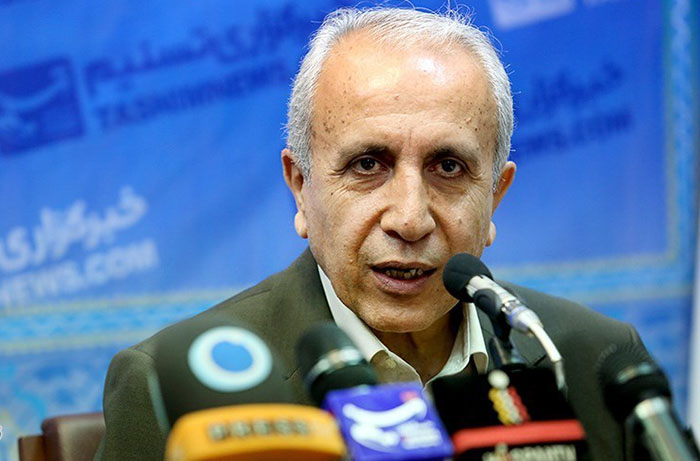
Ebrahim Khodabandeh

Ebrahim Khodabandeh: I was manipulated to tell lies

He explained that after hostilities between Iran and the US increased and the Iranian people showed resistance against Washington’s policies, the MKO were ordered by the White House to make the Iranians disappointed at their government and country.

Khodabandeh noted the propaganda operation of the terrorist group, and said the MKO members who are active in the social media have been trying dissuade the public in Iran from supporting any side in case war breaks out between the US and Iran.

“Such a stance is clearly understood as betrayal to your nation in any part of the world and in any country”but the MKO members are attempting to display it as legitimate with their social media propaganda, he said.

“This betrayal has directly originated from the White House,” Khodabandeh underlined.
In relevant remarks late in July, Head of Iran’s Civil Defense Organization Brigadier General Gholam Reza Jalali said Washington is using the MKO terrorists to attain its goals against Tehran until their expiry date arrives.

“The Monafeqin (hypocrites as MKO terrorists are called in Iran) have always been a plaything in the US hands and of course, they have an expiry date,”General Jalali said in Tehran.

He expressed pleasure that the MKO terrorist group had been expelled from Iraq, and said,”Their headquarters is now in Albania and they are pursuing a new plot using the internet.”

General Jalali explained that the MKO terrorists were misusing some economic weaknesses inside Iran and attempting to create chaos in the country, adding that the foreign social media have turned into a new ground for the MKO to exercise their terrorist moves.

The MKO is listed as a terrorist organization by much of the international community. Its members fled Iran in 1986 for Iraq, where they received support from then dictator Saddam Hussein.

The notorious outfit has carried out numerous attacks against Iranian civilians and government officials for several decades.

In 2012, the US State Department removed the MKO from its list of designated terrorist organizations under intense lobbying by groups associated to Saudi Arabia and other regimes adversarial to Iran.

A few years ago, MKO members were relocated from their Camp Ashraf in Iraq’s Diyala Province to Camp Hurriyet (Camp Liberty), a former US military base in Baghdad, and were later sent to Albania.

Those members, who have managed to escape, have revealed MKO’s scandalous means of access to money, almost exclusively coming from Saudi Arabia.

The MKO terrorist group specified the targets as Major General Qassem Soleimani, who commands the Quds Force of the Islamic Revolution Guards Corps (IRGC), and Iranian Judiciary Chief Seyed Ebrahim Rayeesi.

The terrorist organization said it would “welcome” their assassination, adding that it desired for the ranking officials to “join” Asadollah Lajevardi, Tehran’s former chief prosecutor, and Ali Sayyad-Shirazi, a former commander of the Iranian Army’s Ground Forces during Iraq’s 1980-88 war against Iran.

Earlier in June, a leaked audio of a phone conversation between two members of MKO, revealed Saudi Arabia has colluded with the MKO elements to frame Iran for the recent tanker attacks in the Persian Gulf.

In the audio, which is being released by the Iran Front Page for the first time, Shahram Fakhteh, an official member and the person in charge of MKO’s cyber operations, is heard talking with a US-based MKO sympathizer named Daei-ul-Eslam in Persian, IFP news reported.

In this conversation, the two elements discuss the MKO’s efforts to introduce Iran as the culprit behind the recent tanker attacks in the Persian Gulf, and how the Saudis contacted them to pursue the issue.

“In the past week we did our best to blame the [Iranian] regime for the (oil tanker) blasts. Saudis have called Sister Maryam (Rajavi)’s office to follow up on the results, [to get] a conclusion of what has been done, and the possible consequences,” Fakhteh is heard saying.

“I guess this can have different consequences. It can send the case to the UN Security Council or even result in military intervention. It can have any consequence,” Daei-ul-Eslam says.

Attacks on two commercial oil tankers in the Gulf of Oman on June 13, and an earlier attack on four oil tankers off the UAE’s Fujairah port on May 12, have escalated tensions in the Middle East and raised the prospect of a military confrontation between Iran and the United States.

The US, Saudi Arabia, and the UAE have rushed to blame Iran for the incidents, with the US military releasing a grainy video it claimed shows Iranian forces in a patrol boat removing an unexploded mine from the side of a Japanese-owned tanker which caught fire earlier this month.

It later released some images of the purported Iranian operation after the video was seriously challenged by experts and Washington’s own allies.

The MKO which is said to be a cult which turns humans into obedient robots, turned against Iran after the 1979 Revolution and has carried out several terrorist attacks killing senior officials in Iran; yet the West which says cultism is wrong and claims to be against terrorism, supports this terrorist group officially.

After the Islamic Revolution in 1979, the MKO began its enmity against Iran by killings and terrorist activities.

August 13, 2019 0 comments
FacebookTwitterPinterestWhatsappTelegramSkypeEmail
blank
Nejat Publications

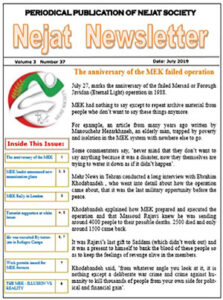
Nejat NewsLetter No.63

Inside this Issue: 

Nejat Newsletter

  • The anniversary of the MEK
  • Work permits issued for MEK formers
  • MEK Rally in London
  • MEK leader announced new assassination plans
  • He was recruited By terrorists in Refugee Camps
  • Terrorist supporters at white house
  • THE MEK : ILLUSION VS. REALITY
August 13, 2019 0 comments
FacebookTwitterPinterestWhatsappTelegramSkypeEmail
blank
Mujahedin Khalq; A proxy force

Why to engage with a Cult-like group

We asked Canadian politicians why they engaged with a ‘cult’-like group from Iran

it looked like a scene from The Handmaid’s Tale. Two glittering flags projected on jumbo screens behind a well-known politician as he addressed a massive gathering, flanked by woman dressed in identical red headscarves and black-and-white overcoats.

But this was no Republic of Gilead: it was rural Albania, the flags were Canadian, and the politician — former prime minister Stephen Harper — was addressing Iranian men and women, alongside dignitaries from at least 10 different countries.

“I am delighted to be here because there are few causes in this world today more important at this moment than what you are pursuing — the right of the people of Iran to change their government, and their right to do it through freedom and the power of the ballot box,” Harper declared to loud applause last month.

Harper was speaking at an event hosted by the National Council of Resistance of Iran, which the U.S. government-funded think tank RAND Corporation describes as”exclusively controlled”by the Mojahedin-e-Khalq (MEK).

Peculiar as it may have appeared to Canadian viewers, the setting was not an unfamiliar one to many Canadian political figures. For almost a decade now, Liberal and Conservative Parliamentarians have attended gatherings or spoken, as Harper did, at events linked to the MEK.

The Iranian opposition group aims to replace Iran’s theocracy with a secular, democratic and Western-facing government. It was previously listed as a terrorist entity in Canada, before Harper’s government dropped the group from the list in 2012, after the United States and the European Union did so. It has long renounced political violence.

The MEK now works closely with powerful hardliners in the White House, including U.S. National Security Advisor John Bolton. But the MEK has also been described in other terms.

RAND, for example described the MEK in 2009 as possessing “many of the typical characteristics of a cult.” Such characteristics, it wrote, include”authoritarian control, confiscation of assets, sexual control (including mandatory divorce and celibacy), emotional isolation, forced labor, sleep deprivation, physical abuse, and limited exit options.”

More recently, investigative reports published by The Intercept, British broadcaster Channel 4 and Al Jazeera English have depicted MEK “troll farms” where members create thousands of inauthentic accounts on a daily basis and promote hashtags and tweets, targeting anyone that favours diplomacy with Iran. Human Rights Watch has reported that MEK leaders force people to issue false confessions.

In 2006, the National Post published an extensive report about a Canadian family that got wrapped up in the group. And in 2003, Neda Hassani, a 26-year-old Carleton University student, became a martyr for the MEK when she set herself on fire in front of the French embassy in London to protest the arrest of its leader by police in France.

‘They help create the illusion of legitimacy’

Video and documents available online show several current parliamentarians have attended MEK functions or given speeches, including Conservative Senator Linda Frum, Conservative MP Michael Cooper, Conservative MP Candice Bergen, Liberal MP Judy Sgro and Liberal MP Michael Levitt.

Stephen Harper

As well, along with Harper, other former politicians have interacted with the MEK in recent years, including Harper’s former foreign affairs minister John Baird, former Conservative MP Paul Forseth, former Liberal minister of justice and attorney-general Irwin Cotler and David Kilgour, a former public prosecutor and MP.

The fact that current and former Canadian politicians attend MEK events is deeply problematic, argues Stephanie Carvin, who worked as a national security analyst with the government of Canada at the time the MEK was a listed terrorist entity.

Politicians attending MEK events “help create the illusion of legitimacy,” said Carvin, who is now an assistant professor of international relations at Carleton University.”It also creates the perception of influence.”

National Observer sought comment from the Canadian political figures that have directly engaged with the MEK in recent years. Of those contacted, Frum, Cooper, Cotler’s policy director and Kilgour responded.

Emails sent to the Liberal and Conservative caucuses, asking whether they were comfortable with MPs attending MEK events, were not answered.

Sylvain Leclerc, a media relations spokesperson for Global Affairs Canada said: “Canada closely follows political activity related to Iran. Canada supports free, inclusive and peaceful political activity and strongly condemns violence in all its forms.”

Shahram Golestaneh, an Iranian-Canadian activist who has been described as “the leader” of the MEK in Canada, initially agreed to an interview via email on July 15, but then subsequently did not respond to questions on July 16.

Those questions pertained to his role in the MEK or its affiliated groups, Canadian Friends of a Democratic Iran or the Iran Democratic Association, which lists an Ottawa address and whose homepage espouses MEK literature and videos, as well as what its objectives are and which Canadian politicians it has had success lobbying.

Follow-up queries to Golestaneh on July 22 and August 1 also did not receive responses. On July 23 and July 31, further attempts to contact several other spokespeople for the organization through their website and social media accounts were left unanswered.

‘Engaging is not endorsing’

In 2017, Frum and Cotler were photographed together at an event organized by the Canadian Friends of a Democratic Iran. Frum and Cotler have categorically denied any affiliation with or support of the MEK.

At the event, Frum delivered a speech, published on her website, in which she appears to call Golestaneh (spelled Goledani in the online version) and other travelling delegations”true heroes.”

When contacted by National Observer, Frum wrote in an emailed response, “I am not affiliated with any lobby group. I believe it’s important to remain independent.”

“I have never attended events in support of the MEK,”she added.”Do I support Iranian regime change? Yes. Do I support or endorse the MEK or any other specific opposition party or group? No…I have never expressed support for anything other than freedom and human rights in Iran.”

When asked to explain the photographic evidence and her endorsement of Golestaneh, Frum said: “The event you are questioning was not in support of the MEK.”

In a separate email, she wrote,”Are you a journalist or an Iranian regime activist? Based on your line of questioning, your unwillingness to take repeated clarifications at face value, I presume it is the regime that is shaping your views.”

On Twitter, Frum has interacted with @heshmatalavi, the account for a purported journalist by the name of”Heshmat Alavi”who has published scores of opinion articles on Iran. A report by The Intercept last month discovered”Alavi”was in fact a fake persona managed by a trio of MEK members.

When asked why she followed MEK-identified accounts, and for comment on the Intercept’s findings, Frum responded: “‘Engaging’ on social media is not the same as endorsing.”

A ‘high-calibre’ delegation

In a video posted by an MEK-affiliated Twitter account last year, Michael Cooper, the Conservative justice critic and MP for St. Albert—Edmonton, is shown expressing his solidarity with the people of Iran who “every day risk their lives to stand up for freedom, democracy, the rule of law and to see an end to the brutal theocratic regime.“

In a phone interview, Cooper said he last attended MEK’s summer rally in 2016 and that he hasn’t been able to go again for scheduling reasons. He is drawn to attending their events, he said, because Iran is “the biggest exporter of terrorism and the greatest destabilizing force in the Middle East.”

“What’s been interesting in the last year or so is that the demonstrations (2017-18 street protests) have been taking place all over the country in areas that were once believed to be regime strongholds…it’s encouraging to see.”

Several MEK defectors based in Albania, Canada and Belgium told National Observer the MEK’s internet unit was active during these public protests over inflation, unemployment and inequality.

When asked what he thought about MEK’s”cult”-like practices, Cooper said: “they are one movement among many others that seek an end to the Iranian regime.”

“What you’ll find is that their Paris rally is a high-calibre delegation of world leaders, including Howard Dean,”he said. Dean is the former chair of the U.S. Democratic National Committee.”I support their efforts along with all efforts on the part of Iranian dissidents to see the end of the regime.”
A ‘message of peace and justice’

Cotler is the founder and chair of the Raoul Wallenberg Centre for Human Rights in Montreal, an emeritus professor of law at McGill University and a human rights lawyer.

Photos and video show Cotler appearing at events for Canadian Friends of a Democratic Iran and the National Council of Resistance of Iran.

Cotler’s policy director, Brandon Silver, said Cotler has not offered support or endorsement to the MEK, and”appearing or speaking at a venue would not imply endorsement of the host, it is the content and nature of this engagement that would be relevant.”

“Indeed, Professor Cotler has in the past indicated to me that he would not have a problem speaking at an event run by the Iranian authorities, as long as it was an opportunity that allowed him to speak on behalf of those unjustly imprisoned, tortured, and murdered, and to share his message of peace and justice for the people and publics of Iran,” he added.

Members of the Canadian Parliamentary Subcommittee on International Human Rights invite witnesses to highlight the domestic repression and rights abuses perpetrated by Iran’s government. In 2014, MEK leader Maryam Rajavi was invited to testify in Ottawa.

Cotler has co-sponsored Iran Accountability Week since its inception in 2012, but denies personally endorsing any of the invited witnesses.

‘Resilient’ freedom fighters

Of all former MPs who have engaged with the MEK in recent years, David Kilgour appears to be among the most directly involved. A retired MP and former lawyer, Kilgour currently sits as co-chair of Canadian Friends of a Democratic Iran, which he said has “no membership or budget.”

“We do support Mrs. Rajavi,” Kilgour told National Observer. “I’ve read about her, met her, talked to her…everything she stands for in her 10-point plan — no nuclear weapons for Iran, equality for men and women, democracy — all these things presumably you and I and everyone else from the democratic world stand for.”

When asked for comment on recent media reports that detail its cultish practices, Kilgour said he had seen no evidence of authoritarian control or forced labour during recent escorted political delegation visits to an MEK compound, Camp Ashraf in Iraq.

“I was a public prosecutor for 10 years and I hope no one’s more opposed to the sort of thing you’re talking about than I am,” he said.

In notes he prepared and published online for an MEK international broadcast held at Sandy Hill Community Centre in Ottawa last December, Kilgour quotes heavily from Struan Stevenson, a former Scottish member of the European Parliament. “I believe Struan Stevenson is a completely honest man who tries to write only what he knows and believes to be true,” he said.

Stevenson’s account relates how the new compound has been constructed by “hard-working and resilient freedom fighters” into “a small city, with shops, clinics, sports facilities, kitchens, bakeries, dormitory blocks, meeting halls, offices and studios. He said the MEK men and women are free to come and go as they please and journalists, politicians, lawyers and trades people visit frequently.

Kilgour suggested National Observer speak to his co-chair, Golestaneh, who he described as “the leader” of MEK in Canada.
‘Zero support’ inside Iran

Thomas Juneau, a former analyst for the Department of Defence who now teaches international affairs at the University of Ottawa, strongly refutes Kilgour’s account of the MEK.

It is “absolutely nonsense. And in most cases they (politicians who support or engage with it) know that is completely factually incorrect…it has zero support inside Iran,”he said.

The MEK being a “cult” is a fact that is uniformly accepted among non-partisan observers who have no skin in the game, he argued.

“It is a brutal, thuggish, corrupt group that is led in a completely dictatorial way by its leader,” he said.

“Supporting MEK as a democratic opposition doesn’t make sense when it’s not a democratic movement,” added Juneau, stating that he doesn’t see it being a serious player if the Islamic Republic of Iran ever falls. “Supporting it is not only pointless, but seriously counter productive.”

Canada-Iran relations are currently at loggerheads. The previous Conservative government under Harper cut diplomatic relations with Iran, shut its embassy in Tehran and kicked out Iranian diplomats from Canada.

The current Liberal government campaigned in 2015 on re-establishing diplomatic relations but has been unable to do so.

Stéphane Shank, a media relations manager from the Privy Council Office, said the government has taken”the necessary steps to understand the possible threats to our democratic institutions, where they come from, and how they could affect our electoral processes.”

“Canada’s foreign policy is developed independently, grounded in an evidence-based approach, and above all, is centred on reflecting and advancing Canadian interests and values.”

It is not known whether any Canadian politicians are paid — outside of travel expenses — to attend MEK-affiliated conferences overseas, although many defectors who spoke to National Observer claimed they almost certainly are.

“They are masterminds of manipulation,” says Reza Sadeghi, a defector who used to work in the MEK’s fundraising section from Canada 30 years ago.

“Maryam Rajavi always talked about how many millions in dollars they paid to politicians to support us. Many gifts consisted of gold or Persian carpets, but it was mostly cash.”

Editor’s note: This story was updated on Aug. 9, 2019 at 7:40 p.m. ET to correct an error. Cotler did not specifically acknowledge that he attended and often spoke at MEK-sponsored events, as was previously reported.

By Shenaz Kermalli, Nationalobserver

August 11, 2019 0 comments
FacebookTwitterPinterestWhatsappTelegramSkypeEmail
blank
Albania

MEK; a puppet terrorist organization with no power to challenge Iran

The American ‘democratic alternative against Iran’ is helping Albania slide toward authoritarianism

The Balkans Post has conducted an interview with Dr. Olsi Jazexhi, a Canadian-Albanian historian who is specialized in the history of Islam, nationalism and religious reformation in Southeastern Europe. We discussed the latest developments in Albania and the MEK’s presence in the country.

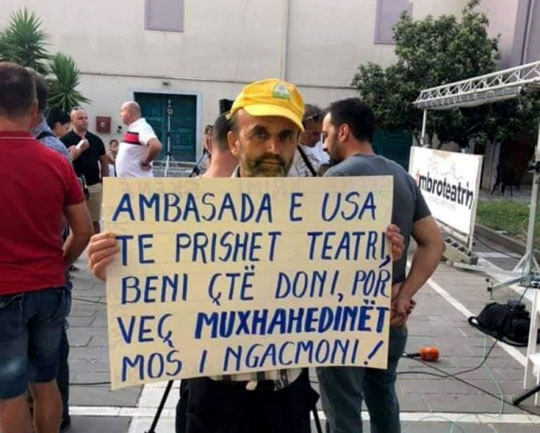
USA Embassy! Destroy the theater. Do anything you want.
Only the Mojaheedens should not be harassed!

The following is the full transcript of the interview:

BP: Dear Dr. Olsi Jazexhi. On June 30, 2019 Albania had municipal elections. These elections were boycotted by the opposition and the president. The ruling Socialist Party of Albania ran alone in this elections and Albania is looking more like North Korea rather than a European Democracy. What is going on with Albania?

OJ: Hello readers of Balkanpost.

The political situation of Albania has become very frightening in the last years. The Socialist Party of Albania which is headed by Prime Minister Edi Rama, a close friend of Tony Blair, Nicolas Sarkozy and George Soros is turning Albania into a one-party state like in the days of Enver Hoxha. Edi Rama, whose family belonged to communist nomenklatura has reinvented himself as a new autocrat of Albania. For this he has the backing of the Trump administration and top U.S. officials who do not care what goes on in Albania as long as the Rama government hosts the Mojahedin-e Khalq (MEK) and other extremist organizations in the country.

However, while during the era of communism, Albania was a social welfare and an independent state, nowadays the Socialist Party of Albania which Edi Rama leads is turning Albania into a frightening authoritarian state. Since his coming to power in 2013 the Rama government has destroyed many social welfare institutions of the country, the healthcare, universities, schools and other state institution. He has cut social support for the needy and has forced thousands of Albanians to pay for their healthcare like never before. He is mass-privatizing and selling state assets and people are suffering as a result of his attack on basic welfare institutions of the country. The best beaches and lands of Albania are being sold to oligarchs and the government is forcefully stealing private properties of many individuals.

By ending state subsidies for the poor, jailing Albanians who cannot afford to pay their electricity bill, stealing agricultural and touristic lands for the oligarchs, not providing jobs for the workers and mass taxing businesses and farmers many Albanians have been forced to leave the country and find jobs elsewhere. Many others have ended up as drug dealers – since this is the only way how the poor can feed their families in impoverished Albania. The Albanian government and its American backers do not care for the welfare of the Albanians and the economic situation is becoming similar to that of many nations in South America.

On the other hand, major drug and criminal gangs have sided with Rama’s government which has helped them to privatize and steal major state assets for their businesses. The municipality of Tirana is the most important state institution which is accused in the media of siding with these criminal gangs. The municipality is headed by Erion Veliaj, an ex-evangelical preacher whose rise to power came thanks to the support of the U.S. Department of State and Soros Foundation. Erion Veliaj is destroying the green spaces of Tirana by building unending towers in every park and garden that he finds. Many businessmen complain about the high level of bribe that his men take from the constructors for granting them building permits. However the justice system which is controlled by the Americans and the Socialist Party does nothing against the mass corruption and electoral fraud that the Socialists do in the country.

BP: What is the ideology of Edi Rama’s government? He claims to be a Socialist but he is siding with the Capitalist mafia. On the other hand Albania is a Muslim majority country. Do Muslims have anything to say in what is going on in the country?

OJ: Even though Edi Rama’s family comes from a Christian Orthodox background, Rama has converted himself into a Catholic. Many of his government ministers, advisers and other apparatchiks are either fundamentalist Catholics or Evangelical Christians. Muslims who are the majority have no power. They are discriminated by the Rama government and the Americans who closely monitor the Muslim community and its mosques in the country. The Muslim Community of Albania which is the ‘Church of Islam’ in the country is under the Fethullah Gulen Network’s control and their American supervisors.

Political power in Albania is at the hand of criminal and fundamentalist groups. The ideology of Edi Rama’s government can be described as American style capitalism mixed with evangelical ideology. The mayor of Tirana, Erion Velija and the head of Tirana’s municipality council Tony Gogu are both protestant preachers – like you have Mike Pence in the United States. They worship Israel and American imperialism.

Rama’s government is accused by many Albanian and international media of grave corruption and racketeering scandals. Major European media like the Bild newspaper in Germany have published many wiretappings from Albanian prosecutors’ office which show how Edi Rama’s Socialist Party steals and blackmails the Albanians to win the elections. However, the Americans who have taken control of Albania’s judicial system do not ‘encourage’ Albanian prosecutors to turn Albania into a normal functioning democracy and establish a real democratic system in the country.

They like Albania to stay as it is. A corrupt mafia-like state ruled by an autocratic ruler who is an obedient ally of the United States. Albania is turning into a second Porto Rico or Haiti.

BP: In recent years, Albania has become a European hub for the promotion of MEK propaganda. What’s your take on this? How do you see the relations between the MEK and European countries? And why did Albania choose to become a country that hosts such a terrorist organization?

OJ: As I have stated before, Albania is a country which according to our president Ilir Meta is run by major criminal organizations and foreign embassies. Our municipal elections of 30 June 2019 which were boycotted by the opposition and declared non-valid by the president – but were forcefully organized by the socialists, have shown to all the Albanians that democracy and rule of law has died in Albania. Prime Minister Edi Rama has become like the dictator of Tunisia, Ben Ali. The Americans and the British who cry for democracy and human rights for Hong Kong, Russia, China, Syria, Turkey and Iran, and who export democracy via B-2 Bombers to Iraq, Afghanistan and Libya do not complain about the mono-party elections of Albania in 2019, the mass-arrest of Albanian politicians, protestors and journalists by the Rama government. If what is happening in Albania were to happen in Turkey, Russia or Iran, the BBC, CNN and other western medias would have protested endlessly and have asked for foreign intervention to bring democracy in those countries.

The Americans do not care for democracy in Albania. The only interest that they have with Albania is to use it for any illegal activity that the United States does in Europe and in the Middle East. The MEK which contrary to Albanian and European laws runs a paramilitary camp in Albania is totally protected by the Albanian government and its ministers like Pandeli Majko. The MEK has created a state within a state in Albania like Osama bin Laden and al-Qaeda created in Afghanistan in the era of Mullah Omar. Albanian police, courts, prosecutors etc. have no power over the MEK. If any state body will ever dare to challenge what the MEK is doing – they will face the wrath of the Americans. By hosting the MEK and supporting its illegal activities the Americans have turned Albania into a kind of a European Guantanamo Bay.

The European Union and many European neighbors of Albania – the Italians, the Greeks, the French and the Germans who are not happy with what is going on with the MEK – do not dare to speak about it. As we have seen with the Iranian nuclear deal, Europe is no longer independent. Many European states do not enjoy freedom and independence in their foreign relations like France enjoyed during the era of Charles de Gaulle, or those that Russia, China and Iran enjoy nowadays.

BP: The Trump administration officials openly support the MEK as a “democratic alternative” to the current Iranian political system. Why is the White House supporting a group that does not have a social base among Iranians?

OJ: The Trump administration is supporting the MEK because they hate the democratic and independent system of Iran. They hate Iran because Iran supports Palestine and does not abandon the Palestinians, and because it has not allowed itself to become a dictatorial regime like Saudi Arabia or the United Arab Emirates.

While the MEK is a ruthless totalitarian cult, which keeps as slaves thousands of its soldiers and its democratic credentials are similar to those of Khmer Rougue in Cambodia, the Americans portray it as the “democratic alternative” to Iran’s democratically elected government. If you ask in private any Albanian politicians – including those who attend the MEK meetings with Maryam Rajavi – as to how much democratic MEK is, they will laugh. The most enthusiastic supporters of the MEK will tell you in private “we know that they are terrorists. But America has told us to support them and we do it.”

Those who consider the MEK a “democratic alternative” to Iran’s democratically elected government should also proclaim Abu Bakr al-Baghdadi and Muhamed bin Salman of Saudi Arabia as champions of democracy in the world.

BP: Backed by U.S. warmongers, Israelis and Saudis, the MEK’s aim is regime change in Iran. What’s your analysis on the role of these countries against the Islamic Republic, especially through their support for the MEK?

OJ: Well, from what we have seen in Albania, the MEK is a puppet terrorist organization which has no power to challenge the military might of Iran. The MEK is a paper tiger which is waved by the Americans and the Israelis to harass the Iranian society. Its 4000+ terrorist members that Albania hosts are not a serious challenge for the Islamic Republic of Iran in military terms. The jihadis of the MEK are mostly old, broken and abandoned by their families. They reside in Manza Camp which is a prison like paramilitary camp where most MEK soldiers are not allowed to go out, marry and live a free life. Many MEK soldiers suffer from cancer and other diseases. They live in fear for the crimes they have committed in the past. If they go out of Albania they have no place to hide. Turkey, Russia, China, Iraq, Lebanon, Iran etc. all consider them to be terrorists and they will end up in jail. The Americans do not give them asylum in the United States. For this reason they are “condemned” to live with Maryam Rajavi and the cult – because this is the only way they can feed themselves and find protection. The Americans, the British, the Israelis etc. will not take them into their countries. They are stateless desperate terrorist like the DAESH terrorists who hide in the deserts of Syria. The only difference between the MEK and DAESH is that the MEK are “our good terrorists” while DAESH are “not useful terrorists” anymore.

The Iranians, even those who do not like the present government, hate the MEK and will never humiliate themselves to associate with a lunatic cult like the MEK. The U.S. claim that the MEK represents a democratic alternative to the present Iranian government is a ludicrous claim, which only a lunatic who might see Ku Klus Klan (KKK) as the democratic alternative to the present U.S. government might believe. The MEK’s paid supporters like Rudy Giuliani, John Bolton, etc. do not even themselves believe in this idiocy. However, they need to prop up the myth of the MEK as a viable militant opposition against the government of Iran for their geopolitical reasons. The Americans have offered to Iran to hand the MEK back to Iran, if Iran would agree not to support Palestine. But Iranians have refused and for this reason they are stuck in Albania.

Through the scarecrow of the MEK, the Americans and their supporters milk the Saudis and Emiratis and convince the Wahhabi despots of the Middle East to continue to side with them and Israel against Iran and Palestine. If the MEK did not exits, the Americans and Israelis would have to invent one, like they did with DAESH and al-Nusra in Syria.

The only danger that the MEK currently represents for Iran is its espionage, propaganda and fake news against Iran. The MEK can also carry limited terrorist actions against Iran.

However Iran, Russia, China and the Europeans have so far shown that they do not take the MEK seriously.

BP: How is the response of the Albanian public towards MEK?

OJ: Well, our media in Albania do not dare to speak much about the MEK. In the past years the MEK has attacked many foreign and Albanian journalists and media by accusing them as “agents of Iran” when they exposed the slave-like conditions of their members. The MEK has complained to the Americans against these journalists and media and they have achieved some kind of success in destroying the freedom of the press in the country. In 2019, the Albanian media has censored much of its news about them – and have instead adapted the American jargon – by describing them as “the democratic opposition” of Iran. In 2018 our media investigated their abuses of their members, but now they do not do that anymore.

In private every Albanian hates the MEK and every journalist knows who they are. Even Sokol Balla a pro-MEK apologetic journalist whose TV has supported the illegal activities of the MEK and refuses to make an open debate about the MEK – because he does not want to upset the Americans, have asked “how the MEK members can live in isolation like they do” and abandon a civilian way of life. If you go on Facebook and many social forums you will see the outrage that the Albanians have with the MEK’s presence in Albania. They ask for their deportation. Even those whom the MEK pays or those who attend their meetings – in private accept that they are lunatics and dangerous but they do not dare to say that in public.

In the recent days when many artists and intellectuals are protesting in Tirana against the Edi Rama government – who is destroying the Italian built national theater of Tirana – some protestors who are upset with the American support for the autocratic regime of Edi Rama are using irony to protest the sad reality of their country. The Trump administration that describes the MEK as “the democratic alternative to the current Iranian political system” is helping Albania to slide toward authoritarianism.

A few days ago, one protestor against the Edi Rama government and the mayor of Tirana made an ironic poster towards the U.S. Embassy in Albania. In the poster he is telling to the Americans:

USA Embassy! Destroy the theater. Do anything you want.

Only the Mojaheedens should not be harassed!

This picture which talks more than 1000 words shows the desperate situation and the negative impact towards democracy that the MEK’s presence is creating in Albania. The Americans are supporting the Edi Rama government which is turning Albania into a one-party system. They are supporting the authoritarian policies and erosion of democracy because their major interest with Albania at present is the preservation of the MEK. They are supporting the destruction of the environment and the cultural heritage by the mayor of Tirana. The only thing that they are asking from the Albanian government is: Protect the MEK and do anything against your people and democracy.

The European Union, the Organization for Security and Cooperation in Europe, the Council of Europe etc. who must intervene and speak against the authoritarian regime of Edi Rama – like the cry wolf they do against Turkey and Iran – are keeping mum. The civil society of Albania feels abandoned. They are witnessing the destruction of the environment and democracy, while the Americans are using their country as a MEK terrorist base “to bring democracy” to Iran.

Many Albanians would like to ask the Americans: why do you want to export democracy in Iran, when you are supporting an authoritarian regime in our country? However, many Albanians have now understood that the democratic system that the Americans would like to install in Iran will look like the regime of Edi Rama or the cult of Maryam Rajavi. A “democracy” like the democracy of the time of Shah Mohammad Reza Pahlavi when the U.S. Embassy was determining the fate of the Iranian nation.
balkanspost.com

August 11, 2019 0 comments
FacebookTwitterPinterestWhatsappTelegramSkypeEmail
blank
Former members of the MEK

My Memories with Mujahidin Khalq Organisation

Bakhshali Alizadeh : FROM CAPTIVITY TO BITTER DAY

According to the Iranian Oral History website, the 304th ‘Night of Memorials of Holy Defense’ event was held on Thursday, July 25, 2019 at the Sureh Hall of the Hozeh Honari. In this meeting, Bakhshali Alizadeh, Ibrahim Khodabandeh and Mohammad Mosaheb, related some of their memories of Mujahidin Khalq Organization and Mersad Operation. Bakhshali Alizadeh was the first narrator. ‘I was captured by the Ba’athist forces in the Musian zone at the front of the Iraq war against Iran in the March of 1986.’ he said, ‘For about three and a half years, I was in Ramadi Camp No. 10, an Iranian prison camp in Iraq. That camp consisted of four divisions, and I was in the third one. I was seriously ill and had many injuries, but there was no enough treatment. I saw that I am at the end stage of my lifetime, so I decided to spend the rest of my captivity in the Mujahidin or Rajavi sect. They came to the camp and propagate widely. They wanted to recruit. I had weighed my condition and said myself that I will be with them for a maximum of two years and then return to Iran when the prisoners were swapped.

Iraq was the headquarters of the organization. I was able to reach there and to join them. They were strong in terms of social relationships; they quickly discovered the weaknesses and strengths of individuals and used them. To what extent are people involved in the organization sensitive and what are their religious beliefs? To what extent are their political, social, and economic beliefs; they took all these into account and came up with the same “brainwashing” term. The organization had religious foundations. They used their beliefs, if some members had strong religious beliefs; from the early days of Islam to the time of Imam Zaman and afterwards. On the other hand, about those who claimed to be laic and had little to do with religious matters, social class issues and individual and social freedoms were discussed. I was neither religious nor laic, but was very sensitive to things in society, such as class distinction and the rich and poor. I could not accept that some people lived at ease and comfort and some people in poverty and misery. They quickly recognized this and began working on it. They said that the cause of these misery is the Islamic Republic! They could not fulfill their promises had given at the beginning of the revolution, so they must be eliminated!

I was one of those who had gone to defend my country, but after a while I realized that I had become one of the elements working against my country. The time I had gone, was coincided with Mersad Operation, which was called ‘Forough Javidan’ in the organization. The organization had broken after this operation. There were many casualties of nearly 1500 people. For an organization with about four thousand member at that time, a number of 1500 people was not few. On the other hand, there were many injured who had filled Iraqi hospitals. Few were able to survive, who were the forces behind the front line. At that time, Maryam Rajavi did not still shoulder heavy burden. The main task was done by Massoud Rajavi. The subject of all his speeches was to consolidate this despairing and depressing atmosphere in the organization. It was not a small blow. They aimed to attack to occupy Tehran. Rajavi’s headquarters had been prepared in Tehran. They had come up with this idea and had failed to fulfill it. It was a mental, physical, ideological, and a political blow. All of these blows hit the whole body of the organization. Massoud Rajavi wished to manage the organization and as an alternative to the Islamic Republic, to be able to reinforce its forces and to embark on against the regime. What was evident at all the meetings was that they brought in some commanders to know what the main cause of the defeat was. The result was that the main cause was the forces themselves. Four to five thousand people has come to fight against a country with at least one million troops. They did not considered the opposing forces, and blamed the forces of the organization and said that you were the cause we could not reach to Tehran. Based on some information, they asked why they couldn’t cross the Chaharzebar Strait. On the route to Kermanshah, there was a road in the center of a strategic region which was called Chaharzebar Strait. The forces of the organization could not passed it. The forces of the Islamic Republic were on the other side of Strait and Rajavi’s forces were on this side. They stopped there and Iranian fighters and airmen fired heavily. Therefore, as all the Rajavi’s forces had gathered on the road, were defeated and quickly withdrew.

When I joined the organization, witnessed that they had no such spirit they showed on television. They had a television program called ‘the face of resistance’, which aired on channel one of Iraqi television for about two hours daily, around 19:00 to 21:00 pm. It was advertising, several scenes of Mujahid men’s and women’s fighting. I joined them and saw none of them. Everyone was blue and sadness was evident on their faces. Because I didn’t know much about the condition, it took me a while to realize that this atmosphere was due to the heavy military blow that the Islamic Republic had inflicted on the organization. After that, the story of Kuwait, the ceasefire, and then the exchange of captives. So, I decided to stay in the organization. I saw that their slogans were consistent with some of my beliefs. In fact, the utopia that existed in my mind was reflected in their aspirations. Therefore, I decided to stay with them when prisoners were exchanged.

You could not understand how Mujahedin organization acts, if you did not have relationship with them. Some people asked me how I could stand in the organization for 30 years. The same motivations and beliefs. We thought that we were fighting for the people of Iran and for God’s sake. We did not know that the leader of the organization was abusing the forces. What Massoud Rajavi was looking for was gaining power and ruling, and this was very prominent in his speeches. He claimed that the sovereignty of Iran was stolen during the revolution. From who it was stolen? He meant it was stolen from him! He said that he should have become president, he should have been leader! This is very evident in his speeches. Now that it is also evident in his messages.

Iraq invaded and captured Kuwait. We had to move from Ashraf Camp to the mountains and camouflage there to escape the bombardment of coalition fighters. Until the Morvareed Operation began. We called it ‘Morvareed’ and I don’t know what it was called in Iran. Rajavi decided to send a group of troops to the Iranian border during that confusion had been occurred in Iraq. I was among those forces who were sent to Khanaqin. Some clashes happened which were settled down. It took about a week and then we returned to Ashraf Camp, where was in commotion. It was a war and there was no quiet day. Now, in the anniversary of Mersad Operation, and as someone who has been there for many years and witnessed those days, I say that those fatal blows of the Islamic Republic on the body of the Mujahedin Organization are still seen. They started then to spread a story called ‘the ideological revolution’. They said you stayed behind the Chaharzebar Strait because your thoughts turned to your wife and children; a man whose thought will turned to his wife and children could not sacrifice himself and commit suiciding! You must divorce your wife and abandon your children! After a while, the member’s children were sent to European countries in various ways to be kept in families that were sympathizer of the organization. Anyone who did not divorce his wife, were expelled. Since the forces were mainly ideological ones, many tendencies began to emerge in the early 1981. Several wings were shaped. The sympathizers joined the organization mostly because of Rajavi’s personality. What he showed outside was different from what it was in his inside. Apparently we saw a sacrificing leader who has spent all his life for the liberation and freedom of the Iranian people. We have realized over time, when looking at the leadership of the cults, that their appearance differs from their terrible animal inward. We had been deceived by his look and it took a long time to find out. Since 2003 when the US invaded and Saddam Hussein fell and Rajavi hid away, it crossed to minds of many of us that if you are a leader, if you are a martyr, if you are following Imam Hussein’s way, if Imam Zaman’s goals are your goals too and you want to make Iran a monotheistic society without any class, where have you hidden now?! Come out! We were under Iraqi’s fire every day, we had lots of casualties every day; if martyring is good then appear and die a martyr; and if you are not, another person undertake the leadership of the organization instead of you. From then on, many forces became contradictory. If you look, you can see that decreasing in forces has been much greater since 2003. Many members fled, many declared separation. The story continues the same way. The war is still going on. That front and this front each has their own activities. But, legitimacy is with the one that dominates the nation and if it were not legitimate, could not rule for forty years.

I returned to Iran after 33 or 34 years. What I saw was unbelievable. I had gone in the early 1981s. The Iran I saw didn’t match the Iran which was shown by the organization. The first time I came to the streets of Tehran, was surprised to see the highways, tunnels and buildings. What is propagandized in the organization is completely different. In the organization it was always propagandized that the atmosphere in Iran is that the nation is dying of starvation and the corpses have fallen in the streets! After abandoning the organization, I moved to European countries for about three years and then returned to Iran from Germany. When we were in the organization, thought that all people around the world lived in the paradise but Iranian nation. I went to Europe and saw that they also dealt with unemployment, poverty and corruption. I saw the contradiction with my own eyes. What they said us in the organization, and now that we left it, how we see them? When I came to Iran, the story was completely different. Everything had changed. My family was in much passion. More than three decades had passed and unfortunately many people had passed away. Children had grown up and gotten married. Life went on completely; but we brainwashed into a completely false environment and deceived ourselves. They held ideological meetings. At these meetings, participants were impressed. They spoke of ‘hero masses’, but there was no ‘hero masses’. You look and see, those who have left the organization are of the same ‘hero masses’. They have sacrificed for years for the organization’s leader, but all of them are now living in the worst situation in Albania. They have sacrificed themselves for him many years, and now the humanity requires that at least he financially supported them. People have been abandoned in a stage society without identity, without knowing the language of others. They don’t have even ID cards. The Albanian government has given them a paper with the holder’s photo in order not to be arrested by the police. These papers are renewed monthly or every two or three months. The organization not only takes the responsibility for them, but if they speak, will be labeled as intelligence agents. How does such an organization want to take responsibility for an eighty million community?! I understand this contradiction, as someone who has seen both sides. I say to myself that if he takes responsibility for Iran, will not only be able to control the situation, but also makes it worse. There is a lot of propaganda against the Islamic Republic there, and as someone who sees the scene, I have to see the reality. I say without exaggeration that whatever exist there, is lie and bluffs.’

Seyed Davood Salehi, the host of ‘Night of Memorials of Holy Defense’, said: tell us a memory from Ashraf Camp.’ Alizadeh said: ‘the most important memory I have is about the time when families came to visit their children. In 2003, some families could travel Iraq to see their children. A few years later, the connection was cut. In 2009, when the families came, the organization closed the doors, claiming that they were not families, but were intelligence agents. We were not allowed to visit our families. My father had also come. Influenced by the organization’s advertising, though I loved to see him, but unfortunately I didn’t go. I still haven’t forgiven myself for doing that. My father was 70 years old at the time. He had come with that difficulty and on that age to see me. I did not forget that story and later became ashamed of it. I kissed his hands and feet and asked him to forgive me. But that day is one of those days that I remember with bitterness.’

Iranian Oral History, Maryam Rajabi, Translated by: Zahra Hosseinian

August 11, 2019 0 comments
FacebookTwitterPinterestWhatsappTelegramSkypeEmail
Maryam Rajavi
Mujahedin Khalq; A proxy force

Once Terrorists. Now so called Alternative!

The White House Once Labeled Them Terrorists. Now It Calls Them Iran’s Next Government

With high-profile supporters like John Bolton and Rudy Giuliani, the Mujahedeen Khalq — or MEK — is being touted as a viable alternative to the ayatollahs. But many question these Iranian dissidents’ intentions for their homeland

As tensions between the United States and Iran continue to escalate, many in President Donald Trump’s inner circle have called for swift regime change in Tehran — pledging support for a dissident Iranian opposition group currently headquartered in, of all places, rural Albania.

Despite its checkered history and only recent delisting as a terrorist organization, Mujahedeen Khalq — known as MEK — has garnered glowing endorsements from international policymakers who have described the group as a viable and democratic alternative to the “ayatollah regime.”

The MEK is not the only source of Iranian opposition to the Islamic Republic, of course. In recent years, Reza Pahlavi — the exiled crown prince of Iran’s final monarch — has also emerged as a leading secular and democratic opponent to the regime in Tehran. Pahlavi has called for nonviolent resistance and, in February 2019, launched an initiative called the Phoenix Project of Iran. According to the National Interest, this is “designed to bring the various strains of the opposition closer to a common vision for a post-clerical Iran.”
However, Pahlavi enjoys nowhere near as much U.S. support as the MEK. Ilan Berman, senior vice president of the American Foreign Policy Council in Washington, argues that this could be because while there are many opposition elements critical of the regime, the MEK is the only one to view itself as a viable alternative.
Last month, as the United States and Iran seemed to be edging closer to a full-on conflict, the MEK hosted a five-day conference at its Albanian base, which is known as Ashraf 3.

blank

A Mujahedeen Khalq honor guard standing guard during a welcoming ceremony for people taking part in the”120 Years of Struggle for Freedom Iran”conference at the Ashraf 3 camp, Albania, July 12, 2019AFP

Trump’s personal lawyer, Rudy Giuliani, was the keynote speaker and was joined by other high-ranking luminaries, including former Democratic Sen. Joe Lieberman, Canada’s former Prime Minister Stephen Harper and British Conservative lawmaker Matthew Offord.

blank

Giuliani’s Cuckoo Praise for the MEK

In a rousing speech, Giuliani lauded the MEK as a “government in exile” and a “group that we can support. It’s a group we should stop maligning and it’s a group that should make us comfortable having regime change.”
But Giuliani is not the only member of Trump’s coterie to be paid to speak at pro-MEK events: In June 2017, John Bolton headlined an MEK rally in Paris, shortly before joining Trump’s administration as national security adviser. (MEK expert and investigative journalist Joanne Stocker estimates that both men have been paid tens of thousands of dollars for their efforts.)
“I have said for over 10 years since coming to these events that the declared policy of the United States of America should be the overthrow of the mullahs’ regime in Iran,” Bolton told a rapturous crowd in 2017, adding that they would all be celebrating the collapse of the government before the end of the decade.

blank

What are the schemes that made Rudy Giuliani millionaire , personal attorney of Donald Trump

And since joining the Trump administration in April 2018, Bolton’s hawkish attitude toward the Iranian government hasn’t wavered. When Trump authorized, then canceled, a military strike on Iran in mid-June following the shooting down of a $130 million U.S. drone over the Persian Gulf, The New York Times reported that Bolton was one of the most vocal proponents of military action.

Deep pockets
The MEK’s deep pockets have long been a source of intrigue in Washington. In addition to Bolton and Giuliani, other prominent politicians paid to speak in favor of the MEK at rallies and conferences include former House Speaker Newt Gingrich and several former heads of the CIA and FBI.
Active U.S. politicians, barred from accepting money directly from foreign entities while in office, have nevertheless allegedly received generous campaign donations. Joanne Stocker, an editor at media outlet The Defense Post who has been investigating the MEK for a decade, tells Haaretz that Rep. Brad Sherman (Democrat of California) received at least $5,200 in campaign donations between 2004 and 2013, and that Rep. Judy Chu (Democrat of California), who was a vocal proponent of the MEK’s delisting as a terrorist entity in 2012, pocketed at least $27,500 between 2010 and 2013 in campaign contributions.
Stocker tells Haaretz that pro-MEK groups like the Organization of Iranian American Communities have played a crucial role in securing broad, bipartisan support in the United States for the opposition group by successfully portraying the group as a democratic, human rights-supporting alternative to the current regime. Stocker, whose findings are based on extensive interviews, public records and court filings, believes the money the MEK uses to pay its international supporters is coming from the Saudi government, which may see the dissident group as a strategic and ideological ally with a similarly antagonistic view toward the Tehran government.
This may be highlighted by the fact that Saudi officials and advocates regularly address MEK rallies. For instance, Saudi Prince Turki al-Faisal, who is also a diplomat and politician, addressed several pro-MEK rallies in France in 2016 and 2017. More recently, Salman al-Ansari, the founder and president of D.C.-based, pro-Saudi lobbying group SAPRAC, spoke at last month’s MEK conference in Albania, declaring his commitment to the Iranian opposition in both Arabic and Farsi.
“I’m proud to be here with you and to fight against [Ayatollah Ali] Khamenei,” Ansari said. “At the end of the day, the ruling mullahs in Iran will be overthrown.”

Evergreen support
The MEK has been able to sustain remarkably broad support from both Democrats and Republicans over the years — something I have spent the past six months probing. My investigation centered on the OIAC, an MEK-linked, all-volunteer advocacy group based in Washington that has allied with administration officials and congressional leaders of all political stripes in clamoring for regime change in Iran.
Former Democratic Congressman Lee Hamilton, who was vice chairman of the 9/11 Commission and once publicly condemned the MEK in Congress, is now a firm supporter. Democratic Sen. Chuck Schumer and House Speaker Pelosi have also made cameo appearances at the OIAC’s annual Nowruz (New Year) celebrations on Capitol Hill, reaffirming their party’s support for the organization’s agenda of securing a secular, democratic and nonnuclear Iran.
Dr. Majid Sadeghpour, who lives in Falls Church, Virginia, has been OIAC’s political director since 2012. He tells me that his heart remains in the Iran he grew up in under the shah, but that he now despises the Islamic regime that recently celebrated its 40th birthday. “America’s vibrant institutions embody democracy,” he says, “which, unlike Iran’s ayatollahs, strive for human rights and liberty for all.”
By day, the 63-year-old Sadeghpour — thin as a rail, clean-shaven, bespectacled and with gray hair — administers medicines and health supplements behind the counter at his local pharmacy. Away from his day job, he is preparing for a revolution. For a new Iran.
For him, the future of Iran is in the tiny town of Manëz, western Albania, where the MEK is drawing up plans for the day the ayatollahs no longer rule Iran.
According to Sadeghpour, thousands of Iranian Americans living in more than 40 U.S. states, from Hawaii to Connecticut, share this vision. And, as Bolton and Giuliani have shown, so do some prominent American statesmen.

The hypocrites
The MEK’s origins can be traced back to the mid-1960s when a group of leftist, Marxist and Islamist graduate students from Tehran University joined together to oppose the rule of Shah Mohammad Reza Pahlavi. Headed by a charismatic revolutionary named Massoud Rajavi, the group briefly joined forces with the Islamists who would eventually oust the shah and bring Ayatollah Ruhollah Khomeini to power in the 1979 Islamic Revolution.
However, the MEK’s alliance with [Ayatollah]Khomeini was short-lived. When MEK members, including Rajavi, were banned from running for office in the new theocracy, the group resorted to violence — including a bombing attack on [ayatollah]Khomeini’s party headquarters in Tehran that killed more than 70 leading Islamist officials.
Some of the MEK’s leadership then fled to Europe, but most of the group’s rank and file crossed the border into Iraq in 1986, midway through the Iran-Iraq War. Iraq’s then-president, Saddam Hussein, who had recently invaded Iran to claim territorial sovereignty over strategic areas of the Euphrates River, offered them protection, funding, equipment and military training. The MEK pledged loyalty to Saddam in return, and its members were sent on martyrdom missions to capture strategic Iranian territory.
One such mission — known as Operation Eternal Light — was botched in July 1988, resulting in Iran’s Revolutionary Guard detaining and executing more than 2,000 MEK members. Today, many Iranians still refer to the MEK as monafeghan, or hypocrites, for fighting alongside Saddam and taking up arms against fellow Iranians.
In 1997, the Clinton administration designated the MEK a foreign terrorist organization for its violent activities, including a wave of attacks on Iranian embassies worldwide in the early ’90s and the assassination of U.S. colonels and officers who had been stationed in Iran in the ’70s. Canada and the European Union followed suit in the early 2000s.
In 2003, when the United States invaded Iraq, Massoud Rajavi vanished, leading most analysts to assume he had been killed. The MEK never confirmed his death but his wife, Maryam Rajavi, has since assumed leadership of the movement.

Saddam’s overthrow in 2003 spelled the end of the MEK’s welcome in Iraq; the group could no longer rely on Iraqi protection and funding. Later that year, the Iraqi Governing Council passed a resolution that called for the total expulsion of all elements of the MEK from the country.
The U.S. military disarmed and rounded up more than 3,500 MEK fighters into the group’s then-base, Camp Ashraf, to protect members from attacks by Iraqi security forces and Iran’s Revolutionary Guard, while exploring resettlement options for the group outside of Iraq.
A decade later, in September 2012, the Americans delisted the group as a foreign terrorist organization, allowing the Obama administration to more easily negotiate the MEK’s resettlement to Albania a year later.
Overwhelming pressure had come from an elite group of former CIA and FBI directors, including Porter Goss and James Woolsey, and Gen. James Jones (President Barack Obama’s first national security adviser), while even renowned journalists like Carl Bernstein argued that the MEK had positively refashioned itself, and that its terrorist designation might be interpreted as an invitation for Iraqi and Iranian agents to attack MEK members who had not committed acts of violence for decades.
“The United States has a duty to 3,500 people whose fate they simply left behind with the departure of the American military forces” from Iraq, said Bernstein in a 2012 speech at a pro-MEK symposium in Manhattan’s Waldorf Astoria. Bernstein later disclosed to Pro Publica that he was paid $12,000 for his appearance, but was not there “as an advocate” but as someone “who believes in basic human rights and their inalienable status.”
Since the MEK’s move to Albania,

Iranian historian Ervand Abrahamian tells Haaretz in a telephone interview, the group has focused less on combat training and more on bolstering its public image on social media, and also carrying out cyberattacks on critics and defectors.

An investigation by The Intercept in June found that “Heshmat Alavi” — a supposed anti-regime Iranian activist who had written for Forbes, The Hill and other outlets — was in fact a persona invented by the MEK, resurfacing concerns over the group’s antidemocratic and anti-liberal tendencies. The group’s sophisticated cyber operations and social media presence have also provoked discussions over the true extent and breadth of the MEK’s support, both abroad and in Iran.
The controversies didn’t end there. The reaction by Albanians to having the MEK in their midst did not seem favorable after an Albanian police “threat assessment” from early 2018 — obtained by Britain’s Channel 4 later that year — concluded that MEK members had been “deeply indoctrinated, been part of military structures and had participated in acts of war and terror.”
The MEK’s move from Iraq to Albania in 2013 also led to a rapid increase in defections, with former members going public about the realities of life under the MEK in Iraq and Albania.
A former MEK intelligence officer, Massoud Khodabandeh, tells Haaretz in an email interview that the group was no longer the highly organized and influential student-led movement of the ’70s that opposed the shah. By the ’80s, Khodabandeh says, the MEK had evolved almost unrecognizably into a violent, anti-ayatollah and pro-Saddam guerrilla organization that had no clear objectives other than pledging unwavering loyalty to the Rajavis.

Another defector, Masoud Banisadr, spoke about gender segregation and how families were torn apart at MEK camps. Children were forcibly separated from their parents, celibacy was enforced and love was criminalized, he alleged — unless that love was directed toward the Rajavis. Members had to divorce their spouses because “we were ordered to surrender our soul, heart and mind to [Massoud] Rajavi,” Banisadr told Vice News in 2014. “The idea was that we were in a war to take back Iran, so you cannot have a family until the war is won,” he said. In 1990, as couples under MEK control in Iraq were forced to divorce, wedding rings were allegedly replaced with pendant necklaces adorned with Massoud Rajavi’s face. Operatives were also required to attend weekly “cleansing” sessions where they would confess their sexual thoughts.
The MEK did not respond to multiple requests for comment sent to its European-based affiliate, the National Council of Resistance of Iran.

Ideological alignment
I first met Majid Sadeghpour last September, at the Sheraton Hotel near New York’s Times Square. We were there for the OIAC’s flagship “Iran Uprising” summit. Security was extra tight that day, Sadeghpour later told me, not only because 25 Iranians had been killed at a military parade in southwest Iran earlier that morning, but because the OIAC believes regime spies have infiltrated past summits, monitoring the activities of Stateside dissidents. In July 2018, Reuters reported that an Iranian diplomat was arrested on suspicion of plotting a bomb attack on a “Free Iran” rally attended by OIAC members in Paris.
The only difference Sadeghpour sees between Iran’s pro-government agents and groups like ISIS is that “in Iran, they’re hiding behind a diplomatic veil.”
More than 1,500 Iranian-American delegates attended the New York summit, cheering on Giuliani (who made an in-person appearance) and a tribute video that marked the passing of Sen. John McCain.
Many Iranian Americans — even those with family still in Iran who were impacted by Trump’s January 2017 travel ban on several Muslim-majority countries — told me they never felt ideologically closer to the White House. “Both Iranians and the U.S. administration see that a prosperous future is one where the current regime in Iran is no longer in power,” says Ideen Saiedian, 25, a slim, blond-haired account executive at Oracle and self-described human rights advocate for the OIAC.

Another delegate, Navid Tavana, also in his mid-twenties, was similarly enthusiastic about this newfound partnership between Iranians and U.S. officials. “I can’t recall ever seeing executives who are working so closely with the president and being so vocal about their support for a change in the Iranian regime,” Tavana says.
But the biggest star of the summit was neither a Republican nor Democrat — nor even, for that matter, an American. It was the MEK’s exiled leader, Maryam Rajavi, who spoke to the delegates via satellite from Albania.
When she appeared on the large screen, the room fell silent. Most of the delegates stood up in deference, their heads looking upward at the screen. “You have organized a gathering that glows with unyielding resolve to secure a free Iran,” Rajavi told the delegates in Farsi.
For them, 65-year-old Rajavi is not just the leader of the most organized resistance group against the Tehran regime; she is president-elect of a post-theocratic Iran. When hawkish U.S. politicians talk about the future of Iran and a post-ayatollahs government, many are talking about her.

blank

MEK leader Maryam Rajavi speaking at an event in Ashraf 3 camp, which Albania, July 13, 2019. Rudy Giuliani is just behind her. FLORION GOGA/ REUTERS

“Maryam is the only one with a plan to ensure a free and democratic Iran,” Sadeghpour tells me, referring to her 10-point plan that promises a future Iran with free and fair elections, a separation of church and state, no capital punishment and gender equality.
But when Sadeghpour speaks of regime change, he does not favor foreign intervention. “The Europeans and the U.S. should help weaken the aggression of the Iranian military machinery through sanctions and economic pressure,” he says, “but the people of Iran will bring about a new government.”

Jonathan Harounoff ,

August 10, 2019 0 comments
FacebookTwitterPinterestWhatsappTelegramSkypeEmail
Money talks - paid advocacy
Mujahedin Khalq Organization as a terrorist group

MEK-Bolton Money Laundering affairs

Canadian Inspector Reveals Bolton’s Involvement in Money Laundering

A Canadian Police inspector has disclosed the results of investigation into a drug-trafficking case that provide clues about US National Security Advisor John Bolton’s involvement in money laundering and suspicious financial transactions.

Senior Canadian law enforcement agent from the Toronto Police Drug Squad, Donald Belanger, reported that Canada Border Services Agency has on July 20 seized a cargo of imported Pakistani clothes impregnated with a significant amount of opium, owned by Toronto-based company “Luna International”, owned by Ali Vakili, an Iranian residing in Concord, Ontario.

“Police investigations show Luna and its CEO are accused of laundering and transferring dirty money between Canada and some European countries, Turkey, the United Arab Emirates and the United States,” Belanger has said in a thread on his Twitter account.

Vakili, Luna’s CEO, is “also associated with corrupt politicians and some criminal gangs,” the Canadian agent noted.

According to Belanger, there is also evidence that Ali Vakili has in 2016 transferred a sum of $350,000 to the account of Jennifer Sarah Bolton, John Bolton’s daughter, through Habib Bank of Zurich.

The police agent has even attached a copy of a SWIFT invoice that reveals Luna’s links with the Boltons.

“According to other documents we got our hands on, in recent months, large amounts of money whose origin is not known have been deposited into Ali Vakili’s account from outside Canada,” he added.

“Interestingly, over the last three months, he (Vakili) deposited $280,000 into the account of Rudy Giuliani, former New York Mayor and Trump’s current attorney,” Belanger reveals.

“Luna’s tax violations and money laundering for unspecified purposes have caused the company to temporarily suspend its business and report to authorities,” said Belanger, who also assured people that Toronto Police will act decisively in the fight against drug trafficking and money laundering.

Existing documents show that Ali Vakiley deposited $350,000 through The Habib Bank in Zurich in 2016 into the account of Jennifer Sarah Bolton, John Bolton’s daughter. The attached Swift invoice shows Luna’s relationship with Mr. Bolton’s family. pic.twitter.com/6AGuI6ZJ1T

— Donald Belanger (@BelangerPolice) August 5, 2019

Meanwhile, investigations have found evidence that Ali Vakili has close ties with the Mujahedin Khalq Organization (MKO) terrorist group, currently based in Tirana, Albania.

The MKO is listed as a terrorist organization by much of the international community. Its members fled Iran in 1986 for Iraq, where it enjoyed backing of former Iraqi dictator Saddam Hussein.

Out of the nearly 17,000 Iranians killed in terrorist attacks since the victory of the Islamic Revolution, about 12,000 have fallen victim to MKO’s acts of terror.

John Bolton is a fervent supporter of MKO terror group.

August 7, 2019 0 comments
FacebookTwitterPinterestWhatsappTelegramSkypeEmail
blank
Mujahedin Khalq; A proxy force

Desperate attempt to awaken the U.S. war machine

Lie, beat and cheat: John Bolton’s desperate attempt to awaken the U.S. war machine

In June, the U.S. came to the brink of war with Iran. Jets were reportedly scrambled and ready to strike Iranian targets in retaliation for the downing of an American surveillance drone flying near the Strait of Hormuz. Yet, everything was going according to plan as per John Bolton, Trump’s mustachioed National Security Advisor and Washington’s highest-flying hawk at the moment.

No War

Throughout his career spanning over four decades in Washington, Bolton has mastered the art of maneuvering the complex web of federal bureaucracy, one-upping his enemies with quick wits and a fiery temper. As an early subscriber of American conservatism, he worked for Barry Goldwater’s 1964 campaign for president while in middle school. Despite Goldwater’s loss, Bolton’s dedication to the conservative cause became more fervent. Coming from a working-class background, he grew to despise his more sophisticated and liberal-leaning classmates while attending Yale University.
Over the years, his ideology has evolved into what resembles self-styled American absolutism where the U.S. can freely punish those who do not fall in line without any constraint from international agreements. To Bolton, where every problem is a nail that justifies a good pounding from America’s mighty hammer.

Bolton’s step-by-step program to lead the U.S. to war with Iran
“And that’s why before 2019, we here will celebrate in Tehran,”declared a flamboyant John Bolton in 2017 to a cultish group of Iranian exiles known as the Mojahedin-e Khalq (MEK), or”Holy Warriors of the People.”Since becoming the National Security Advisor in April 2018, he has skillfully persuaded the Trump administration to pursue policies aimed at dismantling the two countries’ relationship, carefully leading the U.S. into committing military action against Iran.
One month into the new job, Bolton achieved a major milestone when the administration announced that it was withdrawing from its nuclear agreement with Iran – a signature Obama-era policy that gathered major world powers in ensuring Iran would abandon its nuclear weapons program. At the time, the agreement was widely regarded as a buffer toward conflict between the two countries and establishing peace in the Middle East, which had suffered the terror of Islamic States for years. By giving up its ability to produce nuclear weapons, Iran’s economy would catch a break from U.S. sanctions.
Bolton was so proud about pulling the U.S. out of the equation that he hung a framed copy of Trump’s executive order to nullify the deal in his office, according to The New Yorker.
In the following months, he tightened the choke on Iran by bringing back two rounds of sanctions targeting key sectors of the Iranian economy, such as its oil exports, looking to rouse an increasingly angry public to overthrow the government.
As U.S.-Iran relations rapidly disentangled toward the end of last year, Bolton turned things up a notch. In May, he announced the administration was sending a carrier strike group along with a bomber task force to the Persian Gulf, further goading Iran into making a mistake in a game of chicken. He said the U.S. was not looking for a war with Iran but was “fully prepared to respond to any attack, whether by proxy, the Islamic Revolutionary Guard Corps, or regular Iranian forces.” In a moment that eerily resembles the Gulf of Tonkin incident that triggered the Vietnam War, the world watched as Iran shot down an American drone, which it claimed, had violated its airspace. Yet, the ensuing strike never happened as President Trump decided to abort the mission.
After learning 150 Iranians would be killed for an unmanned drone, Trump did not deem the response “proportionate.” But for Bolton, human lives were the least important concern; it does not matter if Iran turns into another Iraq or Libya so long as he sees the collapse of the current order within the country. Neither does the aftermath of a”regime-change”pose a big concern for Bolton, who looks to back the MEK to lead Iran. Over the years, the self-described”pro-American”has fostered a close relationship with the MEK, which the U.S. designated a Foreign Terrorist Organization partially for assassinating six American citizens during the Iranian Revolution. For the uber-hawk, almost any means is justified for waging war.

Intimidation tactics
“We know where your kids live.”These are the words reportedly uttered by Bolton during a meeting with Jose Bustani, then director-general of watchdog group Organization for the Prohibition of Chemical Weapons (OPWC), according to The Intercept and other sources. Before the Iraq War, OPWC under the direction of Bustani, negotiated with Saddam Hussein to allow its inspectors inside the country to ensure its disposal of chemical weapons. This fell out of favor with the Bush administration which was ready to use Iraq’s possession of chemical weapons as a casus belli. To clear the way for an invasion of Iraq, Bolton issued a 24-hour ultimatum for Bustani to resign during the exchange. After asserting that he was elected by OPWC member states and owed no loyalty to the United States, Bolton threatened the chief’s children in front of other OPWC officials, according to The Intercept.
“We know where your kids live. You have two sons in New York,”he was quoted as saying.
In his memoir,”Surrender Is Not an Option,”Bolton claimed he was ready to offer the chief a”gracious and dignified exit”if he complied with his demand. Otherwise, the U.S. government would have him fired. The next year, Bustani was voted out. This was not only time Bolton employed intimidation tactics.
Former director-general of chemical weapons watchdog OPWC and Brazilian diplomat Jose Bustani in a 2011 picture. /VCG Photo
Last year, he threatened the International Criminal Court (ICC) with sanctions if it proceeded to investigate alleged war crimes committed by American troops. He went as far as to suggest criminally prosecuting ICC officials in the American legal system.
Bolton’s history of bullying was put under the microscope during the Senate confirmation process for his nomination as the U.S. ambassador to the United Nations.
“He’s a quintessential kiss-up, kick-down sort of guy,”said Carl Ford Jr. who worked with Bolton during his time at the State Department, to a group of Senators in 2005.”I’ve never seen anybody quite like Secretary Bolton in terms of the way he abuses his power and authority with little people.”During his testimony, Ford brought up an incident involving Christian Watermann, an in-house intelligence analyst who suggested that Bolton’s claim of Cuba’s biological weapons program had been an overstatement not supported by intelligence. A furious Bolton then reached out to Westermann’s supervisor and tried to get the”munchkin”fired.
Bolton’s voracious appetite for war recently got the attention of Fox News host Tucker Carlson, who went on a seven-minute on-air rampage against him.”In other words, last night has been in the works for years,”said Carlson while referring to the short-of-war moment between the U.S. and Iran in June.”John Bolton is that kind of bureaucratic tapeworm. Try as you might, you can’t expel him. He seems to live forever in the bowels of the Federal agencies, periodically reemerging to cause pain and suffering, but critically, somehow never suffering himself.”

By Zeng Ziyi, CGTN.com

August 6, 2019 0 comments
FacebookTwitterPinterestWhatsappTelegramSkypeEmail
blank
Mujahedin Khalq; A proxy force

MEK: Totalitarian Cult, or Iran’s Brightest Hope for “Democracy”?

Certain Trump administration officials favor the US government supporting the MEK, an Iranian opposition group exiled in Albania. Yet a look at the MEK’s history paints a disturbing picture that should give officials in Washington major concerns about any plans for enhancing US cooperation with the organization.

The People’s Mujahedin of Iran, or Mujahedin-e Khalq (MEK), has a dark history of violence and acts of terrorism against American interests. Established in the 1960s, the Marxist-Islamist group killed members of the Shah’s security apparatus on the streets of Iranian cities. Anti-American to its core, the MEK quickly earned a negative reputation in Washington for killing six US citizens, and for targeting American-owned hotels, airlines, and energy companies in Iran. The lyrics from an MEK song illustrate the vitriol which the organization held for the US during its early years: “Death to America by blood and bonfire on the lips of every Muslim is the cry of the Iranian people.”

The revolutionary student-led group played an important role in the Shah’s 1979 ouster. However, after Ayatollah Khomeini’s ascendancy and the Islamic Republic’s consolidation of power, Khomeini and his loyalists refused to share power with their former ally and began to crackdown on MEK protests. MEK responded by accusing Khomeini’s loyalists of monopolizing power, and then resorted to acts of violence and terrorism, including the bombing of the Office of the Prime Minister, killing both President Mohammad-Ali Rajai and Prime Minister Mohammad Javad Bahonar.

Having been forced to take refuge in Iraq under Saddam Hussein’s protection, the MEK sided with Baghdad in the eight-year conflict with Iran. In 1986, Saddam Hussein provided the MEK with a military base at Camp Ashraf, located 50 miles from the Iranian border. From there, the organization waged attacks in Iran with arms provided by the Iraqi government. Immediately after the implementation of the ceasefire between Iran and Iraq in 1988, roughly 7,000 Iraqi-backed MEK fighters launched Operation Forugh-e Javidan (Eternal Light) aiming to oust the regime in Tehran, only to be crushed in a counter-offensive days later by Iranian forces. In 1999, the MEK took its revenge by assassinating Lieutenant General Ali Sayyad-Shirazi, Deputy Chief of Iranian Armed Forces Chief of Staff, who had suppressed the MEK’s incursion.

As part of its overture to Iran, former President Bill Clinton’s administration designated the MEK a Foreign Terrorist Organization (FTO). In 2002, when President George W. Bush was seeking to build up international support for his plans to invade Iraq, he cited Saddam Hussein’s record of sponsoring “terrorist organizations that direct violence against Iran, Israel, and Western governments”, a tacit reference to Baghdad’s patronage of the MEK. Meanwhile, in the post-Saddam environment, more figures in the US government began to view the MEK as a tool to pressure the Islamic Republic. As such, the US military began secretly training the MEK in Nevada. “We did train them here, and washed them through the Energy Department because the Department of Energy owns all this land in southern Nevada,” a former senior US intelligence official told investigative journalist Seymour Hersh.

In Baghdad however, the Shi’a government no longer welcomed MEK’s presence in Iraq, and tacitly allowed the Iranian military to attack MEK’s base on its territory. By 2012, when it became clear that the MEK had no security in Iraq, the Obama administration, under much pressure from well-funded lobbyists, removed the group from the State Department’s FTO list. Meanwhile, the US government reached a secret deal that would relocate roughly 3,000 MEK members from Iraq, where they no longer had security, to Albania. As one former US diplomat involved in the deal explained, the relocation agreement had to be done secretly given the extent to which many government officials in France, Iraq, and Iran would have objected had they been aware of it at the time.

How has a Marxist-Islamist group that defined itself based on an ideology hostile to America gained popularity in Washington?

As the MEK openly calls for the overthrow of the Iranian government, and the recognition of Maryam Rajavi (the wife of MEK’s founder) as Iran’s next leader, the group has garnered strong support from Trump administration officials. But how, one must ask, has a Marxist-Islamist group that defined itself based on an ideology hostile to America gained popularity in Washington?

MEK’s role in exposing Iran’s nuclear activities during the early 2000s, gained the support of DC, where some officials unwisely began seeing it as a force capable of leading Iran into a post-Islamic Republic. Credible reports further suggest that MEK has paid handsome speaking fees to US officials for their appearance. Addressing MEK’s “Free Iran” conference in 2017, National Security Advisor John Bolton proclaimed that “the only solution is to change the [Iranian] regime itself.” Bolton also predicted that before 2019 “we here will celebrate in Tehran.” In January 2019, Ayatollah Khamenei, told a Qom audience that “… one of the US politicians [Bolton] said that he hopes and wishes to celebrate this year’s Christmas in Tehran. Christmas celebration was a few days ago… they are truly first-class idiots.”

Vagueness and a lack of transparency surround the MEK’s source(s) of funding. Numerous investigative journalists in Albania have explored this question. The Kingdom of Saudi Arabia shows support for the MEK politically, yet there is no solid evidence to back up the common assumption that the Saudi government finances the group.
The Regime Change Debate

Fortunately for Tehran, opposition to the Islamic Republic has been fragmented. Deep divisions between various opposing factions—including the MEK, monarchists, and various non-Persian ethnic minorities —have thwarted the establishment of any unified opposition. As the Middle East expert Borzou Daragahi recently explained, a common perception among Iran’s ethnic minorities is that for all their reasons to loathe the Islamic Republic regime, both the MEK and the monarchists would be more hostile to them than their ruling government.

Daragahi also noted that officials in Tehran do not perceive the MEK as a grave threat to the regime’s survival, using it instead as a prop to persuade more Iranians that the “opposition” is dark and beholden to hostile foreign powers targeting Iran since 1979.

MKO making terror trolls in Albania

False Identities Become the New Weapon: War with Iran Promoted by Fake Journalists

Realistically, the MEK lacks any means to mobilize support in Iran for an overthrow of the regime. Furthermore, if there is one thing that unites all Iranians of different affiliations, it is the loathing for a cult that sided with Iraq during its war against their homeland. But for American and British officials who vocally support it, public displays of solidarity with the MEK serve to enrage Iran’s government. They, on the other hand, continue to isolate the country politically and depress its economy through comprehensive sanctions. However, beyond angering those in power in Tehran, it is not clear what the US could achieve by providing more support to the MEK.

Notwithstanding objections to the MEK on moral grounds, it makes little sense to sponsor an organization that is struggling to survive, and has no support within the Iranian population. Since relocating to Albania, approximately 1,000 MEK members have left the group’s base outside of Tirana. The MEK later accused 40 of its former members, who subsequently held protests against it in Albania’s capital, of being “agents of the Iranian regime.” Hence, it is difficult to imagine a group, which still castigates its defecting members, successfully orchestrating a regime change in Iran, let alone one that is coordinated from southeastern Europe.

Shrouded in secrecy and controversy while harmed by global media reports about its conduct in Albania, the MEK has justified its reputation as a cult organization. After the disappearance of her husband Massoud, the 65-year-old Maryam Rajavi has been living in a delusional dream that one day she and her “followers” will march on Tehran to lead a revolution that ends the Islamic Republic. More realistically, MEK’s supporters in Israel, Saudi Arabia, and the US, will continue heaping praise on the group and support its formal and social media campaigns, which align with their anti-Iran agendas.

Yet none of the actors that want to see the Iranian regime fall should have any reason to believe that the MEK is a reliable actor capable of bringing about the desired outcome. It seems though that they all have reached the conclusion that supporting the MEK can be an effective tool to harass the Islamic Republic and use the group that the State Department once had on its FTO list as a bargaining tool. Nevertheless, Washington policy makers should keep in mind that regardless of the fate of the Islamic Republic, the widely despised MEK will have no political future in Iran.
by Giorgio Cafiero – insidearabia.com

August 5, 2019 0 comments
FacebookTwitterPinterestWhatsappTelegramSkypeEmail
blank
Mujahedin Khalq; A proxy force

US Ban on Zarif ‘Childish Behaviour’; President

Iranian President Hassan Rouhani has denounced the United States’ imposition of sanctions on Iran’s Foreign Minister Mohammad Javad Zarif, saying the move ran counter to Washington’s claim it is ready for unconditional talks.

Addressing a ceremony on Thursday, Rouhani said the Americans say they would like to hold talks with Tehran on the one hand, but impose sanctions on the country’s top diplomat on the other.

“They say every day that they are ready for unconditional talks with Iran, but they impose sanctions on its foreign minister,” said Rouhani, dismissing this approach as “childish behaviour”.

“Such a move shows the enemies have become so desperate that they have no time to think,” the president added.

“If they want to hold talk, is there any other path than the Foreign Ministry? He (Zarif) is the head of the foreign policy apparatus,” said President Rouhani.

He said the US is scared of the Iranian foreign minister’s logic.

“All pillars of the White House begin to shake in the face of Zarif’s interviews,” he added.

Iranian First Vice President Es’haq Jahangiri also criticized Washington’s move in a post on his Twitter account.

“Even Zarif’s wise enemies are aware of his almost unrivalled knowledge, skills and ability in negotiations and creating opportunities to ward off conflict and war,” Jahangiri tweeted.

“The imposition of sanctions on Zarif is yet another reason which shows their hypocrisy and lies when calling for negotiations,” he added.

August 5, 2019 0 comments
FacebookTwitterPinterestWhatsappTelegramSkypeEmail
Newer Posts
Older Posts

Recent Posts

  • The black box of the torture camps of the MEK

    December 24, 2025
  • Pregnancy was taboo in the MEK

    December 22, 2025
  • MEPs who lack awareness about the MEK’s nature

    December 20, 2025
  • Why did Massoud Rajavi enforce divorces in the MEK?

    December 15, 2025
  • Massoud Rajavi and widespread sexual abuse of female members

    December 10, 2025
  • Facebook
  • Twitter
  • Instagram
  • Youtube

© 2003 - 2025 NEJAT Society . All Rights Reserved. NejatNGO.org


Back To Top
Nejat Society
  • Home
  • Articles
  • Media
    • Cartoons
    • NewsPics
    • Photo Gallery
    • Videos
  • Publications
    • Books
    • Nejat NewsLetter
    • Pars Brief
  • About Us
  • Contact us
  • Editions
    • عربي
    • فارسی
    • Shqip