
Obsessed with the idea of regime change in Iran, the Mujahedin Khalq Organization (the MKO/ Rajavi’s Cult) have always resorted to any tool. Today, as the final nuclear deal between Iran and the West is highly expected, the MKO cult is trying to sell its regime change agenda in the European Parliament running propaganda about the alleged human rights abuses committed by the Iranian government.
 The MKO propaganda arm spends huge amounts of money and energy to organize hearing sessions in the US Congress or EU parliament. One of the recent events was the controversial hearing at the US Congress in which the so-called president of the MKO testified about the threat of ISIS in Iraq!
This is the account of Eldar Mamedov, political advisor of Committee on foreign affairs of Social Democrats in the European Parliament about Maryam Rajavi’s allegations in the hearing:
“In testimony before the House Subcommittee on Terrorism, Non-proliferation and Trade last month (delivered via videoconference from Paris), Maryam Rajavi, the self-proclaimed “president-elect” of the National Council of Resistance of Iran (NCRI), which serves as the MEK’s front office, suggested the best way for Western nations to combat the threat posed by ISIS is to oust the regime in Iran. Of course, no reference was made of the fact that Iran was one of the first countries to commit blood and treasure to the fight against ISIS. Nor did Rajavi mention that, when ISIS first overtook Mosul in the summer of 2014, the MEK hailed the militant group and its supporters as “part of a popular revolution against the Maliki regime” in Iraq, which the MEK views as an Iranian pawn. Once the U.S. military joined the fight against ISIS, however, it became politically untenable to defend or minimize its crimes. So, the MEK quickly changed its tune, suddenly portraying ISIS as Iran’s creation.”[]
MKO’s “Skilled manipulators of public opinion” –as described by RAND report authors— wear various masks based on the background in which they trap their victims. “Exploiting local political sensitivities in Europe, the MEK has chosen a different tactic to advocate for government overthrow”, Mamedov reveals. “To European audiences, the MEK has emphasized Iran’s human rights issues, such as the high number of executions in the country, as well as issues to do with women rights and infringements on religious liberty.”
The main goal of the MKO’s propaganda is to derail any interaction between EP and Iran. As Mamedov reports, the group launched a huge propaganda in Brussels to obstruct both the visit of Iranian parliamentary delegation to European Parliament and official visit of European parliamentarians to Tehran. Fortunately, both attempts failed despite several public hearings hold in the EP by the MKO that was trying to push its aggressive campaign on what it called freedom and human rights in Iran.
The propagandistic plans failed due to the undisputable, notoriously known history of the MKO on human rights abuse and violence.
The famous Human Rights Watch report on Human rights abuses inside the mujahedin khalq camps “No Exit” just interviewed a few cases of the group victims but it offers appropriate measures to get to know about the cult-like violent substance of the group. The RAND corporation also published a rather systematic report on the MKO in 2009.
Definitely, those politicians who naïvely let themselves become tools in the hands of the MKO’s destructive structures should read these two official reports. Still, there are numerous testimonies, documentaries, interviews and articles by the MKO’s former members –No matter how bellicosely they are labeled as agents of the Iranian Intelligence, by the MKO.
Mazda Parsi
++ The MEK’s reaction to critics who picketed in support of the prosecution of MEK lieutenant Mehdi Abrishamchi on terrorism charges was to launch (yet another) intimidation campaign. MEK agents found the critics’ addresses and posted defamatory leaflets around their neighbourhoods. One perpetrator was arrested by police. He was identified as an illegal Afghan. He admitted being paid by the MEK along with several other Afghans to undertake this kind of activity. Former MEK member Mohammad Karami who was there during the arrest told the man “if you go back to the MEK, tell them if we were going to cave in at these things we wouldn’t have survived what you put us through in Iraq. The Afghan had photographed some of the critics and Karami encouraged him to take them back to the MEK and publish them as it would act as publicity against themselves. Other commentators reminded us that France is responsible for the safety of people in France not the MEK. They warned that some terrorist activity by the MEK is not far off; they will do it, and the host country government will be responsible. Former MEK members in Albania issued a statement supporting the court case against Abrishamchi and cheering on the critics and ex members in Europe.
++ This week in Baghdad, Massoud Meshkinian managed to run away from Camp Liberty and take refuge with the Iraqi authorities. His family had been in Baghdad the week before looking for him. Meshkinian reported that he was being forced by the MEK to appear on their TV to swear at his own family, but while they were trying to convince him he found an opportunity to run away to the Iraqis.
++ The Hajari family (2 brothers 1 sister and the mother) among others have strongly criticised the UN asking why they don’t open the gate of Camp Liberty to see if their relatives are alive or dead after all these decades. They say, “We will not give in to the backers of the MEK, in particular the Western intelligence services which want to keep the cult, and we will continue trying to get contact for as long as it takes.”
++ Several letters, mostly from inside Iran, were written about Maryam Rajavi’s Congress appearance saying that the Israeli lobby have made a disaster for themselves. This has exposed how corrupt they are.
++ Saber from Tabriz sent an article to Iran Interlink titled ‘Trusting Americans to this extent is not wise’. Directed at Massoud Rajavi, Saber examines the relations which the US secret services have had with Al Qaida, Libyan fighters, Saddam Hussein and others. He identifies different levels from foot soldier terrorists to head of state terrorists, all of whom the US used, then killed. He advises Rajavi not to be fooled. He will be next.
++ The President of Iraq, Fuad Masum, is visiting Iran. In meetings with top level Iranian leaders Masum said that work with Iran against ISIS is progressing well and will continue with military and intelligence cooperation to finish them off soon. He reported that the second-in-command of ISIS was killed in Mosul by an Iraqi aerial attack. Iran and Iraq agreed to remove visas between their countries. Responding to this visit, some of the Commentariat mention that it’s time for the Americans to take the MEK home. “Pack up the MEK along with ISIS and your other terrorists, leave the region and go home.”
In English:
++ Nick Hankoff writes in Voice of Liberty ‘Not The Onion: Tom Cotton Befriends Radical Marxist Muslim Cult’. The article exposes US Senator Tom Cotton’s efforts to prevent a negotiated nuclear agreement with Iran by allying himself with the MEK cult. Hankoff suggests: “It’s possible Tom Cotton is (willfully?) ignorant to the leftist, tyrannical values and aspirations of the MEK. But like Howard Dean, Rick Perry, Rudy Giuliani, and many other politicians, there are big opportunities to work together for mutual political growth and enrichment.”
++ Justin Raimondo in Antiwar.com ‘Follow the Money, Why Argentina is in the War Party’s sights’, analyses the MEK’s anti-Iran activities: “Over the years, MEK has carried out a persistent campaign to foment a similar US invasion of Iran, their mainstay being various attempts to document Iran’s alleged nuclear weapons program. Virtually all of these attempts have been debunked as either outright forgeries or else half-truths based on outdated and dubiously sourced information… Now they have tried a different tack: accusing Tehran of sponsoring an international terrorist conspiracy, one tentacle of which is the alleged 1994 plot to bomb a Jewish community center in Argentina.” Raimondo acknowledges that the MEK’s advocates, “the Foundation for the Defense of Democracies (FDD), the American Enterprise Institute (AEI), the Israel Project, and the American-Israel Public Affairs Committee (AIPAC), the powerful pro-Israel lobbying group)… have no lack of means to publicize these theories: the campaign to tar Iran with the “terrorist” brush is fueled by the multi-millions of billionaires like Singer, Sheldon Adelson, and Norman Braman, whose insistence on 100 percent loyalty to Israel in the candidates and causes they support is remaking the political discourse in the US when it comes to foreign policy.”
Raimondo calls for “a mass mobilization by the American people against the drive to war – and, no, that’s not a pipedream. We did it when President Obama decided he wanted to bomb Syria and then gave Congress the last word. Congressional switchboards were soon inundated with calls opposing a new war one-hundred-to-one.”
++ Eldar Mamedov, an official in the European Parliament, writes: ‘MEK in the European Parliament
The Well-Funded Exile Group’s Desperate Attempts to Sabotage Diplomacy on Iran’. Among opponents of a negotiated settlement of the nuclear talks Mamedov says “The cult-like organization has spent vast sums of money to lobby political elites on both sides of the Atlantic for recognition as an alternative to the current Iranian government. Since a negotiated, multilateral deal with Iran would effectively bury prospects of Western-led regime change in Iran, the MEK is attempting to leverage its extraordinary influence to sink talks. Regime change in Iran, by any means, is the only item on the MEK agenda. Like experienced salesmen, its members employ different tactics to “sell” this approach to various audiences.” The article identifies the different tactics used by the MEK in America and Europe where the MEK have cleverly exploited MEPs sensitivities by targeting the issue of human rights. The author acknowledges this is an important issue but concludes “there are more effective ways to address these crucial issues than calling for regime change, undermining nuclear negotiations, or following the agendas of those with obvious ulterior motives.”
++ Sahar Family Foundation in Baghdad reveals ‘Rajavi preparing to battle the families: Killing two birds with one stone’. The article reports news from inside Camp Liberty that residents have been tasked to make and store Molotov cocktails. According to Sahar, residents “have been briefed that there is a danger that Iranian forces will attack the base under the cover of the families of the residents. Therefore they must be ready to defend themselves. Thus the members of the MKO have been mentally prepared to violently oppose the families.” Massoud Rajavi became alarmed when several families arrived at the camp looking for their loved ones. The article concludes: “Massoud Rajavi, like all cult leaders, considers the presence of the families outside the camp as a threat to his cult and like all dictators is against any information reaching the followers.
There is also another fact that some considerable numbers of members are old or sick or discontented and are not of any use to the cult. If they are dismissed or they defect in large numbers there would be a political damage to the organization. Therefore the best option for Rajavi is to get them killed as he planned in the past in the Ashraf Garrison in order to use them for propaganda purposes. In this way he would be able to kill two birds with one stone.
Rajavi is preparing his forces and arming them with Molotov Cocktails to wage battle against the Iraqis. He is using the excuse of the families’ presence at the camp gates in order for those who he considers no longer have any use for him to be killed.”
May 15 2015
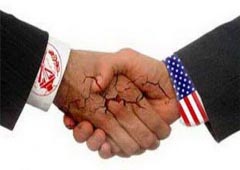
I considered posting on the MeK, but now Richard Sale beat me to it with his excellent article on what they do and what they did.
I’ll try to complement his piece by providing some additional background on what they are. The group has some quite outlandish characteristics that make it rather unique, and US support for it all the more surprising. It is, in a nutshell, Washington’s (and Israel’s) favourite terrorist cult.
A few days back they staged a protest at the White House, in order to plead for dear leader Maryam Rajavi being allowed to testify before congress on ISIS, and naturally, Iran’s evils. I invite readers to have a close look at the image, in particular the mug of their dear leader, Maryam Rajavi (iirc "the true president of Iran", in one of her unofficial titles), on placards.
After the US invasion or Iraq in 2003, the MeK were based in Camp Ashraf and ‘liberated’ by US troops. In fact, it was pretty soon that the US had to protect them from the Iraqis who held unfond memories of them, for aiding Saddam Hussein’s efforts to suppress Kurds and Shia. After Saddam’s demise, the MeK however quickly found a new sponsor in sympathetic neocons, who felt they could put the group to good use against Iran.
The RAND corporation wrote a rather thorough and damning report on the MeK in 2009 which can be found here:
It is absolutely worth to be read in full. It should be required reading for everyone dealing with the group.
I will quote at length from the chapter (p.37 f) introducing the MeK’s cult characteristics and especially from Appendix B (p.69 ff), which goes into greater detail.
♦ A Cult … – p. 37 f of the PDF
Coalition Forces Were Not Prepared to Deal with an Unfamiliar Culture or the MeK’s Atypical Characteristics
… JIATF’s commanders had few or no opportunities to discuss the difficulties inherent in dealing with the MeK, to share knowledge, or to compare strategies. This deficit had particularly profound consequences once it became apparent to JIATF [ed: Joint Inter-Agency Task Force] officers through their early interrogations of MeK members that the organization was not just an FTO [ed: Foreign Terrorist Organisation]; it was also a cult.
The MeK as a Cult
From its earliest days, the MeK had had tight social bonds, but these began to be transformed into something more sinister during the mid-1980s after the group’s leaders and many of its members had relocated to Paris. There, Masoud Rajavi began to undertake what he called an “ideological revolution,” requiring a new regimen of activities—at first demanding increased study and devotion to the cause but soon expanding into near-religious devotion to the Rajavis (Masoud and his wife, Maryam), public self-deprecation sessions, mandatory divorce, celibacy, enforced separation from family and friends, and gender segregation. Prior to establishing an alliance with Saddam, the MeK had been a popular organization. However, once it settled in Iraq and fought against Iranian forces in alliance with Saddam, the group incurred the ire of the Iranian people and, as a result, faced a shortfall in volunteers. Thus began a campaign of disingenuous recruiting. The MeK naturally sought out Iranian dissidents, but it also approached Iranian economic migrants in such countries as Turkey and the United Arab Emirates with false promises of employment, land, aid in applying for asylum in Western countries, and even marriage, to attract them to Iraq. Relatives of members were given free trips to visit the MeK’s camps. Most of these “recruits” were brought into Iraq illegally and then required to hand over their identity documents for “safekeeping.” Thus, they were effectively trapped.
Another recruiting tactic was arranged with the assistance of Saddam’s government. Iranian prisoners from the Iran-Iraq War were offered the choice of going to MeK camps and being repatriated or remaining in Iraqi prison camps. Hundreds of prisoners went to MeK camps, where they languished. No repatriation efforts were made. For coalition forces, the MeK’s cult behavior and questionable recruiting practices are significant insofar as they affect both the daily operations at the camp and the strategic disposition options available to the group. The leadership is unlikely to cooperate with policies that would undermine its ability to exert direct control over its members. Indeed, Human Rights Watch reports that the MeK long ago instituted a complicated process to retain members who expressed a desire to leave, which included a “trial,” forced confessions of disloyalty, and even torture. Although this process has been modified since the group was consolidated at Camp Ashraf, would-be walkaways are still “debriefed” for days or even weeks while held in some form of solitary confinement, during which they are encouraged to change their minds. Conversely, the long-term indoctrination and isolation experi- enced by MeK members are likely to have instilled an exaggerated sense of loyalty, causing them to reject offers to separate themselves from their leaders. This would apply in particular to repatriation to Iran, where the expectation of persecution has been dramatically instilled in their minds.
The MeK as Skilled Manipulators of Public Opinion
During the more than four decades since its founding, the MeK has become increasingly adept at crafting and promoting its image as a democratic organization that seeks to bring down Iranian tyrants, both secular and religious. This profile has been especially effective in the United States and Europe, where, until recently, the MeK’s extensive fundraising activities have been very successful. But despite the MeK’s ongoing attempts to build political support from the West through a multifaceted public-relations campaign, it was not enough to prevent the group from being designated an FTO by the United States as well as by the United Kingdom, Canada, Australia, and the European Union. According to U.S. law, providing any type of support—political, financial, or otherwise—for an FTO is a federal crime. Moreover, many of the MeK’s fundraising activities have been proven to be fraudulent (for example, claiming to be soliciting funds on behalf of Iranian refugees, child welfare, or medical services for children). The MeK has also been linked with a range of money-laundering activities. If coalition forces, and particularly those involved in any type of negotiations with the MeK, had been apprised of the group’s long history of deception, they would have been far less likely to have made the kinds of concessions that proved so troublesome later on. However, they found MeK representatives to be friendly, appealing, and knowledgeable about the United States. Thus, they were susceptible to the MeK’s assertions of neutrality; its apparent willingness to help further coalition goals; its professions of support for democratic ideals, both within and outside its own organization; and its insistence that it had broad political support in the international community. Had the U.S. military, in particular, been more wary, it is unlikely that the MeK would have been able to avoid the surrender demanded by USCENTCOM, and even less probable that it could have elicited a request for review of its FTO status from General Odierno.
…
♦ Appendix B – p.69 ff of the PDF:
Appendix B: Cultic Characteristics of the MeK
The MeK is frequently described as a “cultish” group, but to date, there has been no examination of how its practices relate to cult characteristics defined by experts in the field. This appendix places credible reports about MeK practices into the context of cult theory
The MeK’s Transition from Popular Organization to Exiled Cult
…
Application of Cult Theory to the MeK
MeK leaders and supporters vigorously deny that the MeK is a cult. They allege that former MeK members and critics of the MeK are either Iranian agents or their dupes. However, interviews with U.S. military and civilian officials, information voluntarily furnished by former MeK members at the ARC, and visits to Camp Ashraf suggest that these denials are not credible.The cult characteristics described in this appendix have been widely reported by former MeK members and by Human Rights Watch. They have also been substantiated, at least in part, by interviews with JIATF-Ashraf officers and by information volunteered by former MeK members at the ARC.
Authoritarian, Charismatic Leadership
"Masoud Rajavi appointed himself and Maryam leader and co-leader of the MeK (and, by extension, of Iran) for life, though the NCRI asserts that it would quickly mount elections upon taking control of Iran. This concept of perpetual leadership is reflected in the MeK chant “Iran-Rajavi, Rajavi-Iran” that has been used since the MeK began its transformation into a cult. Equally reflective of the absolute authority wielded by Rajavi is his informal title Imam-e Hal (the present Imam) used by MeK membership. The egocentric character of Masoud Rajavi’s leadership is also illustrated by his willingness to compare his own marriage to that of the Prophet Muhammad. In addition, the MeK membership ceremony involves swearing an oath of devotion to the Rajavis on the Koran. Pictures of the Rajavis adorn all MeK buildings; banners with their portraits hang in the streets of Camp Ashraf. Criticism of the Rajavi leadership is not allowed. …
Intense Ideological Exploitation and Isolation
The MeK leadership requires members to study MeK ideology and to participate in indoctrination sessions that are characterized by a mix of propaganda and fear tactics. Group members are required to watch films of the Rajavis’ speeches and footage of various street demonstrations throughout Europe. The MeK broadcasts from its own radio and television stations. MeK leaders permit group members to listen only to these stations and to read only internal reports and bulletins, such as the MeK-produced Mojahed newspaper and other approved texts. Violators are punished. To reduce the appearance of brainwashing, MeK leaders describe these restricted activities as opposition to the IRI or as exercises in military theory. …
Sexual Control
As a part of the “ideological revolution,” the Rajavis mandated divorce and celibacy. Compulsory divorce required couples to place their wedding rings in a bowl and renounce their affections for one another. (The rules did not apply to the Rajavi marriage, however, nor were MeK leaders required to be celibate.) The MeK denies that these acts were anything but spontaneous and voluntary, claiming, “The reality is that the Mujahideen is based in the territory of a country where . . . family life became impossible” and that every MeK member made the individual, noncompulsory decision to “forgo family life.” This denial is not credible, particularly when taking into account the MeK’s strict limitations on gender interaction, as described next. …
Emotional Isolation
In addition to their geographic and ideological isolation, MeK members in Iraq are severely socially and emotionally isolated, even within their communal living arrangements. Relatives and former spouses are placed in different compounds and are not allowed to see each other. Prior to the U.S. invasion of Iraq in 1991, children were sent to live with foster families in Europe, ostensibly to protect them from the impending invasion, though some returned to Iraq years later. Close friendships are considered “liberal relations” and are strictly forbidden. Members may freely communicate only with their unit commanders, and a commander’s permission is required for any other type of communication. Informants monitor conversations among members. In many cases, MeK members’ families in Iran have been told that their relatives had died or been killed. …
Extreme, Degrading Peer Pressure
The MeK holds daily, weekly, and monthly “sessions” that involve forced public confessions aimed at expelling deviant thoughts and behaviors that are believed to undermine group coherence. MeK members are required to keep daily records of their thoughts and nighttime dreams, particularly sexual thoughts and desires (which are, of course, forbidden), as well as observations about their fellow members. They must submit their journals to their supervisors. During large meetings, members often are forced to read their reports aloud and to make self-critical statements. MeK members are often required to admit to sexual thoughts. In a true Catch-22 situation, if they do not, they will be considered to have been caught in a lie because such thoughts are considered inevitable.
Deceptive Recruitment
Prior to its exile, the MeK was the largest group to oppose the IRI. The organization enjoyed significant support among the young and educated middle class. At the peak of its popularity, it could call hundreds of thousands of protesters into the streets of cities across Iran on minimal notice. Prospective members were attracted to the MeK’s mission, its Marxist-Islamic ideology, and the opportunity to live in coeducational housing and enjoy social debates. However, its ability to recruit was greatly reduced by the IRI’s brutal treatment of MeK members; the group’s departure from Iran, first to France and then to Iraq; and the MeK’s alliance with Saddam, the instigator of the devastating Iran-Iraq War. … These findings suggest that many MeK recruits since 1986 were not true volunteers and have been kept at MeK camps in Iraq under duress. As of June 2004, JIATF estimated that, of the MeK population at Camp Ashraf, only 5 percent had joined prior to the Iranian Revolution and 25 percent had joined at the time of the revolution. A full quarter (approximately 1,500 to 1,800) had been POWs, and 45 percent had arrived at Camp Ashraf after the 1988 move to Iraq. Thus, it is possible that nearly 70 percent of the MeK population may have been recruited through deception and kept at Camp Ashraf against their will.
Forced Labor and Sleep Deprivation
Cults often use long work hours and sleep deprivation as ways to wear down their members and prevent them from identifying with anything other than the group. MeK members often work 16- to 17-hour days and are limited to a few hours’ sleep per night, plus an hour-long nap. To maintain this pace, the MeK leadership mandates continual “make-work” construction and beautification projects and, until OIF, ongoing military training. The results are evident at Camp Ashraf. Built out of the desert, the camp has grand avenues lined with trees and is adorned with an exceptional number of parks, fountains, meeting halls, and monuments, many of which glorify MeK martyrs.
Physical Abuse, Imprisonment, and Lack of Exit Options
Former MeK members claim that punishment was frequently meted out for such offenses as
•expressing or fomenting disagreement with the political/military strategy of the MeK
•listening to foreign radio stations
•sharing individual political views with other members
•failing to attend mandatory meetings
•making personal phone calls
•avoiding participation in military drills
•refusing to participate in the compulsory “ideological divorce”
•having sexual thoughts
•communicating with friends or family
•smoking
•asking to leave the MeK
Recent accounts recall that punishment for disagreeing with MeK policies ranged from forced written confessions of disloyalty to incarceration in special facilities at Camp Ashraf. Former members report torture and long periods of solitary confinement as punishment for disloyalty. To prevent MeK members from departing the camps, almost all MeK recruits were obliged to turn over their identity documents to the MeK for “safekeeping.” The MeK now claims that these documents were securely held until they were destroyed by coalition bombs. Although the group was invited into Iraq and given the use of land by Saddam, the MeK never sought legal residence there. When recruits were brought into the country, Iraqi rules regarding alien visits or immigration were intentionally not observed. With Saddam’s complicity, the MeK leadership was then able to threaten recalcitrant members with prosecution for their illegal presence in Iraq, which would mean incarceration in an Iraqi prison for several years, followed by deportation to Iran, where, members were told, they would face certain persecution. By bringing its members into Iraq illegally and then confiscating their identity documents, the MeK was able to trap them.
Patterns of Suicide
The MeK extols suicide but, unlike jihadist groups, has not used it in attacks since 1981. Prior to their capture in 2003, all MeK members carried cyanide tablets in leather pouches tied around their necks. MeK assassins were instructed to swallow the cyanide if captured during a mission. Masoud Rajavi reputedly has called all MeK members “living martyrs,” and self-immolation is a popular form of MeK suicide. For example, in 2003, there were approximately 10 self-immolations (which killed two) in protest of Maryam Rajavi’s arrest in Paris. The MeK has also used the threat of immolation as a negotiating tool with the JIATF, with British investigators, and with France. Former members indicate that a small number of MeK members committed suicide because they were prevented from leaving the organization and that suicide was also claimed as the cause of death for recalcitrant members who were tortured to death.
Denial of Cultic Tendencies
The MeK and its apologists deny that the MeK is a cult, instead contending that it is a “deeply democratic organization whose guiding principle on all issues is referendum and discussion until a consensus is reached.” The MeK admits to certain practices—such as divorce and celibacy—but justifies them as necessary for effective military operations and claims that they are voluntarily adopted by the membership. However, the MeK denies many other practices attributed to it by it former members, such as intense indoctrination techniques like “thought reform” (commonly referred to as brainwashing) and limiting exit options. As with all criticism aimed at the group, the MeK blames IRI propaganda for characterizing it as a cult. Certainly, the IRI seeks to discredit the MeK, and this includes publicizing the MeK’s cultic characteristics. It is reasonable to assume that some of the IRI’s allegations are inaccurate. But the fact that the IRI seeks to discredit the MeK does notimply that all of its criticisms are inherently untrustworthy. The IRI’s campaign has contributed to weakened support for the MeK in Iran. Although it is not currently possible to conduct a scientific survey of Iranians to gauge their opinions about the MeK—and, in the absence of diplomatic or cultural ties, information regarding Iranian perceptions is extremely limited—anecdotal evidence suggests that the MeK’s cultic characteristics have contributed to its decline in popularity since 1981. An American journalist reports that Iranians whom she interviewed likened the MeK to the Khmer Rouge and the Branch Davidian cult in Waco, Texas, comparisons that have also been made by current and former U.S. officials. Of course, as noted earlier, the MeK’s decision to align itself with Saddam against the IRI and to kill Iranian conscripts during the brutal Iran-Iraq War greatly eroded its popular support in Iran. Although the MeK repeatedly claims to be the most influential opposition group in that country, in reality it appears that this once-prominent dissident group can now validly claim only to be highly organized and well (albeit illegally) funded. Indeed, many Iranians observe that, since the MeK’s move to Iraq, the group is the only entity less popular in Iran than the IRI itself.
…
There isn’t much to add. The MeK and the US are obviously a match made in heaven, a union based on shared values.
Given the choice between joining the MeK or the North Korean Army, to me it’d really be a toss up.
~ by confusedponderer
Links:
•The RAND study on the MeK:
http://www.rand.org/content/dam/rand/pubs/monographs/2009
/RAND_MG871.pdf
•Human Rights Watch Report on the MeK "No Exit":
http://www.hrw.org/legacy/backgrounder/mena/iran0505/
•HRW’s response to critics to the report:
http://www.hrw.org/news/2006/02/14/statement-responses-human-rights-watch
-report-abuses-mojahedin-e-khalq-organization-
•http://en.wikipedia.org/wiki/Camp_Ashraf
•http://en.wikipedia.org/wiki/Maryam_Rajavi
•http://en.wikipedia.org/wiki/People%27s_Mujahedin_of_Iran
•http://en.wikipedia.org/wiki/Operation_Mersad
Turcopolier.typepad.com
News received from within Camp Liberty, base of the Mojahedin-e Khalq Organization (MKO, MeK, Rajavi cult) forces in Iraq, indicates that the MKO is training its members to make Molotov Cocktails and that subsequently some of these hand make bombs have been produced and stored underneath their residential containers.
The individuals are briefed that there is a danger that Iranian forces will attack the base under the cover of the families of the residents. Therefore they must be ready to defend themselves. Thus the members of the MKO have been mentally prepared to violently oppose the families.
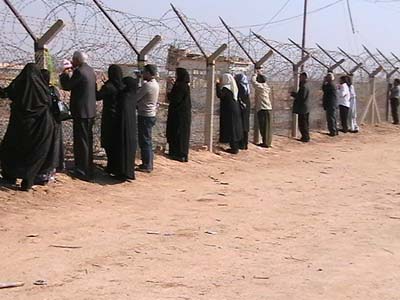 The truth is that the Rajavi cult was alarmed when some families of members trapped in Camp Liberty approached the camp to visit their loved ones and that is why they react like this. Rajavi, like any other cult leader, considers the families as the major threat to its mind manipulation techniques and control over the members.
When the families’ showed their presence at the gates of Camp Liberty, the Rajavi cult started its widespread propaganda against them as though they are organized armed forces who have planned to attack the base and abolish it! This is while the families, who are all empty-handed and without any propaganda tools, approached the camp to hear from their loved ones.
Sahar Family Foundation, which was aware of the families visit to Iraq beforehand, kept its promise to the Iraqi and UN officials by not mentioning anything publicly and kept a low profile in order not to give the MKO leaders any excuses. But the MKO announced the news with extreme propaganda and fabricated lies since it had no intention of allowing the families to visit their loved ones quietly, and made up excuses that there are conspiracies against the camp by the Iranian regime.
Everyone remembers that in the past the families were stationed outside the gates of Ashraf Garrison for about 4 years where they peacefully demanded to visit their relatives. In return the MKO members, indoctrinated by the cult leaders, pelted them with stones and metal pieces which cut their arms and heads and called them all kinds of names and accused them of being the spies of the Iranian regime. But the families patiently tolerated the situation and simply repeated their demands of the leaders peacefully that they just want to know about their loved ones.
The Rajavi cult claimed in the past that they would allow the families to visit their relatives provided it takes place inside the camp with the presence of the MKO officials. The families accepted this condition, but the cult leaders, who are frightened of any contact of their followers with the outside world, in particular with their relatives, broke their promises and did not allow any visits.
Massoud Rajavi, like all cult leaders, considers the presence of the families outside the camp as a threat to his cult and like all dictators is against any information reaching the followers.
There is also another fact that some considerable numbers of members are old or sick or discontented and are not of any use to the cult. If they are dismissed or they defect in large numbers there would be a political damage to the organization. Therefore the best option for Rajavi is to get them killed as he planned in the past in the Ashraf Garrison in order to use them for propaganda purposes. In this way he would be able to kill two birds with one stone.
Rajavi is preparing his forces and arming them with Molotov Cocktails to wage battle against the Iraqis. He is using the excuse of the families’ presence at the camp gates in order for those who he considers no longer have any use for him to be killed.
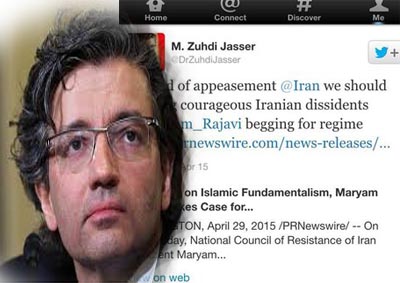
Is there a neo-con war that the sad Zuhdi Jasser will not support or advocate? If you recall, Zuhdi was a cheerleader for the invasion of Iraq in 2003, now he is praising Maryam Rajavi, leader of the cult group, the Mujahideen-e Khalq (MEK), a group that Seymour Hersh revealed received training from the CIA.
The MEK was a designated foreign terrorist organization until it was taken off the list in 2012 due to the lobbying efforts of former government officials.
In his twit post, Jasser asserts, “Instead of appeasement Iran we should heeding courageous Iranian dissidents Maryam_Rajavi begging for regime change”.
Zuhdi Jasser purports to be a representative of the “moderate” Muslims of the United States but reportedly he is nothing but a tool of the right wing who uses him to justify their stereotyping and propagandizing about Muslims and wars in the Middle East.
Nejat Society reporting from LOONWATCH.COM
Follow the Money
Why Argentina is in the War Party’s sights
The brouhaha  over an alleged 1994 Iranian plot to bomb a Jewish community center in Argentina, of all places, has been in and out of the news for years. Hysterical headlines, fantastic allegations, simmering intrigue, a mysterious suicide that some are claiming was a murder – it all sounds like a fourth-rate made-for-television thriller. That may be because its source – the weird neo-Marxist cult known as the Mujahideen-e-Khalq (MEK), which seems to have bought half the Congress and any number of well-known political figures and pundits – is prone to melodrama of the crudest sort.
An Iranian exile group headed up by a woman who calls herself the “President” of Iran, the MEK has an extensive international network, with its fanatic members running a bewildering array of frontgroups – the Iranian American Community of North Texas, the National Council of Resistance, Iran Zamin Cultural Association, the Organizing Committee for Convention for Democracy in Iran, the Human Rights Center in Wisconsin, Association of Iranian Women in America, to name a few. These groups ceaselessly lobby for two main causes: 1) Getting the group delisted as a terrorist organization, and 2) Moving the West to attack Iran.
They succeeded in their first goal, at least here in the US, with Hillary Clinton’s decision to take the MEK off the list of terror groups after a very well-financed and persistent campaign. MEK was listed in the first place because they had launched attacks on US assets and personnel in the late 1970s, murdering six Americans. MEK supported the Iranian revolution that brought the Ayatollah Khomeini to power, only breaking with the regime when Tehran decided to release the US embassy hostages – and after being decisively defeated in subsequent elections.
MEK launched terrorist attacks on the Islamist regime, killing scores of civilians in bombings, and establishing a base in Saddam Hussein’s Iraq, whose regime sheltered and supported them. They played a key role in suppressing revolts against Saddam’s rule, brutally suppressing a Shi’ite rising in the south and a Kurdish rebellion that resulted in the death of thousands.
After Saddam’s fall, they began their rebirth into a “pro-democracy” exile group, reportedly with aid from the Israelis. When a number of neoconservative organizations in the US took up their cause, MEK became the Iranian analogue of the Iraqi National Congress, the group headed up by international intriguer Ahmed Chalabi who provided the Bush administration – and New York Times reporter Judith Miller – with much of the erroneous “intelligence” that led the US to invade Iraq.
Over the years, MEK has carried out a persistent campaign to foment a similar US invasion of Iran, their mainstay being various attempts to document Iran’s alleged nuclear weapons program. Virtually all of these attempts have been debunked as either outright forgeries or else half-truths based on outdated and dubiously sourced information. Their only success has been the revelation of the Iranian nuclear facility at Natanz, and even there they didn’t garner the intelligence on their own: it was reportedly given to them by the Israelis.
Now they have tried a different tack: accusing Tehran of sponsoring an international terrorist conspiracy, one tentacle of which is the alleged 1994 plot to bomb a Jewish community center in Argentina. And their neoconservative cheerleaders have taken up the cry, with the Foundation for the Defense of Democracies (FDD), the American Enterprise Institute (AEI), the Israel Project, and the American-Israel Public Affairs Committee (AIPAC), the powerful pro-Israel lobbying group, all promoting MEK’s indictment.
That indictment was summarized and published by Argentina’s chief prosecutor, Alberto Nisman, who relied exclusively on MEK “experts” to justify his charges against top Iranian officials supposedly involved in the attack on the Jewish center. The head of the National Council of Resistance “intelligence” division, Reza Zakeri Kouchaksaraee, testified that a 1993 two-hour meeting resulted in a decision to bomb the center: he gave the meeting date as August 14. Another National Council of Resistance official, Hadi Roshanravani, gives the date as August 12.
How did MEK know about this alleged meeting, and even the precise agenda, when none of these “experts” were in Iran at the time, nor did they work for or have any contact with the Iranian government when the alleged plot was hatched? Nisman does not say in his report: he only cites MEK-affiliated “defectors” who defected well before the bombing took place. MEK has long traded on its supposed secret connections to mysterious sources inside Iran, but this claim has worn rather thin over the years as their “revelations” turn out to be utter junk. Nisman, however, swallowed them whole in this case, citing no evidence for his charges other than MEK’s bare assertions.
Nisman cites yet another Iranian defector, Aboghasem Mesbahi, who repeats MEK’s claims. Mesbahi’s credibility may be measured by his statements to the 9/11 Commission averring that Iran was behind the attacks on the World Trade Center and the Pentagon: he knew this because he read secret messages in newspapers.
So what’s really behind the international campaign trying to link Iran to the bombing, which killed 85 people and injured 300?
The evidence points to hedge fund chief Paul Singer, one of the richest men in the world, whose financial interests and devotion to Israel combine to produce what can only be characterized as a singular obsession.
In 2001, Argentina defaulted on its debt payments, the inevitable result of years of big government programs, incompetence, and outright corruption. But that didn’t deter Singer from buying up Argentina’s bonds on the cheap. His plan: to pursue Argentina in court and demand full payment. A court victory – which he achieved in the summer of last year, when the Supreme Court ruled in Singer’s favor – would reward him with over $2 billion in pure profit. The “vulture,” as financial publications like Forbes describe Singer and other investors who buy up bonds of desperately poor countries in hopes of making a killing, is now free to seize Argentine’s assets around the world. Argentina is also forbidden to settle with other bondholders who may be willing to accept partial payment until Singer and his fellow vultures are paid in full.
Singer helped found the American Task Force Argentina (ATFA), which has been running newspaper ads in support of Singer’s legal efforts as well as demonizing Argentina as part of a vast Iranian terrorist network operating throughout South America. Singer gave half a million dollars to The Israel Project, which has been frenetically promoting this conspiracy theory. FDD, which has signed on to the anti-Argentina campaign in a big way, received over $3 million from Singer. A whole panoply of Republican members of Congress in the forefront of the anti-Argentina jihad – including presidential candidate Marco Rubio,who introduced a resolution in the Senate demanding an investigation into Argentina’s alleged ties to Iran — have been beneficiaries of Singer’s largesse. AIPAC, which has been more circumspect in is promotion of the Jewish center bombing “connection” to Iran, has been similarly rewarded: its fundraising arm was given over $1 million by Singer and his associates.
A $2 billion payoff – and the smiting of Israel’s principal enemy: that’s the double-barreled motive behind Singer’s anti-Argentina holy war.
Ideology and moolah have always coincided in the world of the neoconservatives: remember Richard Perle’s Trireme Partners, a “security” firm set up to profit off the Iraq war? And of course, as Rand Paul pointed out, Dick Cheney’s connection to Halliburton – and the windfall profits they made off the invasion of Iraq – are emblematic of the neocons’ ability to make mucho dineros off their penchant for conquest. The links of key neoconservative activists with big military contractors like Lockheed-Martin are a matter of longstanding public record.
Not that these people aren’t sincere in their belief that war is indeed the answer: they just aren’t averse to making a few billion in profit along the way.
When prosecutor Nisman committed suicide a day before he was supposed to formally present his charges of a “cover up” by Argentina of Iran’s alleged culpability in the bombing plot, the hysterics in neoconservative circles reached fever pitch. The same people who denounce any arguments that they are trying to push us into war as a kooky “conspiracy theory” were quick to evoke a conspiracy by the Argentine government to commit murder. Yet Nisman’s death was clearly self-inflicted: a gun he had borrowed from an associate was found next to his body, and there were no signs of a struggle or forced entry. No evidence has emerged to show that he was killed by something other than his own hand: but evidence, or the lack of it, has never stopped the neocons from constructing elaborate arguments touting their own “theories.”
And they have no lack of means to publicize these theories: the campaign to tar Iran with the “terrorist” brush is fueled by the multi-millions of billionaires like Singer, Sheldon Adelson, and Norman Braman, whose insistence on 100 percent loyalty to Israel in the candidates and causes they support is remaking the political discourse in the US when it comes to foreign policy.
The forces driving us to war with Iran have billions of dollars to spend. They represent a minority of the population – but that doesn’t deter them. Their strategy is to present both sides of the same coin to the American people, come election time, and then ask them to make a “choice” – a Republican who will take us to war against Iran, or a Democrat who will take the same road.
So what can stop them? If the deck is stacked, how can we prevent the next war in the Middle East – which promises to make the Iraq war look like a mere skirmish?
The answer is a mass mobilization by the American people against the drive to war – and, no, that’s not a pipedream. We did it when President Obama decided he wanted to bomb Syria and then gave Congress the last word. Congressional switchboards were soon inundated with calls opposing a new war one-hundred-to-one. Members of Congress who said they would vote yes for war backed down, and those on the fence came over to our side – until it was clear the administration wouldn’t have the votes. Obama backed off in the face of massive opposition: and, yes, Antiwar.com was a big part of that memorable mobilization.
We did it before – and we can and will do it again.
But we can’t do it without your help.
You can see, from the above, how outgunned we are when it comes to financial resources. The War Party has billions, and money is no object. But I’ll let you in on a little secret: they need those billions, and more, because they represent nothing and no one but themselves. Their support is almost exclusively in Washington, D.C., and New York City, the political and media centers that profit from perpetual war. We, on the other hand, have the overwhelming majority of the American people on our side – if only we can rally them to the banner of peace in time.
Paul Singer’s billions are feeding America a diet of lies. Our answer to him and his confreres is the unalloyed truth – and we don’t need billions, or even millions, to educate the American people about the forces pushing us into war. We just need a basic minimum to keep this web site going.
We’ve been fighting the War Party’s lies since 1995, with the invaluable help of our readers and supporters – and we’ve been doing it on a shoestring budget! What we spend in an entire year is what groups like the Foundation for the Defense of Democracies and the American Enterprise Institute spend in less than a week.
We need your help to counter the well-financed lies that are poisoning the national discourse around foreign policy issues. Your tax-deductible donation goes to counter the Paul Singers, the Sheldon Adelsons, and their friends in what Dwight Eisenhower called “the military-industrial-congressional” complex – and every penny counts.
Today is the first day of our Spring fundraising campaign, and I’m on pins-and-needles, as I am every time we have to go through this process. We’re asking for your vote of confidence – your vote for a more peaceful world. And I believe we deserve that vote of affirmation – because this is the one and only self-sustaining and relatively successful institution the peace movement has. Please help us continue our work on behalf of the cause of peace and liberty. Please make your tax-deductible donation today.
NOTES IN THE MARGIN
You can check out my Twitter feed by going here. But please note that my tweets are sometimes deliberately provocative, often made in jest, and largely consist of me thinking out loud.
I’ve written a couple of books, which you might want to peruse. Here is the link for buying the second edition of my 1993 book, Reclaiming the American Right: The Lost Legacy of the Conservative Movement, with an Introduction by Prof. George W. Carey, a Foreword by Patrick J. Buchanan, and critical essays by Scott Richert and David Gordon (ISI Books, 2008).
You can buy An Enemy of the State: The Life of Murray N. Rothbard (Prometheus Books, 2000), my biography of the great libertarian thinker, here.
by Justin Raimondo,
Senator Tom Cotton (R-Ark.; shown) is not only the darling of the neonconservatives and war hawks, but he also seems to be making a play to get in the good graces of “an Iranian dissident terrorist group.” Here’s the story as reported by Nick Hankoff for Voices of Liberty on May 8: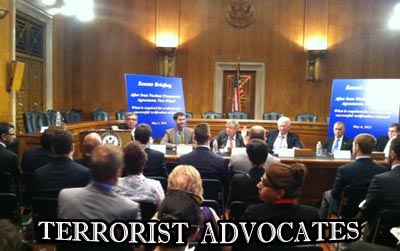
On Wednesday, Cotton participated in a panel called “After Iran Nuclear Framework Agreement, Now What?” organized by the Organization of Iranian American Communities (OIAC) in a Senate meeting room. The OIAC, through spending millions of dollars lobbying, is responsible for getting an Iranian dissident terrorist group removed from the State Department’s official list of terrorist organizations in 2012 by then-Secretary of State Hillary Clinton.
That would be the Mujahedin-e-Khalq (MEK), a group that assassinated half a dozen Americans in Iran and targeted many others in the run up to the 1979 Islamic Revolution. The MEK was founded with Marxist, feminist, and Islamic tenets and incorporated cultish tendencies including personality worship of its husband-wife founders, forced divorces for elderly women, and a forbiddance to marry for young women.
The revolutionary group considers itself a government-in-exile, ready to return to Iran once the current regime is overthrown. The MEK has no measure of support from the Iranian people.
Cotton’s cozying up to the “MEK-fronting OIAC” is particularly troublesome in light of the fondness President Obama seems to have for the same gang. Consider this facet of the story told by The New American’s Alex Newman in 2012:
After a multi-million dollar lobbying campaign that unlawfully enlisted top members of the bipartisan U.S. political class, the Obama administration decided that the Mujahedin-e-Khalq (MeK), an Islamo-Marxist terror cult notorious for murdering Americans, should no longer be on the State Department’s list of designated terrorist organizations. Experts say the decision paves the way to begin openly showering U.S. taxpayer money on the anti-American outfit in its bid to overthrow the Iranian regime.
The controversial decision to formally "delist" the organization came in the wake of reports charging that the federal government was already arming and training the cult-like Iranian MeK in violation of U.S. terror laws. The purpose of the alleged support, according to multiple sources, was to help wage a proxy war against Iran. Criticism of the administration’s recent decision, however, erupted quickly and forcefully.
Newman also briefly outlines the MEK’s origins and mission:
Also known as the People’s Mujahedin Organization of Iran, the MeK was founded in an effort to advance a hybrid system incorporating communism and Islam. It officially landed on the U.S. government’s terror list some 15 years ago for perpetrating numerous terror attacks against civilians and more than a few senior American military personnel. The group was also allied with Iraqi dictator Saddam Hussein, helping him to wage a brutal war against Iran while suppressing dissidents within Iraq.
In fairness, Senator Cotton may be ignorant of the MEK’s militant and terroristic intent. In fact, perhaps his alliance with the group may be an example of an enemy of his enemy being his friend.
Both Cotton and the MEK oppose any agreement between Iran and the United States. Cotton was the chief architect of a controversial letter co-signed by 46 other senators and sent to the government of Iran explaining that any treaty between the two countries would require congressional approval.
For its part, as Hankoff reports: “The female co-founder of the MEK, Maryam Rajavi, has said that toppling the government in Iran is the best shot the US has at defeating the Islamic State.” He adds that, “Cotton has said bombing Iran would last no longer than how long proponents of the 2003 Iraq War promised.”
Hankoff and Newman both point out that Cotton’s not the only neocon to feel comfortable in the company of MEK.
“It’s possible Tom Cotton is (willfully?) ignorant to the leftist, tyrannical values and aspirations of the MEK. But like Howard Dean, Rick Perry, Rudy Giuliani, and many other politicians, there are big opportunities to work together for mutual political growth and enrichment,” Hankoff writes.
Newman confirms this collaboration, reporting:
Despite federal statutes defining as a felony the provision of any “material support” to designated terrorist organizations, the MeK managed to buy die-hard support from numerous senior U.S. politicians and former officials on both sides of the aisle. Advocates for the terror cult range from neo-conservative terror-war cheerleaders like Rudy Giuliani and Michael Mukasey to liberals like Howard Dean and Gen. James Jones. Former White House Chief of Staff Andy Card, ex-CIA and FBI bosses, and many others jumped on the pro-MeK bandwagon, too.
In light of Cotton’s admitted alliance with MEK, where is the outrage from conservatives? Where is the call for Cotton to renounce any association with the group, especially considering that to continue their relationship would be a felony and a violation of federal law prohibiting such cooperation?
Hankoff puts it this way, “Neocons and Marxist-Islamist terrorist cultists joining together to undermine US-led international negotiations to prevent war with Iran. Politics makes strange bedfellows.”
Calls for comment by Senator Cotton’s office made by The New American were unreturned at press time.
by Joe Wolverton, II, J.D., The New American
A month ago, intense negotiations in Lausanne, Switzerland, resulted in a framework for a final nuclear deal between six world powers and Iran. As negotiators from Iran and the P5+1 (China, France, Russia, the United States and United Kingdom, plus Germany) continue nuclear talks to reach a comprehensive deal before the 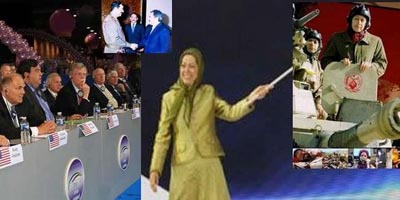 end of June, opponents of diplomacy and potential détente have intensified their efforts to derail any accord.
Prominent in this effort is exiled Iranian dissident organization, the Mujahedin-e-Khalq (MEK or MKO, also known as the People’s Mujahedin of Iran, or PMOI) which was classified as a terrorist organization by the EU until 2009 and by the United States until 2012. MEK is bitterly opposed to the current Iranian government and seeks its overthrow.
The cult-like organization has spent vast sums of money to lobby political elites on both sides of the Atlantic for recognition as an alternative to the current Iranian government. Since a negotiated, multilateral deal with Iran would effectively bury prospects of Western-led regime change in Iran, the MEK is attempting to leverage its extraordinary influence to sink talks.
Regime change in Iran, by any means, is the only item on the MEK agenda. Like experienced salesmen, its members employ different tactics to “sell” this approach to various audiences.
In testimony before the House Subcommittee on Terrorism, Non-proliferation and Trade last month (delivered via videoconference from Paris), Maryam Rajavi, the self-proclaimed “president-elect” of the National Council of Resistance of Iran (NCRI), which serves as the MEK’s front office, suggested the best way for Western nations to combat the threat posed by ISIS is to oust the regime in Iran. Of course, no reference was made of the fact that Iran was one of the first countries to commit blood and treasure to the fight against ISIS. Nor did Rajavi mention that, when ISIS first overtook Mosul in the summer of 2014, the MEK hailed the militant group and its supporters as “part of a popular revolution against the Maliki regime” in Iraq, which the MEK views as an Iranian pawn. Once the U.S. military joined the fight against ISIS, however, it became politically untenable to defend or minimize its crimes. So, the MEK quickly changed its tune, suddenly portraying ISIS as Iran’s creation.
Exploiting local political sensitivities in Europe, the MEK has chosen a different tactic to advocate for government overthrow. To European audiences, the MEK has emphasized Iran’s human rights issues, such as the high number of executions in the country, as well as issues to do with women rights and infringements on religious liberty. In mid-April, MEK operative Firouz Mahvi, a member of NCRI’s so-called “Foreign Affairs Committee” and a fixture at the Brussels-based European Parliament (EP), sent an e-mail to parliamentarians (MEPs) calling on them to adopt an urgent resolution on capital punishment in Iran. The proposed resolution would have almost certainly led to the cancellation of a scheduled visit by members of the Majles, the Iranian parliament, to Brussels. In fact, this very thing happened last year: following the adoption of a different resolution on Iran critical of its human rights record, the Majles delegation cancelled a planned trip in protest.
Inter-parliamentary dialogue is one of the only institutionalized platforms for interaction between officials from the EU and Iran. For progress in EU-Iranian relations to occur, whether on the nuclear issue or otherwise, it is essential to keep Iranian conservatives at the table.
Realizing the issues at stake and familiar with the MEK’s modus operandi, the parliamentary majority read the situation correctly: The MEK’s push for a resolution on capital punishment had little to do with genuine concern for the human rights of Iranians, and everything to do with ongoing attempts to sabotage the nascent EU-Iran dialogue.
When their plan failed, MEK associates, this time under the guise of the dubious “Iranian Refugee Association in Belgium” (it has neither an e-mail address nor a website) launched a call for MEPs to boycott the May visit from the Iranian delegation. While the call was not heeded by Polish conservative Janusz Lewandowski , chair of the EP delegation for relations with Iran, other MEPs fell into the MEK’s trap. For example, Beatriz Becerra, a Spanish MEP from the centrist Alliance of Liberals and Democrats of Europe (ALDE) challenged her colleagues to raise new legislation in the Iranian parliament, which is said to limit the sexual and reproductive health rights of Iranian women, with delegation members. She also tabled a written question on the issue to the Council of the EU and the European Commission. Becerra may be a well-intentioned defender of women rights, but her aggressive advocacy on behalf of the MEK and Maryam Rajavi certainly does more harm than good.
Another common MEK strategy is to hold public hearings in the EP, like the one organized last month on religious freedom in Iran by the European Conservatives and Reformists (ECR) group. ECR is a strange mix of seemingly respectable mainstream parties such as British Conservatives and fringe right-wing outfits, such as the Dutch Calvinist party (which until recently forbade women from becoming members) and the Islamophobic, anti-immigrant Danish People’s Party. When it comes to foreign policy, what binds these disparate forces together is their fervent support for Israel, extreme hostility to Palestinians and hardline hawkishness on Iran. In the recent past, even after the election of Iranian president Hassan Rouhani, the ECR tried to block the first official visit of European parliamentarians to Tehran. The bid failed and the delegation visited Iran in mid-December 2013.
In light of this, it is unsurprising the ECR yielded the floor to Sanabargh Zahedi, chair of NCRI’s so-called “Judicial Committee.” Presenting himself as an “Islamic scholar,” even though there was no evidence of his scholarship on Islam or any other field for that matter, Zahedi asserted that, “unless all countries put improvement of human rights as a pre-condition to doing business and trade with this regime, we will not see any real progress in any area, including the nuclear issue.”
None of this is to say that human rights in Iran should not be a matter of grave concern. [..]
Still, there are more effective ways to address these crucial issues than calling for regime change, undermining nuclear negotiations, or following the agendas of those with obvious ulterior motives. Ultimately, the nuclear deal and the possibility of engagement with Iran hold a better promise for achieving real progress in the human rights sphere than any delusions about “regime change.” This is certainly how respectable human rights organizations and activists see it.
Hadi Ghaemi, director of the New York-based International Campaign for Human Rights in Iran welcomed last month’s Lausanne agreement as an important step toward creating better conditions for discussing human rights with Iran. Those in the West who genuinely care about the human rights of Iranians would do well to listen to these voices rather than let themselves become puppets in the MEK’s destructive schemes.
Eldar Mamedov, Muftah.org
How badly does Senator Tom Cotton (R-AR) want to squander a deal with Iran over its civilian nuclear program? Bad enough to become the fastest rising star of the neoconservative wing of the Republican Party, yes, but this week the freshman senator went even further than sending a letter to the Iranian government.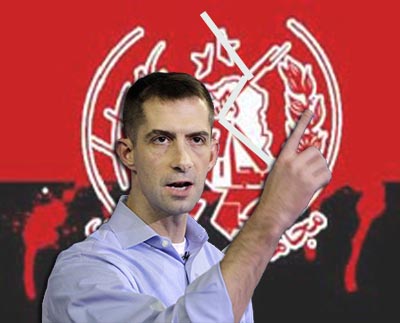
On Wednesday, Cotton participated in a panel called “After Iran Nuclear Framework Agreement, Now What?” organized by the Organization of Iranian American Communities (OIAC) in a Senate meeting room. The OIAC, through spending millions of dollars lobbying, is responsible for getting an Iranian dissident terrorist group removed from the State Department’s official list of terrorist organizations in 2012 by then-Secretary of State Hillary Clinton.
That would be the Mujahedin-e-Khalq (MEK), a group that assassinated half a dozen Americans in Iran and targeted many others in the run up to the 1979 Islamic Revolution. The MEK was founded with Marxist, feminist, and Islamic tenets and incorporated cultish tendencies including personality worship of its husband-wife founders, forced divorces for elderly women, and a forbiddance to marry for young women.
The revolutionary group considers itself a government-in-exile, ready to return to Iran once the current regime is overthrown. The MEK has no measure of support from the Iranian people.
Its possible Tom Cotton is (willfully?) ignorant to the leftist, tyrannical values and aspirations of the MEK. But like Howard Dean, Rick Perry, Rudy Giuliani, and many other politicians, there are big opportunities to work together for mutual political growth and enrichment.
Here’s a tweet heralding the alliance between Cotton and the MEK-fronting OIAC:
For Cotton and the MEK, prospects of their shared enemy in Iran reaching a nuclear deal inspires outrageous rhetoric. The female co-founder of the MEK, Maryam Rajavi, has said that toppling the government in Iran is the best shot the US has at defeating the Islamic State. Cotton has said bombing Iran would last no longer than how long proponents of the 2003 Iraq War promised.
A little more on the MEK: Prior to giving themselves up to Americans in the immediate aftermath of the 2003 US invasion in Iraq, the group was financed by Saddam Hussein (remember the reason for invading, his support for terrorists?). Since then their anti-imperialist leanings have given way to promoting “human rights,” and they’ve dropped their anti-Israel schtick for a partnership with the Mossad, Israel’s secret intelligence service. Through American intelligence officers, NBC News and Seymour Hersh have each concluded that the MEK carried out assassinations on five Iranian nuclear scientists after training with Mossad.
Neocons and Marxist-Islamist terrorist cultists joining together to undermine US-led international negotiations to prevent war with Iran. Politics makes strange bedfellows.
by Nick Hankoff, VoicesofLiberty.com
++ Paris this week saw the start of the court case against leading MEK member Mehdi Abrishamchi on terrorism charges. Several former MEK members staged a picket in support of the prosecution.
++ More responses are rumbling through the Commentariat in reaction to Maryam Rajavi’s speech to Congress. The underlying theme is ‘how on earth did they end up bringing Maryam Rajavi to speak?’ Most concluded that this exposes high levels of financial corruption at the top levels of the US political system. But in that respect only America and Israel are paying the price because Iran is able to use this situation to its favour in the negotiations. By itself the event is a comedy – “bringing the representative of ISIS to talk against ISIS”. Some point out that Maryam Rajavi didn’t even attempt to say anything about ISIS to show any expertise. Worse than that she announced that to fight ISIS you need regime change in Iran fronted by the MEK; which will take the credit and take power. Rajavi complains that nobody should believe there are differences between Sunni and Shia because both Iran and ISIS are both after power. Then immediately follows that by demanding regime change in Iran to give power to the MEK! That, according to her and completely missing her own irony, is the way forward. Even the Americans acknowledge that the only effective force pushing back ISIS in Iraq is the Iranian backed militias alongside the Iraqi army. Some analyses conclude that the presence of Rajavi shows the utter weakness of the Israelis and the Americans. The Israeli lobby and its sub class have been brought so low and powerless as to play this card.
++ The Mohammadi family have written to state that they have not and will not give up on their struggle to make contact with their daughter Somayeh. They, along with other families, are asking ‘where is this so-called international community, where are the human rights organisations? How come, when it comes to the Mojahedin they can do what they want? Why are these organisations so useless?’
++ The MEK is preparing for its annual show in Villepinte celebrating the start of its terrorist campaign inside Iran and again the Commentariat is exposing the MEK saga of buying both audience and speakers.
++ Ehsan Bidi from Albania says the MEK has changed its tactics this week. Now MEK commander Afshin Ebrahimi is asking ex members “why are you still here?” He is encouraging them to leave Albania illegally. Bidi says this makes it even more obvious that they want to establish a base in Albania. The MEK has brought money, forces and have bought land and property there for a reason.
++ Mir Bagher Sedaghi from Setaregan Assoc in Switzerland published a short article asking ‘Is Rajavi as great as she thinks she is, or is she just daft?’ The article quotes Rajavi claiming victory “because the agents of Iran’s Intelligence ministry – Daniel Benjamin and Robert Ford – who tried to stop Maryam Rajavi speaking to Congress failed and we won.”
In English:
++ Fallout from Maryam Rajavi’s appearance by video conference in the US Congress continued this week. Some former MEK members wrote in English to congratulate Robert Ford and Daniel on their stance.
Daniel Larison in The American Conservative writes “The refusal of these former officials to play along with some hawks’ disturbing admiration for the MEK is appropriate, but it is unfortunate that it should be necessary. The attention and praise lavished on the MEK in recent years by former officials, retired military officers, and politicians has been an embarrassing spectacle. Now the strange infatuation that many hawks have with the “former” terrorist group is spilling over into the regular business of Congress. As if to underscore how misguided inviting Rajavi was, a copy of the cult leader’s testimony shows that she intends to use her time to argue for regime change in Iran. Ali Gharib comments: But more to the point, the MEK has always had only one goal: the overthrow of the Iranian regime. For decades, it has tried to shoehorn regional and geopolitical dynamics into its aim, irrespective of any salient connections.”
Atwiw.com’s take on the event is even more blunt. After unpicking the MEK’s attempts to buy respectability, the jokey article concludes: “So, hey, if you’ve ever wanted to testify before Congress but there’s no discernible reason why they should invite you to do so, plus maybe you’ve got some unsavory things in your past that could complicate matters, don’t worry! Just fork over a few tens of thousands to your favorite congressperson and you could soon find yourself offering your “expertise” (or irrelevant ranting, but whatever, you bought your time fair and square) to our nation’s top legislators! Good luck!”
Mazda Parsi in Nejat Bloggers argues that the “Appearance of the self-claimed president of National Council of Resistance, Maryam Rajavi in a hearing in US Congress indicates the absurdity of the claim of fighting against terrorism. Although the credibility of this so called leader is questionable getting support among some US congressmen for her presence in the congress is interesting and creates doubts in everybody’s mind.”
++ Also in America, Eli Clifton writing in Lobelog reveals that ‘Tom Cotton Allies Himself with the MEK’. “It appears that Cotton, who has quickly displaced Lindsey Graham as the Senate’s most hawkish member, has decided that it is necessary – perhaps even politically desirable – to make common cause with a group that has committed serious human rights abuses, allied itself for some two decades with Saddam Hussein, and carried out terrorist acts, including against U.S. citizens and servicemen – all in the interests of sabotaging an Iran nuclear agreement.”
++ On the subject of the nuclear negotiations Akbar Ganji’s article in the Huffington Post suggests ‘Why Tehran Fears the Iraqization of Iran on Nuclear Inspections’. In a well-argued piece he analyses Iran’s mistrust of American intentions. “Iranian leaders are deeply concerned about the IAEA inspection regime, and are afraid that Iran will meet the same fate as Iraq’s, right before its invasion in 2003, when the agency demanded inspecting even Saddam Hussein’s palaces. The IAEA searched everywhere and found no evidence of a nuclear program, yet Iraq was invaded… Ayatollah Khamenei and the military leaders believe that, beginning with the day after signing the final agreement, Israel and the Mujahedeen-e-Khalq will surely declare every single military site as “suspect,” claiming that the Islamic Republic is secretly trying to make nuclear bombs there. If Iran does not allow inspecting the “suspect” sites, Israel and MEK will declare victory, and if Iran does allow the inspection, the agency may eventually demand to inspect even Khamenei’s bedroom.”
++ Iran Interlink believes ‘Maryam Rajavi and her cult brand prove too toxic for The Hill’ after an article by long term MEK supporter Struan Stevenson omitted to mention either Maryam Rajavi or the MEK.