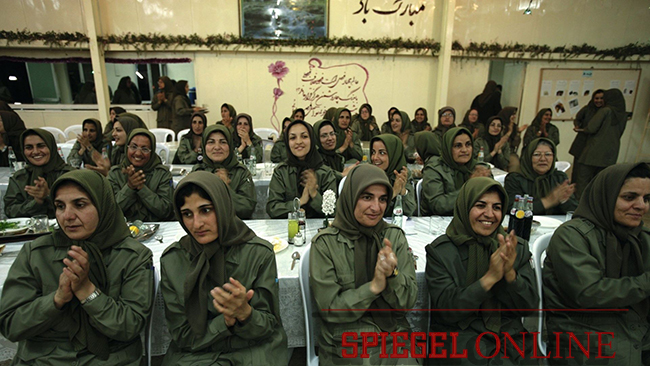
In a recent meeting with cult members, Maryam Rajavi told them that ‘the regime is now ruined, we clearly see signs and symptoms of overthrow of the regime – with this situation and the conditions that the regime has been going through for up to a year and a half, we will see that the regime cannot continue and it’s over, over, over …’
After her speech, one of the members called Mohammad Ali Agahi stood up and asked, ‘Sister Maryam, why are you lying to us about this’. Many then attacked him, but more people came to support him and some minutes later the meeting was ended. Mohammad Ali and the other people who supported him were then sent to Quarantine. For those who don’t know, ‘Quarantine’ is a place of isolation where a person is kept alone until the commanders and leading members of the organization come to talk in a process of so-called ‘Virus Removal’.
The fact is that the slogans of the cult have changed so often – according to circumstances – that it has become another ideological joke in their meetings. One day overthrow is the slogan, next day it was our fault there is no overthrow, next day overthrow is not important only obeying the ideology matters. What a joke.
BY Hassan Heyrani,
Mujahedin Khalq as a Destructive Cult
Following the continuous floods in Iran that started in March claiming 70 lives, destroying infrastructures and displacing thousands of people across Iran, the opportunists such as the Mujahedin Khalq Organization (the MKO/ MEK/ PMOI/ Cult of Rajavi) have made efforts to fish in troubled waters.
The MKO’s propaganda media is flooded with the news of floods in Iran particularly claims of the authorities’ mismanagement to manage the disastrous rain showers and moreover the suppressive attitude of governmental forces against victims of the flood!
Actually the very question is that who cares for the MKO news websites? Definitely not the Iranian nation. The fact was once more repeated by the American prominent journalist a few weeks ago. Michael Rubin has always been a criticizer to the American support for the MKO although he is a significant critic of the Islamic Republic government. In his recent article he asserts that the decisions of the Trump administration “to defy long-held conventional wisdom on U.S. foreign policy” may not be so harmful but “when it comes to the Mojahedin e-Khalq (MEK), an Iranian opposition group, any cooperation and coordination—let alone support—from the United States would be disastrous.”
The main reason that he states for his argument is that there is “only one item that united Iranians inside Iran: absolute hatred of the Mojahedin e-Khalq (MEK).”
Rubin truly suggests, “What really broke any remaining popular support for the MEK among ordinary Iranians, however, was their embrace of Iraqi President Saddam Hussein’s regime against the backdrop of the Iran-Iraq War”. As he accurately states, for most Iranians, the MEK-Saddam relationship is unforgivable.
He frankly puts: “The Mojahedin e-Khalq are a bad bet”
In his opinion, the MKO is a bad bet because the US should not trust a group that is hated among its own country fellowmen and eventually has turned into a political prostitute. “Unable to win any support from Iranians inside Iran, the MEK has turned to the gullible and greedy: they are political chameleons. When in Iran, they were a combination between Islamists and social justice warriors,” Rubin writes.
“In Iraq, they were secularists, basically Baathists without the Arab identity. And while in France, they are Ademocrats. In reality, their behavior resembles a cult, right down to dictating where members live, whom they should marry and divorce, and the rent-a-mobs who populate their rallies.”
Thus, the MKO’s propaganda on the recent flood in Iran has no Iranian audience but it surely has certain listeners among paid Western politicians like Rudy Giuliani and John Bolton. Stephanie Baker of Bloomberg website titles her recent article asking “where Rudy Giuliani’s money comes from”. She suggests that Giuliani has “made millions of dollars while acting as Trump’s unpaid consigliere” including the MKO as one of the main sources of Giuliani’s deep pockets.
“Giuliani told me he’s worked with the MEK since 2008,” Stephanie Baker writes.
“At the time, the U.S. Department of State designated the group a foreign terrorist organization, describing it as “cultlike” and saying members were forced to take a vow of “eternal divorce” and participate in weekly “ideological cleansings.” When the State Department revoked the designation in 2012, it nevertheless expressed serious concerns about the organization, “particularly with regard to allegations of abuse committed against its members.”
However, as Rubin states, the biggest problem is treating the MEK as anything more than a pariah because Iranians hate the group for its history, previous actions, and past allegiances.
According to Dr. Emile Nakhleh former senior intelligence service officer and director of the Political Islam Strategic Analysis Program in the Directorate of Intelligence at the Central Intelligence Agency,
“The MEK, , is a terrorist cult that has received funding from all sorts of dubious sources and is often used as a tool by outside groups, states, and organizations, including intelligence services of regional and international state actors, to further an anti-Iran agenda.”
By Mazda Parsi
Imagine terrorist extremists attacking European citizens, cutting their throats with knife, breaking their hands, removing their eyes with fingers, and tearing their mouth open. Even imagining such scenes seems horrific but there are some people out there who have been trained to do so. A large group of these trained terrorists are members of the Mujahedin Khalq Organization (the MKO/ MEK/ PMOI/the Cult of Rajavi). Coincidently, they live in Europe now.
The recent report published by Der Spiegel revealed the above-mentioned horrific facts about the evil of the MKO. The history of the MKO has proved that committing such violent acts is not far from the background of the group. There are numerous reports and testimonies on the MKO’s armed and unarmed violence. Today, there are hundreds of people in the MKO camp in Albania who have been trained to commit these evil deeds whenever they deem them necessary. One may wonder what makes such brutal trainings as ordinary routine choirs of a community.
The German born prominent philosopher Hannah Arendt is best known for her works on the problem of “evil”. Can one do evil without being evil? This was the puzzling question that she grappled with when she reported for The New Yorker in 1961 on the war crimes trial of Adolph Eichmann, the Nazi operative responsible for organizing the transportation of millions of Jews and others to various concentration camps.
Arendt was remarkably sensitive about some of the deepest problems, confusions and dangerous tendencies in modern political life, many of them still with us today. The suffocating atmosphere of the MKO camps –where members have to pressure their peers abusing them verbally and physically in their everyday life and are always prepared to attack outsiders —is a significant example of complex and dangerous tendencies within a community in the modern world.
Arendt believes that all aspects of the life under the totalitarian ruling systems are controlled by the totalitarian leaders. The evil of the dictatorship leads the followers to an abyss in which they practically lose their mental power. According to her, conscience of the citizens in a dictatorship is paralyzed; they lose their individuality.
This process has been the exact mechanism that has been used in the MKO.
The most recent defector of the MKO in Albania, Hadi Sani Khani admits that once he was an MKO member, he was like a robot, not able to choose for a moment of his private life. “We were brainwashed in daily meetings, our minds had to be drained of any personal thoughts during daily and weekly brainwashing sessions,” he says.
Actually, totalitarianism has sickened members in a dangerous way that they submit to the decisions that the dictator (in this case Massoud Rajavi) makes for them. Members believe in what the top of the hierarchy says. They think that Massoud and Maryam Rajavi are protectors of their rights and interests. “Massoud Rajavi was idolized like a prophet, a god for us,” Sani Khani says.
Hanna Arendt thinks that the evil-seized members are in return the factors to consolidate the absolute power of the dictator. “In politics obedience and support are the same”, she suggests. To break this awkward equation, she suggests a deep inner conversation that awakes the individuality of the citizen.
Those who defect the MKO definitely had experienced the unique moment that they gained the ability to have this inner conversation. This special moment is usually declared in the firsthand accounts of former members’ testimonies. For instance, former member of the group Bahman Azami, speaks of the moment he saw some children playing in the park over the walls of the MKO’s camp in Tirana, Albania. The kids took his mind to the life outside the group. He was eventually punished by his female commandant for he had broken the regulations of the cult that forbids thinking about normal life. However, the inner conversation had started for Bahman. He started doubting the group’s cause questioning himself for all the years of his life he had lost in the group and he finally left the group.
Although Massoud and Maryam Rajavi have been making efforts to remove the past and future of their followers’ lives in order to conquer their minds, we should always be hopeful for the advent of that particular moment that revives past memoirs and experiences in their minds and hearts that will inspire their willingness for a normal future.
Mazda Parsi
When reporter Luisa Hommerich wrote her investigative piece in Der Spiegel titled ‘Prisoners of Their Own Rebellion – The Cult-like Group Fighting Iran’, which exposes the grim situation for MEK members, I doubt she was expecting death threats to follow. After all, she was just doing her job. But that is exactly what the MEK reaction was. A Farsi language statement (written and published in Europe) promised her assassination. Nice.
Of course, for those who already know the MEK, this is not surprising. A timely reminder that the MEK cannot disown its past and cannot stop repeating its past, came in an interview with Nabi Ahamadi, who escaped the cult in Albania recently. Ahmadi was a close friend of Malik Sharai who was killed by MEK in June last year. He confirmed that Sharai was one of the few remaining witnesses to the mysterious death of 53 MEK members in Camp Ashraf, Iraq. He also confirmed that Sharai had asked to leave the group but was then held in solitary isolation before being physically eliminated by the MEK leaders. As a trained swimmer, Ahamdi says it is implausible that he drowned as MEK claim.
Another example is the suspicious assassination of Mohammad Reza Kolahi – the bomber of the Jomhouri Party headquarters in 1981 who was killed in the Netherlands in 2015. After he left the MEK Kolahi was always going to be a liability. He knew too much. So, why is nobody asking Maryam Rajavi about this convenient death?
One reason of course is that the MEK leader Maryam Rajavi refuses to engage with journalists, investigators, researchers. Anyone in fact who might get to the truth about her organization. Indeed, Hommerich did her job thoroughly, as did the journalists of Aljazeera, The Guardian, Independent, Channel 4 News, NBC and other down the years (there is a very long list). They all asked the MEK to give their side, to comment on their findings and to have a voice. The MEK called them all agents of the Iranian intelligence services and refused to talk.
Former MEK members Gholamreza Shekari and Hassan Heyrani from Albania, who were interviewed for the Der Spiegel article, revealed that not only did the MEK refuse Hommerich’s request for interviews, they sent armed guards to prevent her getting near to Camp Ashraf 3 in Manez. This is not the response of a normal political opposition. Issuing death threats to journalists is not the response of a normal political opposition. But then, there’s nothing normal at all about an opposition universally hated by their own people, inside and outside Iran.
It is a mistake to approach the MEK as a normal opposition. Indeed, quoting MEK members is like giving a platform to Flat Earthers or Creationists. It is not balanced reporting. The MEK is a unique entity. Not an opposition, not a ‘group’ or ‘organization’, descriptions which imply a certain kind of accountable system and order.
Hommerich asked to speak with someone from the MEK (NCRI) but they did not reply. Instead, she spoke with some of the many defectors who have escaped. Their stories do not differ much from the testimony of other former members over thirty years: the MEK is a cult that routinely and systematically abuses the human rights of its whole membership. According to 50-year-old Gholamreza Shekari, this is achieved through ‘lies, manipulation and fear’; a methodology known as Cultic Abuse.
For the record, the MEK is a cult. Maryam Rajavi keeps slaves. It is that simple.
Facebook’s foreign policy seems to skew toward crackpots
This article was produced by the Deep State, a project of the Independent Media Institute.
Facebook has a foreign policy, and it seems to skew toward Israel and Iranian crackpots.
Last month, the social media giant announced that (with the advice of the Atlantic Council’s Digital Forensic Lab [DFRLab]) it had removed 783 assets — pages, groups, and accounts — that the company assessed to be associated with an Iran-based network for “coordinated inauthentic behavior.”
The Atlantic Council is a D.C.-based think tank dedicated to multilateralism and “just societies” that embodies the American multilateralist elite. It is also Facebook’s consultant on what should be allowed on the world’s largest social media platform.
Among the problems cited by DFRLab were five Facebook pages about the Israeli-Palestinian conflict that “had a strong bias in favor of Palestine.” They were removed. Thumbs down.
You can rest assured that Facebook has also removed all those pages with a strong bias in favor of Israel — oh wait. Bibi Netanyahu’s Facebook page is still up. So is AIPAC’s. Strong bias in favor of Israel? Thumbs up.
No Bibi Jokes, PleaseAnother banished Facebook page called @Polcartoons was published in Hebrew. The site’s offense? Facebook/DFRLab said it “curated cartoons from various Israeli news outlets that lampooned Prime Minister Benjamin Netanyahu and conservative Israeli political sentiment.”Can you imagine the nerve of these Iranians? What kind of online demons would poke fun at Prime Minister Netanyahu?! In Hebrew! Poor, defenseless “conservative Israeli political sentiment” is under unfair foreign attack! From Iranian hackers! On Facebook! Such behavior, we regret to inform you, will not be tolerated by the politburo in Palo Alto.
Cult
A third offending page, @StopMEK, was removed for promoting views against the People’s Mujahedin of Iran, or MEK. The page was dedicated to denouncing the MEK, an Iranian organization opposed to the country’s clerical leader. The MEK is described by Facebook/DFRLab as “the largest and most active political opposition group against the Islamic Republic of Iran leadership.”
This statement is so factually false as to be ludicrous. The Iranian parliament, the Majlis, has organized factions critical of President Hassan Rouhani that are much larger and more active than the MEK. Masih, the country’s online anti-hijab movement that challenges the Islamic Republic’s clerical leadership, has 2.1 million followers, far more than the tiny MEK.
Facebook, wittingly or unwittingly, has succumbed to a crackpot propaganda campaign.
Supporting Saddam
Here’s diplomatic correspondent Barbara Slavin on the MEK’s sorry history:
“The MEK, a cultish Marxist-Islamist group responsible for the death of six Americans in Iran before the 1979 revolution, lost out in the post-revolution power struggle and fled to Iraq, siding with Saddam Hussein against Iran in the 1980-88 Iran-Iraq war. Maryam Rajavi, the widow of MEK leader Massoud Rajavi, lives in a compound outside Paris…”
From 1997 to 2012, the MEK was listed by the U.S. government as a “Foreign Terrorist Organization.” When Human Rights Watch visited an MEK camp in Iraq in 2010, investigators documented widespread abuse of human rights.
“Serious concerns”
The State Department website says:
“The Department does not overlook or forget the MEK’s past acts of terrorism, including its involvement in the killing of U.S. citizens in Iran in the 1970s and an attack on U.S. soil in 1992. The Department also has serious concerns about the MEK as an organization, particularly with regard to allegations of abuse committed against its own members.”
Most non-governmental observers, who have not received money from the MEK, regard the group as a political cult.
Secretary of State Hillary Clinton delisted the group in 1992 because the MEK paid millions of dollars to ex-U.S. officials of both major parties to speak at MEK events. John Bolton and Rudy Giuliani have taken MEK money. So have Bill Richardson and Howard Dean.
The group is funded by Saudi Arabia, according to Slavin, which “inflames” various conflicts in the Middle East. Writing for the Voice of America, Slavin said:
“Contrary to the MEK’s claims, there is nothing democratic about this cultist organization, which requires its members to divorce their spouses or remain celibate and engage in Maoist-style struggle sessions of self-humiliation. Those that manage to escape often require long periods of de-programming.”
Do Facebook and DFRLab not know that the MEK is a marginal group whose actions are inconsistent with the unobjectionable, if contradictory, stated principles of the Atlantic Council? Or do Facebook and the Council want to promote a crackpot group for reasons of their own, perhaps related to the current U.S.-Saudi policy of hostility to Iran?
All we can say for sure is the MEK has a Facebook page.The Iranian Facebook page @StopMEK is gone.
Requests for response from the Facebook Press Office were not immediately returned.
JEFFERSON MORLEY
Jefferson Morley is a senior writing fellow and the editor and chief correspondent of the Deep State, a project of the Independent Media Institute. He has been a reporter and editor in Washington, D.C., since 1980. He spent 15 years as an editor and reporter at the Washington Post. He was a staff writer at Arms Control Today and Washington editor of Salon. He is the editor and co-founder of JFK Facts, a blog about the assassination of JFK. His latest book is The Ghost: The Secret Life of CIA Spymaster, James Jesus Angleton.
SalonJefferson Morley, Salon
The Cult-Like Group Fighting Iran
Members of the Trump administration have been providing support to a political sect that aims to topple the Iranian regime in Tehran. Around 2,000 of its members live in a camp in Albania. Former members say it subjected followers to torture and psychological terror.

Political sect from Albania fights against Tehran
On a country road in northwestern Albania, a rather odd collection of men and women living together in a camp are busy preparing themselves to topple the Iranian regime. Three times per week, many of them apparently practice slitting throats, breaking hands, jabbing out eyeballs with fingers and performing the so-called Glasgow Smile, which involves cutting cheeks from the corner of the mouth up toward the ear. That, at least, is the story told by a former member of the group.
The camp, roughly the size of 50 football fields and surrounded by high fences, is located just a 35-minute drive from the lively bars of downtown Tirana, but the people inside live in something of a time capsule. Former members of the group report that most of the 2,000 camp residents aren’t allowed to possess mobile phones, watches or calendars, though members of the organization that operates the camp deny those claims.
“My daughter is living somewhere in there,” says Mostafa Mohammadi, a 61-year-old Iranian man with a high forehead and deep eye sockets. Her name is Somayeh, a woman of 38. Her father, who lives in Canada, claims that she is being held in the camp against her will, which is why he spent several months in Albania last year. During a meeting there, he said:”I don’t have anything to do with politics. Please, I just want to see my daughter.”
Just like everyone in the camp, Somayeh Mohammadi is a member of the People’s Mujahedin, a once-militant Iranian opposition group that was listed by the United States. and Europe as a terrorist group until 2012. These days, however, several members of the administration of U.S. President Donald Trump are supporting the group, commonly known by the abbreviation MEK. Both the administration and the MEK, after all, want to see the end of the current regime in Iran — and now that the group has Washington’s backing, the Mujahedin apparently hopes that its time has finally come.
On the sidelines of the Middle East conference in Warsaw, which began on Wednesday, Israeli President Benjamin Netanyahu spoke of possible”war”with Iran. And at an MEK rally in Warsaw, Trump’s lawyer Rudy Giuliani called for regime change in Tehran.
For almost 30 years, several thousand members of the People’s Mujahedin lived in exile in Iraq, but in 2013, many of them moved to Albania. And since 2017, the majority of the group has lived in the isolated camp near Tirana.
Growing Influence
Ever since the group set up shop in Albania, however, more and more members have defected.
Some tell stories of torture experienced in the camp and of group sessions in which members are required to open up about their sexual fantasies. Women are allegedly forced to wear headscarves. And all of it takes place in the name of a phantom leader named Masoud Rajavi, who hasn’t been seen since 2003. Indeed, it isn’t even clear if he is still alive; photos from the 1990s show a mustachioed man in a green uniform.
The residents of the camp are just one part of the movement, which is led by Maryam Rajavi, the wife of the vanished leader. The 65-year-old commutes between Albania and her office in Paris, from which she leads the group’s political arm, the National Council of Resistance of Iran (NCRI), which is active in both Europe and the U.S. NCRI is structured as a kind of interim government, ready to take over in Tehran as soon as the current regime is toppled and the group has offices in many capital cities, including one in Washington not far from the White House. In Berlin, NCRI has an office in the Wilmersdorf district, located just southwest of the city center. The movement in Germany has just a few hundred members, but it has several thousand members around the world.
Maryam Rajavi is the acting leader of the People’s Mujahedin. Her husband has not been seen since 2003.
And they have proven to be adept lobbyists, having won over influential supporters in recent years. U.S. Transportation Secretary Elaine Chao, National Security Adviser John Bolton and Giuliani have all spoken at NCRI events and they all view the group as a viable alternative to the current regime in power in Tehran.
“The mullahs must go, the ayatollah must go, and they must be replaced by a democratic government, which Madam Rajavi represents,”Giuliani said at an annual NCRI rally in Paris in June 2018. And he suggested that such a regime change could come soon:”Next year, I want to have this convention in Tehran!”he said. Both Giuliani and Bolton have even visited the group in Albania, and last Monday, the 40th anniversary of the Iranian Revolution, the national security adviser issued a video message addressing Iranian Supreme Leader Ali Khamenei, in which he said:”I don’t think you’ll have many more anniversaries to enjoy.”
But who are Trump’s allies inside the secretive camp? Two lion statues guard the large iron gate at the camp’s entrance and guards call out”No, no!”if anyone stops out front. Three men march out of the gate and refuse to answer any questions, promising that interview requests will be responded to the next day. But nobody ever calls.
DER SPIEGEL never received a response from the People’s Mujahedin or from the NCRI to any of its interview queries prior to the visit, neither from Tirana, Paris or Berlin. A lawyer representing the group likewise declined to discuss the case of Somayeh Mohammadi. Indeed, the group only responded when DER SPIEGEL sent an email outlining the accusations that had been made against it, with an NCRI spokesman in Berlin essentially denying everything. On its websites, the organization claims to stand for democracy, human rights and the strict separation of church and state in Iran.”We want a pluralist system, freedom of parties and assembly,”it says, for example, in an article entitled”Maryam Rajavi’s Ten Point Plan for Future Iran.”
The statements suggest that once the People’s Mujahedin take over power in Iran, everything will immediately improve. But reports from those who have experienced life in the camp do not reflect that message. Instead, they appear to be prisoners of their own rebellion.

Gholamreza Shekari; Tirana; Der Spiegel
‘Lies, Manipulation and Fear’
It is, of course, undeniable that the regime in Tehran and the People’s Mujahedin are engaged in a propaganda war and lies from both sides are to be expected. But DER SPIEGEL has spoken with 15 former camp residents, some of them for several hours — and their stories are largely consistent on the most important point: The organization is essentially a sect that is difficult to escape.
Gholamreza Shekari, a slender 50-year-old man with bony cheeks, says he spent 27 years as a member of the People’s Mujahedin, adding”the organization’s public face is liberal. Internally, though, it works by way of lies, manipulation and fear.”
Shekari fell into the group of fighters as a 20-year-old, as many others apparently did as well — through false promises. In 1988, during the confusion of the Iran-Iraq War, he fled across the Iraqi border, where he met members of the People’s Mujahedin.”They spoke of freedom and democracy for Iran,”Shekari says.”And then they promised me that they would arrange a visa for Europe for me.”He believed them.
Later, he says, they took his documents and told him that if he left the group, he would end up in an Iraqi torture prison. An organization spokesman rejects the claim as a”ridiculous and fictitious film scenario.”
“They told us lies to ensure our obedience,”says Shekari.”We were guarded and forced to break off contact with our families.”Claims that fighters were banned from maintaining contact with their families are”baseless lies,”says the organization.
Shekari says that he repeatedly asked when he would be allowed to leave. But that turned out to be a mistake: According to Human Rights Watch, the organization began torturing members who wanted to leave the group or who asked critical questions in the mid-1990s.
“They insulted me as a spy, beat my shins until they were bloody and put out burning cigarettes on my skin,”Shekari says. After a week, he says, his lower legs were completely black. He rolls up his jeans to reveal scars covering his legs.
Ultimately, he says, the leader Masoud Rajavi gathered all those who had been tortured.”He threatened that if we ever spoke about it, we would be handed over to the Iraqis, which would mean additional torture or death.”
Group Denies Torture Claims
When confronted with these accusations, the spokesman for the organization’s German chapter says that”neither in the 1990s, nor before or after, did the group keep its members prisoner or torture them.”
Despite everything, Shekari remained with the organization for another 23 years, which at best could be explained as being the result of brainwashing. Only in Albania did the others allow him to leave, in September 2016. Now, he lives in a sparsely furnished apartment in Tirana and receives financial support from the UN Refugee Agency. He doesn’t have much choice but to stay where he is because, as an Iranian, getting visas is difficult and there are many countries to which he is not allowed to travel.
After he left the group, he says he received the equivalent of 350 euros per month from the group for half a year”so that I would keep my mouth shut,”Shekari claims.”The organization claims that we are all agents so that nobody believes us,”he says.”But I’m not working for anyone.”

The People’s Mujahedin used to receive funding from the erstwhile Iraqi dictator Saddam Hussein, but these days, group supporters collect donations and can often be seen in the pedestrian zones of German cities, showing passersby photos of executions in Iran. They operate under the cover of organizations with names like the”Association for Future Hope”or”Aid Organization for Human Rights in Iran.”According to the Federal Office for the Protection of the Constitution, Germany’s domestic intelligence agency, these and other groups are linked with the People’s Mujahedin. In a message written to DER SPIEGEL about the camp’s financing, the group wrote:”All costs are covered by supporters of the resistance both inside and outside of Iran.”
Security experts believe that the U.S., Saudi Arabia and Israel also provide the group with financial support, but there is no proof for that supposition. The organization writes:”We haven’t received even a single euro from any government.”

Masoud Rajavi launched what he called an”ideological revolution”in 1985. He married the wife of a confidant and forced all others to get divorced
An ‘Ideological Revolution’
The transformation into a sect-like organization can be explained by history. After the overthrow of the shah, the militant group, still adamantly anti-American at the time, lost the ensuing power struggle and was persecuted by the religious regime under the leadership of Ayatollah Khomeini. The members fled to Iraq, from where they carried out terrorist attacks in Iran and fought against their own country in the Iran-Iraq War.
Fearing that the group might disintegrate, leader, Masoud Rajavi launched what he called an”ideological revolution”in 1985. He married the wife of a confidant and forced all others to get divorced, with children being sent abroad. Loyalties other than the one to the group’s leader were no longer to be tolerated — and that is when the personality cult surrounding Rajavi and his new wife Maryam began. Still today, many camp residents continue to wear the leader’s likeness on a chain around their necks.
The last time Masoud Rajavi was seen was in March 2003, shortly before the first American bombs began falling in Baghdad. But Maryam Rajavi continues speaking about her husband as though he were still alive. Not long after the beginning of the 2003 invasion of Iraq, the Americans captured the People’s Mujahedin’s camp and disarmed the group. Soon, though, the organization began claiming it backed the U.S., even though it had been fighting on behalf of Saddam Hussein only a short time before.
The group’s disarming could have spelled the end, but hardliners like then-U.S. Defense Secretary Donald Rumsfeld and Vice President Dick Cheney wanted to use them as leverage against Iran. Already in 2002, the group had worked with the Israeli secret service Mossad in revealing that Iran had begun covertly enriching uranium.

In 2007, units of the People’s Mujahedin began to receive training at a U.S. military facility in the desert of Nevada — even though the group was still listed by Washington as a terrorist organization at the time. And now, the Trump administration has taken the position that the People’s Mujahedin has been demanding for years: a hardline stance toward Iran. And the group believes that it has played a role: When Trump abandoned the nuclear deal with Iran in May, the group’s commanders celebrated as though they had just won a great victory.
Their list of supporters is currently longer than it has ever been, including numerous U.S. Senators and members of the U.S. military and security apparatus. The former Saudi Arabian intelligence chief, Turki Bin Faisal al Saud, is also a proponent. In the European Parliament, a group called Friends of a Free Iran advocates on behalf of the People’s Mujahedin as does a multipartisan group in the German federal parliament, the Bundestag, called the German Solidarity Committee for a Free Iran.
Trump confidant Rudy Giuliani:”The mullahs must go, the ayatollah must go, and they must be replaced by a democratic government, which Madam Rajavi represents.”
In October, Martin Patzelt, a parliamentarian with Chancellor Angela Merkel’s Christian Democratic Union (CDU), visited the camp in Albania together with former Bundestag President Rita Süssmuth, also of the CDU. Süssmuth raved about the”joie de vivre culture”among the People’s Mujahedin, adding that the Iranian secret service has repeatedly propagated”terrible things”about the group.
The People’s Mujahedin has often rejected all manner of accusations as propaganda from Tehran. And it has been an effective strategy, in part because Iran has brutally persecuted the group in the past and executed thousands of its followers.

around a thousand members work in the so-called”computer division,”allegedly using fake accounts to post pro-organization propaganda on Twitter and Facebook
War Footing
The depictions of those who have left the organization make it sound like the group is constantly on war footing. Eight residents sleep in each room and they have to get up between 4:30 and 5:00 a.m. In addition to combat training, they also take care of construction projects in the camp. The defectors also say that around a thousand members work in the so-called”computer division,”allegedly using fake accounts to post pro-organization propaganda on Twitter and Facebook. Others, say former members, use the messenger service Telegram to entice new Iranian recruits to join them in Albania.
The group’s spokesman counters that claims that the organization is running a troll factory are merely an”attempt to cover up fake accounts belonging to the Iranian regime.”
Former group members say that there are some 200 commanders in the camp and they sometimes read out a letter from their vanished leader, including sentences like:”Have no fear, victory is ours, we will be in Iran.”
The question as to why the Albanian government tolerates the Iranian group in their country is one that the Interior Ministry in Tirana is not willing to answer. But U.S. government documents make it clear why the People’s Mujahedin ended up in Albania in the first place.
After the fall of Saddam Hussein in 2003, the situation became increasingly dangerous for them. During her time in office, Secretary of State Hillary Clinton helped find a solution, together with the United Nations, and ultimately Albania agreed to accept a number of group members. In return, the U.S. donated $20 million to the UN Refugee Agency and pledged development aid to Albania.
Starting in 2013, group leaders began buying up more and more land and ultimately built the camp, including dozens of white containers and gray, two-story buildings. They house a large kitchen, a bakery, a music studio, a computer center and a dentistry practice — at least according to a propaganda video. On another one of the few videos from inside the camp, Somayeh Mohammadi can be seen, the woman whose father has been trying to free her for 21 years. In the clip, she is wearing a uniform with a headscarf and is being interviewed by two Albanian journalists. Her father, she says, is an agent of the Iranian regime and insists she wants to remain in the camp.”Here is a free country. If I want to go anywhere, I can go.”
The story that her father has to tell, one backed up with documents and video material, sounds quite different. Mohammadi himself was a long-time supporter of the organization and he collected donations for the group in Canada, where he has lived since 1994. When Somayeh was 17 years old, a woman from the organization offered her a”short trip”to the camp in Iraq.

Iranian families of some of the 3,200 members of the MEK, who said loved ones were trapped at the MEK base in Iraq at Camp Ashraf, during a conference on Nov. 25, 2011, in Baghdad, Iraq. The Iraqi government said it would close the base by the end of that year.
Photo: Scott Peterson/Getty Images
‘The Organization Gives Nothing’
Somayeh never came back. The organization sent a cassette recording of Somayeh saying that she had decided to remain in the camp. Her father says that the organization lured him to places in various countries with the promise that he could see her, but instead used him in demonstrations.”The organization gives nothing without getting something in return,”Mohammadi says.
On one video from June 2003, Mohammadi can be seen in front of the French Embassy in Ottawa, apparently drenched in gasoline as he pulls out a match — which a journalist then knocks out of his hand. At the time, group leader Maryam Rajavi was in pre-trial detention in France on suspicions of terrorism and protesters in many countries had lit themselves on fire in front of French embassies. Because he too had apparently been preparing to do the same, Mohammadi was considered a hero within the group from that moment on. He was even allowed to visit his daughter in the camp. But he ultimately distanced himself from the group and began filming everything in an attempt at collecting evidence that she was being held against her will.
On Oct. 17, 2013, Somayeh sent a letter to Canadian authorities, in which she wrote:”Please help me return to my former country, Canada, as soon as possible.”But Somayeh doesn’t have a Canadian passport and the authorities were unable to help her.
But then, she apparently changed her mind yet again — and a book was even published in her name as a PDF document, in which she claims that she wants to stay with the People’s Mujahedin.
“Who knows what they did to her,”says her father.
By Luisa Hommerich / DER SPIEGEL
The MEK, an Iranian group that opposes the Iranian government and has committed several terrorist attacks is hugely controversial. But that doesn’t stop the US from supporting them.
“Iran should be isolated until Iran changes,” US President Donald Trump’s attorney Rudy Giuliani, who claimed to be representing the Iranian group the People’s Mujahideen Organisation of Iran (MEK), during a Middle East conference in Warsaw, Poland.
Giuliani’s suggestion for who will lead the democratic government after replacing the current Iranian government is Maryam Rajavi, the leader of the group that was, until recently, listed as a terrorist organisation by the US.
US support of the MEK is controversial not least because of the cult aspects which dominate its practices, but also the group’s violent past which some suspect continues today.
So, what is the MEK?
The MK is a religious and ‘Marxist’ group aiming to remove the Iranian government. It was founded in 1965 in Iran in opposition to the Shah of Iran, Mohammad Reza Pahlavi, and launched bomb attacks against him. The group is responsible for killing Iran’s then-president Mohammad Ali Rajai and Prime Minister Mohammad Javad Bahovar in 1981 and is suspected of the assassination of six American servicemen.
The group relocated to Iraq after the Islamic Revolution in 1979, when Iran proved that the group had lost a power struggle against the government, and found military support and shelter in Camp Hurriya in Baghdad.
When the eight-year Iran-Iraq war broke out in 1980, the MEK fought alongside Iraqi dictator Saddam Hussein. That led to them being branded traitors by the Iranian government, who executed thousands of political opponents, including MEK supporters, at the end of the war in 1988.
The US State Department added the MEK to its list of terrorist organisations in 1997, and the exact reason why is unknown but the group carried out several terror attacks killing Iranians, Iraqis and Americans in the 70s and 80s. The terrorist label was reversed under the presidency of Barack Obama in 2012 after the group led a multimillion-dollar campaign. A Guardian investigation found that the group flew funds to members of Congress while running a lobbying campaign to erase its past.
When the US illegally invaded Iraq and toppled Saddam Hussein in 2003, the group surrendered to the Americans and began presenting itself as a group advocating democracy.
Until 2012, the group remained in Iraq under US protection, but in fear of Iranian attacks, it was relocated to an unlikely country, Albania, where the group built a massive compound surrounded by barbed wire, high-tech surveillance and armed guards.
Why the US supports the MEK
There is one main reason behind the current US support of the MEK: defeating Iran, the biggest enemy of the US in the Middle East.
In 2015, the Obama administration, along with the UK, China, Russia and Germany reached a deal with the Iranian government. According to the agreement, Tehran would limit its nuclear programme and the world powers sat at the table would remove economic sanctions on Iran.
The US end of the deal eventually fell through when US President Donald Trump decided to withdraw from the agreement in May 2018. Trump’s National Security Advisor John Bolton, who long advocated for the removal of the agreement, and Rudy Giuliani, Donald Trump’s lawyer, have been taking to the stage at the MEK’s rallies, where the speakers are reportedly paid $30,000 to $50,000 per event. Despite speaking at the rallies, neither Giuliani or Bolton have ever confirmed receiving payment from the MEK.
For the US, the rebranded version of the group is the best alternative to fight against Iran, and Rajavi has been leading an expensive propaganda campaign through events at which she aims to attract more supporters. The group’s supporters often make appearances in front of buildings where Iranian officials are attending political gatherings outside of Iran. The group advertises itself as the ‘popular opposition’, but the fact is that it is”almost universally despised among Iranians both inside the country and in the diaspora.”
Is it a cult?
Despite describing its founding principles as a mixture of Marxism and Islam, the group has practices that are characteristic of neither Islam nor Marxism. For followers of the MEK, applying those practices is a matter of dedication and obligatory as much as working against the Iranian government.
It includes the strict segregation of men and women almost from toddlerhood, compulsory divorce and a ban on having children. The members of the group reportedly attend weekly gatherings where they have to confess and clean any idea they have that could conflict with the rules.
The ideology is justified by the group as being in the state of war. “Soldiers can’t have wives and husbands,” one of the followers of the group was quoted as saying in a New York Times article in 2003.
Human rights groups often denounce the group’s cult practices and reported abuses such as torture, solitary confinement and compulsory divorce.
TRT World
Luisa Hommerich of Spiegel posts a detailed report on the Mujahedin Khalq Organization (the MKO/ MEK/ PMOI) as apolitical cult with violent practices, on February 15, 2019.

The article that was published in German sheds light on the violent nature of the group.
“Over 2000 of their people live in a camp in Albania – defectors tell of physical and psychological torture”, according to the report.
“On a country road in northwestern Albania, strange men and women are preparing for the overthrow of the Iranian regime at a camp,” Luisa Hommerich states.
“Three times a week, many of them allegedly practice cutting throats with knives, breaking hand bones”, the German journalist reports referring to the testimonies of former members.
She provides a clear portrait of the isolated camp of the Cult of Rajavi in Albania.
“It is just 35 minutes’ drive from Tirana’s colorful bars, but in it people live like in a time capsule,” she writes. “Defectors say most of the approximately 2,000 residents are likely to have no cell phones, no clocks, no calendars; Representatives of the organization running the camp deny that.”
Hommerich who has interviewed several individuals for this documented report cites Mostafa Mohammadi whose daughter Somayeh has been imprisoned in the MKO since teen age.
“Somewhere in there my daughter lives,”She cites.”Her name is Somayeh, she is an adult woman of 38 years.”
The Spiegel correspondent describes certain cases of human rights violations that take place in the MKO camps every day. Somayeh is one of the 2000 people who are held in the MKO against their will.
Although it is thought that the dictatorship of communism was perished with the collapse of the Soviet Union, the monster is still alive. One may find it strange that the symbolic world that George Orwell depicted in “1984” is still practiced in some communities. As a former member of the Mujahedin Khalq Organization (the MKO/ MEK/ PMOI/ the Cult of Rajavi), the book might astonish you with the huge similarity of the real world inside the MKO and the fictional world in Oceania – the fictional country in the book.
“I was in Turkey in 1992 when a friend recommended me reading “1984” of George Orwell,” writes Mehdi Khoshal, ex-member of the MKO.
“I read the book three times in six months because it was very similar to the situation inside the Cult of Rajavi that I had personally experienced.”
Creating the fictional world of a dictatorship in 1984, George Orwell coined some words and expressions that are called ‘Orwellian’, defined by the Oxford English Dictionary as “Characteristic or suggestive of the writings of George Orwell, esp. of the totalitarian state depicted in his dystopian account of the future, Nineteen Eighty-four”.
It’s the dystopian substance of Oceania which fits so accurately with the Mujahedin Khalq Organization. It is 2019 and members of the MKO are living in an Oceania-like world. This means that ruling system in Oceania is not only a government but also a life style that removes individuality from human beings and make them follow the community and its ruler.
The parallel of the term “Big Brother”—referring to the absolute leader of Oceania—is “Brother Massoud” referring to the co-leaders of the MKO.
Using the terms brother or sister is a successful attempt to diminish the notion of family in the minds of members of the community. Big Brother and Brother Massoud neglect the identity of members. Under their rule, mother and father are taboos. Members should revolt against the opposite sex.
According to the symbolic world that George Orwell creates in “Animal Farm” and “1984”, totalitarians can be communists, fascists or terrorist extremist like ISIS and the MKO. The leaders of the MKO were the leftist Islamists in 1970s but turned out to extremist cultists who rule their rank and file by their propaganda that launches lie, hatred, war and hypocrisy among the public.
George Orwell also created the word “doublethink” in his dystopian novel. “Doublethink is the act of holding, simultaneously, two opposite, individually exclusive ideas or opinions and believing in both simultaneously and absolutely”, based on Oxford dictionary.
In “1984”, the three slogans of the party —”War Is Peace; Freedom Is Slavery; Ignorance Is Strength”— are obvious examples of doublethink. The act of doublethink also occurs in more subtle details throughout the novel. In the MKO, members are called “freedom fighters” but they are not free. They are not allowed to leave the group. They are called “unique gems” but they bear sever verbal and physical abuses under brainwashing programs imposed by the group leaders everyday.
The novel explicitly shows people learning doublethink and newspeak due to peer pressure and a desire to”fit in”, or gain status within the Party—to be seen as a loyal Party Member. In the novel, for someone to even recognize—let alone mention—any contradiction within the context of the Party line was akin to blasphemy, and could subject that person to disciplinary action and to the instant social disapproval of fellow Party Members. This is exactly what the MKO members have been enduring in their everyday life at least for the past three decades. Amir Yaghmaiee who once has been one of the MKO militia recently recounted the very contradictions he experienced inside the MKO. He ultimately could manage to leave the group after the American invasion of Iraq. He was under a 24-hour-long brainwashing session just because he had declared his willingness to leave the group. [link of the video]
1984 demonstrates the rule of ignorance instead of the rule of wisdom. Isolation and brainwashing of members of the community leads to the ignorance of the public opinion. In Oceania, technology in form of telescreens and televisions brainwashes people. In the MKO, the group’s satellite TV and its websites together with the bots in the social media deviate the realities, cover the truth and launch misinformation.
Big brother is alive even if brother Massoud is dead. Brother Massoud is a notion that rules the minds of victims of the MKO.
Mazda Parsi
Embassy of the Republic of France in the Islamic Republic of Iran
85 avenue Neauphle-le-Chateau – Tehran
Honourable ambassador of France, François Sénémaud,
We learned that in an internal meeting in her headquarters in Paris, Maryam Rajavi announced that the MEK (aka NCR) are planning to hold a large gathering in Paris on February 8, 2019.
This day commemorates the deaths of the commander of the military wing of the Mojahedin-e Khalq (MEK) as well as Massoud Rajavi’s first wife in an armed clash in Tehran in 1982.
In those days, widespread terrorist activities were carried out inside Iran conducted directly by Massoud Rajavi from Paris.
The French policy of supporting this terrorist cult which, according to its own publicity, is responsible for the deaths of 12000 citizens inside Iran, and which is currently holding its members captive in an isolated remote and closed camp in Albania, is contrary to French claims of human rights advocacy.
When the French government in this way gives an open hand to the Rajavi terrorist cult for propaganda activity and gatherings on its soil, does it ask them why they deny families to visit with their loved ones inside the cult and why they have kept the members isolated and uninformed for so many years?
Your Excellency,
Our request is for an answer which would clarify the relationship of the French government to this terrorist cult and why the MEK have so much liberty inside France, while they do not give one per cent of it to their own members?
With regards,
Families of the members of the MEK in Iran