
The MKO, which seeks to destabilize the government in Tehran, is currently headed by Maryam Rajavi — who considers herself the president-elect of a supposed Iranian government-in-exile.
France has offered to take in members of the Mujahedin Khalq Organization (MKO) who are being forced to leave Iraq, sources claim.
The French government has volunteered to transport MKO members onboard its passenger aircraft to France as soon as possible, Iraqi sources told Tabnak on condition of anonymity.
The Iraqi officials also told the news agency that Israel has offered to recruit MKO members for its military.
The revelation comes after the European Union removed the exiled anti-Iran group from its list of terror organizations on Monday.
The MKO is notorious for having staged many attacks against Iranian and Iraqi civilians.
The 1981 murder of Judiciary chief Ayatollah Mohammad Beheshti along with 71 other senior Iranian officials is also attributed to the group.
Under the leadership of Massoud Rajavi, the MKO helped the Baath regime of Saddam Hussain in the suppression of the Iraqi Kurds in ‘Operation Morvarid’. Thousands of Iraqi civilians were brutally massacred in the operation.
After the 2003 regime change in Iraq and the 2009 interim security agreement between Baghdad and Washington, the responsibility for the security of Camp Ashraf — an MKO military training ground –, was transferred to Iraqi forces.
The Iraqi government has recently given MKO members a tight deadline to leave the camp, situated in Diyala province, and the country altogether.
Western countries claim that the lives of MKO members will be threatened if they return to Iran. Tehran, however, has promised to welcome the return of any member who has not taken part in any serious anti-Iran activity and is ready to leave the group.
"During the past few years, various MKO members have requested permission to return. Of course, if serious cases have not been filed against them, they can return to the country by handing themselves over," Iranian security official Alaeddin Boroujerdi said on Thursday.
The French proposal to take in the MKO members comes as a surprise, because Paris consistently opposed the motion to remove the group from the European list of terror organizations. France is, already, home to a large number of MKO activities.
MKO is known for the cult-like tactics it uses within the group and for the torture and murder of its defectors.
"There are many [MKO members] who have tried to flee the camp. They have contacted Iran and introduced themselves. But in the end the complicated system has entrapped them," said Boroujerdi.
Numerous articles and letters posted on the Internet by family members of MKO recruits confirm reports of the horrific abuse that the group inflicts on its own members and the alluring recruitment methods it uses.
The most shocking of such stories include accounts given by former British MKO member Ann Singleton and Mustafa Mohammadi — the father of an Iranian-Canadian girl who was drawn into the group during an MKO recruitment campaign in Canada.
Mohammadi gives an account of his desperate efforts to contact his daughter, who disappeared several years ago — a result of what the MKO called a ‘two-month tour’ of Camp Ashraf as a teenager.
He also explains how the group forces the families of its recruits to take part in MKO demonstrations in Western countries by threatening to kill their relatives.
Reports indicate that the banned terrorist group, which lacks a foothold in Iran, recruits ill-informed teens from the immigrant population of Western states, not allowing them to leave afterwards.
Unlike Europe, the US has not removed the group from its terror list.
Talking of the mechanisms the cults exploit to force members submit to the wills of the leaders, the charisma and techniques of persuasion are of the two important factors. The priority of the one over the other has always been the subject of studies and discussions but one thing is clear for certain that the charisma and charismatic features avoid making any negative value in general. However, made judgments indicate that the mentality of charisma plays a crucial role in the structure of a group itself, its pattern of recruitment, its ideology and its contradictions, the mechanisms used to gain commitment, and the maintenance and evolution of the group within a given social context.
Charisma on its own is not evil and does not necessarily breed a cult leader. The negative image of the charismatic context and process that is characteristic of most modern social theory is derived from the history of those charismatic leaders who are most feared because of their anti-human and atrocious activities that have risked many lives and intensified social antagonisms. To define charisma first, one dictionary definition of charisma is "a personal magic of leadership arousing special popular loyalty or enthusiasm for a public figure (as a political leader or military commander); a special magnetic charm or appeal”. 1
Charisma was studied in depth by the German sociologist Max Weber, who defined it as "an exceptional quality in an individual who, through appearing to possess supernatural, providential, or extraordinary powers, succeeds in gathering disciples around him." 2
Thus, charisma is the first factor and the magnetic appeal that helps formation of a new cult by convincing recruits that the leader is giving them the ideal they had long been seeking for:
For the cult leader, having charisma is perhaps most useful during the stage of cult formation. It takes a strong-willed and persuasive leader to convince people of a new belief, then gather the newly converted around him as devoted followers. 3
It is actually true of political cults and their charismatic leader compared with other forms of cults. And again it is more typical of the leftist political cults than rightists since the formers basically claim to be relying on the support of the masses. However, the magnetism of a charismatic leader depends on a follower’s demands. Sometimes it happens that somebody’s love and devotion in a leader turns to be absolute aversion and hatred in another’s eye in the same way that the members of the Marxist camp can never live in harmony with those from the capitalist camp.
So we see that charisma is indeed a desirable trait for someone who wishes to attract a following. However, like beauty, charisma is in the eye of the beholder. Mary, for example, may be completely taken with a particular seminar leader, practically swooning at his every word, while her friend Susie doesn’t feel the slightest tingle. Certainly at the time a person is under the sway of charisma the effect is very real. Yet, in reality, charisma does nothing more than create a certain worshipful reaction to an idealized figure in the mind of the one who is smitten. 4
In fact, the magic of a cult leader is his/her ability to allure recruits and build statuses to which all devotedly bow down. But it has to be pointed out that it is not at all the product of an overnight process but skilful application of various techniques of persuasion and brainwashing. It is through these brainwashing techniques that a seemingly non-destructive cult overturns its peaceful codes of conduct and becomes a destructive and even a terrorist cult.
Once considered a charismatic political leader by the help of his organizational comrades, since he lacked the needed appealing characteristics of a charismatic leader, Massoud Rajavi took himself to the status of a deified cult leader for whom many were ready to sacrifice themselves. The process clearly depicts the effectiveness of cult techniques exploited by the falsely created magnetism of a cult leader. It was much because his close ranking cadres idolized him as a divinely inspired figure whose orders for operations, being them terrorist operations that shed many innocents’ blood or suicide and self-immolation operations, had to be blindly submitted to. Although one may wonder to learn about the horrible potentialities of Mojahedin Khalq with Rajavi at the lead, but it is a true example of an existing terrorist cult in the modern world:
Political cults include terrorist groups that resort to the killing of innocent citizens to promote their cause. Suicide bombers are often members of these extremist political groups. When you hear about a suicide bombing in the Middle East, for instance, you may wonder how someone could give his life in order to kill others. 5
It is hard to develop a deep understanding of Rajavi’s personality especially for the Western people and his advocates there. They will come to know his real nature only when it is too late and they have to pay a great deal for their false calculations. In a discourse on the unnoticed, terrible potentialities of Mojahedin Khalq we read:
As I know Mojahedin, they are too hard a wall to climb. I take the opportunity to inform the US and European states; as a theoretician to whom neither MKO nor NCRI have the least responsibility and to whom neither of them establishes any organizational link, I believe Mojahedin are benefitting a remarkably terrible potentiality which break the control, … . 6
It has to be pointed out that emergence of Rajavi as a propagated charismatic leader depended much on the circumstances that well approve the idea that a “charismatic leadership depends not only on personality but on circumstance: the leader must ride the zeitgeist. Chance and timing playa large part in determining whether a would-be cult leader, for example, ends up as Manson or Moses”.7
It was in the midst of a great revolution that Rajavi was released from the prison and found the opportunity of playing a militia leader especially for the zealous revolutionary Iranian youths who could easily follow a Che Guevara-like model. Hardly believing in what people willed, he would express a new mixture of radicalism and idealism and cleverly played the role of a revolutionary who pretended to respect demands of the rising people based on novel political, social and religious claims. In fact, Rajavi bore no charismatic appeal but it was his adventurous charm that allured inexperienced people to join him in his claimed combat against imperialism. But it did not take long to shock Iranian people and the world in general that the anti-imperialists turned to conduct many assassination and terror operations inside Iran and Iraq, claiming thousands of innocent lives.
Who knows, maybe it was the charismatic charm of the Rajavis that fascinated the Europeans to rub off the terrorist label long attached to their cult!
References:
1. Tobias, Madeleine and Janja Lalich; Captive Hearts, Captive Minds, Alameda, CA: Hunter House 1994.
2. Ibid.
3. Ibid.
4. Ibid.
5. Steven Hassan; Releasing the Bonds; Empowering People to Think for Themselves, Freedom of Mind Press Somerville, 2000, p. 8.
6. On Mojahedin’s future in Iraq, www.goftogoo.net.
7. Tobias, Madeleine and Janja Lalich; Captive Hearts, Captive Minds, Alameda, CA: Hunter House 1994.
Iran has filed a complaint to the UN on the recent EU decision to remove the Mujahedin Khalq Organization from its list of terror groups. 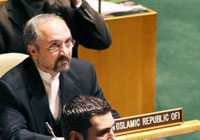
"The European Union must realize that a political approach to terrorism, which threatens the lives and security of people around the world, is totally unacceptable for the global public opinion," Iran’s permanent envoy to the United Nations, Mohammad Khazaei, wrote in a Wednesday letter to the UN Secretary General Ban Ki-moon.
"The EU’s politically motivated decision will not change the terrorist nature of the group. It will not ‘turn the page’ of history on the cult’s terrorist activities and massacre of innocent civilians, nor will it cleanse the terrorist group of its criminal past," he added.
Khazaei added that the removal of the group from the European list of terror organizations had caused great pain for over 14 thousand people who had lost their family members in MKO terror attacks.
The Iranian envoy called on the EU to revise its decision by sending a collection of evidence it has to European courts explaining the terrorist nature of the MKO, and resolving the technical objections that had led to the court ruling.
On Monday EU ministers removed the exiled anti-Iran group from their list of terror organizations, following a European court ruling in favor of the group, which has accepted responsibility for many deadly attacks against Iranian and Iraqi civilians and cooperated actively with the regime of former Iraqi dictator Saddam Hussein.
In one of their deadliest attacks, the MKO carried out a 1981 bombing that killed Iranian Judiciary chief Ayatollah Mohmmad Beheshti and 71 other senior officials.
Among their most recent terror activities is the 1999 assassination of the chief-of-staff of Iran’s Armed Forces, Ali Sayad Shirazi, just outside his house in the early hours of April 10th, as he was preparing to leave for work.
MKO is notorious for the cult like tactics it uses against its members, and the murder and torture of its defectors.
Numerous articles and letters posted on the internet by family members of MKO recruits confirm reports of the horrific abuse that the group inflicts on its own members and the luring recruitment methods it uses.
http://www.presstv.com/Detail.aspx?id=84026§ionid=351020101
G.P. Put on line 27/01/2009 – For Josy Dubié (Belgian MP), there is not a doubt that PMOI is "a sect". The Belgian senator draws from his memories ![Josy Dubié :"They[PMOI/MKO] are still as sectarian as before",](https://st.nejatngo.org/Image/Politician/Josy_Dubie/Josy_Dubie_Belgium_MP_1.jpg) international reporter to the RTBF to affirm it. At the end of the Iraq-Iran war, they are the combatants of this organization which Saddam Hussein had sent like "flesh with canon" at the time of the battle of Mehran, in 1989. The treatment that Moujahidine held for their own troops, the women like the men, and that they applied to their Iranian prisoners were abominable, explains in substance Josy Dubié. "I know them from inside" , continues the senator, " and I can say to you that their behavior is to be brought closer to that of the members of Scientologie". Didn’t they evolve since the Eighties? Josy Dubié does not believe in it at all. "They are still as sectarian as before", he ensures. "However, there is in Iran an opposition much more democratic than that of Moujahidine of the people, the laic opponents, the members of the Communist party Toudeh, the sympathizers of the former Prime Minister Mossadegh ". And Josy estimates that one should not count on OMPI, which " do not represent anything the whole in Iran".
international reporter to the RTBF to affirm it. At the end of the Iraq-Iran war, they are the combatants of this organization which Saddam Hussein had sent like "flesh with canon" at the time of the battle of Mehran, in 1989. The treatment that Moujahidine held for their own troops, the women like the men, and that they applied to their Iranian prisoners were abominable, explains in substance Josy Dubié. "I know them from inside" , continues the senator, " and I can say to you that their behavior is to be brought closer to that of the members of Scientologie". Didn’t they evolve since the Eighties? Josy Dubié does not believe in it at all. "They are still as sectarian as before", he ensures. "However, there is in Iran an opposition much more democratic than that of Moujahidine of the people, the laic opponents, the members of the Communist party Toudeh, the sympathizers of the former Prime Minister Mossadegh ". And Josy estimates that one should not count on OMPI, which " do not represent anything the whole in Iran".
Lalibre.be
Massoud Rajavi, affected by leftist and political cultic relations, grabbed hold of religious considerations to immunize himself against encountered challenges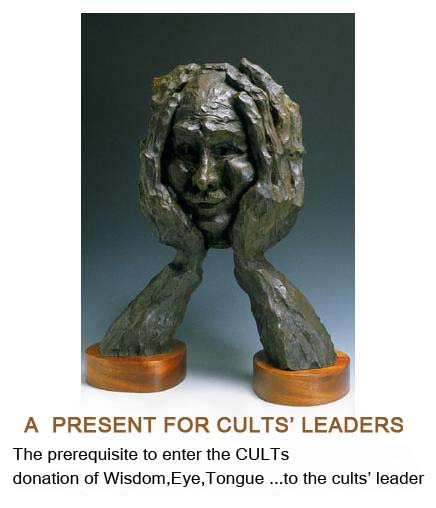 and criticisms and hence, stabilizing his unquestionable leadership in MKO. A significant point to be mentioned is Rajavi’s misusing of religious and ideological factors simultaneously. Singleton elaborates on the interpretation Rajavi made of democracy and responsibility of leaders writing:
Rajavi’s idea of democracy has always been that everybody has the chance of choosing a leader once in their life. As far as he is concerned, people chose either him or Khomeini. After that, the responsibility lay only with the leader, not the individual. People should have no moral guilt if they are totally obedient to the leader. Therefore, good and bad are not for the individual to decide. Members are not even responsible before God because the leader has sacrificed himself to take all their responsibility before God. 1
In fact, Rajavi pursued two objectives. On the one hand, he was likely to convince members to carry out organizational tasks submissively and on the other hand, he was after making himself free from any challenge and criticism. As singleton puts into words, Rajavi justifies his policies as follows:
Later Rajavi implied in his speeches that if such a leader has done his job well enough, then he starts a relationship with the Imam Zaman (the last and still awaited Imam in Shiite Islam) and therefore has direct contact with God. He brought examples from Prophet Mohammad and compared himself to the Shiite Imams. The result of this was to create a mentality of complete lack of responsibility, which would allow the person to take part in suicide bombings or Forouq-e Javidan or any other actions. 2
There are parallel instances of the same mechanisms used by other cults concerning the immunity of leaders against challenges. A look at the statements made by former cult members may bring into eyes the similarities found between cults in this regard. Steven Hassan, a detached cult member himself, refers to the mechanisms used by Marshall Applewhite, his cult leader, and writes:
Charismatic cult leaders often make extreme claims of divine or "otherworldly" power to exercise influence over their members. Many legitimate religions have had powerful figures who have inspired enormous dedication in people. Being a powerful leader is not inherently wrong, though it carries a high potential for abuse. A group becomes destructive when its leader actively uses such power to deceive members and to rob them of their individuality and free will. For example, I was told to surrender my free will (viewed as Satanic) to God’s representative, Moon, and his sub-leaders. Marshall Applewhite told followers that an alien entity was speaking through him, and used this message to justify his absolute control over their lives. Leaders of numerous groups-including the Twelve Tribes, International Churches of Christ, and Jehovah’s Witnesses-claim it is God’s will that members follow them. 3
The effects Stalin had on Rajavi has not to be ignored. Rajavi followed Stalin who claimed to assume political as well as ideological leadership of Marxism and introduced himself as he unquestionable interpreter of Marxist principles. In fact, opposition to Stalin was considered as opposition to Marxist ideology rather than Stalin’s political and strategic theories. As a result, his opponents were considered ideological deviants and were accused of betrayal, espionage, being agents of capitalism, and were sentenced to death by Stalin. Before the development of ideological revolution, Rajavi like Stalin favored democratic centralism and council leadership. Contrary to what is common in MKO at the time being, its organizational principles and pamphlets have referred to leader’s criticism as an organizational necessity:
The necessity of establishing democracy is not just for the sake of claiming to have democracy in the organization (as a liberalist decoration), rather its full implementation aims to revise the decisions made by the organization and its leader on the part of the rank-and-file who are in direct contact with the public and immune leadership against errors and deviations. Since, the leader responsible for decision-makings is likely to make mistakes and is not free from error. 4
The ideological revolution of Mojahedin was initiated under the influence of cultic relations to justify unquestionable as well as cultic leadership of Rajavi by means of controlling mechanisms and brainwashing techniques. It managed to immune leader against all likely criticisms and challenges; from then on the dissidents were known to be the deviated and any posed question an unforgivable sin. The leader was no more responsible fir organizational errors and failures but it was on rank-and-files. As an example, after the failure of the operation Eternal Light, Rajavi accused members and absolved himself from assuming its responsibility. From a psychological point of view, this kind of relationship puts the leader always in an offensive position and members in a position of responsiveness to leader as is common in almost all cults.
Resources:
1. Anne Singleton, Saddam’s private Army, Iran-Interlink, 2003.
2. ibid
3. Hassan, Steven, releasing the bonds, Freedom of mind press, 2000, p.4.
4. The study of the possibility of democratic centralism or the difference between scientific and non-scientific doubt in organizational issues, MKO publication,1980, pp. 40-43.
Never accept Iranian Ben Ladan in the European parliament to batter the popular legitimacy of the European nation’s House. Undoubtedly, Maryam Rajavi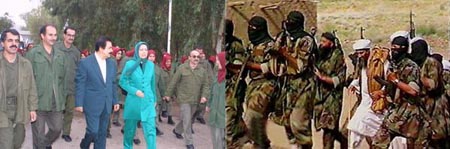 (Iranian Ben Ladan) the leader of the People Mojahedin Organization of Iran (PMOI) is more dangerous and vicious than Afghan Ben Lad an. The west should be on a high alert not to be decoyed by her new sham guise as an advertisement released via her recently under the title of “the ten- point platform for future Iran” in US daily news paper, the Washington Times in January 14 issue. Mr. President, please pay attention to my reasons as a live witness and her victim during last twenty years who has been under her authority and cage in Ashraf garrison situated in Iraq. Meanwhile, I have been separated from Mojahedin cult a year ago and came to France.
In her advertisement, she tries to express her dreams and illusions for “future Iran” with the ill-usage of the international norms and conventions. But, fortunately, she has even no place in her former Ashraf garrison, so, how she intends to make the history of Iran!?!
Let me explain an Iranian maxim which is appropriate for her conditions to make everybody snicker for a while. “A villager person was not allowed to enter the village, but she asked the address of the village bailiff home”. No doubt, Maryam Rajavi has the same story of the villager with her perpetrated crimes and deceits. So that, she has no permission to settle down in any state either USA or Europe, however, she has been indicted by international and local tribunals as such France and Iraq.
To know and understand her serial fobs and illusions, let’s focus on her contradictions in practical fields and her ten- point platform. To save time, let me compare only two of these articles of her platform with her present and past activities and thoughts. In the article 7 of her platform, she claims, ‘we are committed to the Universal Declaration of Human Rights and…’, but, the question arises how she interprets and replies the articles 12 and 16 of the Universal Declaration of Human Rights in comparison with her inhuman activities e.g. forceful ideological divorces of thousands impeccable men and women as well as wrecking and shattering the family foundation and….
Article 12: “no one shall be subjected to arbitrary interference with his privacy, family, home or correspondence, or to attacks upon his honor and reputation. Everyone has the right to the protection of the law against such interference or attacks.”
Article 16: “(1) men and women of full age, without any limitation due to race, nationality or religion, have the right to marry and to found a family. They are entitled to equal rights as to marriage, during marriage and at its dissolution.” “(2) Marriage shall be entered into only with the free and full consent of the intending spouses.” “(3) The family is the natural and fundamental group unit of society and is entitled to protection by society and the state.”
Mr. Mirek topolank, please ask Maryam Rajavi to answer the human conscience and the public opinion of the West regarding forceful and dictated divorces and illegal marriages in her cult by her husband Masood Rajavi who is the lifetime leader of the PMOI. I think a particle of her above mentioned crimes regarding dictated divorces and marriage is enough to prove high contradictions between her false platform and her practical activities.
Mr. President, please let’s check the article 9 of her platform to discern her mock intentions and goals regarding international problems and disasters, “our foreign policy will be based on peaceful coexistence…” as a matter of fact, as a live witness, I got shock of observing such a scene at the time of the occurring of “the September 11 disaster” when Masood rajavi made such speeches, “this is reactionary Islam did such an action, thus, we, the revolutionary Islam can do much better than them. And worse than such a sentence which exposes the nature of the Mojahedin cult’s ideology and thought, was that Maryam Rajavi confirmed his speeches with nodding and smiling.
Now, the question is that is it fair and justice and a just decision to stain the scene of parliament via her presence in the nation’s house?
Yours truly
Hamid Siah Mansouri, Paris, January 25, 2009
The European Union has agreed to remove the notorious Mujahedin Khalq Organization (MKO) from its list of banned terrorist groups. 
EU foreign ministers approved a decision to remove the outlawed terrorist group from a list that includes Palestinian Hamas and Sri Lanka’s Tamil Tigers, an unnamed European official was quoted by Reuters as saying.
The group also known as the”Rajavi cult”named after its leader Maryam Rajavi stepped up efforts to be excluded from the list in 2008.
In November Rajavi met with members of the German Parliament in a bid to rally support for the removal of the group from the European Union’s list of terrorist organizations.
The European Court in Luxembourg ruled in December that the EU was wrong to keep the group’s assets frozen.
“What we are doing today is abiding by the resolution of the European court,”EU foreign policy chief Javier Solana told reporters just before the ministers finalize the decision in a meeting in Brussels.
The MKO, which has been listed as a terrorist organization in Iran and the United States, has a long and bloody history of targeting Iranian civilians and government officials.
Incidents linked with the group include the June 1981 bombing of the offices of the Islamic Republic Party in which 72 high-ranking Iranian officials including judiciary chief, Ayatollah Mohmmad Beheshti, and tens of Majlis deputies were killed.
In the following August the group assassinated President Mohmmad Ali Rajae’i, Prime Minister Javad Bahonar and National Police Chief Ali Dastgerdi at the Prime Ministry building.
The MKO also assisted Iraqi dictator, Saddam Hussein, in the massacre of thousands of innocent Iraqis and is responsible for several acts of terror in Iran including the 1994 bombing of a revered Shia shrine in Mashhad, eastern Iran.
In 2003, French anti-terrorist police arrested 165 members in Paris, including Maryam Rajavi, for ‘associating with wrongdoers in relation with a terrorist undertaking.’
More recently, around 10 members of the notorious organization were arrested in France and Switzerland on charges of money laundering on September 29, 2008.
Europe: Safe Haven For Terrorists
The European Union routinely accuses Iran of sponsoring terrorism for their support of the military wings of Hezbollah, Hamas and Islamic Jihad, forgetting to mention that these are the armed wings of legitimate and democratically elected political parties, who have a legal right to resist Israeli occupation under internationalal law, and are only designated as terrorists organisation by the EU for political reasons – i.e. the EU supports Israel. But what is rarely reported is the extent to which the EU supports terrorist groups. It has reportedly been agreed by EU states to remove the anti-Iranian Mujahedin Khalq Organisation (MKO) from the designated terrorist organisation list in the near future, which makes an absolute mockery of the EU supposed objection to terrorism.
The MKO cult is notorious for committing countless atrocities in Iran and Iraq. In Iran alone, their terrorist attacks have claimed over 12,000 deaths and in Iraq, as well as committing war crimes against the Kurds under the Saddam Hussein regime, they are accused by the current Iraqi government of carrying out terrorist attacks and destabilising the country, despite supposedly being in US custody. The Cult also stands accused of assassinating and torturing dissidence and human trafficking. They have also used self-immolation (suicide bombing!) as a tactic to protest against their designation as terrorist organisation in Europe.
This is why America, Canada and the EU have previously refused to remove the MKO from their terror lists, and as recently as the 12 of this month, Condoleezza Rice announced that the MKO group would remain on the US terror list. So why the change in the EU position now?
Since 2003, Camp Ashraf, the MKO HQ, which is located in Iraq’s Diyala province, along with its 3,400 inhabitants have been under American military control – the Bush regime wanted to protect the 3,400 known anti-Iranian terrorists from being taken into Iraqi custody, so granted them protected status – but since beginning of January control of the base and its inhabitants legally passed to the Iraq government, who have ordered the base closed and all MKO cult members to either return to Iran or select a third country to be deported to.
Obviously it would be politically difficult, if not impossible, for any EU state to open up its borders and welcome 3,400 designated terrorists cult members with open arms, and Obama defintely isn’t going to do it. So quietly the EU has been dropping its resistance to MKO under the pretense that the cult has been disarmed. And the group has one a series of barely contested legal cases. Now that they no longer have a presence in Iraq, it will be easy to argue that they pose no threat to Iraq or Iran, and that might well be true, but this terror cult will be a much bigger threat to Europe than al-Qaeda ever was.
The MKO is committed to the violent overthrow of the Iranian government and enforcing their own brand of fascism, despite the fact that Iranian government was democratically elected (a point often forgotten) and the MKO is universally loathed in Iran and has a long history of anti-western violence as well.
stephiblog.wordpress.com/2009/01/23/europe-safe-haven-for-terrorists
In order to draw a clear picture of cultic groups, it is necessary to have a better understanding of the personality features of cult leaders due to the absolute dependence of cultic relations upon leadership. Almost all  psychologists and researchers in this era are unanimous that the main part of this understanding is to be concerned with personal as well as psychological features of leaders that play a crucial role in all cults. Evidently, psychology is the science that may prepare the ground for acquiring a comprehensive knowledge of various aspects of cult leaders. In this regard, it has been written:
A cult cannot be truly explored or understood without understanding its leader. A cult’s formation, proselytizing methods, and means of control "are determined by certain salient personality characteristics of [the] cult leader….Such individuals are authoritarian personalities who attempt to compensate for their deep, intense feelings of inferiority, insecurity, and hostility by forming cultic groups primarily to attract those whom they can psychologically coerce into and keep in a passive-submissive state, and secondarily to use them to increase their income. 1
Of these fundamental aspects is the leaders’ egocentric personality and unquestionable control over members. This kind of relationship is developed first as a result of leader’s charisma rather than the exercise of power and in itself requires some catalysts and incentives to convince followers of the leader’s charisma. Now the question arises, how cult leaders exercise their hegemony over followers and put them under effect. Clearly, cultic relations depend on members’ persuasion and absolute submission, however, going through this phase needs the preparation of required background, internal motives and incentives to the extent members get convinced of leader power and charisma and consent to participating in cultic activities. Most cultic groups recruit members under the disguise of educational, medicinal, and social services and then expose them to the process of persuasion yet political groups grab hold to different approaches.
In order to come to an appropriate answer, we can rely on the data and results obtained in recent studies on cults. In the book “brainwashing” the role of catalysts has been referred to but not elaborated on. Looking at the instances of political cults in the contemporary world and their cultic relations, the role of the factor of catalysts may well be clarified. Catalysts are, to a number of cult members, who play a key role in the formation and development of cults:
Cultic groups usually originate with a living leader who is believed to be "god" or godlike by a cadre of dedicated believers. Along with a dramatic and convincing talent for self expression, these leaders have an intuitive ability to sense their followers’ needs and draw them closer with promises of fulfillment. Gradually, the leader inculcates the group with his own private ideology (or craziness!), then creates conditions so that his victims cannot or dare not test his claims. How can you prove someone is not the Messiah? 2
Organizational hierarchy present in all cults implies the presence of a minority group within cults that are of a key role in stabilizing the power of the leader to the extent that their absence in cultic relations may lead to the disintegration of cults. The function of these catalysts is different in different cults depending on the approach and policy taken by the leader.
The writer’s emphasis on the god-like status of cult leaders in the eyes of their followers is due to the fact that almost all cults have metaphysical beliefs rooted in their religious inclinations. Even the leaders of leftist groups opposed to metaphysics, in practice resort to the instrument of metaphysics as is evident in the reviewing of the last moments of the life of Stalin. There are a number of cult members who have a key role in the qualitative development of cults called catalysts and are traceable almost in all cultic groups.
In MKO, a notorious cultic group already blacklisted as a terrorist cult, a number of experienced early members play the role of catalysts. In the phase of the ideological revolution of Mojahedin, they played a key role in stabilizing the status of Rajavi as a leader. Their so-called letters of ideological revolution addressing MKO members had a dual role. On the one hand, they elaborated on the contents of the ideological revolution and Rajavi’s determining role in the history of MKO and on the other hand, they convinced members to follow the catalysts in recognizing the cultic and ideological leadership of Rajavi.
The statements of MKO’s political bureau issued and signed by these catalysts, who were in fact the speakers of the leader, implied their critical role. Mehdi Abrishamchi in his lecture on the ideological revolution which lasted several hours did nothing but honoring and praising Rajavi. He would state that the organization and its members need Rajavi’s leadership to understand the reality of the ideological revolution. Maryam Azdanlu, divorced from Mehdi Abrishamchi to remarry Rajavi, had also an effective role in raising the status of Rajavi. The main point focused by these catalysts was to make the leadership of Rajavi believable. They insisted to make members believe in the charisma and leadership of Rajavi. Their main duty, in Hoffer’s terms, was to undermine the power of thinking on the part of members and replace it with an absolute submission to cultic leadership of Rajavi. As Hoffer puts into words:
It is obvious, therefore, that in order to be effective a doctrine must not be understood, but has to be believed in. We can be absolutely certain only about things we do not understand. A doctrine that is understood is shorn of its strength. Once we understand a thing, it is as if it had originated in us. And, clearly, those who are asked to renounce the self and sacrifice it cannot see eternal certitude in anything which originates in that self. The fact lat they understand a thing fully impairs its validity and certitude in their eyes. 3
Therefore, looking at the role catalysts play in cults may clarify how leaders manage to exercise their authority over members. Reviewing the history of MKO since the execution of its early founders and intra-prison control of organization by Rajavi and his catalysts may clarify the determining role of these catalysts.
References:
1. Madeline, Tobias and Jania Lalich, Captive hearts; Captive minds, Halter House, 1994.
2. ibid
3. Hoffer, Eric, the true believer, Harper & Row Publishers, New York, 1951, p.76,77.
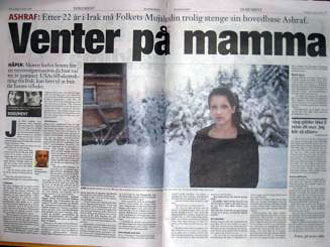
Noshin Bashiri was twelve years old when she learned that she had a mother in Iraq
She lives in the countryside outside Notodden center with her partner and cat. Noshin Bashiri (21) is free from the job that hjelpepleier the day Klassekampen will visit. She offers a treat of coffee and chocolate biscuits in the bright apartment, which is one of several in an old våningshus. We have a good time, for it is a long story she has to tell us. She has not told it to many, and never to journalists before. She seems a little surprised by our interest in it.
– Do you think that it will help? Do you think the mother will come back?
Noshin Bashiri’s mother is one of 3,400 members of the opposition group Mujahedin-e Khalq (MEK), or People’s Mujahedin, who live in Ashraf camp in Iraq. MEK operated under Saddam Hussein’s protection for many years. When his regime was toppled and Iraq was occupied by Americans, the camp was disarmed. MEK aims to overthrow the regime in Iran. But now maybe nearly 30 years of armed actions and terrorist are coming to the end. When Obama’s withdrawal plan from Iraq is set out in fact, the base will probably be left to the Iraqi authorities, who say they will shut down the base. Iranian Press TV reported on Tuesday of this week that Iraq had already taken over the responsibility. But what will happen to residents in the camp?
Bashiri hopes that her mother will come to Norway. But she has her doubts. She has been in Ashraf three times to try to get back her mother. Each time her mother remained in the base.
Bashiri thinks it is because she is brainwashed.
– First, you want her, but after talking with leaders in the camp, she ombestemmer him. They are in a way held there. If they had wanted to be there, it would be okay. But there are some who are forced to be there, and it is completely wrong”, said Bashiri and looks at the fresh snow that has fallen on the white fields outside
Three weeks earlier in an office in Teheran our curiosity was sparked when the name "Bashiri" was mentioned along with "Norway". Klassekampen was reporting from Tehran and the office of Islamic law, which follows the foreign journalists, said it would be happy that we met the Nejat non-governmental organization, composed of defectors from the Mojahedin-e Khalq (MEK).
Nejat means "salvation" and aims to help those who wish to get out of Ashraf-camp. In 2004, Iranian authorities gave amnesty to members of the organization who wanted to return to Iran. In cooperation with, among others, the Red Cross Nejat has now helped 800 to leave the camp and establish a new life. 500 have established themselves in Iran in spite of the many Iranians who regard them as traitors, because of cooperation with Iraq during the Iran-Iraq war and going on to attack Iran. They have also killed several civilians in acts of terrorism, including 26 pilgrims who were killed when MEK blew a bomb in the Imam Reza holy shrine of the 8th Imam in the holy city of Mashad.
Nejat is concerned with reconciliation and that those who come out of the camp get psychological follow-up. They also advise families in how they can be a support for ex-members. Since some have lived as long as 22 years in isolation, they have missed the important mental development and sense of community around them. According to the organization Human Rights Watch there has been serious human rights violations inside the Ashraf-camp. In a report from 2005, partly based on interviews with dissidents, HRW uncovered cases of total isolation, cruelty, verbal and psychological abuse, threats of execution and torture, which in two cases led to death. The report was met with sharp criticism of the Mujahedin when it was launched. Among other things because the interviews were conducted by telephone. As a result of the criticism Human Rights Watch carried out a further report, this time directly with the dissidents, and they came to the same conclusion.
Ebrahim Khodebandeh, spokesperson for Nejat, mentions Noshin Bashiri and her father as an example to illustrate that the MEK recently have been more reluctant when it comes to allowing their members to come in contact with the family. Nejat assisted the Bashiri-family and two other families from Iran and Canada in January 2007. They waited for several weeks in Baghdad before they had contact with the base, located near the town of al-Khalis, north of Baghdad. When they finally came into Ashraf, Noshin and Alireza Bashiri met members of the MEK, but they did not meet her mother and his former wife. Strains from the trip had been so tough that the young woman suffered a late miscarriage.
We are in Notodden to check the history of Nejat against Noshin Bashiris history, and the young woman confirming everything together. Also, about her miscarriage.
– I do not know if it was because of the strain, or whether it would have happened anyway. But to be taken care of by the Iraqi hospital was a terrible experience", said Bashiri.
An important additional piece of information she has, nevertheless, which Nejat did not have from her.
– I was talking to mom in five minutes. She saw me in the camp and pulled me into a tent where we were talking a little" said Bashiri.
Her mother had made it clear to Noshin that she would not join her in Norway. She had been agitated and had said that she did not have as much time to talk, because she had to work.
Repeatedly, there was a man who disturbed them and insisted they should take a picture together.
After this last trip to Ashraf was Noshin tired.
– I cannot be bothered to get there more. I get so tired. Also, it is not easy to take time off for five weeks as we had last time. It is not only just to travel in Iraq, "said Noshin.
She has much to tell, and wonder if we can take a break so she gathers herself together somewhat.
Noshin Bashiri was twelve years old when she learned that she had a mother in Iraq. It was his father’s new wife, who said that she was not her biological mother. She first came into the picture when Noshin was seven.
– Dad married again so that I would have a mother, "said Noshin.
But after Noshin was informed that she was not her biological mother, the relationship between them deteriorated. Today the father Alireza is divorced. It is only Noshin and her father Alireza Bashiri which represents the family in Norway, as it was when they were re-united when Noshin was four.
She remembers nothing from the first three years of life when she was with the mother. What she knows is primarily based on what her father told her.
– Mom and Dad were married when they lived in Iran, then they moved together to Germany where they had me. In Germany, they were familiar with some of the Mujahedin who advertised for the organization and urged them to travel to Iraq to join the resistance movement. They left when I was three months old. But after two years was dad regretted it. He knew that [the struggle] there was not serious. He insisted on leaving and came to Pakistan, and so my mum and I were left, "says Bashiri.
She says that the main reason why her father was upset was that he could not be with his family.
– When we got there, there were many who were married and had kids. But then all had to distinguish themselves, because they should be soldiers. That was when Dad did not accept anymore. He did not see me more than once a week. It seemed he was difficult. It was not why he had gone to Iraq. He quarrelled with the leaders of the camp to come home every night to where mom and I were so he could see me. Finally he accepted no more. He also hoped that I could come to a country where I could have a better life. Dad thought so, but not my mom. She thought that I could be OK there" said Noshin.
How was it not? When Saddam Hussain invaded Kuwait in 1990, it was decided that there would be no young children in Ashraf-camp.
– They sent out all the young kids because there was a war. Those who did not have family abroad, were sent to foster families. I came to a foster family in Syria first. When dad found me there, he contacted the Mujahedin in Oslo, and so I was sent to Norway" she says.
Thirteen years later, when the United States had occupied Iraq and taken control of the Ashraf base, Noshin’s father Alireza Bashiri travelled to Iraq to meet the woman he is still married to under Iranian law, but the MEK would not let him meet her. The year after, father and daughter travelled together. Alireza still cannot meet her, but Noshin got a foot in the camp. After fifteen years of separation the mother and daughter were together for five days.
– We got a room where we would share a double bed. We were almost never alone. The people came to us the whole time. We could not be alone much and talk together. Mom awoke early every day and went out and worked. They made food, arranged the garden, washed clothes. It was work from morning to evening, and at night they switched over to guard duty. For me, it seemed as if they had so much work so that they should not be alone much and think. If you think too much you’ll see that they have no life. There are so many who have been there for too long, so they almost do not know how it is to live outside of Ashraf" said Noshin.
Noshin tried from the beginning to get her mother to consider a life outside the camp.
– She said only that she could not go because she could not abandon the work for their country. She said she did it for me, and that Iran would become a free country and throughout the regulations where, say Noshin.
After two days of persuasion from her daughter, the mother began to slide.
– She began to say that maybe she should come to Norway and have contact with the Mujahedin from there, for she would not break with them. She would not have the reputation for that.
The third day the mother said that she would ask the leaders if she could go.
– She came back to let me know that it was okay. She would get the trip. She only had to complete some things first.
The agreement was that she would come after six months. But she didn’t turn up. When a year had passed Alireza Bashiri went there alone. He did meet her for ten tough minutes.
– She had surrendered herself to them completely. Now she would not travel at all. She stood and cursed at Dad and said he cooperated with Iran and that he was a shame for their country. After a long outpouring she just left without saying goodbye to him, said Noshin.
The following year they travelled down again. It was on this last trip they had assistance from the organization Nejat. After several weeks of waiting Noshin and her father and the other families as well as representative from Nejat managed to get into the camp. They sat in a small room for three hours and waiting for clearance from the leaders to meet their family members. Noshin felt sick with the heat in the room and went out to get fresh air. It was then that she saw her mother.
– She saw me and dragged me into a tent only a few meters away.
Noshin recounts the conversation with her mother for us. They could only speak for five minutes. The whole time the mother couldn’t concentrate and broke her thread of thought and was concerned about a man who repeatedly came in and nagged them to take pictures.
– Come here, so we take pictures together" she said.
– Can we not sit and talk a little, I have not seen you for so long. Why have you not come? You promised that the last time.
– No, I changed my mind. There is nothing for me to do in Norway.
– But I need my mother.
– No, you do not. You are an adult. You are 20 years old, so you do not need a mom" she says and starts to laugh.
– What are you doing here? Asked Noshin.
– Do you think you are the only kid without a mother? There are hundreds of thousands who have no mamma. You are not the only one here.
Noshin shakes his head.
– She was like so rude too.
– Are you mad at your mother?
– In a way I am. Nothing is more important than your kid, I think. But Mom said that her country was more important than me. She said that there were many kids who had it as hard as me. I was not the only one. So it was cool really. I should just be glad that I do not still live with a foster family, but that I lived with Dad" she said.
It has been impossible to determine how many children of Mujahedin members have grown up without their parents, but it is a known issue that women in Ashraf-camp sent their children away.
In 1999, a women’s magazine printed a report on Ashraf-camp by the British journalist Christine Aziz. Her approach was feminist and in the report, we meet the tough female soldiers who operate weapons training. The women also speak as victims of what they have done, that they have to live in seclusion, and that they have to give up children so that they don’t get hurt.
– I had to give up my kids, and they now live in the Netherlands, says Zahra in the report: "Her face is black with oil and sand, and her hands are red and sore after the effort to maneuver the heavy vehicle. She looks up at the gun during speaking:
– I love my tank, "she says, smiling and slapping it.
After Noshin and father had come back to Norway after this last visit to Ashraf base, the mother was put on a programme on the Mujahedin’s TV,(they also have a satellite channel).
– She said that Dad had fooled me so that I had been a shame, because I worked with Iran. She claimed that I had been deceived by my father and that it was unfortunate that some had a child like me.
Noshin shakes his head.
– I have also seen the film of members of the Mujahedin who set fire to themselves in response to the arrest of their leader. They are quite brainwashed" she says.
Noshin’s father should have told the mother that she has been subjected to threats.
– They have said that if she travels with me, they will get their people in Oslo to send someone to kill me. I do not think anything of it, but she is terrified, and dare not say anything against them" said Noshin.
She thinks it’s strange to think that she is now as old as the mother was when she went to Ashraf-camp. We’re shown a picture of her just before she left Iran.
The photographers want us to go outside to take their pictures of Noshin. After the photographer has finished, we ask:
– What do you think when you see the pictures?
– I think that it is my mother.
Åse brand vold, Klasse kampen, January 20, 2009
http://www.klassekampen.no/