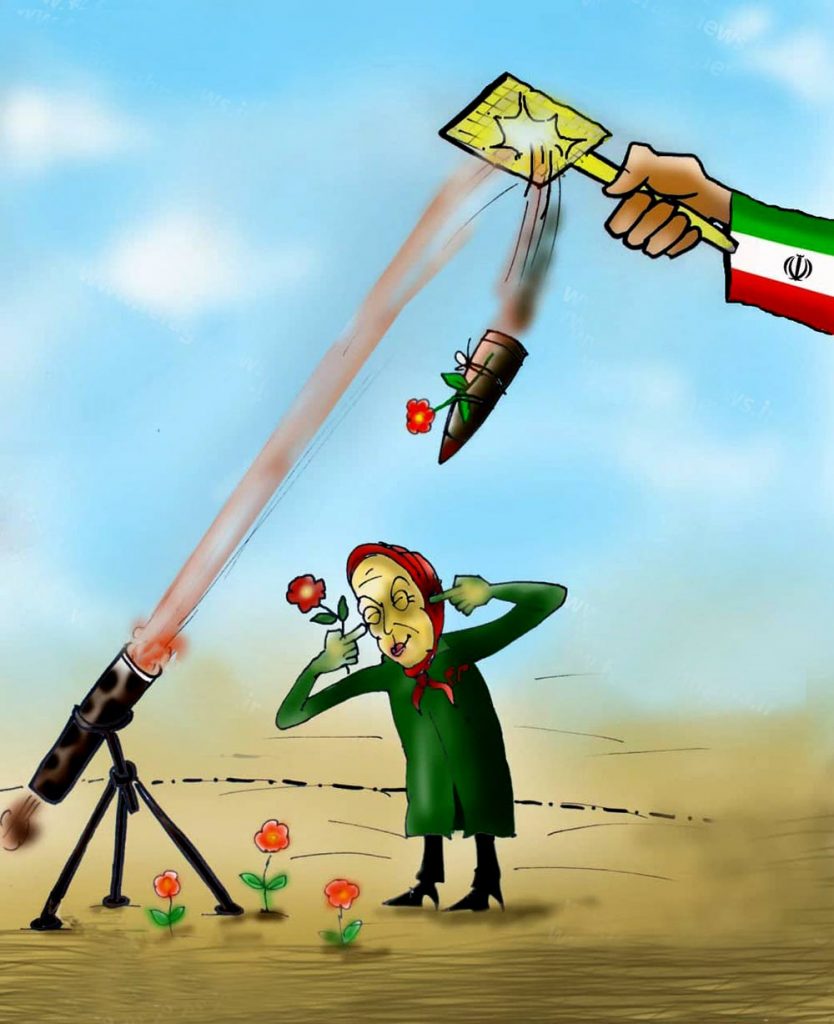
Maryam Rajavi tries to cover her violence under benevolent gestures but the Iranian people’s hatred returns the path of the bullet against herself

Publication: Terrorism Monitor Volume: 16 Issue: 19
Following the U.S. invasion of Iraq, the Mujahedeen El-Khalq (MEK) was the subject of frequent attacks from Iranian-backed proxies, which overwhelmed their members residing in camps Ashraf and Liberty in Iraq. Before this, MEK, an Iranian dissident group, began living in Iraq in the early 1980s under the protection of Saddam Hussein. As a group in exile, MEK sought refuge in Iraq under the protection of Hussein, who utilized their military capacities and ties to Iran to undermine the Iranian regime. Until 2012, the MEK was identified as a terrorist organization due to its activities inside Iran and against other regional and international powers, including attacks against U.S. diplomatic personnel and businesses operating in Iran in the 1970s. [1]
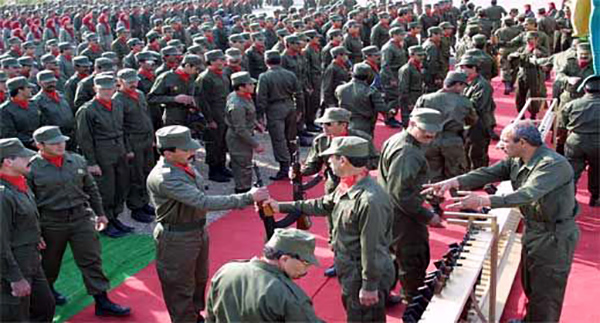
Following a series of lobbying efforts by MEK leadership and supporters, the group pledged to give up their weapons and violent tactics as a means to be delisted as a designated terrorist organization. [2] As a consequence, in 2013, the U.S. government pleaded to a number of governments to provide refuge to the MEK members, including Romania, which was the preferred destination at the time. Albania—grateful to the United States for its support during the war in Kosovo and advocating for its bid to join NATO and the EU—was the only country that responded positively to the request. Albania initially admitted some 200 members between 2013 and 2014. The United States and Albanian governments have extended the agreement since 2013, increasing the number of asylum seekers to somewhere in the range of 500-2,000 MEK members. During the summer of 2016, Tirana received the largest contingent of about 1,900 people, an operation managed by the UNHCR (Shekulli, March 12, 2016). Part of the agreement with Washington was the development of deradicalization and rehabilitation programs to be offered to members of the group.
Now, the group is residing in the outskirts of Tirana’s capital in a highly fortified camp located in Manëz. From this camp, the group is allegedly intensifying its political activities aimed at bringing down the Iranian regime (Exit.al, March 14). With emerging threats coming from radicalization and violent extremism, due to the rise of the Islamic State and other political Islamist groups in the region, the Albanian government may not be prepared or equipped to respond to the potential implications the group’s presence in Albania may bring.
MEK Activities and Support in Albania
There are a number of opportunities MEK is exploiting in order to restart its political activities against the Iranian regime now that they are residing in Albania. Recent propaganda efforts by the group’s leader, Maryam Rajavi, the widow of the founder of MEK, Massoud Rajavi, suggest that she sees herself as a key actor in fostering the opposition in Iran and subsequently bringing down the Khomeini regime (Exit.al, March 14). Much of the group’s propaganda material available online is translated in Albanian and seeks to also reach out to a local audience in their host country (Iran-interlink.org).
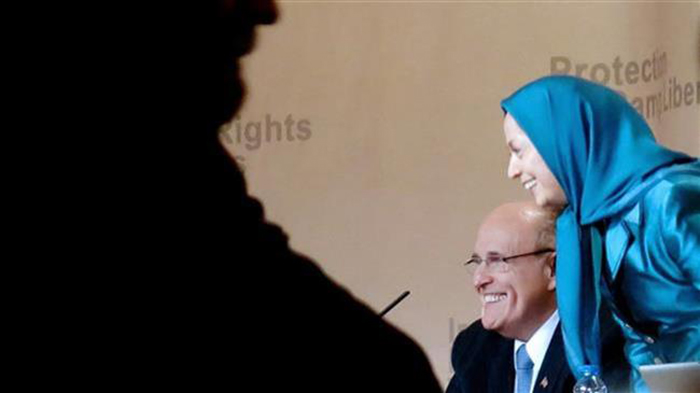
Moreover, the group has gathered significant support from important U.S. leaders who do not shy away from expressing their support for MEK’s potential rise as Iran’s future “democratic government” (Exit.al, June 26). This sentiment is frequently expressed on a number of occasions when important figures of the U.S. political landscape have personally visited Albania and spoken at rallies organized by MEK in Tirana (KlanTV, March 21). The most recent gatherings saw figures such as John Bolton (now U.S. National Security Advisor), Rudy Giuliani, one of President Trump’s most trusted advisors and personal lawyer, and late U.S. Senator John McCain, among others. The three seemingly demonstrated their support for MEK to be at the center of regime change in Iran (Exit.al, June 26).
The reasons why the Trump administration is supporting the group’s political objectives are unclear. It is also unclear the level of support MEK still has among the population in Iran, but it is becoming increasingly obvious that MEK is also making some powerful friends in Tirana as well. Over the years, key leaders from the Albanian government and civil society organizations have similarly provided their support during rallies and conferences organized by MEK in Paris as well as in Albania, where its new headquarters are located. In May 2015, Albania’s former Prime Minister during the war in Kosovo and current Minister of Diaspora, Pandeli Majko attended the National Council of Resistance of Iran rally in Paris with a large delegation of parliament representatives, journalists, lawyers and some civil society representatives, reiterating Albania’s support for Iran’s resistance and promising his personal support for regime change. [3]
In an impassioned speech over a cheering crowd, Majko said “whether you want it or not, you have involved us in your story, in your drama, in your tragedies and we understand you very well…some years ago, an American President was in Berlin and from Berlin, this politician, this great man declared ‘Ich bin a Berliner’. And in the name of my friends and in Albania, I’ve come here to say ‘Men mujahed astam’. I have a dream to come soon to Tehran. Invited by you.” [4] At the time, Majko’s attendance in the Paris rally was not covered by local media.
Despite the group’s increasing political support, recent media reports and several incidents between MEK members and local communities in Albania expose their continuing secretive activities and ongoing struggles to receive legitimacy as a democratic organization. Over the years, several media agencies have been interested in documenting the lives of MEK members in Albania and their political struggles in Iran. Channel 4, a well-known British news agency, recently traveled to Albania to do the same. The film crew was met by hostile private security who were guarding the highly fortified Manëz camp. Camp members physically attacked Channel 4’s camera crew (Shqiptarja.com, August 19). This was an unprecedented event that raised several questions over the camp’s activities (Lapsi.al, August 19). The event was widely reported by local media, which was also able to obtain a threat assessment on the group by Albania’s Intelligence Agency. According to the report initially made available to Channel 4 and then to other Iranian and local media, the group remains “deeply indoctrinated” and some of their activities, including murders of their members, are similar to the ones in Iraq (The Iranian, August 2018).
Testimonies from dissidents who left the group in recent months speak of similar military trainings, indoctrination and pressure to follow the group’s ideology (Top Channel, February 13). Although in the early years some of their members who relocated to Albania sought opportunities to travel abroad and join family members in the West, some 200 members have fled the group and continue to live in Albania (Top Channel, February 13). There is no clarity of their legal status or the employment opportunities available in a country suffering from high unemployment rates. However, some advocacy initiatives—often seemingly pro-Russian and pro-Iranian—are already fostering opposition against the group. Some of this opposition is often portrayed by the MEK leadership as an operation conducted by Iran’s security agencies (Lapsi.al, August 19; Media e Lire, April 17; Nejat NGO, September 29) Moreover, integrating the rest of the members still in Manëz into Albania’s society does not seem to be in the immediate interest for the MEK.
Implications
The MEK’s presence and activities may have serious repercussions for Albania and Albanian policy-makers. Leaders in Tirana may not foresee the long-term consequences of expanding their role on foreign policy issues beyond the small Balkan nation’s traditional reach. The group remains an existential threat to the Iranian regime. Over the years, Tehran has supported significant raids via Hezbollah and other proxy organizations in Iraq to destroy the group and kill key MEK leaders. As a result, Albanian authorities should expect more involvement from Iran in its internal and regional affairs. At the moment, there are no clear signs that Iran’s presence is significant in the region. Authorities in both Kosovo and Macedonia, however, have raised alarm bells over Iranian-linked NGOs having ties to terrorism-related activities in the past (Balkan Insight, June 25, 2015). If no effective responses are undertaken, MEK’s presence and Iran’s attention towards the Western Balkans may inflame sectarian divides in smaller communities and amplify regional rifts. Sectarian division is a latent phenomenon among Albanian Muslims, but they also remain under the pressure of other forms of Islamist radicalization. This is due to the emergence of Islamic State and Turkey’s instrumentalization of political Islam, among others.
Albania continues to struggle with endemic corruption and organized crime and the emergence of religious radicalization as a regional security threat and potential sectarian rifts may add to the list of challenges facing Albania’s political landscape. As a result, the country may not be prepared to inherit a long-standing struggle between a major regional Middle Eastern power and a former terrorist organization. Especially since both may utilize Albania’s internal vulnerabilities for their own political gains.
Notes
1.See U.S. State Department Press Release (US State Department, September 28, 2012).
2.Pandeli Majko’s speech in Paris, May 10, 2015:
3.https://www.youtube.com/watch?v=kIR97EP_phE
4.Ibid.
First published in October 12, 2018
By: Ebi Spahiu – jamestown.org
The Foreign Ministry of Iran strongly condemned a Belgian court’s ruling against Iranian diplomat Asadollah Asadi, saying the illegal prison sentence has been imposed under the influence of terrorist Mojahedin-e Khalq Organization (MKO).
In a statement on Thursday, Foreign Ministry Spokesperson Saeed Khatibzadeh said Tehran strongly condemns the 20-year jail term issued by a court in the Belgian city of Antwerp against Iranian diplomat Asadi.
“As we repeatedly announced earlier, all the procedures that have so far been taken against the diplomat, including his arrest, the case brought against him or the conviction, were all unlawful and amounted to blatant violation of international law, especially the 1961 Vienna Convention on Diplomatic Relations, and the Islamic Republic of Iran will never recognize it,” he said.
“Unfortunately, Belgium and some European countries have taken such illegal and unjustifiable actions under the influence of the atmosphere that has been created by the hostile MKO terrorist group on Europe’s soil,” Khatibzadeh noted.
Therefore, he added, they must be held accountable for their flagrant violation of the Iranian diplomat’s rights, including the inhumane conditions he faced under arrest in Germany and Belgium.
“The Islamic Republic of Iran reserves the right to resort to all possible legal and diplomatic means to realize the rights of Mr. Asadollah Asadi and to hold accountable the governments that have violated their international obligations,”the spokesman added, according to the Foreign Ministry’s website.
In June 2018, Belgian authorities said the police had intercepted a car carrying homemade explosives and a detonation device, claiming that Asadi had handed the materials to two people in Belgium earlier.
Asadi, himself, was apprehended in Germany the next day and told he could not apply his diplomatic immunity.
first published on February, 05, 2021
Throughout the contemporary history of Iran, numerous militia groups have been formed especially among the left streams,among whose common features are violent and terrorist measures. Although those groups were formed to fight the ruling political system, most of the victims of their operations were civilians. The Mojahedin-e Khalq Organization, also known as MKO or MEK, is one of the most well-known of these groups that officially launched its militia in the first months of the victory of the Islamic Revolution and started a period of violence and bloodshed in different parts of Iran. Now, nearly two decades after the MEK’s disarmament, the group has re-launched its terrorist cells under the new name”rebel centers.”
According to dictionary definitions, militia is a military force that is raised from the civil population to supplement a regular army in an emergency. Also, it has been defined as a military force that engages in rebel or terrorist activities in opposition to a regular army.What is meant by militia in this article is the latter definition i.e., the organized armed insurgent forces in the first years of the Iranian Revolution.
After the Islamic Revolution, the term militia was first used in Iran by the Mojahedin-e Khalq Organization (MKO) although this concept was not unfamiliar to left-wing groups. According to the statements and documents the MKO left behind, Massoud Rajavi, the group’s leader after the Revolution, announced formation of the militia on November 23, 1979 although it was officially announced on 27th of November in the Mojahed Magazine. The militia was an organized non-professional force whose members could continue education and work as well as organizational activities. Hence, a militia can perhaps be called a”part-time guerrilla”or, in MKO’s words,”part-time fighters”emphasizing its military and armed nature.
Iran’s Foreign Ministry says the US and Europe, as supporters of the MKO terrorist group, have the blood of Iranians on their hands.
The reason behind formation of the militia
After the siege of the American embassy and Ayatollah Khomeini’s mass mobilization order i.e., “the army of 20 million” on November 26, 1979, the MKO announced the formation of its militia. According to the military-political declaration No. 23 on November 23, 1979, the militia branch was formed in the MKO. In order to justify arming themselves and the formation of this small private army, the MKO announced that they aimed to stand against the United States (Collection of Declarations, Vol. 2, pp. 140-141). Mojahed, the official magazine of the MKO, on November 27, 1979 in its special issue No. 2, thanked Imam Khomeini and tried to turn the Supreme Leader’s order to its advantage by calling its militia the army of 20 million. They issued this statement:”And now all the revolutionary forces, all the brave warriors of the army and our brothers in the Revolutionary Guard Corps are to do everything in their power to establish the 20-million revolutionary army in particular and also organize the militia of thirty-seven million people”.
Next, the MKO issued another statement under the title of “regulations for carrying and maintaining weapons and objectives of the militia” to justify arming of most of their members. During the victory of the revolution, many army garrisons were looted by members of the MKO, and the group’s military branch, which had been active since 1971, was also illegally armed. Therefore, they used to pretend that their armed organization is somehow related to the regular armed forces in an effort to prevent sensitivities that arose after the formation of their militia.
Actions taken by the militia
Since January 1979, the militia was used as a lever at the service of propaganda techniques and social missions to disrupt social order and create confrontations in some neighborhoods of Tehran and other cities. Activities of the militia units augmented during the first presidential election campaign in support of Bani Sadr. Students made up majority of the members of the militia, and, given their revolutionary spirit and great interest in military and armed activities, they constituted a major part of these organized units’ recruitees. According to the policies of the MKO leaders before the crucial period of June 20, 1981, the militia units made several symbolic moves during this period in order to flaunt their power to the opponent. These units performed maneuvers to show their social power at different times such as December, January and February of 1980. At the time, Maryam Qajar Azdanlu (Rajavi), the current leader of the MKO, had various responsibilities with respect to organizing the women’s militia and leading female students’ revolutionary campaigns of construction activities in rural areas (Kayhan newspaper, March 10, 1980, p. 15). The militia marched from the University of Tehran to the US Embassy on Wednesday April 9, 1980, in order to demonstrate its firm grip on the opponents.
Following the tensions created by the MKO, on June 13, 1980, the militia demonstrated simultaneously in 10 locations in Tehran to exhibit its power. In this series of demonstrations, dozens of ordinary people and individuals resembling government supporters (characterized by being religious and having a beard) were beaten or injured by cold weapon. Dozens of buses, motorcycles and people’s automobiles were set on fire and the MKO chanted mottoes against Shahid Beheshti and the Islamic Republic Party and in favor of Bani Sadr. Most of the militia’s encounters in the clashes were physical and involved the use of cold weapon. Members of the militia had received military training and acted in an organized manner and could easily identify the opposition and beat them more. Throughout 1980, the militia started major riots in the cities of Sabzevar, Isfahan, Karaj, Abadan, Gorgan, Ghaemshahr, Tehran and Shiraz. Presence of the militia during Bani-Sadr’s speech at the University of Tehran on March 5, 1981, and its subsequent clash with government supporting forces was another manifestation of this militant group of the MKO.
On the afternoon of June 20, 1981, while the political inadequacy of President Bani Sadr was being examined in the Parliament, the militia which was equipped with knives, cutters, brass knuckles, Molotov cocktails, acid sprays and firearms (only for group heads and main cadres), organized demonstrations on streets of Tehran to revolt against the ruling government. Simultaneously with the movements in Tehran, similar sporadic clashes took place on a smaller scale in several cities such as Isfahan, Hamedan, Urmia, Shiraz, Ahvaz, Arak, Zahedan, Masjed Soleyman, Bandar Abbas and Mashhad, during which dozens were injured and several were murdered (IRIB Website).
Most of the militia’s activities were propaganda and sabotage. Up till June 20, 1981, the militia mostly performed as guardians of meetings and lectures of those they believed in. The activities they performed later on include selling the group’s publications, collecting financial aid for the benefit of the group, organizing construction campaigns in deprived areas of the country, and military activities. Construction activities of the militia and their presence in villages were mostly to compete with the Jihad of Construction (Jahād-e Sāzandegī), to carry out propaganda in favor of the MKO, and to gather supporters for this group, which in most cases failed. In fact, these actions of the militia, similar to the reason of its formation, were in competition with revolutionary institutions and organizations such as the Basij Force.
Having the illusion of owing the revolution, the MKO at this time tried to emulate the government structure as if it were a legitimate ruling system. The MKO had pinned its hope on the militia as a means of executing the group’s authoritarian intentions. Rajavi acknowledged that his militia had about 10,000 capable troops and used it to distrain the ruling government. This half-baked idea of the MKO soon created the illusion of being able to stand against the government. By triggering their revolt on June 20, which led to the apprehension or escape of the MKO militia members and exposure of their weaknesses not only in terms of military power but also in even revolting, this illusion quickly faded (Website of Rahenoo News Agency).
An Iranian Human Rights NGO for the first time releases the names of 1,503 martyrs killed by the MKO terrorist group in 1988.
Formation of National Liberation Army
In the street clashes of the summer of 1981 and on September 27, the militia, whose philosophy of existence was to form a private army for the promised day, entered the social insurgency phase once again by provoking students. According to the available documents, the militia organized eight unsuccessful riots between 1983 and 1985, which were of course much smaller than the flood of people supporting the revolution and simply failed. Nonetheless, the large-scale assassinations of government officials and ordinary people may be considered the greatest achievement of the MKO militia in these years (Document Archive of Habilian Association).
Coming to know its inability to conduct terrorist attacks inside Iran and according to the MKO’s policy on exiting the country, the militia gradually moved to Iraq and with the benefit of Saddam’s military and logistical facilities, changed its name to the so-called National Liberation Army in 1987. In his statement for the establishment of this army, Massoud Rajavi described the militia as the nucleus of the Liberation Army and said in that regard “… this is why the MKO founded the militia in the first year of (Ayatollah) Khomeini’s ruling” (Document Archive of Habilian Foundation). This so-called army of the MKO carried out several military operations against Iran on the battlefields during the last two years of the Iran-Iraq war and was eventually destroyed in Operation Mersad.
After the US occupation of Iraq in 2003, the MEK which was listed by the US as a terrorist group, was forcibly disarmed by the US Army and the group’s military wing was forced to hand over its heavy and semi-heavy weapons to the US forces in Iraq.
The MEK has since tried to adapt its tactics to the new situation. So, in order to get out of the terrorist lists in the UK, EU and US, it took a new approach that was more like a tactical change than a strategical one.In this way, through launching a political and propaganda campaign against Iran, the group sought to persuade the West that it is the only alternative to the Islamic Republic.In recent years, however, the MEK has attempted to direct its regime-change activities inside Iran by organizing its forces in the form of terrorist cells called “rebel centers”.
The fact is that the foundation of this group relied on armed activity both at the time of the official announcement of the formation of the militia in 1979, and during the 1980s. Thus, with Donald Trump coming to power and his non-diplomatic behavior and actions against Iran,the MEK gained the opportunity to gradually revive their past militant approach after 13 years of forced disarmament.
Launching terrorist cells
The MEK considered Trump to be the last circle of pressure on Tehran, whose unprecedented encounter with the Islamic Republic would lead to the collapse of the ruling political system in Iran. Thus, by focusing on the establishment of violent and terrorist cells inside Iran, they challenged the claim of some viewers regarding the group’s transition from military stage to the political phase and proved that the Mojahedin is still a violent militant group.
The remarks made by some senior MEK members during Trump’s presidency regarding the group’s new terrorist cells, known as rebel centers and describing them as an extension of the National Liberation Army militia prove that the political gestures of the MEK leader, Maryam Rajavi, are nothing but a deceptive approach to gain the support of some European and American politicians.
During the same period, the MEK carried out dozens of sabotage and violent operations against various targets in Iran. Although those operations did not cause any casualties or damage, the very establishment of terrorist cells and encouragement of the youth to join these destructive centers as well as inciting them to attack governmental and non-governmental sites, are examples of promoting violence and terror, and are as illegal as the threats of Canadian anarchist extremist groups to target the country’s infrastructure.
Now, with the end of the Trump era and fading of the MEK’s aspirations in the US presidential election, it remains to be seen whether the group’s terrorist cells will continue to act or not. Regardless of the ineffectiveness of the actions of these cells inside Iran during recent years, what seems to be important is that Europe has probably inadvertently become the main focus of the elements of this violent and terrorist group. Previously only present in Western Europe, former pro-Saddam Hussein militia terrorists have now spread to the other side of Europe, the Balkans.
(The views expressed in this article do not necessarily reflect those of Press TV.)
By Reza Alghurabi
Reza Alghurabi is an Arab journalist who lives in Iran. He is a former researcher at the Beirut Center for Middle East Studies and an independent researcher and journalist writing in Iranian newspapers including the Khorasan daily.
A true indication of the dire state of Albania’s politics, and a red line for the EU was on display in the UN Human Rights Council this week; an international forum in which Albania’s small voice would not normally be expected to cause controversy. Yet as Iran criticised Javaid Rehman UN Special Rapporteur’s comments on human rights in Iran, Dr Illir Nezaj from the Albanian embassy in Geneva found himself reading a prepared statement defending the MEK presence in his country.
In this speech, Nezaj claims ‘MEK is not a terrorist organization’. That will be news to the many thousands of victims of MEK terrorism in Iran, Iraq and beyond. Delighted that their man has done his job, the MEK lost no time in spreading this around social media, using the fake Heshmat Alavi account to disseminate the news. (Apparently, the MEK have misplaced their English-speaking team since the translation is full of spelling and grammar errors.)

However, critics of the MEK have welcomed the speech as it acknowledges once and for all in an international arena, that the MEK are a problem for Albania. Historian and activist Olsi Jazexhi Tweeted:
“If MEK is not a terrorist organization why does it run a paramilitary camp in #Albania? Why its members are kept in isolation? Why #MEK is fighting its defectors in Tirana? Why #MEK is smuggling people like #HadiSaniKhani into Europe? Why MEK is attacking foreign and local media?”
If MEK is not a terrorist organization why does it run a paramilitary camp in #Albania? Why its members are kept in isolation? Why #MEK is fighting its defectors in Tirana? Why #MEK is smuggling people like #HadiSaniKhani into Europe? Why MEK is attacking foreign and local media?
— Olsi Jazexhi (@OlsiJ) March 9, 2021
Contrary to what Nezai claims, the MEK was expelled by Iraq’s government as a terrorist entity which belonged to Saddam Hussein’s regime. They arrived in Albania as a foreign terrorist entity. They remain a terrorist entity – the MEK was not disbanded or deradicalized as had been the plan. MEK leader Maryam Rajavi was expelled from the EU in 2018 due to security concerns after a failed false flag bomb plot was found to have involved MEK sympathisers in Belgium.

Rajavi is now in Tirana heading the nefarious, criminal activities of the MEK, including people trafficking. Anne Khodabandeh, long time MEK critic, Tweeted:
“Why are European security agencies investigating the troubling disappearance of former MEK member Hadi Sani Khani from Albania? He was trafficked by MEK into France and disappeared. What have MEK done with him? We expect full cooperation from Albanian authorities in this case.”
Why are European security agencies investigating the troubling disappearance of former MEK member Hadi Sani Khani from Albania? He was trafficked by MEK into France and disappeared. What have MEK done with him?
We expect full cooperation from Albanian authorities in this case.
— Anne Khodabandeh (@AnneKhodabandeh) March 12, 2021
Khodabandeh also questioned MEK impunity in Albania, Tweeting:
“Understand that threatening violent regime change against another country is illegal under Albanian law. What do you think the MEK have been doing since they arrived in your country? https://exit.al/en/2017/04/17/senator-mccain-meets-mek-in-albania/”
Understand that threatening violent regime change against another country is illegal under Albanian law.
What do you think the MEK have been doing since they arrived in your country?https://t.co/A89pySwLkz
— Anne Khodabandeh (@AnneKhodabandeh) March 12, 2021
The MEK presence in Albania is controversial. It will certainly prevent Albania’s accession to the EU; nobody throws rubbish out only to open the back door and take it back in again! There are plenty of solutions to this conundrum. But none of them will be found without courage and honesty. Let’s see where Albania’s path takes it in the next weeks.
Architects of the new warfare seek to find”the soft financial underbelly of the US enemies”.
Over the past decade, the United States has waged a new brand of financial warfare, unprecedented in its reach and ferocity and unique in its intricacy and slyness, mainly against Iran and other countries.
Initially launched as a “hidden war” to financially squeeze America’s principal enemies, it is no longer secret since it is viewed central to America’s national security doctrine.
Far from relying solely on the classic sanctions or trade embargoes, the campaign has consisted of a novel set of financial strategies that harness the international financial and commercial systems to ostracize America’s enemies and constrict their funding flows with the aim of inflicting maximum pain.
Based on a blueprint developed after 9/11 attacks, this warfare is defined by the use of financial tools, pressure, and market forces to leverage the banking sector, private-sector interests, and foreign partners in order to isolate targets from the international financial and commercial systems and eliminate their funding sources.
The intricate plan is based on a simple hypothesis: If you can cut off funding flows to the enemies, you can restrict their ability to operate and force them to submission.
According to Juan Zarate who as deputy national security adviser helped the US Treasury develop the new warfare, “finding the soft financial underbelly of the US enemies” has become the mission of its architects whom he calls “bureaucratic insurgents” and “guerrillas in gray suits”.
For months, the group reportedly debated whether the same tools that the US had used to isolate al-Qaeda from the formal financial system after 9/11 and to target North Korea could be leveraged to attack Iran. Could the new brand of financial warfare be waged successfully against Tehran?
Though it had been subject to US sanctions for years, Iran and its business sector had continued doing billions of dollars’ worth of trade every year with the rest of the world. The sixth largest supplier of energy resources to the European Union in 2012, the country retained deep commercial and financial ties with economic powers such as Germany and South Korea and represented an important market for Europe and Asia.
Neighboring countries, including the United Arab Emirates and Turkey, had even deeper commercial and financial ties with Iran. Likewise, Iranian businessmen and companies did easy and open business in most parts of the world.
Most importantly, Iran had oil which remained its trump card. Oil provides instant access to markets and the business of extracting, selling, and transporting oil brings with it an array of business and financing relationships. Oil also creates ties to an international market reliant on the flow of crude from the Middle East.
Vulnerabilities
Still, Iran depended on its international connections in the global financial and commercial system. The same ties that gave Iranian businesses access to foreign markets created dependencies – and hence vulnerabilities – for them in the international financial system.
What’s more, the Iranian oil market was not immune from pressure. Global oil trading occurs in US dollars, and any deals for Iranian oil had to be priced and transacted in dollars.
Perhaps most important was the vulnerability of the Iranian banking sector. Iranian banks such as Bank Saderat, Bank Melli, Bank Mellat, and Bank Sepah had a deep international presence in places like London, Frankfurt, Tokyo, Beirut, and Dubai. They were important for Iran’s business ties and relations, providing lines of credit, correspondent accounts, and account access around the world to Iranians and their customers.
Enveloping trap
The US had already leveraged relevant multilateral forums to target purported terrorist financing and define international obligations according to its own interests. Just days after 9/11, the Treasury had taken the international components of the National Money Laundering Strategy (FATF) and directed its “bureaucratic insurgents” to steer this international body to focus on US priorities of combating terrorist financing.
The move draws attention again to the real motives and masterminds behind the mysterious attack which unleashed US troops across the Middle East under the moniker of “the war on terror”.
The FATF had been established by the Group of Seven (G7) largest developed economies at a Paris summit in 1989 to tackle the threat of money laundering to the international banking and financial system. By 2012, it had thirty-six members.
The new US campaign included bringing the full weight of the FATF to bear on Iran. If Iran was to be isolated financially, the FATF had to be engaged to pass judgment on Iran’s anti-money-laundering and counter-terrorist-financing system.
If the Iranians were found to be outside the bounds of the financial system or purportedly failing to cooperate or comply with G7-imposed standards, then there could be consequences.
In the post-9/11 era, the United States and other G7 members developed tools to isolate a jurisdiction deemed as non-compliant and make investment and business in that jurisdiction suspect.
As the FATF began engaging directly with the Iranian government, the process soon appeared to be an enveloping trap. Each letter from the FATF seeking sensitive financial intelligence raised Iran’s suspicions about the true intent of the process.
Amid this campaign to put increasingly greater financial pressure on Iran, there emerged an unexpected opportunity to hit the country through a witch hunt. In 2008, the US government searching for Iranian assets became aware of what appeared to be more than $2 billion in a Citibank account held by Clearstream.
In June 2008, a judge in the US District Court for the Southern District of New York froze over $2.25 billion in Clearstream assets belonging to the Central Bank of Iran under the counter-terrorist-financing prerogative.
That year, the US identified Bank Saderat as a principal target per Section 311 of the Patriot Act, under which the Treasury is authorized to designate foreign financial institutions as being “of primary money laundering concern”.
Pressuring Iran to answer questions about its nuclear program was a major goal. When it became clear that Iran would not budge, the United States turned to the use of an all-out financial pressure campaign.
According to Zarate, the aim was to stage the financial assault on Iran’s banks and its financial system—in large part by demonstrating to CEOs and compliance officers around the world that the risk of doing business with Iran was too high.
The Swiss banking giants UBS and Credit Suisse announced then that they would stop or curtail their business with Iran. Other banks and companies would soon follow, including the European banking giants ABN Amro and ING. Germany’s second-largest bank, Commerzbank, also ended its dollar-clearing transactions with Iran.
The financial pressure campaign continued to mount, with more designations and targeting of the private sector. In September 2008, the Treasury designated Iran’s shipping line IRISL and eighteen of its subsidiaries because they were critical to most of Iran’s primary overseas engagements.
‘Tool of hegemony and coercion’
The FATF has raised criticisms of an unfair process targeting easily identifiable and politically vulnerable states.
It is a non-binding regulatory institution formed by Germany, Britain, Italy, the US, France, Japan and Canada plus the European Commission, and eight other European states. It is based on the 40+9 Recommendations imposed by the G7 countries — 40 recommendations on money-laundering and nine special recommendations on terrorist financing.
FATF’s founders praise it for its global standards on countering terrorism financing and protecting the integrity of the international financial system.
Global standards, however, consist of a standard setter and a standard user. The standard setter influences independent organizations and standard users to adopt standards based on the expert knowledge that is suitable for the standard setters’ logic of appropriateness.
Unlike most intergovernmental bodies, the FATF is not regulated by an international treaty. This, experts say, has resulted in the organization having a vaguely defined constitution.
The FATF is also often referred to as a transnational expert network that consists of government officials, finance ministers or financial regulatory agencies. The transnational expert network produces standards that are normally considered to be neutral or fair.
However, various scholars argue that the FATF reflects the interests of powerful countries such as the EU member states and the US that enforce preferences on other jurisdictions. They say the organization reflects the interests of powerful countries because it depends on funds from Western governments, mainly the US.
The US has been at the center of the international counterterrorism policies through the Treasury and the Office of Foreign Assets Control, which is in charge of overseeing the counter-terrorism measures or recommendations and issuing sanctions to non-compliant countries and many states have adopted the American model.
Political scientist and sociologist Anja Jakobi says the US has adopted a Gramscian strategy understood through concepts of hegemony, coercion and consent, such that actors accept the USA preferences as their own.
According to Gramsci’s theory, the world order is controlled by an alliance of elites that have power to influence world affairs to serve their interests. The transnational alliances have common socio-economic and political values and manipulate civil society through the rule by consent.
Gramsci’s theory shows how the 40+9 Recommendations have been imposed by developed countries on developing countries through the use of coercion in the form of blacklisting countries or meting out hefty fines on financial institutions.
The FATF rule-making or decision-making process is also characterized by unequal negotiating power between the developed and developing countries and tends not to reflect the norms of developing countries.
According to Atanu Ghoshray, an economic researcher at Newcastle University, the FATF’s recommendations have been imposed by Western countries on the developing countries’ national laws and financial institutions without considering their different socio-political or economic realities.
It has therefore resulted in the developing countries being coerced to adopt the Western countries’ counter-terrorism measures without having had an input in the decision-making process.
James Thuo Gathii, a professor of law at University of Chicago, says the current setup of FATF’s recommendations and interpretative guidance notes tend to be insensitive to the concerns of the countries that are not economically powerful. Various countries have further implemented all the recommendations without having played a role in formulating the standards.
Other experts say the unequal negotiation power between the developed and developing countries has been worsened by the experts who are appointed and paid by the Western countries to participate on the formulation of FATF standards. The experts, they say, are accountable to institutions such as the UN Security Council and the IMF, which are dominated by powerful Western states.
According to Gathii, like the World Bank and the IMF, the FATF is controlled by the Western countries that manage and control the social and economic realities of the developing countries.
When countries do no not comply with the recommendations they face economic penalties such as reduction of foreign investments, increase on the interest rates on credits, reduction of a country’s credit rating, withdrawal of banking license, freezing of assets or hefty fines impose by US entities like the Office of Foreign Asset Control.
Financial institutions have further feared sanctions by not abiding by the FATF standards. However, countries from the West and their allies have not been subjected to risk- or standards-based reviews in implementing FATF recommendations.
Who is a terrorist? Who are terrorism sponsors?
The FATF views Iran as a jurisdiction of concern chiefly because of its support for Hezbollah which besides defending Lebanon against Israeli invasions is involved in building hospitals, schools and homes. The West also accuses Iran of terrorist links for supporting popular Palestinian movements such as Hamas which are fighting the Israeli aggression and occupation.
However, the FATF has never subjected the US and the Europeans to its anti-terrorism standards for supporting the Mujahedin Khalq Organization (MKO) which until recently was on their list of terrorist organizations. Ironically, a key architect of the anti-terror measures, John Bolton, is a familiar face at MKO’s annual meetings in Paris.
Other anti-Iran terrorist groups such as Jaish al-Adl and PJAK are widely believed to be in the pay of Saudi Arabia and connected to US and European spy agencies, but they have never come under scrutiny to prompt a standard-based review under FATF recommendations.
Saudi Arabia and other Western allies in the Persian Gulf are also known to be the key sponsors of the most violent terrorist groups such as al-Qaeda and Daesh, but they have robust trade ties marked by multibillion dollar arms deals with the US and the Europeans which always escape the FATF’s attention.
Even being wrong-footed by the FATF does not warrant sanctions to be imposed on those countries or to be isolated from the international financial system.
For example, the UAE has been the focus of numerous reports about its role in the dirty gold trade, and chastised by the FATF for inadequate oversight of the sector. A report by the UK’s Home Office and Treasury has also named the UAE as a jurisdiction vulnerable to money laundering by criminal networks because of the ease with which gold and cash could be moved through the country.
Reports have linked European companies, including Swiss refiner Valcambi, to the dirty gold trade by the UAE, but there have never been any consequences.
The US itself created and funded al-Qaeda, according to former Secretary of State Hillary Clinton. Former US president Donald Trump described his predecessor Barack Obama as the”founder”of Daesh and Hillary Clinton as co-founder.
Still, the FATF standards are not applied against the US for founding the most macabrely murderous terrorists, but Iran is a regular target for supporting Hezbollah which is currently a leading anti-terror force and the chief protector of Lebanon.
Israel, another US ally, is given the same treatment. Viewed by many independent international groups and institutions as a prime state terrorist, Israel is known for its sophisticated assassination of Muslim leaders, scientists and scholars.
Intel gathering from ‘gold mine’ of financial transactions
The twenty-first-century economy is defined by globalization and the deep interconnectedness of the financial system. The United States has remained the world’s primary financial hub, with inherent value embedded in access to the American financial system. The dollar serves as the global reserve currency and the currency of choice for international trade, and New York remains a core financial capital and hub for dollar-clearing transactions. With this concentration of financial and commercial power comes the ability to wield access to American markets, American banks, and American dollars as financial weapons.
To exert this power, US strategists found out that what they needed was to develop a more active financial intelligence capability.
Financial intelligence is any bit of information that reveals commercial or financial transactions and money flows, asset and capital data, and the financial and commercial relationships and interests of individuals, networks, and organizations.
Such information can come in a variety of forms, but the quintessential form is the information used and kept by banks and other financial institutions on its clients, customers’ accounts, and transactions. For this reason, the national and international anti-money-laundering frameworks built in the 1980s and 1990s focused on setting reporting requirements for banks and other bank-like financial institutions.
These requirements were expanded well beyond the classic banking sector with the passage of Title III of the USA PATRIOT Act, which further expanded the reporting requirements to nonbank financial institutions such as insurance companies, money-service businesses, and brokers and dealers in precious stones and metals.
Under these requirements, banks and regulated institutions around the world today have to submit transaction reports and currency transaction reports above a certain amount ($10,000 in the United States) to their host governments. Banks that make cross-border wire transfers are required to report specific information about the originator and ultimate beneficiary of any transaction.
The records of those transactions—addresses, phone numbers, real names, banks utilized—are deemed a gold mine of information for the US government.
According to US government planners, “such information can help complete the mosaic of intelligence being gathered by other means and the enemy networks can then be targeted, watched, and disrupted”.
Codename ‘Turtle’: US-Europe complicity
The idea prompted the Treasury to execute the most aggressive financial intelligence collection campaign it ever attempted, but it needed to tap into a system under the European oversight.
The US had to gain access to the bank-to-bank transfer information contained in the databases of the Society for Worldwide Interbank Financial Telecommunication (SWIFT), which operates a financial messaging service for financial transactions communicated between member banks.
The SWIFT system is used daily by thousands of institutions around the world. Based in Brussels, it is overseen by central banks from the Group of Ten (G10) countries. When assets are moved across borders from one bank to another, banks need a harmonized, secure system by which to communicate and transfer those assets—detailing where the transfer is coming from, what amounts are being transferred, and what institutions and clients are the recipients and beneficiaries.
SWIFT has a virtual monopoly as the switchboard of the international financial system. The Treasury never had access to this information, but it would need to find a way of gaining access to this treasure trove of financial data.
The US government had already tried to have access to SWIFT data, but without success. Intrigued by the idea of leveraging SWIFT data, US officials finally invited the CEO of SWIFT who was an American to visit the Treasury, “and he was there to cooperate—seeing himself first and foremost as an American”.
By the end of October 2001, the Treasury Department was reportedly getting the information from SWIFT that it requested and beginning to build the program that would later become known as the Treasury Terrorist Financing Tracking Program.
Within the Treasury, officials gave it the code name “Turtle”—the opposite of SWIFT. The program took on a great deal of secrecy and more code names, with limited access reportedly given to a select group of officials and analysts.
SWIFT was supposed to be apolitical and neutral, but with this move, it was cooperating with the United States in its economic warfare. SWIFT officials had made a risky decision, but the US government had achieved what it wanted.
As pressure on Iran increased, European and American politicians would put access to SWIFT squarely into the debate about isolating Iranian banks. In 2012, for the first time ever, SWIFT unplugged designated Iranian banks from its system, in accordance with a European directive and under the threat of possible US legislation.
Collapse of Western order
Member banks including from China and Russia are now questioning whether SWIFT and the FATF are merely a political tool of the West.
Alternative networks challenge SWIFT’s hold on its position as the core global banking communications system. Already, the Iranians have resorted to using the Internet and faxes to send messages to brokers and banks as a means of replacing SWIFT messages.
While the US has found new ways of using financial intelligence, tools, and campaigns to isolate perceived enemies from the formal financial system, the countries have adapted to avoid the pressure leveled by the formal financial system and the US Treasury.
Most importantly, the states and nonstate actors that the United States has targeted are inventing new means of avoiding sanctions. The United States has little influence over the separate financial and monetary systems that are emerging, particularly in the cyberrealm.
Moreover, there are increasing efforts, including by some US allies, to limit the United States’ unilateral leverage in the financial sphere which is coming home to roost on the yards of the Europeans.
A quick example is the Nord Stream project to bring Russian gas into the heart of Europe, which is nearing completion. However, it has emerged as a major source of friction in trans-Atlantic relations, with the US pushing back against it and threatening to sanction European companies involved in it.
The threat is antagonizing European allies such as Germany, Ukraine, Poland and the Baltic states which are unhappy with the US for using its domestic laws to impose sanctions on foreign companies.
Government’s puzzle
Amid this changing geopolitical power theater and push to channel financial processes away from the US system, there is renewed debate in Iran on the contentious anti-money-laundering and anti-terrorism financing legislation.
In a televised speech recently, President Hassan Rouhani advocated for the ratification of two remaining bills to complete Iran’s action plan with the FATF.
Rouhani admitted that the adoption of the two bills may not solve the country’s problems, but said officials who opposed them should consider how they would explain to the people how not ratifying them would allegedly hurt the country.
Iran’s government officials have said there is no guarantee that after fully signing on all FATF recommendations the West would lift the sanctions. That begs the question as to why then Iran should ratify something which would mean exposing some of its most crucial data to the enemies’ intelligence gathering in return for almost nothing.
The FATF is only one of the tools among US measures to find, in Zarate’s words, “the soft financial underbelly” of the Islamic Republic in order to strike at the country’s crucial economic and trade arteries.
Many observers believe the West’s main issue is with Iran’s nuclear and missile capabilities and joining the FATF would not stop the US and the Europeans from pushing the Islamic Republic further to the corner.
The MEK was founded in 1965 by a group of students from Tehran University who opposed the Shah’s regime. Pahlevi’s policy of alignment with the US and westernization of the country displeased a part of the society, which saw in it a loss of its own values and traditions. It is a heterogeneous group where Marxists and Islamists are mixed, who share the idea of direct action and armed struggle as a strategy of opposition to the Pahlevi regime, according to the website MEK, they are, in the mid 60’s the main group of opponents to the Shah’s regime in Iran. They call themselves the People’s Holy Warriors of Iran or MEK (Mujahedin and Khalq).
The intellectual middle classes and the working classes, are those that nurtured militants to the MEK during the first steps of the organisation, Masud Rajavi joins in 67 in Tehran, stand out as one of the ideologists of the group. After 6 years in which political ideas are shaped and a political ideology based on a mixture of Islam and Marxism is formed, the MKO is ready to carry out its first activity.

Women fighters armed with AK-47s in the National Liberation Army of Iran stand at attention during a flag ceremony at Camp Ashraf,Wednesday Jan 29 1997, 110 kilometeres northeast of the Iraqi capital Baghdad. The fighters are dedicated to overthrowing the Islamic regime in Iran and installing a multi-party democracy. (AP PHoto/ Jassim Mohammmed)
In the early 1970s they plan their first operation, the attack on Tehran’s electricity grid. However the operation fails, the SAVAK (Sazeman e Ettelaat va Amniyat e Keshvar), the Shah’s fearsome secret police, infiltrated into the MEK’s ranks, disrupts the operation. As a result several MKO activists are arrested and three of their leaders, Mohamed Hanifnejad, Saeid Mohsen and Ali Asghar Badizadegan are executed. An international campaign led by Kazem Rajavi, exiled in Switzerland, in which, according to the MKO website, Francoise Mitterrand, among others, participates, leads to Masud Rajavi, also sentenced to death, having his sentence commuted to life imprisonment.
The SAVAK was the intelligence agency of the Shah’s government, specialized in counter-intelligence and counter-insurgency work. It was formed in the late 1950s under the supervision of the CIA and placed under the direct command of the Prime Minister, personally supervised by the Shah. During the early 1960s it infiltrated all areas of Iranian civil society, workplaces, political, social and religious organisations and universities. He carried out censorship in the media, supervised applications for jobs in the state, while monitoring universities for dissidents. One of its main targets is the Tudeh Party, Iran’s communist party, a political organisation that gained considerable strength at the state level during Mossadeq’s rule but was reduced to a residual political force throughout the country in the early 1970s. The SAVAK in the mid-1970s has almost 15,000 members and an undetermined number of informants throughout the country. However, in the face of growing social unrest against the Shah, they are forced to collaborate with the police in a new organisation, the Anti-Sabotage Committee, to coordinate the fight against political dissent.
They are again turning their attention to relevant sectors of society, infiltrating student associations and labour organisations, both trade unions and employers’ organisations, and political parties and organisations considered to be on the left, including the MEK, although they also operate against conservative parties opposed to the Pahlevi regime. At present, the SAVAK has the capacity to control Iranian students studying outside the country, arresting those who are involved in political activities, including in third countries.
It is the CIA that provides capabilities to the SAVAK for the development of this type of operation. During the years before the revolution the SAVAK dismantled most political parties and organisations, did not hesitate to imprison, torture and execute political dissidents or any citizen involved in political actions or dissidents with the Shah’s regime. The SAVAK retaliates not only against those suspected of activities, described as subversive, their families and friends are also in the sights of the fearsome secret police. Confiscations of property, withdrawal of passports, loss of jobs are some of the consequences for families of the political activity of some of their members. They operate outside the law, under the direct control of the Shah, control the streets by operating with small groups and paramilitary organisations, have their own prisons and their own powers to detain or prosecute suspects. The last prime minister of the Pahlevi government, Sapor Bajtiar, faced with the drift of the protests against the Shah, tries to limit the power of the SAVAK by purging the organisation of officers who are followers of General Nematollah Nasirí, the former prime minister, but it is too late. With the march of the Pahlevi into exile in January 1979, Bajtiar dissolved the organisation and arrested its former leaders. In September of that year, the organisation disappeared for good under the direct supervision of Ayatollah Khomeini.
In spite of the difficulties and the danger that the political activity in Iran during the 70’s supposes, the actions of the MEK follow one another, achieving a certain relevance with attacks to American companies, Pepsi-Cola, General Motors or the air company PAN-AM, and American interests in Iran, attacks where civil and military personnel of the USA stationed in the country die. Little by little, throughout the decade, all the leaders of the MEK are imprisoned or victims of the violence of the SAVAK. In 1975, while Rajavi rots in the Shah’s jails, the Mek undergoes its first political split, by the Maoist wing of the organization. With the majority of its main leaders dead or in prison, one of the groups that make up the Mek, expresses in a manifesto its abandonment of Islam and declares Marxism the only engine of the revolution. The Islamic organisations opposed to the Pahlevi dictatorship were quick to declare the entire organisation Marxist, causing the MKO to lose much support among the popular classes, who were heavily influenced by religious rhetoric. In January 1979, Rajavi was released from prison, free and recognized as the only leader of the organization. The differences with the Islamic opposition organizations become more acute when they accuse Rajavi of collaborating with the SAVAK in exchange for his freedom. Despite these accusations he leads the Mek in the protests against the increasingly weak government of the Shah, causing a chain reaction throughout the country against the absolutism of the Pahlevi.
Finally, the protests lead to the overthrow and exile of Mohammed Reza Pahlevi, putting an end to his regime and giving way to the Islamic Revolution led by Ayatollah Khomeini. The differences with the Islamic organizations quickly surfaced, because although they coincided at first with the revolution and the processes that led to it, including the participation of the MEK in the assault on the US embassy in Tehran and the subsequent hostage crisis, since Rajavi is opposed to the release of the hostages decreed by Khomeini.
The rise to power of the ayatollahs implied the suppression of political parties, causing a definitive break with the movement led by Khomeini, until it became one of its main detractors. After the revolution, Masud Rajavi ran in the 1980 elections, his candidacy being vetoed by the Islamic organizations, so that the MEK supported the president who emerged from the first democratic elections in the country since 1951, Abol Hassan Banisadr in opposition to the PRI, the Party of the Islamic Republic of [Ayatollah]Khomeini.
The PRI, founded in 1979 by the clergymen Mohamed Javad Bahonar, Mohammad Beheshti, Akbar Hashemí Rafsanjaní, the current supreme leader of Iran, [Ayatollah]Alí Khamenei and Abdolkarim Musaví-Ardabilí, all of them very close to the leader of the revolution, Ayatollah Khomeini. The PRI was the unifying element around which Khomeini’s followers gathered in the early years of the Revolution. The principles of the party were based on the Revolution as a way of coming to power and on Islam as a political ideology, in opposition to economic liberalism. One year before the end of the conflict with Iraq, with the Ayatollahs firmly in power, the party is dissolved.
After the invasion of Iran in September 1980, Baghdad begins to finance and provide arms and resources to the MEK and makes the organisation its main source of information on Iran. Months later, pressure from the PRI and the Islamists forced Banisadr to resign from his post as president, and in the first months of 1981, the Mek, the president’s main political support, went over to the opposition, declaring a return to armed struggle as a form of political activity and making the PRI its main target.
After Banisadr’s dismissal in July 1981, Masud Rajavi founded the NCRI (National Council of Resistance of Iran), as the political arm of the MKO, to bring together the opposition, including the KDPI (Kurdish Democratic Party of Iran), the Kurdish Democratic Party of Iran, the Union of Communists of Iran and the Workers’ Party. Days after the dismissal of President Banisadr, after an intense campaign by the Iranian government against the MEK, Banisadr and Rajavi leave Iran and go into exile in Paris. Part of the MKO militants go to Europe, a second group goes to Iraq, and finally a third group of MKO militants remains in Iran, going underground to continue the armed struggle. In the NCRI an autocratic style of leadership is quickly revealed, so that the KDPI splits from the organisation.

on August 30, 1981, a bomb attack by an MEK commando killed Iran’s new president, Mohammed Ali Rajai, and the new prime minister, Mohamed Javad Bahonar
During the summer of 1981 the MEK intensifies the attacks on high government officials, fails in its attempt to assassinate [Ayatollah]Ali Khamenei with a bomb, but on June 28, 1981 the MEK achieves one of its greatest successes, by attacking the headquarters of the PRI, killing 75 people, most of them workers. One of the dead in the attack is Ayatollah Mohammed Beheshti, number two in the Islamic Revolution after [Ayatollah]Khomeini. Two days later, on August 30, 1981, a bomb attack by an MEK commando killed Iran’s new president, Mohammed Ali Rajai, and the new prime minister, Mohamed Javad Bahonar. Rajai had taken office 15 days before the attack. That summer the MKO kills more than a hundred people.

In October 1981, Rajavi meets Tarek Aziz, Iraqi foreign minister, in Paris, and, granting himself the representation of all the opposition forces in exile, he theatricalizes a peace signature between Iran and Iraq, according to Rajavi, in the name of the Iranian people. The definitive alignment of the MEK with Iraq takes place in 1983, Abol Hassan Banisadr, separates from the NCRI and with him a great number of militants tired of Rajavi’s authoritarianism and the refusal to support Sadam Hussein’s aggressor government.

In 1985 Masud Rajavi divorces and marries Maryam Rajavi, formerly married to an MEK militant, whom he forces to divorce, according to various sources. From this moment on, both share the leadership of the organization. In 1987 the Mek was expelled from France, the terrorist actions attributed to the organisation attacked an Iranian diplomat in Madrid in the summer of that year, and the Mek’s alignment with Iraq in the conflict with Iran led to the Mek being used as a bargaining chip in the kidnapping of French citizens in Lebanon. In exchange for their release, France expelled the Mek from its territory.
The whole organisation is moved to Iraq, Saddam Hussein provides the necessary infrastructure for Rajavi and 1000 of his militants to settle in the country, military equipment, training and logistics. In exchange the MEK would be integrated as a combat force in the Iraqi army. Throughout that year, around 7000 people join the MKO in Iraq, most of them MKO militants, although some also join the opposition to the ayatollahs’ government. According to the NCRI, they remain independent of Baghdad, representing the interests of the people of Iran as the only valid interlocutors with the Iraqi government.
During the war, the MKO specialised in intelligence work and operations on both sides of the Iraqi-Iranian border, directly confronting the CGRI (Guardian Corps of the Islamic Revolution).
In Iraq Rajavi creates the ENL (National Liberation Army) as the armed arm of the MEK, it is also the moment when the organisation settles in Ashraf. It is the moment of greater collaboration with the Iraqi army, leading the attacks to localities in the border and participating in actions in which the Iraqis use massive gas attacks on Iran. On the other side of the border, the government’s efforts to break up the MKO result in arrests and executions of its militants. In early 1988, according to Human Rights Watch, nearly 2,000 of them were executed by members of the MKO, Kurdish and Tudeh militants captured on the front after Operation Mersad or Eternal Light, the last major offensive of the war, executed by the MKO with Iraqi support. In the same year, 5,000 MKO fighters took part in the battle of Kirkuk between the Kurdish rebels and the Iraqi army.

MEK allied Saddam Hussein in Suppressing Iraqi Kurds
The end of the conflict led the MKO to increase its actions towards its ally in Baghdad, deploying troops and participating in Kurdish repression in Kirkuk and at the United Nations, where the NCRI was struggling to clean up the image of the organisation. The Rajavi were multiplying by giving press conferences as part of an intense propaganda effort. At the same time, they regularly carried out attacks in Iran, operating from Iraq.
In April 1992, the MKO began a chain of attacks against Iranian embassies and interests around the world, which meant that in 1997, the US and the EU included the MKO in the list of terrorist organisations. The NCRI blamed this on a goodwill gesture by the Clinton administration towards the reformist government of Mohammed Khatami.
The MKO’s terrorist actions did not stop after the organisation was placed on the list of terrorist organisations. Between 1998 and 2002, MKO activity multiplied, so much so that in 2002 all EU countries, Canada and Australia recognised the MKO and its political arm, the NCRI, as terrorist organisations.
In 2003, after the invasion of Iraq, the US reached a ceasefire agreement with the MKO, taking control of its main camp in Ashraf and five other smaller camps established throughout Iraq, Anzali, near the Iranian border, Bonyad in Baghdad, Alavi in Kut, Faezeh in Basra and Homayoun in Amara. The MKO accused the U.S. of attacking their camps, as a concession to the Tehran government, while in France, the government was operating against MKO interests throughout the country. At that time, the MKO was a large, fully operational fighting force, with 4,000 MKO members stationed at Ashraf, including about 600 vehicles, including tanks, armoured vehicles and transport, artillery and military equipment to arm about 10,000 fighters. It is at this point that Masud Rajavi disappears, his wife assuming responsibility for leading the organisation.
Between 2004 and 2005, an investigation by the USA was initiated to determine the involvement of the MEK in terrorist acts and war crimes that could constitute crimes against humanity, giving rise to a complaint by militants of the Patriotic Union of Kurdistan in 2005 for war crimes against Rajavi. With the fall of Saddam Hussein’s regime, the group lost its main source of funding and political support, and was forced to provide 2002 information to both the US and Israel on an Iranian nuclear programme, unbeknownst to the UN, detailing two facilities in Arak and Natanz for heavy water production and uranium enrichment. After obtaining this information, the United States recognized the right of the militants of the MEK in Iraq to the protection due to civilians in time of war. Until 2009, when the MKO camps came under the control of the Iraqi government, ELN members continued to train as military units preparing for combat, leading to clashes with the Iraqi armed forces between 2009 and 2013. In 2010, the Iraqi government evacuated Camp Ashraf, relocating MKO militants and their families near Baghdad’s international airport to a new camp called Hurriya or Camp Liberty, where the MKO says there are clashes and numerous crimes against its militants by the Iraqi army and allied Shi’a militias. Tehran is of course accused of instigating these attacks. In the same year, the Iraqi High Criminal Court requested Rajavi’s arrest on the basis of overwhelming evidence of the MKO’s involvement, among other operations, in the 1991 crackdown on Kurdish rebels. Again, despite the evidence, in September 2012, the US State Department removed the MKO from the list of terrorist organisations. According to the State Department, several factors were taken into account, including the MKO’s quick disposition towards a ceasefire in 2003, the resettlement and evacuation of its base in Ashraf, as well as an alleged renunciation of violence. Human Rights Watch attributes this to the organisation’s intensive lobbying of Western governments and political bodies. This decision was decisively influenced by the support of the group by prominent US politicians such as former governors Howard Dean and Edward Rendell or the former mayor of New York, Rudolph Giuliani, who from 2009 to 2012 actively participated in a campaign to remove the MKO from the list of terrorist organisations, influencing the US, the EU and the rest of the countries that had declared the MKO and the NCRI to be terrorist organisations.

US-Delisted MEK Terrorists Still Openly Committed to Violence
In mid-2013, the MEK, under the umbrella of the NCRI, established a headquarters in the US, as a key pillar of the campaign to launder and clean up an organisation which, as we have seen, had not given up its weapons and for which there was more than enough evidence of its terrorist activities. In early 2017, Giuliani put pressure on President Donald Trump, urging him to recognize the NCRI as representatives of the Iranian exile and to open talks between this group and the US government. As part of the support that the Trump administration has given to the MEK, in 2017 one of the guests of honor at the NCRI congress was John Bolton, the other was Prince Turki bin Faisal Al Saud, former ambassador to London and Washington, who during his speech gave condolences to Maryam Rajavi, implying the death of Masud Rajavi. In June 2018, Giuliani was the star guest at the NCRI congress in France. He accused the Iranian government of being Marxist, terrorist and a sponsor of terrorism, recognized the NCRI as the resistance of the people of Iran, and insisted on the need for more belligerent policies against Tehran. Newt Gingrich, former Speaker of the U.S. House of Representatives and former presidential candidate, another active militant in the cause of the MKO, also spoke at this conference.

MEK was not embraced but imposed on Albania in 2016
Finally, in 2016 the MEK is relocated to Albania, in a camp near Tirana, after an agreement reached in 2013 between Barack Obama and Sali Berisha. According to the Balkan Post, the agreement included the construction of a de-radicalisation centre for MKO fighters from Iraq. According to this source, in reality the camp where the MKO militants have been resettled serves as a military training camp, where security is provided by the organisation and the Albanian government has no jurisdiction. The establishment of the MKO militants in Albania has created more than a few frictions between the Iranian and Albanian governments, the last disagreement following the death of Qasem Soleimani, when Iran called Albania a small and sinister country, an instrument in the hands of the USA, where the enemies of Iran hide, due to the presence of the MKO in its territory, where it has been settled since 2016. It has not gone beyond a mere exchange of declarations and accusations between Ilir Meta and Hassan Rohani, but it can be descriptive of the extent to which the MKO conditions Iran’s relations with third countries. According to Albanian media, the EU even looks at the presence of the MKO in Albania with suspicion.
During the first years of political action, the MKO shapes a political ideology dominated by two ideas, Islam and Marxism. Although God created the world, he also enlightened human beings so that through lessons as the powerhouse of history they would be able to shape the world. This political idea not only confronted the Mek with the Pahlevi regime, but also with Shiite orthodoxy, which considered the Mek’s erroneous interpretation of Islam as a mere excuse to justify terrorism.
With the founding of the NCRI, Rajavi gave the first signs of his authoritarian style of leadership, which, as we have already seen, led to the departure of several organisations from the NCRI.
The MEK went from being one of the most relevant organisations of the revolution that overthrew the Pahlevi, to becoming one of the most belligerent organisations with the government of Tehran. In 1985 Masud Rajavi initiated the ideological revolution of the MKO. Rajavi’s leadership cult was promoted and he came to control all aspects of the organisation, including the control of the militants, who were forbidden to leave the organisation, to control its assets and activities and to work for the organisation, adopting a structure at the organisational level more appropriate to a sect than a political party.
With the end of the war between Iraq and Iran and the need to change the image given during the years of the war as a terrorist organisation, the Rajavi abandoned the pseudo-Marxist revolutionary Islamic ideology and embraced, in the eyes of the world, liberal democracy, but without any democratic intention. By their own definition, they oppose the struggle between atheists and Muslims that the ayatollahs’ government promotes and proclaim themselves to be defenders of democracy in Iran. Or what is the same, part of the process of changing the group’s image since the end of the war is to adopt a more friendly image for the West, separating itself from the ideological Marxism adopted by some of the original organisations that formed the MEK 20 years earlier.
The MEK is a complex organisation that responds to a multitude of different acronyms. The MEK is the original organisation, from which the different branches and denominations that make it up derive. Of the different organisations that make up the MEK, the main one is the NCRI, which is considered the political branch of the MEK and is currently based in France. They define themselves as workers for freedom and democracy and declare themselves representatives of the Iranian opposition in exile. The organisation is presided by Maryan Rajavi and is organised around five secretaries and formed by 25 committees, with the aim of planning the future of Iran. These 25 committees act, according to the organisation, as the 25 ministers of the Iranian government in exile. According to the information provided by the NCRI website, the most relevant committees are the Foreign Affairs Committee, which is in charge of influencing both the United Nations and the different governments, political parties, NGOs and organisations of certain social relevance in the countries where they operate. The women’s committee, which works on the rights of Iranian women both outside and inside Iran. Defence Committee, which acts as a sort of intelligence agency, providing information on Iran and its missile programme. Political committee, which analyses the political situation in Iran. Security and anti-terrorism, again, work on intelligence actions against Iranian infiltration of the organisation and on cyber security. It also monitors and controls all the activities of the other committees and the organisation’s militants. Cultural Committee, according to information provided by the NCRI, organises and promotes events on Iranian culture and provides shelter to all artists fleeing the regime of the ayatollahs.
Under Rajavi’s supervision, they meet regularly in a main assembly at the Paris headquarters. They are represented both in the USA and in Europe, where they have delegations not only in France but also in England and Germany.
The ENL is considered the military branch of the MEK, responsible both for the combatants and for the planning and execution of operations.

Who is Maryam Rajavi?
The president of the NCRI and the MEK is Maryam Rajavi, wife of Masud Rajavi, born in Tehran in 1953. As a student at the university, she joined the MEK along with several of her brothers. The death and torture of several of her brothers in the Shah’s prisons definitely mark Rajavi. She is elected to parliament in the first elections after the escape of the Shah from Iran, but with the dismissal of the Banisadr in 81, she goes into exile in France. In 1985, the leadership of the NCRI is reorganised, Maryam Rajavi is appointed co-secretary general of the organisation, giving rise to a two-headed leadership shared by the Rajavi couple. In 1991, she took over the sole leadership of the organisation, as such she was accused by the Iranian government of being the main perpetrator of the MEK’s involvement in the repression of the Kurds in Iraq. In 1993 she is elected president of the NCRI, at the same time, she unilaterally proclaims herself president of Iran in exile. From this moment she carries out an intense work of proselytism and publicity of the organisation all over the world, especially Europe and the USA.
Since 2003 he has been pressing for the removal of both the MEK and the NCRI from the list of international terrorist organisations. That same year the DST (General Directorate of Foreign Security) arrested Rajavi and 20 members of the organisation at the headquarters in Auvers-sur-Oise, accused of keeping several million euros destined to finance terrorist actions. The mobilisation of MKO members led to a ban on MKO demonstrations by the Paris Prefecture following three attempts to immolate them in protest at the arrests. Two MKO members were arrested for incitement to suicide. This fact does not prevent Rajavi from continuing her political activity, being invited the following year to intervene in the European Parliament, where she is presented as the third option, accusing the West of acting either with a speech of appeasement towards the Ayatollahs or of constantly threatening Tehran with war. It was also in 2003 that he began to organise the MEK congresses on the outskirts of Paris, which have given the organisation so much political currency.
With the elimination of the MEK and the NCRI from the list of terrorist organisations, Rajavi focused his political activity on presenting the organisation as the legitimate representatives of the Iranian diaspora in exile, with very intense publicity campaigns and pressure on both governments and political parties to recognise the organisation as representing the Iranian opposition. Since 2016 it has been leading a campaign to condemn the Iranian government for the executions of MEK members during the conflict with Iraq, accusing Tehran of genocide.
Despite this, both in the US and in Europe, the MKO remains an organisation that is viewed with suspicion, several agencies and law enforcement bodies have accused the organisation of sectarian practices, encouraging the cult of leaders among themselves or, as a 2009 Rand report states, practices such as compulsory daily community confession, celibacy, authoritarian practices, forced labour, sleep deprivation, physical abuse, confiscation of property, isolation and confinement of dissidents take place within the organisation. It is noted that during the time that the MKO was integrated into the Iraqi army, the children of combatants in the front line were sent away from their parents to be educated by the organisation and when they reached the age considered appropriate to fight and complete their training, they were returned to their parents to serve as soldiers. This same RAND report in its conclusions indicates that about 70% of the MEK members in Ashraf were forcibly recruited. Similarly, a Human Rights Watch report on the MKOE denounces frequent cases of torture in Ashraf.
Over the past few years they have whitewashed their image and blurred their past as a terrorist organisation, in order to present themselves to other Western organisations and political parties as representatives of the political opposition to the Tehran government. The removal of the MKO from the list of terrorist organisations in the US and the EU has been controversial, as there is no evidence that the MKO has abandoned the armed struggle, and there is no evidence of intensive international image whitewashing. According to Tehran, the change in the US and the EU with respect to the MKO as a terrorist organisation is due not only to the profound work of whitewashing the organisation’s image, but also to bribes paid to politicians, parties and institutions in Europe and America.
The truth is that the abandonment of the armed struggle as a form of political opposition has been determined by the change of political regime in Iraq, its main support, after the US invasion in 2003, and the support given to the organisation by prominent US political figures, who see in the MKO a tool to force regime change in Iran, or at least the way to show the face of political opposition to the Ayatollahs. The NCRI frequently proselytizes in the US and Europe in order to attract funding and support among the political classes, most notably the interventions in events during 2015 and 2016 by Elaine Chao, Secretary of Transportation of the US Government, for which they have spent nearly 70,000 dollars.
At a local level they operate with similar organisations, through which they organise different events and where they solicit contributions for the Iranian opposition in exile, such as the Iranian-American Cultural Association of Missouri, Iranian-American Community of Northern or The Society of Iranians professionals in California, USA. In England, they have used the white label Iran Aid.
A common practice to attract funding comes from the families of MEK fighters in Europe and the USA, where under the cover of the Iranian diaspora, they form this type of association or organisation, where the MEK is never named, and which through different acts and events collect donations destined for the opposition in exile, which finally end up in the hands of the MEK. Another source of funding is donations from the families that are part of the MKO or from the families of MKO combatants, who, as we have seen, are forced to send their children away from the front, generally Iraq, so that the organisation can take charge of their education. In return, these families make donations to finance the MKO. In most Western countries the MKO cannot apply for or raise funds under this name or any of the other names it uses for the organisation. In Germany they have raised funds under the guise of refugee aid involving even political parties, which otherwise would not have collaborated with the MKO, such as the Greens. In the same way, under the cover of aid to Iranian refugees, they have operated to raise funds from individual donors to whom they promise anonymity, without specifying that these donations go into the coffers of the MKO.
Throughout its history, the MKO has used a variety of names and denominations, MKO, NCRI, ELN…in Iran they are popularly referred to as monafeghin, the hypocrites or the sect. It is considered a blasphemous organisation in which the leader, Rajavi, is worshipped. They accuse the Rajavi of appointing themselves president of the Iranian government and head of the armed forces, and censure the presence of women as combatants in the ranks of the MKO, since part of the MKO’s ideology emphasises the role that women play in the organisation, including during the war between Iraq and Iran, the presence of women in the front line of combat. They consider MKO members to be unthinking machines, and women initiated into the cult of the Rajavi to be sex slaves.
The MEK ( Mujahedin-e-Khalq MEK MKO ) is not very well established in the country, and its leaders have, as we see, little or no consideration in Iranian society, despite this they operate internally in hiding and have first-hand information about the country. Their historical leader, Masoud Rajavi, is still missing and so far it has not been possible to determine whether he is alive, in hiding, as declared by the MEK in 2011, or dead, as suggested in 2017 by Turki bin Faisal Al Saud, and what the causes of his disappearance have been. What is certain is that since 2003 he has been placed in many different scenarios, dead in Iraq during the 2003 invasion, arrested by the US and then transferred to Bahrain, arrested by the Jordanians and handed over to the US, or in hiding in Paris, where he is sure to meet with Obama.
Tehran holds the organisation responsible for the death of nearly 12,000 Iranian citizens around the world. The abandonment of the armed struggle has reduced, theoretically to a minimum, the military capacity of the organisation, because as we can see the capacity to finance and recruit new members is increasing, to which we can add the tolerance with which some western countries treat the MEK, especially the US. For the US, even more so at this time, when the confrontation with Iran is a matter of the first order, supporting, or at least not bothering too much an organisation like the MKO, may be a reasonable option in order to destabilise the government of Tehran.
Before taking office in the Trump administration, John Bolton testified at the MEK Congress in France in 2017:
“There is a viable opposition to the leadership of the ayatollahs and that opposition is meeting in this room today”.
Luis Illanas García, Atalayar.com, Spain
The recent disappearance of former MEK member Hadi Sani Khani from Albania is not a new phenomenon as this Special Briefing shows. Ten years ago, Ambassador Daniel Fried, US Special Advisor for Camp Ashraf in Iraq, acknowledged that Camp Ashraf had been “a kind of independent, self-governed, autonomous, extraterritorial facility… for many years”.

This state has been replicated in Albania in Camp Ashraf 3 in Manez. He acknowledged that residents of the camp had not always got there voluntarily, referring to the RAND Corporation report and that of Human Rights Watch, and that potential threats to the residents may be internal rather than external.
Since arriving in Albania, several MEK members have been killed or gone missing from the extraterritorial facility there.
——–
American Special Advisor, Daniel Fried: Take a look at RAND and HRW reports on Mojahedin Khalq, MKO, MEK, Rajavi cult
American State Department, December 20 2011

MR. VENTRELL: Okay. So we’ll go ahead and get started. Everybody, this is Ambassador Fried. This session is on the record, unless otherwise indicated. We do have the director of our Iraq office here to go into some further detail if necessary. But as we start, this is all on the record, unless otherwise indicated.
So Ambassador Fried, please go ahead.
AMBASSADOR FRIED: I’ll start out with some prepared remarks and then take your questions if that’s all right. Oh, and forgive me if I speak a little slowly. This is the result of Novocain and the dentist this morning.
The U.S. seeks a safe, secure, humane resolution of the impasse at Camp Ashraf. Our interest is humanitarian and independent of our views of the MEK’s past record. Thanks to intense efforts by Ambassador Martin Kobler, the head of the UN Mission in Iraq, a reasonable path forward for a safe and secure relocation from Ashraf to Camp Liberty is at hand. On Christmas Day, Kobler signed with the Government of Iraq an MOU that provides details of the transfer and commitments from the Iraqi Government for the safety and security of the residents of Camp Ashraf.
The residents of Camp Ashraf will be moved from Camp Ashraf to former Camp Liberty, which used to be a U.S. military facility and is located near the Baghdad Airport. UNHCR is – will begin immediately to process these people for refugee status. At the same time, those wishing to return voluntarily to Iran as, by the way, several hundred from Ashraf have already done, will be able to do so.
The UN will conduct 24/7 monitoring at Camp Liberty – or former Camp Liberty. In addition, Embassy Baghdad will visit former Camp Liberty on a frequent basis to provide robust observation. The Government of Iraq has agreed in this MOU to the safety and security of Camp Liberty and those there and not to forcibly repatriate any resident of Camp Ashraf/former Camp Liberty to Iran. The Government of Iraq accepted many of Ambassador Kobler’s suggestions, and the plan agreed now reflects major progress since the discussions began. Secretary Clinton, the EU, UN Secretary General Ban Ki-moon have all publicly welcomed the signing of the MOU and have urged that it be implemented in good faith by all sides.
This is Iraq we’re talking about, however. We must be realistic about the difficulties. We’re also acutely aware of the mistrust and even animosity between the MEK and many Iraqis, given the MEK’s history in Iraq. We’re concerned by the recent series of rocket attacks on Ashraf and we condemn them. While these have not caused injuries or damaged property, they heighten and underscore the risks in this situation. U.S. facilities in the area have also been under attack recently.
The UN has expressed its concerns about these attacks to the Iraqi Government. We are doing so as well. Nevertheless and for – perhaps especially because of these attacks, it’s important to move ahead with the MOU. We welcome the willingness expressed yesterday by the MEK to cooperate with implementation of the MOU, specifically their announcement that they are prepared to move the first 400 persons to Camp – to former Camp Liberty. That move is being prepared now.
The UN is putting its assets in place for monitoring and refugee processing. It’s up to the Iraqi Government to prepare Camp Liberty, to receive the first residents of Ashraf, and this is likely to take several more days at least. It’s important that this first move be followed by other moves from Ashraf to former Camp Liberty. Ashraf is relatively isolated and, frankly, less secure than Liberty will be with its UN monitoring and a frequent U.S. presence. We also hope the day-to-day issues of camp management can be worked out on the ground as, hopefully, confidence grows.
The good news is that we are finally entering a phase of implementing an agreement that’s been painfully negotiated and is understood by all sides. But implementation will take sustained cooperation and patience by all. The U.S. will remain closely engaged in all stages of this process.
So with that, let me take your questions.
QUESTION: So how many people in all are we talking about moving? You said a few hundred have gone back to Iran.
AMBASSADOR FRIED: The MEK says there are about 3,200 people at Camp Ashraf. Years ago, when the – in the early phases of the Iraq conflict, we identified about that number of people, but we don’t know how many people are there now. We don’t know how many have left.
QUESTION: Okay. But several hundred, you said, have gone back to Iran?
AMBASSADOR FRIED: We – yes. We believe several hundred have gone back to Iran voluntarily over the years, not recently. Recently, a number of people at Camp Ashraf have gone back to European countries where they have either citizenship or long-term residency. This has been relatively small in numbers, but it’s picked up in recent weeks.
QUESTION: And do you get the sense that some of these people that will be moving over to Liberty are going to want to move on further or that could be their —
AMBASSADOR FRIED: Well, they all want to move out of Iraq. That seems to be – well, let me back up by saying we don’t know actually what the residents of Camp Ashraf want. We know what their leaders say they want. And what they say they want is for them to leave Iraq in safety and security. There is some number – and estimates vary very widely – of how many will actually want to go back to Iran.
Our view is that if residents of Camp Ashraf want to go back to Iran, this is their right, but it has to be really voluntary and not, quote, “voluntary.” That’s why I mention that some hundreds have gone back already. According to international organizations, there is no evidence that they have been mistreated by the Iranians, but we can’t verify that independently for ourselves.
QUESTION: Have they – have the Camp Ashraf group – have they given you any sort of timeline that – you said the first 400 are going to be ready to move. When do you expect them actually to move? When is the camp going to be able to accept them? And do you have a sense that there’s going to be a clear follow-on from that, that they’re going to keep on moving more and more people? Or is this first 400 sort of a test group?
AMBASSADOR FRIED: In the last 48 hours, we have been heartened by the increased willingness of the leaders of Camp Ashraf and the MEK leadership in Paris to participate in this process. We believe that the first 400 are ready to move soon. The – as I said, former Camp Liberty has to be set up, the infrastructure has to be put in place, and this will – it’ll take, we think, at least several days for this to be done. But under the circumstances, we think that the 400 should move as soon as possible, and this should be followed up by more moves.
There are issues of how the new facility will run. Some of these issues were addressed in the MOU. But in reality, they can be worked out on the ground. It’s important now that people start leaving Camp Ashraf, which is really not a secure place, and move to a place where they can be processed by the UNHCR. So we very much hope that as many people will move out as fast as can be accommodated. The first 400 is a good start; it needs to be followed up.
QUESTION: Well, just on the resettlement issue. I understand in the past there was some demands on the part of the Camp Ashraf or MEK that they be done in groups, that they want (inaudible) all go together. What can you – just walk us through what the current understanding is of how and where they might go?
AMBASSADOR FRIED: You are correct that the MEK in the past made many demands, and it wasn’t until recent weeks that it started working with Ambassador Kobler in a serious way. We are very glad that they decided to do so. Late is far better than never, and it’s never too late to do the right thing. So they have done the right thing by working with Ambassador Kobler.
Specific to your question, the UNHCR does not do group refugee designations. They’ve made it clear that they are prepared look at them as individuals and to begin immediately to process them. We’ve also encouraged the people at Camp Ashraf to send in this – in the early group, in the group of 400 and other early groups, those with the strongest ties to the outside world – that is citizens of European countries, citizens of the United States, if there are more still there. We know of only two left there, but we – there could be more. If they send out those with the strongest ties, those will be the easiest to move out of Iraq. And it’s important to show the Iraqi Government and Iraqis and the people of Camp Ashraf this process can work all the way, meaning from Ashraf to former Camp Liberty and out of Iraq safely.
QUESTION: But isn’t there some risk in that, that if you’re starting with the easiest cases then the hard cases are just going to sit there, right?
AMBASSADOR FRIED: Well, the hard cases aren’t going to get any easier with – easier if you move them up front. Move – our view is move those who can most easily move. There are – in terms of numbers, there are a lot of unknowns. But if you start with a topline of 3,200 people, there is – you have to subtract the number of people who may have left. We don’t have it accounted for, so it’s 32 minus X. Then it is minus those will really want to go back to Iran, and there’ll be arrangements in place for them to do so. Then you take away the number of people with citizenship or strong compelling ties to foreign countries. Then you – what you have left is the group which will be interviewed individually for refugee status by the UNHCR. So hopefully those groups subtracted from the topline number will be as big as possible, but we just don’t know.
QUESTION: Is there a risk that you’re just moving – even if it’s Liberty as a more secure place, you’re just moving the problem a few miles?
AMBASSADOR FRIED: Well, there is no way that Ashraf was going to be the venue for the UNHCR interviews. And for reasons having to do with history and the history of the MEK in Iraq, there was no way that the Government of Iraq was going to allow a Camp Ashraf to exist as it was. So for those reasons, this move is critical to start the process in earnest.
QUESTION: Why do you think the MEK has changed its tune? Have you offered them anything? Like, will it be easier for them to get off the terrorism list if they cooperate?
AMBASSADOR FRIED: We have not offered them anything, but it is, I think – and I can’t read their minds, but I think that it became very clear that the United States was (A) concerned with their welfare and willing to put substantial efforts into this process, and (B) quite serious that we could do nothing if they were going to stand pat with maximalist, unachievable positions.
So I think they realized that they had a reasonable offer made by one of the strongest UN officials I’ve ever worked with, Ambassador Kobler. They had the full engagement of the U.S. Embassy in Ambassador Jeffrey. They had the strong interest of Secretary Clinton and other senior people in the U.S. Government. And I think they realized that now was the time to deal seriously.
QUESTION: Does the designation affect their migration status at all, their eligibility to go to any other country, let alone the U.S.?
AMBASSADOR FRIED: One of the enduring urban legends of this process is that the MEK’s current status as a foreign terrorist organization, so listed by the American Government, is in itself a great impediment to resettlement and that removing them from that list would suddenly make many more eligible that are not now eligible. That apparently, as it has been explained to me by those very familiar with American immigration laws, is not true.
The FTO designation process is quite independent from my office and what we’re doing. I haven’t participated in this, in the paperwork. We will – the United States will look at people at Camp Ashraf or future Camp – those who will be at former Camp Liberty on a case-by-case basis. The status of the MEK as a foreign terrorist organization is not, by itself, disqualifying to any particular individual. And removal of the MEK from that list, if it were to happen in the future, would not necessarily make eligible someone who is now statutorily ineligible.
QUESTION: So you can be a member of a foreign terrorist organization and not an American citizen and be given political refugee status in the United States?
AMBASSADOR FRIED: That isn’t what I said.
QUESTION: Right. But I’m asking —
AMBASSADOR FRIED: What I said was it is not – we are going to look at these people on an individual basis. They may have arrived at Camp Ashraf under all sorts of circumstances.
QUESTION: Okay.
AMBASSADOR FRIED: The reason I’m hesitating and being very careful is because interpretation of our immigration laws is not my business at all, and the Department of Homeland Security has, let’s say, a very great deal to say on this subject. But I’ve – in my conversations with them, it’s clear that they’re prepared to look at individuals, but against, obviously, our immigration laws.
QUESTION: Okay.
QUESTION: They’re going to look at an individual and then say, “No,” right?
AMBASSADOR FRIED: I’m not going to pre-judge how they look at individuals. I will say that people may have found themselves in Ashraf on a variety of circumstances.
QUESTION: Unwillingly, perhaps?
AMBASSADOR FRIED: I don’t want to characterize it that way or any way, but just say what I said.
QUESTION: Okay. Now the UNHCR – I understand when they do their interviews, they have to be private. So they won’t have like a MEK superior watching over them and hearing what they say. But this determination of which ones want to return to Iran – is that done somehow through a private interview process? Because then otherwise you might get the groupthink and the “don’t say you want to go back to Iran” and the numbers would be far smaller than you’d expect maybe.
AMBASSADOR FRIED: Without getting into the details of how individuals will be processed by international organizations, it’s not the U.S. doing it on the ground, I should point out. I would say that the UN and other international organizations are very well aware of the potential problem of, as you said, groupthink or group pressure, and they’re very well aware of the many reports about the atmosphere at Camp Ashraf and the character of that place. And I really shouldn’t say any more than that, but —
QUESTION: So they would be doing it, and – UN and international organizations would handle all of the —
AMBASSADOR FRIED: Well, it’s —
QUESTION: Even the part related to the Iran question, not —
AMBASSADOR FRIED: It’s not the United States doing it.
QUESTION: No, I understand, but —
AMBASSADOR FRIED: Everyone is aware of the problem you identified. I should say also that the MOU does contain an Iraqi commitment not to forcibly repatriate anyone to Iran.
QUESTION: Dan, have you seen these latest statements from the MEK in Paris? There was one this morning that says that they have information that the IRGC is going to launch some new rocket attacks tonight. Whether you’ve seen it or not, the other thing they say is that they’re asking for U.S. and UN monitors at the – at Camp Ashraf until it’s been emptied. Is that something from – at least from the U.S. side, is that something that you guys would be willing to consider, sending people to observe?
AMBASSADOR FRIED: The UN has said that it will monitor the former Camp Liberty. Not Ashraf; that’s not your question. But they’ll be at Camp Liberty on a 24/7 basis. The United States is prepared to mount a very robust monitoring – or I should say observation – a robust observation operation at the former Camp Liberty. It’s not practical, for a number of logistic and security arrangements, for us to be out with anything like that intensity at Camp Ashraf, which is one of the reasons people need to think seriously about moving fast.
QUESTION: Why? Why is it not practical?
AMBASSADOR FRIED: Well, it’s a lot farther away, for one thing.
QUESTION: Right.
AMBASSADOR FRIED: And the move – it is harder to move people back and forth. I don’t want to say much more because that involves the logistics of these kinds of things, but we’re going to be at Camp Liberty a lot – at former Camp Liberty a lot more than we are at Ashraf.
QUESTION: Wait, who – I mean, so in other words, you’re not – that’s not in the cards, this latest request for —
AMBASSADOR FRIED: That’s not in the cards. That’s not – that’s right. That’s not in the cards.
QUESTION: And who runs Liberty now? Is it the Iraqi army or —
AMBASSADOR FRIED: It’s an Iraqi – that’s right. We turned over Camp Liberty to the Iraqi military. They’re there. There have been some – a lot of discussions about the security arrangements in future Camp Liberty, and Ambassador Kobler has had these in some detail with his – with his Iraqi counterparts. It will be an Iraqi facility. It’s not going to be a kind of independent, self-governed, autonomous, extraterritorial facility, which is what Camp Ashraf has been for many years.
And the – Ambassador Kobler has had extensive and detailed discussions with both the people at Camp Ashraf – well, the leaders at Camp Ashraf and with – and in Paris. So the MEK knows very well what he is – what the circumstances will be and what the arrangements are.
QUESTION: Are these two Americans who remain?
AMBASSADOR FRIED: We know of two American citizens that are still at Camp Ashraf.
QUESTION: Are they high-level or more of the —
AMBASSADOR FRIED: I – because of – because they are American citizens, Privacy Policy and Act means I can’t talk more about it.
QUESTION: Okay. If they were to return, would they face possible prosecution?
AMBASSADOR FRIED: I can’t talk about any of that. Now there are some at Camp Ashraf – some of the leaders say there are more American citizens there, that there are more permanent residents. We know of just two that remain.
QUESTION: Okay.
QUESTION: Have others come here?
AMBASSADOR FRIED: Yes. Recently, two have come here from – American citizens have come here from Camp Ashraf. And the – I think I can say that the Iraqi Government facilitated that, and it was – when they finally left, it was very smooth.
QUESTION: Are these Iranian-Americans or Americans of Iranian descent?
AMBASSADOR FRIED: I believe they are, but I’m not sure.
QUESTION: As far as you know, there isn’t anyone who’s a non-Iranian in Camp Ashraf, are – I’m just curious. You said there are – some people might have gotten there by very – in different ways.
AMBASSADOR FRIED: Different means, that’s right.
QUESTION: Can you —
AMBASSADOR FRIED: I just don’t know. I don’t think so. I have not heard reports. But I’m not trying to prove a negative. I don’t think so, but I don’t know.
QUESTION: And when you talk about it, can you just say, I mean, just for example, what kind of means would one have gotten there other than voluntarily going in?
AMBASSADOR FRIED: Sorry?
QUESTION: Well, I mean, like the North Koreans, are they running around kidnapping people and bringing them to Camp Ashraf? How do you get there involuntarily? How would one get there?
AMBASSADOR FRIED: There – well, let me refer you to some of the outside studies that have been written – the Rand Corporation report, for one. Take a look at that, or Human Rights Watch. They’ve described what they think are some of the problems. The MEK denies it. Right now, our concern is humanitarian and getting the people out of Ashraf over to Liberty, and then we’ll deal with the next set of really tough problems, which is repatriation/resettlement of these folks.
QUESTION: Some of those other reports that you mentioned have also discussed potential threats to the residents of Camp Ashraf may be internal rather than external. Without going into what your assessment is of where the threats are, is it the U.S. Government sort of understanding or feeling now that the immediate threats that they may have been facing to life and limb in the camp have decreased significantly? Are they not as at-risk as they were prior to this MOU being signed?
AMBASSADOR FRIED: Well, certainly the developments of the – the good developments of the past several days – that is, the signing of the MOU and the MEK’s expressed willingness to work with Ambassador Kobler on the basis of the MOU and move 400 people out – have the effect of lowering the temperature and putting us on an implementation track rather than a negotiation and imminent disaster track.
Now that’s better, right? That’s a better place to be, but implementation is not easy. It’s fraught with the problems we can imagine and probably some we can’t. So no one who’s working on this issue is putting their feet up and saying, well, job is now done, we can just – it’s just on autopilot. Far from it. It will take a lot of work, a lot of work.
QUESTION: Thanks.
QUESTION: Thank you.
—
Ambassador Daniel Fried on MEK Mujahedin e Khalq Special Briefing
Ambassador Daniel Fried, Special Advisor for Camp Ashraf
Washington, DC, December 29, 2011
Link to RAND report
Link to HRW report
FBI recently disclosed report reveals Mojahedin Khalq (MKO, MEK, Rajavi cult) continued terror campaign years after they claim to renounce terrorism
The European Union is a peculiar construct. The idea behind its establishment was to — by jam-packing different political and economic units into one giant entity — create a powerhouse that is politically and economically uniform and competitive. But the result has been an unwieldy structure that struggles to impose unity on its components on matters of internal and external policy and that is submissive to traditional power players, including those inside the Union itself.
Germany and France, among the world’s top 10 economies, seem to lay an outsized claim to authority as political and economic decision-makers in the EU, even though the bloc has appointed senior representatives for policymaking. All the while, poorer, outlying members differ on policy and budget assignment.
That disequilibrium has been on display in the EU’s approach toward Iran, too. While the Union’s high representative for foreign policy seems to be in favor of sound diplomacy with Iran, individual member states, mostly the more powerful ones, have been singing their own tune.
The latest instance is the case of an Iranian diplomat who has been accused of involvement in an alleged bomb plot in Europe. Diplomat Assadollah Assadi, posted originally to EU member Austria, was arrested in EU member Germany in 2018 and was moved to EU member Belgium, where authorities claimed they had intercepted him communicating with alleged suspects planning to bomb a gathering of anti-Iran cultists in France, also an EU member.
Those countries are using their membership in the Union to easily have Mr. Assadi arrested in one member state and move and try him in another, but are conveniently refusing to acknowledge his diplomatic immunity on the grounds that it applies only to one member state, namely Austria. Essentially, they are being EU members when prosecuting Mr. Assadi but unconnected individual units when it comes to acknowledging his immunity.
That duplicitous behavior is confounded when juxtaposed with the position of the Union’s top representative for foreign and security policy, Josep Borrell, who has said he seeks “maximum diplomacy” with Iran.
I asked Belgian Ambassador to Tehran Véronique Petit to comment on the apparent confliction of positions for this article. She declined via the Belgian Embassy on the grounds that it is a “judicial case,” even though the matter is political and she represents all branches of the Kingdom of Belgium in Iran.
Iran’s Foreign Ministry says the unlawful jail term issued in Belgium against an Iranian diplomat is a clear violation of the 1961 Vienna Convention on Diplomatic Relations.
It is worth noting that the accusation against Mr. Assadi is that he was involved in a bomb plot against an anti-Iran group known as the MKO, or more commonly the MEK, a small cult of deranged individuals who have spent most of their lives confined to camps wishing to topple the Iranian government. Their leader, a demented woman who teaches celibacy and armed opposition to Iran, views herself as Iran’s president-in-waiting. The Israeli regime is known to have tapped healthier MKO members to conduct terror attacks inside Iran.
Of course Iran has rejected the accusation against Mr. Assadi and demanded his swift release. (The international convention protecting his diplomatic immunity is, ironically, named after the capital of the European country where he was posted to.) His prosecution comes at a time when there are hopes the parties to the Iran deal could move to revive the agreement in light of the change of administration in the United States. When Mr. Borrell advocated “maxim diplomacy” with Iran, he said it should replace the former Trump administration’s “maximum pressure” campaign against the country.
That is a long way from happening. But Mr. Borrell has seemed eager to work to that end. He has already traveled to Russia and China, the two parties to the deal that are not Western-aligned. Crucially though, the simple question is: who is he speaking for when he speaks of “maximum diplomacy” with Iran while Union members are holding an Iranian diplomat?
The Union may justify by saying it cannot impose policy on individual members, which would take us back to the inherent absurdity at the heart of the EU. If Union members can do something that is contrary to stated Union policy, how can they exist as a union?! The EU can either want to pursue “maximum diplomacy” with Iran or hold an Iranian diplomat hostage. It cannot do both at the same time.
By Hossein Jelveh
(Hossein Jelveh is an independent Iranian journalist based in Tehran. He has graduated with a master’s degree from the Faculty of World Studies at the University of Tehran. You can follow him on Twitter @hossein_jelveh.)
(The views expressed in this article do not necessarily reflect those of Press TV.)
A former U.S. Senate candidate casts doubt on a presumption that the new American administration under Joe Biden’s presidency would have better performance in regard to Iran and Israel.
“Any presumption that the Biden-Harris team will be an improvement on the Trump-Pence team on issues of Israel, Iran, war, and peace, is precisely that–an illusion,” Mark Dankof tells the Tehran Times.

While some political analysts in America expect Biden to adopt a rather wise foreign policy in comparison to Trump, critics rule out a fundamental shift in Washington’s foreign policy approach.
Dankof says Philip Giraldi, an American commentator and security consultant, predicts in an essay for the Unz Review, that”Tony Blinken replaces Mike Pompeo and Israel’s friends will enjoy four more years in power.”
The American analyst recommends Iran “to refuse to negotiate any ‘return’ to the JCPOA treaty where Biden and Blinken will attach all sorts of new, untenable conditions.”
The following is the text of the interview:
Q: Do you agree with former American president Donald Trump who branded the JCPOA as a catastrophe and claimed it undermined peace in West Asia?
A: I absolutely disagree with Trump and with anyone else who suggests that the JCPOA/P5+1 treaty with Iran was a”catastrophe.”My record on this is a public one, including my past interview with Tasnim News Agency on the subject. David Stockman has written several articles on the subject that underscore the treaty’s verifiability, and the compliance of Iran with the treaty terms.
The treaty should have been the basis of a complete re-establishment of a peaceful political, economic, and political relationship between Iran and the United States. Trump’s unilateral withdrawal of the United States from the pact is nothing more than an absolute illustration of the ownership of Trump’s foreign policy by Israel and its lobby in the United States as Stockman, Scott Ritter, Pat Buchanan, and Philip Giraldi have made clear repeatedly. The tragic thing is that the Democrats and Biden will prove no better when it comes to being the tools of Zionism and Greater Israel.
It is Giraldi who warns us in the Unz Review in an essay entitled,”A Domestic Terrorism Law? War on Dissent Will Proceed Full Speed Ahead,”that dissidents like me in the United States are going to be targeted in more aggressive fashion than has ever been witnessed in the United States before. My consistent criticism of American aggression for Israel in the Middle East (West Asia), the role of Israel in the 9-11 event itself, Trump’s idiotic withdrawal from JCPOA, and the public role of the 45th President of the United States in the criminal extra-judicial assassination of General Qassem Soleimani, have earned me a place in the target folders of the Anti-Defamation League of B’nai Brith (ADL), the Southern Poverty Law Center, the American-Israel Public Affairs Committee (AIPAC), the Republican Jewish Coalition, and the Democratic Majority for Israel.
The launching of a false flag incident which would be penned on Iran as a prelude to a shooting war would be accompanied by the arrest and incarceration of those here who would continue to speak out publicly against what is clearly being plotted. David Baxter’s article for the Institute for Historical Review (IHR) entitled,”The Great Sedition Trial of 1944: A Personal Memoir,”serves as a primer for what the globalist, Zionist War Party has in mind in the future for those opposed to their New World Order. Real American nationalists who oppose foreign wars, Iran, Putin’s Russia, Assad’s Syria, Hezbollah, and China are all in the crosshairs of this cabal. This is why I will continue working with Iranian, Russian, and American Alt-Media for as long as I can possibly hold out.
Q: Nuclear-armed countries do not accept to say whether international law applies to their nuclear conduct. What is the practical solution to make these countries accountable?
A: I cannot tell you that I honestly have in mind a practical proposal to make nuclear-armed nations uniformly observe international law as the basis of their actions. In the case of the United States government, it is the only one in history to use these weapons against civilian populations. And yet it presumes to tell Iran it has no right to utilize its rights as a signatory to the Nuclear Non-Proliferation Treaty (NPT), even as Israel is armed to the nuclear teeth, is not a signatory to the NPT, and was itself involved in the assassination of President John F. Kennedy as chronicled by both Laurent Guyenot and Michael Collins Piper. As far as the bilateral relationship between the United States and Iran is concerned, Operation Ajax in 1953, the shootdown of Iran Flight 655, the utilization of the MEK-MKO terrorist organization against Iran and its government, the Soleimani and Fakhrizadeh murders, and the imposition of wartime economic sanctions on Iran after the latter kept its end of the bargain with the JCPOA deal, all underscore that the American word of honor is sadly one of dishonor. This is not simply true with Iran, but with others including Russia, where the post-Cold War assurances to Gorbachev about American intentions and actions after the fall of the Berlin Wall have been routinely discarded.
Q: Do you think possessing nuclear bomb is a successful deterrent strategy to prevent war?
A: Let me answer this way: Does anyone truly believe that the Israeli regime would be threatening to attack Iran if the latter had a nuclear weapon?
Q: Only a few countries have nuclear weapons while they prevent others from possessing such arms. Is it acceptable?
A: No, it isn’t acceptable. The problem is identical to your previous question about making nuclear-armed nations uniformly observe international law as the basis of their actions. I don’t know how those who possess the weapons can be made to voluntarily surrender them since there is so much distrust between those nations themselves, not to mention the problem of their relationships with non-nuclear powers. I think a good place to begin would be the creation of a coalition of agreement among the non-American nuclear nations that Israel’s weaponized nuclear program must be brought into absolute international scrutiny and inspection. But it will never happen. Therein lies the problem.
Q: Regimes like Saudi Arabia and Israel are trying hard to hinder a revival of the JCPOA. Do you think that they can achieve their goals in the new American administration?
A: I believe they can and will. The articles continue to proliferate about the Biden foreign policy and national security policy selections with absolute ties to Wall Street, Israel, Central Banking, and the armaments industry. See samples from People’s Dispatch, the Texas Jewish Post, Reason, In These Times, Caitlyn Johnstone for Scoop, and especially Philip Giraldi’s essay for the Unz Review, entitled”Tony Blinken Replaces Mike Pompeo: Israel’s Friends Will Enjoy Four More Years in Power.”Any presumption that the Biden-Harris team will be an improvement on the Trump-Pence team on issues of Israel, Iran, War, and Peace, is precisely that–an illusion.
My recommendation to Iran is to refuse to negotiate any”return”to the JCPOA treaty where Biden and Blinken will attach all sorts of new, untenable conditions, and for Tehran to ensure that both President Putin’s Russia and the Chinese are ready to counter the Zionist Occupied Government (ZOG) of the United States when it comes to any Israeli aggression against Iran, especially where the use of the American military as a Janissary Force for Greater Israel and the New World Order is concerned.
By Reza Moshfegh