

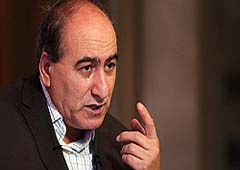
“Some 1000 kilometers of shared borders between the two countries as well as deep rooted religious and historical ties are very important in the relations between the two sides,” Dr. Hassan Salman said in a meeting with Habilian Association Secretary-General.
Referring to the close ties between Iran and Iraq, he added that no group can affect the social relations between the two countries.
This group was supported by Iran’s enemies such as France and England after the Islamic Revolution,” Hasan Salman said, adding, “and a significant number of this group’s members in Iraq hold citizenship of the two countries.
“Saddam Hussein, without a shadow of a doubt, got the green light to support them militarily to keep Iran busy during the Iraqi-imposed war on Iran.”
Chairman of the board of trustees of the Iraq media network went on to accuse the United Nations of backing MKO, saying “the UN’s activities were at the behest of the US and for supporting the MKO.”
Salman underestimated the US delisting of MKO from its blacklist and said, “United States and some western countries decided to took this group off their terrorist lists, but we say this group is a terrorist group even if the US, France, and west think otherwise.”
“We do have problems with this group; hence they must be expelled from Iraq.” “If the Western countries believe these are not terrorists, take them in their lands, especially because most of them hold western citizenship.”
“The western countries will probably use MKO in both security and political aspects in the upcoming presidential election in Iran, just like the last election,” underscored the Iraqi political analyst.
Finally, Hasan Salman said the incentive behind some Iraqi politicians’ support for MKO is not the group itself, but they support this group because of their anti-Iranian intentions.
 nation, and said Iranians will never forgive the MKO.
 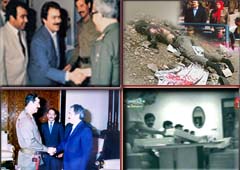 forgivable."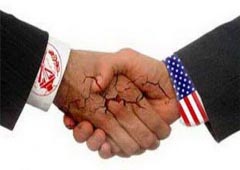
 and articles have appeared on several newspapers and magazines including The New York Times, the Los Angeles Times, The American Conservative, The National Interest and In These Times. Greenwald has received different awards including the first Izzy Award for independent journalism in 2009, and the 2010 Online Journalism Award for Best Commentary.
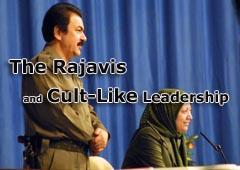 one to make is to avoid admitting them. Of the recent expressions which best describes the terrorist MKO is the one stated by Alan Berger, a Boston Globe editorial writer expert on foreign policy and security issues. In his article entitled Iranian exiles and international blunders, he points to his last year’s interview with MKO’s leader, Maryam Rajavi, and the group’s members he talked to and concluded that “People caught up in a blood feud are not inclined to dwell on their past errors”. As a matter of fact, MKO has been pursuing a never-ending and long lasted vendetta against the Islamic Republic regime for many bloods the group’s own past errors themselves have been the main cause to shed. And MKO laid the cornerstone of all errors when it concluded the inevitability and necessity of initiating armed struggle and violent acts in 1981, a rebellion which was supposed to speed up the collapse of the regime just for a change of power rather than for the accomplishment of democratic and civil causes.
 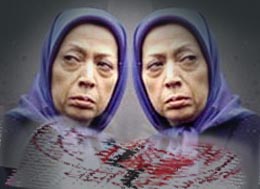 launched a campaign to have France and the European Union grant it the same recognition they have accord to the Syrian coalition battling to overthrow Bashar al-Asad, AFP reported.[1]
 Member of Iran Majlis National Security and Foreign Policy Committee, as saying.
 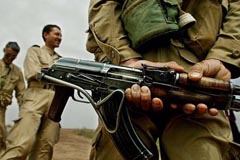 one of the halls at the French Parliament building, Maryam Rajavi demanded that France and the EU support what she called “the Iranian Resistance” similar to what has been done with regards to Syria. “Rajavi emphasized that French Government which has played a decisive role in recognizing the Syrian resistance, must also take up the initiative for a new policy in EU” and “wants Paris and EU to recognize (what she called) “the Iranian resistance” for the regime change in Iran.”
  leader of the notorious terrorist Mojahedin-e Khalq Organization (MKO, also known as the MEK, NCR and PMOI) Maryam Rajavi to take part in their session at the parliament.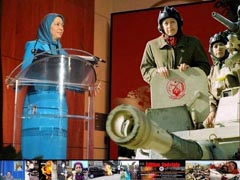
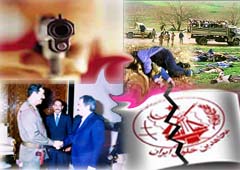 Mojahedin-e Khalq Organization (MKO, also known as the MEK, NCR and PMOI) to pay ransom for the massacres and crimes it has committed against the Iraqi people during Saddam’s era.