
Recent information obtained from Paris, London and the UAE reveal that MKO has come under the full mercenary of CIA by providing mental and human resources as well as intelligence help to America’s Central Intelligence Agency so as to play a major joint role in the production of chaos and insecurity inside Iran.
According to the database of Habilian Association (terror victims’ family) quoting from Nahrainnet, CIA began the formation of especial operations rooms at its offices in Washington and in Los Angeles, California, and outside the United States to deal with the aftermath of the election campaign for the presidency in Iran to develop practical programs to influence the course of elections events and destabilize the Islamic Republic.
In this regard CIA established crisis rooms in its Iran Chambers in the capitals of several countries, including some Persian Gulf countries like the UAE three months ago. A variety of suggestions about Iran’s presidential elections were sent to these rooms which were in charge of the implementation of the choices made by the specialists about how to deal with the elections in Iran.
One task of these rooms was to investigate the guidelines of Mr. Ahmadinejad’s rivals in order to discover the one whose ideas are most close to the U.S. ideas.
These rooms also worked to bring the theories of the overthrow of Iranian President Ahmadinejad to the reality in Iran.
The next stage in this process was to find the best ways of exploiting the results of the elections and to make the public believe that the organized chaos by the external factors was actually ordered by the losers of the elections and that the losers had organized attacking the facilities and security, economic and media centers and the intensification of sit-ins at universities, plazas and squares and mosques.
The slogan of these special operations rooms was "More gasoline on the firewood" and it was agreed between the experts of the American Central Intelligence Agency and elements of the People’s Mujahedeen Organization to create chaos in the streets and mosques and universities and prepare for a velvet revolution by using a specific color and to lay grounds for the collapse of the Islamic Republic or cause its weakness so as to accept the conditions of America and the West.
This procedure was set up the way if Mr. Ahmadinejad wins the elections, his victory would seem abnormal and a huge propaganda and extensive media hue and cry would show an incredible fraud in the election.
Now the controversial results of Iran’s presidential election have been announced it is clear who the real losers are: the Rajavis and their cult.
It seems this the first year that we have not had a peep out of Maryam Rajavi before the election. In previous elections it has been customary for her to issue an imperious edict for Iranian people to boycott their elections. And every election time, totally oblivious to the existence of Madame Rajavi let alone her message, Iranians turn up to cast their vote and make their will known – no matter how little it is heeded by the country’s political elite.
This year is no exception. In fact it appears that this year’s presidential election has become so contentious that even more people than ever have voted. Maybe it has become too embarrassing to continually demand a boycott and be, well, ignored.
Maybe it has finally sunk in that, in spite of the obvious flaws (the candidates all have the approval of the Supreme Leader) and the infighting, or maybe because of this un-precedentedly open, vociferous and challenging campaign, the IRI is not on the verge of collapse and that regime change engineered by some kind of drastic internal revolution is not just around the corner ready for her to exploit. This may come as a surprise to Madame Rajavi, but Iranians love their country and are not about to trash it to suit her agenda.
Speaking of her ‘agenda’, Madame Rajavi, knows better than anyone that her only chance to return to her homeland and impose her husband’s cult onto the people of Iran is for the whole ruling system to collapse. She also knows better than anyone else what the subliminal message of this election is; the only way for her to go home is for her cult to continue to pursue its well-trod path of violence and try to remove the ruling regime by force – a course it has pursued without success for nearly thirty years.
Of course, this is what she has believed all the time, in spite of her phony posturing as a campaigner for democracy and human rights to her – let’s be honest – gullible political consumers and her self-serving western backers.
Looking at all the de-listing activity she has engaged in over the past few years I expect that in time Madame Rajavi would have liked to drop the pretence that she heads a peaceful political opposition group and re-invigorate the National Liberation Army of Iran.
Fortunately for the people of Iran this has become impossible as, thanks to the Government of Iraq, this defunct army is now being carefully and thoughtfully dismantled in order to extinguish it as a terrorist entity.
By Anne Singleton
Obama’s Doublespeak on Iran – USA support for MKO-Jundallah terrorism
Excerpt:
In an interview with National Public Radio (NPR) on the occasion of the publication of his article in The New Yorker, titled “Preparing the Battlefield,” the renowned investigative journalist Seymour Hersh revealed striking details of his findings on the goals of the $400 million budgeted by the US government for covert operations inside Iran. He provided valuable information on US military preparations to strike the country…and on the US support for the anti-Iran terrorist organizations Jundallah and MKO [4].
More evidence of the US involvement in the terrorist activities inside Iran came to light recently when the head of the Jundallah gang, Abdulmalik Rigi, “admitted receiving assistance from the terrorist group Mojahedin Khalq Organization (MKO),” a terrorist gang of Iranian expatriates under US protection in Iraq. There have been persistent intelligence reports of collaborations between the MKO and Jundallah in the past. But, in a significant admission, Rigi told a US-based satellite TV station…on June 2, "They [MKO] have had good intelligence collaborations with us and have provided us with much information about the activities of the Iranian regime” [5].
MKO, sheltered and armed by the Iraqi dictator Saddam Hussein, have killed thousands of Iranians in their decades-old campaign of bombings and other terrorist activities against Iran. After the fall of Saddam Hussein, the MKO came under the protection of the occupying US power in Iraq. Although the US State Department officially lists MKO on its list of terrorist organizations, it nonetheless refuses to turn them in to Iranian authorities, as frequently requested. Nor has the US, as the MKO custodian, put an end to its terrorist activities against Iran
.
That’s why it is safe to argue that the US is playing a crucial (though largely submerged) role in the terrorist collaboration between Jundallah and MKO against Iran.
It is not surprising, then, that Iranians are not thrilled by President Obama’s rhetoric of “peace and dialogue,” as they can easily see who is pulling the strings of the Jundallah-MKO terrorist activities from behind the scene. “What’s going on in Iran today – a sustained campaign of terrorism directed against civilians and government installations alike – is proof positive that nothing has really changed much in Washington, as far as U.S. policy toward Iran is concerned” [6].
Middle East Online, June 10, 2009
http://www.middle-east-online.com
/english/opinion/?id=32649
[Comment by Editor: The MKO is currently mired in a desperate attempt to prevent the dismantlement of its military base, Camp Ashraf in Iraq. Israel’s open challenges to Iran’s nuclear programme are a strong indication that the MKO is no longer useful as a proxy for Israel’s intelligence services.]
Excerpt:
The anonymous Israeli intelligence officials claim, cited in the committee report, that the”blueprints”in the”alleged studies”collection matched documents his agency had gotten from its own source seems to confirm the analyst’s finding that Israeli intelligence assembled the documents.
German officials have said that the Mujahedin E Khalq (MEK), the Iranian resistance organization, brought the laptop documents collection to the attention of US intelligence, as reported by IPS in February 2008. Israeli ties with the political arm of the MEK, the National Committee of Resistance in Iran (NCRI), go back to the early 1990s and include assistance to the organization in broadcasting into Iran from Paris.
The NCRI publicly revealed the existence of the Natanz uranium-enrichment facility in August 2002. However, that and other intelligence apparently came from Israeli intelligence. The Israeli co-authors of The Nuclear Sphinx of Tehran, Yossi Melman and Meir Javeanfar, revealed that”Western”intelligence was”laundered”to hide its actual provenance by providing it to Iranian opposition groups, especially NCRI, in order to get it to the IAEA.
They cite US, British and Israeli officials as sources for the revelation.
New Yorker writer Connie Bruck wrote in a March 2006 article that an Israeli diplomat confirmed to her that Israel had found the MEK”useful”but declined to elaborate.
Read the full article:
WASHINGTON – A report on Iran’s nuclear program issued by the United States Senate Foreign Relations Committee last month generated news stories publicizing an incendiary charge that US intelligence is underestimating Iran’s progress in designing a”nuclear warhead”before the halt in nuclear weapons-related research in 2003.
That false and misleading charge from an intelligence official of a foreign country, who was not identified but was clearly Israeli, reinforces two of Israel’s key themes on Iran – that the 2007 US National Intelligence Estimate (NIE) on Iran is wrong, and that Tehran is poised to build nuclear weapons as soon as possible.
But it also provides new evidence that Israeli intelligence was the source of the collection of intelligence documents which have been used to accuse Iran of hiding nuclear weapons research.
The committee report, dated May 4, cited unnamed”foreign analysts”as claiming intelligence that Iran ended its nuclear weapons-related work in 2003 because it had mastered the design and tested components of a nuclear weapon and thus didn’t need to work on it further until it had produced enough sufficient material.
That conclusion, which implies that Iran has already decided to build nuclear weapons, contradicts both the 2007 NIE on Iran, and current intelligence analysis. The NIE concluded that Iran had ended nuclear weapons-related work in 2003 because of increased international scrutiny, and that it was”less determined to develop nuclear weapons than we have been judging since 2005″.
The report included what appears to be a spectacular revelation from”a senior allied intelligence official”that a collection of intelligence documents supposedly obtained by US intelligence in 2004 from an Iranian laptop computer included”blueprints for a nuclear warhead”.
It quotes the unnamed official as saying that the blueprints”precisely matched”similar blueprints the official’s own agency”had obtained from other sources inside Iran”.
No US or International Atomic Energy Agency (IAEA) official have ever claimed that the so-called laptop documents included designs for a”nuclear warhead”. The detailed list in a May 26, 2008, IAEA report of the contents of what have been called the”alleged studies”- intelligence documents on alleged Iranian nuclear weapons work – made no mention of any such blueprints.
In using the phrase”blueprints for a nuclear warhead”, the unnamed official was evidently seeking to conflate blueprints for the re-entry vehicle of the Iranian Shehab missile, which were among the alleged Iranian documents, with blueprints for nuclear weapons.
When New York Times reporters William J Broad and David E Sanger used the term”nuclear warhead”to refer to a re-entry vehicle in a November 13, 2005, story on the intelligence documents on the Iranian nuclear program, it brought sharp criticism from David Albright, the president of the Institute for Science and International Security.
“This distinction is not minor,”Albright observed,”and Broad should understand the differences between the two objects, particularly when the information does not contain any words such as nuclear or nuclear warhead.”
The Senate report does not identify the country for which the analyst in question works, and the Senate Foreign Relations Committee staff refused to respond to questions about the report from Inter Press Service (IPS), including the reason why the report concealed the identity of the country for which the unidentified”senior allied intelligence official”works.
Reached later in May, the author of the report, Douglas Frantz, said he was under strict instructions not to speak with the news media.
After a briefing on the report for selected news media immediately after its release, however, the Associated Press reported May 6 that interviews were conducted in Israel. Frantz was apparently forbidden by Israeli officials from revealing their national affiliation as a condition for the interviews.
Frantz, a former journalist for the Los Angeles Times, had extensive contacts with high-ranking Israeli military, intelligence and Foreign Ministry officials before joining the Senate Foreign Relations Committee staff. He and co-author Catherine Collins conducted interviews with those Israeli officials for The Nuclear Jihadist, published in 2007. The interviews were all conducted under rules prohibiting disclosure of their identities, according to the book.
The unnamed Israeli intelligence officer’s statement that the”blueprints for a nuclear warhead”- meaning specifications for a missile re-entry vehicle – were identical to”designs his agency had obtained from other sources in Iran”suggests that the documents collection which the IAEA has called”alleged studies”actually originated in Israel.
A US-based nuclear weapons analyst who has followed the”alleged studies”intelligence documents closely says he understands that the documents obtained by US intelligence in 2004 were not originally stored on the laptop on which they were located when they were brought in by an unidentified Iranian source, as US officials have claimed to US journalists.
The analyst, who insists on not being identified, says the documents were collected by an intelligence network and then assembled on a single laptop.
The anonymous Israeli intelligence official’s claim, cited in the committee report, that the”blueprints”in the”alleged studies”collection matched documents his agency had gotten from its own source seems to confirm the analyst’s finding that Israeli intelligence assembled the documents.
German officials have said that the Mujahedin E Khalq (MEK), the Iranian resistance organization, brought the laptop documents collection to the attention of US intelligence, as reported by IPS in February 2008. Israeli ties with the political arm of the MEK, the National Committee of Resistance in Iran (NCRI), go back to the early 1990s and include assistance to the organization in broadcasting into Iran from Paris.
The NCRI publicly revealed the existence of the Natanz uranium-enrichment facility in August 2002. However, that and other intelligence apparently came from Israeli intelligence. The Israeli co-authors of The Nuclear Sphinx of Tehran, Yossi Melman and Meir Javeanfar, revealed that”Western”intelligence was”laundered”to hide its actual provenance by providing it to Iranian opposition groups, especially NCRI, in order to get it to the IAEA.
They cite US, British and Israeli officials as sources for the revelation.
New Yorker writer Connie Bruck wrote in a March 2006 article that an Israeli diplomat confirmed to her that Israel had found the MEK”useful”but declined to elaborate.
Israeli intelligence is also known to have been actively seeking to use alleged Iranian documents to prove that Iran had an active nuclear weapons program just at the time the intelligence documents which eventually surfaced in 2004 would have been put together.
The most revealing glimpse of Israeli use of such documents to influence international opinion on Iran’s nuclear program comes from the book by Frantz and Collins. They report that Israel’s international intelligence agency Mossad created a special unit in the summer of 2003 to carry out a campaign to provide secret briefings on the Iranian nuclear program, which sometimes included”documents from inside Iran and elsewhere”.
The”alleged studies”collection of documents has never been verified as genuine by either the IAEA or by intelligence analysts. The Senate report said senior United Nations officials and foreign intelligence officials who had seen”many of the documents”in the collection of alleged Iranian military documents had told committee staff”it is impossible to rule out an elaborate intelligence ruse”.
Gareth Porter is an investigative historian and journalist specializing in US national security policy. The paperback edition of his latest book, Perils of Dominance: Imbalance of Power and the Road to War in Vietnam, was published in 2006.
(Inter Press Service)
By Gareth Porter
UPI reported on May 16, that more than 180 members of the British Parliament have signed a letter proposing that the Obama administration change its stance on Iranian opposition movements as part its new policy of engagement. "Our experience has shown that the Iran crisis cannot be resolved without an Iranian solution and without relying on its main opposition movement," the letter said.
This lobbying activity to promote the Mojahedin-e Khalq is part of a coordinated Europe-wide action to rescue the MKO; although a resolution pushed through the European Parliament by the MKO’s promoters there has already been watered down to nothing by opponents.
The response of the Islamic Republic of Iran to the MKO’s western promoters is unequivocal; the MKO is a “used card” and the Government of Iran will not pay a penny for them no matter how the group is used by western powers to threaten or cajole.
This posturing from both sides demands a response only because both sides are using MKO members as pawns to win political points in total disregard to their actual situation.
In fact it could be said that the MKO is not a ‘burned card’. The group clearly has a lot of use left in it for both sides. Unfortunately in the real politics of Iran and the west the MKO is the wrong card. By doggedly hanging on to the MKO western players are trying to trump an ace with a Joker. (The Iranian ace being that the existence of the ‘terrorist’ MKO allows the IRI to point to the double-standards in the western approach to terrorism.)
In this ‘game’ it must be understood clearly that the MKO is not a problem for Iran. Instead it is a very real problem for Iraq. MKO promoters have already shown a remarkable unwarranted animosity and arrogance toward the Government of Iraq in challenging its decision to close Camp Ashraf and remove MKO members from the country.
So, do western players really only have a Joker to play?
Perhaps before all else it would benefit both sides of this ‘game’ to appreciate that former members who try to expose the true nature of the group bear no animosity or enmity toward their former colleagues. Rather they regard them with gut-wrenching pity; pity for their current suffering under the crushing daily mind-control regime, pity for the fact that they are not normal people anymore and pity because of the years of their lives which they have lost for nothing.
The MKO’s western promoters want the MKO removed from the US terrorism list. To back this up, their insistence that the MKO no longer believes in violence to achieve its aims can easily be proved by cooperating with the Government of Iraq to remove everyone from Camp Ashraf and bring them to safety in Europe. The continued refusal to offer this help signals a very different agenda, one which is not lost on those who have experienced first-hand the MKO’s belief in violence, the Iraqi people.
It would certainly profit the MKO’s western promoters to take a step back and really look at how ordinary Iranians, inside and outside Iran, regard this group. I suggest this, not because they don’t already know the answer – that ordinary Iranians, almost without exception, either fear, revile or deride the group – but because of the implications of that opinion.
Perception, like reputation, is very hard to correct once it is warped or damaged. With the expenses scandal in the House of Commons and the cash for questions scandal in the House of Lords, British parliamentarians have a very hard task ahead to repair their reputations. Similarly, when protestors burned an effigy of Foreign Minister David Miliband for perceived support of the Tamil Tigers in Sri Lanka, British parliamentarians should take note of what the perception of ordinary Iranians must be when they support the MKO and try to foist a destructive cult on them as the ‘main opposition group’.
When British parliamentarians give their support to such an infamous group, the perception can only be that parliamentary democracy in the UK is open to abuse, whether because political support can be bought or whether it can be got by deception.
Coupled with the recently exposed reputation for ‘dishonesty’, parliamentarians need to recognise that the perception of their support for this defunct group is such that it can only be because of some personal benefit of their own. Certainly there is no benefit for British foreign policy, nor for the Iranian people and especially not for the real victims of the MKO, its own members.
By Anne Singleton
Memoirs of Ms. Batoul Soltani – Part 12
I have to divide this part of my memoirs into two sections: before the fall of Saddam Hussein and after that.
After the basic agreements were reached in the visit between Masud Rajavi and Tariq Aziz, Masud tried his best to serve Saddam Hussein in return for his favors. It is worth knowing that Saddam Hussein gave priority to grant MKO’s demands and requests over all his plans and gradually this support was rapidly increasing in quality and quantity. During the 17 years, between 1985 and 2002, while Masud Rajavi was flattering his boss in Iraq, Saddam Hussein could lead the group in any way he wanted. It should be reminded that the assassination of Sayad Shirazi in Iran was carried out by the direct order of Saddam Hussein. Sayad Shirazi was a commander who resisted against the Iraqi army very firmly during the war, so Saddam had personal rancor against him. Rajavi directed this act of terror for Saddam’s sake only, justifying his crime as eliminating a common enemy.
Rajavi was granted a large reward by Saddam. He was so proud of it that he noted it in all his meetings saying such an act was welcomed by the landlord (Rajavi referred to Saddam as the landlord or Mr. President). However, when you focus on Sayad Shirazi’s assassination, you see that they killed a person who did the most resistance against the invading enemy, but MKO assassinated his personality first and then assassinated him physically and finally they defended their dirty crime.
In 1985 and 1986, Rajavi began his military campaign by bringing his innocent sympathizers from all over the world to Iraq by any means he could, including force, intimidation, and deception. They sent smugglers to gather homeless youth and bring them into the organization. When the recruits were transferred to Iraq, they settled in Camp Ashraf in North of Iraq. From the beginning, MKO needed to have a section to organize its relations with the Iraqi government so it was established and named Foreign Relations Department. Masumeh Malek, a member of the Leadership Council was the person who had sort of responsibility over this section.
Abbas Davari was one of the people who were hired for this section too because he knew Arabic and Mehdi Abrishamchi was also working there before going to Europe. Rajavi himself had arranged some meetings with the Iraqi officials. He always pointed out those visits as being successful, and that he could convince them he really loves Mr. President. Therefore he succeeded to have visits with Saddam Hussein, flattering him in order to get more money and weapons. So long as Saddam was in power, Rajavi always talked about the large amounts of money and weapons granted by him, in his meetings with the Leadership Council. He also told us about the juridical support given by Saddam’s regime regarding false passports or ID cards while the terror teams of MKO wanted to cross Iranian borders to launch their terrorist operations.
Maneuver lands provided by Saddam Hussein was one of the facilities made available. I remember the time when women were winning the high ranks in MKO; there were some trainings for them. The trainers were mostly Iraqi commandants who taught intelligence and security skills too. The women had learned a lot of Arabic. The mutual services Rajavi and Saddam offered to each other led to a lot of benefit for both sides. With the large funds granted by Saddam Hussein, MKO could develop its bases in some European countries. It is obvious that spending too much money will solve many problems. The organization could use Saddam’s money to gain the support of a lot of people to reach its goals. Due to the type of relations with Iraqi government, most of MKO’s actions were rather planned by Saddam Hussein than being adapted with the organization’s principals. Sometimes the members were directly receiving military trainings under Iraqi army commandants. For military maneuvers they used the lands confiscated from the Iraqi citizens.
Then they sent Maryam Rajavi and a group of other members to Europe. They claimed that whatever happens to Camp Ashraf, these people should take care of the organization in Europe. When the US army invaded Iraq, Rajavi’s strategy was to arrange an attack to Iranian borders. After the fall of Saddam, there was a new phase for MKO, and there was also a new question: what would happen to us? What would be our policy? Then we were surprised to see Rajavi organizing a new system called “Kaviani”. Kaviani was the section for negotiations with American forces and also the new Iraqi government. It is worth knowing that the same members who were active in Foreign Relations Department (relation with Saddam’s regime) were now responsible to deal with the new government.
This time, they changed the name of this section and called it Social Relations Department which was responsible to contact Iraqi people too. “Piercing” (cult jargon) was the organizational expression used for this latter duty. The most important target and also outcome of this was “Saleh Matlaq” who was absorbed by MKO. To achieve such a goal, they used any tools such as religious, political, mental and financial means. Their goal mattered to them only. They made too much efforts to affect have an effect on people and maintain their support. The Social Relations Department arranged dinner parties; and celebrations in Camp Ashraf to accomplish its propaganda purposes. They gave out large amounts of money taken out of Iraqi banks, to poor Iraqi citizens in order to gain their support. As an eyewitness, I can courageously say that before the fall of Saddam Hussein even one single Iraqi wasn’t able to enter the camp and Iraqi people had no idea about MKO.
Even a group of members were appointed to deal with Iraqi citizens in order to recruit them. The interesting part was that they had considered prizes for those who succeeded to bring Iraqi citizens into the Camp and put them in front of camera for their propaganda campaign.
Translated by Nejat Society
In his famous «Faust», the German poet Johann von Goethe (1749 – 1828) portrays a human being who sells himself to the devil in exchange for what is believed to be an acceptable price to get to immortality, but in the end he comes to the bitter fact that entering a deal with the devil can end in nothing but the eternal misery.
This is exactly the conclusion the «MKO» terrorist group has come to ultimately after selling themselves and their country to a devil named Saddam Hussein.
Designating the group as an international terrorist organization is the only thing that both Iran and America agreed on, even before the emergence of al Qaeda up to now. So what is the problem with this group?
First of all, and in order to tell the story in a sequence of facts I should indicate that this organization, which the Iraqi government’s stance against it in order to expel it out of the territory of Iraq is argued and criticized by some, is a terrorist organization, in the meaning of each word.
MKO practiced terrorism against the West and America in particular, through assassinations and bombings against Western interests in the sixties and seventies (for which it’s been now for a long time in the West’s list of designated terrorist organizations). Also it has masterminded a slew of assassinations and bombings against the Iranians since the Islamic Republic was established until recently, perhaps the most notorious of which are their bombing of headquarters of the Republican Party and the bombing of Iran’s parliament in the early eighties, which resulted in the death of dozens of senior Iranian officials, including, former Iranian President Rajaei and prime minister Bahonar and former Iranian judiciary chief Ayatollah Dr. Beheshti.
After relocating to Iraq and under the direct protection of Saddam MKO also committed numerous crimes against Iraqi people. With the help from the Iraqi dictator they gained such a power and authority in Iraq which no one could even dream about it, even members of the Iraqi intelligence service and security forces.
Besides many garrisons in Baghdad were allocated to MKO (in addition to the garrisons in other cities which were already devoted to them). As a few examples we can refer to the garrisons behind the Ministry of Agriculture, between Alsadir Hotel and Saadoun Street, the garrison in Forty Thieves street, Abi Nawas Street, the one in Andalusia Square, the one near Baghdad Hotel and the garrison near to Baghdad hospital.
The elements of this organization had near-absolute powers in safeguarding and investigation. They were present in every street, especially in the vicinity of the headquarters of the government and the presidential palaces and homes of officials and ministers, and the Iraqi people merely watched the heavily armed to teeth MKO members and their armored cars. It was as a result of this miserable situation that dozens of Iraqis were killed or arrested, either intentionally or inadvertently, on mere suspicion of not to stop at night.
Today the presence of this military-trained and armed to the teeth organization in the Ashraf camp (camp, not the city) and the rest of the camps set up for them by Saddam is not only contrary to Iraqi sovereignty, but it is ultimately for the inspiration of other terrorist organizations throughout the world and a letter to them saying that you can commit any crime and spill any blood and in the end sell yourself to the devil (every devil, either small or big) and save your life.
The expulsion of this organization from Iraq is not only in the interest of Iraq, but also the interest of the whole region.
And those who shed tears for such a terrorist group which is rejected by the whole world must be aware that terrorists who have sold their souls to the devil would be prepared to do anything to complete the transaction even if they need to backstab their hosts.
I think it is our duty, as Arabs, to stand by the Iraqis in their just position in order to expel these foreign fighters from their own land.
However for those who are not still convinced, the alternative solution is that they «host» MKO in their own countries away from Iraq. They are nothing more than 3500 individuals and just a few Tanks.
Al-Qabas, Kuwait, May 2009
http://www.alqabas.com.kw/
Translated by Habilian Association
The present challenge posed on the west by MKO is a strategic one with idealism and self-interests as its two ends. It is almost two and half a decade that MKO has turned problematic for the west as an armed, ideological, cultic and radical opposition group. The recent regional transitions as well as invasion of Iraq by coalition forces followed by the fall of Saddam in particular have proved that this predicament is worsening ever-increasingly. In this regard, this challenge can be investigated in three different but interrelated fronts: Iran, Iraq, and West.
1. Iran
The west is still far from understanding that the reason why Iran attempts to prove the potential threat and danger of Mojahedin for social and political security of the world as well as national interests of nations is due to its familiarity with the true nature of the organization and is merely a warning and advice. Even if the west is to find an alternative for Iranian government, MKO is the worst one. It has to be noted that using Mojahedin as a playing card in political equations is nothing but killing time and losing opportunities. The reason may be found in the course of events pursued by Mojahedin after the victory of Iranian revolution. They have been a big looser in all phases of their activities, either at the time when they were of a relative organizational and military power in Iran, or when they were allied with Saddam and enjoyed a great amount of military and financial advantages along the borders of Iranian soil, or after their disarmament and entering their present so-called political phase.
Taking all the failures and frustration of Mojahedin in the last three decades into consideration, it seems that they have never been considered a serious threat for the Iranian government. In fact, the most they did was using their infiltrators in various strata of Iranian government. After the failure of the organization in 20 June 1981 events, MKO leaders made use of all their potentialities to infiltrate in the state to the point that it soon led to the bombing attack of 28 June, a terrorist attack of Mojahedin that is still denied by the organization. The low level of political and military awareness of Rajavi and Mojahedin in disregarding the military potential of Iran was proved when he issued the order of the Operation Eternal Light that turned into a total and costly failure and disaster for Mojahedin. Aware of these issues, the west continues its negligence and unclear position takings toward Mojahedin due to political considerations. There are many opposition groups including MKO that are misused and supported by the west to fulfill its interests and objectives all over the world. These groups are well aware of the motivation behind the supports of the west yet have no other option for their survival other than submitting to the will of foreigners.
Mojahedin are no except to this rule. Being aware of the misuse west makes of them they have to bear it hoping that a change in circumstances or conditions, make due ground for their coming to power. In fact, they crow about giving service to the enemies of their own nation as foreign mercenaries. However espionage activities have an expiration date and there comes a time when Mojahedin would have no further advantage for the superpowers since they have expended all their energy and efforts in pleasing their masters. As evident in leaking Iran’s nuclear projects claimed by Mojahedin, it not only failed to result in the political legitimacy of Mojahedin but also had adverse effects on their social support.
Therefore, investing on Mojahedin in the Iran-West conflict is a major error even when Mojahedin pretended to be of a high military potential and made false promises of overthrowing the Iranian government and western media made a wide intentional propaganda blitz on it let alone the time being when they have reached the political and military nadir of their history. After a while, France came to the conclusion that the presence of a terrorist group in its soil channeling its terrorist attacks therein would be detrimental for both the political repute of this country and also the national security of its citizens; thus, it expelled MKO from France and changed its policy toward Iran as well as Mojahedin.
Taking all these points into consideration, it seems that playing with the burnt card of Mojahedin is futile. Furthermore, the efforts of Iran in revealing the true terrorist nature of MKO are just for humanitarian causes far from political considerations since as it was said Mojahedin never pose a real threat for the Iranian government. France has paid the consequences of the cultic and terrorist activities of Mojahedin when a number of its members set themselves on fire in Paris streets in compliant to the arrest of Maryam Rajavi, the group’s she-guru in the absence of her husband. They still grab at the same lever for threatening French authorities and warn France that they would repeat these actions in case if they were prohibited to seek refuge therein. In fact, this is another trial for the west and France in particular to immunize their nations against the danger of a cult of personality.
2. Iraq
Taking a brief look at the primary motivations of France and Saddam in giving refuge to Rajavi (after the events of 28 June when seventy-five senior officials of the regime were killed in the organization bomb attack and France disregarding these events gave refuge to MKO leader), there could be found some similarities between the present situation of Mojahedin in Iraq and that of France. Now, it is assumed that France wanted to make Rajavi closer to Iranian borders. Also, it aimed to intensify the Iraqi threat against Iran (at a time when France had the most arms deal with Iraqi regime), thus expelled him of France and made the ground for his transfer to Iraq, more similarities can be found. In addition, since then Mojahedin have made frequent commutes between Iraq and France and Maryam Rajavi had two so-called strategic transfers from Iraq to France and vice versa. Therefore, it is proved that France and Saddam have had the same position toward Mojahedin. Now, after the fall of Saddam, as the strategic and ideological ally of Mojahedin, they are faced with a newly established Iraqi government that has made its mind to expel them as a terrorist group interfering in the internal affairs of Iraq and communicating with the terrorist and problematic trends therein. The Iraqi officials are well aware that the presence of Mojahedin in their soil cost them considerably with negative political consequences particularly due to their misusing of the critical conditions of Iraq and suffering from internal challenges in order to further their strategic objectives.
In this regard, Mojahedin claim that Iraq is to expel them under the pressure of Iranian government as they claimed when expelled from France. However, the Iraqi and French officials are well aware of the reasons from driving MKO out. Mojahedin have been so problematic for both governments and have committed various crimes and misdeeds recorded in the judiciary system of both countries. In fact, there are two factors leading to the decision of Iraq in expelling Mojahedin; the terrorist activities of Mojahedin in the reign of Saddam as well as the present and future national interests of Iraq. Now, the decision of Iraq seems to be parallel to the wish of Iranian government yet it has nothing to do with the interference of Iranian government in the internal affairs of Iraq. Iraq is well aware that even in case of ignoring the legal complaints of Iraqi people against MKO, their presence therein is too costly. In other words, the Iraqi government is to return the ball France kicked against their field years ago and for sure it would never reach the Iranian field. This issue is proven for the Europe and the US so they never bet on the dead horse of Mojahedin. The maneuvers of Masoud Rajavi on the possibility of their transfer to Iran are baseless and futile and aim to provoke the sympathy of the world and the west in particular.
3. West
The third front is the position of the west toward MKO as a radical and terrorist group. The recent move of the EU in removing the name of MKO from its terrorist list intensified the challenges of the west with Mojahedin and faced them with the negative consequences resulting from this decision. Disregarding the inevitable political feedbacks of this vote, the study of the theoretical aspects of this issue is of significance. Being an extreme radical trend, Mojahedin pretend to be a modernist one seeking peace and security in the world. In fact, MKO is an amalgamation of some apparent paradoxes. It is a designated terrorist group that adopts anti-terrorism slogans; It is an ideological cult that holds grab to liberalism for furthering its ideological objectives; Despite representing the most primitive signs of barbarism, Mojahedin pretend to be pioneers of knowledge and awareness; Using the most reactionary brainwashing techniques in depriving MKO members from their basic physical and mental freedom, Mojahedin propagate the principles of freedom and democracy. Evidently, getting to the deepest layers of this complex phenomenon and its mechanism is not an easy task to be done.
It has to be pointed out that the terrorist nature of Mojahedin has its roots in their radicalism as well as primary manifesto and organizational principles that consider the west and the US as their ideological enemies and symbols of bourgeoisie and imperialism. In fact, the concepts like democracy and liberalism that Mojahedin focus on as their ultimate end to win the attention and support of the superpowers are referred to as the main enemies of humanity in their principles and doctrines. Based on their ideological revolution in which one phase was called “the phase of detachment and worldly combat against the manifestations of bourgeoisie and liberalism”, Mojahedin proved that they are hew to their primary principles yet grab at some short-time changes in their policy for carrying on their struggle for their pre-determined objectives in removing all signs of imperialism, capitalism, and liberalism.
Disregarding the critical viewpoints of some western experts like Antoine Gessler, Ervand Abrahamian, and Alain Chevalerias as well as the detached members of MKO, the honesty and truth of these statements can be proved by means of historical evidences. In fact, there is no need to review the primary and basic organizational principles of MKO rather it suffices to take a look at the official websites of Mojahedin as well as their leaders’ messages to find the points of disagreement of the organization with the modern concepts of the west like democracy, freedom, human rights, etc. The US has a more realistic viewpoint toward MKO compared to that of the Europe as is evident from the statement of the state department of the US in April 2007 in designating it as a terrorist group and also the primary position takings of the US against Mojahedin. The reason why the Europe neglects the potential threat of MKO seems to be more a matter of political considerations and gestures of the Europe and France in particular in claiming to be the supporter of freedom fighters all over the world. Being aware of this, Masoud Rajavi has found the Europe more susceptible to deception and enticement and has misused this negligence praising the great revolution of France in different occasions.
An instance may be the measures taken by the US after the events of 11 September and the enforcement of Patriot Act. According to this Act, some constraints like phone-tapping, searching e-mails, interrogating the suspect individuals, letting security police to make long-time arrests and more were enacted in order to prohibit terrorist activities. However, the US was faced with the severe reaction of the European liberal theoreticians who considered these measures as contradictions to individual and social freedom and citizen rights. In addition, citizen rights of the US differ from that of the Europe. These differences are also apparent in how the US encountered Mojahedin in its soil compared to that of the Europe. It is an issue that has been misused by Mojahedin and they have managed to take advantage of citizen rights in the Europe as they have established their ideological bastion in Auver-sur-Oise in France in front of the eyes of French officials. Another reason may be the more optimism of the Europeans to their surrounding world compared to that of the US.
Another dimension of this issue is related to the pragmatist and provisional viewpoint of the US compared to the courteous and neat viewpoint of the Europe. Once in the past France tried to block the threat of the Algerian self-immolator women by removing their veil. The same women that once transported bomb and arms under the cover of their veil, when faced with the shakedown of French forces, followed French fashions voluntarily and moved their bombs to the farthest point in the European residents of Algeria with no annoyance.
Mojahedin have repeatedly claimed that they have borrowed many of their tactics from the Palestinian fighters. Now, it can be said that on deceiving the Europeans and French in particular, they have modeled the Algerian Mojahedin. Anyhow, delisting Mojahedin from the EU terrorist list may pave the way for their further misusing the western rules and laws. The Europeans and France have to do whatever they can to come to a deep understanding of the true nature and objectives of Mojahedin or postpone the activities of MKO by means of various levers until the time when they recognize the true and potential threat of Mojahedin for the peace and security all over the world.
An Iranian legislator lambasted the West for changing the definition of terrorism on the basis of its own policies, and regretted that the western world has no specific definition for terrorism.
Saying that the western countries follow no specific logic in their behaviors, member of Iranian parliament’s National Security and Foreign Policy Commission Heshmatolah Falahat Pisheh told FNA on Sunday that if they had a certain definition for terrorism, they would not strike the name of the terrorist Mujahedin-e Khalq Organization (MKO) off the list of terrorist groups.
Elsewhere, he referred to a letter from the European Parliament to the US administration demanding the White House to strike the name of the MKO off the list of terrorist groups, and said, "There is no doubt that the Monafeqin (the Hypocrites, as MKO is referred to in Iran) are the friends of the Europeans and they have now returned to the place where they are rooted."
After removing the anti-Iranian terror group from their blacklist, the EU lawmakers are now urging President Barack Obama to follow suit.
More than 100 members of the European Parliament have tried to persuade the US president to lift an American ban on the MKO.
"Before the event we had no doubt in the Monafeqin’s proximity with the West," Falahat Pisheh lamented, referring to the letter sent by EU Parliament to the US administration on MKO.
"The West has used the Monafeqin as a tool during the (Islamic) Revolution and after that," he added.
Asked if the West could use the MKO to make Iran to attend negotiations, the legislator stressed that if the West aims to attain a pressure lever in negotiations with Iran, the measure would lead to nowhere.
He pointed out that Iran’s hesitation for entering negotiations with the West is rooted in such moves by the western countries.
The MKO, whose main stronghold is in Iraq, is blacklisted by much of the international community, including the United States.
In the past, the MKO was on the European Union’s list of terrorist organizations subject to an EU-wide assets freeze. Yet, the MKO puppet leader, Maryam Rajavi, who has residency in France, regularly visited Brussels and despite the ban enjoyed full freedom in Europe.
The MKO is behind a slew of assassinations and bombings inside Iran, a number of EU parliamentarians said in a recent letter in which they slammed a British court decision to remove the MKO from the British terror list. The EU officials also added that the group has no public support within Iran because of their role in helping Saddam Hussein in the Iraqi imposed war on Iran (1980-1988).
The group started assassination of the citizens and officials after the revolution in a bid to take control of the newly established Islamic Republic. It killed several of Iran’s new leaders in the early years after the revolution, including the then President, Mohammad Ali Rajayee, Prime Minister, Mohammad Javad Bahonar and the Judiciary Chief, Mohammad Hossein Beheshti who were killed in bomb attacks by MKO members in 1981.
The group fled to Iraq in 1986, where it was protected by Saddam Hussein and where it helped the Iraqi dictator suppress Shiite and Kurd uprisings in the country.
Dr. Abdalzahra Mohye: Iraqis have suffered from crimes committed by MKO
Iraqi intellectuals meet Habilian Secretary General
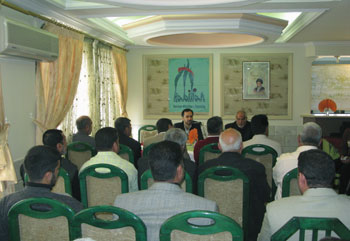
Mashhad- A number of Iraqi elites and intellectuals met and exchanged ideas with Secretary General of Habilian Association over the current status of Iraq and also the presence of terrorist cult of Mojahedin-e Khalq within this country. After welcoming the arrival of the delegation in the holy city of Mashhad at the beginning of the meeting, Mohammad Javad Hashemi Nejad expressed his happiness to host his Iraqi brothers and said: We are very much pleased of the ongoing relations between the people of two brotherly nations of Iran and Iraq and also the strong ties between the authorities of the two countries. No one could possibly find any other two nations around the world closer to each other than Iran and Iraq.
Hashemi Nejad notified the demise of dictatorship systems in the region and the support of colonial powers to them and said: considering the events that have occurred during past three or four decades one can easily find out that the use of force would not work and an instance of that is what we witnessed in Iran. The Shah of Iran which was supported and appointed the Gendarme of the region by Americans was easily brought down by the Islamic revolution.
At the same time, we saw the defeat of the Soviet Union in Afghanistan. Then we saw how the Iraqi dictator Saddam Hussein was toppled. We would also witness how American forces who occupied Iraq for their own interests become involved in the fate of the Soviet Union in Afghanistan.
Secretary-General of the Organization representing the families of the martyrs of terrorism in Iran then referred to the attempts of Americans in order to sow discord among the peoples of Iraq and Iran and said: the United States of America was up to follow the policy of divide and rule in he region ; but we are still friends and there exist very strong relations between us. The colonial powers have always sought for a way to influence the viewpoints of the peoples of the two nations and this is why the responsibilities and pledges of the elites and intellectuals of the two countries is now more difficult than ever and any mistake would have irreparable consequences.
Martyr Hashemi Nejad’s son then spoke about the elections in Iraq and said: we have seen how Americans attempts to influence the Iraqi elections and their efforts to change the results failed.
The expert in the issues related to Iraq condemned America’s double standards in facing the issue of terrorism and said: The arrival of United States in Iraq was concurrent with the entrance of terrorists to Iraq. Now after the handover of the security issues to the Iraqi government the security situation has improved and terrorist operations have reduced to a high extent. In fact, the U.S has provided support for terrorist groups such as MKO (Mojahedin-e Khalq) which is designated as terrorist by America itself. This is an indication to the fact that not only America doesn’t want to fight with terrorism but also it tries to take advantage from terrorist groups.
Hashemi Nejad also said: Americans support MKO terrorist group to pressure against the Iraqi people and government .We must be careful because MKO is a very deceitful group and master of manipulation. All statements they post in the internet on behalf of the Iraqi people and authorities are false. They are professional in giving out false statistics. For example, they announced that five million two hundred thousand of the Iraqi people are on their side and support their presence in Iraq. Then they declare that three million Iraqi Shiites also demand their survival in Iraq; but until this moment none of these so called three million Shiite supporters have asked the government not to expel the group from Iraq.
Then Hashemi Nejad referred to MKO false propagations in the media over the interference of Iran in the internal affairs of Iraq and said: they have staged a large wave of false allegations in the media with the help of Americans against Iran while accusing Iran of having role in destabilizing Iraq; but they haven’t so far presented any document which proves these allegations. This is while America has kept this terrorist group in Iraq and has provided them with unlimited support exactly for the same reason of creating insecurity and sabotage inside Iraq so as to justify the presence of American forces in Iraq. There is also a second reason for the support America decided to provide the group with and that’s their presumptions based on which the attack on Iran will come after the invasion of Iraq, and in this sense terrorist cult of MKO would be useful for them as a source of espionage.
Another reason why MKO is still in Iraq is the refrainment by all nations of the world to give asylum to the group because they consider it a terrorist organization.
Here I should notify that the Islamic Republic of Iran has offered amnesty to those MKO members in camp Ashraf whose hands are not stained with the blood of the innocent people but as the existence of these deceived elements in Ashraf would guarantee the future of the MKO gang leaders and the fact that the leadership looks at them as human shields, therefore it’s ready to sacrifice them for its own survival and that way there would happen a human catastrophe in Ashraf.
Dr. Abdalzahra Mohye who is a university professor enumerated a part of MKO crimes in Iraq and said: I would like to talk about one of our common concerns which is the presence of MKO terrorist organization in Iraq. We know very well that the United States brought up MKO terrorist gang in order to implement criminal schemes against the peoples of Iran and Iraq in the past and even now. I want to tell you that many and Iraqi families have suffered from crimes committed by MKO. As the private army of Saddam Hussein, this little group assisted former regime to massacre Iraqi Kurds and suppress Shiites Intifada.
I saw it with my own eyes how they killed innocent people in a mosque in Baghdad’s Sadr district.
Dr. Abdalzahra Mohye also said: The Iraqi people will not support this criminal gang and will never bear their presence in Iraq.
Dr Ne’me Shihab was another speaker to the meeting who asked Secretary General of Habilian if he believes MKO claims about gathering over five million signatures from Iraqi Shiites whom the group says will support MKO presence in Iraq.
In response to this question Hashemi Nejad said: what is clear is that nobody believes these claims and none of the Iraqi officials confirm such claims. If they have so many
supporters in Iraq why don’t they even stage a rally against MKO expulsion from Iraq? We believe that Al Qaeda was not familiar Iraq and it was MKO which made Al Qaeda familiar with this country. We have talked to many Iraqi tribal leaders and they unanimously said that MKO deceives people and after gathering signatures use them for their own ambitions. We have witnessed the same situation in England, where they follow their terrorist activities and fundraisings under the name of 23 font organizations for human rights.
He also added: All the Iraqi authorities and groups we have met demanded the expulsion of MKO from their country. They believe that MKO receives support from the remnant of Baathis and some notorious figures like Salih al-Mutlak and Khalaf al-Ayan that prefer their personal interests to their national interests.
Dr. Mothanna al-Fadhli was another speaker of the meeting who said: Mr. Hashemi Nejad mentioned that MKO interferes in the Iraqi affairs indirectly; but I should say that they directly meddle in our internal affairs. They come out of camp Ashraf and declare they are Iranians. Then start killing Iraqi people. What I should remind you of is that Shiites never support such a terrorist organization and MKO and its supporters are quite notorious for the Iraqis.