
The controversial marriage and divorce of Massoud Rajavi with Abolhassan Bani-Sadr’s daughter, Firoozeh, is one of the issues that need to be studied in detail. That is because her divorce is concurrent with many organizational-related events including the so-called ideological 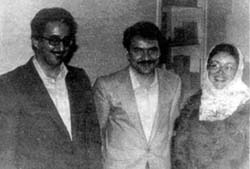 marriage of Rajavi with Maryam Azudanloo, the consequent ideological revolution and disclosures about the scandalous, secret relations of Rajavi and Maryam. In this regard, the available evidences so far are only some remarks made by Abolhassan Bani-Sadr and statements by some detached members of Mojahedin Khalq Organization (MKO, MEK, PMOI, NCR, NLA).
Firoozeh’s divorce hardly attracted attentions since it was eclipsed by the announced ideological revolution immediately after Rajavi and Maryam marriage and only a short statement published in Mojahed announced Firoozeh’s divorce without any further explanation. Since then, Firoozeh Bani-Sadr only once and in a meeting with Ms. Batool Soltani made references about her relations with Massoud Rajavi and his voracious power-seeking. Although her revelations highlight some peculiarities of Rajavi’s character, but Ms. Soltan’s shocking disclosures about Rajavi’s sexual relations with members of the Leadership Council completely overshadowed Firoozeh’s comments. The fact is that Firoozeh’s silence in all these years on the reasons for her divorce and its aftermath is much questionable. Her silence might have been grounded on some personal considerations or the consequent frustration after the disclosures. But her silence does not seem to be much sensible, unless there are unwritten agreements and compromise, when we see that her role in Rajavi’s private life and being au courant of his relations with Maryam Azudanloo might help to illuminate one of the challenging chapters of the organization’s history. But the recent remarks of Abolhassan Bani-Sadr concerning Rajavi’s scandal refute possibility of any compromise and we have to look for causes behind Firoozeh’s silence somewhere else, the most obvious of which can be her fear of Rajavi’s retaliation.
But in relation to disclosures and statements of Ms. Soltani it should be asserted that they did not receive the attention they had to. Perhaps one reason is moral considerations and respect for reputation and honor of those who are still caught in the clutches of Rajavi’s cultic sexual exploitation. On the other hand, the audience and the critics are too shocked by her disclosures to make further queries and to examine them in detail and thus, her remarks were only publicized under a few articles of sex-themed.
But in his recent interview with Mohammad Hussein Sobhani concerning Firoozeh’s marriage with Rajavi, Abolhassan Bani-Sadr also made new references to Rajavi’s cultic exploitation. His assertions as a father indicate that he was not willing to wed his daughter to Rajavi:
You know, as a father I was opposed to their marriage, in fact, I was opposed to political marriage, to pervert marriage for political causes. But my daughter believed in independence and freedom, in political evolution. This guy (Rajavi) had talked to her in detail and they reached an agreement over a dowry of independence, freedom and nationalism. And she was also granted the right of divorce if Mr. Rajavi ever in future made a move to violate Iran’s right of independence, freedom of man and national peace.
According to the mutual agreement between Rajavi and Firoozeh stated by Bani-sadr, the divorce must have been a rational and reasonable outcome as we see Rajavi violated the conditions in practice:
And so it continued until one night when my daughter called me and I could hear her crying over the phone. She said this guy (Rajavi) had decided to move to Baghdad and had told her to make her mind either to come or divorce. I told her why are you crying? You married him on some agreed principles, now you have a choice to break your vow and go to Baghdad with him or keep it. She said she wouldn’t. I said well, right now you leave and come here and tomorrow we will apply to the municipality or anywhere else for divorcing this mister husband. You divorce him and it is finished, this guy goes his own way and you do the same.
But the second part of Mr. Bani-Sadr’s interview focuses mainly on Rajavi’s cultic exploitation, already asserted by Ms. Soltani, which can start a new theoretical and psychosocial study of his lusts and covets. Tacitly approving Ms. Soltan’s disclosures about Rajavi’s sexual exploitations, Mr. Bani-Sadr comments on the close link between sex and the absolute authority that will lead to the demise of totalitarianism at the end according to historical evidences. Since he has stressed that he has authored a new book on this subject, we hope that the book will work as a start to break the long silence and also motivate those interested in the subject to better illuminate the dark aspects. Concerning cultic authority and the destiny of peoples like Rajavi, Mr. Bani-Sadr states:
Breaking from the reality and being imprisoned in a world of fantasy fuels the urge for engaging in such activities and leads to madness. As a result, he [Rajavi] must connect to a kind of reality, an existing reality that can satisfy him. So he comes to say this is the cult that I have formed wherein any man and woman are my devotee. And he is satisfied to say I told them to divorce and they obeyed, I told them either they had to love the organization and its leadership or choose something else but they chose me. Suppose she [Ms. Soltani] is right, which I hope is not, about the sexual intercourse that took place, so it is the only fact and reality he has made a connection with in this cult, no other reality can be found beyond it because he has access to nothing else. ….. This man (Rajavi ) suffers when he has to think about any reality, and he has no other way but to retreat and seek asylum in his created world of fantasy to escape from the reality. And that is the destiny of people like Rajavi.
Remarks of Mr. Bani-Sadr are opening a new chapter on the subject of sexual relations among the cult leaders, and Rajavi in particular, and the reasons behind such unorthodox behaviors. This is a serious approach through which researchers can bring the subject onto the academic scene to study it from a variety of angles and to enlighten the public opinion about the cults’ threats. The taboo of avoiding such overwhelming plight among the societies must be broken as many western countries have already discriminated the necessity of investigation into the subject. Otherwise, people have to pay a heavy price before they come to know the threats of the cults. A predicament is just before our eyes, that is, we are witnessing one of the most inhuman cultic exploitations of the modern world and sexual enslavement of many men and women within the cult of Rajavi.
I Close My Eyes
Man turns his look away from a photo of Massoud and Maryam in his hand, and a drop of tear rolled down his cheek to rest on the blue pillow. He let out a deep, long sigh and turned his head toward the window. The strong wind of the fall was twisting the branches together and blowing the half-dead leaves about; a strong inner turmoil and
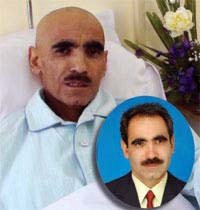 |
| Rajavi refuse Mehdi Fathi to return to France |
anxiety was churning up inside him. Through the trunk of the trees that seemed to get ticker every day he could see the stretched plain bordering the camp which in contrast to the trees seemed to be shrinking day after day. And he could realize his own image fixed among the autumn’s foliage.
It is now for months that he is bedridden like a piece of meat getting weaker and weaker. He is no more than a hollow-eyed man with black rings around them and hardly able to move his limbs. The past weeks were a grueling battle of death and life, a monotony of looking at his pale face in the mirror and the lengthened silence of his room made it more intolerable. The daylight filled him with delight although it ended with a sad nightfall, but the worse was an overwhelming pain that extended into the entire night. He had been told the previous day that they had done whatever they could to relieve the suffering pain that had filled all his cells. Rahman, his organizational senior in charge, had told him that brother Massoud (Rajavi) had been informed of his condition but all he had done to relieve the pain was to send a signed photo of himself and Maryam and a watch with an engraved logo of the organization instead of transferring him to a Hospital in Baghdad to receive due medical treatment. Perhaps it was the magic of the photo, said to be taken in the last days of brother Massoud and sister Maryam’s residence in Camp Ashraf, that was thought to bear the power to alleviate him! Watching him closely to see any trace of reaction, Rahman would say that it was a brand-new photo; and he only nodded without looking at Rahman who was quoting brother Rajavi saying it was the most serious juncture of the struggle against the regime and that they resisted transferring any patient to Iraqi hospitals unless the Iraqi authorities agreed to let interpreters accompany them to hospitals. And an agonizing pain ran through his body as he just listened, since he knew well that brother Massoud would never change his mind as he had never done before.
At dusk, a nurse came into the room carrying a tray of dinner and medicine. “How are you?”, she said. “Comrades did a terrific job today! They made it a hard day for the regime’s agents. Brother Olfat says they will clear out in two or three days if we continue as we did today. What do you say?” She did not wait for a response and began to prepare for an injection while she was eying him from the corner of her eye. And he turned on the bed to let her do her job.
He came to himself when he heard the door closing. The nurse had gone and he tried his best to sit on the bed. He gulped down the pills all with a glass of water and pushed away the tray of dinner. He reached out for the notebook next to the photo of Massoud and Maryam. He tried to write, as he always did at this same hour. The cover bore a smiling photo of brother Massoud and a quote that the daily “regular confessions”* had priority over the daily prayers. He took the black pen between his weak and bony fingers and began to write languorously: “Confession: today, I had some moments of doubt. I’m not well at all. The pain is killing. I do not know how this terrible and grueling condition can be overcome, but it can be made a little better than what it is. I do not know how long I can last out, but I also see no convincing reason to be kept in such a condition. Suffering from an incurable disease does not mean to sit and wait …”
A sudden dizziness overtook him and the pen slid out of his fingers. He opened his mouth to cry for help but no voice came out. His hand went to the small table beside his bed and knocked the photo and a jug of water over. He fell and his face hit the bed. He lost his consciousness.
***
He had a strange feeling of lightness, floating between the sky and the earth. It was a hard try to half-open his eyes to see many shadows moving around his bed. One in white was bending over him to examine his eyes with a flashlight. He could hardly understand what the doctor said but in the dimness he could see he was desperate and anxious. From under his half-closed eyelids he could see the oxigen tube inserted into his nose. He felt a stethoscope cold as a piece of ice gliding down his chest and heard the buzz of some medical equipment over his head. Little by little he came to realize where he was and why he was bedridden; a silent soliloquy began to form in his mind.
Damn these eyelids, they disturb me remaining half-closed! As it is the problem with my mouth, unable to utter a word, as I am frozen in a never-ending wonder. And this damn earsplitting bubbling of the tube in my nose! I cannot remember where I read you could go through your past when the death is near. Now I can only remember yesterday when Mahdi, Rahim, Rahman and other comrades were around my bed. Some tried to hearten me and others were joking, as if I was not to die in a few days. But I had no doubt about it and knew that I had no more than a few weeks or days to end it forever. Strangely, I cannot identify what passed yesterday with what I can now see through my half-closed eyelids! Now I see Rahman whispering something into the doctor’s ear; a meaningful smile appeared on their faces and they nodded to each other. I can hear Rahman asking the doctor “what percent” but the doctor was too vague to comprehend. And I can hear Rahman’s broken words: “unfortunately, … we have run of it, … you know, .. for the same reasons … brother Massoud … it can be turned into a frontline of resistance … to repulse the hirelings. For him it makes no difference to be today or next week, but it is critical for us at the moment. And brother Massoud has also found it right.”
What is he talking about? What reasons? What are they hurrying for? And again I hear Rahman saying: “I understand, but all are waiting, he is the key to open a stuck lock and the primer to blast a big bomb. He can provoke emotions and no doubt, works to disrepute Maleki and the regime”.
And questions one after each are boiling in my head. I see the doctor leaving the room angrily. Two more people that I do not know enter and approach my bed. What are they doing? One begins to draw out the inserted cannulas and the other detaches the wires from my body and a third one that I do not know takes the oxygen mask. What are they doing? I try to be optimistic. Perhaps I never needed all these tubes and equipment attached to me. Yes, maybe once more I have defeated the death and they are taking me to the ward where my other comrades are. They push a stretcher next to my bed but they do not seem to behave friendly.
Oh, why my eyelids feel so heavy. Everywhere is cold and white. All my body is numb and I feel sleepy. Rahman is looking into my eyes but his face is beginning to blur. Now I am entering a dark, endless tunnel and feel as light as a feather. Neither can I hear, nor see, nor understand, nor feel any pain. Anything is different; I am experiencing a new feeling, like a total transfer to a new thing, a new place, like waking from a horrible nightmare to pass into a sweet dream. Still I do not know what is really happening! All I feel is comfort and lightness and I am enjoying the beginning of a journey, an irresistible urge to cross the bounds of despair into the absolute happiness. The journey is tempting and I long to proceed into the fantastic world; I am much delighted, and with the same enthusiasm slowly I close my eyes.
*. “regular confessions” is a regular monitoring technique within the cult of Mojahedin to have the mind and behavioral changes of the insiders under control. Members are forced to write a daily or weekly confession and take part in inquisition sessions through which members have to confess before others of their thoughts and intentions and to renew allegiance to the ideology and the ideological leadership of the organization.
The transfer of the control of Camp Ashraf to Iraqi forces since 2008 and the Iraqi government’s determination to make a decisive decision about the residents of Ashraf has enraged Rajavi and his propaganda machine into a broad campaign against the Iraqi government. MKO’s first reaction was arranging a series of suicidal operations. On July 29, 2009 there was a report of deadly clashes between hundreds of Iraqi police forces and the members of MKO residing in Camp Ashraf that left 11 members dead and scores injured from the both side. While the reasons for the clash was said to be unclear at first, few knew that it was a pre-organized self-destruction plan by a number of Rajavi’s devotees to provoke Iraqi forces to trigger the clash that was well videotaped and broadcasted by the organization itself.
While the Iraqi forces and their commanders were still under the shock of the suicidal and violent behavior of the camp residents, MKO felt easy to feed its propaganda machine for months. Of course, after the events the Iraqi authorities, not acquainted with the group’s self-destructive tactics, were more cautious to adopt appropriate methods when dealing with MKO. The prudential measures were aimed first to secure the rightful demands and rights of Iraqi people and second, to restrict and prevent MKO’s misinformation apparatus and propaganda blitz as its adopted post-disarmament tactic. Despite all these efforts, Rajavi was, and is, focusing on an interlocking violent-political campaign to achieve two objectives; first, to draw attention of the international community through fraudulent claims and misinformation, most of which are distributed and circulated by the group’s paid or naïve political advocates. By rising tension at the camp against the Iraqi plans that are aimed at rightful measures to have more control over the camp, Rajavi also intends to show a martyred image of the residents to question the legitimacy and capability of the Iraqi government in holding the control of Camp Ashraf in an attempt to return the protection of the camp to the US forces.
Now, it has turned to be Rajavi’s short-term strategic goal and agenda. In this hostile and antagonistic behavior against the Iraqi government MKO is also invoking the support of many Western advocates who are engaged in an endless battle of condemning the Iraqi Government and calling for the establishment of US forces in Ashraf voicing that these forces have an obligation to provide the residents’ permanent protection. But they are not the sole means to accomplish Rajavi’s ends. The best means at hand are the members of the organization themselves who are victimized as human-shields to bulwark Rajavi’s cult bastion. However, as the international community is misinformed of what is really happening at the camp and its vicinity, Rajavi at the present grabs at two opportunities to accomplish the above stated objectives.
One is feeding his propaganda machine by making groundless claims following the continued and prolonged picketing of the families of the members outside the camp, families that are deprived of their rights and prevented to meet their enslaved children and relatives unconditionally and without his security monitoring. He blames the families of being a pack of Iranian and Iraqi agents tasked with torturing and disturbing the camp residents psychologically by installing multiple speakers around the camp. Of course, the truth is that the installed speakers are the only means the families have found working to have their voices heard by the insiders to counter Rajavi’s security measures and the falsely made claims.
The patients in the Camp Ashraf suffering from a variety of chronic and acute illness are also callously manipulated as the tools of propaganda. To baffle rightful judgment by perversion and to misuse humanitarian emotions of the world and evoking sympathy of outsiders toward Ashraf residents, Rajavi claims that the patients are prevented by the Iraqi forces to be transferred to Baghdad hospitals for receiving due treatment. Of course, Ashraf residents have no problem in transferring their patients to Iraqi hospitals and the Iraqi authorities have never ceased the entrance of medicine and other necessary medical facilities to the camp. What is opposed to is the exit of attendant agents that the Ashraf leaders insist to be accompanying the patients. On the one hand they voice concerns about the worsened condition of the patients suffering from cancer, cardiopulmonary, respiratory, and other deadly diseases, on the other hand they object to sending out patients unaccompanied and unsupervised.
To justify the escort of patients, it is stated that the patients need interpreters in hospitals to help them explain their illnesses and suffering. At the first look it sounds reasonable, but for those familiar with MKO’s system of control and security it means a strict, cultic method of control that contradicts disconnection of the members from the main body even for a short period of time. And you may become even more suspicious when you come to consider that the insiders, and the patients among them, are unable to express a few Arabic and English words after at least a two-decade long stay in Iraq. And a question for sure may form in the minds that who are these claimed interpreters so liable that nobody else in whole Iraq can undertake their job. What are the cult leaders really anxious about is not the precarious condition of the patients but losing their powerful cult grip over the life and minds of the enslaved individuals in case they leave the camp alone.
What the outsiders are not generally aware of is the methods and ploys Rajavi has developed to control the members’ lives. The watching and controlling measures that monitor the members even in their privacy never permit any risk of leaving a member alone with an outsider, be it a health caretaker or a member of his/her own family. That is why Rajavi objects to letting the member out of the camp or meeting their families alone and unsupervised. He knows well that the thought-reform atmosphere within the camp that is reinforced by a collective modeling behavior of the members prevents insiders from challenging his system, but any short contact with the world outside will open their eyes to the reality in a flash.
The death of a few patients, who have to otherwise risk their life as human shields even if healthy, benefits Rajavi’s system both in winning a propaganda warfare against the Iraqi government and safeguarding the internal integrity of its cult structure. Indeed, all humanitarian claims of Rajavi and bizarre games he plays are rooted in his personal concerns and his fear of organizational collapse that has so far survived even years after the collapse of his patron dictator in Iraq.
Rajavi plans to incites brainwashed Mojahedin Khalq to burn themselves and self-harm after failure of his strategy to escape the crisis engulfing Camp Ashraf
Alnakhel news – confirmed the news from inside Camp Ashraf that after the failure of Massoud Rajavi’s strategy to save the terrorist camp, he has incited the brainwashed Mojahedin to burn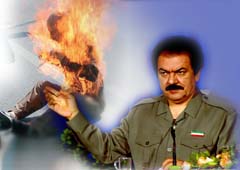 themselves to get out of the impasse that surrounds the camp. Alnakhel news agency reported the possibility of the elimination of members with cancer or other diseases in the MKO terrorist group by forcing them to commit suicide by burning themselves individually or collectively.
The aim of the leaders of this criminal group by forcing members to commit suicide or self-immolation is to point the finger of blame at the Iraqi government so that it shoulder more burdens and face more problems at this time.
In addition to the torture of the MKO members, cult leader Rajavi initiated the anti-humanitarian act …to deny families who have gathered at the camp gates from seeing their children, and on the other hand to prevent the families from checking the health of their loved ones.
Iraqi police intervened last week through inspection of the [MKO] hospital, which is part of the sovereignty of Iraq, to provide medicine and doctors. But the MKO leaders took the initiative to send members to injure themselves to prevent the entry of Iraqi police to the hospital.
In this way, the MKO aims to accuse the Iraqi forces of beating its members so as to create a grievance in order to prevent them from deciding in the affairs of the hospital and the need for medicines and doctors to treat patients. This criminal act comes at the time when Rajavi on one hand sends patients to the best hospitals in the Iraqi capital who are treated by the best doctors and specialists, and on the other hand claims he was facing problems in the treatment of patients due to restrictions imposed by the Iraqi government.
It is worth mentioning that the MKO had initiated the liquidation of a number of its members before and after the occupation of Iraq and claimed then that they were killed in U.S. air raids. A number of witnesses dismissed these false allegations out of hand and said they were killed by members of the MKO group.
Nakhel news, Baghdad – translated by Iran Interlink
Reports from inside the main training camp of the anti-Iran terrorist Mojahedin-e Khalq Organization said MKO ringleaders have started brainwashing members to persuade them to commit suicide in a bid to prevent their possible defection in quest for better living conditions.
Earlier reports had revealed that a large number of MKO members are struggling against killing diseases like cancer, while the group’s leaders have blocked their access to the outside world in a bid to prevent their possible defection.
According to a new report by the Habilian Association, an Iran-based human rights group, the MKO ringleaders allege that their brainwashing plans are aimed at increasing the costs of the camp’s sealing and incarceration by the Iraqi security forces for the Baghdad government.
After intense and repeated requests by the Iraqi people, groups, parties and parliament members, the country’s security forces took control of the training base of the MKO at Camp Ashraf – about 60km (37 miles) north of Baghdad – last year and detained dozens of the members of the terrorist group. The Iraqi authority also changed the name of the military center from Camp Ashraf to the Camp of New Iraq.
The report said that the new measure came after protests remarkably increased inside the group. Right groups are gravely concerned that a large number of MKO members may lose their lives soon if UN, human rights and Iraqi officials do not force the group leaders to end their tortures and pressures against the dissident members.
Leaders of the Rajavi cult (MKO) have cut contacts between the group members and their relatives and family members even in the Camp hospital in a bid to prevent possible defection of the members, which has been on the increase in recent months.
Earlier reports had revealed that under the direct order of MKO’s Ringleader Maryam Rajavi, leaders of the terrorist group allow their members to receive medical aids, healthcare and other services only in return for given levels of cooperation.
Based on the order, dissident members are deprived of medicine and other medical services or, at least, face much hardship and difficulty in procuring their necessary medicines, a report by the Habilian Association said in November.
According to a report by Iraqi daily Motamar, also published by Edalat (Justice) Society web site – an organ of the families of the Iranian victims of terrorism – Iraq’s right groups have sent serious warnings to civil society and human rights bodies as well as the Iraqi government about the ongoing humanitarian disaster in the MKO’s main training camp in Northern Iraq.
Also, Sahar Family Foundation reported that the MKO’s ringleaders are forcing the dissident members of the group to commit suicide, and if they refuse to do so, the leaders massacre defectors themselves.
The right group called on the Iraqi judiciary system, international court of justice and all international human rights bodies as well as the Iraqi and international media to take urgent action to stop the human catastrophe in the camp which, they said, now looks more like a slaughterhouse.
The MKO ringleaders have long been reported to be using torture and pressure on their own dissident members, barring the dissident members from leaving the organization and joining their families.
Earlier this month, an Iraq-based right group unveiled that ringleaders of the MKO have resorted to various forms of mass killing in a bid to bring the group out of the current impasse in Iraq.
In relevant development, a report revealed in November that Ahmad Razzani, a veteran member of the MKO, had been killed inside the Camp.
Reports also said that all exit and entry doors have been locked and none of the members, even those suffering from acute diseases and illnesses, are allowed to leave the camp.
MKO ringleaders have ordered the camp guards to stage snap inspections of the group’s members and their personal belongings under the pretext of finding the lost weapons.
Such behaviors have sparked discontent among a number of MKO members and made them escape the camp and return to their anguished families.
A large number of Iranian and Iraqi families staged a massive protest outside the camp in December, and called for the freedom of their relatives and children who are under various types of torture and pressure by their ringleaders inside the camp.
The protestors demanded the Iraqi government and all human rights groups and organizations to provide the ground for the freedom of their children from the notorious Camp Ashraf, and urged closure of the terrorist hub.
Among the demonstrators were families of the MKO members, who say their loved ones are being held inside the camp against their will.
The MKO, whose main stronghold has been in Iraq’s Diyala province since the 1980s, is blacklisted by much of the international community, including the United States.
Before an overture by the EU, the MKO was on the European Union’s list of terrorist organizations subject to an EU-wide assets freeze. Yet, the MKO puppet leader, Maryam Rajavi, who has residency in France, regularly visited Brussels and despite the ban enjoyed full freedom in Europe.
The MKO is behind a slew of assassinations and bombings inside Iran, a number of EU parliamentarians said in a recent letter in which they slammed a British court decision to remove the MKO from the British terror list. The EU officials also added that the group has no public support within Iran because of their role in helping Saddam Hussein in the Iraqi imposed war on Iran (1980-1988).
Many of the MKO members abandoned the terrorist organization while most of those still remaining in the camp are said to be willing to quit but are under pressure and torture not to do so, the report by the EU parliamentarians added.
A May 2005 Human Rights Watch report accused the MKO of running prison camps in Iraq and committing human rights violations.
According to the Human Rights Watch report, the outlawed group puts defectors under torture and jail terms.
The group, founded in the 1960s, blended elements of Islamism and Stalinism and participated in the overthrow of the US-backed Shah of Iran in 1979. Ahead of the revolution, the MKO conducted attacks and assassinations against both Iranian and Western targets.
The group started assassination of the citizens and officials after the revolution in a bid to take control of the newly established Islamic Republic. It killed several of Iran’s new leaders in the early years after the revolution, including the then President, Mohammad Ali Rajayee, Prime Minister, Mohammad Javad Bahonar and the Judiciary Chief, Mohammad Hossein Beheshti who were killed in bomb attacks by MKO members in 1981.
The group fled to Iraq in 1986, where it was protected by Saddam Hussein and where it helped the Iraqi dictator suppress Shiite and Kurd uprisings in the country.
The terrorist group joined Saddam’s army during the Iraqi imposed war on Iran (1980-1988) and helped Saddam and killed thousands of Iranian civilians and soldiers during the US-backed Iraqi imposed war on Iran.
Since the 2003 US invasion of Iraq, the group, which now adheres to a pro-free-market philosophy, has been strongly backed by neo-conservatives in the United States, who also argue for the MKO to be taken off the US terror list.
The word “cult” is a term with various meanings; the sentiment of the word is nonetheless perplexing. “Cult” has gone through a rather insignificant linguistic evolution. As early as 1617, the word shows up in both Latin and French meaning to worship or care for; it also shows up with the meaning to tend, till (the earth), or cultivate. After the 17th century, the word seemed to wane from usage, and is not found in many texts until it surfaced again in the mid 19th century where it has become to some extent symbolic with bizarre religious groups, ancient or primitive rituals. In 1829 a definition surfaced which signified it with “devotion to a particular person or thing.” More recently the meaning has expanded especially in the West and has come to incorporate a more positive vibe as it refers to films or people with rock-star-type fame. With such development of the word, sociologists have backed away from using the term too specifically in academia, although it is still widely used by the general public.
As terminology has tended to become more specific in the social sciences, experts agree that the word “cult” is a rather loose term and for the most part needs to be explicitly defined. Leona Furnari of International Cultic Studies Association (ICSA) first used a new term which subverts the word*cult * and replaces it with the more specific”closed high-demand group”or CHDG.
CHDG’s are abusive, manipulative groups or relationships in which deception and mind control are used to gain power over members or individuals.”[1]
As a former member of a CHDG, Furnari determines some common characteristics of these groups:
– Members are expected to be excessively zealous and unquestioning in their commitment to the identity and leadership of the group. Personal beliefs and values must be replaced with those of the group.
– Members are manipulated and exploited and may give up their education, career and families to work excessively long hours at group –directed tasks such as selling a quota of candy and books, fund raising, recruiting and proselytizing .
– Harm and threat of harm may come to members, their families and/or society due to inadequate medical care, poor nutrition, psychological, physical or sexual abuse, sleep, deprivation, criminal activities, etc. [2]
Furnari’s unique perspective and knowledge qualifies her to act as an authority on the subject of CHDG’s, and as a result she has become one of the leading experts on CHDC’s. (She currently runs a practice to help people who have been subjected to the exploitive methods of CHDG’s. )
Having determined a clear definition of a CHDG for the purpose of my argument, it is important to know that CHDG’s are not unique to any particular culture, religion, or political group. I’d like to discuss one group in particular who meets the criteria of a CHDG, and whose group shadows many of the socio-political, and cultural-religious aspects of the societies in which they are located, in which they are influenced by, and in which they would like to influence. This group is the Mujahedin-e Kalq Organization, also known as the MEK, MKO, NCRI, and numerous other front names which they come up with in order to confuse the public, and in order to mask their shrewd, dirty practices. The MKO is made up of members (mostly Iranians who do not live in Iran) who have been deceived into believing that the leaders of the MKO, Maryam and Massoud Rajavi, are a viable alternative to the leadership of the current Iranian government.
(While Iran maintains a tainted reputation in the West, mostly for resisting the pressure to conform the West’s ideals, its internal problems, like any other nation, are going to be solved by the population who knows it best—by the intelligent people who live there. Iran has had a long and complicated, highly misunderstood history which for the past 50 years has been exacerbated by propaganda from the West. Iranians feel that the West does not understand Iran, and most people living there feel that the demise of relations comes from a track record of a misinformed media, and a long-standing, unacknowledged grudge for the destabilizing atrocities that the US committed against Iran as it was moving naturally towards a modern political state.) The truth is that the MKO is a closed high demand group and its practices are identical to the criteria that Leona Furnari has proposed. The MKO spends an enormous amount of time and energy conjuring stories to hide its ugly practices and propagate its intention of taking over Iran. For the time being I am going to concentrate on some of the MKO’s CHDG practices for the sake of exposure. The group is dangerous. They have conducted various terrorist attacks over the decades which have literally killed thousands of innocent Iranian citizens and government officials. They are not so much a threat to the Iranian government—but to the members who have been duped into dedicating their lives in one way or another to the MKO. It is important to expose the MKO now, and continue to expose them, because Iran has become, or will soon become a target for the West, and needless to say, enough people have already died because of the MKO—no more need to. The MKO is disguised as an architect of human rights and blind supporters need to know the truth about the group. For this reason, and for the sake of members who have been sadly been tricked into giving up their lives for the MKO’s false hope, I will therefore list a short series of incidents which I feel clearly indicate that the MKO is a CHDG.
One former member of the MKO, Ann Singleton, who now lives in the UK, describes the organization as a “dangerous cult because it believes in using violence to achieve its stated aims. It is destructive because it destroys the lives, minds and spirits of its membership. The majority of the members are held incommunicado, with no access at all to the outside world. Within this isolation they are subjected to a systematic daily regime of psychological manipulation and coercion.”[3]
An example of this violence drew attention in June 2003, following the arrest by French Police of the MKO leader, Maryam Rajavi. Following the arrest, a number of MKO members in various large cities set themselves on fire. People around the world questioned the motivation behind the self immolations. The *National Post* (Canada) reported that after Maryam’s arrest, “the MEK had responded by mobilizing its international network of supporters, ordering them to take to the streets in protest. At the French embassy in London, an Ottawa woman named Neda Hassani died after setting herself on fire.”[4] Her father later told reports that Neda “loved [Maryam Rajavi] dearly.”
In 2005, Human Rights Watch (HRW) interviewed five MKO members who were able to completely defect from the group. HRW reported in an article titled “No Exit” that the defectors’ “testimonies, together with testimonies collected from seven other former MKO members, paint a grim picture of how the organization treated its members.”Furthermore,”the MKO former members reported abuses ranging from detention and persecution of ordinary members wishing to leave the organization, to lengthy solitary confinement, severe beatings, and torture of dissident members.”[5]
The US State Department has documented that main objective of the group’s leaders is to gain power and this is done by having Maryam and Massoud Rajavi sustain a system that maintains a Cult of Personality. But total devotion to the leaders has physically maimed and traumatized some of the members for life. In October 2008, Nasrin (Batoul) Ebrahimi disclosed some of the MKO’s human rights violations. Being an ex-member of the MKO’s so-called elite “Leadership Council” Ebrahimi had both witnessed and experienced some of the worst human violations possible. In her speech at the European Parliament, she revealed an MKO practice called the”Ideal Summit Operation”which was basically a hysterectomy ordered on women members. The operation is done by a doctor named Nafiseh Badamchi, an MKO physician. [6]
Another former member of the group, Batoul Soltani, who also participated in the group’s “Leadership Council”, spoke out about a bizarre manipulative practice called the “Salvation Dance” in which women members were required to dance nude in front of the leaders. Soltani asserts that during the “Salvation Dance,” the women are indoctrinated by their superiors—they are told to remove their clothes in front of Massoud Rajavi who then says he will lead them to heaven and God. Ms. Soltani recalls that she noticed “Maryam and some other high ranking members were monitoring us and trying to convince those of us who hesitated to remove their underwear.”[7]
Members of MKO who live at Camp Ashraf, Iraq have been kept in an atmosphere of horror and isolated from the outside world—especially since the collapse of Saddam Hussein. The group was disarmed by coalition forces and their leader, Massoud Rajavi disappeared—fearing for his life, as he was a close ally of Saddam Hussein—going as far as helping the Ba’athist government exterminate hundreds of Kurds as well as plant bombs against the Iranian people. Members are so highly controlled that they are not able to trust their own families. Ann Singleton writes that “one of the most potent tools used by cult leaders to control their members is through the inculcation of irrational fears, or phobias, in the minds of the cult members.” Singleton believes that today MKO members’ phobias consist of many things, but mostly that, people who want to help them—mostly family members—get out of the cult are somehow coerced by”the agent of the Iranian Intelligence Ministry.”She furthers that “no empirical evidence is required as the phrase works exactly to arouse irrational, not real, fear.”[8] Consistently over time the cult’s leaders have abused MKO members’ rights, and labeled MKO members’ family members as agents of the Islamic Republic of Iran. Because of this, members of the group are not allowed to visit their families. For more information about MKO human right abuse, please refer to the following website of the United Nations Refugee Agency:
http://www.unhcr.org/refworld/
country,,HRW,COUNTRYREP,IRN,,45d085002,0.html
References:
[1]Furnari, Leona.”Born or Raised in High-Demand Groups: Developmental
Considerations.”*ICSA International Cultic Studies Association* 4.3 (2005):
Web. 16 Dec 2010. <
http://www.icsahome.com/infoserv_articles/
furnari_leona_bornraised_en0403.html>
[2] ibid
[3] Singleton, Ann.”Fear and Slavery in the Mojahedin-e Khalq cult.”*
Iran-Interlink* (2009): Web.16 Dec 2010. <
http://www.iran-interlink.org/?mod=view&id=7192>.
[4] National Post.”Father’s Sacrifice.”*canada.com* Sep. 26, 2006: Web. 16
Dec 2010. <
http://www.canada.com/nationalpost/news/story.html
?id=eb5a4184-ebee-4e44-93ce-b9b8485efa33&k=51167>.
This is the third part in a series of five articles by the National Post
investigative team. National Post investigators found the outlawed terrorist
group Mujahedin-e Khalq recruited teenagers in Canada and sent them abroad
to overthrow the Iranian government by force. In this article, a Canadian
family got deeply involved with the guerrillas — and now regrets it.
[5] Human Rights Watch.* *”No Exit: Human Rights Abuses Inside the
Mojahedin Khalq Camps.”18 May 2005: Web. 16 Dec 2010. <
http://www.hrw.org/en/reports/2005/05/18/no-exit>.
[6]Fars News Agency. “The Ideal Summit Mujahedin Khalq makes women
unfertile.” 15 October 2008
Web: 16 December 2010. <http://iran-interlink.org/fa/?mod=view&id=5257>
[7]NEJAT BLOGGERS. “PMOI Leadership Council’s women SALVATION DANCE.” 19
August 2010. Web: 16 December 16, 2010 <
https://www.nejatngo.org/en/posts/3261>
[8]Singleton, Ann.”Fear and Slavery in the Mojahedin-e Khalq cult.”*
Iran-Interlink* NOV 2009: Web. 16 Dec 2010. <
http://www.iran-interlink.org/?mod=view&id=7192>
By Mazda Parsi
An Iraq-based right group unveiled that ringleaders of the anti-Iran terrorist Mojahedin-e Khalq Organization (MKO) have resorted to various forms of mass killing in a bid to bring the group out of the current impasse in Iraq.
According to a report by Iraqi daily Motamar, also published by Edalat (Justice) Society web site – an organ of the families of the Iranian victims of terrorism – the Iraqi right group has sent serious warnings to civil society and human rights bodies as well as the Iraqi government about the ongoing humanitarian disaster in the MKO’s main training camp in Northern Iraq.
The Sahar Family Foundation also said that the MKO’s ringleaders are forcing the dissident members of the group to commit suicide and massacre defectors.
The right group called on the Iraqi judiciary system, international court of justice and all international human rights bodies as well as the Iraqi and international media to take urgent action to stop the human catastrophe in the camp which, they said, now looks more like a slaughterhouse.
A November report by the Habilian Association, an Iran-based human rights group, said that under the direct order of MKO’s Ringleader Maryam Rajavi, leader of the terrorist group in the Camp of New Iraq (formerly known as Camp Ashraf) allow their members to receive medical aids, healthcare and other services in return for given levels of cooperation.
Based on the order, dissident members are deprived of medicine and other medical services or, at least, face much hardship and difficulty in procuring their necessary medicines.
The right group added that the new measure came after protests remarkably increased inside the group, specially in the camp. Right groups are gravely concerned that a large number of MKO members may lose their lives soon if UN, human rights and Iraqi officials do not force the group leaders to end their tortures and pressures against the dissident members.
In relevant development, a report revealed in November that Ahmad Razzani, a veteran member of the MKO, had been killed inside the Camp.
The report said that the move by the MKO ringleaders came after they failed to brainwash their inferiors to convince them to distant themselves from their family members who have been residing and waiting outside the camp for the last 10 months demanding freedom of their relatives.
The right group said after the brainwash policy and efforts of the MKO leaders failed, discontent and protest has both widened and deepened among MKO members.
Earlier reports coming out the camp had said that a large number of MKO’s deprecating members started riots and angry protests to end their forced presence in Camp Ashraf.
According to an August report by the Habilian Association, the MKO leaders have increased their pressures and control over the members of the terrorist group to prevent possible defection and escape by unsatisfied members.
Reports also said that all exit and entry doors have been locked and none of the members, even those suffering from acute diseases and illnesses, are allowed to leave the camp.
MKO ringleaders have ordered the camp guards to stage snap inspections of the group’s members and their personal belongings under the pretext of finding the lost weapons.
Such behaviors have sparked discontent among a number of MKO members and made them escape the camp and return to their anguished families.
According to international human rights bodies, the MKO has a completely black record in human rights. Many of the MKO members have abandoned the terrorist organization while most of those still remaining in the camp are said to be willing to quit but are under pressure and torture not to do so.
A May 2005 Human Rights Watch report accused the MKO of running prison camps in Iraq and committing human rights violations.
According to the Human Rights Watch report, the outlawed group puts defectors under torture and jail terms.
What is the meaning of the ‘Salvation Dance’ (described by Mrs. Batool Soltani, ex-member of the PMOI Leadership Council in her autobiographical writing), which was performed by the Muslim Leadership Council’s women in front of Massoud Rajavi, the leader and founder of the Rajavi cult?
In this so-called Salvation Dance (nude dancing), the women of the Leadership Council were indoctrinated through cultic-religious psychological manipulation to remove all their clothes in front of their guru, imam, spiritual leader, Massoud Rajavi, who is responsible for sending them to heaven while they die for him, in order to show their devotion and allegiance to him.
In Iranian culture, and especially in Islamic culture, the nudity of women in front of men is considered as high corruption and sin. So the question which comes into the minds of right thinking people is “why is the leader of the PMOI, who claims to be Muslim and that his organization is a Muslim organization, demanding that his Leadership Council perform nude dancing in front of him and Maryam Rajavi?” Maybe you think that the PMOI has reformed its ideology into a more western-like culture? Or, that they do this to show their ideological differences with the current regime of Iran.
If you ask the operatives of Rajavi’s cult the same question they will respond that “it shows the richness of their ideology, in which the souls of women and men become as one with their spiritual leaders”. You could also say that Massoud Rajavi is a highly lustful and salacious leader, who wants to take advantage of the women in his organization, especially beautiful women.
Well, we can think and imagine whatever comes into our minds, but if you ask me, as someone who has spent nearly twenty-five years of my life in that organization, I have my own point of view about this sensitive but serious subject.
First of all, whatever interpretations are mentioned above are not wrong; they are correct to some extent, and I can not say that they do not exist at all. But are those above mentioned reasons considered as a threat or danger? Having passion and lust for beautiful women, even as the PMOI’s leader is a matter of Massoud Rajavi’s own personal desires, or even that they are trying their best to show themselves as an open minded and reformed organization and not as a fanatical one to western countries. In this interpretation the behavior may look strange but not dangerous. But what is really happening there? And what is the real purpose of such deeds that occur in the PMOI’s internal affairs? What is the real interpretation of nude dancing in the PMOI? Is it utilized as a tool? What are the leaders of the cult thinking by performing such strange and odd activities? What do they want to achieve?
For Muslim women, according to their religion, one of the most precious and vital aspects of their belief is their cover (hijab); for that reason you would not see even the hair of a Muslim woman because it is covered by a headscarf. In Ashraf garrison, the PMOI’s main base, women and men are completely separated from each other, even their gas station working hours are divided between men and women, and no man can go for gas during the women’s turn, and vice versa.
These women in the Leadership Council are all Muslim, and they are very devout and serious in practicing their religion, and all of them wear a headscarf (hijab). So, taking off their clothes in front of their guru and leader and being naked is a giant step in their internal affairs. It is the end result of the long-term brainwashing and indoctrination which began in 1989 (Second Ideological Revolution).
In this final test, they become completely and utterly devoted and obedient and ready for any order which comes from Massoud and Maryam Rajavi. If this nude dancing which was performed by the Leadership Council in front of Maryam and Massoud Rajavi, were just to satisfy Massoud’s lust and his sexual desires, it could be considered as Rajavi’s sexual exploitation of women inside the PMOI. But the question remains “what did Rajavi want to achieve after all those years of brainwashing and indoctrination?”
To answer these questions I will take you back-stage in the PMOI. These ladies, the Leadership Council, are high commanders and they have many subordinates, the rank and file, who are under their direct command. To gain this position, these ladies must have proven themselves to Massoud and Maryam Rajavi as being ready and willing to implement and carry out their orders by all means, so they had to undergo the most difficult test which was opposite to their religious regulations and beliefs. Taking off all their clothes, even their underwear, in front of Rajavi means they had become the soul of him and at one with him to the point that they are ready to do whatever he wishes. (Do not forget that these ladies, the Leadership Council, are devoted Mulsims.)
After this prelude, I take you to the year of 2003. In that year, many PMOI members set themselves on fire in Paris and other countries in protest to the incarceration of Maryam Rajavi. Setting themselves on fire was an order which came directly from the leaders and Leadership Council of the PMOI. Just by conveying six words: set yourself on fire for Maryam, many of the brainwashed members killed or injured and disabled themselves for that cause. This is the dangerous aspect of Rajavi’s religious indoctrination and brainwashing methods.
These PMOI Muslim women, after passing through many years under religious-cultic indoctrination, entered into the final test to show that they were ready to carry out anything desired by their leaders, even by trampling their Islamic regulations. Their nude dancing in front of Massoud and Maryam Rajavi was the final phase of their brainwashing to become committed, loyal and devoted to their gurus, Massoud and Maryam Rajavi. It showed their allegiance to them for implementing their orders in the PMOI’s internal relations, which means maximum suppression and oppression of the rank and file to keep them as captives and slaves of Rajavi’s cultic thoughts, and ready to implement any order by all means, whenever and wherever their leaders desire.
Unfortunately, all the PMOI Leadership Council’s members who are still in the PMOI have had all human sentiment hollowed out from them, and as a result they are capable of implementing many hazardous deeds and missions; and surely it is not their fault since Rajavi and his brainwashing methods made them like this.
I assert that nude dancing is the final step in brainwashing of the Leadership Council which Rajavi utilizes for implementing his desires. These dangerous desires could be a mass suicide, setting their members ablaze, a mass hunger strike to death, and terrorist activities, etc.
In the end, I do not reject the idea which says Rajavi is a salacious leader, or that he has a passion and lust for women but I emphasize that we should be alert and vigilant to the dangerous purposes and objectives of all this brainwashing and religious indoctrination that Rajavi has done for many years. All these indoctrination and brainwashing methods, which I call “Rajavi’s complicated tools”, are designed for the cult leaders to forward their cultic objectives, whenever and wherever needed, and that is the thing which makes this cult so dangerous and terrifying.
So, in my view, the PMOI is as a dangerous poisonous snake which if you are not vigilant enough, will bite you, and believe me, its poison is deadly as hell, so watch out.
Respectfully
Hassan Piransar , an expert on the PMOI,Paris
To stripe somebody of his individual identity to replace it with a new identity has been a common process in majority of all contemporary cults. This cult identity is created by sophisticated mind control techniques and it does not represent the whole individual. Steven Hassan stresses that “[cult] members are taught to suppress negative personal thoughts and emotions. They are trained to speak only positively of their involvement. When the cult member says he is "happy," it is usually the cult identity who is talking. The cult self is doing what it has been instructed to do”. 1
As cults have developed their own principles and rules, their reactions to the outside world are based on some certain criteria different from that of other political and social organizations that have to exercise the discipline of their own in order to achieve certain objectives; however, rarely they make use of any process to forge identities. At the present, cults are largely in need of obedient and submissive members whose mentality can be shaped through a change of identity and our aim here is to take a brief look at the concepts of individual identity, cult identity and investigate the process of setting up new identity in MKO similar to that of other cults.
We may consider the individual identity as the sum of mental and ideological beliefs of a person and the extent to which he is affected by the environment out of the cult. On the contrary, the detachment of the person from such beliefs and values by means of a system controlling his behavioral, mental and psychological aspects constitute one of the major goals of cults. Such a replacement of values leading to a new cult personality makes the person struggling with many contradictions to adapt his potentiality in line with cult objectives. In other words, cult identity neutralizes the individual identity of the members. In fact all the cultist instructions depend on such a mechanism for actualization.
As such, cults make their best to recruit members with unstable identity and ready to acquire cult identity due to their political, emotional and familial discouragements in order to play the major role in the quantitative growth of cults. Under the impact of a new identity, members easily submit to cultic domination and whatever sacrifices for the cult causes. Eric Hoffer evaluates the factor of devotion based on the cult identity. He believes that the relation between these concepts may clarify the nature of members’ full obedience to cultist instructions:
To RIPEN A PERSON for self-sacrifice he must be stripped of his individual identity and distinctness. He must cease to be George, Hans, van, or Tadao- a human atom with an existence bounded by birth and death. 2
Reviewing the historical cults may reveal the role of such a factor. The earliest religious cults such as Isma’ilis (Hasan Sabbah) tried hard to instill a kind of cult identity into members. They declared openly that members had to do something more than self-sacrifice for leaders and consider the extent of obedience as the main measure for a new cult identity. Therefore, they asked their members to put the principle of absolute obedience into action rather than pretending by merely saying it. What the leaders asked members was to have absolute faith in the cult’s commands:
We don’t ask Fedayeen [self-sacrificers] for passion but for a sound belief. We are to be sure that in case of issuing any order for any of our Fedayeen, there is nothing to prevent it. 3
Cultist relations of Mojahedin, as the most typical political leftist cult, are the same as that of Hasan Sabbah’s cult. The term "spiritual journey" refers to the negation of individual personality and development of a cultist one instead. The theoreticians of Mojahedin resort to mystical concepts in order to justify their procedures and approaches saying:
In spiritual journey, no question is allowed. The wayfarer has to put his faith in Sheikh wholeheartedly and must regard him as the most perfect person to conduct him in spiritual training, guidance and education, be his interlocutor and obey Sheikh far from any inward or outward objection. 4
Then a quotation from Maulavi, the Persian mystic poet, is resorted to:
A wayfarer has no responsibility and should be submissive like a piece of wood in the hands of carpenter. 5
An intellectual outlook does not bear such a procedure and also may denounce it. Mojahedin are against any spiritual identity but have to pretend to its reception. They analyze the
mechanism of such a new identity as follows:
It is evident that such a process does not follow a logical trend. Its dominant factor is not reason nor logic but love and emotion. Its means is not discussion nor justification but blind obedience. Herein Masoud asks for Mojahedin’s hearts. 6
Contemporary cults resort to such techniques in order to establish subordinate identities in which their members have to replace their external ties with internal ones. A new identity is regarded as the origin of cults’ power. Therefore, external bonds are the main barriers in the way of a new identity replaced by cultist models. Hofer refers to such a process saying:
The chief burden of the frustrated is the consciousness of a blemished, ineffectual self, and their chief desire is to slough off the unwanted self and begin a new life. They try to realize this desire either by finding ‘a new identity blurring and camouflaging their individual distinct- and both these ends are reached by imitation. 7
From a cultist viewpoint, a new identity works as a new faith to which a member has to be attached. It may tie an individual to an ideological group, band, political party or any ritual concept. In this regard, Hoffer writes:
Faith here is primarily a process of identification; the process by which the individual ceases to be himself and becomes part of something eternal. Faith in humanity, in posterity, in the destiny of one’s religion, ation, race, party or family -what is it but the visualization of that eternal some- tiling to which we attach the self that is about to be annihilated? 8
The relationship between cults and producing of new identities is a complex one and varies widely from cult to cult. But what is common is that the main goal of producing a new identity in cults is to make insiders dependant on the cult and to be obedient. The mechanisms the cults exploit to achieve the goal are interrelated but each can be discussed separately since they are all prerequisites for insiders’ persuasion and control and the final transformation of the recruits into real cultists. It will not be wrong to say that whatever the cults do is to cut the members off from the outside world to produce a new identity and belief totally different from what the members previously held as right and dear. The process finished, the insiders will adopt a new and reborn personality as Singer states:
As part of the intense influence and change process in many cults, people take on a new social identity, which may or may not be obvious to an outsider. When groups refer to this new identity, they speak of members who are transformed, reborn, enlightened, empowered, rebirthed, or cleared. The group’ approved behavior is reinforced and reinterpreted as demonstrating the emergence of "the new person." Members are expected to display this new identity. 9
The new personality totally split from the outside world is manipulated for a variety of group tasks based on the objectives of the group and cult that consider the outsiders as the enemies who have to be confronted:
The conflicts a mass movement seek and incites serve not only to down its enemies but also to strip its followers of their distinct individuality and render them more soluble in the collective medium. 10
As Hoffer asserts, a cultist personality is formed to be submissive to the inner-cultic relations that have priority to outwardly demonstrated ambitions and goals. The members undergoing overall identity change easily consent to any means of changing behaviour and conduct. Thus, cults can successfully accomplish their goal of binding new members to the group. Considering the stages people will go through as their attitudes are changed by the group environment and the thought reform processes, Singer points to psychologist Edgar Schein’s second stages of three:
During this second stage, you sense that the solutions offered by the group provide a path to follow. You feel that anxiety, uncertainty, and self-doubt can be reduced by adopting the concepts put forth by the group or leader. Additionally, you observe the behavior of the longer, term members, and you begin to emulate their ways. As social psychology experiments and observations have found for decades, once a person makes an open commitment before others to an idea, his or her subsequent behavior generally supports and reinforces the stated commitment. That is, if you say in front of others that you are making a commitment to be "pure," then you will feel pressured to follow what others define as the path of purity. 11
There are also the eight psychological themes that psychiatrist Robert Lifton has identified as central to totalistic environments and cults invoke these themes for the purpose of promoting behavioural and attitudinal changes in the members. The third theme, demand for purity, depicts two opposite world of black and white; the cult being an absolutely white and clean world versus the black and evil world of outside. Of course, the members with a new personality have no other choice but to think and act according to cult’s ideology and drawn strategy:
An us-versus-them orientation is promoted by the all-or-nothing belief system of the group: we are right; they (outsiders, nonmembers) are wrong, evil, unenlightened, and so forth. Each idea or act is good or bad, pure or evil. Recruits gradually take in, or internalize, the critical, shaming essence of the cult environment, which builds up lots of guilt and shame. Most groups put forth that there is only one way to think, respond, or act in any given situation. There is no in between, and members are expected to judge themselves and others by this all-or-nothing standard. 12
The process of producing identity within MKO follows the same mechanism as practiced in other cults and its orientation began with the start of the internal ideological revolution. All the members undergoing the revolution process have admitted, unveiled by the ex-members, their identity change, and the result was development of a long distance between their organizational and personal identities. It was instilled into them that their identity would be prompted based on the extent of adherence to the ideological system of the group and denial of any personal identity. In a written testimony by a member of MKO, he is somehow proud of his new identity that believes has granted him a new insight into his within and without:
Personality, egocentrism, self-reliance and individualism are all souvenirs of the bourgeoisie’s worthless humanism that distanced me from the organization as far as its degree of its impact on me. I was unworthy and this barred me to drink the pure, life-giving instructions of the organization and was leaving me alone in a desolate waste-land with no way out. I was enslaved by dominant ambiguities within me. When I failed to overcome the ongoing struggle inside me, I was even more vulnerable to the outside misfortunes and could not even face them. 13
The member’s confession well depicts his identity destabilization and what psychologists call an identity crisis. He looks back at his own world and values to find out that he has been wrong in the past. This process makes him uncertain about what is right, what to do, and which choices to make and of course, as he admits, only the cult-like instructions of the organization can lead him to what is inspired to be the right path. Consequently, he takes on a new organizational identity which he considers a change for the better. In the process, he, as the member of a cult, detaches from his most dear ideas and attachments which he discovers to have been nothing beyond a barren waste-land for the identity reborn, a utopia in the horizon he fails to dismiss easily. Masoud Banisadr, another separated member of MKO, in his memoir relates of the time when sat tearing whatever attached him to the past under the commands of the organization:
This time I attacked my old photographs from my own childhood till marriage and up to then, my parents photographs as I wanted to deny all of them, my father who was perhaps responsible for my bourgeois tendencies and my mother who was responsible of my own ‘mild’ and ‘gentle’ behaviour known as liberal ones. Anna seeing me taking all those photographs and albums, with anger, was quietly crying, then when I attacked our marriage Album she start crying louder, and asked me to stop it. She said those are not just yours . . . but I was not listening to her and took everything and put them in a rubbish bag. 14
Quoting Lifton’s forth theme, through a cult’s instructions, members are told whatever connects them to their former lives is wrong and has to be avoided, a fact well affirmed by MKO’s ex-members:
Through the confession process and by instruction in the group’s teachings, members learn that everything about their former lives, including friends, family, and non-members, is wrong and to be avoided. Outsiders will put you at risk of not attaining the purported goal: they will lessen your psychological awareness, hinder the group’s political advancement, obstruct your path toward ultimate knowledge, or allow you to become stuck in your past life and incorrect thinking. 15
That is why MKO refer to members’ solubility in the organizational identity as a “reborn” or “identity salvation”. The organization, being transformed into a cult, pursues the same cult mechanism of altering the members’ personal identity to produce a new identity.
References:
1. Steven Hassan’s Releasing the Bonds: Empowering People to Think for Themselves. FOM Press, 2000.2. Eric Hoffer; The true believer, Harper &. Row, Publishers, New York, 1966, p.60.
3. Paul Amir; The Lord of Alamout, p.45.
4. Niyabati, B. A different look at the ideological revolution within MKO, p.32
5. ibid, p.40
6. ibid, p.15
7. Eric Hoffer; The true believer, Harper &. Row, Publishers, New York, 1966, p.94.
8. ibid, p. 62.
9. Margaret Thaler Singer; Cults in Our Midst, JOSSEY-BASS, 2003, p. 78.
10. Eric Hoffer; The true believer, Harper &. Row, Publishers, New York, 1966, p. 112.
11. Margaret Thaler Singer; Cults in Our Midst, JOSSEY-BASS, 2003, p. 76.
12. Ibid, 71.
13. Mojahed, no. 252; Abdol-ali Maasoumi’s letter to the ideological revolution.
14. Masoud Banisadr; Memoirs of an Iranian Rebel.
15. Margaret Thaler Singer; Cults in Our Midst, JOSSEY-BASS, 2003, p. 72.
In the Alborz Mountains of northern Iran there is an isolated area known as the Valley of the Assassins. It is here where Hassan Sabbah, a charismatic man who died in 1124, founded a  notoriously violent radical Islamic sect referred to by historians as the Hashaashiyun (the Druggers). Interestingly, this word, hashaashiyun is the origin of the English word assassin, which means killer. In this valley, Hassan Sabbah created a small and very successful empire of dedicated followers from whom he demanded total devotion. Iranian literature and lore preserve the fascination and opinion that Hassan Sabbah systematically created one of the most effective terrorist groups in history. Sabbah’s magnetic personality and uniquely efficient leadership promoted such intense belief and devotion that members, with the pledge of martyrdom, were able to commit assassinations without hesitation. The zealous follower’s committed ferocious acts of killing, believing that there was a purpose to their heinous acts—and that they would be sent to paradise if they were killed while serving their leader. In effect, martyrdom was an essential element in Hassan Sabbah’s power scheme. Indubitably Hassan Sabbah and his followers in the infamous Valley of the Assassins helped lay the foundation for today’s continued fascination of—and for a few, total acceptance of—suicide .
Hassan Sabbah was an educated, well travelled, intelligent man who spent many years as a missionary. When he chose to gain power and control over the community in the Alborz Mountains, his plan worked because he was able to inspire commitment and action as well as kindle complete obedience from his followers—to the point that followers’ previous sense of right and wrong was phased out of their mindset. Hassan Sabbah knew how to wash a brain—to erase all notions of good and bad—to let fade right and wrong. He replaced followers’ thinking with distorted morals: the notion of “good” became obedience toward the leader, and the notion of “bad” became disobedience towards the leader. With this immense power, Hassan Sabbah’s wishes were the followers’ commands—if it was his wish for a follower to kill, the follower killed. If it was his wish that a follower die, the follower died. Thus became the association of the word killer with the word assassin.
Hassan Sabbah’s group was by today’s definition a cult. He had created a deliberate agenda in order to serve himself for the purpose of creating power for himself. The Hashaashiyun devotees martyred themselves believing that they would attain fulfillment only through servitude. In this way, they gradually earned degrees, which put them closer to their leader who they believed represented God.
The cult created by Hassan Sabbah was successful given that it lasted upward of three decades . Hassan Sabbah’s cult epitomized the idea of suicide killings, and had a significant impact on other subsequent cult leaders particularly the husband and wife team, Maryam and Massoud Rajavi of the Mojahedin-e Khalq, a modern radical religio-political group (based in Paris) who bedevils Iran. Because there is an acceptance of this radical notion from a tiny minority in the Middle East, it is only natural that the MEK would take advantage of it, and then exercise such a “killing device” in their programme de formation. For the naïve MEK members, leaders implementing this contrivance would not be abnormal in the hearts and minds of the  truly dedicated; and committing suicide would not be out of the ordinary because culturally the idea is still present, although most Middle Eastern people and certainly most Iranians would not support such an outrageous “opportunity.”
In a strikingly similar fashion to Hassan Sabbah, in the early1980’s Massoud Rajavi, came to realize that in order to achieve organizational efficiency and maintain his own power, a system must be implemented for the MEK. Professor Ervand Abrahamian—one of the world’s foremost experts on the cult, whose 1989 extensively researched book, The Iranian Mojahedin is still being used to educate professors, politicians and policymakers all over the world—details the cult’s history and evolution. Although it is common knowledge among politically- minded Iranians, Abrahamian affirms that the group officially began in 1963, as a small university student-discussion group. Shortly thereafter, with a revolutionary ideology, they took up arms, and after almost twenty years of growth and some support from Iranians, membership began to dwindle due to the sociological factors which determined their function was not really useful for the Iranian public. Because of this, the group restructured itself into a religio-political sect, and in the mid-1980’s, the Mujahidin, from an outsider’s perspective, had qualified itself as a cult. After renaming itself the “National Council of Resistance of Iran,” the group declared that it was actually founded in 1981. [1]
Abrahamian confirms that “by mid-1987, the Mujahidin Organization has all the main attributes of a cult […] the organization had granted unlimited power to its charismatic leader, [Massoud Rajavi].” He furthers, “Immediately the group had created a rigid hierarchy in which instructions flowed from above and the primary responsibility of the rank and file was to obey without asking too many questions. It has produced its own handbooks, censorship index, world outlook, historical interpretations and, of course distinct ideology—an ideology which, despite the organizations denials, tried to synthesize the religious message of Shiism with the social science of Marxism. It had its own slogans, insignia, icons, relics, ceremonies, rituals and liturgy. It had formulated its own esoteric terminology injecting new meaning into old Islamic words and sometimes coining entirely new terms. It had its own history, martyrs, hagiographies, honored families. It even had its own calendar.
“The organization had adopted its own dress code and physical appearance. It had begun to see the world as divided into two contradictory forces: on one side was the Mojahedin, the vanguard of the select, and those willing to accept its leadership; on the other was Khomeini, the forces of darkness and anyone refusing to accept Mojahedin leadership.
“Essentially the “Mojahedin became increasingly a world unto itself.” [2]
Sadly, in the name of Islam, and in the name of freedom and democracy, after the mid 1980’s, MEK members became increasingly devoted, increasingly isolated—as they were forced to stay on compounds and in camps based in Iraq—the biggest one being Camp Ashraf, where many members are still being housed and are prevented from knowing about the outside world. The MEK leaders, Maryam and Massoud Rajavi remain idols. Members worship them. Today the innocent devotees “volunteer” as suicide bombers or hunger strikers, willing to die for their cause and for their leaders. But the MEK, will never openly admit this practice is required. In January 2009, Iraqi national security adviser Mowaffak al-Rubaie’s made a statement to the Washington Post declaring that “a member of the organization had turned himself in to Iraqi security forces and told them that group leaders had instructed him to detonate explosives at the headquarters of the Iraqi security forces.” [3]
In July 2003 upon the arrest of MEK leader Maryam Rajavi, MEK members took to Paris’ streets and engaged in self-immolation. [4] [At least ten] members set themselves on fire in cities across Europe. [5]
The MEK suicidalists are the modern parallels of Hassan Sabbah’s “Druggers” in the Valley of the Assassins. MEK defectors describe the group as a cult. [6] Former MEK members told Human Rights Watch that when they protested MEK policies or tried to leave the organization, they were arrested, in some cases violently abused and in other instances imprisoned. Two former recruits told the human-rights group that they were held in solitary confinement for years in a camp operated by MEK in Iraq under the protection of Saddam Hussein. [7]
The MEK is a group of misguided individuals who do evil things to themselves and others—not out of malice, but out of faith and devotion to a pair of twisted leaders.
References:
[1] Abrahamian, Ervand. The Iranian Mojahedin. London, New Haven: Yale University Press, 1989. pp.260-1
[2] ibid
[3] Londoño, Ernesto. "Iraq Accuses Iranian Exiles of Plotting Attack". The Washington Post.Wednesday, January 21, 2009
http://www.washingtonpost.com/wp-dyn/content/article
/2009/01/20/AR2009012004051.html.
[4] United States Department of State, Naval Post Graduate School. “Mujahedin-e Khalq organization (MEK), Country Reports on Terrorism, 2007”. Dudley Knox Library. April 2008 ‘
<http://www.nps.edu/Library/Research/SubjectGuides
/SpecialTopics/TerroristProfile/Current/MujahedineKhalq.html>.
[5] BBC News, "Iranian fire protests at Paris arrests". June 18, 2003
http://news.bbc.co.uk/2/hi/europe/2999652.stm.
[6] Allam, Hannah. "Middle East Diary: MEK in Iraq". McClatchy Newspapers .
August 14, 2009
http://blogs.mcclatchydc.com/cairo/2009/08/mek-in-iraq.html.
[7] Isikoff, Michael. "Terror Watch: Consider the Source". Newsweek. May 18, 2005
<http://www.newsweek.com/2005/05/17/
terror-watch-consider-the-source.html>.
By Mazda Parsi