
Families of Iraqi victims of terrorist attacks by the Mujahedin Khalq Organization (MKO) are to file a lawsuit against the terrorist group with the Iraqi Judiciary.
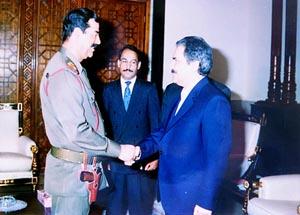 |
| Iraq’s executed dictator Saddam Hussein (L) and MKO leader Massoud Rajavi |
A number of the families of the victims of the March 1991 massacre are to file a lawsuit against the MKO, reported Habilian — an association that groups the families of those killed in terror operations across Iran — on its website.
The families seek the prosecution of the perpetrators of the massacre and want the leaders of the organization to be brought to justice, the report added.
They reiterated that the MKO had a hand in the 1991 crackdown of Iraqis. They said that they have evidence at hand proving the MKO’s crimes, adding that they would present the evidence to the Iraqi Judiciary.
The MKO is listed as a terrorist organization by much of the international community and is responsible for numerous acts of terror and violence against Iranian civilians and government officials.
The group fled to Iraq in 1986, where it enjoyed the support of Iraq’s executed dictator Saddam Hussein and set up Camp Ashraf near the Iranian border.
The organization is also known to have cooperated with Saddam in suppressing the 1991 uprisings in southern Iraq and the massacre of Iraqi Kurds.
According to Iraqi President Jalal Talabani, 5000 members of the MKO joined forces of Saddam in the battle for Kirkuk to help the suppression of Iraqi Kurds.
Several defectors from the group have also verified that the group played a significant role in repressing the Iraqi Kurds.
Batoul Soltani, a former member of the MKO leadership council, told a press conference in 2009 that the MKO played a prominent role in repressing the Iraqis in the southern Iraqi cities in 1991, adding that Saddam’s regime did not rely on its soldiers more than relying on the MKO militants in this particularly respect.

 evoked reactions from many of those included in the list as well as from the Arab media, among them apologists for Saddam’s regime. The fact that so many have opted for silence may give credence to the list’s authenticity.
 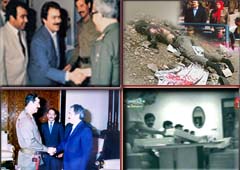 death sentence because of his crimes which include his role in eradicating rival political-religious parties while holding power during the Ba’athist regime. Aziz had been on trial in a long-running case in which he was accused of being part of a campaign of persecuting, killing and torturing members of the Shiite opposition and other banned parties. [2]
 between the two and MKO willingly began to accept Saddam’s donations to meet its expenses in France. The first ostensible agreements were reached in the visit between Rajavi and Tariq Aziz, an opportunity to expand ties and to serve Saddam in return for his favors. It is worth knowing that Saddam gave priority to grant MKO’s demands and requests over all his plans and gradually this support was rapidly increasing in quality and quantity.