
On Friday, August 26th, 2011, the streets surrounding the US State Department featured a motley crowd of protesters wearing yellow hats and t-shirts, chanting slogans, and pleading for the removal of Mujahedin Khalq (MKO/MEK) from the State Department’s list of Foreign Terrorist Organizations. The crowd was mixed in race, and top-heavy with African Americans. An unusually large number of the protesters had scruffy hair and tattered clothes. And surprisingly, only a small number were actually Iranian-Americans. As the crowd was addressed by US politicians who supported the group’s cause, oddly, many in the crowd were not aware of what exactly it was they were protesting—this is because the majority of protesters did not really *have* a cause. They were merely following the assignment of the organizers, who paid them, fed them, and lodged them so they would commit to demonstrate that day. Protestors at the scene told one reporter that the Mujahedin Khalq organizers had told them that there were at least two thousand demonstrators present that day, but the estimate seemed high. [1]
The MKO is a terrorist group and has been blacklisted by the Department of State since the list was first created in 1997. Since then the MKO has persisted with a campaign to get itself removed from that list. And this time they have stooped to new lows: hiring the needy and desperate to do their dirty work, enlisting what seems like a busload of homeless to turn out in grand numbers for a spurious representation of support. It was purely a show of spectacular exploitation—the latest and greatest example of the MKO’s multi-million dollar effort to build support among Washington political elite, according to *The Cable*. [2] And if the false demonstration wasn’t bad enough, it has been reported in *The Christian Science Monitor* and *The Huffington Post* that many of the so-called MKO advocates had been paid large amounts of speaking fees. [3][4] According to Zaid Jilani of *thinkprogress.org* the rally included well-paid speakers and also paid demonstrators “who, it is probable fair to say, know even less about the MEK than the big-money speakers” and “were bused in from as far as New York city.” [5]
The group’s purchased advocacy was also confirmed by *Radio Free Europe / Radio Liberty, The National Interest, and The Cable*.
Golnaz Esfandiari and Hossein Aryan of *Radio Free Europe / Radio Liberty*report that “rally participants also included a number of non-Iranian-Americans. Several of them told Esfandiari and Aryan that they had little or no knowledge about the MKO.” One African-American who was asked whether he and his female companion received money to attend the rally—his companion admitted they had, but then retracted her statement at the man’s behest. [6]
Many non-Iranian rally attendees claimed that they were there in the name of Iranian human rights but were actually confused by the term MEK. Zaid Jilani writes that “of this group [of demonstrators], few seemed to have many details about the MEK, and instead pledged vague notions of support for human rights and democracy, often even getting the name of the MEK wrong.” [7] He revealed that in fact “some of the attendees had been bused and flown in at no personal cost, receiving transportation and in some cases lodging and meals.” [8]
Paul R. Pillar of *The National Interest* writes that one of the participants, a 23-year-old man from Staten Island named Melvin Santiago, said he learned about the demonstration from a friend who in turn got word of it through a flyer distributed in front of a church where the friend said that Santiago “usually goes for the food pantry”. [9]
Another attendee told Zaid Jilani that he supported human rights in Iran and he was informed about the rally at his church and admitted, “to be honest, I don’t really understand what the MEK is.” [10]
It is this latest rally that one can see the effort that the MKO has put in to changing their public persona as they push for being de-listed. According to a RAND report, the MKO are “skilled manipulators of public opinion.” [11] Paul R. Pillar, a professor, and a retired person who served over two decades in the US Intelligence Community asserts that “those who have sold their advocacy for big bucks deserve shame; those who have done so for a meal or two may be deserve our pity.” [12] What is truly appalling is that the MKO is actually a cult who abuses its own members, and now they are exploiting the public—a public who seems to have a weak moral code. Group supporters need to come forward and admit what’s going on, and the general public needs to question more deeply the legitimacy of this atrocious group, and especially those who are paid speaking fees to help the MKO.
The US needs to be aware of that the MKO’s past is beset with crimes and bloodshed. They not only have a history of terrorism against Iran, but against the US and its allies—in fact in the 1970’s, the MKO murdered several US citizens. The MKO has little support in the West, but in effect no viable support inside Iran (because they are a cult, but mostly due to their treasonous relations with Saddam Hussein). In short, US citizens, like Iranian citizens, should not trust the MKO. Pillar suggests that Hillary Clinton “should pay no heed to what Melvin Santiago and the other hungry homeless outside her office window are saying, or to what the high-paid hired guns are saying, about the MEK. Nor does she need to pay any attention to what people like me are saying about the group. She should keep the windows closed and just pay attention to the terms of the law and to what officials in the departments and agencies involved say about whether the terms of the law still apply in this case”.[13]
By Mazda Parsi
References:
[1]Jilani, Zaid, Attendees bused into MEK Rally, Some of Whom Don’t Really
Understand What the MEK Is, ThinkProgress, August 26,2011
[2]Rogin, Josh, MEK rally planned for Friday at the State Department, the Cable/ Foreign Policy, August 25, 2011
[3]Peterson, Scott ,Iranian group’s big-money push to get off US terrorist list, The Christian Science Monitor, August 8, 2011
[4]Wilkie, Christina, Mujahideen-e Khalq: Former U.S. Officials Make Millions Advocating For Terrorist Organization,The Huffingtonpost, August 9,2011
[5] Jilani, Zaid, Attendees bused into MEK Rally, Some of Whom Don’t Really
Understand What the MEK Is, ThinkProgress, August 26,2011
[6]Esfandiari, Golnaz, &Aryan, Hossein, MKO Supporters Rally To Call For
U.S. Delisting, Radio Free Europe/Radio Liberty, August 26, 2011
[7] Jilani, Zaid, Attendees bused into MEK Rally, Some of Whom Don’t Really Understand What the MEK Is, ThinkProgress, August 26, 2011
[8]ibid
[9]R. Pillar, Paul, The Lobbying that Shouldn’t be Happening, The National Interest, august 27,2011
[10]Jilani, Zaid, Attendees bused into MEK Rally, Some of Whom Don’t Really Understand What the MEK Is, ThinkProgress, August 26,2011
[11]Goulka, Jeremiah &Hansell, Lydia &Wilke, Elizabeth &Larson, Judith, The Mujahedin-e Khalq in Iraq; A Policy Conundrum, RAND Corporation, August 2009.
[12] R. Pillar, Paul, The Lobbying that Shouldn’t be Happening, The National Interest, August 27,2011
[13]ibid
 rally to remove a controversial Iranian exiled opposition group from the U.S. terrorist rolls afterpreviously not saying if he was paid.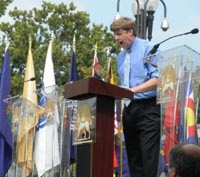
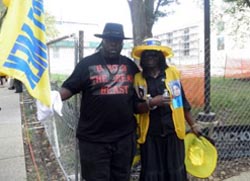 as a "foreign terror organization," wonder no more. Meet The Great Lonnell and his 200 friends from his church in Staten Island, who attended a 1,000-1,500 person rally in DC on Friday. "We are here representing on behalf of the Iranian community," The Great Lonnell told Foreign Policy’s The Cable.
 .jpg)
 remove the group from its list of foreign terrorist organizations. In a sophisticated display of its public relations ability, the demonstration featured scores of young supporters wearing matching yellow T-shirts and straw hats chanting slogans, live big-screen broadcasts of the speakers, appearances by well-know U.S. politicians and the release of white doves that flew up toward the State Department’s enormous navy-blue flag as a storm of yellow and blue confetti filled the air.