
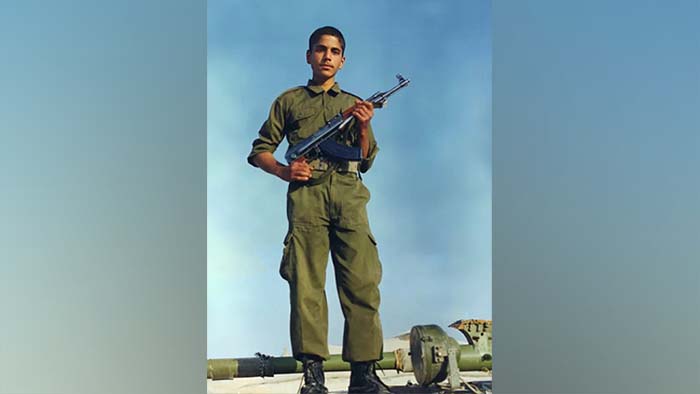
Amir Yaghmai, former child soldier of the Mujahedin-e Khalq recounts of one of his most traumatic memoirs of his involvement with the MEK which he considers as “one of the most painful and deepest scars” in his life. That was the night that MEK’s top commanders tortured him and his mother because he had asked to leave the group.
On the eve of the American invasion to Iraq in 2003, Massoud Rajavi, called all members of Camp Ashraf to gather in a large hall. “He began by describing the sensitive political situation at the time and the serious threat posed by the United States against Iraq,” Amir Yaghmai writes in his memoirs. “He then said that in these circumstances, MEK members must maintain their focus and no longer be involved in the issue of defection or “cutting off” of individuals. Therefore, each member must sign a new contract in which he undertakes not to ask for leaving the group for the next two years.”
Amir was shocked. He had wanted to leave the MEK for years but hadn’t been able to. “Each time I had been forced to sign different contracts for different reasons,” he writes. However, this time, the matter was more serious than ever. Massoud Rajavi was officially ordering members to stay in the isolated Camp Ashraf. “You were supposed to keep your mouth shut for two years, not to express a single doubt.”
Amir told himself: “I won’t sign! They can do whatever they want! Take me to a confession session, quarantine me for two years, send me to Abu Ghraib prison, or hand me over to the regime! It doesn’t matter! I can’t take it anymore.”
This was also his response to his commander when he asked Amir to sign the contract. Consequently, Amir entered a traumatic cycle of bribery, threat, intimidation and humiliation.
First, the MEK leaders tried to bribe him promising to allow him to have a home in Baghdad, and to get married –the possessions that are forbidden for MEK members. This was a promise made by Maryam Rajavi, Massoud Rajavi’s third wife but it was presented to Amir by Mohammad, the son of Massoud who was also a child soldier and a friend of Amir’s.
Nevertheless, Amir replied Mohammad Rajavi: “I want to be free, to go for a walk without a barbed wire or a guard tower in front of me. To love. To sing. To wear the clothes I want. To see the world. I won’t go and regret the unseen. Not just to get married.”
When the first tactic did not work for the cult commanders, they tried to threat Amir and pressure him by intermediating an emotional tool: his mother.
“In a large room, around an oval-shaped conference table, the high-ranking commanders of the MEK were sitting: Ahmad Waqef, Mahmoud Ata’i, Fereshteh Yeganeh, Mahvash Sepehri, Mohammad Rajavi… and my mother!”, he pens.
Nasrin (Mahvash Sepehri) told Amir: “When you joined, your mother guaranteed that you would never leave us. Now she has to come with you, go into quarantine for two years, and then be sent to Iran with you. Then, she has to find a way back—if she gets arrested, she has to commit suicide.”
Amir shouted at them shouted: “You have no right to make my mother the victim of my decision! I am responsible for my own choices. I am twenty years old!”
Fereshteh Yeganeh opened a folder and showed him. His mother’s signature, and all the oaths he had been forced to sign over the years. Amir protested that all of this was by force. “If my mother is leaving with me, I am not leaving at all!” Amir told them. Nasrin replied emotionlessly, “If you want to stay, you have to defend your choice. We are not convinced yet.”
They kept Amir and his mother in the room for over 9 hours, until the dawn. During the entire hours, the commanders were insulting Amir, calling him “traitor”, spitting on his face and his mother was watching him with weeping eyes.
The next morning, Amir had been coerced to sign a new contract. “I signed a new contract which had nothing for me except humiliation,” he writes.
This is how he describes that night: “The night at Camp Ashraf, when just because I wanted to leave the organization, they made me go under the most severe stress, threat, insult, and humiliation. Worst of all, my mother, who was an old member, was also tortured before my eyes in order to force me to confess that I was wrong. Seeing tears and sufferings of my mother was one of the most painful moments of my life.”
