Nejat Society
  • Home
  • Articles
  • Media
    • Cartoons
    • NewsPics
    • Photo Gallery
    • Videos
  • Publications
    • Books
    • Nejat NewsLetter
    • Pars Brief
  • About Us
  • Contact us
  • Editions
    • عربي
    • فارسی
    • Shqip
Nejat Society
Nejat Society
  • Home
  • Articles
  • Media
    • Cartoons
    • NewsPics
    • Photo Gallery
    • Videos
  • Publications
    • Books
    • Nejat NewsLetter
    • Pars Brief
  • About Us
  • Contact us
  • Editions
    • عربي
    • فارسی
    • Shqip
© 2003 - 2024 NEJAT Society. nejatngo.org
Duplicity of the MEK nature

MKO’s version of democratic government

As s cult-like terrorist organization, Mujahidin Khalq has never believed in democracy in its long history of cult-like approaches. Despite their propaganda for democracy and human rights, they have always believed in an ideological system originated in religion of Shiite Islam [MKO’s version] and Marxism. All documents on MKO’s background prove this ideology which opposes liberalism and individualism as well as capitalism. But today in a U-turn regarding their past doctrine, MEK try to draw the attention of Western governments to themselves by their large-scale propaganda in Western lobbies, advocating a “secular democratic regime of Iran.”

The controversial title “President Elect” for Maryam Rajavi is the main example of MKO’s false propaganda. Who has elected Mrs. Rajavi as the President?
National Council of Resistance that is the umbrella organization for MKO.

Due to its atrocities against Iranian compatriots during Iran-Iraq war, as Saddam Hussein’s accomplice, and its terrorist acts against Iranian targets and civilians, MKO has never had support among Iranians. Therefore, Maryam Rajavi can never be the President-elect of Iranians except those manipulated members in the isolated cult of Rajavis.

Now, after the controversial presidential election in Iran, which was a big practice of democracy for Iranians, Maryam Rajavi is seeking an opportunity to impose her cult of personality to Iranian nation, advocating her regime change policy. All experienced practitioners of democracy argue that democracy includes sharing of power by various parties, a phenomenon that has never existed in MKO, since its foundation, the dissidents have been always suppressed by the cult leaders.

In reaction to the post-election incidents in Iran Maryam Rajavi once more proposed her solution as “democratic change” against Velayet-e-Faqih regime! And she probably sees her cult of personality as the best alternative to the ruling system.

Maryam Rajavi, the advocate of regime change is of course the best person to destroy the progressing path of democracy in Iran, since the destructive cult of hers and her husband’s is the best symbol of suppressing the freedom of expression and speech.

Masud Rajavi who has imposed himself as an idol to be worshiped by the members given that he is the leader of Iran [as an impossible option]could be the most notorious dictator, after Stalin and Hitler in the new regime that MKO is seeking to establish.
By Mazda Parsi
July 5, 2009 0 comments
FacebookTwitterPinterestWhatsappTelegramSkypeEmail
UK

A debate over Camp Ashraf

Iraq: Camp Ashraf

Question

Asked By Lord Eden of Winton

British Parliament, House of Lords  –  July 01, 2009

Lord Eden of Winton (Conservative)
To ask Her Majesty’s Government whether they have recently made representations to the governments of the United States and Iraq concerning the current threats to the inhabitants of Camp Ashraf in Northern Iraq.

Lord Brett (Government Whip (technically a Lord in Waiting, HM Household); Labour)
My Lords, the UK ambassador to Baghdad called on the Iraqi Human Rights Minister, Widjan Salim, on 13 April this year to raise the issue of Camp Ashraf, and to remind her of the early assurances made by the Iraqi Government about the humane treatment of its residents. Officials at the British embassy in Baghdad continue to discuss Camp Ashraf with staff at the US embassy; the most recent discussion took place on 10 June 2009.

Lord Eden of Winton (Conservative)
My Lords, I am grateful for that Answer. I recognise that the Government have no wish to intervene in matters that are the concern of other countries, but given that the Government apparently now subscribe to the culture of "responsibility to protect", should we not be doing all that we can to avert a potential humanitarian catastrophe? What precisely were the assurances given by the Iraqi Government? Will it be made clear to Mr Maliki that international opinion will hold him accountable for the safety of the citizens of Ashraf?

Lord Brett (Government Whip (technically a Lord in Waiting, HM Household); Labour)
My Lords, the UK Government remain concerned that the fundamental human rights of all the residents of Camp Ashraf are fully observed. We particularly sought assurances from the Iraqi Government, who have given them—I now give the assurance that the noble Lord seeks—that no Ashraf residents will be forcibly transferred to a country where they have reason to fear persecution or where substantial grounds exist to believe that they would be tortured. We continue, as the noble Lord rightly says, to have no direct interest or control in this camp, but we continue to liaise with our colleagues in the United States, who are monitoring events with the Iraqi Government.

Lord Archer of Sandwell (Labour)
My Lords, can my noble friend confirm that the citizens of Ashraf have been accorded protected person status under the fourth Geneva Convention, that the initial protecting power was the United States and that it cannot divest itself of its obligations simply by announcing that it has transferred them to the Iraqi Government? Given that the United Kingdom participated in the original invasion, have we expressed some of these concerns to our American allies?

Lord Dholakia (Liberal Democrat)
My Lords, would the noble Lord accept the recent statement made by Mrs Rajavi in Paris calling for free and fair elections supervised by the United Nations? More importantly, is he aware of the intimidation of the inhabitants of Ashraf City? Would it not be right at this time to ensure that the European Union, Britain and America warn Iran that any harm, intimidation or persecution of those inhabitants will result in a reference to the International Criminal Court?

Lord Brett (Government Whip (technically a Lord in Waiting, HM Household); Labour)
My Lords, I have no knowledge of intimidation in the manner that the noble Lord suggests. If he has such evidence, I would be pleased to receive it and pass it to authorities which can take the matter further. It is a clear indication of the Government of Iraq’s position that they have given assurances that no Ashraf residents will be forcibly transferred. That suggests that they are honouring their obligations. Our consular staff in Baghdad have talked to people in the camp and assure us that food and medicines are getting through, so there does not seem to be any lack of supply. However, I will happily take on board any evidence that the noble Lord has.

Lord Waddington (Conservative)
My Lords, would the noble Lord agree at least that Britain, being a party to the decision to hand over responsibility for Ashraf City to Iraq, now has some responsibility for recent developments and for the residents’ safety? How on earth can it be right for the Iraqi authorities to blockade Ashraf City, refusing people the right to take in food, and demanding police access to the city while asserting that those living there have no rights whatever as citizens? Surely it is time that the British Government talked again to the Iraqi Government and reminded them of their responsibilities under international law.

Lord Brett (Government Whip (technically a Lord in Waiting, HM Household); Labour)
My Lords, I can but repeat the invitation I gave to the noble Lord, Lord Dholakia. If the noble Lord, Lord Waddington, has evidence of that nature to put forward, I will happily take it on board and ensure that the Foreign and Commonwealth Office can inquire into it.

Lord Maginnis of Drumglass (Crossbench)
My Lords, I am surprised that the Minister is unaware of the fact that Camp Ashraf is in essence being besieged by the Iraq authorities. As someone who had grave reservations about the sacrifice that our soldiers made to achieve democracy in Iraq, I ask how we can allow those in Camp Ashraf, who have the same objective for Iran, to be harassed in the way they are. The Minister asks for evidence; he is in a better position to know the evidence of which the rest of us speak.

Lord Brett (Government Whip (technically a Lord in Waiting, HM Household); Labour)
My Lords, the answer is already in the noble Lord’s question. Iraq is a democratic and independent sovereign state. The United Kingdom, and even the United States, which handed over control of the camp from 1 January, have to recognise that fact. However, that does not prevent us making representations, hence my invitation for any evidence.

British Parliament, House of Lords

July 4, 2009 0 comments
FacebookTwitterPinterestWhatsappTelegramSkypeEmail
Mujahedin Khalq Organization as a terrorist group

US Lawmakers Call For Supporting Terrorists In Iran

The Obama administration should be doing more to support Iranian resistance groups — including the Mujahadeen-e-Khalq (MEK), a "cult-like" terrorist organization that has engaged in suicide attacks against their own countrymen, according to the U.S. State Department — in an all-out effort to affect regime change in Tehran, two American lawmakers said at a recent press conference in Washington, DC.

The lawmakers’ call for greater U.S. support for self-styled resistance groups opposed to Iran’s government comes as the Islamic regime has accused groups protesting the recent disputed presidential election of receiving Western backing.

At a Capitol Hill press conference on June 26th, Rep. Bob Filner (D-CA), chairman of the House Veterans’ Affairs Committee, declared that the U.S. government, which has imposed stringent economic sanctions on Iran since the 1979 Islamic revolution and supported Iraq’s invasion of the country in the 1980s, had too often sought "to mollify or appease those in charge" of that country. Instead, Filner argued the U.S. should explicitly side with Iranian "resistance groups", including the MEK, which he described as a "democratic, non-nuclear, secular group fighting for freedom for all the people in Iran."

The U.S. State Department notes that the MEK "advocates the violent overthrow of the Iranian regime and was responsible for the assassination of several U.S. military personnel and civilians in the 1970′s," and that the group maintains "the capacity and will to commit terrorist acts in Europe, the Middle East, the United States, Canada, and beyond."

Following the Iranian revolution the MEK fled Iran for neighboring Iraq, where it received support from Saddam Hussein’s regime to launch "suicidal, mass wave attacks against Iranian forces." The MEK’s fighting on behalf of the Iraqi regime in a war that killed hundreds of thousands of Iranians is generally seen as undermining their credibility among the Iranian public.

Human Rights Watch has also accused the group of perpetrating serious human rights abuses, including torture, at a number of secret prison camps.

Nonetheless, citing the internal unrest in Iran over last month’s disputed presidential election and the fact that an invasion "is not an option today," Filner said the U.S. government should be doing much more to support "one of the biggest resistance groups in Iraq, the so-called MEK.
"They say, ‘Let us do the job; get out of our — just get out of our way,’ because we have not helped the internal resistance movements," Filner said. "We can help internal resistance movements in Iran, and we should not stand in their way of trying to get rid of the present regime."

Joining Filner in the call for greater U.S. support for the MEK was Rep. Dana Rohrabacher (R-CA), who briefly fought alongside the Afghan mujahideen in their war against the Soviet Union. Though declared "freedom fighters" by the Reagan administration, the mujahideen proved to be fertile recruiting grounds for the Taliban and al-Qaeda.

Conceding that, like the Afghan mujahideen, the MEK is not "perfect," Rohrabacher said that "during the American revolution there were a lot of imperfect organizations around too. But the fact is, the mullahs are what now — they are the ones who are murdering their people. They are the ones who are threatening world peace."

Rohrabacher also rejected the premise of a question about whether overt U.S. support for terrorist groups opposed to the Iranian government might undermine future U.S.-Iran negotiations.

Filner and Rohrabacher appeared at the press conference with Soon Sansami, currently the executive director of the Women’s Freedom Forum. Previously she was the spokesperson for the National Council of Resistance, identified by Filner as "the umbrella Iranian internal resistance movement in the United States." The U.S. Treasury Department lists the group as a "Specially Designated Global Terrorist" organization and one of many "aliases of [the] MEK."
Antiwar .com

July 3, 2009 0 comments
FacebookTwitterPinterestWhatsappTelegramSkypeEmail
Mujahedin Khalq as an Opposition Group

MKO provoked post-vote unrest

An Iraqi security official says the terrorist Mujahedin Khalq Organization (MKO) triggered the recent post-election unrests in Iran.

National Security Advisor Mowaffaq al-Rubaie said in an interview with al-Hayat that certain members of the terrorist group had instigated and fomented the recent political unrest in Iran.

"We have intelligence reports available that certain elements of the Mujahedin Khalq Organization (MKO) infiltrated into the crowd of protestors [after the election results were announced] and sparked the riots."

The announcement of the Mahmoud Ahmadinejad’s re-election sparked opposition rallies in the capital Tehran with defeated candidates Mir-Hossein Mousavi and Mehdi Karroubi rejecting the result as fraudulent and demanding a re-run.

President Ahmadinejad’s victory caused Mousavi supporters to take to the streets to protest the vote result. The rallies turned violent, resulting in the death of at least 20 people.

Al-Rubaie, however, rejected claims that MKO members had entered the country through neighboring Iraq, claiming that MKO terrorists were ‘either already in Iran or had entered it from another country’.

Iranian security officials had earlier reported that a large number of MKO members who were involved in recent riots had been identified and arrested.

According to security officials, the detained MKO members had confessed to receiving extensive training in Iraq’s camp Ashraf to create post-election mayhem in the country.

The MKO is blacklisted as a terrorist organization by many international entities and countries, including the US.

The group was exiled from Iran after the Islamic Revolution and settled in Iraq in 1986, where it enjoyed the support of former Iraqi dictator Saddam Hussein.

The MKO is responsible for numerous acts of violence against Iranian civilians and government officials as well as Iraqis during the reign of Saddam.

July 2, 2009 0 comments
FacebookTwitterPinterestWhatsappTelegramSkypeEmail
Former members of the MEK

On MKO’s Ideological Revolution

Memoirs of Batoul Soltani – Part 17
As a high ranking member of the leadership Council, I was in charge of a series of meetings, and I received special trainings from Maryam Rajavi on how to deal with the contradictions arising from ideological divorce which forced a woman to leave her husband in order to stay loyal to the organization’s ideas.

Besides, Masud managed the meetings of the ideological revolution himself saying:”suppose that you have brought an Iranian youth to the organization and you want to explain and justify the ideological revolution to him. You should clarify it to him that he cannot be married and be a fighter at the same time. You should explain that one cannot think of sexual or emotional problems while one is struggling.

Then you should ask this question that whether one wants to be in the path of struggle and liberty or in the path of a normal life. So, this was the way we encountered the newcomers explaining that they would fail to succeed in their struggle to the extent that they are involved in external problems. For example, when we argued with an unmarried girl, we told her: ”in the core of your personal relations and emotions, there is a symbol which is the idol of the society”. Then we asked her:”what‘s your symbol and idol, as a girl in the society?” and then we answered the question ourselves: ”a good husband according to your ideals.”

Also for a married woman, there has always been a person in the heart of her emotions. I remember the example that Rajavi always used to use: ”what does a revolutionary person have to give as the price of his revolution? You have left your homes, your families, your spouses, and your children, so what do you offer to your revolution now?” Then he added “But I’d say that you have a lot to give for the revolution and that is your emotions.” They dealt with the center of emotions in individuals because it is the origin of motives and interests. Thus, they analyzed the members’ internal motives to remove all other motives from the members’ minds except the motive of struggle. On the other hand, we tried to suppress the alleged anti-revolutionary motives of the members saying that: “all your motives have to be for the organization and according to the desires of the leaders.”

If an individual has a problem with understanding such a mechanism, he will be likely to leave the group someday.” Then the officials try to guess in which phase that individual will have problems with the internal ideological revolution so they recognize if the person is an appropriate recruit or not. In fact, for Mojahedin, recruitment means total devotion to the organizational relations. They try to reach their goals by using these anti-human levers.

About the marriage of Masud and Maryam, they make some examples: they believe that Maryam’s efficiency has become much higher than the time she was Abrishamchi’s wife and when she removed the obstacle of her ex-husband and linked herself to Masud, she raised her abilities to the level of the first authority of MKO while before her ideological marriage with Masud she was just in charge of a single unit! Then they make it a practical fact in the routine life of members. They try to convince members that the only way to promote your abilities is to link yourself with Masud by abandoning your spouses, your families, and your children… For instance, they asked Maryam:”could you do your current tasks before your divorce and marriage with Masud?” she replied:”No, I was unable to do so, I was weak. I could not even manage two persons. Then my energy was liberated, my abilities flourished. I could rely on another point which was Masud Rajavi so I could accept higher responsibilities.” This has become a proof for their arguments.

I believe that Masud Rajavi has a very poor relationship with men. This aspect of his personality is very clear within his regular relations. I remember that he seriously disagreed with men to film his internal meetings. So he ordered that all leadership Council meetings should be filmed by women only. He planned a time schedule for some women to learn how to work with a camera. He hysterically opposed the men. Now, when I look back, I see the roots of this characteristic in his sensuality and jealousy. Maybe, it is natural that when a man is among a number of women, he would not like another man to be there. This is my internal feeling. That’s why Rajavi tried to choose women for all needed forces related to him. I think he couldn’t tolerate a camera man in front of himself.

He tried hard to remove the members of the political office since they were all men. Apparently he believes that women work very hard so he was always fond of women. When a new woman entered the organization, he was fascinated by her. He welcomed her by joking and having fun. In the high ranks of the hierarchy of the group he was all the time seeking to remove a man from the high ranks and replace him with a woman. Due to this personal tendency he filled up his leadership Council with a selection of female members.
Translated by Nejat Society

July 2, 2009 0 comments
FacebookTwitterPinterestWhatsappTelegramSkypeEmail
Former members of the MEK

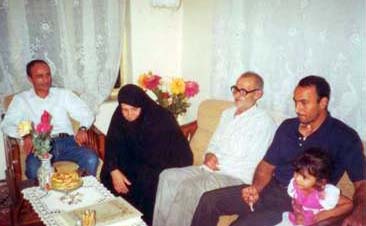
Mr. Fallah joined his family

Coming Back to Life
Mr. Afshin Qare Tappe from Golestan Province joined his family.

Mr. Afshin Qare Tappe from Golestan Province joined his family.

After years of sufferings and being captive behind the bars of Rajavis’ Cult, Mr. Fallah could manage to release himself from that infernal organization and returned to his homeland and family.

Mr. Afshin Fallah went to Turkey to find a job in 1999.
In Turkey the MKO elements tricked Mr. Fallah into recruiting him. Then he was sent to Camp Ashraf, Iraq by a person called Ali Ankara.

Nejat Society – Golestan Branch

July 2, 2009 0 comments
FacebookTwitterPinterestWhatsappTelegramSkypeEmail
Mujahedin Khalq; A proxy force

MKO role in a Color Revolution

In his new book, "Full Spectrum Dominance: Totalitarian Democracy in the New World Order," F. William Engdahl explained a new form of US covert warfare – first played out in Belgrade, Serbia in 2000. What appeared to be "a spontaneous and genuine political ‘movement,’ (in fact) was the product of techniques" developed in America over decades. With respect to Iran’s post-election crises, there is a discourse underlined “Iran’s Made-in-the-USA "Green Revolution" that offers reasons for a new attempted American backed color revolution in Iran.

After Iran’s June 12 election, days of street protests and clashes with Iranian security forces followed. Given Washington’s history of stoking tensions and instability in the region, its role in more recent color revolutions, and its years of wanting regime change in Iran, analysts have strong reasons to suspect America is behind post-election turbulence and one-sided Western media reports claiming electoral fraud and calling for a new vote, much like what happened in Georgia and Ukraine.

The same elements active earlier are likely involved now with a May 22, 2007 Brian Ross and Richard Esposito ABC News report stating:

"The CIA has received secret presidential approval to mount a ‘black’ operation to destabilize the Iranian government, current and former officials in the intelligence community tell the Blotter on ABCNews.com. The sources who spoke on the condition of anonymity….say President Bush has signed a ‘nonlethal presidential finding’ that puts into motion a CIA plan that reportedly includes a coordinated campaign of propaganda, disinformation and manipulation of Iran’s currency and international financial transactions."

Perhaps disruptions as well after the June 12 election to capitalize on a divided ruling elite – specifically political differences between Mahmoud Ahmadinejad and Supreme Leader/Grand Ayatollah Ali Khamenei on one side and Mir Hossein Mousavi, former president Hashemi Rafsanjani, and Grand Ayatollah Hossein Ali Montazeri on the other with Iran’s Revolutionary Guard so far backing the ruling government. It’s too early to know conclusively but evidence suggests US meddling, and none of it should surprise.

Kenneth Timmerman provides some. He co-founded the right wing Foundation for Democracy in Iran (FDI) and serves as its executive director. He’s also a member of the hawkish Committee on the Present Danger (CPD) and has close ties to the equally hard line American Enterprise Institute, the same organization that spawned the Project for the New American Century (PNAC), renamed the Foreign Policy Initiative (FPI) for much the same purpose.

On the right wing newsmax.com web site, Timmerman wrote that the NED "spent millions of dollars during the past decade promoting color revolutions in places such as Ukraine and Serbia, training political workers in modern communications and organizational techniques." He explained that money also appears to have gone to pro-Mousavi groups, "who have ties to non-governmental organizations outside Iran that (NED) funds."

Pre-election, he elaborated about a "green revolution in Tehran" with organized protests ready to be unleashed as soon as results were announced because tracking polls and other evidence suggested Ahmadinejad would win. Yet suspiciously, Mousavi declared victory even before the polls closed.

It gets worse. Henry Kissinger told BBC news that if Iran’s color revolution fails, hard line "regime change (must be) worked for from the outside" – implying the military option if all else fails. In a June 12 Wall Street Journal editorial, John Bolton called for Israeli air strikes whatever the outcome – to "put an end to (Iran’s) nuclear threat," despite no evidence one exists.

Iran’s rulers know the danger and need only cite Iraq, Afghanistan, and numerous other examples of US aggression, meddling, and destabilization schemes for proof – including in 1953 and 1979 against its own governments.

On June 17, AP reported that Iran "directly accused the United States of meddling in the deepening crisis." On June 21 on Press TV, an official said "The terrorist Mujahedin Khalq Organization (MKO) has reportedly played a major role in intensifying the recent wave of street violence in Iran. Iranian security officials reported (the previous day) that they have identified and arrested a large number of MKO members who were involved" in the nation’s capital.

They admitted to having been trained in Iraq’s camp Ashraf and got directions from MKO’s UK command post "to create post-election mayhem in the country." On June 20 in Paris, MKO leader Maryam Rajavi addressed supporters and expressed solidarity with Iranian protesters.

In 2007, German intelligence called MKO a "repressive, sect-like and Stalinist authoritarian organization which centers around the personality cult of Maryam and Masoud Rajavi." MKO expert Anne Singleton explained that the West intends to use the organization to achieve regime change in Iran. She said its backers "put together a coalition of small irritant groups, the known minority and separatist groups, along with the MKO. (They’ll) be garrisoned around the border with Iran and their task is to launch terrorist attacks into Iran over the next few years to keep the fire hot." They’re perhaps also enlisted to stoke violence and conduct targeted killings on Iranian streets post-election as a way to blame them on the government.

July 1, 2009 0 comments
FacebookTwitterPinterestWhatsappTelegramSkypeEmail
Iraqi Authorities' stance on the MEK

Elements of Mojahedin organization in Tehran Riots

Rubaie told “Al Hayat”: the stability of Iran and Iraq is in the regional interest

LONDON – Raed Jaafar – The national security adviser Mowaffak al-Rubaie said the security and political stability in Iran is in the interest of the region in general and Iraq in particular, and warned that any political or security flaw in Iran would have a negative impact in the region in general and Iraq in particular, explaining that “Our intelligence confirms that during the manifestations of opposition, elements of the Mujahideen infiltrated among the demonstrators, giving rise to riots”.

Rubaie told “Al Hayat” that “the differences between the so-called Reformists and Conservatives in Iran focus on domestic issues more than specific foreign policy”. Referring to “the absence of major differences in the foreign policies of Iran”, he added “Whoever wins in Iran will not change the policy with Iraq since Tehran’s policy toward Iraq will not be much affected by the victory of any of the parties”, explaining that “foreign policy is almost uniform with the same constants”.

Rubaie said that the “Iraqi leaders governing the country now, and since the days of the late opposition to the regime of President Saddam Hussein, have strong historical ties with the ruling power in Iran now, the conservatives, from the top of the pyramid below them”. He continued: “They have been in power for a long time, such as the Republic’s Supreme Leader Ali Khamenei and the others, and have close ties with the Iraqis, and that gives Iraq a particular role for the Iranian regime”.

He added: “But we do not know many Reformists, and we had no relations with them in Iraq despite their 8 years under Khatami. We were not in power (in the first two years after the occupation of Iraq) and there is no strong relationship with the Reformists, without that meaning any diminution of them”. He added that “the Conservatives understand Iraq more than the Reformists, as they have a clear record in support of the Iraqi opposition (during Saddam’s rule), and support for the political process after the fall [of Saddam]”.

Rubaie confirmed “we do not interfere in the internal affairs of Iran in any way, in a trend to prefer any party, but limit ourselves to respect the choices of and support the Iranian people and respect the existing system of the Constitution and laws, institutions and others in Iran”.

He added: “But from our point of view from outside and our knowledge of Iranian affairs, and our long experience, we believe that the vast majority of Reformers are part of the very essence of the Islamic system».

He added that “Our intelligence confirms the presence of very small groups, few in number, including elements of the Mojahedin organization in opposition to the regime, which infiltrated demonstrations in protest against the results of the presidential election, which escalated the protests and demonstrations into riots”.

Rubaie denied the possibility of infiltration of the «Mujahideen» from Camp Ashraf in Diyala province, into Iran to participate in the protests or the riots there, explaining that the Iraqi authorities overseeing the camp do not allow its members to get out, and added that “elements of the Mujahideen entered from several countries into Iran, not from Iraq, some of whom were already present, too, to stir up trouble”. He warned that the “high probability of migration is the opposite for these elements, therefore, we have enhanced our intelligence level of preparedness and readiness on the border with Iran, for fear of infiltration of the elements of the Mujahideen Khalq, and crossing the border into Iraq and their attempt to enter the Camp Ashraf”.

In addition, some criticized the Arab media, dealing with the repercussions of the Iranian presidential elections, as “short-sighted, as I believe that support for the Reformists can win the Reformists and weaken Iran”. This was seen as a “kind of revenge or wishful thinking”, stressing that “any instability in Iran, meaning the lack of stability in the region, especially the Gulf States and Iraq”. He said that “some of this is media-driven, non-political, professional”, referring to the “ethnic and racial factors which play a role in this area, such as Arabs and Shi’ites, and this demonstrates the short-sightedness of the media … considering that the stability of a large country like Iran in the region is a stabilizing factor for the entire region”.

Al Hayat (Arabic), London,

July 1, 2009 0 comments
FacebookTwitterPinterestWhatsappTelegramSkypeEmail
Former members of the MEK

No suicide operation unless commanded by the organization

Sahar Family Foundation: Will you explain when for the first time you came to know about the suicide operation in the organization and how did they justify it and give trainings?

Batool Soltani: The first time I was notified about the sacrosanct suicide operation was when I was under political-ideological trainings to be accepted within, to be exact, when I was a trainee member studying the history of the organization. In the course of the discourses it happened to talk about Reza Rezai, as the first martyr of the organization and the first reverent suicide. The organization highly termed it the sacrosanct suicide operation and tried to inspire us with it.

They explained that when Reza was ringed by police, he detonated a hand grenade killing himself along with a number of SAVAK agents. Then they began to give reasons for his daring act saying not only he eluded being arrested alive but also destroyed his arms, information and his body to frustrate the agents’ attempt to have access to them. He was presented as an organizational archetype for the members to follow, a hero whose adherents could never be hindered to accomplish organizational ends. In fact, by the story they intended to mark some points. First, the aspiring members had to bear in mind that a devoted Mojahed disappointed the enemy even in obtaining access to his body.

Second, it was a daring act that needed ultimate bravery one could ever achieve; in the course of trainings, recruits thought it was the last stage a combatant could make it through the stages of the struggle and thus, the trainings seemed much valuable and we tried to comprehend and learn them as fully as we could. In many occasion, for instance, Massoud Rajavi reiterated that Reza deprived the enemy of accessing his information and even his arms and body. Of course, his words were much influential to create a sacramental atmosphere to halo the act and Reza, in this particular phase of trainings, became the sole archetype that could well inspire the trainees with courage, and he did indeed.

SFF: what was specific in Rezai that they made an archetype out of him?

BS: As I pointed out, he was displayed a paragon in some manners especially in his confrontation with police and an example of one with many potentialities that could be followed as a model. Maybe they had anticipated that they could successfully meet organizational ends through these suicide operations and the forces had to be prepared psychologically to carry out the mission. Besides, any training requires a certain model and there was no better match in the organization than Rezai to exemplify for others. Another point about him was his mental potentiality as well as his physical. He was illustrated to be much active in his clashes but he was also mentally competent in analytical and theoretical issues. Perhaps they meant that a combatant had to attain a high versatility but easily sacrifice himself. That is to say, even the mental potentialities of a formidably intellect member hat to in no way interfere with the commitment to the suicide act. These were all aspects of the illustrated archetype that could practically influence the trainees.

SFF: In what level of background did they arrange for this discourse?

BS: Everyone in the organization has to necessarily undergo these instructions, even if some had already passed them. It made no difference; any recruit had to pass through these discourses which the suicide operation was an inseparable part. Even I, a ranking member of the leadership Council, was constantly exposed to these discourses. It was an issue of high priority on the agenda before the leadership when the organization reached a critical stalemate. In the process of dispatching operation teams across the Iranian borders to carry out operations inside Iran, the prerequisite was a proclaimed preparedness for committing suicide. They were thoroughly checked and approved by higher ranks before they were assigned for the mission. The responsible ranks tested them to make sure they would break and swallow their cyanide capsules or did other self-annihilation actions when sensing danger. The interesting point in all these was that a second fellow had to give a pledge that his comrade committed self-annihilation and promised that his comrade would certainly destroy himself in face of danger and in any possible way.

In general, it is a responsibility all have to assume in the organization. Before the invasion of the US against Iraq, for instance, all members took the responsibility of committing suicide by chewing their cyanide capsules if Camp Ashraf would be invaded by the US forces or any threat of arrest, security inspection or else would foreshadow the camp. We had also preplanned arrangements for committing suicide by Cyanide and spilling petrol or ethanol over bodies. We were told to kill or set ourselves on fire if the US forces ventured to enter the camp to start a house by house inspection. Even later and in course of the US’s deployment of forces in the region, we were routinely checked to make sure we were in the state of readiness. Even among the cadres of the Leadership Council they were making a firm stand on self-annihilation if any threat would be posed against the camp by any forces being them Iraqis, Americans, Iranians and Kurds. It was discussed in details how to perpetrate the deed when the right time came: the members had taken the responsibility of reciprocally setting each other on fire by the means of petrol, ethanol and other flammable substances.

In the Leadership Council we were frequently notified that anybody had to be prepared for being killed or suicide. It has always been a key point in varying phases of the organization. In the phase of venture operations, the operatives’ priority was to commit suicide by chewing the carried cyanides, a commitment that the members had to be again checked for its performance in the phase of the US invasion. It was exactly what happened in the case of the 17 June self-immolations; everything was already provided for the operations and the volunteers were only ready for the signal to begin.

SFF: How they assessed and discussed the suicide operations in the Leadership Council? In how many possible ways could they be committed and under what literature they could be justified?

BS: There was a certain book in which an article especially focused on the suicide operation and definitely on the issue of arbitrary suicides. It mainly argued that an act of suicide could be appraised worthwhile and valuable only if committed under some organizational instruction and command; otherwise it was worthless and liable to criticism and belittled by the organization. It was even worse if it was a suicide done in objection to the organization; the perished body was then nothing but a corpse on the hands of the organization.

Even the bodies of these opponent suicides were buried in a different graveyard outside far from Camp Ashraf. The suicides had to be justified according to organizational line of ideology and principles as stated earlier and the cadres of the Leadership Council were not exceptional but on the front-line with the priority of using guns and cyanides. Soon after guns and cyanides were collected and confiscated, petrol and ethanol were replaced as the alternate means. None of the self-burnings done in France were arbitrary but justified organizationally; otherwise they failed to be glorified as they did. In one case, inside Camp Ashraf, a member called Rasoul, blinded in one of military operations, set himself on fire in protest against one of the articles of the ideological revolution called ”article D” (it was about superiority of women over men in all levels of organizational relations and activities). His commission infuriated Rajavi who stated that his act done in opposition to such an issue was denigrated and did not qualify a devoted member to be buried in Ashraf graveyard where the martyrs had been buried. The news of his suicide was heavily censored and they belittled it as a contemptuous act in the organization.

SFF: When they began to collect cyanides?

BS: Once Marjan Akbari snitched the cyanide belonging to her responsible rank and killed herself. Her suicide was masqueraded and reported to be a heart attack but all cadres of the Leadership Council knew the truth about her death and from then on they collected all cyanides. In one occasion, the American forces got suspicious of existing cyanides in Camp Ashraf and began to search for them but they had all been already collected and hidden in a secure place. Of course, at the same time all cadres of the Leadership Council carried capsules.

SFF: Did not Americans know that the organization had cyanides?

BS: It seems that at first they did not, but later on they began to suspect and search for them. As a result, all cyanides were collected and delivered to Zohreh Akhyani and the members were told to seek for alternative working means of suicide. However, it was resolved that in case of any threat against Camp Ashraf, the cyanides had to be distributed among the cadres of the Leadership Council.

SFF: What was the substitute for the cyanides?

BS: Both petrol and ethanol. There were even some places where they distributed the flammable liquids for the purpose of suicide.

To be continued

Translated by Mojahedin.ws – July 1, 2009

July 1, 2009 0 comments
FacebookTwitterPinterestWhatsappTelegramSkypeEmail
Auver-sur-Oise

Waves; Invisible fighters of the cult of Mojahedin

The June 17th dossier of MKO is already 6 years old. Despite the emphasis of French officials on the significance of this legal case on terrorism, it has not been given a verdict yet. However, this is not the end of the story. Mojahedin consider this delay as a subterfuge for calling its accusations baseless and asking to be acquitted on all charges. The silence of France on the issue intensifies its complexity and ambiguity. Whatever the vote of the court, it is evident that the DST operation in 17 June 2003 has been very significant for French authorities. The future will demonstrate whether France government and Nicolas Sarkozy take a realistic stance not to endanger the interests of France for the sake of expediency and negligence or not. He once as the Minister of the Interior emphasized that the materials seized at Auvers-sur-Oise justified the operation (1).

However, what is of more significance is reviewing hidden aspects of this operation and the evidences by which French police and judiciary have managed to prove its legitimacy. Now, this question arises: What are the precautionary measures taken by France in recent years for controlling the illegal activities of Mojahedin in its soil after finding a huge amount of facilities used for terrorist and espionage activities? The activities of MKO in recent years in France indicate that not only no measure has been taken for controlling Mojahedin but also France has acted passively paving the way for extending the activities and facilities of the organization.

The basic question is that while according to the police, this raid was "one of the biggest undertaken by the DST (French Counter-intelligence) in the last 30 years" and international press agencies reported that it was the result of more than three years of investigation (2), what have been the practical, judicial, and controlling measures of French officials in this regard? The discovery of more than eight million dollars in cash and 150,000 Euros as well as computer equipment and dozens of satellite dishes (3) is just a part of the illegal activities of MKO in France. According to the following report by French resources, Mojahedin planned to use these facilities for furthering their cultic objectives:

The Associated Press underlined the significant means deployed by the French police authorities. This shows that the French security services did not take this raid lightly: even bringing in aerial surveillance helicopters. The operation was aimed according to the Ministry, above all, "at the leaders of an organization which threatens public order and is planning or preparing to finance terrorist acts". During the raid, it was necessary to use explosive charges to break open "blocked doors", the police stated. "The People’s Mojahedin are the military wing of Massoud Rajavi’s National Resistance Council, based in the Paris suburbs… The raid, carried out under a search warrant issued by the Paris-based anti-terrorism investigative magistrate, Jean-Louis Bruguiere, mobilised more than 1200 officials, including 80 members of the elite GIGN: France’s SWAT team. It was carried out by the Directorate for National Internal Security (DST or French counter-intelligence) with the support of the Central Command of the Judiciary Police and under the technical direction of the RAID (France’s specialised unit for hostage and terrorist incidents). Thirteen targets were surrounded in the Val d’Oise and Yvelines departments, with a particular focus on the Auvers-sur-Oise camp which was suspected to be a refuge for many active PMOI members… ‘Its bases in the Paris region are considered to be used for questionable organisational, logistical and financial purposes’, added the Ministry…". 4

Undoubtedly, the consequences of 17 June operation were far beyond the discovery of some facilities. In fact, it attracted the attention and aroused the sensitivity of French officials to MKO camp in Auver-sur-Oise as their main headquarter. This is the reason why Mojahedin took a hostile position toward our warnings on the strategic nature of Auver and initiated a propaganda war to distract the attention of international organs from the dangers of this strategic and ideological bastion. France is to identify the real objectives pursued by Mojahedin in Val d’Oise to foil their illegal and terrorist plans. There is no doubt that Auver has turned to the main headquarter of MKO and Mojahedin are after connecting it to their remnant members in Camp Ashraf. After their disarmament and the fall of Saddam leading to the end of his alliance with Masoud Rajavi, Rajavi realized that he no more could use Camp Ashraf as an operational unit. Therefore, his base was transferred to another safe haven, Auver-sur-Oise. French officials found out his objective and performed the operation 17 June. According to an Interior Ministry source:

Auvers-sur-Oise had been turned into the Mojahedin’s "International HQ". Up until March-April [2003], their command structure was in Iraq and only moved with the outbreak of war. 5
This transfer was far from a mere physical one. Mojahedin made use of technology for reorganizing their members and activities all over the world. Despite the necessity of human control of their camp in France by police forces, it hardly suffices since they carry out the greatest portion of their operations through electronic waves that are intangible far from the eyes of inspectors. They no more grab at historical and reactionary means of communication used by cults like Batinis and Al-Qaeda. On the contrary, they have access to the latest scientific achievements and further their objectives through lines and waves. According to French officials:

In 2001, the PMOI had claimed responsibility for more than 195 terrorist attacks on Iran from its base in Auvers-sur-Oise. 6

The same resource refers to the cultic structure of the organization based on Masoud Rajavi and Maryam Azdanlu, the cultic leaders of MKO:
It was more like a sect, a cult of personality for Massoud Rajavi and his wife. 7

In a nutshell, Mojahedin open their way easily for the achievement of their predetermined objectives wherever they settle or even have least physical presence by manipulating means of the modern media and communicational techniques to run its propaganda machine.

References:

1. Gessler, Antonie, Autopsy of an Ideological Drift, Chapter 1: The end of tolerance
2. "Coup de filet centre les Moudjahidin du peuple iranien" – dispatches of Agence France Presse (AFP) and Reuters, 17 June 2003.
3. Associated Press, Operation de grande envergure contre les Moudjahidin du people en region parisienne, 17 June 2003.
4. France News, Coup de filet contre les Moudjahidin du people iranien, 17 June 2003.
5. ibid
6. Associated Press, Les Moudjahidin du peoples’appretaient a commettre des attentats selon la DST, 10 June 2003.
7. ibid.

June 30, 2009 0 comments
FacebookTwitterPinterestWhatsappTelegramSkypeEmail
Newer Posts
Older Posts

Recent Posts

  • Various Aspects of Massoud Rajavi’s Disappearance

    October 20, 2026
  • MEK agents near schools in Tirana, Albania

    October 17, 2026
  • Expectations of human rights bodies regarding censorship within the MEK

    October 13, 2026
  • The Jamalis’ Plea for Help: Save Our Brother from the MEK!

    October 11, 2026
  • Testimonies of Participants in the MEK’s Staged Propaganda Stunt in Karaj

    October 7, 2026
  • Facebook
  • Twitter
  • Instagram
  • Youtube

© 2003 - 2025 NEJAT Society . All Rights Reserved. NejatNGO.org


Back To Top
Nejat Society
  • Home
  • Articles
  • Media
    • Cartoons
    • NewsPics
    • Photo Gallery
    • Videos
  • Publications
    • Books
    • Nejat NewsLetter
    • Pars Brief
  • About Us
  • Contact us
  • Editions
    • عربي
    • فارسی
    • Shqip