Nejat Society
  • Home
  • Articles
  • Media
    • Cartoons
    • NewsPics
    • Photo Gallery
    • Videos
  • Publications
    • Books
    • Nejat NewsLetter
    • Pars Brief
  • About Us
  • Contact us
  • Editions
    • عربي
    • فارسی
    • Shqip
Nejat Society
Nejat Society
  • Home
  • Articles
  • Media
    • Cartoons
    • NewsPics
    • Photo Gallery
    • Videos
  • Publications
    • Books
    • Nejat NewsLetter
    • Pars Brief
  • About Us
  • Contact us
  • Editions
    • عربي
    • فارسی
    • Shqip
© 2003 - 2024 NEJAT Society. nejatngo.org
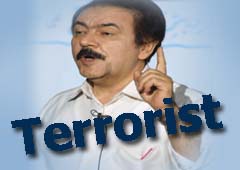
Mujahedin Khalq Organization as a terrorist group

Interpol issues arrest warrant for 12 MKO members

Baghdad- Interpol has issued arrest warrant for 12 members of the terrorist Mujahideen Khalq Organization (MKO) for involvement in ‘illegal’ operations,Interpol has issued arrest warrant for 12 members of the terrorist Mujahideen Khalq Organization (MKO) for involvement in'illegal' operations wrote an Iraqi daily. 

Baghdad-based daily ‘Al-Sabah’ in its Monday issue quoted a judicial source in Iraqi Diyala province as saying that 12 of the terrorist MKO members are accused of being involved in ‘illegal’ operations, including kidnapping.

The source said since police is not allowed to enter Camp Ashraf and due to the refusal of the criminals to surrender, the enforcement of the arrest warrant has encountered some difficulty.

March 31, 2009 0 comments
FacebookTwitterPinterestWhatsappTelegramSkypeEmail
Iraq

Iraq to Relocate Iran Opposition Group

U.S. Guarded Embattled Movement’s Camp

Iraq’s national security adviser said Friday that the government intends to move an Iranian opposition group from its sanctuary near the Iranian border to a location where leaders and”brainwashed cult members”will be separated and the latter”detoxified.”

Mowaffak al-Rubaie’s remarks about the future of the Mujaheddin-e Khalq, or MEK, were his most detailed to date on how his government intends to deal with an issue that has been an irritant in relations between Iraq’s government, which has built close ties with Iran, and the U.S. government. The group received support from Saddam Hussein’s government and has been designated a terrorist organization by the State Department, but U.S. officials credit the MEK with providing information about Iran’s nuclear program.

The Iraqi government’s resolution of the conundrum is likely to shed light on how an increasingly sovereign Iraq will handle such vexing problems, and is likely to speak volumes about the extent to which Prime Minister Nouri al-Maliki is influenced by Iran.

Members of the group”should understand that their days in Iraq are numbered,”Rubaie told Western journalists at a briefing in the Green Zone.”We are literally counting them.”

Iraqi officials, including Maliki, have in recent months publicly lambasted the group, generally during or after official visits to Iran.

The U.S. military has protected the group’s camp in Iraq since the 2003 invasion. It handed over nominal control of the outer perimeter to Iraqi security forces in February but said it is keeping a contingent there to ensure that group members are treated humanely.

At one point in his remarks, Rubaie said Iraq would not forcibly deport MEK members because”we are a civilized country.”But later, he said the Iraqi government would have a”thick skin”when it came to any negative press or international outcry generated by the eventual repatriation of members.

“The party is over for them. The party is over for coalition protection for them,”he said, referring to the U.S. military.

A spokesman for the group, Mohammad Mohaddessin, said in a statement that residents of Camp Ashraf, which is 40 miles north of Baghdad,”will never leave their home”and warned that Rubaie’s plan is”setting the stage for a human catastrophe.”

Rubaie did not indicate when or how the Iraqi government will expel the people at Ashraf. He said the government is considering facilities in western and southern Iraq to house the camp’s 3,418 residents while it studies its options.

Rubaie said the government hopes to wean”brainwashed cult members”from the sway of the 25 or so leaders at Ashraf before they are repatriated.

Rubaie, citing numbers he obtained from the U.S. military, said Camp Ashraf’s population includes 11 Canadians, five Americans, four Swedes, three Dutch and three Britons. Hundreds more have legal residency permits issued by France, Germany and other Western countries, he said. But ascertaining the identity and nationality of everyone there has and will probably continue to be challenging, he said, because the group’s leaders”are obstructing us.”

Rubaie said he recently met with ambassadors from several countries whose citizens or permanent residents are at Ashraf to urge them to take the group members back following a”meticulous vetting process.”If they do not, Rubaie warned,”we will provide them with Iranian passports,”and”they will wind up on a European street.”

The group includes 900 young women but no children because members are barred from having sex, he said.

Many members are the children of Iranian exiles recruited during the 1980s and ’90s. Hussein used the heavily armed and well-trained group during his decade-long war with Iran in the ’80s, and it also reportedly played a role in Hussein’s bloody suppression of Shiite and Kurdish uprisings after the Persian Gulf War in 1991.

MEK leaders say the prospect of being forcibly repatriated to Iran would expose them to torture and execution.  

Rubaie said the Iraqi government has arrest warrants for three group members and that the United States has warrants for two others. He said that Iranian officials plan to prosecute more than 50 Ashraf residents and that they recently proposed that their prosecutions be carried out in Iraq.

By Ernesto Londoño – Washington Post Foreign Service

March 30, 2009 0 comments
FacebookTwitterPinterestWhatsappTelegramSkypeEmail
Iraq

Countdown for MKO departure

Iraq has warned that the Mujahedin Khalq Organization (MKO) has outstayed its welcome in the country and is obliged to pack its bags. "The residents should understand ... that their days in Iraq are numbered and we are literally counting down," al-Rubaie

Iraqi National Security Advisor Mowaffaq al-Rubaie said at a Friday news conference that the Mujahedin Khalq Organization (MKO) had to leave Iraq soon but did not give any time-frame for the relocation.

“The residents should understand … that their days in Iraq are numbered and we are literally counting down,”al-Rubaie told reporters.

He, however, said that the Iraqi government would not appeal to force if the group obides by the departure regulations in a non-forcible way.

“We will not use force … unless the residents use force against the Iraqi security forces. This whole process will be pain-free if they cooperate.”

Baghdad holds the anti-Iran MKO responsible for destabilizing Iraq through its terror attacks.

The Iraqi government took control of the group’s military training grounds in Camp Ashraf from the US in January.

The official on Friday did not identify where the group would be moved to but the al-Bayyina al-Jadida daily reported that Iraq was in talks with Australia to find an alternative place for the group.

Iraqi sources revealed in February that several countries were considering granting entry permission to certain members of the terrorist group.

Egypt, they said, had agreed with a request by MKO leaders to establish a camp in the country.

In a Saturday statement, the MKO members reacted angrily to plans by Baghdad for their resettlement and called the demand”absolutely illegal”.

The MKO, blacklisted as a terrorist organization by many international entities and countries, including the US, is responsible for numerous acts of violence against Iranian civilians and government officials as well as Iraqis during the rein of former dictator Saddam Hussein.

The group was exiled from Iran after the Islamic Revolution and settled in Iraq in 1986, where it enjoyed the support of Saddam.

Tehran has long called for the expulsion of MKO members from Iraq. Tehran says the members of the group who have not participated in terrorist activities can return home but others will need to stand trial.

Some MKO members have defected from the organization and have returned to Iran.

March 30, 2009 0 comments
FacebookTwitterPinterestWhatsappTelegramSkypeEmail
The MEK to launch Armed Struggle

Great Expectations of a terrorist cult

Those familiar with the true nature of MKO are well aware of the fact that the terrorist cult can hardly back away from a four-decade long strategy of armed struggle. As noticed in Rajavi’s message of December 27, now after being removed from the EU terror list, Rajavi hopes its organization to be rearmed but legally this time.

In the written agreement between all MKO members and American forces, signed after the recognition of legal status of MKO members in Ashraf, all Ashraf residents denounced violence and terrorism and assured that they would never be armed illegally.

What Rajavi means by emphasizing on Ashraf residents’ refraining to be armed illegally? Who can guarantee that they will not be granted a legal or illegal opportunity to be rearmed? His statement may violate the prerequisite of the vote ruled by the EU to remove MKO from its terrorist list in which it is supposed that Mojahedin have stopped their armed struggle and terrorist activities since January 2003. His emphasis on the unlikeliness of their illegal rearming implies that their disarmament as well as bringing terrorist activities to an end was far from a voluntary act, rather it took place obligatorily due to the critical circumstances of the region. Therefore, the falsehood of the claim of the EU as well as Mojahedin that the armed struggle of Mojahedin has been replaced by the diplomatic and peaceful solution of Maryam Azdanlu is a proven fact.

Furthermore, Maryam Azdanlu as well as Masoud Rajavi insist on the restoration of their arms by the US. Also, Rajavi has repeatedly asserted that the US can count on his so-called liberation army and use Ashraf residents as a military lever in the region. He pretends that equipping Mojahedin with arms depends on the will and decision of the US. It is evident that Mojahedin have ceased their terrorist and violent activities temporarily due to the invasion of the coalition forces to Iraq as well as fall of Saddam and the trigger-happy Mojahedin have preserved their strategy of armed struggle.

His words may verify the accuracy of the decision taken by the Iraqi government on expelling Mojahedin from Iraqi soil due to their interference in its internal affairs. The fact is that the analysis of Rajavi’s statements word by word may provide Iraqi government with due motive to end the presence of Mojahedin in Iraq. In a nutshell, declaring the likelihood of the legal arming of Mojahedin in Rajavi’s message may lead to:


1. Providing sufficient legal reasons for expelling Mojahedin from Iraqi soil,

2. Putting the issue of Mojahedin’s asylum seeking under question,

3. Proving the falsehood of Mojahedin’s claims on stopping armed struggle and terrorist activities,

4.  Rejecting the claim of Mojahedin’s refraining to interfere in the internal affairs of Iraq,

5. Revealing the false strategic alliance of Mojahedin and Iraqi people as claimed by Rajavi.

March 30, 2009 0 comments
FacebookTwitterPinterestWhatsappTelegramSkypeEmail
MEK Camp Ashraf

Iraq closes Camp Ashraf by the end of the month

Maliki says Iraq no place for PKK, Iranian rebels

BAGHDAD (Reuters) – Iraqi Prime Minister Nuri al-Maliki has promised to helpMaliki :"We have informed this terrorist organization that Iraq can be no place for you... Search for another place," Turkey fight Kurdish separatists who use northern Iraq as a base from which to launch attacks.

Maliki gave the promise in a recorded interview on Iraqiya state TV on Wednesday after a visit to Iraq by Turkish President Abdullah Gul, who asked Iraq on Tuesday to help quell more than two decades of rebellion by the Kurdistan Worker’s Party (PKK).

Turkey has accused Iraq in the past of not doing enough to crack down on the outlawed PKK, considered terrorists by Washington and the European Union.

“The PKK is a terrorist organization and it has caused a crisis (between Iraq and) … Turkey,” Maliki said. “This matter must be ended. Our will is decisive … (Here) there is no place for terrorist organizations.”

On Monday Iraqi President Jalal Talabani, a Kurd, told the PKK to disarm or leave Iraq, in some of the toughest comments to date by any Iraqi leader against the rebels, whose use of Iraq as a base has strained ties between Baghdad and Ankara.

Maliki’s comments were a further sign of a thaw in relations between the two major trading partners, starting with a trip to Iraq by Turkish Prime Minister Tayyip Erdogan last year.

In the same interview Maliki also warned the Iranian opposition group, the People’s Mujahideen of Iran (PMOI), that they must leave Iraq, reiterating a pledge by National Security Adviser Mowaffaq al-Rubaie to close down Camp Ashraf on the Iranian border, where the PMOI are currently based.

“We have informed this terrorist organization that Iraq can be no place for you… Search for another place,” he said.

The camp’s 3,500 residents have been in limbo since Iraq took it over from U.S. forces this year. Iraq’s Shi’ite Muslim leaders are friendly with Tehran, which wants the camp closed and PMOI members on a wanted list handed over for trial. Human rights groups say that would violate international law.

Iraq has appealed to other foreign countries to accept residents when it closes Camp Ashraf at the end of this month.

Reporting by Tim Cocks

March 29, 2009 0 comments
FacebookTwitterPinterestWhatsappTelegramSkypeEmail
Europe

Europe begins transfer of MKO terrorists

The first group of MKO terrorists has reportedly been transferred to Europe after their training ground in Iraq came under threat.

The group, comprised of 64 senior members of the Mujahedin Khalq Organization, were transferred from Jordan to an unknown European state by two military planes, the Tabnak website reported.

The report quoted Arab correspondents in Jordan as saying that the Iraqi government had not been informed on the”quite confidential”move.

Reports suggest that the MKO terrorists were moved to Romania, but no official has given information about the case.

Iraqi soldiers, under orders from Iraqi National Security Advisor Mowaffak Al-Rubaie, have surrounded MKO’s Camp Ashraf since Thursday, after Baghdad vowed to shut down the training ground and end the group’s presence in the country.

After the finalization of a security agreement between Baghdad and Washington, the Iraqi government took over the country’s national security issues. Under the interim agreement, Iraq now has control over Camp Ashraf in Diyala province.

The Iraqi government has vowed to expel the members of the terrorist group from the country, saying their presence”in Iraq is not an option”.

The anti-Iran MKO, which defines itself as a Marxist-Islamist guerilla army, has carried out acts of terrorism against Iranian nationals and officials.

Outlawed in Iran, the group was relocated in France before its armed wing was expelled at the order of the then-prime minister Jacques Chirac.

The organization eventually moved to Iraq, where it assisted former dictator Saddam Hussein in the massacre of thousands of Iraqi civilians in the 1990s.

Many countries, including the US, have blacklisted the MKO as a ‘terrorist’ organization. The US State Department says that the MKO assassinated at least six US citizens in Iran, prior to the victory of the Islamic Revolution in 1979.

In January, the 27-nation European Union ruled to remove the MKO from its blacklist after a seven year presence. The ruling is believed to be politically motivated, the result of legal developments combined with intense lobbying by the cult-like group.

March 29, 2009 0 comments
FacebookTwitterPinterestWhatsappTelegramSkypeEmail
The cult of Rajavi

Imaginary invaders of Camp Ashraf

As it is the case with majority of cult leaders, they always try to warn against imaginary enemies that might be jeopardizing the life of people. In most cases they threaten to strongly react in the case of any alien invasion or government intervention. As the evidences corroborate, the real victims of these claims have always been the insiders themselves rather than the outsiders. The message of Masoud Rajavi on 27 December is out-and-out based on fabrication, perversion, fallacy, and bluff. Surprisingly enough, the apparent paradoxical points of his statements have been hidden from the European advocates of the organization as well as its numerous critics. Following the analysis of this message in preceding articles, other points are to be elaborated on here.

The western advocates of Rajavi should take necessary precautions not to pave the way for turning MKO into another al-Qaeda or Taliban as a terrible nightmare for the US and its allies. Masoud Rajavi, the cultic leader of MKO, in the conclusion of his message refers to those politicians who are steadfastly and blindly supporting the notorious group he steers saying:

Yet as confirmed by compatriots, lawyers, parliamentarians, and prominent political figures different countries in the world, it is assured that in case of any invasion against the security and rights of Ashraf residents, the world will rise in protest.

An instance of his intended rise took place after the arrest of Maryam Azdanlu in France in June 2003 when a number of MKO cult members committed self-immolation in Paris streets; however, the revolt meant by Masoud Rajavi in his messages is of a different form. He is well aware that his European advocates are different from his absolute obedient disciples and he cannot even rely on them for half a day hunger strike in his support, let alone any form of protest. They can hardly understand some phenomena common in MKO like ideological revolution, sacrifice, etc and the fact is that it is just their diplomatic objectives that necessitate supporting an opposition to the Iranian government for a while.

Unfortunately, despite all investigations carried out by the France government and monitoring of Mojahedin illegal activities in France as well as the report of DST, France officials have been subject to passivity and condonation. However, Rajavi is well aware that he can just count on his own cultic levers like terrorist and suicide activities of MKO members not his western sympathizers who grab hold to propaganda blitz on Mojahedin and their status as a political lever for furthering their own diplomatic objectives and have nothing to do with Masoud and Maryam. A brief look at a statement made by the same backers may clarify the issue that westerners had identified the true nature of Mojahedin long before when they referred to them as a wolf in sheep’s clothing *. In fact, this is the most true picture of Mojahedin drawn by westerners.

Evidently, Masoud Rajavi is aware that the support offered by westerners as well as his own warning of an imminent invasion to Camp Ashraf is baseless. Nevertheless, he pursues his common cultic procedure of inculcating the international bodies with the idea of an assumed enemy ready to attack Camp Ashraf by which he has preserved the integrity of MKO and Camp Ashraf in recent years.

Now, he claims that the world is ready to rise against those invading Ashraf but refrains to say who these invaders might be. In addition, this question arises that if he demands international bodies to solve the problem of keeping the security of Camp Ashraf and its residents and, as he claims, he recognizes international rules and conventions more than their legislators, what is the rationale behind all his fabrication, perversion and propaganda war? 


* Gessler; Autopsy of an Ideological Drift, Translated byThomas R. Forstenzer, Published in France in 2004, chapter 15.

March 28, 2009 0 comments
FacebookTwitterPinterestWhatsappTelegramSkypeEmail
Mujahedin Khalq Organization as a terrorist group

Hosted by terrorists?

An organization in Ottawa’s bad books wined and dined Canadian politicians

Eight current and former Canadian parliamentarians attended a conference and rally in Paris last summer that was organized by the political wing of an Iranian opposition group that Canada and the United States have designated as a terrorist organization. At least four had some of their expenses covered by supporters of the banned group. The visit shows how difficult it can be for Western politicians to navigate the confusing waters of Iranian politics, where even those opposed to the theocracy in Tehran can be tainted by accusations of violence and human rights abuses.

The National Council of Resistance of Iran staged a massive rally in Paris last June to support its now-disarmed military wing, the People’s Mujahedeen Organization of Iran, also known as the Mujahedeen-e-Khalq, or simply the People’s Mujahedeen. The group invited hundreds of politicians from around the world, and Maryam Rajavi, “president-elect” of the NCRI, met with many of them at her home outside Paris. Canadian politicians who attended included: Liberal MPs Carolyn Bennett, Yasmin Ratansi and Raymonde Folco; Bloc Québécois MP Meili Faille; Andrew Telegdi and Tom Wappel, who were Liberal MPs at the time but are no longer; and Liberal Senator David Smith. David Kilgour, who sat as both a Progressive Conservative and Liberal MP before leaving politics as an Independent in 2006, was also there. Bennett and Telegdi were given a little less than $2,000 each toward transportation, accommodation, and meals. Wappel’s bill for the same totalled $3,780. Smith says he was put up free of charge in a hotel.

The People’s Mujahedeen was officially designated as a terrorist group by Canada’s Liberal government in May 2005. The Conservatives upheld this decision in November 2008. The U.S. State Department considers the People’s Mujahedeen and the NCRI as simply different names for the same organization. Despite numerous requests by Maclean’s, officials with the Department of Public Safety would not say whether Canada distinguishes between the two.

Based in Iraq but with supporters all over the world, the People’s Mujahedeen seeks the overthrow of Iran’s theocracy. It has carried out numerous bombings, military raids, and assassinations in Iran since its founding in 1965. These included the murder of American military personnel and civilians in Iran during the 1970s, as part of its efforts to help overthrow the shah in 1979.

The group found safe haven in Iraq under Saddam Hussein during the 1980s and allied with Iraq in its war against Iran. Shortly after a ceasefire between the two warring nations was announced, in July 1988, the People’s Mujahedeen invaded Iran from Iraq, believing that the Iranian government was on the verge of collapse. The invaders were easily repulsed, and Iran executed as many as 5,000 political prisoners soon afterwards—most of whom were supporters of the People’s Mujahedeen. People’s Mujahedeen fighters based in Iraq also reportedly took part in the Iraqi Republican Guard’s bloody repression of Kurds and Shia Arabs in 1991.

The group has not been linked to any violent acts since 2001 and was recently removed from British and European Union lists of terrorist organizations. The National Council of Resistance of Iran says its goal is the establishment of a secular democracy in Iran. Its supporters include Iranian expatriates, as well as many Western politicians. People’s Mujahedeen members inside Iran appear to be well organized and have passed on intelligence to the United States, despite the official American position that the group is a terrorist organization. This reporter encountered little support for the People’s Mujahedeen among ordinary Iranians during a visit in 2004—though one Iranian political prisoner, in a personal letter, has since praised the kindness of People’s Mujahedeen members with whom he is jailed.

Mohamad Tavakoli, a professor of history and near and eastern civilizations at the University of Toronto, says most Iranians have never forgotten that the People’s Mujahedeen joined forces with Saddam Hussein and invaded their country. “Iranians will not forgive them for that,” Tavakoli says. “Even secular Iranians who have been in opposition to the Islamic Republic, they do not forgive the People’s Mujahedeen and the National Council of Resistance for their collaboration with Saddam Hussein. The mujahedeen and the National Council of Resistance doesn’t have credibility with the Iranian people. It does have some hard-core supporters. But that’s it.”

Critics, including other Iranian opposition groups as well as the U.S. State Department, describe the NCRI as a personality cult built around Maryam Rajavi and her husband, Massoud, who hasn’t been seen in public for years. Several of its supporters, including at least one Canadian, have set themselves on fire during public protests. A 2005 Human Rights Watch report accused the People’s Mujahedeen of severe human rights violations at its sprawling “Camp Ashraf” headquarters in Iraq, before the camp was disarmed by American forces in 2003. These violations included subjecting dissident members who wished to leave to years of solitary confinement, abuse, torture, and, in two cases, murder. (The future of the camp’s 3,500 residents, who include scores of Canadians, is unclear. The Iraqi government wants them out of the country. People’s Mujahedeen members fear they will be jailed or worse should they return to Iran.)

The Canadian delegates to Paris appear to have been aware that they would be attending NCRI events. Wappel described the purpose of his trip to the ethics commissioner as “to meet with representatives of the National Council of Resistance of Iran.” He told Maclean’s that he supports the removal of the People’s Mujahedeen from Canada’s list of banned terrorist groups. According to a press release from the NCRI’s foreign affairs committee, Wappel, Folco, and Ratansi all attended a meeting hosted by Rajavi, where they also pledged to work at getting the People’s Mujahedeen removed from Canada’s list of terrorist groups.

Tavakoli, the University of Toronto professor, says he can understand why Western politicians might want to support the National Council of Resistance of Iran. The current regime in Tehran is illiberal and often brutal. And supporters of the NCRI present themselves as the only viable alternative. “I beg to differ,” Tavakoli says. “They present themselves as a democratic alternative to the Islamic Republic, with the hope of overthrowing the regime. But democratic involvement is really being involved in building grassroots organizations, and they are not interested in that. They view themselves as a vanguard political organization, and vanguards do not have patience for doing the dirty work of democracy. I don’t think the National Council of Resistance, with any kind of stretch of imagination, represents the Iranian diaspora community and their democratic aspects.”

Bennett, Wappel and Telegdi told the ethics commissioner their expenses were covered by the “Iran Democratic Association.” Reza, a spokesperson for the group who asked that his last name not be printed to protect relatives in Iran, describes the association’s members as “supporters and sympathizers” of the NCRI but not formally part of the organization. “As far as I’m concerned and my colleagues are concerned, we believe that this group can realize what our goals are—a nuclear-free, secular Iran,” he said in an interview with Maclean’s. “There is no other alternative that stands against the barbarity of the Iranian regime.”

Carolyn Bennett, in an interview with Maclean’s, acknowledged the People’s Mujahedeen’s violent history but says it has evolved. “Obviously, some people who were involved in it in the past have been accused of, you know, acts we wouldn’t want,” she said. “But like so many of these resistance movements, whether you’re in Northern Ireland or South Africa, there are people who are victimized and who are now fighting for democracy.” David Smith, the senator, also described the People’s Mujahedeen’s terrorist designation as “a complete and utter bum rap.” Yasmin Ratansi incorrectly claimed that the People’s Mujahedeen has not been armed for more than 20 years. In fact, when Camp Ashraf was disarmed in 2003, the People’s Mujahedeen relinquished more than 2,000 tanks, armoured personnel carriers, and heavy artillery pieces.

Although no Conservative MPs attended the NCRI’s rally and meetings in Paris last summer, the group has drawn Conservative support in the past. Paul Forseth, a Conservative MP until his defeat in the 2006 election, has previously attended an NCRI rally in Paris and remains a strong supporter of the group. And in April 2006, Immigration Minister Jason Kenney, then the parliamentary secretary to the Prime Minister for multiculturalism, spoke at a small rally on Parliament Hill held by apparent supporters of the People’s Mujahedeen. A photo of Kenney addressing the group appeared on the website of the National Council of Resistance of Iran. Kenney later claimed he had been invited to give a speech by a group calling itself the Committee for Human Rights in Iran and said he had no idea the group was linked to the People’s Mujahedeen.

Denis Coderre, the Liberal defence critic, didn’t accept this explanation and called on Kenney to apologize and denounce the People’s Mujahedeen: “A terrorist group is a terrorist group,” said Coderre. “Jason Kenney, who likes to play politics and who’s as subtle as Barney Rubble in politics, he should do better than that.” Maclean’s called Coderre’s office to find out how he felt about his Liberal colleagues attending a People’s Mujahedeen rally and taking money from supporters of the group, but he did not respond to a request for an interview.

by Michael Petrou, Macleans.ca

March 28, 2009 0 comments
FacebookTwitterPinterestWhatsappTelegramSkypeEmail
MEK Camp Ashraf

Iraqi official to warn over violations in Camp Ashraf

In a Sunday statement, Iraqi National Security Advisor Mowaffaq al-Rubaie asked MKO leaders to stop using "torture tactics" against members who want to leave the organization.

In a Sunday statement, Iraqi National Security Advisor Mowaffaq al-Rubaie asked MKO leaders to stop using "torture tactics" against members who want to leave the organization."The MKO violates the freedom of speech in all possible ways. It does not even follow human rights when dealing with its own members," the statement said."The MKO violates the freedom of speech in all possible ways. It does not even follow human rights when dealing with its own members," the statement said.

"It deprives of them [MKO members] from the right to determine their own fate," the statement added.

Although the European Union has recently outraged the victims of MKO violence by removing the group from its list of terrorist organizations, the group is still blacklisted in Iran, Iraq, Canada, and the United States.

The group, exiled from Iran, has claimed responsibility for bombings, killings and attacks against Iranian government officials and civilians over the past 30 years.

The attacks include the assassination of the late president Mohammad-Ali Rajaei, prime minister Mohammad-Javad Bahonar and judiciary chief Ayatollah Mohammad Beheshti.

The MKO is also known to have cooperated with former Iraqi dictator Saddam Hossein in suppressing the 1991 uprisings in southern Iraq and the massacre of Iraqi Kurds.

The Iraqi government has recently given MKO members a deadline to leave their Camp Ashraf military training ground in Diyala Province.

MKO is notorious for using cult-like tactics within the group and for torturing and murdering its defectors.

Iranian officials say that many MKO members have contacted Iran in an attempt to flee the camp but have eventually been entrapped by the group.

Numerous articles and letters posted on the Internet by family members of MKO recruits confirm reports of the horrific abuse that the group inflicts on its own members and the alluring recruitment methods it uses.

The most shocking of such stories includes accounts given by former British MKO member Ann Singleton and Mustafa Mohammadi — the father of an Iranian-Canadian girl who was drawn into the group during an MKO recruitment campaign in Canada.

Mohammadi recounts his desperate efforts to contact his daughter, who disappeared several years ago — a result of what the MKO called a ‘two-month tour’ of Camp Ashraf for teenagers.


He also explains how the group forces the families of its recruits to take part in pro-MKO demonstrations in Western countries by threatening to kill their loved ones.

Lacking a foothold in Iran, the terrorist group recruits ill-informed teens from Iranian immigrant communities in Western states and blocks their departure afterwards. 

March 26, 2009 0 comments
FacebookTwitterPinterestWhatsappTelegramSkypeEmail
Iraq

MKO Members Bribe Iraqi Politicians

"Available intelligence reports, which are very accurate, indicate that several political figures and groups have taken bribes from the MKO in exchange for their support," Iraqi National Security Advisor Mowaffaq al-Rubaie, said in remarks translated from Arabic.

"From a legal perspective, these briberies have reached a stage where they can be considered criminal activity," Rubaie told reporters following a Saturday meeting with top Shiite cleric Grand Ayatollah Ali al-Sistani, press tv reported.

However, the senior Iraqi advisor refrained from implicating any particular individual.

Rubaie said that Baghdad does not recognize the MKO cult to be a legal group nor is it allowed to carry out its activities in Iraq.

"Those 3,418 individuals who are currently residing at Camp Ashraf in the Diyala province are there as Iranian nationals," he explained.

Rubaie pointed out that although Iraq will not force occupants of Camp Ashraf to return to Iran, many of them are willing to go back to their homeland voluntarily.

The MKO, whose main stronghold is in Iraq, is blacklisted by much of the international community, including the United States.

Before an overture by the EU, the MKO was on the European Union’s list of terrorist organizations subject to an EU-wide assets freeze. Yet, the MKO puppet leader, Maryam Rajavi, who has residency in France, regularly visited Brussels and despite the ban enjoyed full freedom in Europe.

The MKO is behind a slew of assassinations and bombings inside Iran, a number of EU parliamentarians said in a recent letter in which they slammed a British court decision to remove the MKO from the British terror list. The EU officials also added that the group has no public support within Iran because of their role in helping Saddam Hussein in the Iraqi imposed war on Iran (1980-1988).

Many of the MKO members abandoned the terrorist organization while most of those still remaining in the camp are said to be willing to quit but are under pressure and torture not to do so.

A May 2005 Human Rights Watch report accused the MKO of running prison camps in Iraq and committing human rights violations.

According to the Human Rights Watch report, the outlawed group puts defectors under torture and jail terms.

The group, founded in the 1960s, blended elements of Islamism and Stalinism and participated in the overthrow of the US-backed Shah of Iran in 1979. Ahead of the revolution, the MKO conducted attacks and assassinations against both Iranian and Western targets.

Leaders of the group have been fighting to shed its terrorist tag after a series of bloody anti-Western attacks in the 1970s, and nearly 30 years of violent struggle against the Islamic Republic of Iran.

In recent months, high-ranking MKO members have been lobbying governments around the world in the hope of acknowledgement as a legitimate opposition group.

The UK initiative, however, prompted the European Union to establish relations with the exiled organization now based in Paris. The European Court of First Instance threw its weight behind the MKO in December and annulled its previous decision to freeze its funds.

The group started assassination of the citizens and officials after the revolution in a bid to take control of the newly established Islamic Republic. It killed several of Iran’s new leaders in the early years after the revolution, including the then President, Mohammad Ali Rajayee, Prime Minister, Mohammad Javad Bahonar and the Judiciary Chief, Mohammad Hossein Beheshti who were killed in bomb attacks by MKO members in 1981.

The group fled to Iraq in 1986, where it was protected by Saddam Hussein and where it helped the Iraqi dictator suppress Shiite and Kurd uprisings in the country.

The terrorist group joined Saddam’s army during the Iraqi imposed war on Iran (1980-1988) and helped Saddam and killed thousands of Iranian civilians and soldiers during the US-backed Iraqi imposed war on Iran.

Since the 2003 US invasion of Iraq, the group, which now adheres to a pro-free-market philosophy, has been strongly backed by neo-conservatives in the United States, who also argue for the MKO to be taken off the US terror list.

The MKO has been in Iraq’s Diyala province since the 1980s.

In August 2008, the Iraqi parliament passed a resolution setting a six-month deadline for all MKO members to leave the country or face possible expulsion.

Tehran has pardoned several former MKO members who have expressed remorse, allowing them to return to the country. 

March 26, 2009 0 comments
FacebookTwitterPinterestWhatsappTelegramSkypeEmail
Newer Posts
Older Posts

Recent Posts

  • Pregnancy was taboo in the MEK

    December 22, 2025
  • MEPs who lack awareness about the MEK’s nature

    December 20, 2025
  • Why did Massoud Rajavi enforce divorces in the MEK?

    December 15, 2025
  • Massoud Rajavi and widespread sexual abuse of female members

    December 10, 2025
  • Farman Shafabin, MEK member who committed suicide

    December 3, 2025
  • Facebook
  • Twitter
  • Instagram
  • Youtube

© 2003 - 2025 NEJAT Society . All Rights Reserved. NejatNGO.org


Back To Top
Nejat Society
  • Home
  • Articles
  • Media
    • Cartoons
    • NewsPics
    • Photo Gallery
    • Videos
  • Publications
    • Books
    • Nejat NewsLetter
    • Pars Brief
  • About Us
  • Contact us
  • Editions
    • عربي
    • فارسی
    • Shqip