
The MKO is responsible for numerous acts of violence 
against Iranian civilians and government officials as well as Iraqis
A senior Iranian dignitary describes the EU-led decision to remove the Mujahedin Khalq Organization (MKO) from the terror blacklist as a ‘strategic mistake’.
A senior member of Majlis National Security and Foreign Policy Commission Javad Jahangirzadeh said the EU move to exempt the MKO from the killings of thousands of Iranians was a political disgrace, Fars News Agency reported Sunday.
“It is the European Union’s strategic mistake to hold hope on the MKO because the terrorist group has no social or popular base in Iran,”he added.
The lawmaker said the mistake by European countries would be in Iran’s favor because the”West has no concrete information and analysis about the MKO.”
The Mujahedin Khalq Organization, which identifies itself as a Marxist-Islamist guerilla army, was founded in Iran in the 1960s, but was exiled some twenty years later for performing numerous acts of terrorism in the country.
The terrorists are especially notorious for taking sides with former dictator Saddam Hussein during the war Iraq imposed on Iran (1980-1988).
Anne Singleton, an expert on the MKO and author of Saddam’s Private Army explains that the West aims to keep the group afloat in order to use it in efforts to destabilize Iran and possibly attempt to stage a regime change.
“With a new Administration in the White House a pre-emptive strike on Iran looks unlikely. Instead the MKO’s backers have put together a coalition of small extremists groups, the known minority and separatist groups, along with the MKO. These groups will be garrisoned around the border of Iran and their task is to launch terrorist attacks inside Iran over the next few years to turn up the heat,”she explains.
“The role of the MKO is to train and manage these groups using the expertise they acquired from Saddam’s Republican Guard,”Singleton added.
A 2007 German intelligence report from the Federal Office for the Protection of the Constitution has identified the MKO as a”repressive, sect-like and Stalinist authoritarian organization which centers around the personality cult of [MKO leaders] Maryam and Masoud Rajavi.”
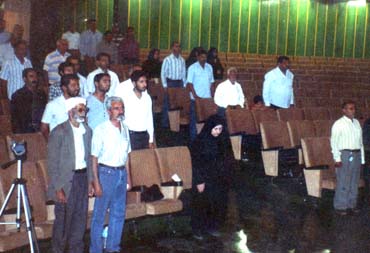
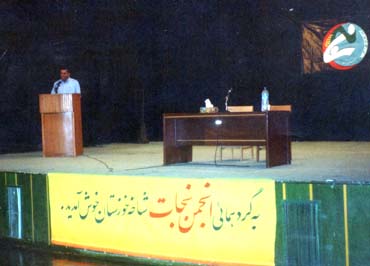
On Friday, 8th May families of MKO members held a meeting in Ahwaz at Aftab Hall.
The meeting was held with the presence of more than 50 families of MKO captives who are banned behind the bars of Rajavis’ cult and also some of the separated members.
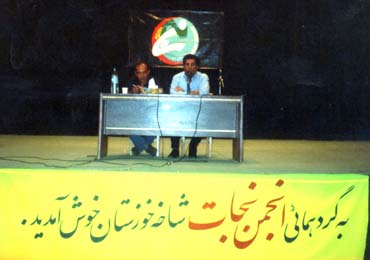
After presenting the schedule of the meeting Mr. Hamid Dehdar Hassani ; head of Nejat Society office – Khuzestan Branch gave a report on Nejat Society’s activities during the last year and also on incoming programs of the Society .
Mr. Ekrami member of Nejat Society then addressed the audiences under the title of “Active relations between families and Society, guaranties the release of hostages of MKO”.
Mr. Maziyar Shirvani the former member of MKO who recently managed to release himself from the cult and joined his family explained aspects of the atmosphere rules the cult of Rajavi and the role of Nejat Society in releasing the captive members of Mujahedin.
During the meeting books as well as articles and interviews of MKO former members presented to the participants.
Also during the meeting 17 families of captives of MKO, signed a letter of request to meet their beloveds. The letter was to be sent to ICRI.
At the end the statement to Mr. Nuri Al Maliki was read and signed by the participants of the meeting.
The meeting was ended at 12:30 PM.
Release of the book “A report on Ashraf city” written by Mr. Manoochehr Hezarkhani at a time when closing Camp Ashraf is on the agenda of Iraqi government is an interesting point to be elaborated on due to two factors. First, the preparation of this report as a book by a member of NCRI and second, the paradoxes found in its short excerpts on the websites of Mojahedin. However, the readers are recommended to study the preface of this book carefully.
This short excerpt from the book suffices to prove many of our claims on the true nature of Camp Ashraf. Seemingly, Mr. Hezarkhani has made his best in this book to persuade his foreign audience as well as MKO and Camp Ashraf critics that there is nothing inside Camp Ashraf to be investigated. In this regard, the book is compiled in a way to win the hearts of the audience and arouse their sympathy for Ashraf residents on the one hand and on the other hand, pave due propaganda background for the coming humanistic disaster inside Camp Ashraf focused by Masoud Rajavi.
The first unanswered question is that why this report is made on the basis of the observations of a member of NCRI despite the fact that logic necessitates it that an independent person and one in middle-of-the-road write a much more reliable report. Whereas, a few months before, one of the oldest residents of Ashraf called for visiting Camp Ashraf along with some members and representatives of international bodies and high commissary. This request has been faced with the silence of Mojahedin. The one-sided judgment of Mr. Hezarkhani had no result but his own strong impression caused by visiting Camp Ashraf. For many years, reporters and researchers have requested to visit Camp Ashraf but their request has been neglected so far. Therefore, if Mojahedin are to give some information on Camp Ashraf, it’s better to make use of those who understand the exact definition of city and those who can talk with a number of the residents of Ashraf freely rather than using Mr. Hezarkhani as their own agent.
As it is said, the entrance of the representatives of Human Rights has been prohibited to Camp Ashraf once more. Common sense orders not to recognize the legitimacy of the report of Mr. Hezarkhani compared to that of a legitimate international organ. We do agree with Mr. Hezarkhani that the residents of Camp Ashraf are a number of idealist and honest men and women, but those like Mr. Hezarkhani that are agents of MKO are better to let them govern their own destiny.
The best solution is to let them free even for half a day to visit and talk freely with the inspectors of Human Rights that already are in Iraq under no control. Mojahedin highrankings and Mr. Hezarkhani are of no authority; however, if Masoud Rajavi consents to do this, we are ready to bear all its consequence.
It seems that the thrill and ecstasy of Mr. Hezarkhani by seeing a football field or a swimming pool of saltwater is due to the fact that he has not enough time to go on a cruise in Paris despite living therein. How is it possible that a person living in Paris, flames and heats by seeing the facilities of a military city, as he calls it? Evidently, his own place of residence is nothing more than Camp Ashraf. The true visage of Camp Ashraf is depicted by MKO members not only the detached ones but also those already living therein and making some statements on it for pleasing MKO leaders.
Taking a look at the archive called Ashraf city reveals tens of notes by its residents that unintentionally have depicted the true visage of this camp. Likewise, Mr. Hezarkhani has repeated the same points in his report. Since the issue of Camp Ashraf is on the agenda of Mojahedin and international bodies, the content of the report of Mr. Hezarkhani is to be analyzed and its contradictions and paradoxes expounded on in a number of articles to find out the true definition and indices of a city and the reason why for example, Mr. Hezarkhani calls Camp Ashraf a city just by observing an instance of deal therein.
Dr. Abdalzahra Mohye: Iraqis have suffered from crimes committed by MKO
Iraqi intellectuals meet Habilian Secretary General
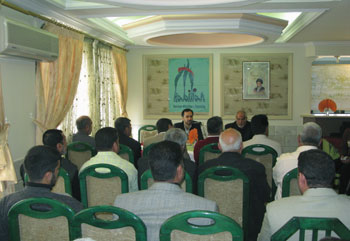
Mashhad- A number of Iraqi elites and intellectuals met and exchanged ideas with Secretary General of Habilian Association over the current status of Iraq and also the presence of terrorist cult of Mojahedin-e Khalq within this country. After welcoming the arrival of the delegation in the holy city of Mashhad at the beginning of the meeting, Mohammad Javad Hashemi Nejad expressed his happiness to host his Iraqi brothers and said: We are very much pleased of the ongoing relations between the people of two brotherly nations of Iran and Iraq and also the strong ties between the authorities of the two countries. No one could possibly find any other two nations around the world closer to each other than Iran and Iraq.
Hashemi Nejad notified the demise of dictatorship systems in the region and the support of colonial powers to them and said: considering the events that have occurred during past three or four decades one can easily find out that the use of force would not work and an instance of that is what we witnessed in Iran. The Shah of Iran which was supported and appointed the Gendarme of the region by Americans was easily brought down by the Islamic revolution.
At the same time, we saw the defeat of the Soviet Union in Afghanistan. Then we saw how the Iraqi dictator Saddam Hussein was toppled. We would also witness how American forces who occupied Iraq for their own interests become involved in the fate of the Soviet Union in Afghanistan.
Secretary-General of the Organization representing the families of the martyrs of terrorism in Iran then referred to the attempts of Americans in order to sow discord among the peoples of Iraq and Iran and said: the United States of America was up to follow the policy of divide and rule in he region ; but we are still friends and there exist very strong relations between us. The colonial powers have always sought for a way to influence the viewpoints of the peoples of the two nations and this is why the responsibilities and pledges of the elites and intellectuals of the two countries is now more difficult than ever and any mistake would have irreparable consequences.
Martyr Hashemi Nejad’s son then spoke about the elections in Iraq and said: we have seen how Americans attempts to influence the Iraqi elections and their efforts to change the results failed.
The expert in the issues related to Iraq condemned America’s double standards in facing the issue of terrorism and said: The arrival of United States in Iraq was concurrent with the entrance of terrorists to Iraq. Now after the handover of the security issues to the Iraqi government the security situation has improved and terrorist operations have reduced to a high extent. In fact, the U.S has provided support for terrorist groups such as MKO (Mojahedin-e Khalq) which is designated as terrorist by America itself. This is an indication to the fact that not only America doesn’t want to fight with terrorism but also it tries to take advantage from terrorist groups.
Hashemi Nejad also said: Americans support MKO terrorist group to pressure against the Iraqi people and government .We must be careful because MKO is a very deceitful group and master of manipulation. All statements they post in the internet on behalf of the Iraqi people and authorities are false. They are professional in giving out false statistics. For example, they announced that five million two hundred thousand of the Iraqi people are on their side and support their presence in Iraq. Then they declare that three million Iraqi Shiites also demand their survival in Iraq; but until this moment none of these so called three million Shiite supporters have asked the government not to expel the group from Iraq.
Then Hashemi Nejad referred to MKO false propagations in the media over the interference of Iran in the internal affairs of Iraq and said: they have staged a large wave of false allegations in the media with the help of Americans against Iran while accusing Iran of having role in destabilizing Iraq; but they haven’t so far presented any document which proves these allegations. This is while America has kept this terrorist group in Iraq and has provided them with unlimited support exactly for the same reason of creating insecurity and sabotage inside Iraq so as to justify the presence of American forces in Iraq. There is also a second reason for the support America decided to provide the group with and that’s their presumptions based on which the attack on Iran will come after the invasion of Iraq, and in this sense terrorist cult of MKO would be useful for them as a source of espionage.
Another reason why MKO is still in Iraq is the refrainment by all nations of the world to give asylum to the group because they consider it a terrorist organization.
Here I should notify that the Islamic Republic of Iran has offered amnesty to those MKO members in camp Ashraf whose hands are not stained with the blood of the innocent people but as the existence of these deceived elements in Ashraf would guarantee the future of the MKO gang leaders and the fact that the leadership looks at them as human shields, therefore it’s ready to sacrifice them for its own survival and that way there would happen a human catastrophe in Ashraf.
Dr. Abdalzahra Mohye who is a university professor enumerated a part of MKO crimes in Iraq and said: I would like to talk about one of our common concerns which is the presence of MKO terrorist organization in Iraq. We know very well that the United States brought up MKO terrorist gang in order to implement criminal schemes against the peoples of Iran and Iraq in the past and even now. I want to tell you that many and Iraqi families have suffered from crimes committed by MKO. As the private army of Saddam Hussein, this little group assisted former regime to massacre Iraqi Kurds and suppress Shiites Intifada.
I saw it with my own eyes how they killed innocent people in a mosque in Baghdad’s Sadr district.
Dr. Abdalzahra Mohye also said: The Iraqi people will not support this criminal gang and will never bear their presence in Iraq.
Dr Ne’me Shihab was another speaker to the meeting who asked Secretary General of Habilian if he believes MKO claims about gathering over five million signatures from Iraqi Shiites whom the group says will support MKO presence in Iraq.
In response to this question Hashemi Nejad said: what is clear is that nobody believes these claims and none of the Iraqi officials confirm such claims. If they have so many
supporters in Iraq why don’t they even stage a rally against MKO expulsion from Iraq? We believe that Al Qaeda was not familiar Iraq and it was MKO which made Al Qaeda familiar with this country. We have talked to many Iraqi tribal leaders and they unanimously said that MKO deceives people and after gathering signatures use them for their own ambitions. We have witnessed the same situation in England, where they follow their terrorist activities and fundraisings under the name of 23 font organizations for human rights.
He also added: All the Iraqi authorities and groups we have met demanded the expulsion of MKO from their country. They believe that MKO receives support from the remnant of Baathis and some notorious figures like Salih al-Mutlak and Khalaf al-Ayan that prefer their personal interests to their national interests.
Dr. Mothanna al-Fadhli was another speaker of the meeting who said: Mr. Hashemi Nejad mentioned that MKO interferes in the Iraqi affairs indirectly; but I should say that they directly meddle in our internal affairs. They come out of camp Ashraf and declare they are Iranians. Then start killing Iraqi people. What I should remind you of is that Shiites never support such a terrorist organization and MKO and its supporters are quite notorious for the Iraqis.
The honorable representative of ICRI in Tehran,
This letter is to inform you that Hamid Reza Nouri, soldier of Division No.64 was captured by forces of Mujahedin –e- Khalq Organization in the fronts of Iran – Iraq was in Haj Omran operational region in 1986 when only a few days of his serving period was left.
The above-named was married and had a baby girl. After several years of lack of information on his fate, in 2000, we were informed that he was in MKO’s Camp Ashraf, Iraq. In September 2002, his brother and daughter went to visit him. They succeeded to have a 2-hour visit, under the supervision of MKO forces, persuading him to return to his family but unfortunately due to the strong monitoring of MKO during the visit, it had no outcome.
In a following meeting another brother of him and his father-in-law visited him. Once more they couldn’t talk to each other in a free, honest atmosphere because of the severe security supervision. Therefore, regarding the last time that his brother visited him, we found out that he is severely brainwashed and due to his physical and mental imprisonment in Ashraf he fears to tell the truth. We believe that if the visits take place in another place with total freedom, they will end with positive outcomes.
Sincerely, we ask the honorable representative of ICRC in Tehran to arrange our visits in a place outside Camp Ashraf, far from the supervising eyes of MKO agents.
We hope that it will be a start for the return of our beloved brother to the family.
Yours Faithfully
Mojtaba Nouri, Hamid Raza’s awaiting brother
Following the AIPAC meeting, Senator John Kerry, a Democrat, said that Washington is not in a ‘regime change mode’.
"Our efforts must be reciprocated by the other side: Just as we abandon calls for regime change in Tehran and recognize a legitimate Iranian role in the region, Iran’s leaders must moderate their behavior and that of their proxies, Hezbollah and Hamas," said Kerry, who currently chairs the Senate Foreign Relations Committee.
Irrelevant to any position taken, observers are aware that this is a government which has been happy to host the head of Jondolla terrorist group on a "Voice of America" programme in which Jondolla was presented as a democratic alternative to the Iranian government.
This is a government whose CIA is holding regular meetings in Soleimaniyeh to create and develop FTOs to target Iranian people.
This is a government which has established offices in London, Dubai and Frankfurt under the Patriot Act in order to recruit people who travel to Iran to meddle in the internal affairs of the country.
This is a government with a long and continuing history of support for Saddamists in Iraq in the hope that they can be paid to foment and maintain hostilities against Iran.
By far the most blatant example of this is that from 2003 until now the US has desperately tried to keep together what is left of the Mojahedin-e Khalq at Ashraf terrorist camp (the
MKO is on the US’s own list of terrorist entities) against the wishes of the Government and people of Iraq and against the human rights of the people inside the camp. The US has shown clear resistance in front of the Government of Iraq and the families of victims of this terrorist cult to the process of dismantling and disbanding it. The US has 25 soldiers stationed at the camp, plus five US citizens inside it. They have prevented families from freely visiting their relatives at the camp, they have interfered in the Iraqi process of dealing with individuals and imposing law and order in the camp and have interfered in the process of human rights organisations getting in and helping people individually.
Once the US stops these activities then it can claim it is not in ‘regime change mode’. If Senator Kerry or Nicholas Burns or any other ‘we have changed now it’s your turn’ pundits in the US have any doubt about the veracity of these activities or if they believe they are not perceived – particularly by Iraqis – as a continuation of ‘regime change policy’, then please feel free to contact me and I can appraise them further to this information.
After removing an anti-Iranian terror group from their blacklist, European Union lawmakers are now urging President Barack Obama to follow suit.
More than 100 members of the European Parliament have tried to persuade the US president to lift an American ban on the Mujahedin Khalq Organization (MKO), AFP reported on Thursday.
The MKO, which identifies itself as a Marxist-Islamist guerilla army, was founded in Iran in the 1960s but was exiled some twenty years later for carrying out numerous acts of terrorism inside the country.
The group is especially notorious for the help it extended to former dictator Saddam Hussein during the war Iraq imposed on Iran (1980-1988) and helped him in the massacre of thousands of innocent Iraqis.
The group masterminded a slew of assassinations and bombings inside Iran, one of which was the 1981 bombing of the offices of the Islamic Republic Party, in which more than 72 Iranian officials were killed, including the then Judiciary chief Ayatollah Mohammad Beheshti.
The report adds that the lawmakers feel the group’s removal from the US list of terror is necessary as it has”clearly demonstrated”its commitment to the West and its opposition to religious fundamentalism.
The organization, known as the”Rajavi cult”after its leader Masoud Rajavi, was placed on Washington’s list of banned organizations in 1997.
The European Union had also initially banned the group, but later gave in to the intense lobbying of Rajavi’s wife Maryam and removed it from the terrorist list in January.
Renowned journalist Elizabeth Rubin of the New York Times brands the group as a cult, operating like”any other military dictatorship.”
“No one can criticize Rajavi. And everyone must go through routine self-criticism sessions…If there’s a sign of resistance, you are considered not revolutionary enough, and you need more ideological training. Either people breakaway or succumb,”she wrote in 2003.
The group’s cult-like activities include psychological coercion techniques, physical abuse and ‘forced sterilization’ to prevent members from leaving the group.
The MKO is responsible for several acts of terror in Iran including the 1994 bombing of a revered Shia shrine in Mashhad in eastern Iran.
In 2003, French anti-terrorist police arrested 165 members in Paris, including Maryam Rajavi, for ‘associating with wrongdoers in relation with a terrorist undertaking.’
More recently, around 10 members of the notorious organization were arrested in France and Switzerland on charges of money laundering on September 29, 2008.
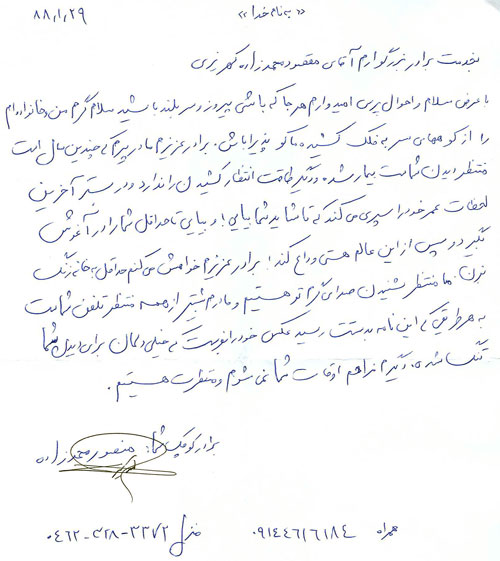
The respectful family of Mr. Moqsud Mohammad Zadeh, especially his mother has been waiting for him for more than twenty years.
But the unkind leaders of MKO still ignore maternal emotions and think of their own ambitions.
By their close communication with Nejat Society and ICRC the Mohammad Zadeh family has been always looking for a way to release Maqsud from the horrible Rajavi’s gang.
Today his awaiting mother, confined to bed, expects MKO leaders not to prevent his beloved son from returning home.
There is no doubt that the right to deciding for one’s fate is one of the basic human rights which is absolutely considered as one of the most important human rights by the Global Human Rights Statement.
The leaders of the cult of Rajavi must obey the courteous request of Maqsud’s mother and his other family members. The leaders of Rajavi’s gang should no more violate natural and basic rights of their victims.
Bellow is Mr. Mohammad Zade letter to his brother Maqsud
Open letter to Secretary General of AI
Honorable and Esteemed the Secretary General of Amnesty International
On 15th of April 2009, PMOI published a letter which was written by a person named Ali Pak. In this letter which contains lots of alleged accusations against some of the separated veteran – members of PMOI and some prominent and distinguished Iranian- personalities who are very well respected because of their opposition against Iranian government among people not only in Iran but also in Western and European Countries.
This letter, which PMOI’s operatives claimed was written by a person named Ali Pak, has accused many people of having connection with Iranian intelligence service.
I as a separated veteran member of PMOI with more than two decades suffering and torment in Rajavi’s Cult, would like to indicate the following facts:
1. As I mentioned many times in my articles, the PMOI is a terrorist organization which is taking advantage of democracy and freedom in foreign countries specially in Europe, to propagandize in favor of its cultish culture and ideology, and unfortunately they have succeeded to deceive some members of parliaments in different countries and as a result of that, they have found some lobbies among the members of some parliaments. I would like to emphasize that nothing has changed in the violent and brutal ideology, the entity and essence of this cult. The only thing which has changed in this cult is their foreign policy which is based on complete deception and hypocrisy, especially after the overthrow of Saddam Hussein.
2. PMOI is on the verge of ideological, political and organizational decomposition and annihilation especially after being disarmed by coalition forces led by USA and after its defeat in its strategy, armed struggle, and losing its military capability which was formed in its army, National Liberation Army of Iran(NLA).
3. ASHRAF garrison which was the PMOI’s most powerful military base in Iraq during Saddam Hussein’s reign is on the edge of closure forever by Iraqi government , and all 3500 residents and inhabitants of this base are notified of such a decision. They have been given two options by Iraqi government either to repatriate freely to their motherland, Iran, or to find a third country to settle.
4. Despite of all expensive efforts and endeavors which PMOI’s operatives carried out and implemented to prevent its separated members to reach to European countries, fortunately many separated members who had been kept in American camp called TIPF as detainees for almost five years, succeeded to leave the camp behind and via hiring human smugglers managed to leave Iraq and enter European countries to start a new life. Some of those separated members who had been living more than two decades in PMOI, despite dangers decided to open their mouth and began revealing the most heinous, horrendous, terrifying and scandalous facts which PMOI’s operatives have tried their best to hide them fully from the public thoughts since the fall of Saddam Hussein. The facts which ruins the moderate and democratic face of PMOI’s leaders before western and European governments.
5. I am asking the leaders of this so called organization to bring their unstable accusations to the court of law and deal with those accusations before judge and jury. I welcome to such a decision to go to the court of law, because this idea of taking our case (PMOI’s crimes) to the court of law has been our request from parliamentarians and governmental officials since our entrance to Europe. I have a lot to say before judge and jury regarding my observations and experiences about PMOI’s crimes against the people of Iraq and suppression, repression and even slaying and killing many political dissidents who were totally against PMOI’s barbaric and in-humane policy towards Iraqi people and its own members. I have mentioned many times in different occasions that I am ready to co-operate with all humanitarian organizations and governments to reveal and disclose all those crimes which PMOI has perpetrated during Saddam Hussein’s reign. We are efficient and reliable witnesses to testify about our direct observations from the crime scenes. For that reason the PMOI’s leadership is very upset and furious and they have begun to make absurd and preposterous accusations against the dissidents as well as beating up the former members who are living in Europe.
6. The PMOI which accuses us of working for Iran’s intelligence service probably has forgotten that during Saddam Hussein’s reign, they handed over many of their dissidents to Saddam Hussein’s security officials to send them back to Iran forcibly to exchange them with Iraqi P.O.W’s who were captive in Iran. They sent almost all to Iran despite of their unwillingness and fear of being persecuted and tortured in Iran. We have not forgotten that in those days there were neither a U.N office nor the Red Cross in Baghdad, but PMOI officials did not bother themselves and they chose the easiest way and the most lucrative one to get rid of all those dissidents, which was selling them to Saddam and forcing them to repatriate.
7. Despite of all the pressures and confinements which I had in U.S camp, but I did not surrender and give up, on the contrary I persevered and I did not repatriate to Iran. I persevered and resisted and I succeeded to stay in U.S camp till 26th of April, 2008 when the U.S camp was shut down. We all spent almost five years of our life and tolerated the difficult and harsh conditions in that camp, because we did not want to repatriate to Iran.
8. The only reason the PMOI’s officials labeled us as Iran’s mercenaries is our decision to separate from them for good. We were full of information which could jeopardize their organizational benefits and profits. We knew much about their illicit and illegitimate relations with Saddam Hussein and his government. The information which can ruin and destroy the PMOI’s deceitful and hypocritical face and reveal their real cultish essence.
9. Our lives are in danger. PMOI’s officials do not want us to go to a court of law and open a file against the crimes that they perpetrated. They have threatened, beaten up and labeled separated people in European countries many times. Few weeks ago the henchmen of PMOI assaulted and threatened Mr. Mohammad Hussein Sobhani (the former member of PMOI) in city of Cologne / Germany. They told him if he does not stop talking against PMOI, they will punish him so badly that the biggest piece left of him will be his ear.
10. The PMOI operatives are acting like bullies and they do not tolerate any criticism specially criticism which is made and expressed against the leaders of PMOI.
ALL THE BEST
HASSAN-PIRANSAR/FORMER MEMBER OF PMOI
TRANSCRIPT
U.N.H.C.R
ICRC
FRENCH HOME OFFICE
GERMAN HOME OFFICE
HUMAN RIGHTS WATCH
Hassan Piransar, Iran Peyvan, Paris, May 05, 2009
A delegation of ten journalists from Czech Republic visited Nejat society office in Tehran, yesterday. 
During this visit, Mr. Arash Sametipour the secretary of Nejat Society welcomed the delegation giving a detailed description of the activities of the society and its plans for future.
Mr. Khodabandeh also explained the current situation of Rajavi’s Cult, the measures of violation of human rights in the cult, manipulation practices and the efforts of the cult leaders to maintain power over the members’ lives and time.
The members of this delegation asserted the cult-like nature of MKO declaring that the European authorities are well aware of the disgusted image of the group all over the world.
Nejat Society officials then answered the questions posed by the journalists and asked the European Union to support Iraqi government’s decisions on MKO cult. Czech Republic currently holds the EU Presidency.