
Iran has filed a complaint to the UN on the recent EU decision to remove the Mujahedin Khalq Organization from its list of terror groups. 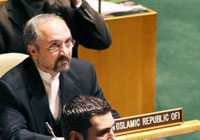
"The European Union must realize that a political approach to terrorism, which threatens the lives and security of people around the world, is totally unacceptable for the global public opinion," Iran’s permanent envoy to the United Nations, Mohammad Khazaei, wrote in a Wednesday letter to the UN Secretary General Ban Ki-moon.
"The EU’s politically motivated decision will not change the terrorist nature of the group. It will not ‘turn the page’ of history on the cult’s terrorist activities and massacre of innocent civilians, nor will it cleanse the terrorist group of its criminal past," he added.
Khazaei added that the removal of the group from the European list of terror organizations had caused great pain for over 14 thousand people who had lost their family members in MKO terror attacks.
The Iranian envoy called on the EU to revise its decision by sending a collection of evidence it has to European courts explaining the terrorist nature of the MKO, and resolving the technical objections that had led to the court ruling.
On Monday EU ministers removed the exiled anti-Iran group from their list of terror organizations, following a European court ruling in favor of the group, which has accepted responsibility for many deadly attacks against Iranian and Iraqi civilians and cooperated actively with the regime of former Iraqi dictator Saddam Hussein.
In one of their deadliest attacks, the MKO carried out a 1981 bombing that killed Iranian Judiciary chief Ayatollah Mohmmad Beheshti and 71 other senior officials.
Among their most recent terror activities is the 1999 assassination of the chief-of-staff of Iran’s Armed Forces, Ali Sayad Shirazi, just outside his house in the early hours of April 10th, as he was preparing to leave for work.
MKO is notorious for the cult like tactics it uses against its members, and the murder and torture of its defectors.
Numerous articles and letters posted on the internet by family members of MKO recruits confirm reports of the horrific abuse that the group inflicts on its own members and the luring recruitment methods it uses.
http://www.presstv.com/Detail.aspx?id=84026§ionid=351020101
The family members of victims of MKO terrorist attacks have cautioned the EU against becoming the organization’s “partner in crime”.
“As victims of MKO terrorism, we advise the European Union 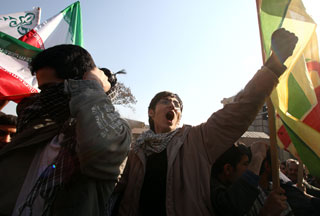 not to turn into the group’s collaborator in their atrocities against the Iranian nation,” reads a statement from the family members.
The victims had gathered in front of the British embassy in Tehran in protest at a recent decision to remove the group known as the ‘Rajavi cult’ from a list of banned terrorist groups in the EU.
“When Masoud Rajavi and his group launched their terrorist attacks in Iran in 1981, European counties not only did not condemn their atrocities but also gave them refuge in their countries,” adds the statement.
The Mujahedin Khalq Organization (MKO), which identifies itself as a Marxist-Islamist guerilla army, was founded in Iran in the 1960s but was exiled some twenty years later for carrying out numerous acts of terrorism inside the country.
The terrorist group is especially notorious for the help it extended to former dictator Saddam Hussein during the war Iraq imposed on Iran (1980-1988).
The group masterminded a slew of assassinations and bombings inside Iran, one of which was the 1981 bombing of the offices of the Islamic Republic Party, in which more than 72 Iranian officials were killed, including then Judiciary chief Ayatollah Mohammad Beheshti.
“The Rajavi cult has conducted its campaign of terror in Iran with the support of the European governments and from their safe havens inside the European capitals,” the families said.
In recent months, high-ranking MKO members have been lobbying governments around the world to acknowledge the dissidents as those of a legitimate opposition group.
During the revolution in Iran, the group criticized Ayatollah Ruhollah Khomeini for releasing the American diplomats, arguing that they should have been executed instead.
The United States and Canada have refused to drop the MKO from their lists of terrorist organizations.
The group has also been engaged in cult-like activities such as psychological coercion techniques and physical abuse.
The group has also resorted to ‘forced sterilization’ as a strategy to prevent members from leaving the group.
Talking of the mechanisms the cults exploit to force members submit to the wills of the leaders, the charisma and techniques of persuasion are of the two important factors. The priority of the one over the other has always been the subject of studies and discussions but one thing is clear for certain that the charisma and charismatic features avoid making any negative value in general. However, made judgments indicate that the mentality of charisma plays a crucial role in the structure of a group itself, its pattern of recruitment, its ideology and its contradictions, the mechanisms used to gain commitment, and the maintenance and evolution of the group within a given social context.
Charisma on its own is not evil and does not necessarily breed a cult leader. The negative image of the charismatic context and process that is characteristic of most modern social theory is derived from the history of those charismatic leaders who are most feared because of their anti-human and atrocious activities that have risked many lives and intensified social antagonisms. To define charisma first, one dictionary definition of charisma is "a personal magic of leadership arousing special popular loyalty or enthusiasm for a public figure (as a political leader or military commander); a special magnetic charm or appeal”. 1
Charisma was studied in depth by the German sociologist Max Weber, who defined it as "an exceptional quality in an individual who, through appearing to possess supernatural, providential, or extraordinary powers, succeeds in gathering disciples around him." 2
Thus, charisma is the first factor and the magnetic appeal that helps formation of a new cult by convincing recruits that the leader is giving them the ideal they had long been seeking for:
For the cult leader, having charisma is perhaps most useful during the stage of cult formation. It takes a strong-willed and persuasive leader to convince people of a new belief, then gather the newly converted around him as devoted followers. 3
It is actually true of political cults and their charismatic leader compared with other forms of cults. And again it is more typical of the leftist political cults than rightists since the formers basically claim to be relying on the support of the masses. However, the magnetism of a charismatic leader depends on a follower’s demands. Sometimes it happens that somebody’s love and devotion in a leader turns to be absolute aversion and hatred in another’s eye in the same way that the members of the Marxist camp can never live in harmony with those from the capitalist camp.
So we see that charisma is indeed a desirable trait for someone who wishes to attract a following. However, like beauty, charisma is in the eye of the beholder. Mary, for example, may be completely taken with a particular seminar leader, practically swooning at his every word, while her friend Susie doesn’t feel the slightest tingle. Certainly at the time a person is under the sway of charisma the effect is very real. Yet, in reality, charisma does nothing more than create a certain worshipful reaction to an idealized figure in the mind of the one who is smitten. 4
In fact, the magic of a cult leader is his/her ability to allure recruits and build statuses to which all devotedly bow down. But it has to be pointed out that it is not at all the product of an overnight process but skilful application of various techniques of persuasion and brainwashing. It is through these brainwashing techniques that a seemingly non-destructive cult overturns its peaceful codes of conduct and becomes a destructive and even a terrorist cult.
Once considered a charismatic political leader by the help of his organizational comrades, since he lacked the needed appealing characteristics of a charismatic leader, Massoud Rajavi took himself to the status of a deified cult leader for whom many were ready to sacrifice themselves. The process clearly depicts the effectiveness of cult techniques exploited by the falsely created magnetism of a cult leader. It was much because his close ranking cadres idolized him as a divinely inspired figure whose orders for operations, being them terrorist operations that shed many innocents’ blood or suicide and self-immolation operations, had to be blindly submitted to. Although one may wonder to learn about the horrible potentialities of Mojahedin Khalq with Rajavi at the lead, but it is a true example of an existing terrorist cult in the modern world:
Political cults include terrorist groups that resort to the killing of innocent citizens to promote their cause. Suicide bombers are often members of these extremist political groups. When you hear about a suicide bombing in the Middle East, for instance, you may wonder how someone could give his life in order to kill others. 5
It is hard to develop a deep understanding of Rajavi’s personality especially for the Western people and his advocates there. They will come to know his real nature only when it is too late and they have to pay a great deal for their false calculations. In a discourse on the unnoticed, terrible potentialities of Mojahedin Khalq we read:
As I know Mojahedin, they are too hard a wall to climb. I take the opportunity to inform the US and European states; as a theoretician to whom neither MKO nor NCRI have the least responsibility and to whom neither of them establishes any organizational link, I believe Mojahedin are benefitting a remarkably terrible potentiality which break the control, … . 6
It has to be pointed out that emergence of Rajavi as a propagated charismatic leader depended much on the circumstances that well approve the idea that a “charismatic leadership depends not only on personality but on circumstance: the leader must ride the zeitgeist. Chance and timing playa large part in determining whether a would-be cult leader, for example, ends up as Manson or Moses”.7
It was in the midst of a great revolution that Rajavi was released from the prison and found the opportunity of playing a militia leader especially for the zealous revolutionary Iranian youths who could easily follow a Che Guevara-like model. Hardly believing in what people willed, he would express a new mixture of radicalism and idealism and cleverly played the role of a revolutionary who pretended to respect demands of the rising people based on novel political, social and religious claims. In fact, Rajavi bore no charismatic appeal but it was his adventurous charm that allured inexperienced people to join him in his claimed combat against imperialism. But it did not take long to shock Iranian people and the world in general that the anti-imperialists turned to conduct many assassination and terror operations inside Iran and Iraq, claiming thousands of innocent lives.
Who knows, maybe it was the charismatic charm of the Rajavis that fascinated the Europeans to rub off the terrorist label long attached to their cult!
References:
1. Tobias, Madeleine and Janja Lalich; Captive Hearts, Captive Minds, Alameda, CA: Hunter House 1994.
2. Ibid.
3. Ibid.
4. Ibid.
5. Steven Hassan; Releasing the Bonds; Empowering People to Think for Themselves, Freedom of Mind Press Somerville, 2000, p. 8.
6. On Mojahedin’s future in Iraq, www.goftogoo.net.
7. Tobias, Madeleine and Janja Lalich; Captive Hearts, Captive Minds, Alameda, CA: Hunter House 1994.
An Iranian lawmaker today urged France to relinquish any political pressure to remove name of the Iraq based – Mujahideen Khalq Organization (MKO) out of the terrorist groups’ list and keep up its independent position. Iran considers the group to be terrorist.
Head of Majlis National Security and Foreign Policy Commission Ala’eddin Boroujerdi said in a meeting with French parliamentary delegation that the decision to bring MKO out of the terrorist groups’ list runs counter to anti-terrorist claims of European states and will have negative impact on Iranian nation’s public opinion.
Boroujerdi briefed the delegation on chronology of terrorist activities of the MKO as its leaders have confessed to that and also assassination of hundreds of innocent women, children and people in Iran.
He said, “French government is expected to maintain its independent position in that connection.”
Head of MKO Maryam Rajavi is expected to remain excluded from the UK despite the EU dropping the previously outlawed group from its proscribed list.
British Foreign Office said that although it does not discuss individual cases of exclusion, the government continues to believe that the MKO or MeK, as it prefers to call it, was “responsible for vile acts of terrorism over a long period.”
“If an individual has made public statements in the past supporting or condoning terrorism, and has not publicly and unambiguously apologized and refuted such statements, then this would constitute grounds for not admitting an individual into the UK,” Foreign Office spokesman Barry Marston said.
“We are not satisfied that the MeK has done enough to distance itself from its past. There is no dispute about its previous terrorist activity: it claimed responsibility for a large number of violent attacks inside Iran for a number of years,” Marston told IRNA.
Rajavi was subject to an exclusion order back in October 1997, which banned her entry to the UK on the grounds that the organization contained a large faction of terrorists. The Foreign Office at the time said her presence was ‘not conducive to the public good’.
The British government insists that the deproscription of the MKO was ‘a judicial and not a political decision’ both in the EU as it was earlier in the UK and that it opposed its removal.
“We have made it clear that we were disappointed by the verdict of the Proscribed Organizations Appeal Commission and of the Court of Appeal, but we had to comply with their decisions,” Marston said about the British decision last July.
“Equally, given the clear judgment of the Court of First Instance on December 4, 2008, annulling the MeK’s listing in the EU, the EU had no choice but to observe and respect the court’s judgment,” he added.
Asked whether the UK government still considered the MKO as a terrorist organization, he said that there were still ‘serious reservations about the MeK’s assertion that it represents a democratic opposition in exile’.
“We see no evidence of popular support for the MeK in Iran, because of its responsibility for terrorist attacks which resulted in the deaths of many Iranian citizens, and because it fought alongside Iraqi forces against Iran during the Iran-Iraq war,” Marston said.
Regarding the potential that the controversial decision could have an adverse effect on Iran’s relations with the UK and the EU as a whole, he stressed that it should ‘not be seen as a political decision’.
“We would not hesitate to re-proscribe the MeK if circumstances changed and evidence emerged that it was concerned in terrorism,” the spokesman said.
He also quoted Home Office Minister Tony McNulty insisting last June during the debate on the MKO that the UK government have “no plans to meet its representatives.”
An Iraqi politician said the recent decision of the European Union to remove the terrorist Mojahedeen Khalq Organization from the list of terrorist groups benefits only European countries and as such did not concern Iraq.
In an exclusive interview with the Iranian news agency IRNA, Spokesman for Iraqi National Congress Mohammad Hassan al-Mousawi said both the Iraqi nation and government strictly considered the group as terrorists and were opposed their presence on their soil.
He pointed out that the Iraqi Constitution has banned engagement of any group in terrorist activities against one of nation’s neighbors.
He stressed that Iraq was strongly in favor of expelling the group from its soil.
Pointing out that his party, led by Ahmad Chalabi, was working on a plan to set up a strong regional union to include Iran, Iraq, Turkey and Syria, he said the presence of such terrorist groups as the MKO and the PKK in Iraq prevented materialization of the plan.
arabicnews.com
The MKO, which seeks to destabilize the government in Tehran, is currently headed by Maryam Rajavi — who considers herself the president-elect of a supposed Iranian government-in-exile.
France has offered to take in members of the Mujahedin Khalq Organization (MKO) who are being forced to leave Iraq, sources claim.
The French government has volunteered to transport MKO members onboard its passenger aircraft to France as soon as possible, Iraqi sources told Tabnak on condition of anonymity.
The Iraqi officials also told the news agency that Israel has offered to recruit MKO members for its military.
The revelation comes after the European Union removed the exiled anti-Iran group from its list of terror organizations on Monday.
The MKO is notorious for having staged many attacks against Iranian and Iraqi civilians.
The 1981 murder of Judiciary chief Ayatollah Mohammad Beheshti along with 71 other senior Iranian officials is also attributed to the group.
Under the leadership of Massoud Rajavi, the MKO helped the Baath regime of Saddam Hussain in the suppression of the Iraqi Kurds in ‘Operation Morvarid’. Thousands of Iraqi civilians were brutally massacred in the operation.
After the 2003 regime change in Iraq and the 2009 interim security agreement between Baghdad and Washington, the responsibility for the security of Camp Ashraf — an MKO military training ground –, was transferred to Iraqi forces.
The Iraqi government has recently given MKO members a tight deadline to leave the camp, situated in Diyala province, and the country altogether.
Western countries claim that the lives of MKO members will be threatened if they return to Iran. Tehran, however, has promised to welcome the return of any member who has not taken part in any serious anti-Iran activity and is ready to leave the group.
"During the past few years, various MKO members have requested permission to return. Of course, if serious cases have not been filed against them, they can return to the country by handing themselves over," Iranian security official Alaeddin Boroujerdi said on Thursday.
The French proposal to take in the MKO members comes as a surprise, because Paris consistently opposed the motion to remove the group from the European list of terror organizations. France is, already, home to a large number of MKO activities.
MKO is known for the cult-like tactics it uses within the group and for the torture and murder of its defectors.
"There are many [MKO members] who have tried to flee the camp. They have contacted Iran and introduced themselves. But in the end the complicated system has entrapped them," said Boroujerdi.
Numerous articles and letters posted on the Internet by family members of MKO recruits confirm reports of the horrific abuse that the group inflicts on its own members and the alluring recruitment methods it uses.
The most shocking of such stories include accounts given by former British MKO member Ann Singleton and Mustafa Mohammadi — the father of an Iranian-Canadian girl who was drawn into the group during an MKO recruitment campaign in Canada.
Mohammadi gives an account of his desperate efforts to contact his daughter, who disappeared several years ago — a result of what the MKO called a ‘two-month tour’ of Camp Ashraf as a teenager.
He also explains how the group forces the families of its recruits to take part in MKO demonstrations in Western countries by threatening to kill their relatives.
Reports indicate that the banned terrorist group, which lacks a foothold in Iran, recruits ill-informed teens from the immigrant population of Western states, not allowing them to leave afterwards.
Unlike Europe, the US has not removed the group from its terror list.
Head of MKO terrorist group Maryam Rajavi is expected to remain excluded from the UK despite the EU dropping the previously outlawed group from its proscribed list.
British Foreign Office said that although it does not discuss individual cases of exclusion, the government continues to believe that the MKO or MeK, as it prefers to call it, was ‘responsible for vile acts of terrorism over a long period’.
"If an individual has made public statements in the past supporting or condoning terrorism, and has not publicly and unambiguously apologized and refuted such statements, then this would constitute grounds for not admitting an individual into the UK," Foreign Office spokesman Barry Marston said.
"We are not satisfied that the MeK has done enough to distance itself from its past. There is no dispute about its previous terrorist activity: it claimed responsibility for a large number of violent attacks inside Iran for a number of years," Marston told IRNA.
Rajavi was subject to an exclusion order back in October 1997, which banned her entry to the UK on the grounds that the organization contained a large faction of terrorists. The Foreign Office at the time said her presence was ‘not conducive to the public good’.
The British government insists that the deproscription of the MKO was ‘a judicial and not a political decision’ both in the EU as it was earlier in the UK and that it opposed its removal.
"We have made it clear that we were disappointed by the verdict of the Proscribed Organizations Appeal Commission and of the Court of Appeal, but we had to comply with their decisions," Marston said about the British decision last July.
"Equally, given the clear judgement of the Court of First Instance on December 4, 2008, annulling the MeK’s listing in the EU, the EU had no choice but to observe and respect the court’s judgement," he added.
Asked whether the UK government still considered the MKO as a terrorist organization, he said that there were still ‘serious reservations about the MeK’s assertion that it represents a democratic opposition in exile’.
"We see no evidence of popular support for the MeK in Iran, because of its responsibility for terrorist attacks which resulted in the deaths of many Iranian citizens, and because it fought alongside Iraqi forces against Iran during the Iran-Iraq war," Marston said.
Regarding the potential that the controversial decision could have an adverse effect on Iran’s relations with the UK and the EU as a whole, he stressed that it should ‘not be seen as a political decision’.
"We would not hesitate to re-proscribe the MeK if circumstances changed and evidence emerged that it was concerned in terrorism," the spokesman said.
He also quoted Home Office Minister Tony McNulty insisting last June during the debate on the deproscription of the MKO that the UK government have ‘no plans to meet its representatives’.
Iraqi government has asserted any decision against its policy to expel the terrorist Mojahedin Khalq Organization (MKO) has no impact on Baghdad decision, Iran’s ambassador to Baghdad told ISNA.
The moves and activates in Iraq show the government is serious about its decision for expulsion of the MKO, Hassan Kazemi Qomi said on Tuesday.
Since the Iraqi government believes the nature and activities of MKO are based on terrorism, it has informed the members that they must leave the country and it pursues the case, he added.
Iraq’s National Security Adviser Mowaffaq al-Rubaie on Tuesday held a meeting with ambassadors of 9 European countries, the US, Canada, Australia and Iran to ask them to accept the MKO members in their countries.
"We want to close all the files with our neighbors, and our eastern neighbor Iran sees this as a threat to their national security," Reuters cited al-Rubaie.
Qomi said in this regard that in the meeting with presence of Iraqi Human Rights Minister, Wijdan Michael, Baghdad officials insisted on their policy towards the MKO and called for other countries to aid Iraq implement this policy.
Iraq’s government asserted not only the MKO but also all terrorists must leave Iraq’s territory and Tehran is primed to aid Baghdad fulfill the task, he added.
European foreign ministers on Monday dropped the MKO from the EU terrorist blacklist but said the group may be put in the list in the future.
BERLIN – The notorious MKO terror group will continue to be monitored by Germany’s domestic Verfassungsschutz intelligence agency despite the decision by the European Union to delist the MKO , a German government source told IRNA in Berlin Tuesday. 
Just because the EU has lifted the ban, it does not mean that we don’t have our own national security considerations, the official said, speaking on condition of anonymity.
For instance, parts of the German Left party are being subjected to surveillance by the Verfassungsschutz although they are not blacklisted by the EU, he added.
The official made clear that Germany’s federal secret service and its state branches will continue their observation of the MKO.
Each German state has also its own separate Verfassungsschutz intelligence apparatus.
The MKO has been involved in the mass killings of thousands of innocent Iranians over the past 30 years.
Furthermore, the Israeli-backed MKO terror grouplet has also collaborated with the former Saddam regime, in brutally massacring tens of thousands of Iraq Kurds and Shiites.
A former member of the Islamic Mujahedin-e Khalq Organization (MKO) has welcomed the European Union’s decision to take the MKO off the EU’s list of terrorist organizations.
Massud Khodabandeh said the ruling will give thousands of MKO members "the right to return to their families," RFE/RL’s Radio Farda reports.
Khodabandeh said the ruling will "save some of those individuals from the situation they’re facing in Iraq," where they number some 3,000.
The MKO seeks the overthrow of the Iranian government, and the EU decision has prompted sharp words from Tehran.
Organizations such as Human Rights Watch have accused the MKO of subjecting dissident members to torture.
It is still considered a terrorist group by the United States.
TEHRAN – Germany’s Federal Intelligence Agency (BND) has released a report on the National Council of Resistance of Iran (NCRI), calling it a “fake parliament”. 
The NCRI is a part of the terrorist Mojehedin Khalq Organization (MKO) and is headed by Maryam Rajavi.
The BND also stated that the military wing of the MKO is “an army of insurgents”.
Not only are the MKO leadership’s claims to adherence to democratic values disingenuous, but they also follow the tenets of Stalinism and use brainwashing techniques, the report noted.
The report also stated that the MKO finances itself through activities such as economic fraud, the production of false documents, and using children to get donations from charity organizations.
The European Union removed the MKO from its blacklist of terrorist groups on Monday
http://www.tehrantimes.com/index_View.asp?code=188028