Nejat Society
  • Home
  • Articles
  • Media
    • Cartoons
    • NewsPics
    • Photo Gallery
    • Videos
  • Publications
    • Books
    • Nejat NewsLetter
    • Pars Brief
  • About Us
  • Contact us
  • Editions
    • عربي
    • فارسی
    • Shqip
Nejat Society
Nejat Society
  • Home
  • Articles
  • Media
    • Cartoons
    • NewsPics
    • Photo Gallery
    • Videos
  • Publications
    • Books
    • Nejat NewsLetter
    • Pars Brief
  • About Us
  • Contact us
  • Editions
    • عربي
    • فارسی
    • Shqip
© 2003 - 2024 NEJAT Society. nejatngo.org
Mujahedin Khalq 's Function

Abedin’s interview with Banisadr & reaction of the terrorist MEK

As expected the terrorist Mojahedin-e-Khalq showed a knee-jerk reaction to Mahan Abedin’s interview with Masoud Banisadr at iranefshagar website.

Here is Mr. Abedin’s comment on  the  MEK reaction:

There can be no dialogue with people who reduce everything to such slanderous and  libellous gesture politics! FYI Masoud Banisadr translated the unedited version of the interview into Persian and displayed it on his website:

http://banisadr.info/

But in regards to the MEK’s Iran-efshagar website , it may interest you to know that this forum is controlled from Germany by the organisation’s intelligence section. The core mission of this website is to use existing members to attack former members.

The ultimate objective is to make it difficult for existing dissident members to defect. Therefore every character that appears on that website is considered to be "dissident" or "potentially dissident" by the organisation. By forcing them to attack their former comrades the organisation hopes to maintain a degree of ideological and organisational cohesion. Yet another Stalinist policy by an organisation that was branded a serious abuser of human rights by the New York based Human Rights watch in May 2005. You can access my article on that designation:  A recent report by the New York-based Human Rights Watch (HRW) that documents and condemns serious human-rights abuses by the Iraqi-based and formerly armed Iranian opposition group Mujahideen-e-Khalq (MEK) came as welcome relief to dozens of former members of this controversial organization who have consistently complained of gross human-rights abuses in MEK camps in Iraq since 1991.

The MEK insists that it should lead a US-backed effort to bring what it has termed democratic rule to Iran. Last month it organized a rally, attended by several powerful Republican lawmakers and billed as the "2005 National Convention for a Democratic, Secular Republic in Iran", at Washington’s historic Constitution Hall.

Since the March 2003 US-led invasion of Iraq, where the MEK had been based since 1986, the group has tried to persuade Washington that it holds the key to overthrowing the Islamic republic next door. It has been backed in this quest by right-wing lawmakers, a group of hardline neo-conservatives and retired military officers called the Iran Policy Committee, and some US officials – particularly in the Pentagon – who believe the MEK could be used to help destabilize the Iranian regime, if not eventually overthrow it in conjunction with US military strikes against selected targets.

While the group’s supporters in the Pentagon so far have succeeded in protecting the several thousand MEK militants based at Camp Ashraf near the Iranian border from being dispersed or deported, they have failed to persuade the US State Department to take the group off its terrorist list, to which it was added in 1997 based on its attacks during the 1970s against US military contractors and its participation in the 1979 seizure of the US Embassy in Teheran. The European Union also cites the MEK as a terrorist organization.

After a year-long tug-of-war between the two US agencies, a truce between the State Department and the Pentagon was apparently worked out. MEK members at Camp Ashraf were designated "protected persons" under the Geneva Conventions. Since then, the Pentagon has recruited individual members of the MEK to infiltrate Iran as part of an effort to locate secret nuclear installations, according to recent articles published in The New Yorker and Newsweek magazines. At the same time, nearly 300 members have taken advantage of an amnesty in Iran to return home, leaving a total of 3,534 MEK members inside Camp Ashraf as of mid-March, according to the HRW report.

Given that the HRW report is a major strategic setback for the MEK, it is not altogether surprising that this controversial organization and its Western backers have started a major propaganda campaign, accusing former members of maintaining ties with Iranian intelligence services. It is important to review both sides of the argument to understand the full significance and the implications of the HRW report.


A controversial organization

By all accounts, the MEK is a controversial organization. The group emerged in the mid 1960s as a splinter faction from the Freedom Movement of Iran (itself a splinter group from the National Front). In the 1970s, the MEK gained notoriety by assassinating five US military technicians in Iran. The organization enthusiastically welcomed the Islamic revolution of 1979 and was even more enthusiastic about the seizure of the US Embassy later that year. However, the organization’s inability to penetrate the inner sanctums of power, coupled with the misgivings of the revolutionary regime toward this quixotic group, eventually propelled them into conflict with Ayatollah Ruhollah Khomeini.

From 1981-83, the MEK prosecuted a serious campaign of violence against the Islamic republic; in the process, eliminating many of its top officials and ideologues. But this came at a terrible cost to the organization, which lost more than 8,000 of its members in executions and street battles with revolutionary guards. Indeed, by late 1983 the MEK network had been completely eliminated inside Iran. The group’s entire leadership and more than 90% of the remaining members took refuge in Paris, where the group underwent a series of bizarre transformations in the mid-1980s.

Always a quixotic and perplexing organization, the MEK promoted an ideology based on Marxism-Leninism and Shi’ite theology. However, in January 1985 Massoud Rajavi – keen to consolidate his dominance over the organization – married the wife of his right-hand man and set in motion an "ideological revolution" that was theoretically designed to turn the MEK into the antithesis of the Islamic regime. The result was the wholesale "feminization" of the organization and the placing of females – irrespective of competence – in all top positions.

Consequently, the MEK banned all relationships within the group and commanded their members to fully eschew their individualism and devote all their energies to the cause. Given the extremity of these transformations, even sympathetic observers could not dismiss the notion that the MEK had become an isolated cult. But to the MEK, these changes were necessary to maintain the unity of the organization in the face of the Islamic republic’s relentless security and propaganda onslaughts.

Another hugely controversial feature of the MEK was its decision in 1983 to ally itself with the former Iraqi regime of Saddam Hussein. Massoud Rajavi moved to Baghdad in 1986, and the following year announced the formation of the National Liberation Army. The NLA fought alongside Iraqi forces against Iranian troops, thus completely destroying the organization’s rapidly diminishing credibility inside Iran. Moreover, a number of Iraqi Shi’ites and Kurdish organizations have alleged that MEK forces played a role in the suppression of the so-called Safar Intifada of March 1991 against the former Iraqi regime. In a remarkable reversal of fortunes, the same forces that the MEK allegedly helped suppress in 1991 are today in power in Baghdad and thus – at the very least – anxious to expel them from Iraqi territory.


MEK and its dissidents

Historically, the MEK has had major problems with internal dissidence. In the mid-1970s, the organization was almost destroyed as a result of an internal "Marxist" coup. The root cause of the problem was the organization’s awkward mixture of Marxism-Leninism with Islam. In the mid-1980s, another wave of dissenters caused a major crisis inside the organization. This time the dissenters, led by Parviz Yaaghoubi, were objecting to Rajavi’s "ideological revolution" and his increasingly bizarre personality cult.

Anxious to suppress any signs of internal dissidence, the MEK labeled all dissenters as either "quitters" or "agents". The former category applied to those former members who left the MEK quietly and did not raise their objections publicly, thus saving the organization from embarrassment. The latter – and far more sinister – category was applied to those former members who chose to publicize their differences with the organization. As a highly centralized, disciplined and overly pretentious organization with impeccable authoritarian instincts, the MEK is unable to accept criticism from any quarter, let alone criticism from those formerly in its ranks, whom it sees as lacking the quality and stamina to continue the fight against what it anachronistically calls the "Khomeini regime".

The MEK’s problems with its dissidents became much more serious following the ending of the Persian Gulf War of 1991, which saw its Ba’athist hosts being decisively defeated and driven out of Kuwait by an international coalition led by the United States. Several dozen members and active sympathizers deserted its Ashraf base, northeast of Baghdad, protesting, among other things, the MEK’s complicity in the suppression of Kurdish and Shi’ite rebels in the aftermath of the Kuwait war. The arrival of these former members in Europe and their organized attempts at spotlighting the alleged abuses and deviations of the organization, led the MEK to intensify its character assassination campaigns against its former members. The organization even coined a new term, borideh-mozdoor (quitter-mercenary) to denounce its former members. This term had a simple logic; the former members were quitters simply for leaving the organization and they were mercenaries because their disclosures – irrespective of accuracy – coincided with the propaganda of the Iranian government.

The MEK went even further and accused the active former members of having been "bribed" and effectively recruited by the Iranian intelligence services. These accusations had worked well against one former senior member, Saeed Shahsavandi, who had been captured by Iranian forces during the MEK’s ill-fated "Eternal Light" operation at the end of the Iran-Iraq war. Shahsavandi spent nearly two years in Iranian prisons before he was released and allowed to leave for Europe. Having settled in Germany, Shahsavandi began to outline his perspective on why things had gone so badly wrong with the MEK. Not surprisingly, the MEK started a merciless character assassination campaign against Shahsavandi, not only accusing him of having been sent to Europe at the behest of the Iranian intelligence services, but also of having taken part in executions of imprisoned MEK members. The accusation of complicity in executions was particularly outrageous, but it had the desired effect; Shahsavandi was forced into silence. Nearly 15 years after the events, it has turned out that accusations that Shahsavandi had Iranian intelligence links were completely unfounded. Indeed, it was revealed earlier this year that certain personalities inside the MEK, including veteran member Mohsen Rezai (better known as "Habib") had maintained a relationship with Shahsavandi throughout these years.


HRW report and MEK dissidents

The 28-page HRW report, "No Exit: Human Rights Abuses Inside the MKO Camps", details how dissident members of the MEK were tortured, beaten and held in solitary confinement for years at military camps in Iraq after they criticized the group’s policies or indicated that they planned to leave the organization. The report is based on the direct testimonies of a dozen former MEK members, including five who were turned over to Iraqi security forces and held in Abu Ghraib prison under Saddam’s government. The witnesses also reported two cases of deaths under interrogation by MEK operatives.

Disclosures on detentions inside MEK camps and torture at the hands of senior members are nothing new and date back from as early as April 1991. However, this is the first time that a credible and high-profile human-rights organization has verified the testimony of former members and thus given a major boost to a wide spectrum of people who want the MEK to admit to their abuses and correct their behavior accordingly.

It is not only former members who have been putting pressure on the organization in the past several years, but a wide array of Iranian organizations and personalities, including the hugely respected Iranian human-rights lawyer and activist Karim Lahiji and Farah Karimi, a Dutch member of parliament of Iranian origin. But true to form, the MEK prefers to label its critics as "agents" and "apologists" of the Islamic republic rather than address the very serious and altogether credible allegations that have been made against it in the past 15 years.

In the bizarre ideological cosmos of the MEK, Human Rights Watch, by lending credence to the disclosures of MEK dissenters, has become an agent of the "Khomeini regime". Historically, the MEK has never seen the virtue of being open with the public that it is trying to address. The fate of the MEK’s "ideological leader", Massoud Rajavi, is a case in point. More than two years after the downfall of Saddam, not a word has been heard from Rajavi, who is believed to be hiding in the Ashraf camp, in Iraq’s eastern Diyala province.

But what of the MEK allegations that the most active and vocal former members are disinformation agents at the behest of the Iranian intelligence services? First and foremost it is important to note that not a single shred of credible evidence has ever been presented to establish a relationship between any former member and Iranian intelligence. Instead, the MEK has relied on "confessions" from former members before they are "expelled" from the organization. But more than anything else, these signed confessions point toward the existence of torture and aggressive interrogations at MEK camps. The MEK also issue reports from their "sources" inside the Iranian government, which strangely coincide with their own propaganda. Not surprisingly, these "confidential" reports have all the trappings of disinformation and propaganda in its most amateurish forms.

Consider, for instance, how the MEK has tried to tarnish the reputation of one former member, Mohammad Hossein Sobhnai, who spent eight years in solitary confinement in a MEK prison and whose testimony to HRW was particularly damning. The MEK claimed that its sources in Iran had secured an internal memorandum of the Iranian Ministry of Intelligence (VEVAK) containing the following information:

In an internal VEVAK report dated February 20, 2002, Ramin Darami, a member of the Sobhani ring, wrote to Haj Saeed, his new handler, "After we entered Iran through legal channels [from Iraq], we were sent to Marmar Hotel in Teheran and were given a high-level reception. While we were in Marmar Hotel, the head of our team was brother Mohammad Hossein Sobhani and others in our group were Ali Qashqavi and Taleb Jalilian. Our brothers from the Ministry of Intelligence paid us daily visits and resolved all our problems, and during this period I spoke to Haj Mahmoud … My stay in the hotel lasted 10 days … During the period we stayed in Marmar Hotel, your proposed plans were reviewed several times by brother Mohammad Hossein Sobhani within our team and we were briefed on it."

While these so-called "disclosures" are only intended for a select audience (namely the MEK’s sympathizers), it is unlikely that even the most hardcore of MEK supporters could really believe such puerile concoctions.

In fact, it has been claimed that the MEK’s relentless efforts at branding active former members as Iranian intelligence agents has made it easier for the "real" agents to operate covertly inside the organization. Indeed, by all accounts the MEK has been heavily penetrated by Iranian intelligence. The organization has on occasion accepted this and published lists of alleged infiltrators. One of the most successful infiltrators was Mohammad Edalatian, whose entire family was connected to the MEK (and whose brothers were executed in Iranian prisons). While in Iranian detention (on charges of MEK activity), Edalatian was recruited by Iranian intelligence and on his release from prison was tasked with penetrating the MEK organization in Iraq. On completing his mission, Edalatian killed three MEK operatives on the Iran-Iraq border and subsequently returned to his handlers. At first the MEK reported that Edalatian had been "martyred" alongside his other three comrades, but several months later Edalatian turned up on Iranian TV and disclosed his mission.

Broadly speaking, the pattern of Iranian intelligence activity against the MEK over the past 24 years has been more geared toward penetration and subversion, rather than elaborate disinformation campaigns. There is a good reason for this: the MEK suffers from a severe credibility problem inside Iran and among Western political and media elites. In other words, there is no real need to tarnish the image of an organization that has no presence inside Iran and which has no serious widespread Western audience.


Conclusion

Even if we accept at face value the MEK accusation that its former members are working at the behest of Iranian intelligence, this still does not absolve them of their human-rights abuses, for surely even agents have human rights too. The signs of torture and mistreatment are all over the bodies of the former members who have consistently lobbied human-rights organizations for the past 15 years to get the MEK officially listed as a serious abuser of the human rights of those closest to it.

The HRW report has tremendous long-term consequences for the MEK, and at the very least deprives it of yet another propaganda plank. For as critics of the organization have pointed out, a group that is a serious human-rights abuser cannot effectively protest at the human-rights abuses of the Iranian government. More broadly, the HRW report complements US government reports of 1994 and 1997 that branded the MEK as undemocratic and terrorist, respectively. The combination of these official listings means that no matter how hard the MEK and its handful of Western supporters try to win the group a measure of respectability, they are likely to be thwarted time and time again.


Mahan Abedin is the editor of Terrorism Monitor, which is published by the Jamestown Foundation, a non-profit organization specializing in research and analysis on conflict and instability in Eurasia. The views expressed here are his own.


http://www.atimes.com/atimes/Middle_East/GF08Ak02.html

Iranian exile group strikes back

By Mahan Abedin  
May 25, 2006 0 comments
FacebookTwitterPinterestWhatsappTelegramSkypeEmail
Former members of the MEK

Nejat Meeting in Isfahan – return of MR. Hatami

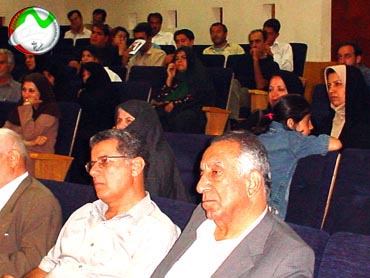
On Tuesday, May 16th the tenth meeting of Nejat Society Isfahan Branch was held on the occasion of the return of Siamak Hatami, a defector of MeK, to Siamak Hatami dispatched of the MKO CultIran.

During the meeting, Mrs Yazdan Parast a member of the Society presented the schedule of the meeting and invited the audience to watch the film of Mrs. Marzie Qorsi’s Return.

The film imprisoned the audience a lot since she hadn’t seen his son for ten years.

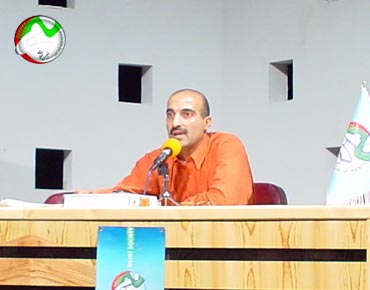
During the other stage of the meeting Mr. Hashemi the President of Isfahan Nejat Society, presented a report of the Society ‘s activities in recent months including a meeting in Kashan on the occasion of the return of Mr. Najafizadeh, a meeting with several German lawyers, foundation of Nejat Society office in Kerman and also visits with some European researchers…

Then Mrs. Baba Safari the sister of one of defectors who had returned to Iran previously, explained her efforts to meet his brother and convince him to return home. She noted the correspondence of families with international organizations. Mrs,Yazdan Parast also declared why the process of separation has become slower recently. She noted that”… MEK has distributed some forms among the members and asked them to fill them out in order to get refugee status.

However we welcome any factor that causes the members leave the Camp Ashraf…

She also read an appeal letter to Iraqi and British embassies. US interests office in Swiss Embassy and UN office and IRC office in which a member of families asked to have the permission to visit their children, contact them by telephone. The families signed this letter.

Behrouz Nazarian, another former member who had been a member of MEK for 17 years explained how he joined the MeK and separated from them.

Siamak Hatami was another person who addressed the audiences during this meeting, he described the 14 years he passed in Ashraf and appreciated Islamic Republic’s efforts to liberate the members.

At the end the families talked to defectors showing the pictures of their children in order to get information of their beloved ones.

on the occasion of return of Hatami

May 25, 2006 0 comments
FacebookTwitterPinterestWhatsappTelegramSkypeEmail
Mujahedin Khalq 's Function

MKO a False Pro-Democratic Movement

[Mojahedin.ws comments: In spite of its extensive propaganda activities to epitomize itself as a pro-democratic group to fulfill the Western incited regime change in Iran, the MKO fails to convince many advocates of regime change to regard it as representing the Iranian people. Kenneth R. Timmerman, Executive Director of the Foundation for Democracy in Iran, warns against the allure of false democratic movements like the Mojahedin. In a discussion symposium directed by Front Page Magazine, he tipped off people to the traps laid before the democratic aspirations of bringing freedom to Iran.]

Trap number one: we must not fall for the allure of false democratic movements, such as the Mujehedin-e Khalq. This Islamist-Marxist cult hides behind a number of fronts, including the National Council of Resistance and a host of U.S.-based “Iranian-American community” groups, and pretends to support democratic ideals. But make no mistake. The Mujahedin murdered Americans in the 1970s, took part in the Khomeinist revolution, helped the regime seize the U.S. embassy and take U.S. diplomats hostage in 1979, and remains committed to an Islamist state in Iran. Additionally, the MEK has aroused widespread hatred in Iran because it sided with Saddam Hussein during the 1980-1988 Iran-Iraq war.

This is a group that attempted to invade Iran militarily in April 1988 with the help of Saddam Hussein’s army, and was repulsed by 16-year old kids and grandfathers armed, literally, with pitchforks. The overwhelming majority of Iranians consider them as traitors.

The MEK has for years claimed to head a “coalition” that formed a “parliament-in-exile.” In fact, the 500-or so front groups that belong to this “coalition” are just MEK fronts –and some of them just individuals – not independent groups. Ultimately, they elevated the leader’s wife to become “president-elect.”

Kenneth Timmerman, Front Page Magazine –  May 19, 2006

May 24, 2006 0 comments
FacebookTwitterPinterestWhatsappTelegramSkypeEmail
Duplicity of the MEK nature

The most hated Iranian group;MEK terrorists

Here comes the most hated Iranian group again,"MEK terrorists" The MEK (Mujahedin-e Khalq) is organizing major conferences in Paris and in Washington, DC in the coming week, in an effort to shore up support for the group among European and American law-makers. In recent years, the MEK has shifted its rhetoric, abandoning earlier statements, contained in Maryam Rajavi’s "16 Points" that it planned to ban all opposition once it seized power through a violent uprising.

Now the MEK claims to be a non-violent, pro-democracy group.

The Paris meeting will take place on Monday, May 22, from 5-8 PM, at the Salons Hoche, 9 avenue Hoche, 75008 (near l’Etoile). No prior reservations are necessary. An announcement from the group says it is being organized by the London-based "Gulf Intelligence Monitor," a subscription-based website. Several of the U.S. participants told FDI they were going to Paris to "attend a conference with the leaders of the National Council of Resistance of Iran," the main MEK front organization.

The five American participants – Ray Tanter, Maj. Gen (ret.) Paul Vallely, Lt. Gen (ret.) Thomas McInerney, Navy Capt. (ret) Chuck Nash, and LtCol.(ret). Bill Cowen – are all members of the Iran Policy committee, an organization set up by Tanter and by former CIA officer Clare Lopez in early 2005. The group has published a number of "white papers" — all of which have one thing in common: they urge the Bush administration to take the MEK and its various front organizations off the State Department list of international terrorist organizations. The group regularly has hired rooms at the National Press Club to hold press conferences. While it lists "members" on its website, it provides no information on a board of directors, and is not registered in the corporations data bases of Washington, DC, Maryland, or Virginia. The NCRI website links to the latest IPC White paper, calling IPC "an independent U.S. policy group."

No sponsor is listed for the May 25, 2006 Washington, DC conference, but the logo accompanying the on-line registration form is identical to the "lion and the sun" logo the MEK adopted from the Iranian flag of the shah’s period.

So where is the MEK getting the money to finance these elaborate public relations activities? And why is the FBI allowing a group that is on the State Department’s list of international terrorist organizations to operate openly in the United States?

iranian.ws  –   19/05/2006

May 24, 2006 0 comments
FacebookTwitterPinterestWhatsappTelegramSkypeEmail
Germany

Germany reaffirms MKO terrorist status

Germany has reaffirmed the terrorist status of the MKO grouplet in its 2005 terror report released by the German domestic intelligence service Verfassungsschutz on Monday.

The report pointed to the fact the MKO was "responsible for numerous (terrorist) attacks in Iran."

Berlin has so far resisted intense MKO pressure tactics to have the terror grouplet removed from its official terror blacklist.

IRNA, Berlin, May 22

May 24, 2006 0 comments
FacebookTwitterPinterestWhatsappTelegramSkypeEmail
MEK Camp Ashraf

Defectors of MEK were granted refugee status

UNHCR in its annual report published in April, 2006, reported that:

IRAQ OPERATION, 2006

SUPPLEMENTARY APPEAL

Ashraf Facility: Some Iranian detainees at this facility near Baghdad have applied for asylum. UNHCR has been requested to verify their status and pursue solutions for those who qualify as refugees. Due to lack of access to Ashraf by humanitarian agencies, UNHCR has piloted the first Refugee Status Determination interviews using video tele-conferencing facilities.

Targets: Some 180 asylum-seekers from Ashraf are interviewed in the first half of 2006, their status is determined and solutions are identified for those who are recognised as refugees.

http://www.unhcr.org/cgi-bin/texis/vtx/partners/opendoc.pdf?tbl=PARTNERS&id=4458c0f22

May 24, 2006 0 comments
FacebookTwitterPinterestWhatsappTelegramSkypeEmail
Former members of the MEK

Dissent and defection: An Iranian confession

Masoud Banisadr is an Iranian historian and political analyst. He is a former senior member of the Iranian opposition group the Mujahideen-e-Khalq Organization (MEK), and was its representative in the United States from 1990-96. Banisadr left the MEK in in June 1996 and has lived in London since. He finished his PhD research in chemical engineering and engineering mathematics at Newcastle University in 1981. Banisadr’s book Masoud: Memoirs of an Iranian Rebel is widely regarded as the most authoritative ideological exposition of the MEK.

The MEK, which in some countries, including the US, has been placed on a terror watch list, has been based since 1986 in Iraq. It has been backed in the US by right-wing lawmakers, hardline

neo-conservatives and retired military officers, among others, who believe the MEK could be used to help destabilize the Iranian regime, if not eventually overthrow it in conjunction with US military strikes against selected targets. This interview was conducted on May 10 in London.

Mahan Abedin: This June will mark the 10th anniversary of your defection from the MEK. What is your feeling toward this organization today?

Masoud Banisadr: I am sad for the organization’s members and supporters and those who lost their lives on this path. I am also sad to see the organization in its current state, when they are fighting for survival and have abandoned all their original core principles. At the same time, I am happy that I have at last freed myself of them, physically, emotionally and ideologically. When I left the organization I did not have a deep understanding of what was wrong with it. After 10 years I am confident I know what went wrong.

MA: And what is wrong with them?

MB: We were attracted to the organization for two reasons: its sacrifices during the struggle against the shah’s regime and its sincere commitment toward the Iranian people. By changing from an ideological and political organization into a cult with a political agenda, the Mujahideen[-e-Khalq] fully disconnected themselves from this heritage. Many Iranians do not understand the concept of a "cult". This is partly rooted in language; the word "cult" is firqah in Persian and as such it has no negative connotations. When hearing the word firqah, Iranians immediately think of innocuous Sufi orders, so they don’t fully appreciate the implications of this word.

The MEK is a cult in the conventional sense of the word, and as such it has no respect for the values to which it was originally committed. The organization had five original goals and aspirations for the Iranian people: (1) independence; (2) freedom (as in individual rights); (3) democracy; (4) progress and social justice, including some elements of socialism borrowed from Marxist-Leninist ideology; (5) Islamic culture. When it changed into a cult, the interests of the cult entirely eclipsed those of the country and the people. To advance the interests of the cult, they were prepared to collaborate closely with the worst enemies of the country, in particular Saddam Hussein, thus jeopardizing our independence.

A cult that is deeply committed to an "ideological leadership" cannot believe in equality, social justice and democracy. The first rule of membership in a cult is sacrifice of personal individuality; therefore a cult cannot believe in Western concepts of freedom and democracy based on individualism. Merit and personal ability are prerequisites for progress in any realm, but in a cult where lack of individuality and blind obedience toward the guru are conditions of membership and promotion, real progress is impossible.

For instance, despite the proliferation of talent, the Mujahideen have been unable to solve their financial problems, thus relying on Iran’s enemies for funding. The Mujahideen’s deeply rooted cult culture came to the fore in June 2003 when Maryam Rajavi and dozens of her closest advisers were detained by French counter-terrorism police. The Mujahideen’s response was to encourage their members to set themselves on fire in major Western capitals.

How can you justify this level of submission and servitude toward another human being within the framework of Islamic monotheism? The real tragedy is the Mujahideen’s acceptance that all their sacrifices and commitment [are] to the leadership and no other entity. This, by itself, highlights the depth of their ideological decline and is a stark reminder of their abandonment of all original values and objectives.

MA: How do you assess the MEK’s activities against Iran’s nuclear program?

MB: This goes back to the most important value outlined above, namely independence. When it was formed back in the 1960s, the organization was a vociferous champion of Iranian independence, but since its transformation it is exclusively preoccupied with the interests of the cult rather than the country. It was this transformation that led it to cooperate with Iran’s national enemy Saddam Hussein, and is now leading it to side with those who want to sabotage Iranian aspirations for a peaceful nuclear program.

MA: But some people say the MEK has provided a valuable service by exposing aspects of Iran’s nuclear program, not least the August 2002 exposure of the Natanz and Arak facilities.

MB: Despite being a cult, the organization has a distinct political agenda, and it uses a variety of methods to promote that agenda. For instance, it is well known for gross exaggerations and downright fabrications.

MA: But on that occasion its exposure proved accurate. My question is whether the MEK is providing a valuable service to international stability by exposing aspects of the country’s nuclear program that the Iranian government wants to conceal.

MB: The Iranian nuclear program – as long as it remains peaceful – is a truly national aspiration regardless of the nature of the Iranian government. This is a national asset, and as such it belongs to all Iranians. Given this state of affairs, the MEK’s activities are treacherous through and through. Even if there is any truth to its propaganda, every sensible and conscientious Iranian is well aware of our country’s military weakness, vis-a-vis the Western powers and our immediate neighbors.

Moreover, every sensible observer knows that Iran has not committed a single act of aggression in the past 200 years and has, in fact, been invaded by a coterie of Western and regional enemies. Given this state of affairs, I don’t think many Iranians would object to possessing nuclear weapons for defensive purposes.

MA: You have recently given media interviews, and the MEK has hit back through character assassination. I refer specifically to your interview with the Persian service of Radio France. How do you assess its reaction to your interviews?

MB: Well, they are very predictable in this regard. I am happy that they are showing such reaction because it vindicates my decision to leave the organization. If their reaction was any different, I would have doubted myself and my achievements in the past 10 years.

MA: What does it hope to achieve by these character assassinations?

MB: Since their transformation to a cult in the past two decades, their only interest is to advance the interests of the cult. So whatever they do is guided by this central goal. Their first priority is to safeguard the reputation of their "Guru" (Masoud Rajavi), and they do this by labeling any dissident member as a traitor and agent of the Iranian government. This is standard procedure for them.

MA: What do you think the MEK’s reaction to this interview will be?

MB: (Laughs) Probably the same as always!

MA: But your critics do raise an interesting point, namely that you left the organization 10 years ago and for most of that period you were politically inactive. It is only recently that you have come out to defend yourself and criticize the organization. How do you explain the long years of silence?

MB: That is a very good question. First and foremost, it is important to understand that physical separation from a cult might happen overnight, but emotional, spiritual and, most important of all, ideological separation needs time and hard work. I had to understand what had happened to me. I had to get to know myself all over again. Don’t forget that I was a member of a cult and had spent more than 15 years suppressing my personality.

When I left in June 1996, my personality had been reduced to virtually nothing, and I needed time to recover from this trauma. I had to understand what had attracted me to the MEK in the first place, and this led me to review the organization’s history and ideology all over again. I had to go through this journey to be able to explain to myself, my children and whoever wants to know, what went wrong. I am afraid I feel that some of those who have left the organization and are currently engaged in a single-minded struggle against it are (despite appearances to the contrary) still trapped in the Mujahideen’s ideological cosmos.

They are still living in the bipolar and black-and-white world of the Mujahideen-e-Khalq. It seems that their opposition to the Mujahideen is more born out of personal grudges than a desire to expose the organization for its betrayal of our people. Furthermore, their activism (against the Mujahideen) is not even effective. It serves to make ordinary supporters more committed to the organization.

MA: Curiously the Mujahideen did not attack you for writing the book. But they started an onslaught of character assassinations when your book was translated into Farsi. Why is that?

MB: The book (in its English version) was published about two years ago. When it was translated into Farsi, it became immediately accessible to ordinary supporters. The Mujahideen were terrified of the prospect of supporters questioning them because of the contents of the book. You should note that ordinary supporters (as opposed to members and cadres) are more valuable to the organization as their support is more effective and doesn’t cost much financially.

Furthermore, holding on to them doesn’t require significant organizational effort. I believe the ordinary supporters are the real members of the Mujahideen, as they have not been forced to change their personality and individuality. Therefore, their support is truly meaningful. This is in stark contrast to the members who had to change into a new person to be able to remain fully committed to the organization. Moreover, members have to be supported financially and have to be kept under constant ideological surveillance, to prevent them from "rediscovering" their old personalities.

MA: Have you now completed the journey of self-discovery?

MB: There is now much more clarity. But on rare occasions I find myself exhibiting some old organizational behavior. The difference is that I recognize this instantly and fight it accordingly.

MA: Let us now discuss anti-Iran lobbying in the US. You spent many years as the MEK’s main representative to the US and developed impressive lobbying skills in the process. Please summarize your insights.

MB: First you have to understand the American system. I don’t know how much Asia Times Online readers understand the American foreign-policy establishment. Direct and intensive lobbying has a lot of influence on the key foreign-policy centers in the US, in particular the Senate and the House of Representatives. As for the State Department, the NSC [National Security Council], the administration, Pentagon and the CIA [Central Intelligence Agency], lobbying takes the form of common interests. There is a lot of common interest between some of these centers, in particular the Pentagon, and exiled Iranian opposition outfits, regardless of the meager weight of these organizations. But insofar as the Congress is concerned, you need conventional lobbying power.

MA: Explain what you mean by lobbying power.

MB: There are three components: numbers of constituents, money, and organizational strength. There are basically two anti-Iran lobbies in the US. The first belongs to the supporters of the former monarchical regime and the second to the Mujahideen. Both lobbies are very weak and would be completely ineffectual were it not for the support of the pro-Israel lobby. To take a hypothetical case, if you need 1,000 lobbying units to influence Iran policy in the US Congress, 999 of these are provided by the pro-Israel lobby or the American administration, and the remainder by the weak and fragmented exiled opposition. Those 999 units constitute the weight and the one unit provided by the exiled opposition brings a fig leaf of legitimacy to these anti-Iranian activities. It also enables the pro-Israel lobby in the US or other American entities to claim there is effective opposition to the Iranian government.

MA: Explain the dynamics in the MEK-Israel lobby relationship.

MB: If there is an anti-Iran petition on the table in the Congress, the two lobbies would work hand-in-hand to promote it, without necessarily communicating directly.

MA: Are the two lobbies organizationally linked?

MB: To give you an example, we knew which members of Congress were influenced by AIPAC [American Israel Public Affairs Committee], so when we needed signatures we’d go to these congressmen first. AIPAC has a lot of weight in Congress, and without having to communicate with them directly, we benefited enormously from their deep influence. We also copied their lobbying techniques. Consequently the Mujahideen’s lobby in the US is organizationally strong but it lacks the two core elements I outlined earlier, namely numbers and money. They have a tiny constituency among Iranian-Americans, and even with the addition of imaginary names and addresses they cannot deliver votes or similar political advantages to congressmen. It also lacks an independent financial base. Much of its funding came from the former Iraqi regime.

MA: Your claim that there were no direct contacts between the MEK and the pro-Israel lobby is undermined by the organization’s intensive and very direct cooperation with the "Iran Policy Committee", which seems to be a spin off of AIPAC. There are also regular media reports alluding to direct MEK-Israel ties.

MB: I would not be surprised if these links existed. As I said earlier, the MEK is exclusively motivated by the interests of the cult, and as such it will cooperate with any constituency. If there is any hesitation in collaboration, it stems from Israeli reluctance, since the Mujahideen, because of its close relationship with the PLO [Palestine Liberation Organization], is not fully trusted by the Israelis. On the other hand, from an Israeli perspective, the MEK is the only viable tool against Iran.

Monarchists are deeply divided and lack organization. However, Western and Israeli intelligence are well aware of the MEK’s limitations. They are perfectly aware of the cult nature of the organization and know that it has – at most – around 5,000 members and active sympathizers (most of whom are stranded in the Ashraf camp in Iraq) and are in no position to seriously threaten the Iranian government. This factor – coupled with the organization’s cult-like and totalitarian ideology – dissuades the US State Department from working with them.

To put it simply, the Americans do not trust Mujahideen-e-Khalq, for they know they have no principles, save the interests of the cult. This is why, despite all the efforts of the organization in the past quarter-century, they have not been able to pass a single substantial resolution in support of the organization in Congress. Note also that the US government regards the Mujahideen as a terrorist organization and does not want to create another al-Qaeda.

…

Mahan Abedin is the editor of Terrorism Monitor, which is published by the Jamestown Foundation, a non-profit organization specializing in research and analysis on conflict and instability in Eurasia. The views expressed here are his own.

By Mahan Abedin

May 22, 2006 0 comments
FacebookTwitterPinterestWhatsappTelegramSkypeEmail
Mujahedin Khalq; A proxy force

US becomes a state sponsor of terrorist groups

In Raw Story today, a report that the Pentagon has unleashed the Mujahedeen-e Khalq (MEK), an exile Iranian organizationpreviously identified as a “foreign terrorist organization” by our State Department in its annual report on terrorism.*

The Pentagon is bypassing official US intelligence channels and turning to a dangerous and unruly cast of characters in order to create strife in Iran in preparation for any possible attack, former and current intelligence officials say.

One of the operational assets being used by the Defense Department is a right-wing terrorist organization known as Mujahedeen-e Khalq (MEK), which is being “run” in two southern regional areas of Iran. They are Baluchistan, a Sunni stronghold, and Khuzestan, a Shia region where a series of recent attacks has left many dead and hundreds injured in the last three months.

One former counterintelligence official, who wished to remain anonymous due to the sensitivity of the information, describes the Pentagon as pushing MEK shortly after the invasion of Iraq in 2003. The drive to use the insurgent group was said to have been advanced by the Pentagon under the influence of the Vice President’s office and opposed by the State Department, National Security Council and then-National Security Advisor, Condoleezza Rice.

The MEK, in fact, was the only identified terrorist group with substantial operations on soil controlled by Saddam’s regime. Other terrorist camps were located in the Kurdish-controlled north. From page 116 of the State Department’s 2002 report:

Description

The MEK philosophy mixes Marxism and Islam. Formed in the 1960s, the organization was expelled from Iran after the Islamic Revolution in 1979, and its primary support now comes from the Iraqi regime. The MEK’s history is studded with anti-Western attacks as well as terrorist attacks on the interests of the clerical regime in Iran and abroad. The MEK now advocates a secular Iranian regime.

Activities

The worldwide campaign against the Iranian Government stresses propaganda and occasionally uses terrorist violence. During the 1970s, the MEK killed US military personnel and US civilians working on defense projects in Tehran and supported the takeover in 1979 of the US Embassy in Tehran. In 1981, the MEK detonated bombs in the head office of the Islamic Republic Party and the Premier’s office, killing some 70 high-ranking Iranian officials, including chief Justice Ayatollah Mohammad Beheshti, President Mohammad-Ali Rajaei, and Premier Mohammad-Javad Bahonar. Near the end of the 1980-88 war with Iran, Baghdad armed the MEK with military equipment and sent it into action against Iranian forces. In 1991, it assisted the Government of Iraq in suppressing the Shia and Kurdish uprisings in southern Iraq and the Kurdish uprisings in the north. Since then, the MEK has continued to perform internal security services for the Government of Iraq. In April 1992, the MEK conducted near-simultaneous attacks on Iranian Embassies and installations in 13 countries, demonstrating the group’s ability to mount large-scale operations overseas. In recent years, the MEK has targeted key military officers and assassinated the deputy chief of the Armed Forces General Staff in April 1999. In April 2000, the MEK attempted to assassinate the commander of the Nasr Headquarters—the interagency board responsible for coordinating policies on Iraq. The normal pace of anti-Iranian operations increased during the “Operation Great Bahman” in February 2000, when the group launched a dozen attacks against Iran. In 2000 and 2001, the MEK was involved regularly in mortar attacks and hit-and-run raids on Iranian military and law-enforcement units and government buildings near the Iran-Iraq border, although MEK terrorism in Iran declined throughout the remainder of 2001. Since the end of the Iran-Iraq war, the tactics along the border have garnered almost no military gains and have become commonplace. MEK insurgent activities in Tehran constitute the biggest security concern for the Iranian leadership. In February 2000, for example, the MEK launched a mortar attack against the leadership complex in Tehran that houses the offices of the Supreme Leader and the President. Assassinated the Iranian Chief of Staff.

After the fall of Saddam’s regime, the Bush administration granted MEK “protected status“, while insisting it was not “protecting” them, and now reportedly has sought to use its members as irregular combatants against Iran.

If these reports are accurate, we are now employing these same terrorists in operations against Iran.

Supposedly we invaded Iraq because, apart from false reports of WMDs and spurious connections with al Qaeda, because Saddam was a state sponsor of terror. Now, we’ve seemingly taken over sponsorship of what is by far the single largest terror group Saddam sponsored. As the Raw Story report states: “These guys are nuts,” this intelligence source said. At first I thought the source was referring to the MEK, but on second glance, he appears to be referring to the Bush apparatchiks who dreamed this one up.

I guess it’s a good thing the State Department stopped issuing its annual report on Patterns of Global Terrorism, or else we might have to identify ourself as a state sponsor of terror. (link via Talk Left)


*The Department’s annual report has been discontinued by the Bush administration after the reports noted substantial increases in terrorist attacks following the Iraq invasion, and past reports are no longer available on the Department’s web site.

Posted by Alex on Thursday, April 13th, 2006 at 12:10 pm, filed under Martini Republic. You can follow any responses to this entry through the RSS 2.0 feed. You can leave a response, or trackback from your own site.

Martini Republic  –  posted by Alex  – April 13th, 2006

May 21, 2006 0 comments
FacebookTwitterPinterestWhatsappTelegramSkypeEmail
Temporary Internment and Protection Facility-TIPF

Nejat Society’s letter to TIPF

Temporary International Presence Facility (TIPF)

Dear Sir,

We in the Nejat (Salvation) Society in Iran would like to draw your outstanding attention to a very important and imperative subject concerning the members of the Mojahedin-e-Khalq Organisation (MKO) of Iran whom are held in the Ashraf Camp in north of Baghdad.

The Nejat Society consists of those ex-members of the Organisation whom have been rescued from the notorious establishment of the MKO and returned to their families inside Iran. The main objective of the Society is to help the previous colleagues whom still mentally or even practically are imprisoned by the Organisation in Iraq. We have tried to our best to manage visits between the relatives and the members; although we have not been very successful in this regards.

We have learned about the excellent activities of TIPF in Iraq who has done a good effort to help those members who wished to free themselves and start a new respectful life for the rest of their lives. Your work has always been appreciated by the many Iranians particularly the families of the victims who are still held captive in the Camp in Iraq. To our opinion TIPF has a historical and humanitarian roll to play for those who really need to be supported and helped to a safe and sound future. We also believe that your work has not been fully recognised and appreciated worldwide and more support must be gained for it.

It should be taken into consideration that the MKO has been recognised as a cult organisation and dealing with a cult which has had the chance of controlling its members in such isolated surroundings like Iraq for many years is a very careful assignment. To our opinion the members of the Organisation should individually be treated as separate cases and the help of their relatives and old friends should be sought. We are pleased to say that the Nejat Society has had plenty experience in this manner.

We are fully aware that the MKO is not happy with the work of TIPF since they wish to continue their domination and control over the members in the framework of the Organisation as they used to do under Saddam Hussein’s dictatorship. We have observed that the MKO has had a hostile attitude towards TIPF and even called them the apparatus of the Iranian Regime. But we believe that TIPF should continue with its good work and insist on the visits made between the members of the Organisation and their families without the presence of the authorities of the MKO under the supervision of the International Red Cross.

We strongly believe that TIPF could play a vital roll to break the present lock concerning the members still residing in Iraq in order to help them to freely and independently decide about their own future without the inspiration usually imposed by the Organisation. Whether they would like to leave the Organisation or hold with it and whether they wish to return to Iran or move to a third country ought to be decided unconventionally with enough thought and careful study by every one personally.

The Nejat Society is seeking an active contact with TIPF since the two establishments are dealing with the same subject and they both wish to help the same people. To our opinion the work of TIPF so far should carefully be revised and evaluated. We think we could find a great deal of subjects that we could share and discuss about. We would be most delighted if we could receive a communication from you soon and we do appreciate any contact with your institution in the future.

Looking forward to hearing or seeing from you

Yours Sincerely

Copy to:

– the International Committee of the Red Cross

– the Iraqi Ministry of Human Rights

May 21, 2006 0 comments
FacebookTwitterPinterestWhatsappTelegramSkypeEmail
Former members of the MEK

Report on delivery ceremony of Mrs.Marzieh Qorsi

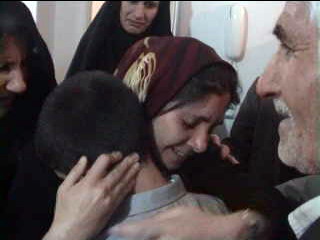
On Monday,May 15th,Mrs. Marzieh Qorsi, nicknamed Arezoo who after years of tolerating challenges and unbelievable mental pressure separated from Rajavi’s terror cult and returned to Iran, through an impressing and exciting ceremony and with the presence of a large number of her relatives at the office of Oroumieh Nejat Society, was delivered to her parents.

When she was visiting her brothers ,sisters and parents, her elder brother hugged her and while he was crying said :" My sister, you were so brave to defect from Rajavi’s group, you did good work, we are very happy that you separated from Rajavi’s cult and came back to us, God’s damnation be on Rajavi."

During this impressing meeting, Marzieh’s family members especially her sister shedding tears of happiness were very excited to have her among them. They declared their serious hatred toward Rajavi’s goup since for ten years its leaders had kept their sister against her will and by force in Camp Ashraf and had prevented her from contacting her son, Saeed, in Iran.

During the ceremony, Mrs.Qorsi’s family members appreciated the efforts of Nejat Society,Azarbaijan branch in order to liberate their sister.

Nejat Society Azerbaijan Branch

May 17, 2006 0 comments
FacebookTwitterPinterestWhatsappTelegramSkypeEmail
Newer Posts
Older Posts

Recent Posts

  • Why the MEK Failed to Become a National Movement

    August 26, 2026
  • From Studying in America to Death in a Village in Albania

    August 22, 2026
  • The Psychological Impact of MEK Ideology on Members

    August 17, 2026
  • A study on the financial mechanism of the Mujahedin-e Khalq

    August 10, 2026
  • A Child behind the Ideological Bars of Massoud and Maryam Rajavi

    August 8, 2026
  • Facebook
  • Twitter
  • Instagram
  • Youtube

© 2003 - 2025 NEJAT Society . All Rights Reserved. NejatNGO.org


Back To Top
Nejat Society
  • Home
  • Articles
  • Media
    • Cartoons
    • NewsPics
    • Photo Gallery
    • Videos
  • Publications
    • Books
    • Nejat NewsLetter
    • Pars Brief
  • About Us
  • Contact us
  • Editions
    • عربي
    • فارسی
    • Shqip