
After removing the extremist organization Mojahedin-e-Khalq (MEK) from its list of terrorist organizations in 2012, the US State Department has been unsuccessfully trying to move militants from this group out of Iraq and closer to sites that are being readied for future armed hostilities.
Romanian Foreign Minister Titus Corlatean listens to U.S. Secretary of State John Kerry, Brussels, December 3, 2013
Washington seems to feel that Romania would be an auspicious location for 3,000 of these militants, specifically the city of Craiova, which is located near the Bulgarian border. Massoud Khodabandeh, who was previously a highly placed leader within the Mojahedin-e-Khalq, referred to the Bulgarian press in his claims that the issue of their resettl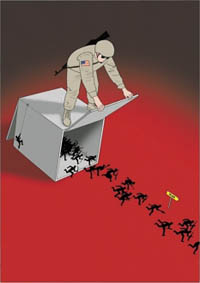 ement was discussed during the meeting between the American secretary of state, John Kerry, and the Romanian foreign minister, Titus Corlatean, in Brussels in early December 2013.
Early last year, Albania and Germany announced their willingness to accept a few hundred of the 3,000 fighters. However, the MEK insists that all the members of the group be resettled together in one area, something to which the governments of these countries have not been prepared to agree.
Despite Hillary Clinton’s decision to the contrary, the MEK is still considered a terrorist organization in Iraq and Iran. Iraq’s Shiite government, which rose to power after the US invasion in 2003, has an adversarial relationship with the members of the Mojahedin-e-Khalq and insists that any countries that provide the group with support also be willing to accept its members for resettlement within their own borders.
At present, MEK militants are being housed at a former American military base near Baghdad, and their camp has more than once been the target of rocket attacks in recent months (the latest incident was on Dec. 27, 2013). Mojahedin-e-Khalq militants blame the Iraqi authorities for the attacks, but the latter have denied any involvement.
Who is the Mojahedin-e-Khalq?
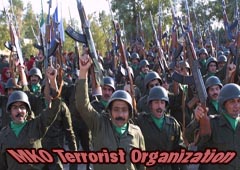
The MEK is a militant organization that is waging an armed struggle against the Iranian regime. The group has been responsible for the deaths of about 50,000 people, including the assassination of the president, prime minister, and dozens of senior Iranian officials. After its relocation to Iraq in 1986, Saddam Hussein often received assistance from the organization’s members during the Iran-Iraq war and also employed them to suppress the Kurdish separatist movement.
From the beginning of the US campaign against Saddam Hussein, the organization became a focus of interest of the American government. In 1994 the State Department sent Congress a damning 41-page report conclusively proving the MEK’s status as a terrorist organization, and as a result, the group was included in the State Department’s 1997 list of terrorist organizations. The report specifically stated, “It is no coincidence that the only government in the world that supports the Mujahedin politically and financially is the totalitarian regime of Saddam Hussein.”
After the American military invasion in 2003, the group came under US control. The MEK actively lobbied to be removed from the official list of terrorist organizations, and the US put its members to use as part of America’s clandestine commando operations against Iran.
It has now emerged that the Bush administration secretly brought members of the MEK to the US for military training that included signals intelligence and other skills related to covert espionage. Presumably the program ended just before the Obama administration took office. Apparently, the MEK was then placed under the control of Mossad, which utilized it to kill Iranian nuclear scientists. Thanks to an article by Justin Raimondo, the writer and founder of the Antiwar.com website, the group was dubbed “Hillary’s Terrorists.”
It is obvious that the Mojahedin-e-Khalq is not a peaceful organization. In fact, it would be better compared to the Taliban, Al-Qaeda, or Jubhat al-Nusrah, other groups which also enjoyed the tacit support of the United States until they became too unruly. In addition, Syria, Iraq, and Afghanistan have still been unable to extricate themselves from the aftermath of the MEK’s activities within their borders.
One can only guess at what awaits Romania should this army of 3,000 militants come calling at its door. Harboring so many fighters so close to Ukraine, a country that has been afflicted with EuroMaidan fever for the past month and a half, could pave the way for any number of coercive scenarios for regime change.
Source in Russian: Regnum
By Anna MIKHAILENKO (Russia), Orientalreview.org
 g Iran, which the West also seeks to weaken by all means available.
 group of nations. But then, on Thursday, an actual sanctions bill was introduced. Ali Gharib took the time to read it (he got an advance copy and posted about it Wednesday) and what he found is profoundly disturbing (emphasis added):
 Russia’s resurgence, the instability wrought by the Arab Spring, and the dangers posed by rogue regimes, the world remains far freer now than at any point in history.
 (MEK, PMOI) for twenty years, serving as the organizations representative to the United Nations and to the United States during his tenure. The group is largely obscured from public discourse, or more recently veiled in headlines describing them as political dissidents or refugees. To those more familiar with the group the debate tends to focus primarily on their nature. For many MEK is a dangerous terrorist organization, yet for others they are freedom fighters and the only legitimate alternative to the Iranian Government. They’ve been subject to several pieces suggesting they work as assassins for the United States and Israel. Masoud has published a book called Memoirs of an Iranian Rebel about his experience in the organization, which he very candidly describes in detail as a cult, and one that has long lost its strength and vibrance. He now focuses much of his work on the research and understanding of cults, terrorism, and cult behavior within those structures.
 MEK. VOR’s Sean Nevins writes about the event, as well as his one-on-one interview with former Secretary of Homeland Security, Tom Ridge, and a discussion with the MEK’s political arm.
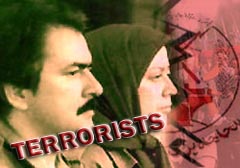 lawmakers, however, will press him on a very different issue: the recent killings of dozens of members of a former terrorist group that the Iraqi government had promised — and failed — to protect.