
MKO is afraid of no front but the one wherein the front-line combatants are the ex-members
Presently highlighted in MKO’s media, the group has started an all-out campaign aimed to  prolong its stay in Iraq. Now, after a lengthy process of transferring the members in Camp Ashraf to a Temporary Transit Location and since its settlement there, MKO has kept caviling at the camp’s conditions and now presses to be returned to Ashraf complaining that the recent rainfalls have inundated the whole camp. The call is made after the vain attempt to enforce recognition of the transit location as a refugee camp. However, as the possibility of returning to Ashraf is out of question and a transit location fails to be an appropriate location for a refugee camp, MKO is changing expectations for a third location that could guarantee a few years stay in Iraq; “UNHCR has another refugee camp in Iraq and on the UNHCR Web site it is stipulated that its residents have the right to ownership of land and vehicles and to revenue generating activities”.
Everything is actually ready for the residents’ transfer to EU member states and any third country that will offer to receive them as refugees. Reportedly, up to this point, 2600 residents have gone through identity verification process by the UNHCR and close to 1750 have been privately interviewed outside the camp. But the problem is that so far no country has shown a willingness to accept them and the best option for MKO to survive is to prolong its stay through any flimsy excuses and accusations made against people like the head of UN Assistance Mission for Iraq (UNAMI) or Prime Minister Maliki’s government. And of course, all blames as usual are on Iranian regime as behind-the-curtain hand for whom all the mentioned as well as other opponents and the defected members are accused to be working as the agents.
It is a taboo making any allusion to Iranian regime inside MKO and it is an unforgivable sin to defect from the group. MKO tags any defected member an Iranian agent, particularly if the defected engage in counter-MKO activities, in an attempt to besmirch what it highly values as the acquired reputation of a resistance fighter. In fact, in the black and white world of MKO anyone siding with Iran against it is regarded an enemy of the group and nobody is more threatening and harmful than a defected member since the exposed information makes the closed group vulnerable to the adversaries outside.
Unfortunately, the key role these defected members can play to frustrate plots and anti-human activities of MKO go unnoticed. Majority of these defected members volunteer to have an active role to rescue their comrades if the responsible organizations demand their aids as some do. But it is not enough as the activities lack the needed cohesion. If MKO insists to stay in Iraq, no problem, let it be there as it might be the land where it is doomed to crumble by dissociating its enslaved members. And it can be done by the lantern of those who survived after being lost on a dark path that was not straight. Ex-members of a terrorist cult know how to fight fire with fire and MKO is afraid of no front but the one wherein the front-line combatants are the ex-members. The fortune of MKO might decline in Iraq, a land that once fulfilled its wishes can now crush it by refusing them.
 similar to that of the ideological drift in 1975 drafted by Taghi Shahram, who broke the seemingly Islamic ideology of the organization and officially announced it to be Marxism. Consequently, Shahram suppressed any protest and opposition and even plotted assassinations to liquidate opponents or as a method of silencing them.
  Rajavi’s gang to try to pose itself. Referring to the content of Pentagon report on Iran, remnants of Rajavi forge that they are the greatest and the most dangerous opposition of the Iranian government.
 agent of Iranian regime whenever the organization ever publicizes the news of some defection itself. The announcement does not appear just after the escape or defection but months and even years later and after the group fails to come to terms with the defected to stop him/her talking out. The stigma, MKO believes, on the one hand will possibly neutralize the disclosures and on the other, hand will boost a propaganda battle to talk big of its intelligence potentiality in detecting the infiltrated agents. Thus, it may appear to many as a never-ending battle between MKO and Iran’s Ministry of Intelligence and security; and of course the more secretive and sophisticated the ministry is depicted the more capable its rival can be proclaimed.
  Resistance and the leader of the most viable alternative- as she claims – to the Islamic Republic, it seems odd that she has experienced so few appearances in the media, and roughly no appearance in Persian media.
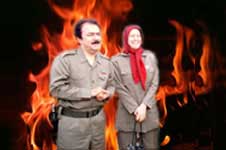 Intelligence and Security: a Profile’.
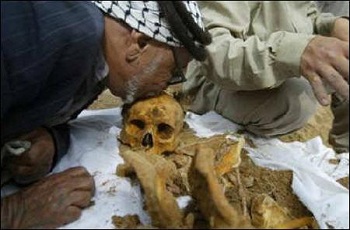 Iraq, where thousands of Iraqis had been buried after apparent mass executions. The discovered graves accounted for a plainly shocking fact that how Saddam got rid of his opponents with no sense of remorse or mercy. And now after the evacuation of Camp Ashraf, a bastion for his mercenary forces, additional dimensions of crimes committed by his mercenaries have been unearthed.
 believe it at all); the US administration doesn’t believe it, at least for the time being. Recent acts by the US administration have somewhat dismantled the mask that the government actually cares about the Iranian people. Once upon a time the US was at least pretending that it was caring for people of Iran.