
Update No. 11
Conflict in Iraq con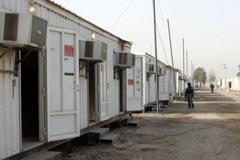 tinues to affect residents of the Hurriya Temporary Transit Location
The surge in conflict since June 2014 has continued across significant areas in Iraq. Violence has displaced hundreds of thousands of Iraqis, who have either moved internally or across borders to become refugees in the region. UNHCR and its partners have scaled up operations to respond to their urgent needs for protection and assistance.
The dramatic deterioration of the security situation in Iraq as a result of the fighting is equally worrying in the context of the efforts – on-going since 2011 – of UNHCR and the United Nations Assistance Mission in Iraq (UNAMI) to find relocation opportunities outside Iraq for former residents of Camp New Iraq (formerly Ashraf). Approximately 2,700 people reside in the Hurriya Temporary Transit Location (TTL) near the Baghdad International Airport (BIAP).
The residents suffered three separate rocket attacks in 2013, each of which resulted in deaths and injuries. In addition, an attack against Camp New Iraq in September 2013 left 52 dead and seven persons missing. The escalation in conflict across Iraq leaves residents of the Hurriya TTL open to significantly heightened security risks.
In light of the current situation, UNHCR urgently renews its calls upon governments of other countries to admit residents and to find ways to offer long term solutions to all. If long term solutions cannot be made available immediately, the urgent need to relocate the residents would justify an extraordinary evacuation to a temporary platform from where they could be permanently relocated to a third country. UNHCR stands ready to assist states in achieving this.
UNHCR deeply appreciates the measures taken by some countries already to relocate residents to situations of safety and security. These measures contribute greatly to international efforts to find solutions for this group of people.
UNHCR recalls that all residents of the Hurriya TTL registered with UNHCR are persons of concern to UNHCR. They are thus entitled to protection against expulsion or forced movement to any place where their lives or freedom would be threatened. The Memorandum of Understanding between the Government of Iraq and the United Nations explicitly recognizes that residents benefit from the principle of non-refoulement.
UNHCR continues to call upon the Government of Iraq to take all possible measures to ensure the safety and well-being of residents, including ensuring access to life saving medical treatment.
UNHCR,Geneva
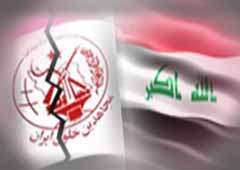 Minister-designate Haider al-Abadi, is determined to work toward the expulsion of the terrorist MEK from Iraq.
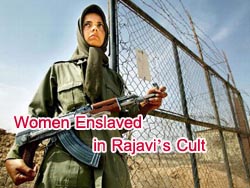 about the leaders of the terrorist cult. According to these women, all female members of the MKO were sexually abused by MKO leader Masoud Rajavi. “Comrades in Arms” is the title of a documentary which is to be aired soon on Press TV. The film that was debuted in the presence of Iranian filmmakers as well as former MKO members, investigates the sexual slavery of women and the unlawful affairs of Masouj Rajavi with female members of the cult. According to this documentary, anyone who refused Rajavi’s sexual demands would be killed. Also the three former female members narrate how couple members were forced to divorce only to be accepted into Rajavi’s circle of comrades. The MKO fled Iran in 1986 for Iraq, where it received the backing of Iraq’s executed dictator Saddam Hussein and set up a camp near the Iranian border. The terrorist group also sided with Saddam during Iraq’s eight-year imposed war on the Islamic Republic in 1980-1988 and the massacre of Shiites and Kurds during Iraq’s uprising in 1991. The MKO is listed as a terrorist organization by much of the international community but there is no end in sight for its terrorist operations against the Iranian nation.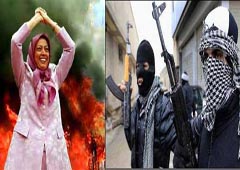
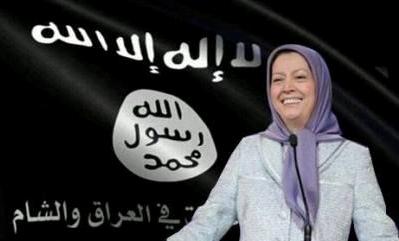 esentative of the International Parliament for Safety and Peace in Iraq told FNA reporter in Baghdad:” the MKO terrorist group has long been contributing ISIS elements. They also support the Tekfiri ISIS logistically and militarily.”

 agents who beat them and force them to leave the hall.
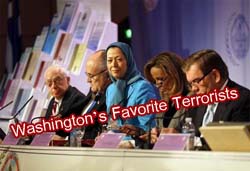 ublished on the USA Today daily on Thursday, Counselor and Head of Press Office for the Permanent Mission of Iran to the UN Hamid Babaei, criticized Washington for removing the MKO from the US State Department’s list of terrorist organizations in 2012.
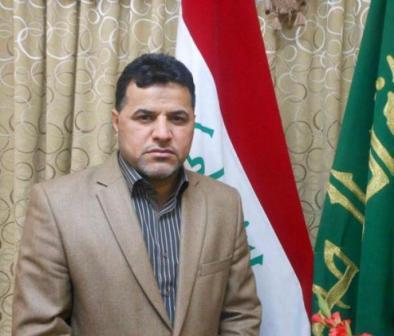 Mujahedin Khalq Organization (the MKO), in particular Massoud and Maryam Rajavi.