UK gov’t should revise antagonist stands to expand ties with Tehran – Diplomat anaging Director of IRI Foreign Ministry’s Western Europe Affairs Office emphasized here Wednesday any kind of expansion of ties with London depends on UK government’s revising of its antagonist stands regarding Iran. According to Foreign Ministry Press Department, Ali Dowlatyar made the comment in a meeting with the Head of the Middle East and North Africa Bureau of the British Foreign Office, John Jenkins. Dowlatyar added,”Intensifying of the MKO’s recent antagonist moves, pursuing measures aimed at imposing more limitations against our country, efforts aimed at closing the branches of Bank Melli Iran (BMI) throughout Europe, Mr. Tajik’s issue, immediate extradition of Mr. Badavinejad, and other issues of such nature cannot be ignored by Tehran.” He denounced a recent verdict issued by a British court, resorting the reasoning that the MKO terrorist grouplet has conducted no antagonist move during the course of the past few years, as a political verdict, arguing,”The great Iranian nation considers as unacceptable the double standards observed by Britain in its campaign against terrorism, regrading the recent verdict as a strongly antagonist act.” Touching on Tajik’s issue, too, the Foreign Ministry’s Managing Director of West Europe Affairs said,”It was obvious from the beginning that Mr. Tajik’s case is a conspiracy led by the US intelligence agents, and that the matter was politically motivated.”Dowlatyar added,”There are numerous questions related to Mr. Tajik’s case that have still remained unanswered and keeping in mind his physical conditions, and particularly his heart’s status, in addition to the nuisances and problems with which him and his family have been entangled during the past couple of months, this inhumane trend should end as soon as possible.” Jenkins, too, said,”As the British Foreign Secretary and other high ranking UK officials have stated, the British government considers the moves made by the terrorist group (MKO), as well as the moves made by the National Resistance Council, as shameful.”The Managing Director of the British Foreign Office’s Middle East and North African Affairs Bureau emphasized,”We, too, hate the MKO terrorist group, and despite the existence of lots of differences of opinion, that is something natural in relations among countries, we favor improvement and expansion of ties with Tehran.” Tehran, July 03, 2008
News
On Saturday, they gathered to call on the European Union and the United States to remove what they called unjust terrorist label from MKO immediately. Yes, they want it, or rather order, to be soon and immediately. It is typical of Mojahedin-e Khalq that they become bolder and want more if being granted, not gaining as it might be their right, something that changes nothing in general.
They have also some supporters in the Congress who have been calling for the US to back terror groups in Iran. There are reports that indicate that this program has already been in place for years. It was nearly two months ago that Ret. Gen. Thomas McInerney in a Fox News appearance publicly called for the US government to support groups like MKO (Mujahedin-e Khalq Organization), which is listed by the State Department as a terrorist organization, and carry out deadly bombings in Iran. He already knew about the true nature and terrorist potentialities of MKO as know the EU member governments, including the UK.
But, the UK government still considers MKO a terrorist group, in spite of being defeated in a long court battle, as does the US. In the State Department’s issued Daily Press Briefing on June 30, Tom Casey, Deputy Spokesman, reiterated that the US government’s policy is not to engage in any contacts with terrorist groups like MKO:
QUESTION: Just to follow up on the same story. (Inaudible) also outlines that the U.S. had – may encourage or had some contacts with some of the dissident groups, including Mujahedin-e Khalq and the PJAK. Can you formulate a comment on this?
MR. CASEY: Including, sorry, which groups?
QUESTION: The PJAK, which is an extension of the PKK and the Mujahedin-e Khalq.
MR. CASEY: Yeah. Well, you know, our policy is not to engage or have discussions or contacts with terrorist groups. The MEK is a terrorist group, and certainly we don’t – aren’t engaged in any kinds of conversations or discussions with them.
July 2, 2008
http://www.mojahedin.ws/news/text_news_en.php?id=1730
Iran has criticised Polish students who went to Paris last weekend to party with the Iranian People’s Mujahedin.
Saturday’s ‘party’ thrown by the People’s Mujahedin, deemed by the USA, Canada, EU ant the Iranian government as a terrorist organisation, was attended by several thousand young Poles. They travelled to France after being offered the journey at a cost of under ten euros conditional upon taking part in an accompanying demonstration.
But Iranian Ambassador to Poland Hadi Farajvand said Thursday that the participation in the demonstration is likely to have a negative impact on the Polish-Iranian relations.
“It is very important for academia, and especially students, to cut themselves off such terrorist organisations. It is regrettable that this organisation deluded the Polish [students],” said the Ambassador.
The People’s Mujahedin of Iran is a secular, socialist organisation which aims to overthrow the Islamist Iranian government. It was accused of being behind the murder of the president and PM of Iran 1981. The organisation sided with Saddam Hussein during the Iraq-Iran war and was accused of assisting the Iraqi republican guard in the suppression of Kurds and the Shi’a Muslims in the 1980s.
Polskieradio – July 4, 2008
Iraqi MP Sheikh Jalaleddin al-Saghir has said the government will expel MKO members if they fail to leave the country before their six-month deadline is reached. “After the deadline passes, the Iraqi government will not tolerate any pressure, or interference aimed at keeping MKO members in the country,” Arab media quoted Sheikh Jalaleddin al-Saghir as saying. “The procedure will be carried out according to a government decision. MKO members will be handed over to the Red Cross so that they can leave for another country,” said al-Saghir. The Mujahedin Khalq Organization [MKO] is recognized as a terrorist group by Iran, Iraq, Canada, the United States, and the European Union. The organization, closely allied with former Iraqi dictator Saddam Hussein, has carried out numerous bombings, assassinations, and terrorist attacks in Iran and Iraq over the past 25 years.
A parliamentarian said on Sunday that the British government is responsible for any terrorist operation by the MKO members in the future.
Alaeddin Boroujerdi, head of Majlis National Security and Foreign Policy Commission, talking to reporters, denounced London’s move to remove the name of terrorist Mujahedin-e Khalq Organization from its terrorist blacklist.
“The British government which supports the terrorist MKO should accept consequences of its acts,”he reiterated.
“The British government justifies its act (removing the MKO from its terrorist list) by saying that members of the grouplet have not carried out any terrorist operation in the past few years while the MKO terrorist leaders still lead the group,”Boroujerdi added.
He said he was surprised by freedom of action of MKO members MKO in the European countries.
British lawmakers decided to lift ban on the MKO on Monday, following a court decision last month that ruled the government had to remove it from a terrorist blacklist.
The order to remove the MKO, which was originally banned in 2001, from Britain’s list of proscribed groups will come into effect soon, after it was approved without a vote.
The MKO, formed in the 1960s, is on the European Union’s list of terrorist organizations subject to an EU-wide assets freeze, and has been designated by the US government as a foreign terrorist organization.
Iraqi Tribal Leaders Want Mojahedin Khalq (Rajavi cult) Expelled BASRA, Iraq, June 28–Southern Iraq’s tribal leaders held a session Saturday in which they called for a bid to expel the terrorist elements of Mujahedin-e-Khalq Organization (MKO) from Iraqi soil. Speaking at the session, tribal committee chief at Iraq’s parliament condemned the existence of any terrorist organization in Iraq naming the MKO which was considered as a tool in the hands of Iraq’s former Baath regime to suppress Iraqi Shiites. Listed as a terrorist organization by Iran, Iraq, the United States, Canada and the European Union, the MKO is believed to be in charge of several terrorist operations carried out especially in Iran and Iraq. "Southern tribes condemn all terrorist organizations because their hands are stained with Iraqi people’s blood," Daqer al-Mousavi told the session. Iraqi lawmakers and political leaders have long insisted on a request to expel the anti-Iranian MKO from Iraq. Earlier this month the United Iraqi alliance, which is the biggest bloc in the parliament, and the National Kurdistan Alliance, submitted a bill to the parliament demanding an end to the presence of MKO terrorists in Iraq which was approved later. Iraqi officials say the group is playing a significant role in violence and insecurity in the country. "MKO members are crossing freely in Diyala every day and enjoying the most facilities in the province while Iraqi people are struggling with starvation to survive," Salem al-Dorraji, one of the tribal leaders, told Alalam reporter. "We have no place for those who slaughtered Iraqi people in 1991 and are still killing our people, they must leave our soil immediately," al-Dorraji added.Supported by Saddam Hossein, the MKO committed widespread crimes in Iraq, killing many people, after the 1991 Persian Gulf War. Iraq, June 29, 2008 http://www.alalam.ir/english/en-NewsPage.asp?newsid=031030120080628225807
An Iranian rebel group that is aggressively campaigning for Washington’s support as part of a "regime change" strategy in its homeland has committed serious abuses, including torture and prolonged isolation, against dissident members, according to a leading human rights watchdog.
The group, the Mujahedin-e-Khalq (MEK), insists that it should lead a U.S.-backed effort to bring what it has termed democratic rule to Iran. Last month, it organized a rally, attended by several powerful Republican lawmakers and billed as the "2005 National Convention for a Democratic, Secular Republic in Iran," at Washington’s historic Constitution Hall.
But MEK’s own human-rights record during its almost 20 years as an armed group sheltered and supported by former Iraqi President Saddam Hussein belies its professed commitment to democratic rule, Human Rights Watch (HRW) said in a 28-page report, "No Exit: Human Rights Abuses Inside the MEK Camps," released Thursday.
"The Iranian government has a dreadful record on human rights," said Joe Stork, Washington director of HRW’s Middle East division. "But it would be a huge mistake to promote an opposition group that is responsible for serious human rights abuses."
The report comes amid rising tensions between Washington and Tehran focused primarily on U.S. charges that Iran is building a nuclear weapon, a development that President George W. Bush has described as "unacceptable."
The U.S. administration has not yet explicitly endorsed "regime change" in Iran, but hardliners based primarily in Vice President Dick Cheney’s office and at the Defense Department have made little secret of their belief that such a policy should be adopted. Their only question is how best to achieve that goal.
Since the March, 2003 U.S.-led invasion of Iraq, where the MEK had been based since 1986, the group has tried to persuade Washington that it holds the key to overthrowing the Islamic Republic next door.
It has been backed in this quest by right-wing lawmakers, a group of hardline neoconservatives and retired military officers called the Iran Policy Committee (IPC), and some U.S. officials – particularly in the Pentagon – who believe that the MEK could be used to help destabilize the Iranian regime, if not eventually overthrow it in conjunction with U.S. military strikes against selected targets.
While the group’s supporters in the Pentagon so far have succeeded in protecting the several thousand MEK militants based at Camp Ashraf near the Iranian border from being dispersed or deported, they have failed to persuade the U.S. State Department to take the group off its terrorist list, to which it was added in 1997 based on its attacks during the 1970s against U.S. military contractors and its participation in the 1979 seizure of the U.S. embassy in Tehran. The European Union (EU) also cites the MEK as a terrorist organization.
After a year-long tug-of-war between the two U.S. agencies, a truce between State and the Pentagon was apparently worked out. MEK members at Camp Ashraf were designated "protected persons" under the Geneva Conventions.
Since then, the Pentagon has recruited individual members of the MEK to infiltrate Iran as part of an effort to locate secret nuclear installations, according to recent articles published in The New Yorker and Newsweek magazines. At the same time, nearly 300 members have taken advantage of an amnesty in Iran to return home, leaving a total of 3,534 MEK members inside Camp Ashraf as of mid-March, according to the HRW report.
In this context, the MEK and its supporters have been campaigning hard for the group to be "de-listed" by the State Department as a terrorist group. That appeared to be the principal demand of last month’s rally, which was addressed via video-conference by MEK’s co-president, Maryam Rajavi.
In another column published by the International Herald Tribune in January, Rajavi, who also heads the National Council of Resistance of Iran (NCRI), a MEK front group, stressed that she was "committed to holding free and fair elections within six months of regime change, to electing a constituent assembly and handing over affairs to the people’s elected representatives."
Those claims are likely to invite greater skepticism in light of the new HRW report, which is based on a series interviews between February and May 2005 with 12 former MEK members currently living in Europe.
They testified to a pattern of torture, beatings, and prolonged detention in solitary confinement at military camps in Iraq after they criticized the group’s policies and what they called its undemocratic practices, or indicated that they planned to leave the organization. Two of the interviewees said they had personally witnessed the deaths of two prisoners under interrogation.
Those who wished to leave the organization were held incommunicado in special units in the camps, they said. If they held a high rank in the MEK, they were held for years; one of the interviewees reportedly was held for a total of eight and a half years; another for five years.
The most brutal treatment was meted out to suspected dissidents in secret prisons located within the MEK camps, according to the report. Four of the witnesses, who were suspected of dissident views, testified that they had all been severely tortured and forced to sign false confessions asserting that they had links to Iranian intelligence agents.
Three of them witnessed the death of Parviz Ahmadi, a former unit commander, in February 1995, shortly after a particularly severe beating. His death was reported three years later in the MEK’s publication, Mojahed, which described him as a "martyr" killed by Iranian intelligence agents.
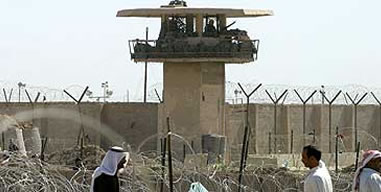
Five of the witnesses were eventually transferred to Abu Ghraib prison during the 1990s and released by Saddam Hussein’s government in 2001 or 2002.
The testimonies included in the report also lend weight to the view that the MEK is more of a cult than a political movement. They suggest that the group’s exile in the early 1980s, followed by the marriage of Masoud and Maryam Rajavi in 1985, set off a series of phases in what the husband-and-wife team declared was a permanent "ideological revolution" that the couple embodied.
These included compulsory divorce of married couples, regular self-criticism sessions, renunciation of sexuality, and absolute mental and physical dedication to the leadership. "The level of devotion expected of members was on stark display in 2003 when the French police arrested Maryam Rajavi in Paris," HRW said. "In protest, 10 MEK members and sympathizers set themselves on fire in various European cities; two of them subsequently died."
by Jim Lobe
Iran: British overt support for Mojahedin Khalq (Rajavi cult) terrorists is in line with London’s new policy of using terrorists in the region
Iran to UK: MKO ruling will isolate you
Iran says a decision by the British court to remove a ban on Mujahedin Khalq Organization (MKO) would only isolate the UK government.
(MKO cult members in Camp Ashraf!!)
Foreign Ministry spokesman Mohammad-Ali Hosseini condemned the decision to remove the MKO from the blacklist of terrorist organizations, saying, "Britain has distanced itself from the international community.”
(British Lord!! Corbett promoting terrorism under the Logo of MKO for the past 25 years)
“This ruling will without a doubt isolate the UK," Hosseini cautioned, adding that the move was in line with London’s new policy ‘to use the terrorist card’ to step up pressure on regional nations and governments.
"By adopting a policy of supporting terrorist groups, it (Britain) is pursuing certain provisional interests."
The Iranian spokesman called on European institutions not to be affected by the politically motivated, illegitimate verdict of the British court in favor of the terrorist cell.
The MKO has claimed responsibility for hundreds of bombings and assassinations in Iran, including the assassination of a president, a prime minister and 80 senior officials as well as thousands of civilians.
Press TV, June 25, 2008
http://www.presstv.ir/Detail.aspx?id=61399§ionid=351020101
UK is fully responsible for any future terrorist act of Mojahedin Khalq
Commenting on the de-proscribtion of the Mojahedin Khalq Organisation by Britain, an Iraqi member of parliament emphasised that Iraq has never been more adamant to get rid of the remains of Saddam’s terrorists. Now that the British govenment has acceped that they are not terrorists, they should take them back home immediately. It is now clear that the UK is fully responsible for any future acts of violence committed by the MKO in Iraq, Iran or elsewhere. The MKO has been and is a tool of US, UK and Israeli foreign policy and they should now take them and put them back in their tool boxes in London.
Iran: west is arming Mojahedin Khalq Terrorists (Saddam’s private army or Rajavi cult) for target assassination in the Middle East and Europe
‘Attempt on Ahmadinejad’s life failed’
An Iranian presidential aide says Mahmoud Ahmadinejad had been the target of an assassination plot at the UN food summit in Italy.
President Ahmadinejad’s adviser for human resources, Ali Zabihi, said Monday that measures taken over the past three years by the Iranian Chief Executive have jeopardized the ‘illegitimate interests’ of global powers.
"Such measures have prompted certain parties to try and assassinate or force the president to leave office," Zabihi added.
Earlier on Thursday, President Ahmadinejad said the enemy had planned to assassinate him during his March visit to Iraq, adding that last-minute changes in his schedule had foiled the plot.
"The plots to assassinate the president in Iraq and at the UN Food and Agriculture Organization (FAO) conference have both failed," Zabihi continued.
He maintained that the attempts on Ahmadinejad’s life were in line with a secret directive issued in March by US President George W. Bush ordering ‘the assassination of targeted Iranian officials’ as part of efforts to destabilize the Iranian government.
According to a report by Counterpunch magazine, the US president signed a secret finding in March authorizing a covert offensive against Iran which called for the arming and funding of terrorist groups, such as the Mujahedin Khalq Organization (MKO) and Jundallah (Army of God).
Press TV, June 24, 2008
http://www.presstv.ir/Detail.aspx?id=61154§ionid=351020101