In describing the characteristics of cult leaders, their anomalous skills and potentiality to enslave recruits, it is commonly referred to as complimentary factors closely related to their charisma. Cult leaders make use of their charisma as well as other psychological and thought-reform techniques in order to control their followers. However, these levers and techniques are to be parallel to the belief system of their followers and is of utmost effect. In fact, cult leaders hold grab to members’ background and misuse through weird means to deprive members of their systems of values and beliefs and to replace them with heretical ones. However, it is not clear whether they believe in their magic power or just use it for deceiving members. According to a researcher working on cults:
Harder to evaluate, of course, is whether these leaders’ belief in their magical powers, omnipotence, and connection to God (or whatever higher power or belief system they are espousing) is delusional or simply part of the con. Megalomania–the belief that one is able or entitled to rule the world–is equally hard to evaluate without psychological testing of the individual, although numerous cult leaders state quite readily that their goal is to rule the world. In any case, beneath the surface gloss of intelligence, charm, and professed humility seethes an inner world of rage, depression, and fear. 1
Although this evaluation seems to be paradoxical, but well illustrates the complex personality of cult leaders. They pretend to act as a savior and a social reformist, while are well aware of the egocentric motives behind their actions and behaviors. According to Weber, an expert on cults, cult leaders in general and political cult leaders in particular, aim to propagate a new religion. He believes that they spread anarchy in the world and exhibit highly destructive behaviors. There are also other features distinguishing political cult leaders from other parallel cases:
Charismatic leader is "a sorcerer with an innovative aura and a personal magnetic gift, [who] promoted a specific doctrine…. [and was] concerned with himself rather than involved with others….[He] held an exceptional type of power: it set aside the usages of normal political life and assumed instead those of demagoguery, dictatorship, or revolution, [which induced] men’s whole-hearted devotion to the charismatic individual through a blind and fanatical trust and an unrestrained and uncritical faith. 2
In the morphology of the leadership of MKO as a political cult, almost all above features are found. The following classification of cult leaders’ characteristics may give us a better understanding of the issue.
1. Believing pretentiously in God,
2. Showing narcissism and megalomania,
3. Aiming to rule the world and develop a global revolution,
4. Fostering innovation and fabricating false religious interpretations,
5. Adopting unusual and unique procedures and approaches,
6. Trying to convince and control individuals,
7. Leading to destruction and anarchy using all possible means,
8. Seeking personal interests.
All these features can be traced in Masoud Rajavi, the leader of MKO, a notorious cult blacklisted in the terrorist list. It has to be noted that he got a number of these features after the development of the ideological revolution of Mojahedin in MKO. However, it is not our intent here to identify the above factors and their instances in Rajavi. Although it is difficult to make a generalization on whether all cult leaders believe in their own magic power and connection to God or not but there can be a clear-cut judgment on Masoud Rajavi in this regard. Taking a closer look at his past history clarifies his inconsistent personality and traits and his grabbing at cultic relations in order to conceal his problematic personality.
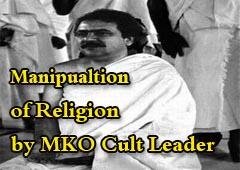
Rajavi’s paradoxical personality is apparent where he makes an attempt to stabilize his position by all means either by resorting to the religion or by opposing it. In other words, Rajavi is not even an out-and-out cult leader yet has grabbed at cultic relations and techniques in order to achieve his personal and totalitarian ambitions. Having some features of cult leaders like megalomania and narcissism as well as borrowing cultic thought-reform techniques facilitated his furthering of personal interests. Therefore, he has a more complex personality compared to other cult leaders. His charisma is not an inherent feature but is an instrument intentionally used to subordinate members. In fact, it is a combination of charisma and psychopathy that is common in most cult leaders:
In the case of cults, of course, we know that this induction of whole hearted devotion does not happen spontaneously but is the result of the cult leader’s skillful use of thought-reform techniques. Charisma on its own is not evil and does not necessarily breed a cult leader. Charisma is, however, a powerful and awesome attribute found in many cult leaders who use it in ways that are both self-serving and destructive to others. The combination of charisma and psychopathy is a lethal mixture. 3
It seems that the complexity of Rajavi’s personality cannot be understood without taking general cult leaders’ characteristics into consideration.
References:
1. Madeline, Tobias and Jania Lalich; Captive hearts, Captive minds, Halter House, 1994
2. ibid
3. ibid

 the most convenient houses and hotel were dedicated to the families. It was the time when Masud and Maryam Rajavi came to Iraq from France. The MEK had used all its strength to recruit members and all IRI opponents from all over the world. There was a tension among supporters in abroad. Rajavi was using his entire wisdom to get the supporters out of their normal life and bring them to the organization and of-course the prison of Ashraf. They used any practice to bring the people to the cult in Iraq. For example they managed to send smugglers, financing them, to take the people out of their families and bring them to Iraq.
 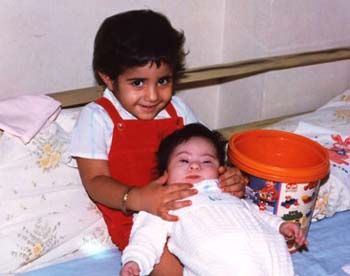 I remember they used the opportunity of war in 1991 and said: “Due to the war, we can not keep the kids here”, so they arranged another chantage and separated the children from their families. That was a treacherous plan that was executed. They even said themselves:” That’s a good pretext to get rid of children.”
 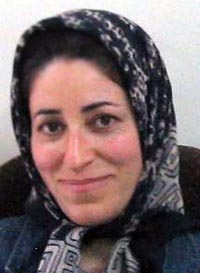 I am Sho’le Shadram. I was born in 1966 in Lahijan,