
A group of Ex MEK members and supporters, started a new campaign in Facebook which has outraged the 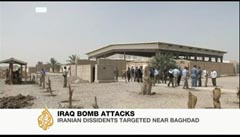 Rajavists.
The campaign which was formed after the mortar attack to camp Liberty, has called for immediate replacement of MEK members to safe countries. A request that is against the rajavis will.
It is mentioned in the declaration of the campaign, “We call upon the United Nations and other responsible organizations for the immediate safe transfer of these defenseless political asylums before anymore future attacks.”
Despite the humanitarian nature of the campaign, Rajavi organization has mobilized its member and supporters to accuse founders and members of the campaign to be agents of Islamic Republic of Iran.
One of the founders of the campaign, Mrs. Atefeh Eghbal, is a former high ranking MEK official who left the Iraq based group in mid 90s. Her brother Mohammad Eghbal is still a high ranking MEK official in camp Liberty and is Arabic translator.
According to MEK websites MR. Eghbal has written a public letter to her sister and other campaign activists and accused her of being a traitor as well as insulting her. MEK has showed a huge desire to accuse every ex MEK and other criticizers in order to stop them from writing and talking about MEK.
Despite the efforts of MEK, this small group and their campaign has raised a question among Iranian internet activists that why Ravi`s Organization takes no action to help its members to leave Iraq.
It was commented in the Facebook page of the campaign, “Rajavi claims that he has support of more than 7000 mayors in France and a huge support among members of parliaments in European countries and in America. Why NON of these supports has taken any actions to save members in Iraq?
Meanwhile MEK has called for immediate return to Ashraf, where was given to Rajavists by Saddam and has a better infrastructure for the cult like organization.
An Ex MEK member told Mojahedin Monitor that Rajavi is not willing that its members leave Iraq. They are hoping to remain and return to Ashraf. Rajavi has proved that he is willing to sacrifice its members for his goals.
http://www.facebook.com/groups/campaigneliberty/?bookmark_t=group
Iraqi Prime Minister Nouri al-Maliki called on the UN to speed up the process of expulsion of the members of the terrorist Mojahedin-e Khalq Organization (MKO) from Iraq.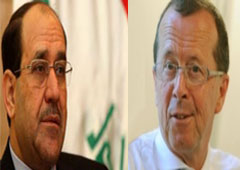
Ali Al-Moussavi, a senior advisor to the Iraqi prime minister, announced that Maliki has met with Martin Kobler, Special Representative of the UN Secretary-General in Iraq over the UN’s activities in Iraq, including the transfer of the MKO from the country.
Moussavi said that Maliki has asked the UN representative to fulfill his pledge to rapidly implement expulsion of the MKO members from Iraq’s soil.
The advisor stated that Maliki has told Kobler that "Iraq can no more tolerate" the terrorist organization’s members and will not extend their presence in Iraq "even for one single hour", reiterating that any MKO overstay in Iraq will be illegal.
The United Nations Assistance Mission in Iraq (UNAMI) monitors the transfer of Camp Ashraf residents to Camp Liberty which lies Northeast of the Baghdad International Airport.
The MKO, founded in the 1960s, blended elements of Islamism and Stalinism and participated in the overthrow of the US-backed Shah of Iran in 1979. Ahead of the revolution, the MKO conducted attacks and assassinations against both Iranian and Western targets.
The group started assassination of the citizens and officials after the revolution in a bid to take control of the newly-established Islamic Republic. It killed several of Iran’s new leaders in the early years after the revolution, including the then President, Mohammad Ali Rajayee, Prime Minister, Mohammad Javad Bahonar and the Judiciary Chief, Mohammad Hossein Beheshti who were killed in bomb attacks by MKO members in 1981.
The group fled to Iraq in 1986, where it was protected by Saddam Hussein and where it helped the Iraqi dictator suppress Shiite and Kurd uprisings in the country.
The terrorist group joined Saddam’s army during the Iraqi imposed war on Iran (1980-1988) and helped Saddam and killed thousands of Iranian civilians and soldiers during the US-backed Iraqi imposed war on Iran.
Since the 2003 US invasion of Iraq, the group, which now adheres to a pro-free-market philosophy, has been strongly backed by neo-conservatives in the United States, who argued for the MKO to be taken off the US terror list.
The US formally removed the MKO from its list of terror organizations in early September, one week after Secretary of State Hillary Clinton sent the US Congress a classified communication about the move. The decision made by Clinton enabled the group to have its assets under US jurisdiction unfrozen and do business with American entities, the State Department said in a statement at the time.
In September 2012, the last groups of the MKO terrorists left Camp Ashraf, their main training center in Iraq’s Diyala province. They have been transferred to Camp Liberty.
Massoud Rajavi suffers from narcissism
Dena Peace and Freedom Association interviewed a European intellectual on the Cult of Rajavi(MKO/MEK). Ms. Shemeltz who is an expert and scholar on psychotherapy, has personal and scientific experience about 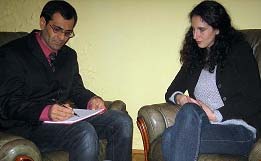 cults.
As the representative of Dena Peace and Freedom Association, Mr. Mohsen Abbasslou talked with the honorable expert, Ms. Shemeltz.
Mr. Abbaslou: Ms. Shemeltz, most of audiences may want to know how you have such a deep insight on the MKO Cult. They surely want to know more about you.
Ms. Shemeltz: I’d prefer to publicize personal identity only to the extent we have agreed on. I am a researcher and I’d like to do my job without tumult and distracting elements, this way I will achieve my research objectives with more energy and tranquility.
As you know, I have been closely working with cults for years. I even traveled to Africa to live in a cult. That was a precious experience for me. It offered me the opportunity to get to know about cult functions more closely. Mr. Abbaslou, you know the name of that cult and you notice how much it is similar to the MKO. I’d like to compare the Cult of Rajavi with the African cult regarding their structures and functions, in my next investigative project.
All cults in the world follow common rules and they are always headed by a charismatic but actually hypocrite person. Of course each cult has its own characteristics that should be investigated separately.
The issues regarding the MKO should be studied in a large political scope. In my idea, the MKO Cult is not a play ball in hands of others that everyone can use it for his own interests. The leaders of the Cult know it well but intentionally they pretend that their cult is useful and valuable for that person or government.
They play such a role to make others think that their cult is like a ball that everyone can play with in order to achieve his goals. Actually, the MKO itself is active in politics. It hides itself in political crisis and controversies and uses them to survive and to prolong the life of its organization and thus it runs its own policies.
It is a narrow-minded belief to think that the MKO is a victim of other political movements or states. I don’t think so. They are politically active and seek their own interests.
Mr. Abbaslou: Ms. Shemeltz, Imagine that Mr. Massoud Rajavi is here now. What should we do with this man? Should he be executed? Should he be jailed? How should we deal with him?
Ms. Shemeltz: As I said, if I psychologically study Mr. Rajavi’s past and present life and his behavior, I will be sure that he suffers from a severe mental disease. He is suffering from narcissism. He thinks that he is the best person on the earth. He has no feelings for others…
To be continued
Nasrin Ebrahimi is a former member of the Mujahedin Khalq Organization, who fled the group in 2006. She was one of the first survivors of the Cult-like MKO who dared to reveal the corruption of the leaders of the group. She was the first person to speak of the “Summit Operation” which was a cult jargon through which a large number of female members of the group became infertile by Hysterectomy surgery.
Nim Negah Website is publishing series of interviews with Ms. Ebrahimi. Nejat society translated excerpts of her memoirs of the sufferings of living in the MKO cult.
Collapse of Dream!
… I was attracted by the MKO when I was 13 and I joined the group in Iraq a year after. As I lived in a town near Iraqi border where the MKO TV Channel was available, I was absorbed by the group propaganda. I decided to join it. I was fourteen when I took some money from home and paid a human–smuggler to pass me through Iraqi border.
As a teenager, I had no correct information on either the Iranian government or the MKO. I had no idea of politics.
From the first days of my residence in Camp Ashraf, I realized Rajavi’s version of democracy, freedom, equality and human rights.
…. In a short time Rajavi found out that female members of the group can better run his plans. This way, women would think that they were promoted in the cult hierarchy and they would feel superior over their male comrades…Massoud Rajavi made women feel that they owe their position to him …
I remember Maryam Rajavi saying in a meeting for women:”Without Massoud, you are nothing so for your own promotion and your own growth you must blindly obey Massoud”! … Thus women in Ashraf were living in an illusion world that was built by the Rajavis. They were stranger to their inner self.
… Women in Ashraf had no freedom to choose their clothing; otherwise they would be oppressed by the worst methods. Cosmetics were forbidden in Ashraf. Women were not allowed to tide up otherwise they would be interrogated; they would be asked about what they had in their mind.
This was the “freedom of clothing” the MKO claims.
… We were not permitted to look at men and were constantly supervised by our superior officials. We had to confess all our thoughts; For example, if we had recalled a man, our husband or our boyfriend, we had to confess it in the meeting. We had to verbally abuse ourselves before others because we had betrayed Rajavi. We shouldn’t let our mind think of any other person except Massoud Rajavi who, was as we were told, our possessor.
Do you know any other place where women are so ruthlessly suppressed ? Even in Saudi Arabia the rules are not as anti-woman as it is in the MKO.
A Typical Day in Camp Ashraf
Camp Ashraf is like a prison in or in better words like Nazis Forced Labour Camps.
We were woken up by a dreadful march-like sound every morning at 5 or 5:30. A quarter later we had to go to the eating place for breakfast. After a quarter, we were supposed to do our public task, in public places until 6 o’clock. Then from 6 am until 13 pm, we were horribly forced to do exhausting labors including cleaning up the streets, pulling weeds in Iraqi arid desserts, moving goods from one place to another. We were regularly supposed to carry objects to a new place and again we had to move them to another location after a few weeks. This was just a way to keep us busy and exhausted. We had to clean and grind a set of old artillery that hardly ever could go more than a few Kilometers…
13:00 was lunch time. The food was so bad… after the US army was settled in Ashraf, the food became a little better because the group leaders wanted to pretend that everything was fine there…
After lunch, sometimes we had an hour to relax and again we had to start working until night. After dinner, we had to attend meetings such as Current Operation and Daily Cleansing (Two cult jargons practiced regularly in the MKO). Both sessions were like a court in which you had to report your thoughts during the day; others would humiliate you and abuse you verbally …
At 12:00 we had to go to bed. In the middle of night, we had to get up and get on guarding posts for 3 or 4 hours…Regarding such an awful condition don’t Iwe have the right to compare ourselves with Nazi forced labourers?
to be continued
Germany’s Ambassador to Iraq Britta Wagner said her government supports expulsion of the member of the terrorist Mojahedin-e Khalq Organization (MKO) from Iraq.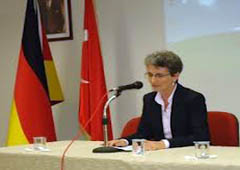
According to a report by Buratha news website, Wagner praised in a statement the performance of the United Nations Assistance Mission in Iraq (UNAMI) in monitoring transfer of the MKO members from Camp Ashraf, the terrorist group’s main training camp in Iraq, to the Camp Liberty, a transient settlement facility in Iraq.
"I would like to express the full support of the German federal government to the United Nations Assistance Mission in Iraq (UNAMI) that has monitored the transfer of Camp Ashraf residents to Camp Liberty," she said.
The MKO, founded in the 1960s, blended elements of Islamism and Stalinism and participated in the overthrow of the US-backed Shah of Iran in 1979. Ahead of the revolution, the MKO conducted attacks and assassinations against both Iranian and Western targets.
The group started assassination of the citizens and officials after the revolution in a bid to take control of the newly-established Islamic Republic. It killed several of Iran’s new leaders in the early years after the revolution, including the then President, Mohammad Ali Rajayee, Prime Minister, Mohammad Javad Bahonar and the Judiciary Chief, Mohammad Hossein Beheshti who were killed in bomb attacks by MKO members in 1981.
The group fled to Iraq in 1986, where it was protected by Saddam Hussein and where it helped the Iraqi dictator suppress Shiite and Kurd uprisings in the country.
The terrorist group joined Saddam’s army during the Iraqi imposed war on Iran (1980-1988) and helped Saddam and killed thousands of Iranian civilians and soldiers during the US-backed Iraqi imposed war on Iran.
Since the 2003 US invasion of Iraq, the group, which now adheres to a pro-free-market philosophy, has been strongly backed by neo-conservatives in the United States, who argued for the MKO to be taken off the US terror list.
The US formally removed the MKO from its list of terror organizations in early September, one week after Secretary of State Hillary Clinton sent the US Congress a classified communication about the move. The decision made by Clinton enabled the group to have its assets under US jurisdiction unfrozen and do business with American entities, the State Department said in a statement at the time.
In September 2012, the last groups of the MKO terrorists left Camp Ashraf, their main training center in Iraq’s Diyala province. They have been transferred to Camp Liberty which lies Northeast of the Baghdad International Airport.
Did Pentagon lobby for Mojahedin Khalq?
Letter to the editor
Mail on Sunday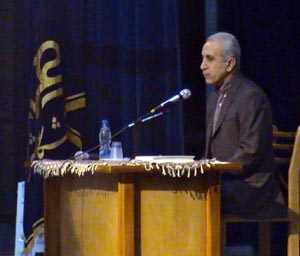
Mr. Geordie Greig.
An unpublished report produced by the US Library of Congress for the Department of Defense (the Pentagon), has been continuously quoted by the Mojahedin-e Khalq terrorist cult in their media since it was conveniently ‘leaked’ to the internet in January. The so-called ‘Pentagon report’ mentioned my name along with that of my brother and my sister-in-law, but because what was written was so obviously made-up to fulfill the agenda of the MEK themselves, I chose to ignore it.
Then in an article dated February 16, 2013, the British newspaper Mail-on-Sunday also referred to this report and again this has been widely used by the cult in its media. Amused by the dramatic tabloid headline "British 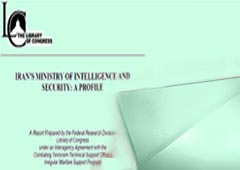 housewife accused by the US of spying for Iran ‘to save her brother-in-law’s life’", I had a closer look to find out why this article had been published six weeks after the report was first leaked.
The US report claims that in 2002: "She (i.e. my sister in law Anne Singleton) agreed to cooperate with MOIS (Iran’s ministry of intelligence) to save her brother-in-law’s life – he (i.e. me, Ebrahim Khodabandeh) was still a member of MEK at the time."
In 2002 I was living in one of the MEK’s bases in London. This means that my life was in danger inside the MEK in the UK!
In my opinion the Mail-on-Sunday article was published specifically to cover up this gaffe. It even points to this in the title.
At the start of the article it says: "Anne Singleton, 53, is alleged to have been blackmailed into training with the Iranian secret service during a visit to Tehran in 2002. The Pentagon-commissioned report claims that Mrs Singleton and her Iranian husband, Massoud Khodabandeh, 56, agreed to work for the regime in return for saving the life of his jailed brother." [bold added]
Not only is this untrue, it is yet another gaffe. The original report did not say that I was in jail at that time and the author of the article either did not bother to read the actual report, or was probably as confused as everyone else who read it as to what it was actually trying to say.
The fact is that I was arrested in Syria and taken to prison in Iran in June 2003.
In the year 2002 I was still a member of the MEK living in their collective base in London. My brother and my sister-in-law who had both left the MEK had established the iran-interlink.org website and were active in exposing the violation of human rights inside Rajavi’s cult which had been going on for many years.
I can tell from my 23 years’ experience and as one of the key personnel in the MEK’s Foreign Affairs Department in Europe that the gaffes made in the report and in the article both originated from the MEK.
Ebrahim Khodabandeh
February 20, 2013
United States uses MKO to spread terror and chaos inside Iran: Paul Sheldon Foote
Terrorist organizations are in the job of doing terror. In recent years they have been inside Iran conducting 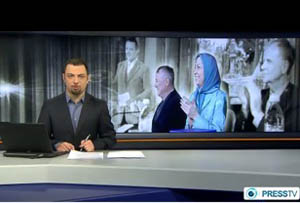 terrorist activities, bombing up places. The fact that they are Iranians, the fact that their native language is Persian means that they can move in and out of Iran a lot easier than anyone else could and so this would be a continuation of (the United States) using them inside Iran to kill people and blow up buildings.”
An analyst says the recent US, MKO meeting signifies that Washington is trying to use the organization for killings and bombings inside Iran as acts of terrorism are what terrorist groups typically do.
The comment comes as a bipartisan group of US congress members has met with the anti-Iran terrorist group Mujahedin-e Khalq Organization (MKO) in France.
The congressional team led by Dana Rohrabacher, a California Republican, met the MKO terrorists in Paris on Sunday and expressed strong support for the group.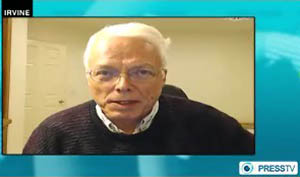
The MKO is listed as a terrorist organization by much of the international community.
On September 28, the terrorist group was taken off the US State Department’s terrorism blacklist a week after US Secretary of State Hillary Clinton sent the US Congress a classified memo about the move.
Press TV has conducted an interview with Professor of California State University Paul Sheldon Foote to further discuss the issue. What follows is an approximate transcription of the interview.
Press TV: Sir welcome to the program. Well the MKO is well-known for carrying out a long list of terror acts. How do you see the sequence of events that led to Europe and the United States delisting the MKO from their list of terrorist organizations and also about the timing of this meeting in France?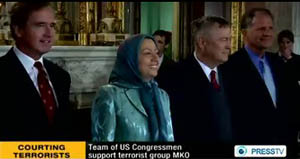
Foote: The problem America has had for very many years is that the Iraqi government has said you say we are a free country now well why do we have to keep Iranian communists, free terrorists in our land and there have been frequent action for some of the Mujahidin cult terrorists have been killed by Iraqi troops.
So America keeps trying. It’s a real shame that Dana Rohrabacher who claims to be a Republican from Southern California is continued being reelected. It shows you how stupid Republican voters are when you have Republicans supporting communist terrorists.
Press TV: And what do you think the United States has in mind next for the MKO?
Foote: Terrorist organizations are in the job of doing terror. In recent years they have been inside Iran conducting terrorist activities, bombing up places. The fact that they are Iranians, the fact that their native language is Persian means that they can move in and out of Iran a lot easier than anyone else could and so this would be a continuation of using them inside Iran to kill people and blow up buildings.
An Iranian exile group attacked in Iraq this month has moved from terrorism lists to international good graces, but Baghdad wants it out over its opposition to Iran’s rulers and ties to Saddam Hussein.
On February 9, mortar rounds and rockets slammed into Camp Liberty, a former US military base near Baghdad that now houses some 3,000 members of the People’s Mujahedeen Organisation of Iran (PMOI), killing five people, according to Iraqi security officials.
The attack triggered condemnation from the United States and United Nations, but in Iraq officials are eager to see the group depart.
The PMOI’s "presence in Iraq is illegal and illegitimate," Ali Mussawi, Prime Minister Nuri al-Maliki’s spokesman, told AFP. "Their presence is rejected."
Iraqi political analyst Ihsan al-Shammari said the "nature of the relationship between the (Iraqi) Shiite political powers and Iran," Baghdad’s Shiite neighbour to the east with which it has close ties, is a key factor in Iraq’s insistence on the PMOI’s ouster.
Shammari also noted other factors including the PMOI’s links to executed dictator Saddam, under whose rule Iraq’s now-empowered Shiite majority was oppressed.
Saddam allowed the PMOI to establish a base called Camp Ashraf northeast of Baghdad after he launched the 1980-88 war with Iran, in which the group fought alongside his forces.
According to the US State Department, Saddam armed the group with "heavy military equipment and deployed thousands of (PMOI) fighters in suicidal, mass wave attacks against Iranian forces" near the end of the war.
Following the 2003 US-led invasion of Iraq, the PMOI turned over "2,000 tanks, armoured personnel carriers, and heavy artillery," the State Department said.
The group was also allegedly involved in Saddam’s violent suppression of 1991 Shiite and Kurdish uprisings in Iraq.
"The former regime used (the PMOI) to carry out repression" in Iraq, said Dr Adnan al-Saraj, who has written books about the group.
Saddam gave the PMOI four bases in Iraq, buildings in central Baghdad and other perks including Iraqi passports and free petrol, Saraj said.
Almost all PMOI members in Iraq have moved to Camp Liberty from Camp Ashraf, the last of their bases, as part of a UN-backed process that aims to see them resettled outside the country.
But after this month’s attack, the PMOI complained about the slow pace of the process, which has dragged on as few countries have come forward with concrete offers of resettlement.
The PMOI has not taken the move from Camp Ashraf, where some members have lived for decades, quietly, alleging Baghdad is acting at Tehran’s behest.
It has also criticised the UN’s assertion that the camp meets minimum humanitarian standards and complained about a variety of alleged shortcomings including restrictions on using forklift trucks, which it said amounted to "torture".
While not accepted in Iraq, the PMOI has made strides internationally.
The group, which was founded in the 1960s to oppose the shah of Iran but took up arms against the country’s new clerical rulers after the 1979 Islamic revolution, successfully campaigned for its removal from US and EU terrorism lists.
The PMOI said it renounced violence in 2001 after carrying out attacks in Iran and elsewhere for decades. It now issues deluges of statements to the media and has enlisted well-known western politicians and officials as advocates.
The language of the official US condemnation of the attack on Camp Liberty also indicates the progress made by the PMOI, which was listed as a "terrorist organisation" by Washington until last year and by the EU until 2009.
The US State Department condemned it as a "terrorist attack," and also referred to the attack as a "tragedy".
Although the PMOI has gained international acceptance, Karim Sadjadpour, an Iran expert and senior associate with the Carnegie Endowment for International Peace, said the same is not true within Iran.
"They’re widely viewed as a backward and intolerant cult by their opposition peers in Iran," Sadjadpour said.
By W.G. Dunlop – Dailystar.com
The congressional team led by Dana Rohrabacher, a California Republican, met the MKO terrorists in Paris on Sunday and expressed strong support for the group.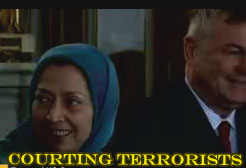
The US congress members called for the immediate transfer of the MKO terrorists to Camp Ashraf in Iraq’s Diyala Province. The American legislators even threatened to declare Iraq’s Prime Minister Nouri al-Maleki a sponsor of terrorism after an attack on the terrorist members inside another camp in Iraq.
The mortar attack, which happened earlier this month on Camp Liberty near Baghdad, left at least seven members of the terrorist group dead and more than 50 others wounded.
Members of the MKO terrorist group are being transferred from Camp New Iraq, formerly known as Camp Ashraf, which is situated about 120 kilometers (74 miles) west of the border with Iran, to Camp Liberty near Baghdad Airport.
The MKO is listed as a terrorist organization by much of the international community.
On September 28, the terrorist group was taken off the US State Department’s terrorism blacklist a week after US Secretary of State Hillary Clinton sent the US Congress a classified memo about the move.
The MKO fled to Iraq in 1986, where it received the support of Iraq’s executed dictator Saddam Hussein, and set up its camp near the Iranian border.
The MKO has carried out numerous acts of violence against Iranian civilians and government officials.
Investigate the MEK and its critics – abuses at Camp Liberty cannot continue
A missile attack on Camp Liberty on 9th February resulted in the tragic deaths of seven residents. Seven more 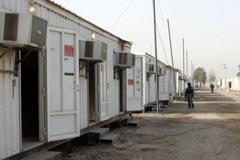 families have been plunged into grief and dismay over losing their loved ones. Their grief compounded by the fact that, whatever their wishes, they will have had no contact with this loved one for several years. And compounded by the fact there appears to be no acceptable explanation why they had to die at all but especially in such a tragically avoidable way.
The problem with the MEK in Iraq is not so much where they are, but that they are still there at all. Even the MEK’s own supporters understand this logic. Speaking to an MEK rally in the US, long time MEK advocate Rudi Giuliani said, "These people can all be removed within hours… Planes can be sent immediately. They can be here within a day. We have done far more difficult things than that. It’s only about 3,000 people".
Moves to relocate the MEK and send them to third countries started two years ago. Officials from the United Nations and the government of Iraq collaborated to undertake the calm and unhurried negotiation needed to achieve their peaceful relocation first out of Camp Ashraf to a temporary transit camp – Camp Liberty – and then on to third countries where they can rebuild their lives in safety and security. Their every effort has been met by obstruction and obfuscation by the MEK leadership. Two years on and the residents are still no closer to gaining their actual freedom. Even worse, many have died and will continue to die as long as they are unable to walk freely out of the camp and get the help that is available to them. (The Iraqi authorities have kept alternative accommodation available for two years for the individual residents.)
Describing the attack as “vicious and senseless”, US State Department spokesperson Victoria Nuland said, “We call on [the Government of Iraq] to earnestly and fully carry out that investigation and to take all appropriate measures to enhance the security of the camp consistent with its commitment and obligation to the safety and security of the camp’s residents. The terrorists responsible for this attack must be brought to justice.”
It is essential that a thorough investigation be made into this latest attack and the perpetrators brought to justice. More than anything this is necessary for the families of the victims. They need the facts and they need justice. But above all else they need answers. Any family suffering the sudden and violent loss of a loved one will ask ‘Why?’ Why did they die in this way?
The only person preventing the residents in Camp Liberty from leaving and taking refuge in a safe place is the leader of the MEK, Massoud Rajavi. He is therefore the only person who can answer this question. Only he can explain to all the suffering families why their loved ones are still in the path of danger. Why, after ten years, they are still unable to walk freely from the camp and continue their lives in freedom and safety. Why is he still holding them hostage and what did these seven individuals die for?
While we wait for a reasoned, satisfactory answer – which will never be forthcoming – the focus must return to the living. While the Government of Iraq pursues its thorough, painstaking investigation into the deaths of these seven victims, international human rights investigators must likewise undertake a rigorous investigation into the never ending allegations of unbearable daily systematic abuses against all the residents of the camp, including the leadership cadre.
While the MEK persists in denying access to the relevant external agencies to freely enter Camp Liberty and talk to the residents without hindrance, this investigation can start with the recently escaped members. Many of them are now resident in Europe as well as in Iraq and Iran and are willing to give testimony to their experience of human rights abuse inside the MEK camps.
Human Rights Watch conducted a scrupulous and methodological investigation into allegations of human rights abuse resulting in the report ‘No Exit’ in 2005. Testimony from former members in Europe formed the basis of the report. HRW rigorously checked them, their background and their information. A similarly professional approach toward the more recent escapees will yield further evidence of abuse. One of the more controversial but easily verifiable allegations is that the MEK leader instigated a programme of spurious hysterectomy operations to ‘neutralise the gender’ of women members. Already the names of a hundred women victims have been compiled (out of around 800). Medical records and examination will verify the conditions surrounding these operations. Around thirty women who now live in Europe have declared themselves willing to participate in such an investigation. They want justice, for themselves and for the other women still trapped in Camp Liberty.
These women, the families and the former members challenge international human rights organisations to be fearless and determined. Every aspect of this sad debacle must be examined from every angle; the MEK itself and its critics. Such an investigation is long overdue and can only help to end the existing stalemate at Camp Liberty.
Anne Khodabandeh (Singleton), Middle East Strategy Consultants