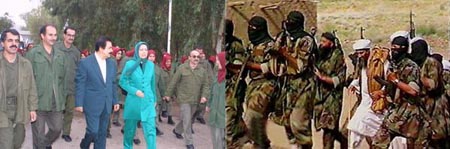
The MKO terrorist cult threatened Iraqi newsmen who had released documents indicating that the Mujahedin-e Khalq Organization (MKO) had a hand in suppressing Iraqi Shiites’ Intifada [in 1991]. According to Albayyenah newspaper, the MKO terrorist group made death threats to Iraqi newsmen through the internet and their mobile phones as well. These newsmen had published documents on the MKO having a hand in suppressing the Intifada of Iraqi Shiites. Albayyenah also adds: As a result of these open threats, the Iraqi Newsmen’s Union will condemn the MKO’s recent measure through issuing a formal statement. The MKO terrorist cult has also already threatened Ali Dabbagh, an Iraqi government spokesman who is also responsible for Iraq’s Research Center, with death because of opposing the Monafeghin’s remaining in Iraq.
News on the MEK
In a new humanitarian move taken by Anne Singleton and Massoud Khodabandeh, ex-members of MKO, they strive to help other members of the terrorist MKO held against their will within the walls of Camp Ashraf in Iraq detach from the group. Their move is appreciated by a number of other oppositions including Alireza Nourizadeh who has long been revealing facts on MKO and voicing urgency to help dissatisfied members whose destiny is unclear.
Nourizadeh’s remarks stated on humanitarian grounds rather than a political notion has filled MKO with indignation and the group showed a harsh and insulting backlash against him in its media as it is its typical. Regardless of any political stance, the move by Sahar Family Foundation (SFF) run by the Khodabandehs for the survival of the reminders of their comrades from the clutches of the terrorist cult of Mojahedin is a worthwhile activity.
Mojahedin.ws- March 5, 2008
Ahmadinejad and his Iraqi counterpart condemn an Iranian opposition group under U.S. guard northeast of Baghdad.
BAGHDAD” The presidents of Iran and Iraq today harshly condemned an Iranian opposition group here which has ties to U.S. neoconservatives and remains under the shelter of American forces.
President Mahmoud Ahmadinejad, who arrived here today on a historic visit, blasted the Mujahedin Khalq Organization, as munafiqin, or hypocrites. The term refers to an account in the Koran of a group who pretended to follow the Prophet Mohammed’s teachings only to betray Muslims.
Talabani, appearing with Ahmadinejad at a press conference, repeated the insulting word and added, "The presence of this terrorist organization is prohibited according to the constitution and we are seeking to get rid of them soon."
The armed opposition group, which sometimes goes by the abbreviations MKO, MEK or PMOI, fought the Iranian government during the 1980s, when it received shelter from Saddam Hussein. Both Europe and the U.S. State Dept. list the group as a terrorist organization.
But as tensions between the U.S. and Iran have mounted, some in Washington have cultivated ties with the group and advocated using them to destabilize the Tehran government. Numbering up to 3,000, they remain under U.S. guard at their former base northeast of Baghdad.
Before the press conference, Ahmadinejad strode up a red carpet and into the Iraqi presidential compound today for the start of what may be the first-ever visit by an Iranian head of state to Iraq. The deposed late Shah Mohammed Reza Pahlavi fled briefly to Iraq in 1953 amid political turmoil in Tehran.
Iran and Iraq fought a brutal eight-year war during the 1980s that left up to 1 million people in both countries dead and maimed. The United States accuses Iran of meddling in Iraq’s political affairs and violence.
But there was no sign of lingering animosity during today’s lavish arrival. Iraq’s president, Jalal Talabani, smiled broadly as he guided his guest from a dark sedan into his compound in Baghdad’s Karada district. Iran sheltered many leaders of the current Baghdad government during Hussein’s rule.
"We welcome them and all who helped the Iraqi people during the hard days when the Iraqis were displaced and deprived from all human rights," Talabani said at the press conference, which was aired live on Iraqi television. "We think that this visit will produce good results and the preliminary discussions have had good results."
Ahmadinejad, a divisive figure in his home country and internationally, steered clear of controversies during his first appearance. Iranian officials say the primary purpose of the visit is to enhance economic ties between Iran and Iraq. Since Hussein’s ouster five years ago, trade between the two countries has reached about $8 billion a year, and Iran recently announced a $1 billion loan to Iraq.
"It seems that the Iraqi people are passing through critical circumstances," Ahmadinejad told reporters. "But according to our knowledge with the Iraqi people we know that they have huge natural and human abilities and they will overcome these circumstances."
In a striking departure from other high-profile visitors to Iraq, Ahmadinejad did not use a helicopter to come into the center of the city from the airport. Instead, his convoy used the airport road, once notorious for bombs and other attacks and heavily patrolled by U.S. forces. He also did not head into the heavily protected Green Zone, going instead to Talabani’s home outside the fortified area.
A military band played rousing anthems as Ahmadinejad shook countless hands on his way into the building. Amid the stern-looking security men who surrounded the entourage, there was a notable omission: U.S. troops, who usually form the bulk of protection forces for high-profile guests in Iraq.
This time, the U.S. military made clear it would not be involved in protecting the Iranian president, who denies White House claims that his country has provided lethal bombs as well as training and financing to Shiite militias in Iraq.
Iraq’s government has also accused Iran of fomenting violence here and has indicated that the topic will be up for discussion during Ahmadinejad’s two-day visit.
"This should be presented at the table and discussed and negotiated," the Iraqi government spokesman, Ali Dabbagh, said recently when asked what would be on the agenda. "This is something that worries us in Iraq. We need to find a way to stop all this," he said, referring to alleged arms smuggling over the Iranian border.
Talabani, who visited Tehran in June, will host Ahmadinejad. The Iraqi president’s ties to Iran stretch back to the 1980s, when he and other Kurds as well as Iraqi Shiite Muslim political parties and militias sought refuge there and fought alongside Iranian forces against Saddam Hussein’s army. On Saturday, on the eve of Ahmadinejad’s visit, Talabani met with both the U.S. and British ambassadors to Iraq.
By Tina Susman and Borzou Daragahi, Los Angeles Times Staff Writers, March 2, 2008
http:www.latimes.comnewsnationworldworldla-fg-iraniraq3mar03,0,4974258.story
Also on:
http:www.chicagotribune.comnewsnationworldla-fg-iraniraq3mar03,1,715485.story
tina.susman@latimes.com, daragahi@latimes.com
A member of Iraqi parliament criticizes the Turkish incursion against PKK rebels in northern Iraq, stressing that Iraq’s territories should not be used to attack neighboring countries.
“Before attacking northern Iraq, Turkey was supposed to attempt resolving the crisis by exercising the bilateral cooperation and diplomatic measures to prevent PKK from threatening Turkey’s security, a crucial measure that has regrettably not adopted,”said Abdul Aziz Al- Enzi, an Iraqi MP on Sunday evening to Alalam TV.
He said that Iran has also expressed concerns over ‘Mujahedin Khalgh’ an Iranian opposition terrorist group (MKO) to employ Iraq’s territories to target some ends in Iran.
“Iraqi government should adopt swift measures to resolve this crisis,”he said. Al- Enzi stressed that any delay in resolving the MKO terrorists and PKK rebels’ crisis would have negative affect on Iraq- Turkey and Iraq- Iran ties.
“Iraq’s Foreign Ministry should try to find a way out of this crisis to avoid such accidents with the adjacent countries,”he added.
Al- Enzi rejected any rumors, saying,”Iraqi President Jalal Talabani has demanded Turkish government to suppress the PKK in northern Iraq,”stressing that the president strongly respects Iraq’s sovereignty.
He pointed out that the US has double standard policy towards Iraqi armed insurgents and US troops protect some armed militants such as the PKK rebels and MKO terrorists.
“Iraqi government is not able to resolve the crisis of the armed groups, because it has not power to control the whole country,”he concluded.
alalam-February 25, 2008
WASHINGTON, Feb 29 (IPS) – The George W. Bush administration has long pushed the "laptop documents" — 1,000 pages of technical documents supposedly from a stolen Iranian laptop — as hard evidence of Iranian intentions to build a nuclear weapon. Now charges based on those documents pose the only remaining obstacles to the International Atomic Energy Agency (IAEA) declaring that Iran has resolved all unanswered questions about its nuclear programme.
But those documents have long been regarded with great suspicion by U.S. and foreign analysts. German officials have identified the source of the laptop documents in November 2004 as the Mujahideen e Khalq (MEK), which along with its political arm, the National Council of Resistance in Iran (NCRI), is listed by the U.S. State Department as a terrorist organisation.
There are some indications, moreover, that the MEK obtained the documents not from an Iranian source but from Israel’s Mossad.
In its latest report on Iran, circulated Feb. 22, the IAEA, under strong pressure from the Bush administration, included descriptions of plans for a facility to produce "green salt", technical specifications for high explosives testing and the schematic layout of a missile reentry vehicle that appears capable of holding a nuclear weapon. Iran has been asked to provide full explanations for these alleged activities.
Tehran has denounced the documents on which the charges are based as fabrications provided by the MEK, and has demanded copies of the documents to analyse, but the United States had refused to do so.
The Iranian assertion is supported by statements by German officials. A few days after then Secretary of State Colin Powell announced the laptop documents, Karsten Voight, the coordinator for German-American relations in the German Foreign Ministry, was reported by the Wall Street Journal Nov. 22, 2004 as saying that the information had been provided by "an Iranian dissident group".
A German official familiar with the issue confirmed to this writer that the NCRI had been the source of the laptop documents. "I can assure you that the documents came from the Iranian resistance organisation," the source said.
The Germans have been deeply involved in intelligence collection and analysis regarding the Iranian nuclear programme. According to a story by Washington Post reporter Dafna Linzer soon after the laptop documents were first mentioned publicly by Powell in late 2004, U.S. officials said they had been stolen from an Iranian whom German intelligence had been trying to recruit, and had been given to intelligence officials of an unnamed country in Turkey.
The German account of the origins of the laptop documents contradicts the insistence by unnamed U.S. intelligence officials who insisted to journalists William J. Broad and David Sanger in November 2005 that the laptop documents did not come from any Iranian resistance groups.
Despite the fact that it was listed as a terrorist organisation, the MEK was a favourite of neoconservatives in the Pentagon, who were proposing in 2003-2004 to use it as part of a policy to destabilise Iran. The United States is known to have used intelligence from the MEK on Iranian military questions for years. It was considered a credible source of intelligence on the Iranian nuclear programme after 2002, mainly because of its identification of the facility in Natanz as a nuclear site.
The German source said he did not know whether the documents were authentic or not. However, CIA analysts, and European and IAEA officials who were given access to the laptop documents in 2005 were very sceptical about their authenticity.
The Guardian’s Julian Borger last February quoted an IAEA official as saying there is "doubt over the provenance of the computer".
A senior European diplomat who had examined the documents was quoted by the New York Times in November 2005 as saying, "I can fabricate that data. It looks beautiful, but is open to doubt."
Scott Ritter, the former U.S. military intelligence officer who was chief United Nations weapons inspector in Iraq from 1991 to 1998, noted in an interview that the CIA has the capability test the authenticity of laptop documents through forensic tests that would reveal when different versions of different documents were created.
The fact that the agency could not rule out the possibility of fabrication, according to Ritter, indicates that it had either chosen not to do such tests or that the tests had revealed fraud.
Despite its having been credited with the Natanz intelligence coup in 2002, the overall record of the MEK on the Iranian nuclear programme has been very poor. The CIA continued to submit intelligence from the Iranian group about alleged Iranian nuclear weapons-related work to the IAEA over the next five years, without identifying the source.
But that intelligence turned out to be unreliable. A senior IAEA official told the Los Angeles Times in February 2007 that, since 2002, "pretty much all the intelligence that has come to us has proved to be wrong."
Former State Department deputy intelligence director for the Near East and South Asia Wayne White doubts that the MEK has actually had the contacts within the Iranian bureaucracy and scientific community necessary to come up with intelligence such as Natanz and the laptop documents. "I find it very hard to believe that supporters of the MEK haven’t been thoroughly rooted out of the Iranian bureaucracy," says White. "I think they are without key sources in the Iranian government."
In her February 2006 report on the laptop documents, the Post’s Linzer said CIA analysts had originally speculated that a "third country, such as Israel, had fabricated the evidence". They eventually "discounted that theory", she wrote, without explaining why.
Since 2002, new information has emerged indicating that the MEK did not obtain the 2002 data on Natanz itself but received it from the Israeli intelligence agency Mossad. Yossi Melman and Meier Javadanfar, who co-authored a book on the Iranian nuclear programme last year, write that they were told by "very senior Israeli Intelligence officials" in late 2006 that Israeli intelligence had known about Natanz for a full year before the Iranian group’s press conference. They explained that they had chosen not to reveal it to the public "because of safety concerns for the sources that provided the information".
Shahriar Ahy, an adviser to monarchist leader Reza Pahlavi, told journalist Connie Bruck that the detailed information on Natanz had not come from MEK but from "a friendly government, and it had come to more than one opposition group, not only the mujahideen."
Bruck wrote in the New Yorker on Mar, 16, 2006 that when he was asked if the "friendly government" was Israel, Ahy smiled and said, "The friendly government did not want to be the source of it, publicly. If the friendly government gives it to the U.S. publicly, then it would be received differently. Better to come from an opposition group."
srael has maintained a relationship with the MEK since the late 1990s, according to Bruck, including assistance to the organisation in beaming broadcasts by the NCRI from Paris into Iran. An Israeli diplomat confirmed that Israel had found the MEK "useful", Bruck reported, but the official declined to elaborate.
*Gareth Porter is an historian and national security policy analyst. The paperback edition of his latest book, "Perils of Dominance: Imbalance of Power and the Road to War in Vietnam", was published in 2006.
By Gareth Porter-IPS-Feb 29
Is UK inviting Massoud Rajavi to London today?
An appeal panel’s decision to remove the main Iranian opposition movement from the UK’s list of banned terrorist organisations was challenged by the Government in the Court of Appeal today.
Lawyers for Home Secretary Jacqui Smith argued that the People’s Mujahideen of Iran (PMOI) had not given "a clear and unequivocal denunciation of terrorism".
Last November, a cross-party group of 35 MPs and peers won a ruling from the Proscribed Organisations Appeal Commission (POAC) that the PMOI should be delisted and that the Government’s decision to keep it on the proscribed list was "perverse".
But Home Office counsel Jonathan Swift told the Lord Chief Justice, Lord Phillips, today that the Government feared the PMOI’s professed cessation of terrorist activities was temporary and "for pragmatic reasons".
Lord Phillips, sitting with Lord Justice Laws and Lady Justice Arden, heard that the pro-democracy PMOI was formed 40 years ago with the aim of replacing the then-government of the Shah of Iran. During the 1970s, it carried out a number of violent attacks against the Shah’s government and its western allies.
After the current regime came to power in 1979, the PMOI was engaged in a 20-year campaign of violence, internal and external, against the government.
Since the mid-1980s, it had also maintained an armed force in Iraq until it gave up its arms to US invaders in 2003.
The PMOI insisted it had been involved in no military activities since 2001 and that it had publicly denounced terrorism. The American authorities had granted special protected status to 3,000 of its members still held in Camp Ashraf, Iraq.
But Mr Swift told the judges that, in the light of the organisation’s history, the Home Secretary could not accept its assertion that it had undergone a significant and radical change of direction.
The POAC’s ruling followed a European court decision in December 2006 that the PMOI should come off the EU terror blacklist. Despite that ruling, it remains on the EU list.
The hearing, set for three days, was adjourned until tomorrow. The judges are expected to reserve judgment on Wednesday.
By Mike Taylor, PA-Press Association National Newswire
BAGHDAD – Iraqi police arrested 31 Shiite activists Saturday in early morning raids south of Baghdad, and five American soldiers were killed in two roadside bombings, officials said.
The U.S. troops were killed Friday – four in Baghdad and one in the northern Tamim province, the military said. At least 3,958 members of the U.S. military have died since the beginning of the Iraq war in March 2003, according to an Associated Press count. Saturday marked a third day of U.S. and Iraqi operations in an area that includes several Shiite holy cities – raising tension with some Shiite tribesmen and fighters who have pledged to halt attacks. Radical Shiite cleric Muqtada al-Sadr ordered a six-month cease-fire for his Mahdi Army militia, but some members have broken away and violated the pledge, which expires later this month. U.S. and Iraqi forces say they are targeting rogue, criminal elements of his and other militias. But several Shiite imams, during Friday prayers, suggested Iraqi forces were taking advantage of the cease-fire to crack down on rival groups. Al-Sadr has threatened not to extend his cease-fire unless the government purges rival Shiite militiamen he alleges have infiltrated the security forces and are targeting his followers. Fifteen of Saturday’s arrests took place in Karbala, a Shiite holy city 50 miles south of Baghdad, where Shiite Islam’s two most revered saints are buried. Another 16 men were arrested in a Sadrist area of Nasiriyah, about 200 miles southeast of the capital, police said. Rahman Mshawi, spokesman for Karbala police, said four of the Karbala suspects are members of the Iraq-based People’s Mujahedeen Organization of Iran, or Mujahedeen Khalq. The group was founded in the late 1960s and fled to Iraq in the early 1980s after it fell out with the clerical regime of Ayatollah Ruhollah Khomeini. During Saddam Hussein’s rule, the movement used Iraq as a base for operations against Iran’s government. Thousands of its members remain in Iraq, and both the U.S. and Iraq consider the Khalq a terrorist organization. In addition to the Khalq members, Mshawi said five others detained Saturday belong to a Shiite cult group. He did not elaborate or give details about the group. The remaining six suspects were "wanted men," Mshawi said. Meanwhile north of Baghdad, Iraqi police said a local al-Qaida in Iraq leader was killed in his home, and 12 decomposed bodies were discovered in a mass grave. Abu Omar al-Dori resisted police for about an hour before he was killed around 4 a.m. in his house in downtown Samarra, a police officer said. He spoke on condition of anonymity because he was not authorized to speak to media. Samarra is a mostly Sunni town about 60 miles north of the Iraqi capital. According to Iraqi police, al-Dori had been assigned to lead al-Qaida in Iraq operations in Samarra just one week ago. It was unclear whether his predecessor was killed or captured. Farther east near Baqouba, a joint patrol of Iraqi police and soldiers found a mass grave with 12 bodies, including three of women, according to police and morgue officials. The bodies were found in the al-Ehaimer area on the outskirts of Baqouba, 35 miles northeast of the capital. The U.S. military had no immediate comment on either incident. Meanwhile, Iraqi President Jalal Talabani traveled Saturday to Najaf, another Shiite holy city south of Baghdad, to meeting with Grand Ayatollah Ali al-Sistani, Iraq’s most prominent cleric. It was unclear whether the meeting was scheduled in light of the recent Shiite arrests. Talabani was expected to hold a news conference later Saturday By SINAN SALAHEDDIN, The Associated Press -2008-02-09
Iraqi police has announced the arrest of a number of Mujahedin Khalq Organization (MKO) members in a raid on rogue elements in Karbala. Karbala police spokesperson, Rahman Mshawi said four of the fifteen detainees are affiliated with the MKO terrorists. Other sources claim six members of the group were arrested in the raid. The European Union, the United States and other members of the international community have blacklisted the MKO as a terrorist organization. The group, which assisted Saddam in the massacre of thousands of innocent Iraqis, is responsible for several acts of terror in Iran including the 1994 bombing of Imam Reza’s holy shrine in Mashhad. Press TV -Sat, 09 Feb 2008
TEHRAN (FNA)- Iraqi officials have issued warrants for arresting three members of an anti-Iranian terrorist group called the Mojahedin-e Khalq Organization (MKO), and the court order is viewed by observers as to be testing the United States’ honesty in restoring calm and security in Iraq. The Iraqi criminal court issued warrants for the arrest of Mozhgan Parsayee,
Abbas Davari and Sediqeh Hosseini, who are deemed to be among leaders of the terrorist group, following the several complaints lodged by the relatives of a number of MKO members. While different peace-seeking groups and the plaintiffs are demanding implementation of the court ruling, the arrest warrants will produce no results unless the US troops show cooperation, and this has faced the US with a new challenge to prove its allegations about the fight against terrorism in Iraq. Despite the slogans frequently chanted by the US about a so-called tough campaign against terrorism, ever since the US invasion of Iraq and the fall of former Iraqi dictator Saddam Hussein, Washington has always shielded the MKO and provided backup and support for the terrorist group in a bid to use them for materializing its goals. The Bulgarian military commander in Iraq admitted in May 2006 that his forces are protecting the MKO at the request of the US central command in Iraq. Bulgaria had withdrawn most of its forces from the occupied Iraq by the end of 2005, but 154 of its soldiers still remain as security guards for the Ashraf camp where 3500 MKO terrorists are based. MKO terrorists have martyred many innocent Iranians over the past 25 years and had supported Saddam’s tyrannical Ba’th minority regime during the 8-year Iraqi imposed war on Iran in the 1980s. Fars News Agancy-10 Feb.2008
British Foreign Office announced on Tuesday that the British government still considers the banned MKO a terrorist organization. Mark Mallon Brown, British deputy foreign secretary for Asia and the United Nations, protested a recent verdict by the Commission for Reviewing the Status of Banned Organization. He noted that until the final verdict is issued about the Mujahedin-e Khalq Organization (MKO), the organization will be considered to be a terrorist organization. Lord Malloch Brown, a member of British House of Lords, pointed out that terrorism is something unacceptable; it does not matter who commits such offense. The British Prime Minister Gordon Brown had said earlier that the MKO has not changed its behavior, which makes it inelligible to be removed from the list of terrorist organizations. The UK has banned the MKO in line with a decision made by the European Union and another by the US, which is widely known to be cooperating with the terrorist organization, despite officially having it on its list terrorist entities.
PressTV- 06 Feb 2008