
MEK created a perfect garrison in the heart of Europe; they have made the French Parisian country side, Ouver Sur Oise, their headquarters to control their cult; they own over 30 phone lines and a powerful internet connection; there are houses aligned next to each other; the walls between the house have been removed so as the houses can serve as a hall in case of necessity; the complex is even equipped with rifle-pit and secret rooms; this is the place where Maryam Rajavi resides and directs her cult.
There are various teams who serve there: a team to control the members organizationally; a team to arrange foreign relations; a team to manage financial sources and money laundry. They have also formed a section for the protection of the forces; a section for controlling them and a political section.
In the eastern part, there are separate buildings which house the so-called members of the council where they get the orders of what to do and what to write. They are considered as the cult’s political and cultural arms. But when it is the turn for the more internal relations of the cult these people are called as lazy people without motivation, who should always be pushed to work.
The MEK has tried to keep the neighbors satisfied so they spent large amounts of money on gardening and decorating their houses; they have even helped the reconstruction of other buildings paying large sums to the Mayor. Of-course the satisfaction of the neighbors can not justify the existence of a terrorist cult in France. The cult has forced most of the members to stay.
Can anyone in Europe believe that there are some people who are not allowed to leave their house without permission? Can the Europeans believe that there are some people in Europe who are not allowed to get out of their house except for gathering and demonstrations? These people are living in Ouver Sur Oise. There are some supervisors who are assigned to control those who are not satisfied with the cult or who are likely to complain and also all the walls, doors and windows are always controlled by the protection guard.
All ordinary people in the camp have had no contact to the free society for years, so they can’t speak or understand French, and they are not able to solve their personal problems independently and this is one of the obstacles against their will to leave the cult. The French government is well aware of the internal structure of MEK and its cult-like practices and inhumane behavior in Ouver Sur Oise, but it hasn’t done any significant act to remove this base and even hasn’t banned their illegal activities. If the French government builds a refugee camp ( like TIPF in Iraq) near Auver Sur Oise camp, most of the forces will leave the base ( and this is what most of the defectors wish for their ex-comrades )
But the reason that the French government hesitates to do so is simply stated by a normal French authority:” if France does so, it implies that it is itself accused of helping MEK; in Iraq the fault was on Saddam Hussein who had protected MEK for his own benefits but in France the fault will be put on the current administration that surely will not accept it.” Therefore the defectors feel a heavy responsibility to denounce the camp and the inhuman treatments inside the camp and the crimes committed by MEK leaders who hide themselves there. Maybe the French authorities will be forced to open the doors of that horrible castle.
Translation – Nejat Society
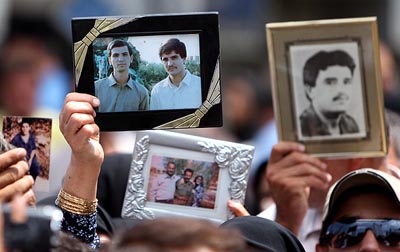


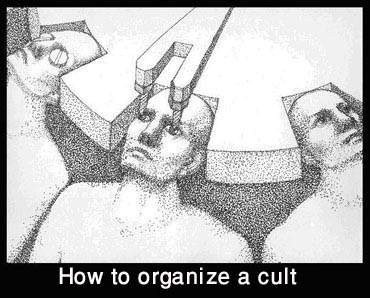 As part of the intense influence and change process in many cults, people take on a new social identity, which may or may not be obvious to an outsider. When groups refer to this new identity, they speak of members who are transformed, reborn, enlightened, empowered, rebirthed, or cleared. The group’ approved behavior is reinforced and reinterpreted as demonstrating the emergence of "the new person." Members are expected to display this new identity. 1 The new personality totally split from the outside world is manipulated for a variety of group tasks based on the objectives of the group and cult that consider the outsiders as the enemies who have to be confronted: The conflicts a mass movement seek and incites serve not only to down its enemies but also to strip its followers of their distinct individuality and render them more soluble in the collective medium. 2 As Hoffer asserts, a cultist personality is formed to be submissive to the inner-cultic relations that have priority to outwardly demonstrated ambitions and goals. The members undergoing overall identity change easily consent to any means of changing behaviour and conduct. Thus, cults can successfully accomplish their goal of binding new members to the group. Considering the stages people will go through as their attitudes are changed by the group environment and the thought reform processes, Singer points to psychologist Edgar Schein’s second stages of three: During this second stage, you sense that the solutions offered by the group provide a path to follow. You feel that anxiety, uncertainty, and self-doubt can be reduced by adopting the concepts put forth by the group or leader. Additionally, you observe the behavior of the longer, term members, and you begin to emulate their ways. As social psychology experiments and observations have found for decades, once a person makes an open commitment before others to an idea, his or her subsequent behavior generally supports and reinforces the stated commitment. That is, if you say in front of others that you are making a commitment to be "pure," then you will feel pressured to follow what others define as the path of purity. 3 There are also the eight psychological themes that psychiatrist Robert Lifton has identified as central to totalistic environments and cults invoke these themes for the purpose of promoting behavioral and attitudinal changes in the members. The third theme, demand for purity, depicts two opposite world of black and white; the cult being an absolutely white and clean world versus the black and evil world of outside. Of course, the members with a new personality have no other choice but to think and act according to cult’s ideology and drawn strategy: An us-versus-them orientation is promoted by the all-or-nothing belief system of the group: we are right; they (outsiders, nonmembers) are wrong, evil, unenlightened, and so forth. Each idea or act is good or bad, pure or evil. Recruits gradually take in, or internalize, the critical, shaming essence of the cult environment, which builds up lots of guilt and shame. Most groups put forth that there is only one way to think, respond, or act in any given situation. There is no in between, and members are expected to judge themselves and others by this all-or-nothing standard. 4 The process of producing identity within MKO follows the same mechanism in the cults and its orientation began with the start of the internal ideological revolution. All the members undergoing the revolution process admitted their identity change, that there does exist a long distance between their organizational and personal identities. It was instilled into them that their identity would be prompted based on the extent of adherence to the ideological system of the group and denial of any personal identity. In a text written by a member of MKO in self-denial we read: Personality, egocentrism, self-reliance and individualism are all souvenirs of the bourgeoisie’s worthless humanism that distanced me from the organization as far as its degree of its impact on me. It was like a chaff that barred me to drink the pure, life-giving instructions of the organization and was leaving me alone in a desolate waste-land with no way out. I was enslaved by dominant ambiguities within me. When I failed to overcome the ongoing struggle inside me, I was even more vulnerable to the outside misfortunes and could not even face them. 5 The member’s confession well depicts his identity destabilization and what psychologists call an identity crisis. He looks back at his own world and values to find out that he has been wrong in the past. This process makes him uncertain about what is right, what to do, and which choices to make and of course, as he admits, only the cult-like instructions of the organization can lead him to what is inspired to be the right path. Consequently, he takes on a new organizational identity which he considers a change for the better. In the process, he, as the member of a cult, detaches from his most dear ideas and attachments which he discovers to have been nothing beyond a barren waste-land for the identity reborn, a utopia in the horizon he fails to dismiss easily. Masoud Banisadr, another separated member of MKO, in his memoir relates of the time when sat tearing whatever attached him to the past under the commands of the organization: This time I attacked my old photographs from my own childhood till marriage and up to then, my parents photographs as I wanted to deny all of them, my father who was perhaps responsible for my bourgeois tendencies and my mother who was responsible of my own ‘mild’ and ‘gentle’ behaviour known as liberal ones. Anna seeing me taking all those photographs and albums, with anger, was quietly crying, then when I attacked our marriage Album she start crying louder, and asked me to stop it. She said those are not just yours . . . but I was not listening to her and took everything and put them in a rubbish bag. 6 Quoting Lifton’s forth theme, through a cult’s instructions, members are told whatever connects them to their former lives is wrong and has to be avoided, a fact well affirmed by MKO’s ex-members: Through the confession process and by instruction in the group’s teachings, members learn that everything about their former lives, including friends, family, and nonmembers, is wrong and to be avoided. Outsiders will put you at risk of not attaining the purported goal: they will lessen your psychological awareness, hinder the group’s political advancement, obstruct your path toward ultimate knowledge, or allow you to become stuck in your past life and incorrect thinking. 7 That is why MKO refer to members’ solubility in the organizational identity as a “reborn” or “identity salvation”. The organization, being transformed into a cult, pursues the same cult mechanism of altering the members’ personal identity to produce a new identity. References: 1. Margaret Thaler Singer; Cults in Our Midst, JOSSEY-BASS, 2003, p. 78. 2. Eric Hoffer; The true believer, Harper &. Row, Publishers, New York, 1966, p. 112. 3. Margaret Thaler Singer; Cults in Our Midst, JOSSEY-BASS, 2003, p. 76. 4. Ibid, 71. 5. Mojahed, no. 252; Abdol-ali Maasoumi’s letter to the ideological revolution. 6. Masoud Banisadr; Memoirs of an Iranian Rebel. 7. Margaret Thaler Singer; Cults in Our Midst, JOSSEY-BASS, 2003, p. 72.