Ban Ki-moon demands investigation by Iraqi authorities into deadly attack on dissident base that left at least six dead. 
Ban Ki-moon, the UN secretary-general, has condemned a deadly attack on an Iranian dissident camp in the Iraqi capital and demanded an investigation by authorities.
"(Ban) strongly condemns the mortar attack today on Camp Liberty, the temporary transit facility near Baghdad for former residents of Camp Ashraf," his press office said in a statement after the attack on Saturday.
The US state department labelled the assault a "vicious and senseless terrorist attack," and called on Iraq to probe the attack and enhance security at the camp.
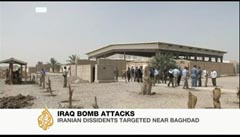
According to the Associated Press, at least six people were killed and dozens of others were injured when missiles struck the area occupied by the Mujahadeen e-Khalq (MEK) group near Baghdad.
A spokesman for the European Union foreign policy chief Catherine Ashton, also joined in the condemnation of the attack.
"We express our condolences to the families of the victims. We are concerned that it could add tension to the present situation in the camp," the EU spokesman said.
A spokesman for the interior ministry, however, said only one person had been killed and that reports of more deaths were "exaggerated".
There was no immediate claim of responsibility for the attack on the transit camp, a former American military base known as Camp Liberty, adjacent to Baghdad’s international airport.
The camp was the base that now-executed dictator Saddam Hussein allowed the group MEK to establish in Diyala province in the 1980s, during Iraq’s eight-year war with Iran.
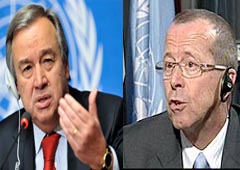
Martin Kobler, the top UN official in Iraq, told Al Jazeera that he was "shocked" by the attack.
"These people have to be protected," he said, calling on Iraqi authorities to "promptly conduct an investigation".
‘Terrorist group’
The camp is home to more than 1,000 residents from the MEK who were moved last year, on Iraq’s insistence, from their historic paramilitary camp of the 1980s – Camp Ashraf.
The MEK was founded in the 1960s to oppose the Shah of Iran, and after the 1979 Islamic revolution that overthrew him it took up arms against Iran’s rulers.
It says it has now laid down its arms and is working to overthrow the government in Tehran through peaceful means.
It is no longer welcome in Iraq under the Shia-led government that came to power after US-led forces invaded and toppled Saddam in 2003.
Al Jazeera’s Jane Arraf, reporting from Baghdad, said Iraq sees the MEK as a "terrorist group".
"They [MEK] say they’re in danger from the Iranians and the Iraqi government," she said.
The UN intends to process them for refugee status in other countries but no country has so far welcomed them.
Britain struck the group off its terror list in June 2008, followed by the European Union in 2009 and the US in September 2012.
The US state department holds the group responsible, however, for the deaths of Iranians as well as US soldiers and civilians from the 1970s into 2001.
The MEK has no support in Iran, and no connection to domestic opposition groups.
The Third View on Mujahedin Khalq
Lord Maginnis of Drumglass (Non-affiliated)
To ask Her Majesty’s Government what recent information they have concerning flooding by sewage and storm water at Camp Liberty, and whether they have made representations to the United Nations and the United
Nations Assistance Mission for Iraq about conditions at the camp.
Baroness Warsi (Conservative)
My Lords, we are aware that parts of Camp Liberty were flooded during a recent period of heavy rainfall, as were many parts of the Baghdad area. Fortunately, this did not affect residents’ accommodation blocks. We continue to monitor the situation at Camp Ashraf and Camp Liberty through the embassy in Baghdad and to raise issues with the Government of Iraq and the United Nations.
Lord Maginnis of Drumglass (Non-affiliated)
My Lords, is it not time that the Government made a judgment, based on first-hand evidence such as that produced by the ex-UNAMI chief Tahar Boumedra, and ignored the manipulation and dissembling by Martin Kobler on behalf of the Secretary-General of the United Nations? If the United Kingdom is to maintain its integrity and influence in the Middle East, we should be pressing for the dismissal of Herr Kobler and, indeed, be asking ourselves, with our allies, whether the present Secretary-General of the United Nations has not outlived his usefulness.
Baroness Warsi (Conservative)
Before I answer the noble Lord’s very important question, I am sure the rest of the House will want to join me in wishing him a very happy birthday.
The noble Lord raises an important point. The Secretary-General, whom I met with last week at the United Nations, is doing a very important job, with the support of the international community, in some very difficult circumstances. The specific situation in relation to Camp Liberty is that the Special Representative of the Secretary-General for Iraq, as part of the United Nations Assistance Mission, regularly reports about the situation in Camp Liberty and Camp Ashraf. Our own officials visited in July last year and the international community does not, at this stage, find any credible evidence to support the matters that have been raised by Mr Tahar Boumedra.
Lord Avebury (Liberal Democrat)
My Lords, considering that many of the complaints that are made by the residents of Camp Liberty and, indeed, Camp Ashraf, against the Iraqi authorities and UNAMI could be easily verified or refuted and that some have been confirmed not only by Mr Tahar Boumedra but by the UN Working Group on Arbitrary Detention, will the Government press for an inspector to be appointed by the UN Secretary-General to look into the serious allegations of ill treatment, such as denial of access to urgently needed medical treatment, which has lead to the deaths of two inmates of Camp Liberty? Since we have been aware for some time that 52 residents of Camp Liberty were formerly refugees in the United Kingdom, will my noble friend press for their immediate transfer to the UK?
Baroness Warsi (Conservative)
As my noble friend is aware, the situation in Camp Ashraf and Camp Liberty is in many ways much better than that of residents in Baghdad. For example, electricity is available for 24 hours a day, as opposed to the three hours for which it is available in some parts of Baghdad. About 200 litres of water are available to residents there, when about 90 litres are available in some parts of Baghdad. My noble friend raises the very important issue of the recent death of a resident there. We share those concerns about the death of Behrooz Rahimian and have made inquiries specifically in relation to the medical assistance that he received. We are aware that there is a doctor and medical facilities on site 24 hours a day; there is also the opportunity to receive medical assistance from doctors in Baghdad. We understand that Mr Rahimian was afforded medical assistance in relation to his illness.
Lord Foulkes of Cumnock (Labour)
My Lords, will the Minister confirm that the new Parliament in Baghdad will be built to a British design, that UK parliamentarians, including the noble Lord, Lord Kirkwood of Kirkhope, are out there helping to develop democracy and that the development of a democratic Government in Iraq to deal with the kind of issues raised by the noble Lord, Lord Maginnis, is the number one priority and will be supported fully by the British Government?
Baroness Warsi (Conservative)
I agree with much of what the noble Lord said. He will also be aware that this situation goes back many years. The group that lives in Camp Ashraf and Camp Liberty is an organisation that originally left Iran after the Iranian revolution. Mujaheddin e Khalq, the group that is predominantly part of Camp Ashraf and Camp Liberty, has its own history and record, and we must be incredibly careful about which members of that group we readmit to the United Kingdom.
Lord Dholakia (Liberal Democrat)
My Lords, does my noble friend agree that one of the problems we have is that the United Nations has not granted Camp Liberty the status of a refugee camp? It that were granted, would it not be possible to have adequate medical facilities and for water, sewerage et cetera to be resolved? At the same time, the status of Camp Ashraf could be looked at because the property of individuals is systematically being looted there, and the information the Minister has is not the information that we receive from residents of those camps.
Baroness Warsi (Conservative)
I can assure my noble friend that about 3,000 residents of Camp Ashraf have moved to Camp Liberty. It is not a refugee camp as such; it is a place where individuals are being assessed as to the countries to which they could be relocated. Four have already come to the United Kingdom, a fifth who was offered that has decided not to come and about 52 others are being considered for coming to the United Kingdom. In relation to property at Camp Ashraf, I can assure my noble friend that about 100 residents of this group remain in Camp Ashraf specifically to sell off their property.
David Anderson (Blaydon, Labour
(
To ask the Secretary of State for Foreign and Commonwealth Affairs what recent reports he has received on the condition of residents of Camp Ashraf and Camp Liberty; and what representations he has made to the Iraqi Government on that matter.
Alistair Burt (Parliamentary Under Secretary of State (Afghanistan/South Asia, counter terrorism/proliferation, North America, Middle East and North Africa), Foreign and Commonwealth Office; North East Bedfordshire, Conservative):
The UN visit Camp Liberty, where the majority of former residents of Camp Ashraf now live, several times a week, and report that facilities at the camp meet international humanitarian standards. For example, residents have access to electricity 24 hours a day and over 200 litres of water per person per day. This compares well to the situation for many Iraqis. I raised the situation at Camp Ashraf and Camp Liberty with the Iraqi Minister for Foreign Affairs and the Minister for Human Rights in July 2012. We continue to monitor the situation at Camps Ashraf and Liberty through our embassy in Baghdad, and to raise issues with the UN and the Government of Iraq where appropriate.
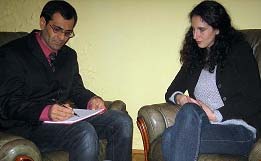
Dena Peace and Freedom Association interviewed a European intellectual on the Cult of Rajavi(MKO/MEK). Ms. Shemeltz who is an expert and scholar on psychotherapy has personal and scientific experience about cults.
As the representative of Dena Peace and Freedom Association, Mr. Mohsen Abbasslou talked with the honorable expert, Ms. Shemeltz.
Mr. Abbaslou: Ms. Shemeltz can we regard Rajavi’s organization a cult? If yes, why?
Ms. Shemeltz: yes, I consider the MKO as a cult. Its leaders and members think that their ideology is the best of all and only their own ideology is right. This is one of the signs of cults. The other reason is that the member inside the organization cannot realize the true nature of the cult unless he gets out of it.
In a cult-like system, the main decisions are made behind the scenes. The truth is hidden, dark clouds surround the organization. Members can hardly ever see and understand what’s going on beyond these dark clouds.
The reality and the true face of the cult-like organization is only known to a very very few people who are completely trusted by the leader.
The leader of cult exposes his true intentions to those few confident members around him. We can investigate and psychologically, scientifically analyze just a few aspects of the reality and true substance of a cult based on experiences, knowledge and testimonies of its survivors.
We can scientifically analyze Mr. Rajavi’s true personality and intentions only if we can keep him under control and treatment in a clinic. By clinic, I mean that cult leaders usually have evil inner thoughts so they are considered dangerous psychos. We should view them as dangerous lunatic patients.
Such a patient that should be under 24-hour supervision, is now inaccessible . More dangerous is that, besides power and money he has a large number of individuals under his command. This can be very disastrous. Rajavi’s organization is also in line with cults and groups that have inhuman financial resources such as drug smuggling groups, human smuggling groups … If you push away the dark clouds around the cult of Rajavi, you will definitely find signs of these activities. Signs of human smuggling, drug trafficking, money laundry and document forging can be certainly found in the MKO. These activities are some of the ways they use to earn money. As I have studied the cults and have done a lot of research on the issue, I’m sure that the cult of Rajavi is not an exception.
To be continued
Dena Peace and Freedom Association – Translated by Nejat Society
If you ask US Iranians to identify their community’s loudest mouthpiece for Neocon-MEK disinformation, chances are Hassan Dai would place high on the list. And it seems like almost every month something new appears to reaffirm that view.
Dai’s latest blunder came in the multiple orgasms he had covering a report linking two anti-MEK activists to Iranian intelligence. The report by the Library of Congress was leaked to Neocon Bill Kristol’s Washington Free Beacon. The MEK’s online operation immediately distributed the report with its own interpretation, and Hassan Dai followed suit a day later.
But Dai’s excitement was to be short lived. In what appears to be an unprecedented move by the Library of Congress, they retracted the report for inaccuracy, as its findings were revealed to trace back to the MEK.
In the aftermath of the embarrassment, the Library of Congress has distanced itself from the report and most of the report’s online occurrences have been pulled (fringe Neocon publications notwithstanding.)
Dai’s piece has yet to be withdrawn, and no corrections have been issued.
Publishing bogus stories using faulty sources is nothing new for Mr. Dai. The real story here is Dai’s emergence as the instrument of choice by the MEK and Neocons to spread their message in the Iranian community. If the MEK takes up an issue today, Dai can be expected to echo it tomorrow.
Dai’s latest misinformation debacle follows explosive revelations just weeks earlier exposing his deep financial ties with pro-war, pro-MEK, anti-Iranian racists like Daniel Pipes who coordinated and directed his attacks inside the Iranian community.
It is important to keep perspective however; by himself, Hassan Dai is a nobody. But for Rajavi and his Neocon sponsors, he serves a useful purpose. Daniel Pipes is happy to use Dai as a smelly brown megaphone to serve his ends, only to toss aside like a roll of toilet paper when its usefulness has reached its end. With Dai’s “journalistic” blunders piling up, it won’t be long before the Neocons turn to someone else to do their dirty work.
Yesterday I posted a blog titled Hassan Dai: Unrepentant Fraud, exposing the self-proclaimed “progressive” activist. It quickly became Iranian.com’s hottest topic. Hassan Dai entered panic mode.
Dai falsely accused me of working for NIAC and refused to address the points in my article. Then he reposted his comment word for word. And finally, in a comedic act of desperation, Dai posted a blog four hours after mine with an old recycled article to distract from the attention my piece was getting.
As I told Mr. Dai, Iranians do not like liars and frauds, and sooner or later he is going to have to come clean to the Iranian people.
Mindful of the fact that at least he did comment on my article and does read these blogs, this may be the perfect (and perhaps only) opportunity to ask Mr. Dai the questions he has long avoided answering. After all, this is a man who prides himself on being transparent and responsive to questions.
Since Dai constantly avoids answering questions about his links with Masoud Rajavi’s Mujaheddeen (MEK) cult, and friendly TV hosts don’t press him on it, I’ll begin with unanswered questions on this topic.
1. You were in Iraq, but you have never disclosed how long you were in Iraq and for what purpose. Please clarify this for us.
2. Members of your family, such as your brother and sister, have held (and perhaps continue to hold) important positions in the MEK organization, as spokesman and other roles. Was your time at Camp Ashraf solely for visiting them? How much time in total did you spend at Camp Ashraf?
3. Mindful of your ties to the highest levels of the MEK, how many times in total have you met Maryam Rajavi?
4. Do you believe the MEK has ever engaged in terrorism and what was your reasoning for lobbying for their delisting?
5. Do you consider the MEK to be a cult?
6. The MEK is infamous for practices such as forcible divorce and breaking up of families. You divorced your first wife, and it’s been said you no longer have contact with her or your son. Was the divorce and prohibition from contacting your son related to your time with the MEK?
I have seen the panic and emotional reactions you exhibit when asked about your MEK ties on television. Perhaps for once you can summon the courage to answer these questions for people. If you have nothing to hide, you have nothing to be afraid of. At a separate time, we will explore your deep financial and political ties with pro-war Neocon racists. You have a lot to answer for, but let’s take this one issue at a time.
By Kourosh Ighani
A US Library of Congress report asserting that Iran’s Intelligence agency has 30,000 employees has been widely quoted – and criticized. The report has been withdrawn and is now under
revision.
An official with the Library of Congress says a widely cited but poorly sourced report his office did on Iran’s intelligence ministry has been pulled from circulation.
As we detailed last week, the study’s ill-supported claim that the Iranian intelligence ministry has 30,000 employees was picked up by CNN and others. News outlets have also seized on other assertions in the report.
The report, which was produced on behalf of a Pentagon office, had been posted on a non-public government-only website. It was leaked earlier this month.
"The report was pulled for revisions after the Division staff identified a passage that should have been caveated but was missed in the initial reviews," said Federal Research Division chief David Osborne in an email. "The report will be re-posted when revised."
Osborne declined to specify the passage in question. It might have had nothing to do with the 30,000 figure.
Another section of the report prompted a married couple branded as spies for Iran to consider legal action.
The report flatly claims that a British woman and her Iranian-born husband are operatives for Iran’s intelligence ministry. The husband, Massoud Khodabandeh, is a former-member-turned-fierce-critic of the Mujahadin-e Khalq (MEK), a small exile group that has long fought the government of Iran and was recently removed from the U.S. government’s list of terrorist organizations.
The report even includes their pictures.
The report’s source for the spy claim is a 2007 essay published on a now-defunct website by Rabbi Daniel Zucker, who is chair of a group called Americans for Democracy in the Middle East and has frequently written in support of the MEK.
The Zucker piece in turn cites a 2005 post on another now-defunct pro-MEK website called iranterror.com. That site also states Khodabandeh and his wife are operatives for Iranian intelligence, but does not offer any sources or evidence.
Even though it relied on questionable sourcing, the report effectively extended the imprimatur of the U.S. government to the claim that the couple are spies.
Asked about the various criticisms of the report, Pentagon spokeswoman Anne Edgecomb told ProPublica: "We believe its findings will enrich the discussions and concepts of policy makers."
She declined to comment further.
The MEK’s official website seized on the government report this month, publishing an item claiming that "a recent investigative report by [the] Pentagon … revealed that Anne and Massoud Khodabandeh are agents of the mullahs’ Ministry of Intelligence and Security."
Khodabandeh and his wife, Anne, who also worked with the MEK in the 1980s and 90s, were incensed by the government report.
"Everything they’ve said is just made up," Anne Khodabandeh told ProPublica.
Massoud Khodabandeh wrote a response column on Huffington Post blasting the report for its reliance on pro-MEK sources. The couple, who are based in the United Kingdom, run an anti-MEK website and consider the group a dangerous cult. (That charge that has been echoed by some outside observers but rejected by the MEK.)
The study claims that after Khodabandeh left the MEK in 1996, he and Anne "agreed to work for [Iran’s intelligence ministry] and spy on MEK." It claims that the intelligence ministry used threats against Khodabandeh’s family in Tehran to compel the couple to cooperate.
Earlier this month, Anne Khodabandeh emailed Osborne, the Federal Research Division chief, saying that "my solicitor would like to know the actual provenance of the report for further action." Osborne responded that the report had been pulled down for (again unspecified) revisions.
"The fact that the document was leaked to [Washington Free Beacon reporter] Mr. Bill Gertz or otherwise publicized is not the fault of the Library of Congress," Osborne wrote Jan. 9. "It is not and will not be posted to any Library of Congress site."
Anne Khodabandeh told ProPublica she and her husband are holding off on legal action at this point because of the potential expense involved, and the fact that the report does not name its author.
Justin Elliott,
The Library of Congress has pulled a report on Iran’s intelligence activities from circulation after an American journalism watchdog showed that the widely cited text was playing fast and loose with the facts.
American and international media outlets had jumped in the report’s claim that Iranian intelligence was employing 30,000 people, a figure called "ill-supported" by ProPublica, a New York-based non-profit reporting on public interest matters.
The report had been produced by a Pentagon office and posted to a US government intranet site before leaking to the public in early January.
And a massive Iranian intel staff wasn’t the only dubious claim brought to light by ProPobulica: the report also alleged, without much evidence, that Vienna was the European hub for the Iranian foreign spy network and that Tehran was gathering information by way of "signals intelligence stations" throughout the Middle East, with many of them in Syria.
"The report was pulled for revisions after the Division staff identified a passage that should have been caveated but was missed in the initial reviews," Federal Research Division chief David Osborne told ProPublica in an email.
Though the document was taken offline "for revisions," it has not gone back up in a modified form.
It was also the source of public humiliation in the UK after claiming explicitly that Briton Anne Khodabandeh (nee Singleton) and her Iranian-born husband Massoud were Iranian foreign intelligence operatives, even showing their pictures. Khodabandeh, a former member of the MEK, the exiled group fighting the Iranian government, has in recent years become a critic of the group, which was recently taken off the US government’s list of terrorist organizations.
To back up its claim that Khodabandeh was spying for Tehran, the report cited a 2007 essay written by Rabbi Daniel Zucker, who chairs a group called Americans for Democracy in the Middle East and is known to write often in support of the MEK. The website where his essay was published is no longer operational, but had linked to the also now-defunct iranterror.com as its source.
After seeing the report, even the MEK claimed that the Pentagon’s report showed that "Anne and Massoud Khodabandeh are agents of the mullahs’ Ministry of Intelligence and Security."
"Everything they’ve said is just made up," Anne Khodabandeh told ProPublica.
Despite such sketchy sources, the report was for all intents and purposes the official word of the United States government.
The Khodabandehs are refraining from legal action due to the costs of such a lawsuit and the fact that report does not credit an author.
Dena Peace and Freedom Association interviewed a European intellectual on the Cult of Rajavi(MKO/MEK). Ms. Shemeltz who is an expert and scholar on psychotherapy, has personal and scientific experience about cults. 
As the representative of Dena Peace and Freedom Association, Mr. Mohsen Abbasslou talked with the honorable expert, Ms. Shemeltz.
Abbasslou: Ms. Shemeltz, many people can hardly believe that an organization or an individual could be able to keep and control thousands of people under the name of struggle in one place for about three decades. Do you think that Rajavi has used an especial formula and method to control members’ minds and bodies?
Ms.Shemeltz: in the MKO, they use an apparently simple but very dangerous formula. Everyone is in the group is told: “You are like brothers and sisters for each other and you should call each other “Brother” or “Sister”.
The other day I saw a sentence on the wall of a mosque. It was written “if your spiritual brother or sister tells you that you are wrong about something, you shouldn’t get upset but you should try to correct your mistake and then thank your brother or sister for the notice."
In a glance, the slogan is a positive one but if you deeply think about it you’ll find out that the slogan is implying that you should supervise your spiritual brother or sister to seek for his or her mistakes. According to the science of behavior such an instruction is considered good for reforming a society but in a particular organization or group especially a religious one, with special goals, it can be very dangerous.
In the Rajavi’s establishment, exactly the same instruction is used in safety measures. Members are told, ”If your brother or sister tells you something or monitors you, you shouldn’t turn sour but you should confirm what you’re told because this is good for your promotion in the organization.”
They are told or they in fact are responsible to watch the comrade next to themselves.
Rajavi has efficiently used the formula. Everyone should watch his comrade. Everyone is monitored by many eyes in everywhere. You are controlled by your organizational brothers and sisters all the time and in all places so the risk of committing organizational mistakes decreases. The organizational formula in the MKO is: to control one person by the one next to him. The formula has been so efficient in the MKO. To the mentioned formula, you should add suppression and violation of private and public space of members by the cult leaders.
The controlling formula is supported by organizational punishment.
Rajavi is an intelligent person on the ground of using contrasts in inhuman way. Using political contrasts in the past and present time, he could build places like Ashraf or Ouver Sur d’Oise to control individuals.
He well recognized political splits and used the challenges and clashes in politics to maintain the structure of his cult. He knows whom to contact with in the world of politics using opportunist and venal politicians.
In my opinion, the leader of Mujahedin cult has recruited a team of these opportunists, venal politicians. He makes deals with them to achieve his organizational and political objectives. It is not difficult to find such sort of people in Europe and the West. Nowadays, such people are numerous.
Translated by Nejat Society
In an interview with Ashraf News, the Kurdistan Alliance Block in the Diyala Provincial Council confirmed that the Mojahedin Khalq carried out operations against the Kurds in the 1988
campaign.
Dalir Hassan, speaking for the Kurdistan Alliance Block said "We have documents that confirm the involvement of the Mojahedin Khalq organisation in operations against the Kurdish people in Kara Tepe, Khanaqin and Jalula". He added that the MEK were not only active in the north but also against the southern provinces of Al Amareh and Basra during the popular uprising in 1991.
The Vice-Chairman of the Security Committee in the province of Diyala said, "One of the ugliest landmarks left by Saddam Hussein and his regime with the participation of the terrorist MEK organization was his notorious campaign against the Kurds, who named it ‘Anfal’."
*************
The Chairman of the Commission on Security and Defence and Parliamentary leader of the Coalition of State Law, Hassan al-Sanid, said that the Mojahedin Khalq will not return to Camp Ashraf in Diyala province after having been transferred to Camp Liberty near Baghdad. 
In a statement issued yesterday, the MEK demanded they return to Camp Ashraf where they had spent 26 years.
Al-Sanid said in an interview for Ashraf News, that Iraq will expel the MEK and end their presence on Iraqi territory. He said, "the Iraqi government, in coordination with the United Nations Assistance Mission for Iraq (UNAMI), will act speedily on the mutually agreed resolution and drive them out."
As leader of the Coalition of State Law, he also stressed that the Iraqi constitution does not allow the harbouring of any terrorist group under any name, pointing out that Iraq still considers the group as terrorist. He noted that "the MEK acted as henchmen for Saddam’s intelligence services and practiced many abuses and terrorist operations against the Iraqi people."
Translated by Iran Interlink