
Iraq has reached an agreement with the United Nations and the European Union to move the remaining members of the Iranian Mojahedin-e Khalq (MEK) to the Romanian territories as soon as possible.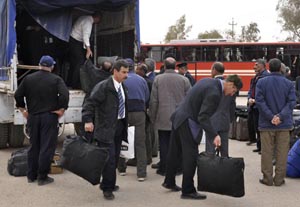
The Iraqi Government had discussed with the European Union Ambassadors, the agreement between Iraq and the UN to move the remaining MEK members in Liberty camp (located near the capital Baghdad) to a third country, as it became impossible for the MEK to remain in Iraq after having information regarding their involvement in cooperating with Saddam Hussain in oppression of 1991 revolution in Iraq.
MP from the State of Law, Foud al-Duraki said in a statement to PUKmedia that the third country had been agreed on by Iraq, UN and EU which shall be Romania. “the Iraqi Government do not want MEK members to stay in Iraq, as they participated in oppression of 1991 revolution in Iraq with the former regime” al-Duraki added.
The Iraqi Government had designated $500 thousand to transport the MEK members from Iraq, Iraqi Minister of Human Rights, Muhammad al-Shaya’a announced. Another € 22 million (EUR) from the European Union shall also be designated to transport MEK members out of Iraq.
3164 members of the MEK, had been transported to Huriya camp under the supervision of UNAMI to be moved to a third country (Romania).
Reported by Nazik Muhammad from Baghdad,PUKmedia
 secured bipartisan support from a host of heavyweight Washington insiders and fought its way off of the State Department’s list of designated terrorist organizations illustrates how power is wielded in Washington, and how former officials continue to influence American foreign policy.
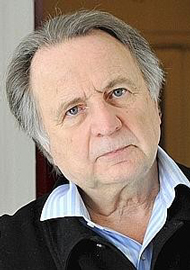 visited Iran. He has written his account of a brief stay in Tehran and Qom. Impressed by the trip to Iran, the French journalist got to know that his visit to Iran was “enough to shake lazy prejudices” he “was not free to leave”.
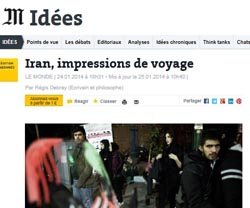 Regis Debray suggests:
 rabic-language website Voice of Russia, in her meeting with the Iraqi minister of Human Rights, head of the European Union Delegation in Iraq Ambassador Jana Hybáškova, said the EU plans to allocate 22 million euros for the relocation of MKO members outside Iraq in order to respond to Iraq’s requests.
 imposes new sanctions on Iran if passed, even though we are engaged in historical negotiations that would end any attempts by Iran to build a nuclear weapon—and even though there is no actual proof they are. The legislation demands Iran give up its legal civilian nuclear program entirely, and would commit the U.S. to join any attack that Israel launches against Iran.
 attended a briefing in the Dirksen Senate office building on Capitol Hill sponsored by “an Iranian exile group related to the Mujahedin-e-Khalq (MEK).” The former government officials speaking out on behalf of this group against diplomacy with Iran included “former Vermont Governor Howard Dean, former Ambassador to Morocco Marc Ginsberg, General James L. Jones, and and former US Special Envoy for Nuclear Nonproliferation Robert Joseph.”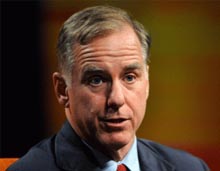
 Ecuadorean bankers, according to a New York City TV station.
 orge W. Bush’s presidency, his inner circle twice debated whether diplomacy or American air strikes were the best way to stop Middle Eastern foes from building a nuclear bomb. In both debates, involving Syria and Iran respectively, Robert Gates, the defence secretary, argued that Mr Bush could afford to try talking first without sacrificing his credibility. “I suspect no one in the world doubts this administration’s willingness to use force,” Mr Gates told Mr Bush in 2007, with more than a touch of understatement.
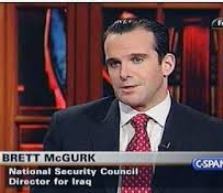 The U.S. Embassy also said McGurk visited Friday with members of Mujahedeen-e-Khalq, the militant wing of the National Council of Resistance of Iran, whose camp outside Baghdad came under rocket attack last month. The statement said the U.S. diplomat stressed the urgency of relocating the residents of Camp Hurriya to another country.