
MKO former members
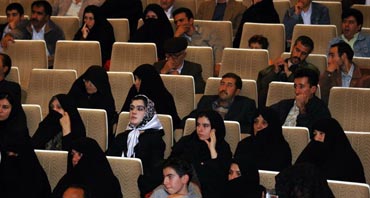
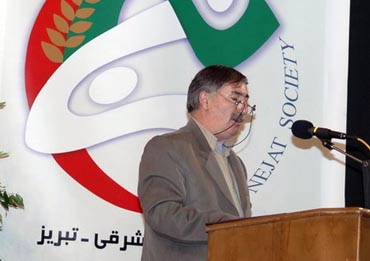
Brainwashing and its function on self immolation
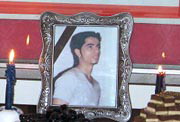
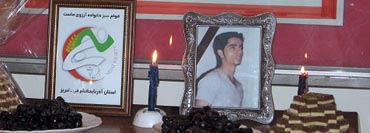
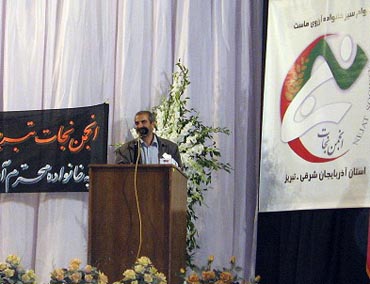
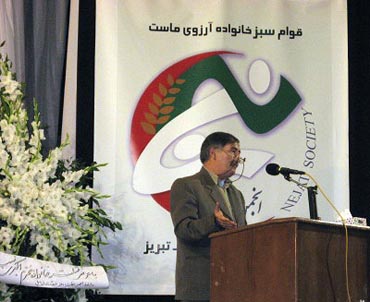
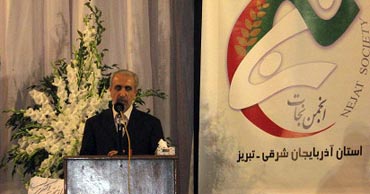
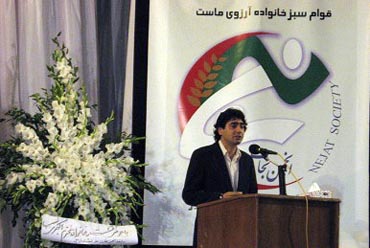
in the memory of Yaser Akbarinasab;the victim of Rajavis’ cult
MKO former members
Brainwashing and its function on self immolation
in the memory of Yaser Akbarinasab;the victim of Rajavis’ cult

Participating
Mr. Babak Amin, head of the Nejat delegation in Paris. Amin was recruited by the MKO while a student in Austria and trained in its terrorist camps in Iraq. He carried out over 10 terrorist operations in Iran before being arrested by the Iranian security forces. He was sentenced to ten years imprisonment in Evin prison. He served 5 years and was released after serving half his sentence. Amin is now continuing his IT degree in the University of Tehran and working part time in an IT consultancy company.
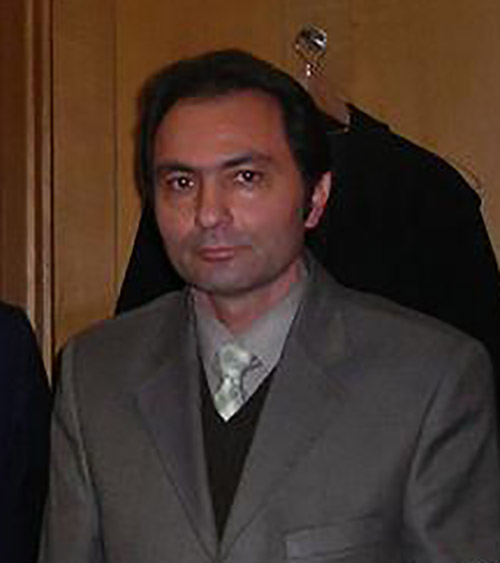
Mr. Ali Moradi, a sergeant in the Iranian military, he was captured by Iraqi forces at the start of the Iran-Iraq war. Given to the MKO by Saddam after serving 9 years as a POW, Moradi never accepted the MKO and eventually took refuge from the MKO with the American army after the invasion of Iraq. He was recently married and is self-employed as a trader and cab driver. Moradi is also the head of Nejat Association in Lorestan province.
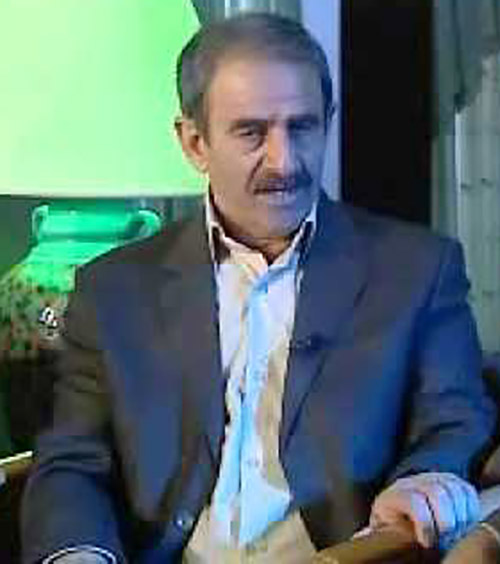
The interview was carried out in Bastille, Paris as the delegation emerged from one meeting on their way to catch the next one at the start of their intensive two week schedule.
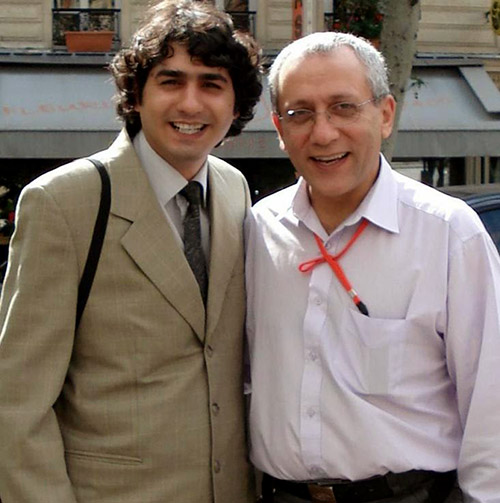
Mr. Arash Sametipour, recruited as a teenager by the MKO in Washington DC through their agent in the USA, Alireza Jafarzadeh. Sametipour was trained in the MKO’s terrorist camps in Iraq before being sent to perform an armed operation in Tehran. He tried to kill himself at the time of his arrest by taking his cyanide pill and exploding a grenade. He survived but lost his right hand. He served 4.5 years of his sentence in Evin prison and is now continuing his study as well as working as a language teacher. Sametipour was recently married.
Download Mr. Masud Khodabande interviewd Mr.Babak Amin
Download Mr. Masud Khodabande interviewd Mr.Ali Moradi
Download Mr. Masud Khodabande interviewd Mr.Arash Sametipour
Yaser, whose numerous requests for leaving the camp/organization have been ignored, finally committed suicide by setting himself on fire sometimes in August 2006. When the MKO officially announced the incident on September 11, 2006, after over a month delay, they claimed that Yaser took his own life in protest to the conditions caused by the U.S. control of the Ashraf.
Personal Column: The former Islamic militant
Anne Singleton, 48, was recruited into the mujahedin at university, and was active for seven years. She left the organisation in 1996 and now campaigns to warn others
Interview by Lynne Wallis
Published: 01 October 2006
Manchester University in the early 1980s was very political. My then boyfriend Ali, an Iranian, was interested in the mujahedin, and I became interested in them and Islam. I have never been religious, but the structured life Islam offered made sense to me.
The mujahedin seemed to be the only group who were doing anything, fighting the regime of the Ayatollah Khomeini in Iran after the revolution. I went to so many meetings that I neglected my studies and flunked my exams (I completed my degree at Sheffield poly). Their religious role-modelling was intense, and their behaviour so righteous. They were willing to sacrifice their own interests for that of their society. I worshipped them.
In l985 the mujahedin leader Massoud Rajavi took over and married a woman called Maryam whose role was to encourage women to break away from male control. As a feminist, this appealed to me. They had used bombers from the early 1980s. They said they wanted to break the atmosphere of terror by killing their oppressors, and it seemed noble.
I spent all my spare time with the movement, caring for members’ children, cooking and monitoring media reports. If they asked me for a £l0 donation I’d give £l00 to impress them with my commitment. They flattered me, and then would make me feel guilty, pushing for more so I’d feel worthy enough to be recruited. I got totally hooked.
I did temporary jobs and lived frugally in bedsits, my walls covered with posters of their martyrs – suicide bombers and women with guns. I felt part of something very right. Everyone else had posters of Che Guevara who was part of an armed struggle. I was just supporting a different revolution. We saw fighting films and listened to heroic poetry and revolutionary music. I had had such a boring childhood, this was what I had been looking for. My working-class family was quite political but never did anything except watch telly. There wasn’t much debate, so I grew up seeing life as black and white.
I moved to London in 1989 and found some activists at a safe house in Finchley who treated me as a trusted supporter. The UN Human Rights Rapporteur visited Iran in l990 and we wanted to put pressure on him to ask about all the mujahedin prisoners so we went on hunger strike.
After five days I felt high as a kite. My perceptions changed, and I felt I had transcended normal humanity. I had so much energy and felt as if I were walking in a bubble. Food deprivation is a classic recruitment technique used to weaken resistance.
I quit my job as a computer programmer and became a full-time worker for the mujahedin. I didn’t question a thing, even the violence, which they inure people to so cleverly. I was shown a film of a female suicide bomber blowing up an ayatollah in Iran. It was horrific, and very shocking, at first, but I was shown the film many times, and each time was less distressed. Then they put it on over dinner and I didn’t bat an eyelid. I believed she had a duty to perform, this brave, wonderful martyr.
I barely saw my parents, I’d ditched all my friends, and I’d publicly burnt the diaries I’d kept since childhood, insisting”my past means nothing”, but it wasn’t enough. I still wasn’t seen as 100 per cent obedient.
In l992 they asked me if I’d like to go to Iraq for some military training. I knew as a member of an”armed struggle”this might be required, so I didn’t resist, although I knew I could never kill anyone. I learned how to drive a truck, march and shoot a gun, but I clearly wasn’t soldier material. I loved the camp and the irresponsibility – I obeyed orders and it felt liberating. I had this childlike feeling that if I put myself in their hands, I’d be OK.
Then they decided marriage was banned. I couldn’t agree as I wanted marriage and kids. I was punished and they put huge pressure on me to conform. I returned to London, telling myself I’d sort my head out then return refreshed to the movement, but it wasn’t to be.
In l993 I met my husband, another disillusioned member, and we were drawn to each other. I resisted constant pressure to be re-recruited and we broke away for good in l996. We acted as counsellors to each other, de-programming ourselves from the horrific abuse we had endured. But we didn’t recover properly until 1999, when we read literature from the Cult Information Centre. I was furious when I learned that everything we’d been through was on a”recruitment techniques”list! The anger and betrayal I felt was enormous, but I felt relief that it wasn’t my fault, and I could put a name to it – psychological coercion. It didn’t mean you were weak, evil or stupid.
We believed we had reached the pinnacle of human existence, that the worst thing in life was to be ordinary. Well, we’re ordinary now and it’s wonderful. We had a son in 2000 and live in a three-bedroom semi in Leeds. A life where we make our own decisions is amazing.
I still think of myself as Muslim, I still think it is a good belief system, but I eat pork and drink like a fish.
Spreading the word about the dangers of cults is my new cause. When people are recruited into these groups they have no critical ability. It can happen to anyone, any time. If you’re lucky you end up with a timeshare. If you’re unlucky you end up blowing people up on the Tube.
For more information contact: iran-interlink.org or khodabandeh.org; cultinformation.org.uk
The Independent, October1, 2006
The Independent, U.K.
According to Nejat Society Correspondent, "Mr. Gholam Reza Sadeqi Jabali " – the old member of MKO could release himself from the hell made by Rajavi’s cult and join his family.
Mr. Jabali holds the message of many other dissatisfied members who are still captive behind the bars of Rajavi’s Cult in Iraq.
Referring to the dangerous situation of those members in Iraq, He’s requested the families to do their utmost for the salvation of their beloveds.
He described the inner MKO’s condition as being "chaotic ".
He added that the discontented members do any thing to free themselves from the intolerable situation of the cult and unfortunately some of them, commit suicide as currently some have set themselves on fire.
Although MKO defectors are being protected in a separate camp, have stopped organizational ties with this group and have quitted terrorist operations, and although they have been interviewed by the UNHCR, the process of transferring them from Iraq has been suspended so that the residents of this camp have gone on hunger strike.
Meanwhile, the website of Hambastegimelli, whose authors interfere in the affairs of these defectors, quoted Mr. Emanuel Giang the head of UNHCR in Iraq as saying: "The process of transferring and resettling these people in a third country is very long and complicated. Their presence in Iraq and their past ties to the MKO are important factors that can slow the process."
Opposition of governments to granting refugee to defectors in TIFF (against the will of UNHCR) and other problems which will come for the residents of this camp and also residents of Camp Ashraf certainly are the consequences of working and cooperating with a terrorist organization. That’s why they face the opposition of governments despite the international regulations that entitle them to choose freely their destination. The governments and authorities preserve their own right not to allow the entrance of these people, with the background of working with a terrorist group, into their countries.
The total dismantling of MKO is the best solution for all the members in Iraq, that’s why after the fall of Saddam, Massoud Rajavi, who saw it was not possible to construct his organization anywhere else, ordered his forces to insist on staying in Iraq.
According to Nejat Society’s reporter, on Monday, July31 Mrs. Elham Motehamel and Mr.Salazehi who had defected terror cult of Rajavi and returned to Iran a few days ago, were delivered to their expectant families.
The ceremony that was held at Nejat Society building in Tehran was accompanied with tears and smiles of the families who are the members of Nejat Society.
Their hatred toward Rajavi’s terror cult that could be seen in their eyes, promises the return of their other beloveds.
The complimentary report with photos of the ceremony will be subsequently published on the website.
Nejat Society
Following the separation of a large number of the Rajavi’s cult members, two other members named Elham Motehamel and Sattar Salah zahi returned to Iran. These two who were two of the most professional members noted that Rajavi’s cult is destroying and the leaders of the group do anything to prevent the demolishment of the cult. Recently, they even have resorted the Zionist lobby. Therefore they, who know themselves as Abu Amar’s children and were trained in Palestinian Camps, don’t show any reaction to massacre of Palestinians by Israelis.
Nejat Society reporter, July22, 2006
Three years ago this month the world was turned upside down for this month’s lead contributor. It was in June 2003 that Ebrahim Khodabandeh and his Mojahedin colleague Jamil Bassam were extradited from Syria – following their arrest on smuggling charges – and imprisoned in Iran’s Evin. For their families it was a time both of distress and of a strange relief. At least now they knew where the men were.
They were not in the Mojahedin’s Iraqi camps under bombardment, nor were they in Europe being ordered to set fire to themselves to protest the arrest of MKO leader, Maryam Rajavi. Although Rajavi’s own arrest is the focus of Ebrahim’s article, his and Jamil’s situation is interesting in itself. For three years they have been in prison for acting on the orders of the Mojahedin cult and now, with their trial underway, a verdict is expected shortly.
Conversely, Maryam Rajavi and her leading cohorts are still awaiting trial in France on terrorism charges. After three years the two stories could not have more different outcomes. Ebrahim, beyond the reach of the organisation’s system of thought control, has become an outspoken critic of the Rajavi leadership.
Maryam Rajavi on the other hand still refuses to renounce violence as the only means at her disposal to achieve political power. Yet in spite of this, she continues to beg for the Mojahedin to be removed from global terrorism lists. Is she asleep? Is she dreaming? Or is she – as Maryam Khoshnevis describes Massoud Rajavi in her article ‘Sleep- Stricken’ – only pretending to be asleep so as not to be awoken from her dream of power.
Ebrahim worked in the Mojahedin’s ‘diplomacy’ section and is known to many MPs in Britain and in Europe. Similarly, Massoud Banisadr will be known to many legislators in the USA. His interview with Mahan Abedin is one of the most revealing to have come out from a former member who once stalked the corridors of power on behalf of the Mojahedin.
When Rosemary Hollis of the Royal Institute of International Affairs, visited Iran, she spoke about western support for the organisation: "They have managed to get a very few irresponsible people, being MPs or others, to go along with them. These are very dangerous and ruthless people."
But while western supporters of the Mojahedin are certainly irresponsible, I don’t believe this is sufficient to describe their support. Surely we want to know how and why, in defiance of all the documented evidence as well as the thoroughly researched assessments of their own governments, they come to support so obviously unsavoury a group.
While it might be possible to allege that some of the Mojahedin’s supporters are ‘paid’ in some way, or it may be possible to conjure up some private or sponsored agenda behind their support, these arguments, again, are not sufficient. When all the world is agreed, why do a handful of individuals, who are not notable as rebels, turn their face away from all the available evidence, even the evidence of their own senses, and speak glowingly about a known terrorist organisation?
If we listen to former members, no matter what their role was inside the Mojahedin, one thing they agree upon unanimously; the Mojahedin operates as a cult. As it is known that one of the main characteristic of cults is that they employ known methods of psychological manipulation and thought reform, then it is reasonable to add to Dr Rosemary Hollis’ description something from Ian Haworth’s excellent introduction to cults, ‘Cults, a practical guide’; "Too often rational people say, "It could never happen to me. I could never be recruited into a cult.”They do not realise that people do not ‘join’ cults, but are instead actively recruited” anyone can be recruited by a cult if they are not able to recognize the cult in advance and have the strength to walk away from it." Why would members of parliament suspect that for years a dangerous cult has been able to openly and actively recruit in the very buildings where they make laws to protect the citizens of their countries? But Massoud Banisadr was just one of those recruiters “ whether he was aware of it or not. And it would surely be naive to think that members of parliament cannot be recruited just by dint of their job. Indeed, because of their position, they are more likely to be targets for recruitment. As well as the core members which they use as dispensable slaves, a cult also needs recruits who can perform other activities on its behalf, people in positions of power, whether they be fundraising celebrities or legislating politicians.
Unlikely as it may seem, ‘it really could be you’.
SurvivorsReport.org – June 2006
Born into a middle class family in Tehran in 1956, I completed my elementary schooling in Alborz High School, in 1974. A year later I joined my brother, Ebrahim Khodabandeh in the UK where he was already studying Electrical Engineering in Newcastle University (Newcastle-upon-Tyne).
I graduated from Newcastle Polytechnic (now Northumberland University) in Electrical and Electronic engineering and spent another year in Leeds (UK) to gain my Chartered Engineering Diploma, before moving to Loughborough University to study for a Master’s degree.
I was first introduced to politics in Iran, but became more interested in the various opposition groups while a student in Newcastle. I joined groups of students opposing the Shah’s regime, and in the last years of my stay in Newcastle became more and more interested in the so-called ‘revolutionary groups’, one of which was the Mojahedin-e Khalq Organisation of Iran (MKO).
In 1978, when Ayatollah Khomeini moved from Iraq to Paris, I joined a group of young people who went to visit him. This had, of course, a profound effect on me. On my return, I started a Society for Iranian Students in Newcastle Polytechnic, and soon joined with another group of people who were supporting the Mojahedin and who were in contact with them. By doing so, I was able to establish a strong ‘foothold’ in our university. In those days the Mojahedin comprised no more than a group of martyred or imprisoned young people who were following Ayatollah Khomeini – or at least that’s what they told people like me!
Later on I became more involved and was instrumental in the foundation of the “Committee for the Support of the Mojahedin-e Khalq Organisation”. The Committee was founded and led by a known member of the organisation, Dr. Reza Ra’eesi, who had come to London a few years previously; a man of principle, with a wealth of philosophical, political and organisational skills and knowledge. (Shortly after the Revolution, Ra’eesi left the organisation due to his belief that the organisation was no longer following the minimum standards of democratic practices.)
During the course of the revolution in Iran the Committee went through dramatic changes. The name changed to the Moslem Iranian Students’ Society, and the members, who studied and followed the teachings of the Mojahedin literature, became full-time ‘Revolutionaries’. Demonstrations, printing and distributing publications, fundraising, and etc became not just part of my (and my colleagues’) life, but all of it. Individual rooms and flats were given up and we were now living in communal houses, incorporating offices and dormitories. I was soon transferred from Loughborough, where I was studying a research course, to London, and was given the task of heading the organisation in the north of England.
In 1980, I and another 51 members occupied the Iranian embassy in London for which we were sentenced to some months of imprisonment. Dr. Ra’eesi had already left the organisation by this time and had returned to Iran, and we were now receiving direct orders from the Mojahedin HQ in Tehran. I believe that the Mojahedin ordered attacks on Iranian embassies to all of the branches in different European and north American countries as a last show of power before Massoud Rajavi fled Iran following his failed coup d’etat on June 20, 1981.
When I was released from prison, Massoud Rajavi had already arrived in Paris. I joined him and the other Mojahedin after a few days, and spent a few months in the Paris base handing over my responsibilities as head of all the Societies outside Iran. The Moslem Iranian Students’ Society was the only asset left for the Mojahedin outside Iran, and it was rapidly transforming itself into the “Union of Moslem Iranian Students’ Societies” with the HQ in Paris. I was being relieved from all my responsibilities in order to start my next assignment: to go to Iran for a specific mission.
I met with Mr. Saeed Shahsavandi in Germany. (Shahsavandi was a well-known member of the Mojahedin who had suffered in the prisons of SAVAK. He later left the organisation due to disagreements with Massoud Rajavi; in particular over the Internal Revolution of Massoud and Maryam.) Shahsavandi headed a team tasked with purchasing a 10 Kilowatts radio transmitter as well as other telecoms equipment – intended to connect Iran to the Paris HQ – and other materials and to transfer them to Iranian Kurdistan where the new Iranian Government could not exert its power. I was appointed as technical advisor and subsequently, the technical head of broadcasting once the stations were installed in Kurdistan.
Saeed and I ended up in Baghdad airport the same day that Mousa Khiabani and Ashraf Rabiee (who had been left in Iran after Massoud Rajavi had fled to Paris) were killed in a gun battle with the Revolutionary Guards in Tehran. We had with us a huge load of telecoms and other equipment. We were working under the protection of the Kurdish Democratic Parity (KDP) which would allow us passage from Iraqi into Iranian Kurdistan. The equipment was shipped by the Iraqi military to Soleimanieh – where the Iraqis would go no further – and from there we were taken towards the border of Iran by Kurdish people sympathetic to the KDP. It was winter and it took us several months to transfer the dismantled pieces of radio equipment into the mountains of Sardasht (in Iran) from where the transmitter started broadcasting the clandestine short and medium wave ‘Radio Mojahed’ into Iran. The transmitter (and therefore me and my team) had to change place in the mountains of Kurdistan more than 7 times over the next two years in order to survive the air attacks. We survived as a team (though of course some individuals didn’t) and continued our broadcasting successfully.
When we first arrived in Iranian Kurdistan, the Mojahedin base was inside the KDP compound just outside Sardasht. But our numbers were growing rapidly. Kurdistan was becoming the HQ for training terror teams to carry out operations inside Iranian cities and it was the major transit route for transferring Mojahedin executives from Iran to France (via Turkey or Iraq/Jordan).
It took two years of military battles during the summers and fighting with nature in the mountains of Kurdistan in the winters before the Iranian army reached the ‘Free Zone’ of Iranian Kurdistan. After a few days of battle, we had no other choice than to abandon everything and, crossing the border river Zab, to retreat into Iraq. We had to blow-up everything we had in order not to let them fall in the hands of enemy but managed to bring the transmitter with us and even managed to get it up and running again in only a few days to broadcast Radio Mojahed. But now we were living alongside an Iraqi military base with direct connection to roads, and after two years I enjoyed the luxury of moving around with cars instead of mules! It didn’t take long before I was given the go-ahead to return to Paris. Now that transmission was taking place from Iraqi territory with the help of the Iraqi Government, I was perhaps needed more in Europe than in Iraq. So, I went back to Paris.
With fluent English and a little French, I was assigned to a team specifically taking care of Rajavi’s personal affairs. He was then married to Firoozeh Banisadr and my main job was partly her protection and partly working with the Mojahedin intelligence system which was mainly occupied with intelligence gathering about other opposition forces outside Iran. My boss for the specific matters involving Firoozeh was Maryam Azodanloo (who was the head of a team providing personal needs of Massoud Rajavi. She later became the 3rd wife of Massoud and co-leader of the organisation), and for the intelligence section I had Bijan Rahimi as my boss. When Massoud divorced Firoozeh and married Maryam (then the wife of his friend Mehdi Abrishamchi), I was freed from my other responsibilities to move into the HQ of Auvers-sur-Oise to become an overt member of the personal protection of the Leadership, which meant Massoud and his new wife (my old boss) Maryam. My responsibilities were mainly security, liaison with French Security and above all, updating and reforming the system of security according to the available resources in Europe. Technical aspects of the matter were my main focus. This continued until the departure of the organisation to Iraq.
I travelled to Baghdad a few weeks before the arrival of Massoud Rajavi from Paris. I took Maryam with us and she prepared for his arrival.
I was now in a new environment. We were now working in a totally different atmosphere. In Paris everything was systematic and at the end of the day we were a force outside the government. In Paris, security meant a totally different thing than in Iraq. Here we desperately needed training in every aspect if we were going to work and survive with the Iraqi security. But I could also see that there were a lot of things we had brought with us that the Iraqis hadn’t known about. We were now expected to be confident, very confident with arms. We needed to adjust ourselves and become a military force. We were going to be trained to become part of Saddam’s apparatus and that’s what we did.
During the years to come I never separated myself from telecoms, IT and electronics. It was needed both for security and for the army. I would make a few trips to Europe every year to update myself on security and telecoms issues. I would attend Interpol and other security exhibitions and meetings, and of course buy and import the necessary materials for ourselves and for the Iraqis, from simple closed circuit cameras to metal and explosive detectors, up to sophisticated surveillance and counter surveillance equipment, coders, decoders,…, . I also became the person entrusted with arranging for the personal needs of Massoud and Maryam, providing them with whatever was necessary for the ‘Leadership’. During the years of my stay in Iraq I participated in many joint projects and training with the Iraqi army. These included military and security training, special forces training specific to the Republican Guards of Saddam Hussein, as well as joint projects in VIP Shelter technology and infrastructural projects in electrical and telecommunication grids. During these years I even escorted Maryam Rajavi on her holidays to European as well as Arab countries across the world. And of course, every now and then, I would be part of the team carrying messages between Iraq and whichever country they were destined for. I have been responsible for the telecommunication of all the major military operations of the MKO, sitting in the command room connecting Rajavi and his top commanders to the field commanders from his HQ (usually part of an Iraqi military base near the border). Many memories from the four days of the Forough-e Javidan operation (aka Mersad or Eternal Light), the few months of the First Gulf War (Kuwait), and many other events, perhaps need more time and space. I have to bring myself to start writing about them but not right now.
In 1994, after two years of push and pull by Massoud to convince a few remaining non Mojahed members of the National Council of Resistance of Iran (NCRI) to accept Maryam as ‘the President Elect'(!!), he sent her to Europe to “create a foothold for Massoud if things don’t go as well as they should” (maybe he was thinking about a rainy day like today!). As usual it was up to me to bring her to Paris. We were supposed to take her to the USA where she could impose herself as a refugee, but by over-estimating the connections we had, she insisted on getting a valid visa for the US before departure. (She of course, did not even have valid papers for France and the French did not know that she had again been brought to Paris.) The visa application alerted the Americans, and of course after they rejected her we had to surface Maryam in Paris. That was annoying enough, but not as annoying as the fact that she tried to put the blame on Mohammad Mohaddessin (Rajavi’s Pentagon contact who after being arrested in Paris in 2003 and awaiting trial alongside Maryam, has now been replaced by Alireza Jafarzadeh), accusing him of not using his influence with the Americans enough.
In 1995, after a period of disagreements, now directly conducted with Maryam Rajavi, over what was going on in Iraq as well as her increasingly un-diplomatic and un-political and in many cases inhumane conduct, the culmination of years of disagreement was reached and I demanded to leave. Being in Paris was of course to my advantage. But even so, I was forcefully kept and even injected with sleeping and other drugs to the point that even a few days after they stopped the injections I still could not stand up for more than a few minutes. This was of course the minimum just to keep me quiet. After some compromise, agreements and accepting some of my criticisms at face value, I was sent back to Iraq (I was told that the VIP (anti nuclear) shelter compound in Ashraf camp had malfunctioned, which they could not sort out and the engineers had asked for me). In Iraq, I found out that I was being checked by Massoud himself and there I realised that I would lose everything (including my life!) if I continued to insist on my criticisms. I acted compliant for a few weeks until I got my Iraqi and Jordanian documents back and was allowed to get out of Iraq once more. This time I left for London. Soon I contacted Maryam (and later Massoud) and told them of my final decision to have noting to do with them any more.
I presented myself to the British authorities (and later the French authorities) and told them about my exit from the Mojahedin-e Khalq Organisation. (In those days they had not yet been proscribed as terrorists). In the same year (1996) Maryam Rajavi went back to Iraq after a totally disastrous failure in achieving what she came for. The money Saddam had invested was spent on dinner meetings promoting the ‘Ideological Revolution’ and expensive gatherings “teaching feminism to Western women” and the human resource which went back to Iraq was considerably less than what she had come out with.
Having left the Mojahedin with nothing but a few pounds in my pocket, I went to an old student friend of mine in the north of England for help. To his lasting credit, he gave me more than just financial help at a time when I needed every help possible to stand on my feet again. Rajavi tried a few times to get me back and even called to convince me to go back to Iraq for a few days (we both knew he would not let me out again!) But as soon as he became convinced that I am no longer his man, he started announcing that I am, and had been for some time, working for the Iranian Intelligence ministry, a label he has used for more than 800 ex members and critics of the MKO among Iranian opposition forces in Europe and America. In one way this was good news. It meant he has accepted the fact that I have escaped him. Now the problems he would make for me could not be more than some annoyance in the western security services or the British Home Office. I had run away safely. I was much luckier than many of my friends. I couldn’t believe it myself.
When I left the Mojahedin, I was a high ranking commander of the National Liberation Army in charge of the security of the leadership. I was a member of the Executive Committee of the Mojahedin Khalq Organisation and I was a member of the National Council of Resistance of Iran, the so called political wing of the Mojahedin. My departure coincides with the departure of many, many others including high profile people Dr. Massoud Banisadr, Dr. Bahman Etemad and Dr. Hedayat Matindaftary and Mrs. Maryam Matindaftary and … . later Rajavi even blamed me for the departure of others!
It was not surprising that one year after we came out, in 1997 the US government despite all their grievances with the Iranian government, added the name of the Mojahedin in their list of terrorist entities. In the year 2000, Britain followed suit and announced the MKO as a proscribed terrorist organisation. In 2002 the European Union announced them as terrorists and in 2005, Canada officially listed the organisation. In May of the same year, Human Rights Watch published a 40 page report about human rights abuse inside the Mojahedin. I always consider myself one of the luckiest ones. Those who stayed after me have gone through a much harsher experience, many lost their lives, many their sanity.
After leaving the Mojahedin, it took me a few years to retrain myself, get a proper job and stand on my own feet. In 1997 I met Anne Singleton whom I had seen a couple of times before in the Mojahedin’s bases. She had also left them alongside many others outside Iraq. Later we married and now have a son called Babak.
I started working with my friend in his factory for a year and after retraining got back to my main line of work, Telecoms. I have since worked for a variety of companies in direct employment and/or subcontracting, including Ericsson in the UK, Alcatel in Germany and France, and a range of smaller companies outsourcing parts of their Intercontinental Terrestrial Transmission projects.
In 2001 together with Anne we founded Iran Interlink organisation to help the people who leave the organisation to come to terms with their experiences inside the organisation. Now our organisation along with many other similar organisations throughout the world are of themselves a noticeable weight among the opposition forces outside Iran – opposed to the Mojahedin and to the Islamic regime. Many of my friends have been killed during the past two decades, but the ones whose backs did not break under the cruelties of Rajavi and Saddam have now grown even stronger.
In 2002 I joined the centre de recheche sur le terrorisme in Paris as an analyst on terrorism, with which I still work closely. I have widened my circle ever since and now have very good friends across the world from Tel Aviv to Riyadh and from Moscow to Washington. In 2003, after the fall of Saddam and the arrest of Maryam Rajavi I added my own complaints against her to the court case in Paris. The investigations are still ongoing but I certainly hope that one day the truth about what has happened will come out whether in a court room or elsewhere.
After the fall of Saddam many of my friends have managed to leave Iraq and the Mojahedin; some from Abu Ghraib prison. Their stories are horrifying. To think that one day I was a member of such an organisation sends shivers down my back. Now over a thousand people have freed themselves from the cult. Some have gone back to Iran, and some live in western countries. Of course many have lost their lives and many are still trapped inside – about 3500 in Iraq and about 300 outside Iraq in western countries and of course none in Iran. Their average age is approaching 50. You can guess about their morale yourselves. I can’t ignore the number of Iranians killed during the Mojahedin’s so called operations either. To come to terms with these events – on whichever side you find yourself – will certainly take a generation if not more.
As a brief biography, I have tried my best not to enter into specific events and/or specific instances, each of which will need their own article or even book.
One day I may enjoy the luxury of having the time to write a thorough biography of my life (or even write about the Mojahedin), but for the time being I see my time as more beneficially spent putting more time in my work as a consultant, supporting my family and raising my child Babak as best as I can, and of course sparing all the effort possible to help those people who joined the Mojahedin with the sole purpose of helping bring about prosperity and democracy to Iran, but who found themselves siding with the enemies of their own country and with no escape.