The Honorable John Sidney McCain
United States Senator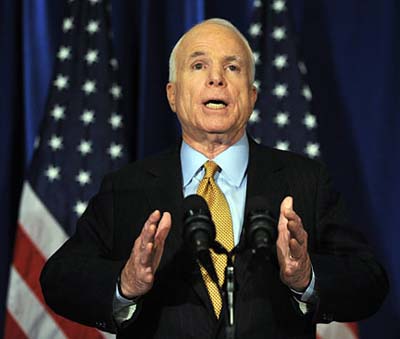
United States Senate
Washington DC
Dear Senator McCain
As an Ex-resident of Camp Ashraf for nearly three decades, I have read your letter of support for the people of Camp Liberty in Iraq to US Secretary of State John Kerry.
The people in Camp Liberty are victims of terroristic policies. Before the invasion of Iraq they were used to operate, help, administer and train terrorists. After the invasion, the leader escaped to the West, and now they are being used to safe guard the leaders in the West by feeding and creating the necessary cause for the leaders to deceive the West about their ominous thoughts and beliefs.
I am sure you remember that the September 11 tragedy masterminded and put to action by people who lived in West and pretended to be civilized people. Even now days people from civilized world who have been deceived, are joining the most barbaric terrorist groups in the Middle East region and elsewhere, which as a consequence the world has paid and is still paying a heavy price because of their evil actions.
On the verge of the invasion of Iraq and toppling of its dictator, we were told in the Camp Ashraf by Masoud Rajavi and Maryam Rajavi, that we must stay in Camp Ashraf for any price that it requires, and if we had to leave, we would ask them to send us to California, to create a dead end situation for US in order to prevent US from moving us from the Camp Ashraf.
Masoud and Maryam Rajavi having watched the September 11 barbarism live on CNN, praising it, commented facing their 4000 members then “…because Al Qaeda harmed Imperialism before and better than us, must not think Al Qaeda is more progressive than we are, ,”. Mujahidin believe in violence to reach their political goals, look at their emblem.
Mujahidin believe in destroying the Western Civilization as Western Imperialism, oppose and compete with ISIS and Al Qaeda from the point of being more anti-Western and anti-Imperialistic than they are.
Your Honor
What I would like to point at is that, it is time for everybody in the west and around the world to face international and regional terrorism with open eyes. Terrorism has changed face and is adopting new tactics to destroy the civilization. They have learnt how to deceive the world and utilize every means to reach their mediaeval barbaric goals.
Especially as a well-known and influential Senator that have great responsibility on your shoulders on behalf of your constituents and contemporary world, with the facilities at reach to investigate about the true nature of the people and groups, facing them blind folded or be deceived just by their appearance or pretense of supporting democracy or women’s rights … is no longer acceptable by the public opinion and the future generations.
All members of the Mujahidin are barred from any public and free media, books, newspaper, contacting their families and even their children. They must only love Masoud and Maryam Rajavi as their Caliphate and if anything else went through their mind but must be daily reported. They are a Cult group and not a political entity.
Mujahidin believe in separation of sexes in any common ground of activity. They force their women members to divorce their husbands and marry Masoud Rajavi as the Caliphate who owns them!
Residents of Camp Liberty are used as a prey by Masoud and Maryam Rajavi to gain media attention to utilize it to reach their goals in the West while they are still at reach by law. Masoud and Maryam Rajavi are waiting as such ISIS to reach the power to show his real face.
Your Honor
But please don’t let your political consciousness be humiliated by them.
Sincerely yours
Ehsan Roshanzamir

 who have been victims of this terrorist cult. We read your far reaching speech in the State Department Web site on September 10, 2014. We would like to express our highest appreciation and admiration for the deep understanding of the issue of terrorism and cults in the Middle East region shown in your speech.
 the gaps left at the end of the last session. Here in the UK, we think we know what our position must be. Iran must make concessions on the number of its centrifuges and in exchange sanctions will be lifted within a reasonable time scale. In this respect, the UK falls broadly in line with the American position. But with the opening of the 69th Session of the UN General Assembly next week, and the second visit to New York of Iran’s President Rohani, perhaps this is a good time for the UK to step back and consider exactly what that American position actually is. A side-meeting on September 18 in New York will test the waters on progress. Iran is not optimistic.
 ckdrop of the war against the Islamic State (IS, formerly ISIS/ISIL), Washington has managed to kill two birds with one stone, as the saying goes. Not only has the US removed a political leader who had proven to be problematic due to his opposition to US military presence in Iraq, as well as his staunch support for Syria and President Assad, they have also created the conditions for the dismemberment of the Iraqi state.
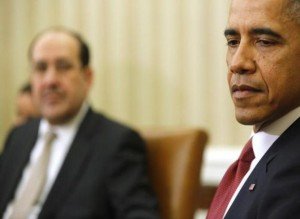 in Iraq, a clear shift has taken place in the rhetoric against, and analysis of, Prime Minster Nouri al-Maliki and his government. Though he was praised up and down by Washington while US troops remained on Iraqi soil, in the nearly three years since their exit he has transmogrified into a brutal sectarian autocrat evoking the worst aspects of both Saddam’s regime and that of his Shia neighbors and allies in Iran. What could possibly account for such a dramatic about-face?
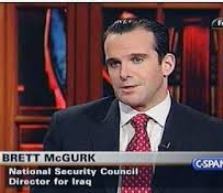 The U.S. Embassy also said McGurk visited Friday with members of Mujahedeen-e-Khalq, the militant wing of the National Council of Resistance of Iran, whose camp outside Baghdad came under rocket attack last month. The statement said the U.S. diplomat stressed the urgency of relocating the residents of Camp Hurriya to another country.