Nejat Society
  • Home
  • Articles
  • Media
    • Cartoons
    • NewsPics
    • Photo Gallery
    • Videos
  • Publications
    • Books
    • Nejat NewsLetter
    • Pars Brief
  • About Us
  • Contact us
  • Editions
    • عربي
    • فارسی
    • Shqip
Nejat Society
Nejat Society
  • Home
  • Articles
  • Media
    • Cartoons
    • NewsPics
    • Photo Gallery
    • Videos
  • Publications
    • Books
    • Nejat NewsLetter
    • Pars Brief
  • About Us
  • Contact us
  • Editions
    • عربي
    • فارسی
    • Shqip
© 2003 - 2024 NEJAT Society. nejatngo.org
Mujahedin Khalq Organization as a terrorist group

Eternal Light caused the death of about 2700 MKO Members

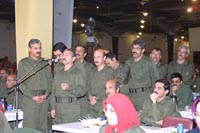
On the occasion of the twenty-first anniversary of Eternal Light (Forough Javidan) Operation that caused the death of about 2700 members of Mujahedin Khalq Organization, Nejat Society held a meeting at Khuzestan Office where 15 defectors attended. In 1987, Eternal Light Operation was launched by MKO across Iranian borders after the cease-fire between Iran and Iraq. Nejat Society held a meeting at Khuzestan Office where 15 defectors attended

Hamid Dehdar Hassani (MKO Defector) began the meeting by speaking on the necessity of the active mutual relation between defectors and Nejat Society in order to denounce Rajavi’s crimes and to release captives of his cult.

Then Mr. Ali Ekrami (MKO defector) analyzed MKO’s strategy since July 21 until the case –fire (between Iran and Iraq) and the beginning of Eternal Light Operation. He revealed some untold facts about this black deadly tragedy. Stressing that Eternal Light was the outcome of Rajavi’s misinterpretation on the concrete situation of Iranian Society, Mr. Ekrami said that the crucial duty of separated forces is the relentless denunciation of Rajavi along with efforts to rescue those who are banned behind the bars of Ashraf base.

Mr. Maziyar Shirvani who is one of the recently defected members, also gave a report on the latest status of MKO in Iraq.

In addition, some of the defectors described their memoirs of Eternal Light Operation, and revealed the crimes Rajavi and his accomplice, Saddam Hussein committed through the mass murders during that operation.

At the end, they issued a statement in which Nejat Society declared its readiness to fight the illegitimate ambitious leadership of MKO. The statement ends with four articles:

1.We recognize Massoud Rajavi as the main agent to commit the crimes of this massacre in which the lives of a nation were targeted.

2.We appeal for the establishment of a trial for the investigation of war crimes Rajavi and his allies committed.

3.We ask Human Rights organizations to challenge MKO’s crimes, based on the testimonies made by a large number of live witnesses and documented facts.

4.As the defectors of the cult, who survived that tragedy, we declare our preparation to attend any court or human rights organization to accuse Rajavi as a war criminal.

July 25, 2009 0 comments
FacebookTwitterPinterestWhatsappTelegramSkypeEmail
Iraq

Maliki complains about US-insurgents meeting

Iraq calls US officials meeting with Iraqi insurgents shocking

Maliki complains about US-insurgents meetingThe Iraqi Prime Minister Nouri al-Maliki has complained to the US President Barack Obama about a meeting between US officials and Iraqi insurgents, a Baghdad official says.
Although officials at the US State Department said that they were unaware of the alleged meeting, Maliki implicitly confirmed that he had raised concerns about the issue with Obama.

Commenting on the issue, the Iraqi Foreign Minister Hoshyar Zebari said in Washington that Baghdad found it "shocking" that representatives of the "Iraqi resistance movement," Turkish officials and at least one US official had reportedly met in Turkey in March.

Zebari, however, said that Baghdad was "still investigating" the alleged meeting with the "resistance political council," confirming that the Iraqi government had discussed the issue with US officials, AFP reported.

The Iraqi premier, speaking at the United States Institute of Peace (USIP), said that he was assured that conditions would be attached to any US talks with insurgents.

"The US government and President Obama told us that they will not be tolerant against those who kill the Iraqi soldiers, kill the US soldiers and kill Iraqi citizens," Maliki said.

"So there will not be negotiations by the US government or any of its representatives with those killers," added Maliki, who held his first White House talks with Obama on Wednesday.

July 25, 2009 0 comments
FacebookTwitterPinterestWhatsappTelegramSkypeEmail
Iraq

Iraq slams US for contacts with insurgents

Americans meeting with Terror group in Istanbul)

Iraqi Prime Minister Nouri al-Maliki has complained to President Barack Obama about a US meeting with Iraqi insurgents, Baghdad’s top diplomat said.

Iraqi Foreign Minister Hoshyar Zebari said in Washington Thursday the Iraqi government found it shocking that representatives of "the Iraqi resistance movement" met at least one US official last spring.

Zebari told Al-Hurra, the official Arabic-language US television station, that the insurgent groups adopt violence and terrorism.

Zebari said Baghdad was still investigating the meeting, adding that it apparently took place in March in Istanbul and that the Iraqi government had discussed the issue with US officials.

July 25, 2009 0 comments
FacebookTwitterPinterestWhatsappTelegramSkypeEmail
Mujahedin Khalq Organization's Propaganda System

Iranians in No Mood to Forgive MKO

A small classified advertisement placed in the Hamshahri newspaper, which is affiliated to Tehran’s City Hall, in June 2007 might not initially have seemed like a big deal, but it turned out to be intriguing.

It was addressed to a young woman called Maryam and wished her the best of luck with her return, alongside a picture of her wearing a veil.
At first glance, this was nothing out of the ordinary. Most people would not have recognised her, but some of the newspaper’s readers – those who were alive 30 years ago – knew who she was.

It was the same picture that Maryam Rajavi had used while campaigning in the first parliamentary elections after the 1979 Islamic revolution.

The ad was an attempt by the People’s Mujahedin of Iran, MKO, to revive – and rehabilitate – its name in the minds of the Iranian people after a long absence from public view.

Seven years ago, during the presidency of Mohamad Khatami, the European Union added the MKO to its list of terrorist groups. In June 2003, French police arrested Rajavi and some of her followers and Iranian television broadcast images of her in handcuffs.

For many young Iranians, this was the first time they had laid eyes on the disgraced opposition leaders.

However, on January 26 at a meeting in Brussels, the 27 EU member states decided to remove the MKO from its list, a decision that angered the Islamic Republic’s leaders.
Mohsen Torkaman, a 21-year-old student at Azad University, was also dismayed, "The Europeans showed that they use terrorism as an instrument. What matters to them is to confront countries that pose a threat to them. They do not care that a group like MKO carried out many terrorist operations in the 1980s in Iran and killed civilians."

The MKO was officially founded in 1966 after the Shah cracked down on Ayatollah Khomeini and his followers. Its goal was to overthrow the Pahlavi regime and establish an Islamic government, a mission that was supported by other Islamist militants close to Khomeini.

Families of MKO members protest in front of British Embassy in Tehran
July 2008

Massoud Rajavi –at the time a high-ranking MKO leader who later became Maryam Rajavi’s husband– was a victim of the Shah’s violent repression. He was arrested in 1971, along with 12 other MKO members, but was released after the revolution. He was the only one to survive – the rest had been executed.
After the downfall of the Shah, the MKO quarrelled with the clerical leadership of the revolution, both over ideology and how to run the country.
For example, Akbar Hashemi Rafsanjani, an influential revolutionary cleric, told the Keyhan newspaper in July 1980, "The MKO was based on Islam and Shi’ism in the beginning, but the MKO did not reach out to scholars and experts on Islamic studies nor did Islamic scholars pay any attention to them. Inevitably, the MKO fell into the hands of opportunists and immature people."

Some MKO members were the children of leading clerics, but found they could not accept the "Guardianship of the Islamic Jurists" – under which the work of government is overseen and guided by expert practitioners of Shia law. The late Ayatollah Taleghani, one of the two most important revolutionary leaders, Ayatollah Ali Janti, the head of Guardian Council, and Ayatollah Mohamadi Gilani, then attorney general, are among the best-known clerics whose offspring joined the MKO.
Although the MKO rejected the constitution that was approved by a referendum a few months after the revolution, Massoud Rajavi tried to run in the first parliamentary elections. However, he was disqualified because of his opposition to the constitution.

On June 18, 1981, after these disagreements had intensified, the MKO publicly announced it was going into opposition. Later that month, the offices of the Islamic Republic Party were bombed, killing more than 70 people. Many in Iran suspected this was the work of the MKO.
The MKO’s leaders then withdrew from politics altogether, left for Iraq and took up armed resistance. They were not alone; Saddam Hussein had already been waging war on Iran for a year.

This was seen as a betrayal of Iran and public opinion hardened against the MKO. But Reza, an MKO member who now has political asylum in Germany, says the leaders of the Islamic Republic gave them no choice, "Their exclusivist approach didn’t leave any room for the political participation of other groups."
After Iran accepted UN resolution 598 in June 1988 urging Iran and Iraq to accept a ceasefire, the MKO launched a military attack against Iran across the Iraqi border.
"This operation was our last chance, based on the MKO’s idea that we would either kill and win or die," said Hadi Shabani, a former member of the MKO who has since returned to Iran, according to Fars News Agency.

The MKO advanced into Kermanshah, a city in the west of Iran, but the Iranian army counter-attacked, and the MKO fighters were either killed or withdrew.
After this operation, it is claimed that many political prisoners affiliated to the MKO were executed in the summer of 1988. Ayatollah Hussein Ali Montazeri, Khomeini’s deputy, confirmed this in his memoirs, although there are no official statistics.
Now, after many years, the removal of the MKO from the EU’s list of terrorist groups is seen as a big victory for Maryam Rajavi and her followers throughout the world who are trying to keep their name alive in Iran.

But Reza, who kissed his political activities goodbye many years ago and now earns his living driving a cab, doesn’t think his former comrades stand a chance of coming to power any time soon.
Former Iraqi dictator Saddam (l) and MKO leader Rajavi
"The hardest job for the MKO’s leaders is to explain to the Iranian people why they stood alongside Saddam Hussein. Many people don’t understand the MKO’s situation," he said.
So although the EU may have enhanced the MKO’s international reputation, winning over Iranians might prove an impossible task.
Sara Shams is the pseudonym of a journalist in Tehran

About Mianeh: Mianeh is a new independent web-based initiative run as a project by the Institute for War & Peace Reporting (iwpr.net) the award-winning non-profit media development organization that works across the globe to platform local voices and promote international learning and engagement. Mianeh aims to be an open space for ideas, news and debate where writers in Iran can reach out to each other as well as to those outside the country who are interested in learning more about the vibrant and dynamic society that is Iran today.
Payvand News – 03/02/09
By Sara Shams, Tehran (Source: Mianeh)

July 23, 2009 0 comments
FacebookTwitterPinterestWhatsappTelegramSkypeEmail
Hadi Shabani
Former members of the MEK

Mujahedin’s Eternal Light Operation

The following is a part of Hadi Shabani’s interview with FNA. He was the advisor of Mozhgan Parsaiee (the chief commandant of MKO at the time) during the operation Eternal Light (Forough-e-Javidan). He spent twenty years of his fifty year-old life in the group until he could escape out of MKO camp in 2005.

In his denouncing interview, he retold his memories of the Eternal Light.

FNA: how was the military invasion ordered to you?

H.Sh: Immediately after the ceasefire between Iran and Iraq, Masud Rajavi held a meeting where he said that we should attack Iran in a week since the acceptance of the 598 resolution by Iran notified the weakness of Iranian forces in the fronts. He said that it was our fault that Iran accepted the resolution because when in the previous operation (Chelcheragh) we seized Mehran [a city near Iranian border] and we chanted the slogan “Today Mehran, Tomorrow Tehran.”, the Iranian regime were afraid of our arrival in Tehran and immediately accepted the ceasefire. Following such a speech the new brigades and battalions were organized. Later Masud [Rajavi] told that according to an organized plan with Iraqi army, they (Iraqi forces) were supposed to attack Iran from the Southern borders so as we could go ahead in the Western borders.

Hadi Shabani

Hadi Shabani

FNA: did you participate the “justification meeting for Light” or “the Goodbye meeting”?

H.Sh: yes, all the forces were there. Masud addressed a long speech and told that we should start tomorrow and said to Mahdi Abrishamchi (the commandant of Tehran Axis): “when you arrive in Tehran, prepare my former office on Alavi street, Tehran, for me to settle down there.” he addressed the forces.”After you arrive in Tehran, you can do anything you like for 48 hours, kill anyone you like until I come to grant public amnesty.”

How did the forces hope to win in the operation?

All of us thought that the plan was really practical.

Maud said: “the Iranian forces have no motive to fight and the people are tired and waiting for a spark to revolt against the government.” Even when we told him that we had some shortages in the units, he said:” don’t worry. As soon as we arrive in the first city, the people will join us and cover our shortages.’’

From the other side, it was the last opportunity for us who had joined the organization to struggle. According to the indoctrinations of MKO, we had to fight or kill or die.

-But meanwhile, the Iranian forces could defeat the Iraqi forces in the South. Didn’t you wonder how a country, which was allegedly weakened, could do such a thing?

-You should know that as the MKO members, our mind didn’t work tactically. We couldn’t understand it. We were the same as a skier who slips over the snow of the emotions. We were not able to analyze, we even couldn’t work on the map. The commandant told us to go straight ahead until you get Kermanshah and then Hamedan where you go to Zanjan, Saveh and Tehran. And we accepted. Now that I see, I figure out that the operation was a failure from the beginning. Moving in a line on tanks in an asphalted road had no possibility to success but nobody knew that at the time.

The proceeding night, Masud convinced the members so well that they wanted to start the operation the same night. Some members worked hard, they slept only two hours a day, and then during the Eternal Light Operation, some members were so exhausted that they overslept.

Did you receive special trainings for the operation?

The trainings were so few and only for those who had just come from the Europe two or three days ago. They were only trained to shoot with Kalashnikov and colt. Those who arrived while the operation didn’t even received that short training. They were only given an arm to go fight. MKO told them falsely that we were for example in Kermanshah and they should go there. Some members who were in Europe had left their children to their neighbors in order to reach the operation. Those who couldn’t recognize their right hand from their left hand. The forces who participated in the operation included three parts:

The old members of the organization who were trained.

The members who had just come from the other countries.

The war prisoners of the organization.

Explain more about the two last parts, please.

The forces who hadn’t received training and participated the operation to take a use of such a large chaos!! They were hopeful to change Iranian regime and get a position or rank in the new regime but most of them were killed. The situation of the prisoners was even worse.

Eternal light

How come?

Some of the prisoners were the Iranian prisoners who were in Iraqi prisons where they were treated so badly. Some of them accepted to fight in the hope that they can escape during the operation. They were about 300 people. Most of them were from the army forces that were captured in Sardasht or Fakeh. Also some of them were taken as war prisoners in Chelcheragh operation. All of them were held in Camp called Debes in Kirkuk.

When the operation started, the organization had to use the maximum use of its forces, so they looked for the war prisoners. Some of the prisoners whose number was small declared their preparation to participate. The rest were jailed in a room where some food and water were left for them. They were told:” after the victory we will come back to you.

One of the MKO officials, ”Ahmad Vaqef said:”the following day we went to the room to tell them that we could seize Kermanshah and anyone who wants to come, can come. A number of them were tricked and came and the others were imprisoned again.” Therefore the organization could force about 40 people of them, to participate the operation and most of them could escape from the scene. The organization knew that but they said that they had no way except increasing the number of the forces. However Karand was besieged by the Iranian forces so the organization forces were surrounded in Islam Abad.

During the operation, in which unit were you serving?

I was working in artillery, our commandant was Mahin Rezaiee who was called Azar.

The first day, two sets of Ayfa were delivered to us. We were four people. We had no important problem until we reached Islam Abad where 122 small fights happened but any way we could open the way. Then the real fight began. I was injured then taken to Islam Abad. The injured fighters were a lot. We were taken to Bagdad hospital by Iraqi helicopters. The hospital was dedicated to MKO injured members due to their large number.

Your friends, did they tell you anything about the fights?

One of them described his memory which I’d like to retell it now that you see that MKO and Masud’s emotion and kindness! MKO’s strategy in the Eternal light was the “Military Flag” Strategy. It means: kill anyone who is against you and this “anyone” means “revolutionary guard’’.

A friend of mine explained:”we captured some of revolutionary guards during Eternal Light operation and kept them in a place with tied hands. The weather was very hot, and they were very thirsty. One of the members went before the commandant “Afshin” and asked him what to do with the captive ones. Afshin who liked colt very much took out his colt and killed all of them, put their bodies on each other and took pictures of them. The picture was shown repeatedly in MKO’s meeting as one of the most important achievements of Eternal Light.

What was the reflex of the failure of Eternal Light in the organization?

It was so terrible that after a week, Masud declared a public meeting and ordered to bring all the forces, even the injured ones, to the meeting, I was in the hospital at the time but they brought me to the meeting with my bed. The situation was very bad. Most of the forces were discouraged.

What did the organization do to deal with the situation?

During the meeting, Masud began with justifying the failure, the thing he was so good at. However the atmosphere after the operation was very heavy, the organization started to recruit new forces from Europe. They were told to come to Iraq for some military training and then they are free to stay or to go. Masud said that they were preparing for the operation “Eternal 2”

But it was of no use. The condition lasted until the American invasion to Iraq and then it reached its summit.

Translated by Nejat Society

July 23, 2009 0 comments
FacebookTwitterPinterestWhatsappTelegramSkypeEmail
Former members of the MEK

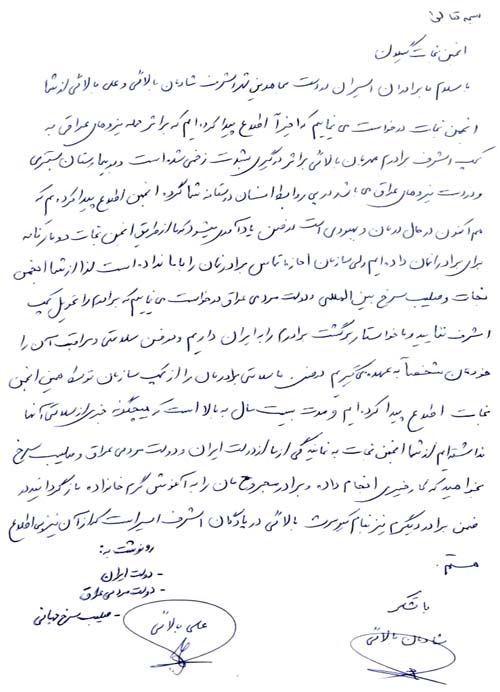
Hajipur Ex-member of Rajavi’s Cult Welcomed by Nejat Families

According to Nejat Society’s President at Gilan Office, Hamid Haji pur who spent twenty years of his life in MKO succeeded to defect from the cult a few months ago and return to his hometown in Gilan, Iran. Hamid Haji pur who spent twenty years of his life in MKO succeeded to defect from the cult

Following his return, a lot of families who are members of Nejat Society in Gilan office, contact the office in order that they can get news about the health of their beloved ones in Camp Ashraf.

To facilitate Mr. Hajipour’s visit with Nejat families, Gilan office held a meeting where the families welcomed Mr. Hajipour and asked about the condition of their children who are still captured in Camp Ashraf.

The president of Gilan office added that Mr. Hajipur described the mental and physical pressure he had suffered as a member of Rajavi’s cult. Impressed by Hamid Hajipur’s story in MKO, the families showed concern about the release of their beloved ones and their return to Iran.

The meeting lasted two hour. At the end the families took some photos together with Mr. Hajipur and his family.

July 22, 2009 0 comments
FacebookTwitterPinterestWhatsappTelegramSkypeEmail
Former members of the MEK

Human tragedy in prospect; Mojgan Parsai the first volunteer

An interview with Batool Soltani on MKO self-immolations – Part 8

Sahar Family Foundation: In our last session we talked about the possibility of a human tragedy. You said that all volunteers had signed a written pledge for self-immolation. The question is to what degree the organization can exploit these signed pledges to stage a human tragedy?

Batool Soltani: This is an issue of high potentiality. In fact, these letters helped the organization have an effective evaluation to plot its future scenarios. They are substructures on which the organization will lay the groundwork for its political strategies. But regardless of these potential means and developing a true assessment of the devoted on whom it can relay, it shows the organization’s own fascination in such activities that are some true aspects of cultic relations. Admittedly, most cults behave according to pre-planned scenarios in their relations with the outside world. It is also the same with Mojahedin.
 
When a member like Sedigheh Mojaveri commits self-immolation, for sure her feat has been already discussed in detail in higher echelons of the organization. It fails to be an arbitrary decision, not even one percent, to step into the street and set oneself on fire; any instance of unbridled passion is absolutely rejected by the organization and fails to be accounted as an organizationally directed objective.
 
Frankly speaking, no member of the organization with whatever ranking, being in charge of any post or else, hardly takes a step uncontrolled and uncoordinated by the organization. In a hierarchical order within an organization with tight discipline and very limited internal democracy, the responsible ranks have to be aware of the slightest overt and covert things about the members under their authority and there is nothing kept secret about the members in respect to their status.

For example, I was in England for four years and my massul (the one in charge) was aware of the single moments of my stay there; it was the same with the members under my authority. Hardly can you find an organization with so strong sense of cohesion and tight internal discipline. Consequently, no decision of self-immolation remains concealed from the ranks in charge and nobody ever dares to disobey the organization to engage in any self-motivated act of suicide.

SFF: From what layer of the organization were specifically the first volunteers of self-immolation in Camp Ashraf? Can you, for instance, name the first volunteer?

BS: You know, anything in an organization emerges from the top layers and gradually, through a well orchestrated mechanism, is spread to lower layers. It is done so skillfully that after a while those in the top can hardly believe that what is so easily embraced and theorized among the lower ranks is a magnified reflex of what had been originated in the top.

SFF: Now, can you name the first volunteer for self-immolation in Camp Ashraf when it was resolved on the act?

BS: In the department I was, Mojgan Parsai was the first who broached the subject and she was also the first volunteer. Her first sentence to begin was ‘It is worthwhile to set on fire whatever we have in Camp Ashraf for Maryam’s freedom’. Of course, what she said was another interpretation of Massoud Rajavi’s message stating that we had to make use of all our facilities and potentialities wherever we were to set Maryam free. He would say any Mojahed breathing on this planet had to be ready to sincerely sacrifice and set on fire whatever he had for the sake of Maryam. Thus, it all began in the echelon of the Leadership Council and the enthusiast slid down to the lower layers. It is also the same with other issues. Consider, for instance, they want to elect a first secretary.
 
The candidate would be elected in the first layers of the Leadership Council but remained secret. Idiomatically they would say ‘let the string of anything loose and it will unwind to the lowest layers’. They meant that whatever they decided on would be indirectly conveyed to the lesser ranks down to the bottom where it again quickly and energetically bounces back to the top layers as something new. Now it was our time to galvanize them into action and arrange a formal meeting to elect the one we had already decided on. None of the members present at the meeting knew what was really going on and how they had been inculcated to vote for Mojgan Parsai or Sedigheh Hussaini for example. Anything would end happily. On the one hand the top layers had picked up their favorite one and on the other hand, it would be propagated that a candidate had been elected through a totally democratic process. Everyone thought that his/her has been respectfully accomplished. Now suppose that somebody from the top layers had decided to commit self-immolation.
 
The decision had to be discussed in detail in all three layers of the Leadership Council before being approved by the first secretary and the leadership. I mean to say again that nobody with whatever ranking and organizational status, even if a proxy for the leadership, could take a perverse and decisive action or decision for whatever personal and organizational objective. Only those familiar with the layers of the Leadership Council can understand what I mean.

Systematically, when one from the top volunteers for self-immolation, as I did, it denotes that the person has grabbed at the loosed string whether he accedes to it or not. When I myself unwillingly volunteered for the act, in fact, I was sizing the string Mojgan Parsai had let down to let it pass to lower levels. It was only a reaction to what the organization tried to instill into the members. When I saw how devoted Mojgan was when she announced her readiness to burn herself for the sake of Maryam, although I did not know how sincere she was in what she claimed, naturally it could impress me to be the second to volunteer. Of course the sincerity is not at all a matter of any significance but the enthusiast and incitement such an atmosphere created among others.

Now the question is how the incitement could provoke the human tragedy you mentioned. Through the same mechanism of the idea being passed down from the top to the down, the crystallized ideas in the lesser layers very easily generate actions and the created enthusiast erupt into actions that may lead to human tragedy. It is much expected among the lower layer than the top since the rank and file are more emotive and impulses from the top easily impress themselves on them. Of course, you may notice that the top layers never fail to show off their emotions but for sure they are rational and reasonable when they have to act.

That is why they are the first to volunteer but hardly the last to put the words into action; unlike them, the lesser layers are resolute not only to do what they volunteer themselves for but also enter a compete and try to outstrip each other. That is how it may end to a human tragedy in its worst form. When I see that a ranking member like Mojgan Parsai volunteers for self-immolation, what do you expect of me as a subordinate! To be sure, as I have been already notified, I will not be the one to set myself on fire when the time comes because I know they will never let me harm myself as one belonging to the higher echelon. However, the occurrence of a human tragedy inside Camp Ashraf depends on Massoud Rajavi’s will and a number of other factors well identified by him to trigger the disaster. And it is all because of the strategically decisive role Camp Ashraf plays in Mojahedin’s existence and survival. So important an issue it is for Mojahedin that it requires a long discourse.

To be continued

Translated by Mojahedin.ws

July 22, 2009 0 comments
FacebookTwitterPinterestWhatsappTelegramSkypeEmail
Mujahedin Khalq Organization members' families

More than 2 decades of slavery

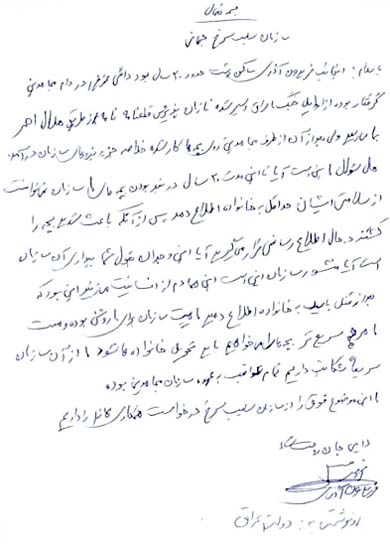
Shaaban pour family worry about the fate of their beloved Hassan.
Hassan has been captured in Camp Ashraf of Rajavis’ Cult for more than twenty years according to Asgar Shaabani pour, Hassan’s brother who is an active member of Nejat Society Mazandaran Branch.

Asgar has tried a lot to release his brother from the bars of Camp Ashraf. Last year, together with a number of families of Nejat he went to Camp Ashraf gate but they were affronted by MKO officials including Ozra Alavi [Ms. Ozra Alavi Taleqani the Deputy Commander in Chief of the National Liberation Army] so they couldn’t visit their beloved ones.Hassan has been captured in Ashraf for more than 2 decades

July 21, 2009 0 comments
FacebookTwitterPinterestWhatsappTelegramSkypeEmail
Former members of the MEK

Mr. Hamid Hajipur,MKO ex-member joined his family

Mr. Hamid Hajipur who has experienced the bitterness of being captive in exile for more than 20 years, managed to release himself from the bars of Rajavis’ Cult and returned home and joined his family in Nejat Society office, Gilan Branch.

Declaring his separation from MKO and expressing his hatred towards the organization’s compulsory work camp; Camp Ashraf, Mr. Hajipur returned to his homeland and to his warm family center to shape his own life as he wishes.Mr. Hamid Hajipur,MKO ex-member joined his family

July 21, 2009 0 comments
FacebookTwitterPinterestWhatsappTelegramSkypeEmail
Terror Teams of the MEK

40 MKO terrorists killed in Taliban clashes

Over 40 members of an anti-Iran terrorist group have been killed during deadly fighting with The MKO is notorious for the help it extended to former dictator Saddam HusseinTaliban militants in Afghanistan.

Sixty members of the Mujahedin-e-Khalq Organization (MKO) had entered Afghanistan with the help of intelligence forces from the United Arab Emirates with the aim of carrying out raids in Iran, Pouya News reported on Sunday.

The group, which was faced with strong resistance from the Iranian troops stationed on the border attempted to withdraw when it came under heavy Taliban fire from the Afghan side.
The deadly battle left over 40 MKO terrorists and an unknown number of Taliban militants dead, Pouya News said.

The MKO was founded in Iran in the 1960s, but its top leadership and members fled the country some twenty years later after carrying out a series of assassinations and bombings inside the country.

The group is especially notorious for the help it extended to former dictator Saddam Hussein during the war Iraq imposed on Iran (1980-1988) and in the massacre of thousands of innocent Iraqis.

July 21, 2009 0 comments
FacebookTwitterPinterestWhatsappTelegramSkypeEmail
Newer Posts
Older Posts

Recent Posts

  • The black box of the torture camps of the MEK

    December 24, 2025
  • Pregnancy was taboo in the MEK

    December 22, 2025
  • MEPs who lack awareness about the MEK’s nature

    December 20, 2025
  • Why did Massoud Rajavi enforce divorces in the MEK?

    December 15, 2025
  • Massoud Rajavi and widespread sexual abuse of female members

    December 10, 2025
  • Facebook
  • Twitter
  • Instagram
  • Youtube

© 2003 - 2025 NEJAT Society . All Rights Reserved. NejatNGO.org


Back To Top
Nejat Society
  • Home
  • Articles
  • Media
    • Cartoons
    • NewsPics
    • Photo Gallery
    • Videos
  • Publications
    • Books
    • Nejat NewsLetter
    • Pars Brief
  • About Us
  • Contact us
  • Editions
    • عربي
    • فارسی
    • Shqip