The former Iraqi foreign minister, Tariq Aziz, who was also a close ally and personal advisor of Saddam Hussein, has recently been sentenced to death. A CNN report of the news states that he was “one of the best-known faces of the Iraqi government for more than two decades.” [1] But this well-known face was not known for his good deeds. The Iraqi tribunal had decided on a 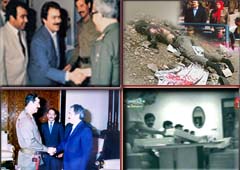 death sentence because of his crimes which include his role in eradicating rival political-religious parties while holding power during the Ba’athist regime. Aziz had been on trial in a long-running case in which he was accused of being part of a campaign of persecuting, killing and torturing members of the Shiite opposition and other banned parties. [2]
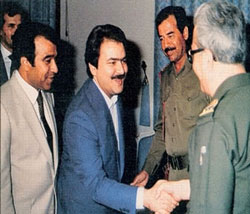
For the Shiite population especially, Aziz’s death sentence means a step toward justice, and the majority of Iranians would agree. But for the Mujahedin-e Khalq Organization (MKO), a bizarre Iranian opposition group led by self-appointed husband and wife, Massoud and Maryam Rajavi, news of Aziz’s sentence prompted a statement of condemnation. Tariq Aziz was both their friend and ally. Before Saddam Hussein bankrolled the MKO, Iranians remember clearly in 1983 when Massoud Rajavi signed a treasonous pact with Aziz—a pact which enabled the MKO to become heavily armed and shortly thereafter violently turn against their own countrymen. A detailed report on the People’s Mujahedin Organization of Iran (PMOI/MKO) published by the US Department of State in 1994 points out how Massoud Rajavi’s alliance with Saddam Hussein’s Ba’athist Regime was formed while Iran was being invaded by Iraq during the 1980’s:
*In Paris; the non-Mojahedin members of the NCR encountered the autocratic style of Rajavi. In particular, Rajavi’s unilateral decision to tie the Council to Iraq alienated the others, who viewed the alliance as a traitor’s deed. The Council’s most important participant, former president Bani Sadr [sic], formally split in 1984, castigating Rajavi as "a pawning [sic] the settlement of the Iran-Iraq conflict." (Bani Sadr [sic] asserts that the first formal pact between the Mojahedin and Iraq was negotiated during a January 1983 meeting between Rajavi and Iraqi foreign minister Tariq Aziz in Fragce [sic]. Mojahedin publications also confirm this meeting.)* [3]
Rajavi’s seditious meeting with Tariq Aziz was the starting point of a long-lasting alliance with the former Iraqi dictatorship. The State Department report concludes that "government-controlled Iraqi media accounts of recent Saddam-Rajavi contacts provide further insight into the MKO’s current relationship with Baghdad. Meeting [sic] between the two are announced to buttress Saddam’s isolated position or to send a message to the government of Iran. For example: On July 31, 1994, Rajavi sent Saddam a ‘message of congratulations.’ On January 26, 1994, Rajavi met with Saddam and Tariq Aziz, Iraq’s deputy prime minister."[4]
The State Department’s conclusion regarding the association is confirmed by another source, the former Iranian president, Dr. Abulhassan Banisadr. Banisadr refers to Massoud Rajavi as a "power addict" in his interview with Pen Club’s representative, Muhammad Hussein Sobhani. During the interview, which took place in Farsi, Banisadr recalls the time Rajavi was planning to meet with Tariq Aziz:
*I told him [Rajavi] now that you accepted to visit him [Aziz], you should treat him the way our Iranian Emperor Shahpour the First treated the Roman Valerian. Our Emperor humiliated the invader to our country. He [Aziz] should’ve understood that he has invaded a country which has national pride.
I advised him [Rajavi]: You shouldn’t let the visit last more than half an hour.**He said, Ok, I will but instead of behaving like what he was supposed to, the meeting lasted five hours so that the following day Le Monde newspaper wrote that Mr. Tariq Aziz bought Mr. Rajavi or something like that […]. **After that visit, Rajavi’s behavior changed and changed. **[5]*
*Aziz, the MKO, and France*
Tariq Aziz has been under a microscope for a number of years by justice seeking-Iranians, and accordingly the official report of his death sentence comes as a small victory. Many French citizens would agree. Aziz’s relationship with the MKO—whose European headquarters is located in Paris—has always been a political thorn for the French where the MKO is heavily scrutinized because of their cult mindset and their violent terrorist activities. Geoff Hutchison interviewed Amir Taheri, a French–Iranian affairs analyst, in June 2003 following the arrest of Maryam Rajavi and 160 other MKO members, who were located at the MKO compound in Ouver Sur d’Oise, Paris. After the arrest by French police, Taheri suggested two reasons for France’s decision on taking MKO terrorists into custody.
Taheri said that interior minister at the time, Nicolas Sarkozy, "is trying to appear very tough, especially against illegal immigrants and the Mujahedin have been running a racket of political asylum and so-on for many years. The second reason is that the presence of the Mujahedin in France was negotiated by Tariq Aziz, number two of Saddam Hussein in 1981, and now with the fall of the Iraqi regime there is no reason for the presence of the Mujahedin on French soil."[6]
The accounts of MKO activities are agreeably and accurately documented by the governments of France, the United States, and Iran. All have the same opinion that the noteworthy initial visit with the MKO’s Masoud Rajavi and Tariq Aziz signifies a precise turning point in the history of MKO endeavors. That meeting was the start of a long-term strategy in which Rajavi lassoed power and led the group into a bizarre existence as he became an autocratic ideological leader with a cult of personality. For Banisadr, who was one of the main founders of the National Council of Resistance, the meeting was fundamentally immoral. Banisadr points out in his interview that three basic principles, “independence, freedom and non-existence of hegemony” [7] were needed in order to generate positive results in the cause. Massoud Rajavi’s treasonous pact was a contradictory element for Banisadr and others because it violated the most important principles of the NCR. In taking part in this act of treason Rajavi dedicated the NCR’s capacity to act, and his warped vision led the MKO to become a mercenary force for Saddam Hussein. As Rajavi proceeded he rejected the integrity of the NCR, but more importantly, in doing so, he rejected the people of Iran. Rajavi cultivated and broadened hegemony over all the members of the NCR. Many groups did not agree with him and they were excluded. Eventually the NCR consisted only of MKO supporters. Other opposition groups simply left the organization, feeling tainted by the MKO.
Although it has been three decades since the MKO hijacked the National Council of Resistance, it still exists, and still the MKO assumes total control. The MKO is very tight-lipped about synonymy with the NCR and they would rather not disclose that the two are essentially under the same management. This is an important and little known reality for the masses in the West. What is surprising is that the Rajavis decided that the NCR needed to publicly lament the news of the Tariq Aziz’s death sentence. Their website states “the Iranian resistance strongly condemns the death sentence against Tariq Aziz." [8] The statement is a puzzling response from a group who, since the Iraq war started, has been trying to sanitize their image in the West. It’s highly conceivable that the statement is a part of a new strategy to justify the fact that they turned against Iran. Perhaps they are just taking advantage of the fact that the West is still largely unaware of the murderous atrocities the MKO committed against not only their own Iranian countrymen, but against Americans.
Mostly likely the MKO is seeking publicity and they want to make a statement in order to prepare for hitchhiking on the much-anticipated execution of Tariq Aziz. Whatever the case, the MKO knows the world will be watching. The power hungry MKO-controlled NCR has a plan up its sleeve, and it is not in the best interest of the people of Iran; it is for themselves. That much is for sure.
References:
[1] CNN Wire Staff. "Iraqi court sentences Tariq Aziz to death." *CNN* 26
Oct 2010: Web. 17 Nov 2010. <
http://articles.cnn.com/2010-10-26/world/
iraq.aziz.sentence_1_iraqi-high-tribunal-death
-sentence-malcolm-smart?_s=PM:WORLD>.
[2] AP. *CTV News* 26 Oct 2010: Web. 17 Nov 2010. <
http://www.ctv.ca/CTVNews/World/20101026/
tariq-aziz-death-sentence-101026/>.
[3] Note: In 1981, the Mojahedin leadership fled to France and with other
Iranian opposition movements formed the National Council of Resistance
(NCR).
Katzman, Kenneth. US State Department Report, Library of Congress.
Congressional Research Service. The People’s Mojahedin Organization of Iran.
Washington, Nov 1992. Doc. call no.: M-U 42953-1 no.92-824F as posted on the
Iran-interlink.org website:
http://www.iran-interlink.org/files/child%20pages/USstatedept.htm
See also: Office of the United Nations High Commissioner for Refugees
website: http://www.unhcr.org/refworld/pdfid/4ac9c2c52.pdf.
See also: CORI (Country of Origin Research and Information) website:
http://www.unhcr.org/refworld/pdfid/4ac9c2c52.pdf
[4] Ibid
[5] Iranian Pen Club. "The outset of Rajavi’s longtime treason." *NEJAT
Society* 06 Nov 2010: Web. 17 Nov 2010. <
https://www.nejatngo.org/en/posts/3339>.
See also original interview in Farsi: Banisadr, Abulhassan interviewed by
Mohammad Hossein Sobhani
http://www.iran-interlink.org/fa/index.php?mod=view&id=8888
[6] “France targets Mujahedin e-Khalq." (transcript) *Current Affairs*.
Geoff Hutchinson Amir Taheri in Brussels. Australian Broadcasting Company:
702 ABC, Sydney, AM – Wednesday, 18 June, 2003 08:11:05 Radio. 17 Nov 2010.
<http://www.abc.net.au/am/content/2003/s882312.htm
[7] Iranian Pen Club. "The outset of Rajavi’s longtime treason." *NEJAT
Society* 06 Nov 2010: Web. 17 Nov 2010. <
https://www.nejatngo.org/en/posts/3339>.
See also original interview in Farsi: Banisadr, Abulhassan interviewed by
Mohammad Hossein Sobhani
http://www.iran-interlink.org/fa/index.php?mod=view&id=8888
[8] NCR Website
By Mazda Parsi


 man’s previous supports from Mojahedin-e Khalq. This is an alarm for people like Massoud Rajavi who are responsible for the death of tens of thousands of people and now are hiding in their shelters. Rajavi and other leaders of the MKO consider the fate of Tariq Aziz as their own coming destiny. Therefore they are frightened from being trapped by justice one day.