The Records:
After Saddam Hussein’s dictatorship, the main sponsor of Massoud Rajavi was toppled, a ray of hope lit the hearts of the families of the members of MKO (Rajavi cult). They thought that with Saddam Hussein removed from power in Iraq, the gates of Ashraf garrison would be open to the families and they would be able to see their loved ones after many years of waiting.
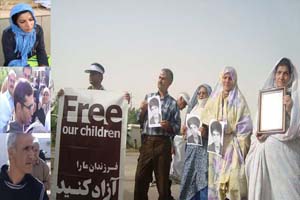
This hope soon faded when after a short time the American Forces took the place of Saddam Hussein for the Rajavi cult and gave the cult leaders an open hand to create the same circumstances for their followers. The report published by the American institute RAND for the Defense Department fully exposes the support of some American commanders for the cult’s leaders to be able to keep their followers imprisoned inside Ashraf garrison.
Since the conditions for travelling to Iraq became easier, many suffering families of the members of the destructive, terrorist cult (MKO), from various parts of the world and in different timings, approached Ashraf gates in Iraq and tried their chance to see their loved ones. Some visited several times through the years and got no results.
During this time the families who were attending outside Ashraf gate either returned empty handed or the cult leaders would make the particular member insult the family and complain why they have become the agent of the Iranian regime and why they intend to destroy Ashraf?!
Family Sit-in Starts:
In February 2009 some families of the trapped members of the Rajavi cult, as in previous times during the past few years, approached Ashraf gate and demanded visits with their relatives. The immoral attitude of cult officials and even attempting to beat up the families created great concern in them for the fate of their relatives. Some decided to form a picket line along the main entrance of Ashraf garrison and they announced that they would not be moved until they see their loved ones. Later more families joined them and gradually a movement preceded which has continued until now.
Many hardships such as expiring visas and limitations that the Iraqi government and U.S. forces imposed on the families made life for the families very tough – so that Massoud Rajavi said that the families would not stand for more than 20 days.
Since the families’ move to the front of Ashraf gate was spontaneous and without any previous planning, no precise date was recorded for its start. Regarding the residential hardship, some families returned to Iran but more families took their place and continued the picketing.
The New Round of Sahar Activities:
In June 2010, that is after 4 months had passed, the families’ move created increased motivation amongst the human rights activists in Europe and America, in particular amongst the former members of the MKO who were active in trying to help their former colleagues. This ended in the formation of a seminar in Paris on 19 June 2010. In this seminar Ms. Batul Soltani, a former member of the MKO leadership council and a founder of SFF who is residing in Europe now had a telephone conversation with Ms. Sorayya Abdullahi, a suffering mother of a captive member inside Ashraf garrison and the representative of picketing families. This dialogue was heard by the audience on both sides of the line. This seminar became a milestone for the activities round the demand of the families in Iraq, Europe and America.
The public activities of SFF declined a little since it has been more involved in legal activities on behalf of former members’ complains against the MKO in the Iraqi courts as well as having some officials moving to Europe. It must be said too that we were caught by surprise by the families’ action. But after this seminar and with the new form of Sahar website, our activities found a new pace with regards of informing the public about the families.
From the beginning, the families stationed outside Ashraf garrison approached the MKO officials and demanded to see their relatives, but every time they faced a humiliating attitude. The families decided initially to not seek any publicity over the issue in order to raise their chances of seeing their cherished ones. But the cult leaders started a political confrontation against the families by insulting them and threatening them and also accusing them.
The cult leaders clearly proved that they do not understand logic and they must be forced to respect other people’s rights as well as their own members’ rights by the public opinion and international organizations. Rajavi showed everyone that he finds himself right on all grounds and has no respect for other people’s ideas and emotions. He acts according to his cultic reactionary ideas and ruthlessly makes an old mother suffer and does not recognize any human rights.
Sized members flee from Ashraf:
During the past year, that is since the Iraqi police force managed to establish posts inside the entrances of the Ashraf cult garrison, a substantial number of members attempted to escape from the camp. These members, some of whom have been held captive inside the garrison for more than a quarter of a century, have had a bitter experience. They have no idea about modern science and technology and do not know anything about the outside world. Worse than all, they were in a critical mental situation after so many years of brainwashing and mind manipulation. They were afraid of anyone outside the cult and considered everything out there to be satanic and corrupt. Some of them were even afraid to give their names and they used to think that they are still under the influence of the cult. Some, even one year after leaving Ashraf, still have nightmares about there. But they are all content that they are out now and they only worry about their former colleagues who are still there.
Some of those who attempted to escape did so with the assumption that they might be tortured and then executed either by the Iraqis or by the Iranians. Some after spending one year in a hotel in Baghdad are still not ready to have their names published and do not wish to contact their families. Some say, in particular the women, that they do not have the nerve to see their relatives.
This applies to the families who are picketing outside the Ashraf garrison too. They do not wish to be photographed or for their names to be published. They clearly say that they do not want anyone to know that their relatives – who everyone thought had been missing in the war or has been martyred – have actually been helping Rajavi and Saddam Hussein.
What must be done?
On the one hand the issue of the MKO is a national security problem for the Iraqi government. As they say, this difficulty is a heritage from Saddam Hussein for the people of Iraq. The Iraqis want them out of their country but so far they have not been able to remove them. On the other hand this cult could be used by the U.S. or Israel against Iran. At least some elements in the west think that they might be useful as they are ready to use terrorists on the borders of Iran, so they try to preserve the cultic relationship and keep the members captive inside the garrison. But as far as the families are concerned they only have a legitimate humanitarian demand.
The families have every right to have free access to their relatives inside the garrison which is approved by all international regulations. If we consider the inhabitants of Ashraf as prisoners, still they have the right of free contact with their next of kin.
Apparently these families have no one but God to help them. No one can expect anything from the governments of the US, Iraq, Iran or etc. It is clear that international organizations such as the UN or ICRC have, for some reason, turned their back to this humanitarian problem and have closed their eyes. The families of course have created an extensive example of resistance with their bare hands which moves every human being. At least the families have prevented more people falling into the trap of the Rajavi cult. Rajavi has used the US soldiers to put pressure on the families who have come from very long distances just for a family visit. Rajavi of course has stopped investing in the Iranian people for his goal to reach to power in Iran and tries hard to attract support from the US and from Israel.
Those who really understand the situation of the families are the ones who also have someone in Ashraf garrison. The families and the former members whose relatives or friends are held captive there and have no way out, understand well that a tragic cultic ending the same as the cults of Jim Jones and David Koresh, or becoming like gladiators in modern slavery who must kill until they get killed, could threaten their loved ones.
In whatever county that you are, anywhere that you work and live, any thoughts or ideas that you have, any political stances that you might hold, it is necessary to let the world know about this human rights issue and act in any way you can. Rajavi and his international backers must be put under the pressure of public opinion. He is not prepared to recognize the rights of the families and his own followers and under the present political circumstances does whatever he desires.
We in the SFF who are facing the problem directly know that we have not done enough and we had to do much more than this. We do need help from those who understand our situation. Please don’t let the resistance of the families not reach the desired results. The sit-in by the families is a humanitarian move. Let’s share their cause by helping them.
Please let us know your opinion.
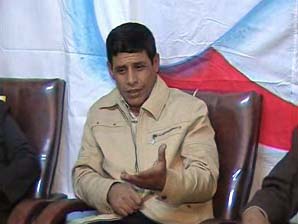 made significant changes in their policy in order to maintain their garrison. To be able to prolong their stay in Iraq, they shifted their agenda to get close to "Enemy", because they needed to maintain Ashraf at any cost even the cost of violating the principals of the organization! The only way left to keep Ashraf was to get along with the American’s policy. MKO was classified as a foreign terrorist group so admitting the relationship with MKO by US was seriously doubted.
  Meanwhile, the argument on "family" was brought about. The leaders were sure that if the notion of family had been revived in the minds of members, they could have no longer stayed in the camp. This fact terrified the leaders who had to encounters various problems in the camp.
 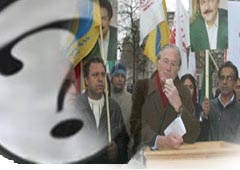 destructive mind control cult which has been designated as a terrorist entity in the USA since 1997, the only other reasonable explanation is that they have succumbed to the influence of the cult and been subjected to the same mind control techniques which have enslaved the members of the MEK.
  MKO nourished the anti-Iran media, which attempted in vain to underestimate Iran’s success in starting a nuclear facility. Various TV stations have introduced a number of “nuclear experts” on their news programs trivializing Iran’s nuclear success. Insofar as the MKO is concerned, this type of reaction is expected—it is merely a tactic used to boost their promise (to followers) to take over the government of the Islamic Republic within six months. It is also an approach they engage in order to self-adorn their support from various Western Islamaphobic neoconservative politicians and think tanks. For the upper echelon of the MKO, seeing their home country make nuclear achievements is oddly worrisome.