
Although you may be familiar with MKO’s rhetoric and its dual face when addressing the world outside versus its strongly closed internal fort, you could be possibly taken by surprise to hear its leaders once more reiterating brazenly what they dreamed for the future Iran with not in the least belief to what they publicize. Of course, majority of the gathering hired crowed in the Paris-Nord Exhibition Hall on June 28 hardly knew what Maryam Rajavi was saying in her speech because neither had they any basic information about the organization nor were they to be under any further aegis of MKO as its supporters.
The gathering was claimed to be incorporated representatives from the Iranian exile community residing in various countries in Europe, the United States and Canada but none from Camp Ashraf whose members the organization propagate as the backbone of the Iranian Resistance against Iranian regime. Camp Ashraf is also known to be the ideological preserver of the organization and a micro society upon which it intends to build the future Iranian society. Thus, whatever the organization suggests for Iran has to have been already tested within its miniature model of promised utopia, Camp Ashraf.
Here is what Maryam Rajavi puts forward in her speech: ‘The future Iran we are fighting for will be a society in which all Iranian citizens enjoy freedom of speech, belief, religion, clothing, and free access to information. Everyone will be equal before the law.’
 In his first organizational gathering after the initiation of the ideological revolution, Massoud Rajavi in depiction of the process to arrive at the intended utopia said: “All the discoveries are first made in a laboratory before being generalized. I hope we bring this wave to the surface of the society in the near future”. Of course, he meant his novel, unprecedented discoveries through an unconventional internal revolution that totally discarded traditional social values.
Honestly speaking, are Ashraf residents, locked up within high walls of a closely watched camp to represent an Iranian micro-society, enjoying ‘freedom of speech, belief, religion, clothing, and free access to information’? I think Maryam Rajvi knew well she was joking when she was saying these words. And I do hope the organization is removed from terror lists at least because the captured souls of Camp Ashraf will be granted the opportunity of attaining physical freedom out of a dangerous cult whose leader looks upon them as scapegoats for the accomplishment of his/her cult ambitions.
Sattar Orangi, Mojahedin.ws, June 30, 2008
http://www.mojahedin.ws/news/text_news_en.php?id=1727

 Considering itself an alternative, MKO, in spite of chanting slogans, hardly believes in and adheres to the principles of human rights. Reportedly, the organization is notoriously known to be abusing its insiders through a various instances of human rights violations. Reported by Human Rights Watch, “abuses carried out by MKO leaders against dissident members ranged from prolonged incommunicado and solitary confinement to beatings, verbal and psychological abuse, coerced confessions, threats of execution, and torture that in two cases led to death”. 1
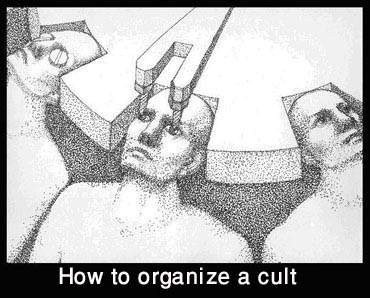 As part of the intense influence and change process in many cults, people take on a new social identity, which may or may not be obvious to an outsider. When groups refer to this new identity, they speak of members who are transformed, reborn, enlightened, empowered, rebirthed, or cleared. The group’ approved behavior is reinforced and reinterpreted as demonstrating the emergence of "the new person." Members are expected to display this new identity. 1 The new personality totally split from the outside world is manipulated for a variety of group tasks based on the objectives of the group and cult that consider the outsiders as the enemies who have to be confronted: The conflicts a mass movement seek and incites serve not only to down its enemies but also to strip its followers of their distinct individuality and render them more soluble in the collective medium. 2 As Hoffer asserts, a cultist personality is formed to be submissive to the inner-cultic relations that have priority to outwardly demonstrated ambitions and goals. The members undergoing overall identity change easily consent to any means of changing behaviour and conduct. Thus, cults can successfully accomplish their goal of binding new members to the group. Considering the stages people will go through as their attitudes are changed by the group environment and the thought reform processes, Singer points to psychologist Edgar Schein’s second stages of three: During this second stage, you sense that the solutions offered by the group provide a path to follow. You feel that anxiety, uncertainty, and self-doubt can be reduced by adopting the concepts put forth by the group or leader. Additionally, you observe the behavior of the longer, term members, and you begin to emulate their ways. As social psychology experiments and observations have found for decades, once a person makes an open commitment before others to an idea, his or her subsequent behavior generally supports and reinforces the stated commitment. That is, if you say in front of others that you are making a commitment to be "pure," then you will feel pressured to follow what others define as the path of purity. 3 There are also the eight psychological themes that psychiatrist Robert Lifton has identified as central to totalistic environments and cults invoke these themes for the purpose of promoting behavioral and attitudinal changes in the members. The third theme, demand for purity, depicts two opposite world of black and white; the cult being an absolutely white and clean world versus the black and evil world of outside. Of course, the members with a new personality have no other choice but to think and act according to cult’s ideology and drawn strategy: An us-versus-them orientation is promoted by the all-or-nothing belief system of the group: we are right; they (outsiders, nonmembers) are wrong, evil, unenlightened, and so forth. Each idea or act is good or bad, pure or evil. Recruits gradually take in, or internalize, the critical, shaming essence of the cult environment, which builds up lots of guilt and shame. Most groups put forth that there is only one way to think, respond, or act in any given situation. There is no in between, and members are expected to judge themselves and others by this all-or-nothing standard. 4 The process of producing identity within MKO follows the same mechanism in the cults and its orientation began with the start of the internal ideological revolution. All the members undergoing the revolution process admitted their identity change, that there does exist a long distance between their organizational and personal identities. It was instilled into them that their identity would be prompted based on the extent of adherence to the ideological system of the group and denial of any personal identity. In a text written by a member of MKO in self-denial we read: Personality, egocentrism, self-reliance and individualism are all souvenirs of the bourgeoisie’s worthless humanism that distanced me from the organization as far as its degree of its impact on me. It was like a chaff that barred me to drink the pure, life-giving instructions of the organization and was leaving me alone in a desolate waste-land with no way out. I was enslaved by dominant ambiguities within me. When I failed to overcome the ongoing struggle inside me, I was even more vulnerable to the outside misfortunes and could not even face them. 5 The member’s confession well depicts his identity destabilization and what psychologists call an identity crisis. He looks back at his own world and values to find out that he has been wrong in the past. This process makes him uncertain about what is right, what to do, and which choices to make and of course, as he admits, only the cult-like instructions of the organization can lead him to what is inspired to be the right path. Consequently, he takes on a new organizational identity which he considers a change for the better. In the process, he, as the member of a cult, detaches from his most dear ideas and attachments which he discovers to have been nothing beyond a barren waste-land for the identity reborn, a utopia in the horizon he fails to dismiss easily. Masoud Banisadr, another separated member of MKO, in his memoir relates of the time when sat tearing whatever attached him to the past under the commands of the organization: This time I attacked my old photographs from my own childhood till marriage and up to then, my parents photographs as I wanted to deny all of them, my father who was perhaps responsible for my bourgeois tendencies and my mother who was responsible of my own ‘mild’ and ‘gentle’ behaviour known as liberal ones. Anna seeing me taking all those photographs and albums, with anger, was quietly crying, then when I attacked our marriage Album she start crying louder, and asked me to stop it. She said those are not just yours . . . but I was not listening to her and took everything and put them in a rubbish bag. 6 Quoting Lifton’s forth theme, through a cult’s instructions, members are told whatever connects them to their former lives is wrong and has to be avoided, a fact well affirmed by MKO’s ex-members: Through the confession process and by instruction in the group’s teachings, members learn that everything about their former lives, including friends, family, and nonmembers, is wrong and to be avoided. Outsiders will put you at risk of not attaining the purported goal: they will lessen your psychological awareness, hinder the group’s political advancement, obstruct your path toward ultimate knowledge, or allow you to become stuck in your past life and incorrect thinking. 7 That is why MKO refer to members’ solubility in the organizational identity as a “reborn” or “identity salvation”. The organization, being transformed into a cult, pursues the same cult mechanism of altering the members’ personal identity to produce a new identity. References: 1. Margaret Thaler Singer; Cults in Our Midst, JOSSEY-BASS, 2003, p. 78. 2. Eric Hoffer; The true believer, Harper &. Row, Publishers, New York, 1966, p. 112. 3. Margaret Thaler Singer; Cults in Our Midst, JOSSEY-BASS, 2003, p. 76. 4. Ibid, 71. 5. Mojahed, no. 252; Abdol-ali Maasoumi’s letter to the ideological revolution. 6. Masoud Banisadr; Memoirs of an Iranian Rebel. 7. Margaret Thaler Singer; Cults in Our Midst, JOSSEY-BASS, 2003, p. 72.
 MKO by their TV and Radio programs. I became their full-time sympathizer from 1999 to 2001 in Tehran and my activities contained social and advertising for the organization. I leaved Iran to Iraq from Turkey for joining to MKO on July 18-2001. I stayed in Turkey for around one month and then after explanation process by the organization’s people in charge, I got moved to Iraq first to Basra port and then to Baghdad. After staying in Baghdad for half day I was moved to Ashraf camp.
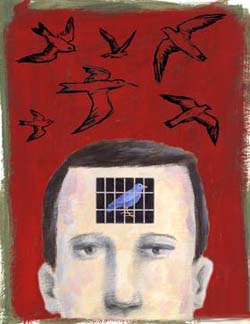 of the major issues in internal cultist relations. The reasons why a person submits to be subjected to mental, physical , psychological, and financial misuse to the extent that he/she gives up job, family, and the individual freedom are very important issues for those interested in investigating cultist mechanisms and levers. In simple words, those outside cults, out of curiosity, strive for public awareness and preventing people’s deviation as well as discovering how in an age of scientific development and communication there people who easily fall in the cults’ trap and are are hoodwinked by their tricks. In order to understand such an issue we must look at the social and psychological techniques used by cults and cultic groups. This process of planned, convert coordinated influence-popularly called brainwashing or mind control or, more technically, thought reform-is the means by which the cult leader subjugates the followers.