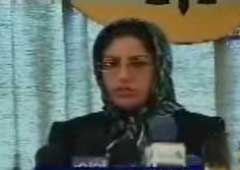
The terrorist Mujahedin Khalq Organization (MKO) has reportedly played a major role in intensifying the recent wave of street violence in Iran.
Iranian security officials reported Saturday that they have identified and arrested a large number of MKO members who were involved in recent riots in Iran’s capital.
According to the security officials, the arrested members had confessed that they were extensively trained in Iraq’s camp Ashraf to create post-election mayhem in the country.
They had also revealed that they have been given directions by the MKO command post in Britain.
Street protests broke out after defeated presidential candidate Mir-Hossein Mousavi rejected President Ahmadinejad’s decisive win in the June 12 election. His supporters have staged a series of illegal rallies ever since.
Iran’s deputy police commander, on Saturday, warned against the mass gatherings, asserting that those who engage in any such actions would be severely reprimanded.
Earlier on Saturday, MKO leader Maryam Rajavi had supported the recent wave of street violence in Iran during a Saturday address to supporters in Paris.
Rajavi had reportedly described the MKO terrorists as the real winners of the Iranian election.
The Mujahedin Khalq Organization is a Marxist guerilla group, which was founded in the 1960s.In the past two decades, MKO leaders have been resettled in the northern outskirts of Paris.
The terrorists are especially notorious for taking sides with former dictator Saddam Hussein during the war Iraq imposed on Iran (1980-1988).
The group masterminded a slew of terrorist operations in Iran and Iraq — one of which was the 1981 bombing of the offices of the Islamic Republic Party, in which more than 72 Iranian officials were killed.
A 2007 German intelligence report from the Federal Office for the Protection of the Constitution has identified the MKO as a "repressive, sect-like and Stalinist authoritarian organization which centers around the personality cult of [MKO leaders] Maryam and Masoud Rajavi".
Anne Singleton, an expert on the MKO and author of ‘Saddam’s Private Army’ explains that the West aims to keep the group afloat in order to use it in efforts to stage a regime change in Iran.
"With a new Administration in the White House a pre-emptive strike on Iran looks unlikely. Instead the MKO’s backers have put together a coalition of small irritant groups, the known minority and separatist groups, along with the MKO. These groups will be garrisoned around the border with Iran and their task is to launch terrorist attacks into Iran over the next few years to keep the fire hot," she explains.
"The role of the MKO is to train and manage these groups using the expertise they acquired from Saddam’s Republican Guard," Singleton added.
A May 2005 Human Rights Watch report also condemns the MKO for running prison camps in Iraq and committing human rights violations. According to report, the outlawed group puts defectors under torture and jail terms.
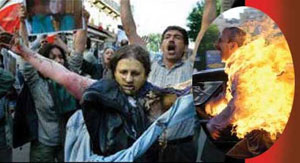 She was a member of the leadership council and the closest to the organization’s power hegemony and, consequently, she can be regarded the most reliable source of information compared to other separated rank and file. The best evidence is the statements and disclosures she has made, and is still making, on multitudes of issues concerning the organization.
 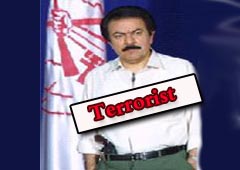 north-eastern province of Khorasan. He finished his primary school there and later he moved to Mashhad to continue his high school education. He was accepted as a law student at Tehran University where he was linked with the newly established organization founded by Hanif Nezhad, Badi’ Zadegan, Saeed Mohsen. In 1970, he was arrested along with a large number of his comrades in the group. Consequently, all MKO leaders were executed except Masud Rajavi who was released during the first days of the Islamic Revolution in 1979. Soon he declared his opposition to the Islamic Republic. I think he had some desires and he knew that he was not able to achieve them at that situation.
 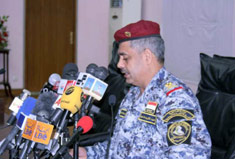 Governorate, has reported that the Iraqi Police’s Rapid Response Forces tightened their embargo on the camp’s occupants and banned the entry of goods and people to it.