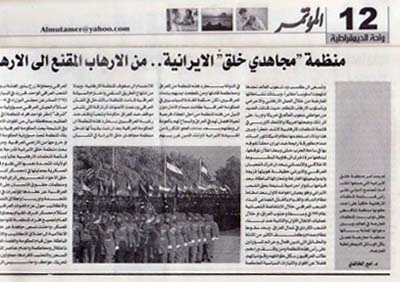
Pulling out the fangs of a viper is much safer than pressing the venom out of it every day. But even the vendors of the venom that keep and feed it to make fortune out of it are cautious enough to protect against its mortal bite by keeping it away in a safe box. A deadly viper pretending to be lying dormant, Mojahedin Khalq Organization (MKO) suddenly went rampant just when the Iranian people tried to recover from the wreaks of a revolution and had just engaged in fending off the invasion of a greedy neighbor. It emptied all its venom into the nation and inflicted irreparable damages to the same people who had feed it.
And just when it was being hunted for to pull out its fangs, it escaped away to be cared by the advocates of democracy who were, of course, concerned a lot about the rights of animals. Soon it was passed to anther monster that provided for its shelter and food to extract voluminous amounts of venom to be used against both Iranian and Iraqi people. Nobody doubts how dangerously the viper has been crawling about after its escape from Iran inflicting harm by ejecting out its venom while taking shelter in the arms of its protectors who know well that it can neither be tamed nor controlled as it is a matter of nature rather than training and instruction.
The list of terrorist organizations that for some time worked as a secure cage to repulse its possible offenses against themselves was suddenly opened to take it out. Does it mean that they intend to pull out its fangs or use it to bully Iranian regime to achieve their own interests? At least they have come to know that Iranian people are waiting with shovels at the door for the vipers unless they are fangless. It is a rule that old and harmless creatures are pitied everywhere in the world.
It is best recommended that they draw the fangs out of the adders to let them free; for sure it will make the world more secure. Some believe that the howl of a toothless wolf has the magic of lullaby causing a calm, deep sleep. It won’t take long to see how wise the viper-keepers have been!
by Mahin Tajimalek
The MEK’s terrorist activities
many years, the roughly 3,500 members of the Iranian dissident group Mujahedin-e Khalq (MEK) living quietly in Iraq drew little attention. But now the
relatively obscure group is at the center of an increasingly contentious argument among leaders in Baghdad, Tehran and Washington, where decisions the new White House makes about the rebels will probably set the tone for U.S. relations with Iran in the near term.
The simmering issue of the MEK’s fate flashed into the open earlier this month when Iraqi Prime Minister Nouri al-Maliki unexpectedly declared that the group would no longer be allowed to remain in Iraq. Shortly after that, Maliki’s national security adviser, Muwaffaq al-Rubaie, said the MEK’s camp roughly 40 miles north of Baghdad would be disbanded within two months, declaring during an appearance in Tehran that Iraq would not play host to threats toward its neighbor.
The issue grew more complicated on Jan. 26, when the European Union removed the MEK from its list of terrorist organizations, a roster that includes organizations such as Hamas, Palestinian Islamic Jihad and the Revolutionary Armed Forces of Colombia (FARC). The E.U. move, which came after a long lobbying campaign by the MEK’s supporters in Europe, sparked an outcry in Tehran. About 300 people were gathered around noon on Wednesday in front of the British Embassy in Tehran to protest the E.U. decision. Some in the crowd threw stones at the embassy, while others held up shoes on sticks in a show of deep disrespect in the Middle East.
"What people side with the enemy and kill their own people in a war?" said demonstrator Sina Zamanian, 17, referring to the MEK’s alliance with Saddam Hussein during the Iran-Iraq war, which led them to settle in Iraq. "They are the worst kind of opportunistic terrorists and should be forever marked as such."
Nevertheless, some in Baghdad are calling for the group to be allowed to remain in Iraq, or at least to not be turned over to Iran, for political reasons. "We have to deal with this issue very delicately," says Ayad Jamal al-Deen, an Iraqi parliamentarian aligned with Shi’ite cleric Muqtada al-Sadr. "I’m not here to defend this organization. I have no interest in them. But I am looking out for the Iraqi national interest." Al-Deen and other Iraqi political figures see the group essentially as a bargaining chip with Iran, one of the few Iraq holds against its powerful neighbor. They argue that simply shuttering the MEK camp as Iran demands squanders what precious little leverage Iraq has against Iran. Al-Deen adds, "In my opinion, Iraq has only this card, MEK, to pressure Iran."
At the moment, however, the MEK’s ability to remain in Iraq depends on the will of the Americans. The Bush White House continued to use the military to protect the MEK at Camp Ashraf despite its current status as a terrorist organization on the U.S. list and periodic complaints by the emerging Iraqi government and Tehran, which says the group is still involved in subversive activity inside Iran. Outwardly, U.S. officials have said disbanding the camp would be in contravention of international humanitarian law because the group’s members are likely to face persecution in Iran or Iraq. But many Iraqis and Iranians suspect that the U.S. keeps the camp open for intelligence purposes, since the MEK’s spy network played a key role in uncovering Iran’s secret uranium-enrichment program in 2002.
Maliki appears intent on pressing the issue anew with the Obama Administration, which will have to decide soon whether to keep offering U.S. protection to the group or to yield to Iraqi demands to close Camp Ashraf. If the White House allows the Iraqi government to close the camp, the Iranian leadership is likely to see the move as a sign that the new Administration is eager to ease tensions between Washington and Tehran. A continuation of the status quo, however, could chill Obama’s early outreach efforts.
At Camp Ashraf, MEK members simply wait for word on what may happen to them as discussions continue in Baghdad, Tehran and Washington. Shahriar Kia, a spokesman for the group, says a closure of the camp would be a disaster for those living in what amounts to a protective quarantine for roughly the past seven years. "Closing down Camp Ashraf and the displacement of its residents, who are protected by the Geneva Conventions, against their will is a war crime," says Kia. "This will cause a humanitarian catastrophe."
— With reporting by Tariq Anmar in Baghdad
By Mark Kukis / Baghdad
http://www.time.com/time/world/article/0,8599,1875917,00.html
A former member of the Mojahedin-e Khalq Organisation (MKO), who abandoned the outlawed group in protest at its terrorist operations, said the
European Union should take responsibility of supporting the MKO in its terrorist acts.
Masoud Khodabandeh said deproscribing the MKO by the EU is a politically-motivated move which leads to support for the terrorism spread by the MKO.
He told the Islamic republic news agency that Europeans should take the responsibility of future measures by MKO terrorists who are going to be allowed to enter Europian countries.
"You [the Europeans] cannot defend terrorists [by deproscribing the MKO] and at the same time claim you are countering terrorism," he said.
Khodabandeh, who is now the spokesman of a non-governmental organisation dedicated to help members abandoning the MKO, said European leaders have adopted a double-standard policy towards the issue of terrorism.
"The MKO case proves that the European Union behaves in a discriminatory manner," he said, adding that Europeans are well-aware that MKO members have conducted many terrorist operations in the past three decades.
He said the MKO bears "no significance" in international developments as "it has now expired".
Khodabandeh added that MKO members, if released from the Ashraf Camp in Iraq and admitted to European countries, would spread insecurity and terrorism across Europe.
He said the terrorist nature of the MKO has never changed as its members are wearing uniforms and taking military drills in the Ashraf Camp.
He added that Mojahedin-e Khalq Organisation has not only slaughtered many Iranians but also "has been directly engaged in killing Iraqi Shiites and Kurds and suppressing even its own members".
Out of around 3,000 MKO members, he suggested, some 2,000 are in critical health conditions "and are willing to leave the Ashraf Camp."
Khodabandeh said if Europeans do really want to extend their help to these people trapped by the MKO, they should welcome them to Europe–a move he said his organisation will favour.
EU turning blind eye on MKO terrorism, says Iranian Embassy
London – Iran’s Embassy in Norway announced on Thursday that the European
Union has turned a blind eye on terrorist activities of Mojahedin Khalq Organisation by deproscribing it from its terror list. In a statement, the embassy said the MKO has conducted many assassination and terror operations inside Iran and Iraq, claiming thousands of innocent lives.
“The EU’s move to take MKO out of its terror list is in contradiction with its decision several years ago to announce the grouplet a terrorist organisation,” the statement reads.
The embassy also said there is enough evidence that the MKO is a terrorist organisation and its leaders collaborated with Saddam Hussein in his war against Iran and suppression of his own nation.
“Based on verifiable documents and footages from Saddam’s intelligence unit, MKO leaders had met him and other Iraqi officials and briefed them on their involvement in the massacre of Iraqi people, especially the Kurds.”
The Iranian Embassy in Norway further expressed regret that the EU has isolated itself from the global community in its campaign against terrorism.
“The EU instead extended a hand for friendship and cooperation with MKO terrorists,” it said, adding that the EU’s move is in contradiction with the international laws and rights, as well as its commitments towards international anti-terrorism treaties.
zawya.com
G.P. Put on line 27/01/2009 – For Josy Dubié (Belgian MP), there is not a doubt that PMOI is "a sect". The Belgian senator draws from his memories
international reporter to the RTBF to affirm it. At the end of the Iraq-Iran war, they are the combatants of this organization which Saddam Hussein had sent like "flesh with canon" at the time of the battle of Mehran, in 1989. The treatment that Moujahidine held for their own troops, the women like the men, and that they applied to their Iranian prisoners were abominable, explains in substance Josy Dubié. "I know them from inside" , continues the senator, " and I can say to you that their behavior is to be brought closer to that of the members of Scientologie". Didn’t they evolve since the Eighties? Josy Dubié does not believe in it at all. "They are still as sectarian as before", he ensures. "However, there is in Iran an opposition much more democratic than that of Moujahidine of the people, the laic opponents, the members of the Communist party Toudeh, the sympathizers of the former Prime Minister Mossadegh ". And Josy estimates that one should not count on OMPI, which " do not represent anything the whole in Iran".
Lalibre.be
The family members of victims of MKO terrorist attacks have cautioned the EU against becoming the organization’s “partner in crime”.
“As victims of MKO terrorism, we advise the European Union
not to turn into the group’s collaborator in their atrocities against the Iranian nation,” reads a statement from the family members.
The victims had gathered in front of the British embassy in Tehran in protest at a recent decision to remove the group known as the ‘Rajavi cult’ from a list of banned terrorist groups in the EU.
“When Masoud Rajavi and his group launched their terrorist attacks in Iran in 1981, European counties not only did not condemn their atrocities but also gave them refuge in their countries,” adds the statement.
The Mujahedin Khalq Organization (MKO), which identifies itself as a Marxist-Islamist guerilla army, was founded in Iran in the 1960s but was exiled some twenty years later for carrying out numerous acts of terrorism inside the country.
The terrorist group is especially notorious for the help it extended to former dictator Saddam Hussein during the war Iraq imposed on Iran (1980-1988).
The group masterminded a slew of assassinations and bombings inside Iran, one of which was the 1981 bombing of the offices of the Islamic Republic Party, in which more than 72 Iranian officials were killed, including then Judiciary chief Ayatollah Mohammad Beheshti.
“The Rajavi cult has conducted its campaign of terror in Iran with the support of the European governments and from their safe havens inside the European capitals,” the families said.
In recent months, high-ranking MKO members have been lobbying governments around the world to acknowledge the dissidents as those of a legitimate opposition group.
During the revolution in Iran, the group criticized Ayatollah Ruhollah Khomeini for releasing the American diplomats, arguing that they should have been executed instead.
The United States and Canada have refused to drop the MKO from their lists of terrorist organizations.
The group has also been engaged in cult-like activities such as psychological coercion techniques and physical abuse.
The group has also resorted to ‘forced sterilization’ as a strategy to prevent members from leaving the group.
Iran has filed a complaint to the UN on the recent EU decision to remove the Mujahedin Khalq Organization from its list of terror groups. 
"The European Union must realize that a political approach to terrorism, which threatens the lives and security of people around the world, is totally unacceptable for the global public opinion," Iran’s permanent envoy to the United Nations, Mohammad Khazaei, wrote in a Wednesday letter to the UN Secretary General Ban Ki-moon.
"The EU’s politically motivated decision will not change the terrorist nature of the group. It will not ‘turn the page’ of history on the cult’s terrorist activities and massacre of innocent civilians, nor will it cleanse the terrorist group of its criminal past," he added.
Khazaei added that the removal of the group from the European list of terror organizations had caused great pain for over 14 thousand people who had lost their family members in MKO terror attacks.
The Iranian envoy called on the EU to revise its decision by sending a collection of evidence it has to European courts explaining the terrorist nature of the MKO, and resolving the technical objections that had led to the court ruling.
On Monday EU ministers removed the exiled anti-Iran group from their list of terror organizations, following a European court ruling in favor of the group, which has accepted responsibility for many deadly attacks against Iranian and Iraqi civilians and cooperated actively with the regime of former Iraqi dictator Saddam Hussein.
In one of their deadliest attacks, the MKO carried out a 1981 bombing that killed Iranian Judiciary chief Ayatollah Mohmmad Beheshti and 71 other senior officials.
Among their most recent terror activities is the 1999 assassination of the chief-of-staff of Iran’s Armed Forces, Ali Sayad Shirazi, just outside his house in the early hours of April 10th, as he was preparing to leave for work.
MKO is notorious for the cult like tactics it uses against its members, and the murder and torture of its defectors.
Numerous articles and letters posted on the internet by family members of MKO recruits confirm reports of the horrific abuse that the group inflicts on its own members and the luring recruitment methods it uses.
http://www.presstv.com/Detail.aspx?id=84026§ionid=351020101
A State Department Spokesman says the US administration will not change the terrorist status of the Mujahedin Khalq Organization (MKO).
“We’ve already done a review and it was determined that there would not be a revocation of that status for the Mujahedin-e Khalq, so nothing has changed from our standpoint,” Robert Wood said at a briefing on Monday, when asked if Washington would follow the action taken by the European Union.

The EU removed the MKO from its list of terrorist organizations on Monday. The move outraged the Iranian Foreign Ministry, which in a statement, called the decision incomprehensible.
Wood added that there had not been ‘any change at this point’ in the status of the MKO, suggesting that the new administration was unlikely to alter its stance on the outlawed group.
The US announced on Jan. 12 that labeling the MKO as a terrorist group was an appropriate act and that the group had to remain on the blacklist.
The MKO, blacklisted as a terrorist organization by many international entities and countries including the US, is responsible for numerous acts of violence against Iranian civilians and government officials.
The group also attempted an unsuccessful invasion of Iran in the last days of the Iraq-Iran war in 1988.The MKO was involved in the massacre of Iraqis under former Iraqi dictator Saddam Hussein.
PARIS ” The Canadian government rejected Monday a call to follow Europe’s lead and remove an Iranian resistance group from its list of banned international terrorist organizations.![]()
The European Union, saying it was forced to comply with a series of court decisions by the European Court of Justice, announced on Monday it would end the ban imposed on the People’s Mujahedeen Organization of Iran (PMOI).
But a spokeswoman for Public Safety Canada said there will be no change considered until the next two-year statutory review of banned groups such as PMOI, also known as Mujahedeen-e Khalq (MEK).
"The Government of Canada is determined to take decisive steps to ensure the safety of Canadians against terrorism," Jacinthe Perras said in an e-mailed statement.
"The MEK is a listed entity pursuant to the Criminal Code. It is a criminal offence to knowingly deal with the assets of a listed entity or knowingly participate in any activity that would enhance its ability to carry out a terrorist act. "
The latest December court ruling by the European court said the EU had breached the PMOI’s right to self-defence by failing to inform the group of new information used to keep blacklisting it.
"What we are doing today is abiding by the resolution of the European court," Javier Solana, foreign policy chief for the 27-nation EU, told reporters in Brussels.
The group was banned by the U.S. in 1997, by the EU in 2002, and by Canada in 2005.
Iranian state radio has condemned the EU’s move as "irresponsible," while the group’s affiliated political arm praised the decision that it said will free millions of dollars in assets frozen in western bank accounts.
"Removing the terror tag is a crushing defeat to Europe’s policy of appeasement" and a blow against the "mullahs’ medieval regime" in Iran, according to a statement from Maryam Rajavi, who is described as the "president-elect" of the Paris-based resistance movement.
Fears have been expressed that the delisting could impair international efforts, now being led by U.S. President Barack Obama, to convince Iran to suspend its nuclear program.
David Kilgour, a human rights advocate and former junior foreign affairs minister in Jean Chretien’s Liberal government, said Canada should follow Europe’s lead.
"Canada’s long-term political and economic relations (with Iran) are best-served by standing with its people, not the regime," Kilgour said in a statement.
"The time for appeasing the ayatollahs and suppressing the Iranian opposition must end."
The Canadian government included the PMOI when it extended late last year the list of banned groups that have "knowingly carried out, attempted to carry out, participated in or facilitated a terrorist activity or is knowingly acting on behalf of, at the direction of or in association with such an entity."
Among those on the list are al-Qaida, Hamas, Hezbollah, Peru’s Shining Path, the Sikh terror organizations Babbar Khalsa and the International Sikh Youth Federation, and the Tamil Tigers of Sri Lanka.
The PMOI was formed as a leftist organization in the 1960s opposed to the U.S.-backed regime of Shah Mohammed Reza Pahlavi. It was allied with the Islamist forces of Ayatollah Ruhollah Khomeini in the Shah’s 1979 overthrow, and engaged in assassinations of American targets before the revolution.
It also took part in the hostage-taking incident at the U.S. embassy shortly after the Shah fled the country that year.
But the group broke with Khomeini and then allied with the late Iraqi dictator Saddam Hussein during the Iran-Iraq War of 1980-88. They established bases in Iraq and took part in a number of bombings and assassination attempts against Iranian government targets as late as 2001, according to a 2008 analysis by the Council on Foreign Relations, a Washington-based think-tank.
"While the group says it does not intentionally target civilians, it has often risked civilian casualties. It routinely aims its attacks at government buildings in crowded cities," the analysis noted.
However, the group’s terrorist activities declined after 2001, and its fighters were disarmed by U.S. forces after the American invasion of Iraq in 2003. There are currently about 3,500 members at a camp there, including 60 Iranians with Canadian citizenship, according to Winnipeg human rights lawyer David Matas, who was in Brussels with Kilgour Monday.
The U.S. State Department regularly refers to PMOI as a "cultlike terrorist group" because of the control wielded by the two leaders, Massoud Rajavi and his wife Maryam, who have followers worldwide.
"In addition to its Paris-based members (PMOI) has a network of sympathizers in Europe, the United States, and Canada," according to the Council on Foreign Relations analysis.
The PMOI has won considerable political support in western countries, from politicians and activists like Kilgour, as it calls for a fully democratic Iran that endorses the free enterprise system with full rights for women and ethnic and religious minorities.
By Peter O’Neil, Europe Correspondent, Canwest News
TEHRAN – Germany’s Federal Intelligence Agency (BND) has released a report on the National Council of Resistance of Iran (NCRI), calling it a “fake parliament”. 
The NCRI is a part of the terrorist Mojehedin Khalq Organization (MKO) and is headed by Maryam Rajavi.
The BND also stated that the military wing of the MKO is “an army of insurgents”.
Not only are the MKO leadership’s claims to adherence to democratic values disingenuous, but they also follow the tenets of Stalinism and use brainwashing techniques, the report noted.
The report also stated that the MKO finances itself through activities such as economic fraud, the production of false documents, and using children to get donations from charity organizations.
The European Union removed the MKO from its blacklist of terrorist groups on Monday
http://www.tehrantimes.com/index_View.asp?code=188028