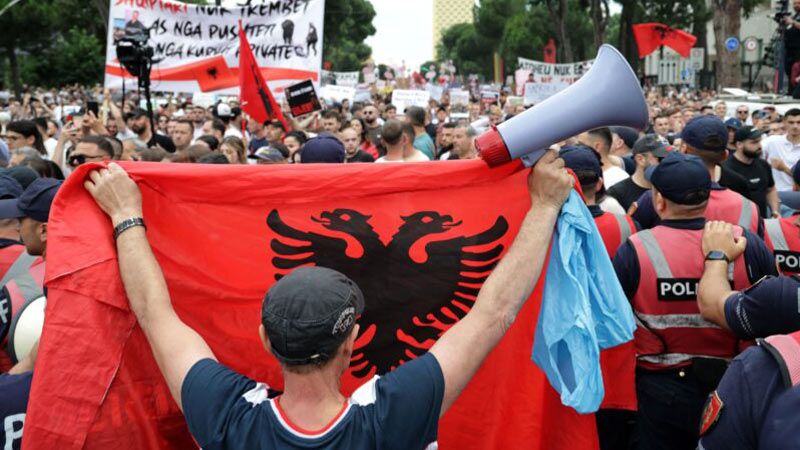
Thousands of Albanian citizens took to the streets of Tirana to pretest the construction of a luxury seaside resort linked to US President Donald Trump’s son-in-law Jared Kushner amid mounting calls for the project to be blocked.
The protests are primarily about environmental concerns, land ownership, transparency, accountability and alleged preference toward foreign investors connected to Trump family. Many protesters are using slogans such as “Albania is not for sale” and are criticizing what they see it as an opaque government decision-making.
However, Albanian prime minister Edi Rama on Friday accused the Iranian government of stirring the ongoing rallies in Tirana. He claims that Iran is behind protests against Kushner resort using disinformation.
Albania’s close alignment with US policy preferences, particularly regarding the hosting of the Mujahedin-e Khalq (MEK), contributed to a significant recalibration of Tehran’s stance toward Tirana. This process accelerated the diplomatic breakdown and culminated in cyberattacks attributed to Iran against Albanian state institutions, in past years.
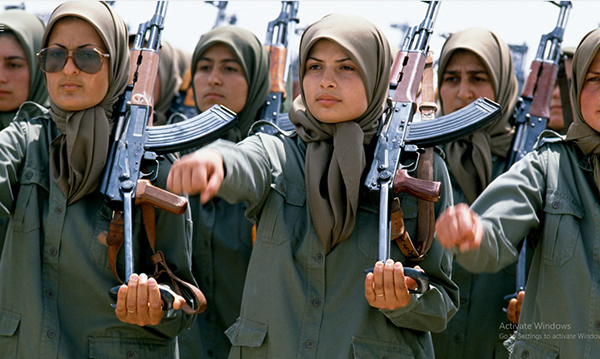
Iran was aware of the Western Balkans’ strategic sensitivity and the dominant influence of Western institutions in the region but its limited engagement in bilateral cultural ties became increasingly strained following Albania’s decision to host the MEK, a formerly designated terrorist group with a long record of acts of violence against Iranian civilians as well as officials.
The relocation of MEK members to Albania, strongly supported by the USA on the alleged humanitarian and security grounds, marked a critical turning point in bilateral relations. For Tehran government, the presence of an organized opposition group operating from Albanian territory was perceived as a direct challenge to its political and security interests.
Nevertheless, while Edi Rama is trying to project his political and economical issues onto Iran, the protests in Albania are primarily domestic in nature, according to the mainstream media such as Reuters, The Guardian and AP. The protesters’ call is centered on environmental concerns, allegations of corruption and broader dissatisfaction with the government. Protesters have even called for Rama’s resignation.
Rama’s accusations on Iran seems to be a political attempt to reframe a domestic controversy in national-security terms. The MEK’s presence in Albania itself can become a major protest demand. A protest movement focused on transparency and accountability could easily expand into other demands. This would fit naturally into a broader movement criticizing opaque decision making and insufficient public consultation.
If public attention shifts towards government transparency, the political outcome can be that more Albanians begin asking why such an important foreign policy and security decision –sheltering thousands of members of a cult-like extremist group– has received limited public scrutiny or parliamentary debate. The MEK may become one of several examples cited by activists who seek greater disclosure and public oversight of major government decisions. Thus, wider concerns will be raised by civil society and governance observers about transparency, consultation and accountability in Albania.
Mazda Parsi